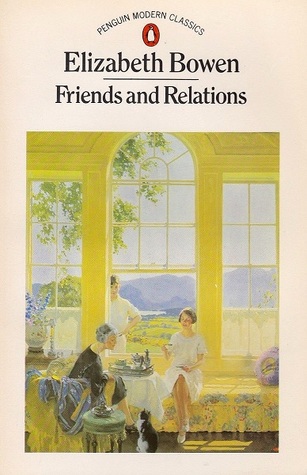
Friends and Relations – Elizabeth Bowen (1931, 159 pages)
Following on from yesterday, another Irish novella today, this time by Elizabeth Bowen, whose longer novels I’ve greatly enjoyed and two of which I wrote on for Reading Ireland 2017.
Friends and Relations opens with the wedding of Laurel Studdart to Edward Tilney. Laurel is beautiful and not particularly nervous about the wedding: she spends the morning playing cards with her father. This sets a major theme for the novel, around lack of passion in marriage and how much importance should be attached to it.
The reception is at the family home in the Malvern hills, Corunna Lodge. The only discordant note in this upper middle-class idyll is the groom’s slightly scandalous mother:
“Edward remained throughout wonderfully self-possessed; perhaps because of this he did not make an entirely good impression. Lady Elfrida, in claret-coloured georgette, also over-acted a little. Besides being a divorcee, which should but does not subdue, she was the bridegroom’s mother – and one apt to play always a little too gracefully a losing game.”
Laurel’s sister Janet sits on various committees and has roped her Wolf Cubs into helping out at the wedding. She is pragmatic and sensible, yet it is her choice of beau in Rodney Meggatt just a few months later which introduces conflict into the family. Rodney’s uncle Considine was named as co-respondent in Lady Elfrida’s divorce proceedings. Lady Elfrida fails to see what all the fuss is about:
“She did not consider the situation awkward at all. Not nowadays when everybody was different, everyone else dead.”
Lady Elfrida is a wonderfully self-centred creation. She doesn’t seek to hurt others, but barely acknowledges how her actions impact on people, such as Edward’s enduring sense of shame, or when she broke Considine’s heart.
“She had perhaps injured him, perhaps even vitally…Under her dry-eyed farewell look, her last tragic un-regret, in Paris, he had certainly desiccated.”
Similarly self-focussed is Theodora Thirdman, schoolgirl and guest at the wedding, given to prank phone calls and later a flatmate of Edward’s best man’s sister, determined to demand the love she craves.
“she had passions for women – awkward, such a tax on behaviour, like nausea at meals.”
As the years pass, Edward doesn’t want any connection between his children and Considine, but events conspire against him when his children visit their aunt and uncle, who are now living in Considine’s manor house, Batts:
“At one time his children were not to be at Batts with Considine…on any account. But since a first epidemic had swept the Tilney family, this had relaxed. He wished his children would not call Considine ‘Uncle’ and that Hermione Meggatt need not appropriate Lady Elfrida as ‘Grandmother’. Between these whirlpools of sensibility, these reefs of umbrage, the two families had, however, steered for ten years an uneventful course.”
This is a densely written novel with a focus on character rather than plot. Things do happen, particularly in one eventful week following a typically unsubtle manoeuvre by Theodora, but it is primarily people and their relationships that change and develop.
Bowen often leaves it for the reader to fill in the gaps – more than once I had to go back and check I hadn’t missed something. But no, it’s just that she doesn’t lay everything out explicitly, including her characters’ thoughts and motivations. This could be frustrating, but I thought it worked well in capturing the sense of a well-to-do family at a historical time when things are left unsaid and everything simmers below the surface.
“You must see what families are; it’s possible to be so ordinary; it’s possible not to say such a lot.”
There are comedic moments, particularly with Theodora, and in some ways it could be read as a comedy of manners, but Friends and Relations is more subtle than that, and contains a great deal of pain and sadness too. Not my favourite of the Bowens I’ve read, but definitely worth a look for her highly skilled writing and astute insights into human beings.
 madame bibi lophile recommends
I struggled to finish this. Yes, there’s some polished prose, but I found it cold and mannered. Shame, because I’d really enjoyed other novels by EB
LikeLiked by 1 person
I know what you mean, I didn’t find it cold but I did find it harder work than the others of hers I’ve read. She’s still a writer I’d like to explore further though.
LikeLike
I haven’t always enjoyed Bowen’s longer novels so perhaps I should try this and see if I have better luck. I always feel that I am at fault in not being able to appreciate her.
LikeLiked by 1 person
I’ve found her longer novels easier than this, but you never know! You’re not at fault – some writers just don’t work for us. I can never get anywhere with Henry James, even though I’d really like to…
LikeLike
Hmm… I’m all for things left unsaid and character-driven novels but I think I might struggle with this one, particularly after Tredynas Days’ comment which confirms my impression from your excellent review.
LikeLiked by 1 person
It’s quite dense, so even though its a short novel its a demanding read. I’ve definitely found her longer novels easier!
LikeLiked by 1 person
I do have this one waiting, but it might not leap to the top of the pile, based on your review and the comments. I do go back and forth with Bowen, so need to choose wisely!
LikeLiked by 1 person
For me this didn’t work as well as some of her others, but I would’t want to put you off. But so many books, so little time – we do need to choose wisely!
LikeLike
I do love Bowen, though I agree with what you say about the density of her prose. This one is still on the TBR, but I think I’ll probably read her more famous works first!
LikeLiked by 1 person
If you love Bowen I’m sure you’ll find much to enjoy here Kaggsy, but yes, her more famous works may be worth prioritising first! I’d love to hear how you find it when you get to it 🙂
LikeLiked by 1 person
Another new one for me! How do you go about organising yourself for this challenge? Did you already have the books or at least know what you wanted to read, because it’s such an accomplishment! Not just the reading but the posting too – do you put the book down and just start writing? I hope you don’t mind me asking!
LikeLiked by 1 person
Of course not Jane! I try and have posts done a few in advance, because I work full time and I couldn’t write a post after a full days work. So I start a few ahead, and then try and write more each weekend to keep up. I have an idea of some I want to read and then others are recommended or I choose as the month progresses.
Having said that, I can already tell this month will be a mad rush at the end, so if the posts diminish to about 4 lines each and are posted a few minutes off midnight, you’ll know why 😀
LikeLiked by 1 person
I’ll watch out for the end of the month!
LikeLiked by 1 person
Ah, excellent! This one doesn’t appeal to me in the slightest! Keep up the good work… 😀
LikeLiked by 1 person
I’ll get you yet FF, you wait 😀
LikeLiked by 1 person
This was the Bowen I read most recently, I enjoyed it a lot but I must admit to not remembering it as well as some of her other novels.
LikeLiked by 1 person
Yes, the other novels I’ve read by her are a bit more plot driven so easier to remember I think. Mind you, I have a terrible memory for plots so I’m always a bit vague about books I’ve read a few months down the line 😀
LikeLike
It’s interesting to see that you enjoyed this a little less than some of Bowen’s longer novels. She does make the reader do some of the heavy lifting in her narratives, so I wonder whether the gaps she leaves in this shorter novella make it all the challenging to interpret?
LikeLiked by 1 person
That might be it Jacqui, in such a tight space the gaps have a huge impact. I didn’t mind the gaps but maybe this contributed to the feeling of it being hard work to read overall.
LikeLike