Novella a Day in May 2026 – No.30

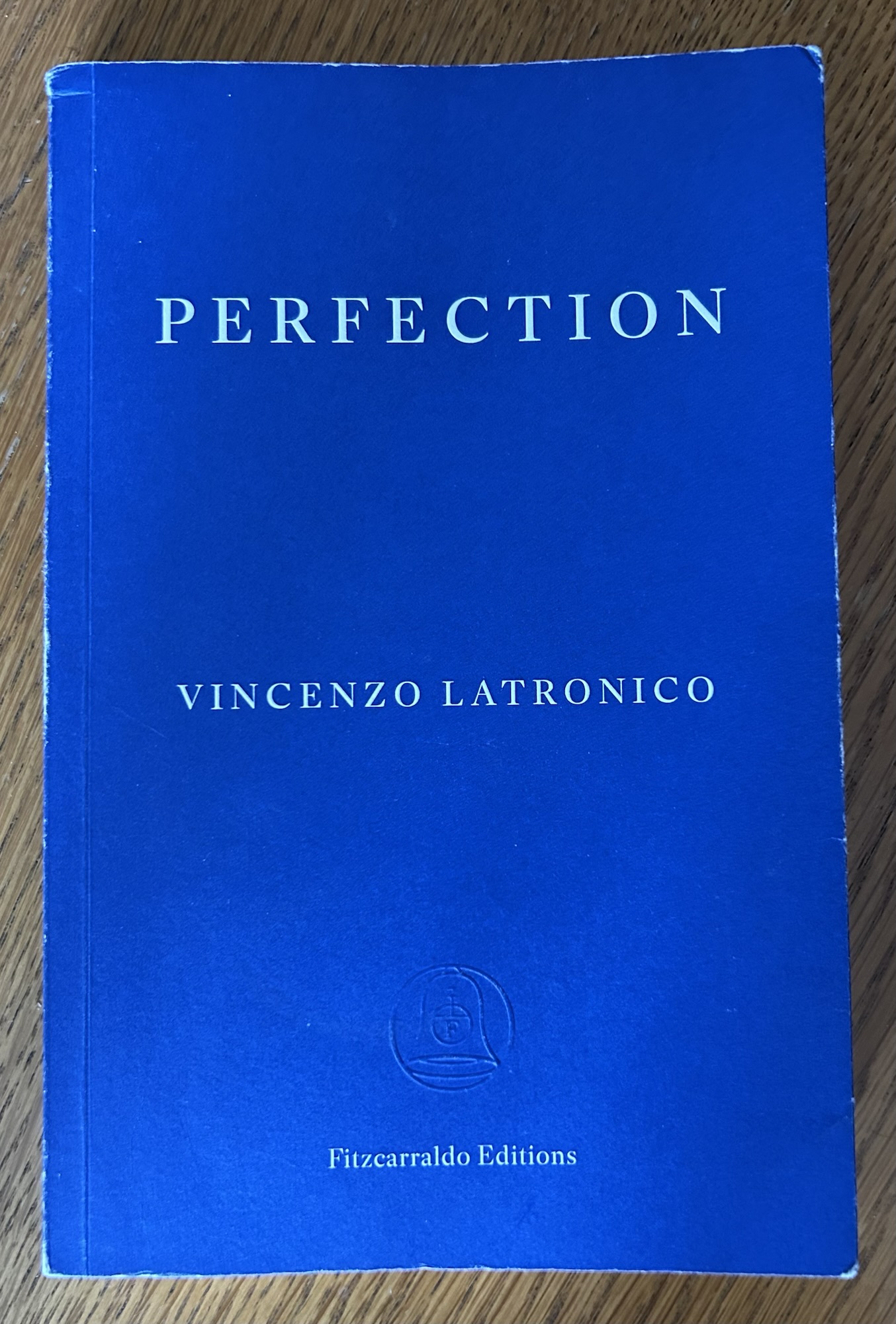
I enjoy satire but I think it can be hard to sustain, becoming bitter and distancing. Perfection by Vincenzo Latronico (2022, transl. Sophie Hughes 2025) judged this just right – at only 115 pages it is quick and incisive.

Anna and Tom have emigrated from an unnamed southern European country to Berlin, drawn by its cool reputation and cheap housing (at that time). The novella opens with an interiors magazine style description of their home, all verdant plants, string lights, mason jars, marble pastry table, and on and on and on… an overwhelming piling up of what they own and how they’ve styled it.

The next chapter gives the reality of living in that space: the clutter, the cleaning, the dust, the constantly accumulating mugs and tissues:

“It wasn’t order they so desperately craved, but something deeper and more essential. […]

In itself, chaos could be joyful, creative; But in that context, it only seemed to signal impermanence.”

Therein lies the problem. Anna and Tom are millennials who have grown up with the internet from its early iterations, they are constantly online looking at images, and feel very insecure when they can’t curate their reality like an Instagram post.

“Anna and Tom spent much of their first year in Berlin carefully constructing this mythology. And it wasn’t personal to them; its value lay precisely in its universality…. it was the topic of countless lifestyle articles and documentaries, and circulated on the Facebook timelines and Instagram feeds of an entire generation.”

They remain entirely ignorant of Berlin beyond cool places to socialise, and Germany itself. Their work is carried out online, their friends are just like them. They don’t learn German, they use Google translate.

“It never occurred to them, for example, that the distinction between Alt- and Neu- buildings in property listings had been drawn by the Allied bombings.”

Telling the story in the third person is entirely right: Anna and Tom have no innate sense of self, no inner life. They don’t know who they are if they are not viewed externally. While Latronico relates this very much to a specific online generation:

“They lived a double life. There was the tangible reality around them, and there were the images, also all around them.”

I also felt it was long-established folly to believe that what you own is who you are. Apparently Perfection was inspired by Things: A Story of the Sixties by Georges Perec, which shows how this conflict between image and reality, consumerism in a search for meaning did not arrive with the internet!

Advertising, which is both implicit and explicit in Anna and Tom’s world, is constantly promoting the idea that worth as a human is determined by money spent. You are your sofa/kitchen/car… But then, advertising also encourages consumers to constantly find themselves wanting, because there is always more money to be made by selling more stuff:

“The collective upheaval of the 20th century was over and the vestiges had been translated into the language of individualism—that is, of consumerism. Freedom had turned into abundance.”

Of course Tom and Anna aren’t happy. Their reality will always be messy at the edges, unlike a cropped image. They are also entirely incapable of working out why they aren’t happy. Content, well-adjusted people won’t spend as much money chasing illusion, so these answers won’t be sold online.

In an attempt to find meaning, they are clicktivists. I felt this was where Latronico was most scathing, whereby they and everyone in their bubble tells themselves they are socially engaged and responsible, just so long as it doesn’t mean any real action needs to be taken in their own lives, which could inconvenience them in any way:

“They identified as feminists and spoke out against social injustices, which in practise meant they were willing to express outrage at instances of racism or sexism that took place in New York. […] in practise, their social commitment amounted to using Uber only if it was snowing and always leaving tips in cash. They didn’t eat tuna.”

But for the most part I didn’t think Latronico despised Anna and Tom, I thought he felt for them as they struggled against what is essentially existential despair, without any tools to manage this. They were baffled that where they lived, what they owned, where they ate, and the holidays they took weren’t working. How could this be, when all those things looked great in online posts?

Perfection is short and snappy. It manages to be pinpoint specific and universal. Another fascinating read from Fitzcarraldo Editions!

Novella a Day in May 2026 – No.28

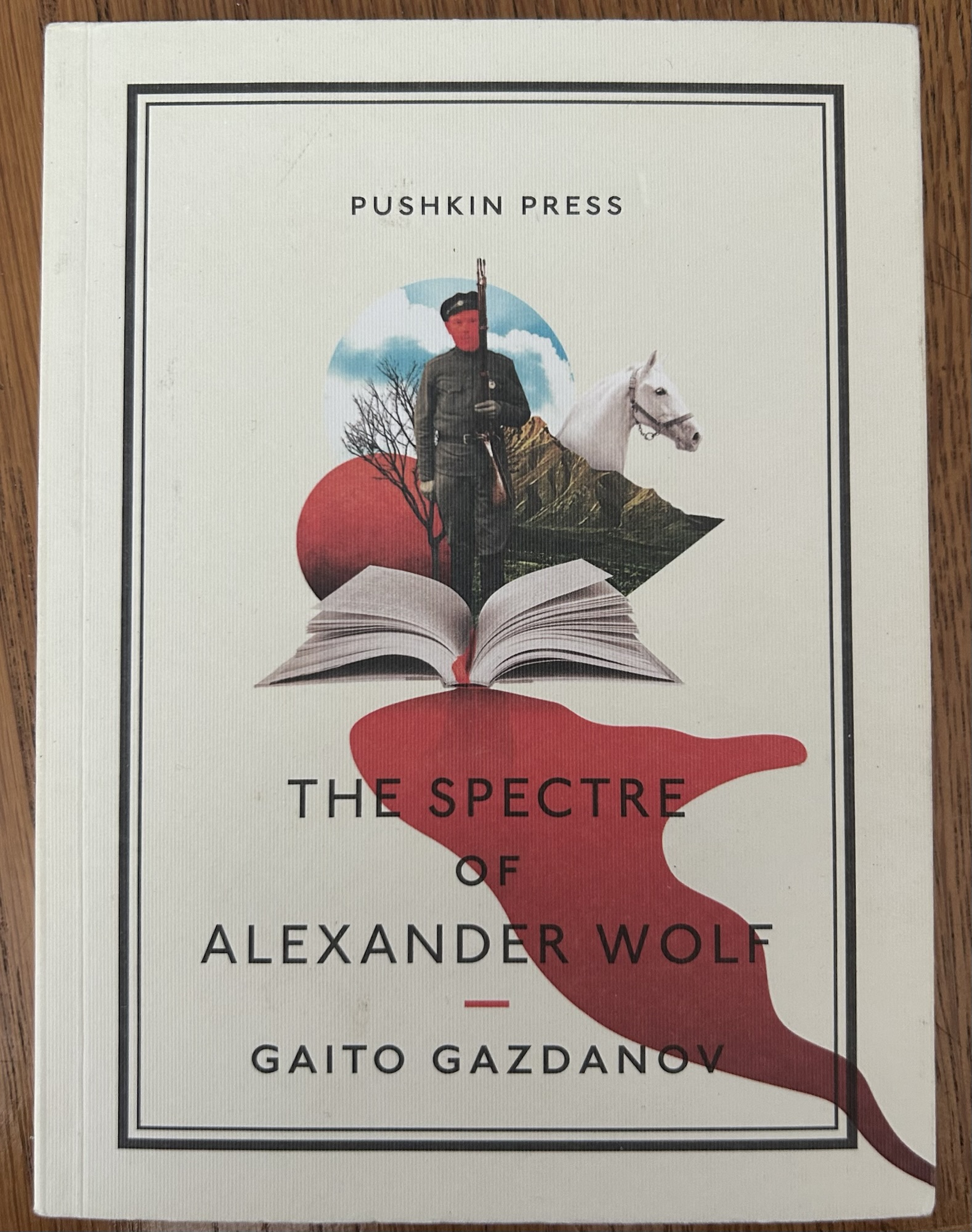
I really enjoyed Gaito Gazdanov’s The Buddha’s Return when I read it a few years ago, so I’m pleased to return to him with The Spectre of Alexander Wolf (1947-8, transl. Bryan Karetnyk 2013) published by Pushkin Press in one of their lovely smaller editions with French flaps.

It opens beguilingly:

“Of all my memories, of all my life’s in innumerable sensations, the most onerous was that of the single murder I had committed.”

This isn’t quite as it initially appears – the killing took place during the Russian Civil War. A man shoots the horse the narrator was riding, and in self-defence he shoots back. He then steals the other soldier’s white horse, later selling it and fleeing to Paris.

He is living in Paris and working as a journalist when he comes across a book of collected stories called I’ll Come Tomorrow by Alexander Wolf. Reading it, he is shaken by one of the stories, The Adventure of the Steppe in which the events above are described almost exactly.

As the book is written in English, when he is in London he visits Wolf’s publisher, who assures him:

“Mr Wolf is an Englishman; I’ve known him for many years and can vouch for that. What’s more, he’s never left England for more than two or three weeks at a time, which he spends mostly in France or Italy. He hasn’t travelled farther; I can say this with certainty.”

However, he is shaken on his return to France when he meets Voznesensky, a drunken acquaintance who has a copy of the book and claims to know the author. Voznesensky is incredulous at the thought of “Sasha Wolf, an Englishman!”

So who is Alexander Wolf? Was he the dead soldier? An Englishman who holidays in Italy? A Russian who lives in Paris?

Having set itself up as a possibly metaphysical detective story, the novel then takes a swerve into almost a completely different genre, detailing the narrator’s love affair with Yelena Nikolayevna.  She’s an enigmatic woman with a mysterious past (!) but gradually an intimacy begins to build, despite an “unnatural divide between the inner life and physical life that was so characteristic of her”.

The sudden shift is somewhat disconcerting but Spectre… remains very readable. Essentially the story is less about plot and more a consideration of where we look for meaning. The narrator channels his energy first into Wolf and then into Yelena, but ultimately he has to create his own meanings with his mortality a constant consideration:  

“I thought about how Wolf had become – and not so much Wolf personally as the very thought of him—the involuntary personification of everything dead and sad that existed in my life.”

By the ending, not everything is fully explained, although reader can piece events together. I think by leaving the plot unresolved, Gazdanov keeps Spectre…  as a philosophical consideration foremost, encouraging the reader to make their own meanings as the narrator needs to do.

I also think there is humour in it, I don’t think we’re supposed to take the narrator as seriously as he takes himself:

“Everything that my existence had comprised until now—regrets, dissatisfaction and a sense of the manifest futility of everything I did – began to seem very distant and alien to me, as though I was thinking of something that had taken place long ago.”

I realise I’ve been a bit vague, but Spectre… is an enigmatic and slippery book to both read and describe! It is an eloquent contemplation of its themes, so if you fancy those wrapped up in a few somewhat unresolved narratives then give it a try – I certainly enjoyed it a great deal.

Novella a Day in May 2026 – No. 25

Daniela Krien is an author I’ve been meaning to try for a while, and today was the day! The Fire (2021, transl. Jamie Bulloch 2023) follows long-term married couple Rahel and Peter over a few weeks as they try to find their way back to one another, or at least identify if that remains something they want at all.

They have planned a break from their Dresden home, to a cabin in Upper Bavaria. Right before they are due to leave, it burns down.

“Had this happened ten years ago the two of them would have shaken their heads. ‘Who knows, there might be a silver lining…’ Peter would have probably said, giving her a comforting hug. But he’s not so laid back anymore. His subtle sense of humour often veers towards the cynical nowadays, and their lively discussions have given way to a polite amicability. But, worst of all, he’s stopped sleeping with her.”

A recent professional crisis for literature professor Peter has left him and Rahel increasingly distant. Told from Rahel’s point of view, she is desperate to recover their intimacy, but is at a loss as to how to achieve this, despite being a psychologist and used to discussing other people’s relationships.

“In literature he loves impatient, tempestuous souls. Only in books does he get close to them without feeling threatened.”

They end up staying at the remote home of a friend of Rahel’s late mother. Ruth’s husband Viktor has had a stroke so she needs Rahel to watch the house and garden, and care for her considerable menagerie of animals, while she is at the rehab centre. Ruth and Viktor’s home was a constant in Rahel’s tumultuous childhood, and the backdrop to some of the unanswered questions she has from that time.

Over their days there, Rahel will reflect on her past, both her childhood and the thirty years she has shared with Peter. Their somewhat chaotic daughter Selma will arrive with their young grandchildren, they will swim in the lake, care for the animals, eat food and drink wine, and things will change almost imperceptibly but irrevocably.

“It occurs to Rahel that, particularly in a marriage, the sum of what isn’t said for outweighs the sum of what is.”

The Fire builds careful character studies of Rahel and Peter: who they are professionally; as spouses; and as parents as well as individuals. In middle-age they are trying to navigate their place in a changing world. Both are increasingly frustrated at work in different ways. Krien considers generational differences, compounded by Rahel and Peter growing up in the GDR which Selma is scathing about, resentful of her parents’ anti-capitalist leanings which means limited inheritance for her.

The characterisation is subtle. I’m not sure I particularly liked Rahel or Peter, but I didn’t particularly dislike them either. They were believable, flawed people, somewhat unhappy, trying to work out what would make life better for them. This would make a good read for a book club, with plenty to discuss in terms of character and relationship dynamics.

Krien’s writing is pared-back and understated. She trusts the insight of her readers, very much showing and not telling. The ending isn’t tied up neatly, the writing is too sophisticated for anything trite. But it is a satisfyingly realised story, leaving me keen to explore this writer further.

“Nobody else she knows has this connection with literature. Peter doesn’t just read books, he works with them, relates what he’s read to himself, his views, his behaviour and changes them if necessary. For him, literature is like a living counterpart. Sometimes even more alive than what plays out before his eyes. And unlike people, he finds it indispensable.”

Novella a Day in May 2026 – No.24

It’s been years since I read Yuri Herrera’s Signs Preceding the End of the World but I remember being impressed by it. Published in translation by the always interesting AndOtherStories, his debut novel Kingdom Cons (2008, transl. Lisa Dillman 2017) is a fable of just over 100 pages.

It is told from the point of view of Lobo, whose parents left him an accordion when they went to ‘the other side’ which I took to mean the USA. He makes his living singing on the streets and in cantinas, until one day he sees The King.

He decides he wants to be part of the Court, and so he goes to the King’s palace:

“The royalty of a king determined these things: the man had settled among simple folk and turned the filth to splendour. Approached from afar, the palace exploded from the edge of the desert in a vast pageantry of gardens, gates and walls. A gleaming city on the fringes of a city in squalor, a city that seemed to reproduce its misfortune on street after street.”

The King takes a shine to him, and so Lobo becomes The Artist, part of the coterie. Frequently referred to as a ‘fool’ or ‘clown’, he is the court jester, a musician placing The King in folk ballads.

“The Artist bowed again and followed the man, fit to burst into tears and blinded by bright lights and his future.”

Also in court are The Heir, The Manager, The Journalist, The Doctor, The Witch and other courtiers. The Artist falls for the daughter of The Witch, but there is much he doesn’t know about her, and how things run at Court, although he starts to piece them together.

Of course, this isn’t a medieval centre of rule, but a modern day drug cartel. We see the politics between cartels, the violence and power struggles at a step removed, but they are there. (The only violence I found difficult was the killing of a bird, which isn’t directly depicted.)

I didn’t find the fairytale/fable framing to be obfuscating or sanitising what was taking place. Instead. I thought it was a clever move by Herrera to show how embedded cartels are in society, how they draw on long-established societal structures, and how there is wider complicity. It is an inventive way of approaching a story so frequently told.

Kingdom Cons is a quick read, almost a short story. The characters are deliberately lightly sketched, presenting as long-established archetypes to emphasise how the running of the cartel is nothing new. It is powerful in its demonstration of how mythology endures, questions who should be mythologised, and the use that is made of myths.

“It’s as if there is no right to beauty, he thought, and he thought that the city ought to be set alight from its foundations, because in each and every place where life sprouted up through the cracks, it was immediately abused.”

Novella(s) a Day in May 2026  – No. 22 & 23

Well, I knew it would happen eventually and possibly not for the last time this month – work demands and home renovation chaos meant I didn’t post my NADIM yesterday. I did manage to read a novella and finished it around 10pm but I was soooooo tired and also achy from hoicking furniture around in a manner that would have health and safety professionals fainting clean away, that I decided my bed was calling.

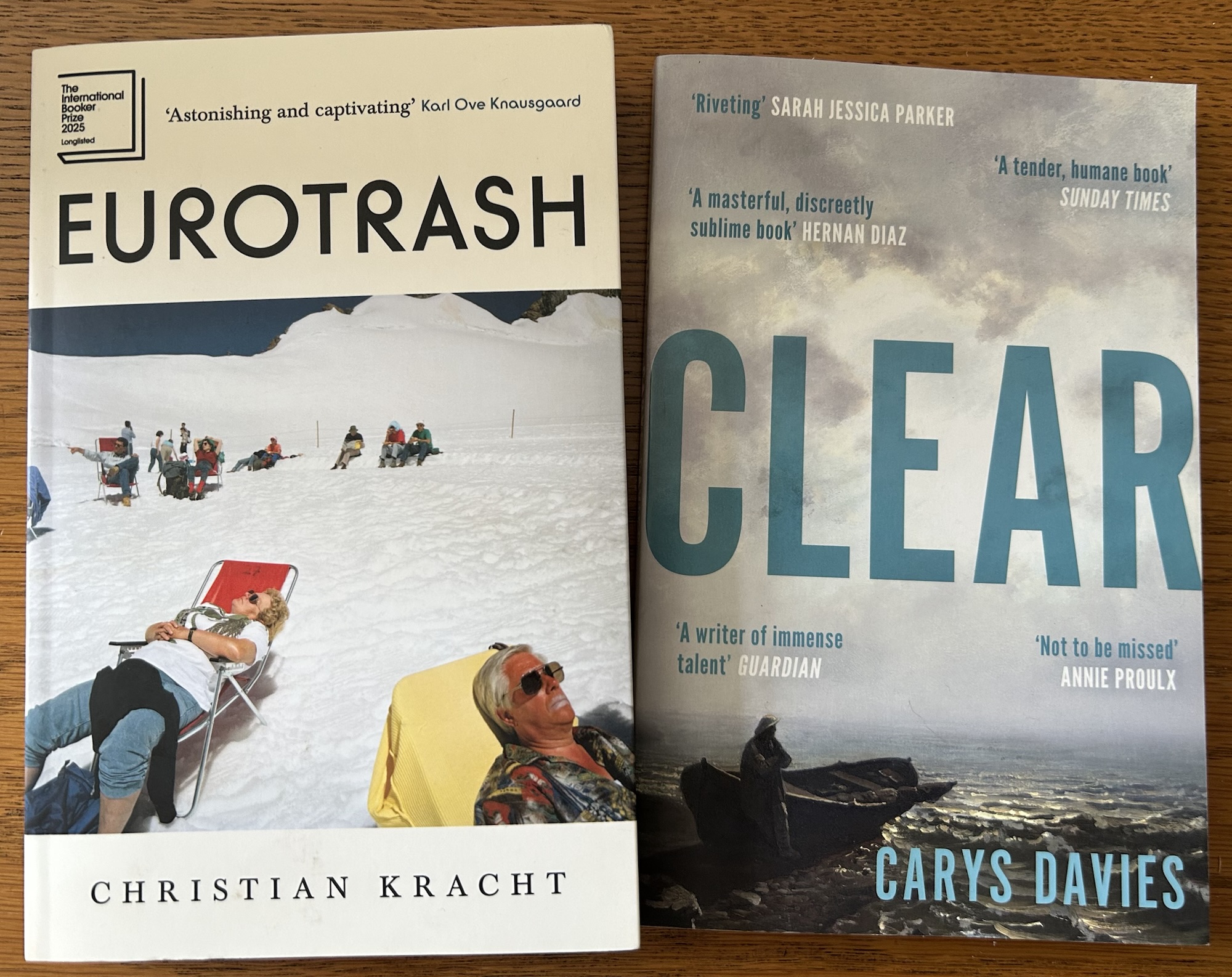
The novella was Eurotrash by Christian Kracht (2021, transl. Daniel Bowles 2024). This is the first by Kracht I’ve read but apparently it forms a sort-of sequel to his 1995 novel Faserland, presenting as auto-fiction about a writer called Christian who wrote that novel (and in a running joke, is consistently mistaken for Daniel Kehlmann.)

The novella follows Christian and his mother, whom he finds “thoroughly objectionable”, taking a road trip across Switzerland. She has recently been discharged from residential mental health care, and has asked him to visit her in her apartment where she self-medicates on a heady mix of cheap wine, vodka and phenobarbital.

“Perhaps today, rather than just pretending, I would succeed in accepting her as she was, and then, for once, not vanished down the bottomless rabbit hole of memory, but be amenable to the moment, to her delusions, to which I could simply open myself. What on earth did she want?”

Christian is deeply angry about his family history, which includes his grandfather being Nazi and a father who worked for a right-wing media mogul. He’s also furious about Zurich, about trappings of wealth, about seemingly everything. Wherever he turns he finds things morally abhorrent, and he doesn’t seem mistaken in this.

“It had been put into my mind that the circumstances of my childhood and youth were in some way special or extraordinary, where in reality they were steeped not only in bourgeois mediocrity—for that I’d have been able to accept—but also in profound menace.”

His mother adds to this when she decides to cash in her stocks and shares for a trip to Africa, and it seems she is quite wealthy from investing the arms trade. She and Christian travel around Switzerland with 600k in a shopping bag, driven by an accommodating taxi driver, encountering various immoral people from where they have to make their escapes. They also keep trying and failing to give the money away.

As the novella continues, it becomes more metafictional, with Christian describing a scene he wasn’t privy to:

“It was as if I had floated out of my brain and taken a walk, as ether, had flowed out of the plot I had been part of, even, and as if it had thereby become possible for me to be omnipresent, which, in the end, I was anyway, in my story.”

And then his mother summarising Eurotrash thusly:

“Your mother. Takes her along to some saccharine melodrama, tragedy, comedy, whatever, starring yours truly. Promises her who knows what, seeing that she’s got to drink herself to oblivion constantly and choke down pills for her unendurable pain. And then he blames everything on Switzerland, the Nazis, and the Second World War.”

I probably wasn’t in quite the right mood for Eurotrash, being really very tired, and I remained ambivalent about it for most of the book. A lot of the blurbs pitch it as a dark comedy, but aside from a few moments I didn’t find it particularly funny, due to how bitterly cynical and disillusioned Christian is.

However, I kept reading because Kracht’s style is so readable, and ultimately at the end it genuinely surprised me by being quite tender and moving, despite my reservations (personal, not literary) about the set-up for the final scene. So all in all I’m glad I persevered!

And then today I read Clear by Carys Davies (2024). I think I was the only person in the bookish blogosphere who didn’t get on with Davies’ debut novel West, but on the strength of this I might give it another try because I absolutely loved Clear.

Set in 1843, it takes the clearances as its starting point. Landowner Lowrie is going to evict Ivar from the island somewhere between Scotland and Norway where he is the sole remaining inhabitant, and where he has lived his whole life.

“Walking along the bank between the two low waters and the lightly moving wind, he thought about that, the pleasure of it—sitting with Pegi and quietly knitting; Pegi very still, his hands barely moving as they worked the needles; the only other motion a cobweb quivering in the atmosphere near the ground.”

Into his solitary, quiet existence comes John Ferguson, a minister who has left the Scottish Church to join the Free Church, and as a consequence has no money. This puts him in a vulnerable position and he ends up being employed by Lowrie to tell Ivar he will have to leave. Lowrie assures John that Ivar will not be disadvantaged by the move, something John’s feisty wife Mary sincerely doubts:

“Thinking of reports she’d read in the newspapers over the years of people in Sutherland and Wester Ross and the Hebrides who had not, in fact, done well for themselves; who had wanted very much to stay where they were and farm, instead of seeing their houses burned or reduced to rubble and the land they’d worked for generations laid under sheep.”

Things become further complicated when John is seriously injured on his first day and his belongings destroyed by the sea, including the few words he had written down to try and speak with Ivar in Norn. As Ivar cares for him, the two men start to build a fragile bond despite having no common spoken language.

“It was so long since anyone […] had looked at him properly, and if he’d been asked to describe his feelings he might have reached for that word in his language that described what happened when a rock is covered and uncovered by the sea – when, briefly, the water rises up and submerges it completely before it falls away again and reveals it.”

Clear is beautifully written, poetic and precise. It builds a carefully tender portrait of an emerging relationship between two people whose lives are so entirely different. And ultimately it surprised me by becoming a real page-turner! An absolute stunner.

Image from here

Novella a Day in May 2026 – No.20

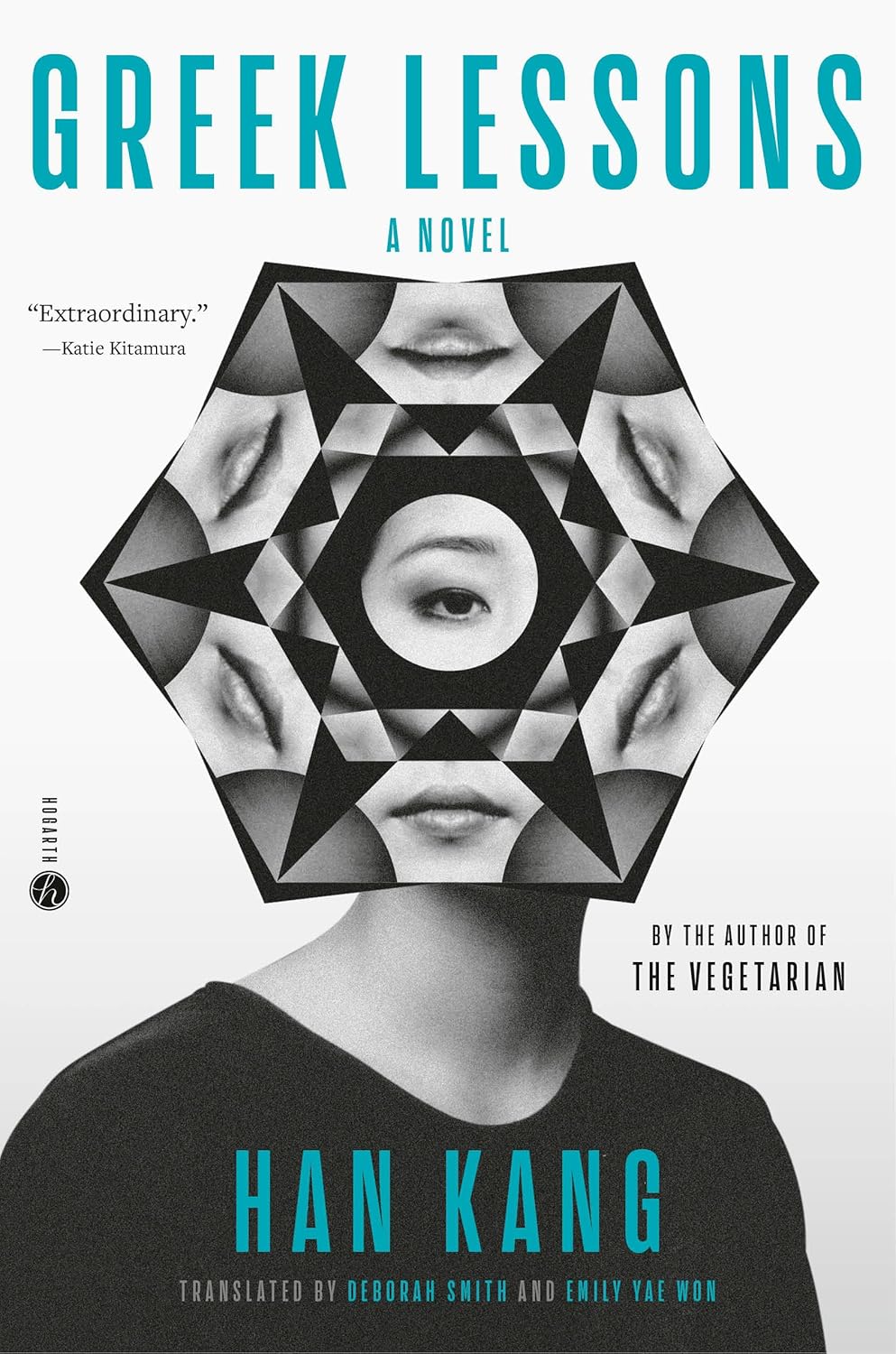
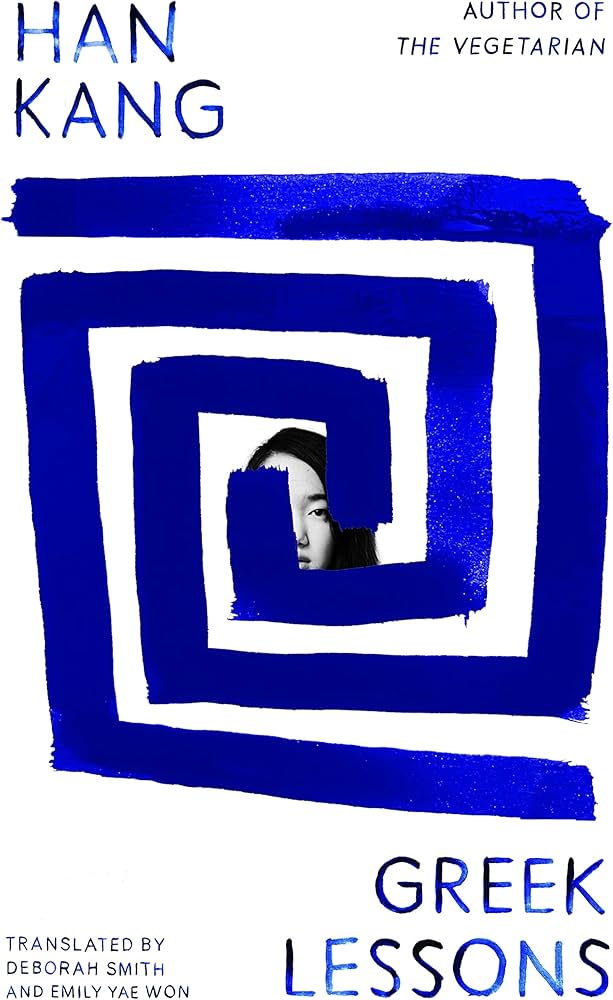
It’s been years since I read Han Kang but I did like The Vegetarian and Human Acts, so I was looking forward to reading the novella which came between those two, Greek Lessons (2011, transl. Deborah Smith and Emily Yae Won, 2023).

In mainly alternating chapters, it tells the story of a teacher of Ancient Greek who is losing his sight due to a long-standing condition, and his pupil who has spontaneously stopped speaking for the second time in her life. His chapters are mainly first-person, hers are third-person.

To be honest, if I heard this premise described without knowing the author I would think it sounded clunky, and I’m a bit tired of unnamed narrators too. But that just shows how little I know because Greek Lessons was a tenderly realised exploration of human connection and the role of language.

The woman is recently bereaved and has also lost custody of her son. She lives alone and is entirely isolated:

“She knows that no single specific experience led to her loss of language. Language worn ragged over thousands of years, from wear and tear by countless tongues and pens. Language warm ragged over the course of her life, by her own tongue and pen.”

The teacher reminisces about a love he had when young. She was deaf and used sign language. He was worried that when he lost his sight they wouldn’t be able to communicate:

“I know now that, had we in fact lived together, I wouldn’t have needed your voice after I went blind. For even as the visible world would gradually have receded like an ebb tide, at the same time, the silence we shared would have gradually become replete.”

In this way Greek Lessons looks closely at language: its limitations, the silences between what is said, what it opens up and what it closes off.

“Despite what her psychiatrist and mother had hoped, the stimulus of social interaction couldn’t fracture her silence. Instead a brighter and more concentrated stillness filled the dark clay jar of her body. In the crowded streets on the way home, she walked weightless, as though moving encased in a huge soap bubble. Inside this gleaming quiet, which was like gazing up at the surface under water, cars roared thunderously by and pedestrians elbows jabbed her in the shoulders and arms, then vanished.”

As these two people move towards one another, Kang questions how much true intimacy is derived from a shared language, and how much language enables avoidance of intimacy:

“She would have still had language then, so the emotions would have been clearer, stronger.”

Greek Lessons is very densely written, so although it’s short it isn’t a fast read. It is a detailed exploration of loss in many guises: the senses, people, love, roles, choices. There isn’t really a plot and there isn’t resolution, so definitely not the read for when you’re looking for those. But as a fractured, elliptical exploration of her themes through the lives of two lost people, it is engrossing.

Novella a Day in May 2026 – No.11

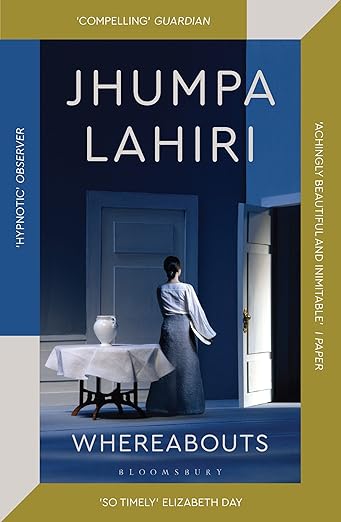
Jhumpa Lahiri was a novelist I used to read as her books came out, then I entirely lost track of her and now have some catching up to do. Interestingly, she wrote Whereabouts (2018) in Italian first, having lived in Italy for a time, before translating it into English herself in 2021.

The novella follows the unnamed narrator over the course of a year, as she considers her past, present and future while she moves within various environments in an unnamed city. The vignettes have titles such as At the Trattoria; In the Pool; On the Couch. Only In My Head recurs, three times. In other words, it is a contemplation of her metaphysical whereabouts from within her physical whereabouts.

The narrator feels a sense of separation: living alone, being single, with no immediate family around. In her mid-forties, her father has died and she has a strained relationship with her mother. There is a vague crush on the partner of her friend, easily relinquished. She works as an academic and writer, and so her career necessitates a degree of isolation.

In the Office: “My colleagues tend to keep to themselves, as do I. Maybe they find me prickly, unpleasant, who knows? We’re forced to inhabit close quarters, we’re told to be accessible, and yet I feel peripheral.”

There is a tension within the narrator. She seems content in some respects yet also dissatisfied, but unable to articulate what it is she yearns after, or if she does so on any significant scale. I’m not a subtle enough reader to know for sure, but possibly the translation by the author from a language to which she was comparatively new, added to the slight sense of dislocation, of spaces between what is felt and what it is possible to put into words.

In My Head: Solitude: it’s become my trade. As it requires a certain discipline, it’s a condition I try to perfect. And yet it plagues me, it weighs on me in spite of my knowing it so well.

But while she grapples with the bigger issues of her life, she remains alert to small moments too. I liked the unspoken comradeship she forms with a philosopher at a much-dreaded three day work conference:  

In the Hotel: Without planning to, we wait for each other every morning and every evening, and for three days our tacit bond puts me obscurely at peace with the world.

Small moments include physical pleasure as well as cerebral reflection:

In the Sun: The simple sandwich I always get amazes me, too. As I eat it, as my body bakes in the sun that pours down on my neighbourhood, each bite, feeling sacred, reminds me that I’m not forsaken.

Throughout the year there is a gentle, almost imperceptible movement towards something better, a potential for more happiness in her life.

Whereabouts is not the book to pick up if you want a pacy, plot-driven read. It is a finely observed study of a person’s interaction with place, while allowing them to remain somewhat unknowable to themselves and the reader. It is about the thoughts, the places and the moments that make up every day lives and the tiny yet significant changes that occur.

Simon has also reviewed Whereabouts this month, for his #BookADayinMay. You can read his review here.

Novella a Day in May 2026 – No.6

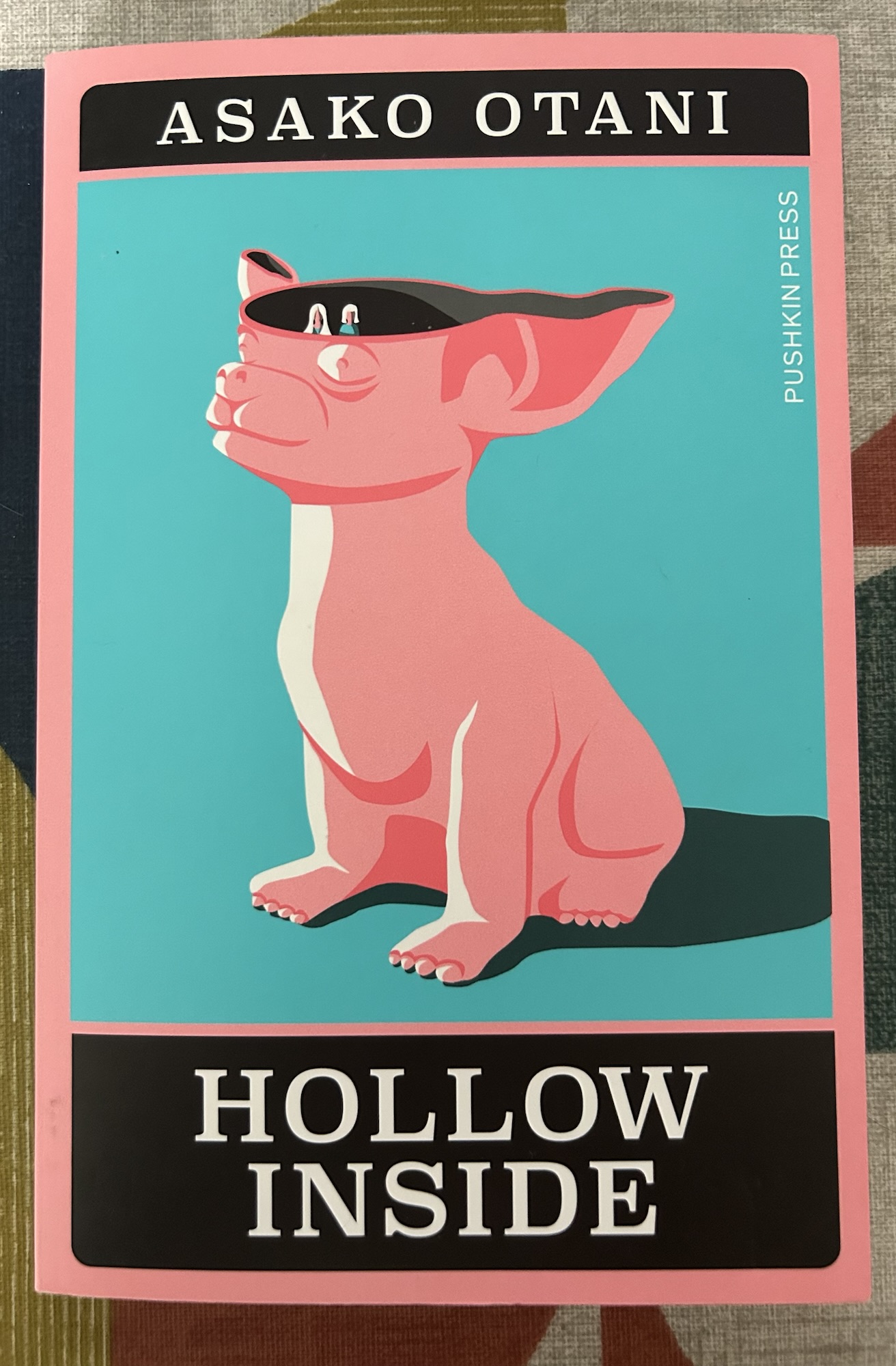
Hollow Inside is the debut novel of Asako Otani (2023, transl. Ginny Tapley Takemori 2026), published by the ever-wonderful Pushkin Press. At only 108 pages it is an accomplished portrayal of a woman trying to find peace within and without.

The narrator is Hirai, self-described as:

“A plain woman just shy of forty in a grey skirt. I had the feeling that by blurring my focus I could be completely assimilated into the jostle of strangers around me on the swaying train. I crossed my eyes slightly and concentrated on erasing my existence.”

We join her when she has been living for four months with Suganuma, slightly older at the age of forty-two. They met at work bonding over their love of the same boyband from their youth.

It is Suganuma who suggests they live together, fed up with the cramped flats and loneliness of living alone.

“As far as I was concerned, my decision to move in with Suganuma meant that I’d given up. A future in which I was married and had children was looking impossible.”

Suganuma is more sanguine, seemingly content in her life choices, and overjoyed at living together as Hirai wryly observes:

“It happened so fast I couldn’t help thinking that if she only handled her work in the same way she’d be able to live in a larger flat of her own.”

Suganuma works mainly from home, 3D printing pets for bereaved owners. The title comes from the figurines and from Hirai’s identification with them.

Hirai also has no sexual attraction to men and ambivalence towards being a mother, both of which she wishes were different. She feels she doesn’t fit, and limits social contact with colleagues and with her family.

“Every single one of my childhood and college friends now had their own family, and for years now the only contact I had with them was liking each other’s social media posts.”

In a very short space, Otani establishes a sympathetic but not sentimental character study of Hirai, showing her pain and confusion as she struggles to find a place for herself. By the end of the novel, she will made some significant decisions, but the author avoids trite conclusions or neat resolution.

To end, regular readers will know I never shy away from an entirely obvious choice:

“At seventy-one dawn still found her undaunted, if not always undamaged.” (Colette, My Mother’s House)

Although I mentioned in my previous post that I rarely write about memoir, here is another post on the same genre, as I thought it would be perfect for Mother’s Day (today in the UK). A short while ago I picked up a little hardback which had Colette’s meditations on her mother in one volume, My Mother’s House and Sido (1922/1929 transl. 1953 Una Vincenzo Troubridge and Enid MacLeod/Enid MacLeod).

Image from here

Colette clearly adores her mother and admits in the preface the limitation of what she is attempting in these volumes:

“I am not at all sure that I have put the finishing touches to these portraits of her; nor am I at all sure that I have discovered all that she has bequeathed to me. I have come late to this task. But where could I find a better one to form my last?”

My Mother’s House is a series of vignettes which have an energetic immediacy, while Sido perhaps has more of a sense of the older Colette looking back, split into Sido (her mother) The Captain (her father) and The Savages (her siblings).

Colette is the youngest child of her mother’s second marriage, born to parents who adore one another. My Mother’s House is formed through a series of brief chapters, intensely readable, as Colette evokes the late nineteenth-century Burgundy landscape of her childhood beautifully, with a love of the natural world she inherited from her mother Sido.

“I shall never be able to conjure up the splendour that adorns, in my memory, the ruddy festoons of an autumn vine borne down by its own weight and clinging despairingly to some branch of the fir-trees. And the massive lilacs, whose compact flowers — blue in the shade and purple in the sunshine — withered so soon, stifled by their own exuberance.”

Sido is shown as a woman intricately bound with her surroundings, tending her garden with love and knowledge.

“She was already out of sight, but her voice still reached us, a brisk, soprano voice full of inflections that trembled at the slightest emotion and proclaimed, to all and sundry, news of delicate plants, of graftings, of rain and blossomings, like the voice of a hidden bird that foretells the weather.”

She is also a hard worker, running her house and rearing her children.

“Why did no one ever model or paint or carve that hand of Sido’s, tanned and wrinkled early by household tasks, gardening, cold water and the sun, with its long, finely tapering fingers and its beautiful, convex, oval nails?”

There’s nothing saccharine in Colette’s fond reminiscences, and Sido emerges as a feisty, determined character. There’s a very funny chapter on her run in with the locate curé where it’s not totally clear who has emerged victorious (Sido is a non-believer) and I also enjoyed how she dealt with the upset which the precocious Colette experiences by reading beyond her years:

“There’s nothing so terrible as all that in the birth of a child, nothing terrible at all. It’s much more beautiful in real life. The suffering is so quickly forgotten, you’ll see! The proof that all women forget is that it is only men—and what business was it of Zola’s anyway?—who write stories about it.”

Colette’s father is also written about with love, particularly in The Captain section of Sido:

“And he would fasten on his chosen one that extraordinary, challenging, grey-blue gaze of his, which revealed his secrets to no one, though sometimes admitting that such secrets existed.”

These two volumes are just gorgeous: gentle, loving, funny, real. Colette’s parents are portrayed as strong individual characters, brought together by a deep and enduring love, raising a family in circumstances that are not always easy.

My favourite aspect of Colette’s writing is always her evocation of the natural world and there is so much to savour here. However, I’ll end with this mention of how Colette the writer started to emerge, under the sceptical eye of Sido:

“Beautiful books that I used to read, beautiful books that I left unread, warm covering of the walls of my home, variegated tapestry whose hidden design rejoiced my initiated eyes. It was from them I learned, long before the age for love, that love is complicated, tyrannical and even burdensome, since my mother grudged me the prominence they gave it.”

To end, a track from the CD I bought my mother for today (yes a CD, she is 82 and while she embraces much of modern technology streaming music would not go down well 😀 ):

“Everything amazes me when I go back to the past.” (Banine, Days in the Caucasus)

“We all know families who are poor but ‘respectable’. Mine, in contrast, was extremely rich but not ‘respectable’ at all.”

I don’t often write about memoir on the blog, but Days in the Caucasus by Banine (1945, transl. Anne Thompson-Ahmadova 2019) was just irresistible. Detailing her childhood in Baku, capital city of Azerbaijan, it is the next stop in my Around the World in 80 Books reading challenge, and my final read for this month’s #ReadIndies, hosted by Kaggsy.

Banine’s style is energetic, direct and engaging. Although chronological, she doesn’t attempt to capture a full picture of her life, but rather a patchwork of people, places and events. It reads like a novel, and this description of her relationship to inanimate objects as a very small child gives an indication of the writer who would emerge:

“But not many people understood it, and when Fräulein Anna caught me in conversation with a tree or bench, she would take exception and threaten me with punishment. ‘What for?’ I would ask in surprise. Adults’ blindness towards my world seemed to me a fundamental injustice.”

Her family were farmers who made a lot of money unexpectedly in oil. This has caused tension as her father and his brother have disagreed about how the inherited wealth has subsequently been distributed:

 “[Uncle Suleyman] let his wife live with us, on the sole condition that she had the occasional row with my father.”

Banine has never known it to be different, and her imperious grandmother rules over their privilege with a rod of iron:

“Like Louis XIV she found it practical to spend much of her time on a commode, a jug for ablutions within reach. Sitting regally on this throne, she received her supplicants, including men.”

“She was highly suspicious of any country outside of circumference of fifty kilometres. Once past the fifty-kilometre mark they were all equally far away—France, Crimea, America or Batumi.”

However, the world will soon impose on their way of life. Banine lives through the Russian Revolution and the invasion of the Azerbaijan Democratic Republic. As a teenager, she is torn between her Islamic upbringing and Communism, specifically, falling in love with a Bolshevik while the family arrange her marriage to a man she despises.

“I didn’t know that a long, hard war and a long, hard revolution would one day open up to me the land of my most cherished dreams. No, I knew none of this then. I was preparing for a very different life that I thought I already knew.”

Her cousin Gulnar is more rebellious and unashamed of her considerable drives, announcing to her much more innocent cousin:

It can’t be as much fun to write a novel as to live one.”

The politics don’t detract from Banine’s love of family and love of her land though. I enjoyed this description of female-only hammam parties:

“The dense steam went to their heads like wine. Between washing their hair and depilating their thighs, they would on occasion be bold enough to arrange a marriage, which only increased the prestige and renown of the hammam parties.”

And her uncle’s whimsical home:

“The house had an inner courtyard for elephants (who never did take up residence) and a roof where jasmine could grow (but never did).”

Eventually though, the family have to decide whether to stay or go as they will not be able to continue the lives they are used to under Russian occupation:

“Uncle Suleyman had, therefore, decided to ‘escape’. This heroic verb pleased him greatly: he conjugated it with sensual delight, repeated it with satisfaction all day long, artfully using it to impress his audience.”

Days in the Caucasus captures a time of great upheaval and change, both personally and politically for the young Banine. War, Turkish occupation, British occupation, establishment of the ADR, then Russian occupation. But even for those of us that haven’t lived through such immense events, she remains recognisable and relatable as she struggles find her place in her family, her culture and society.

Banine is such an endearing narrator too: unsentimental, loving, and funny. I’m looking forward to catching up with her in her second memoir Parisian Days, also published by Pushkin.

“Who can tell the importance of dreaming? And of reading!”