“Walk on air against your better judgement.” (Seamus Heaney, Nobel Lecture, 1995)

I wasn’t planning on posting this week, as I have two exams on Thursday, and despite the fact that I am a major procrastinator I’m really trying to revise.  (And keep getting distracted by episodes of Cake Boss, of which there seem to be approximately twenty million.  If I end up answering a question with the phrase “Byron is prime example of poetry in the Hoboken style, baby!” I have only myself to blame.  A little in-joke there for anyone else who follows this extraordinary bake-fest.)

Anyway, I wanted to post to commemorate the work of Seamus Heaney, whose death was announced today.  This is a sad loss to the contemporary poetry scene.  Heaney was as extraordinarily sensitive poet, dedicated to his craft, alive to all the possibilities of language.  To see him interviewed was the opportunity to listen to someone intelligent, unpretentious and engaging.

I’ve picked two of his poems pretty much at random.  He was a prolific writer so even if you don’t think much of my choices do check him out, there’s bound to be something for you.

Firstly, Blackberry Picking.  I chose this poem because I’m pretty sure this was the first Heaney poem I ever read, at school.  My English teacher was a massive Ted Hughes fan, so Heaney (contemporary and friend of Hughes) wasn’t too much of a leap.  You can view the whole poem here.  I’m just going to look at the first ten lines, and then the end line.

Late August, given heavy rain and sun
for a full week, the blackberries would ripen.
At first, just one, a glossy purple clot
among others, red, green, hard as a knot.
You ate that first one and its flesh was sweet
like thickened wine: summer’s blood was in it
leaving stains upon the tongue and lust for
picking. Then red ones inked up and that hunger
sent us out with milk-cans, pea-tins, jam-pots
where briars scratched and wet grass bleached our boots.

I love his imagery here.  I grew up with blackberries at the bottom of my garden and to me this vividly evokes that memory, but also his use of language is so accessible.  Sometimes contemporary poetry (or any poetry) can seem so impenetrable.  Heaney is great communicator, and I think this poem is easy to understand.  That’s not to say it’s simple – there’s a violence to this childhood memory, created through the visceral imagery (clot/flesh/blood/lust/scratched) that unnerves me, and stops it being a straightforward nostalgia trip.   Heaney’s last lines are often powerful and punchy endings.  In Blackberry Picking it’s this:

Each year I hoped they’d keep, knew they would not.

I think this is so simple and beautiful.  It succinctly captures the sadness that tinges childhood memories, and the way we learn that the world is not always as we want it to be, or something we can control. I don’t want to go on too much because I think poetry is an intensely personal experience, and everyone sees and gains different things from it.  I hope its enough of a taster to encourage you to check out the full poem.

Secondly, Two Lorries.  This is quite a famous poem of Heaney’s, from his Whitbread Award winning collection The Spirit Level, published the year after he won the Nobel Prize.  I chose it because there’s a recording of Heaney reading the poem available online, here.  What better way to experience the poem? This is one of the poems where Heaney looks at the Troubles that have been the enduring political experience of his country in his lifetime.  Here are the first two stanzas:

It’s raining on black coal and warm wet ashes.
There are tyre-marks in the yard, Agnew’s old lorry
Has all its cribs down and Agnew the coalman
With his Belfast accent’s sweet-talking my mother.
Would she ever go to a film in Magherafelt?
But it’s raining and he still has half the load

To deliver farther on. This time the lode
Our coal came from was silk-black, so the ashes
Will be the silkiest white. The Magherafelt
(Via Toomebridge) bus goes by. The half-stripped lorry
With its emptied, folded coal-bags moves my mother:
The tasty ways of a leather-aproned coalman!

This shows Heaney’s great skill at capturing life experience: the voices of his mother and the coalman are so clear and direct, despite being indirectly quoted.  Once again, I find his imagery so beautiful, and disturbing.  The idea that the coal turns from one extreme to the other (silk-black to silkiest white) is an image that has so much to say, and the extremity is evoked within a resolutely domestic scene gives it an extended context that makes it personal and political.  The second lorry of the title is the one that blows up the bus station in Magherafelt.  Here’s the end of the poem:

So tally bags and sweet-talk darkness, coalman,
Listen to the rain spit in new ashes

As you heft a load of dust that was Magherafelt,
Then reappear from your lorry as my mother’s
Dreamboat coalman filmed in silk-white ashes.

I’ve said before that I find it hard to write about things I really love.  This is one of those times.  The end of that poem is incredibly powerful and moving, I think I’ll just let it speak for itself.

Seamus Heaney 1939-2013.
“Many people, myself among them, feel better at the mere sight of a book.” (Jane Smiley)

Hello you gorgeous creature.  Yes, you.  I’m talking to you.  You’re lovely.  Thank you for visiting my blog, I really appreciate it.  And I’m confident in my assertion that you’re lovely, because in the short time I’ve been blogging, I’ve been struck by what a great community the blogosphere (as I’ve encountered it) is.  Recently there’s been a lot of attention in the media given to trolls, and the very real havoc they can wreak.  While this atrocious, it’s also true that “Two Bloggers Disagree – Lively & Respectful Debate Ensues” is not a headline you’ll see anytime soon.  People behaving well is just not newsworthy.  So this week I thought I’d make the theme of my post comfort reading.  A cosy corner to celebrate the niceties of life, with you, my fellow bibliophiles and general all round good-eggs.  Pull up an overstuffed chair, wrap yourself in a quilt, keep the hot chocolate and cake within arm’s reach – let’s get cosy and settle down to some books!

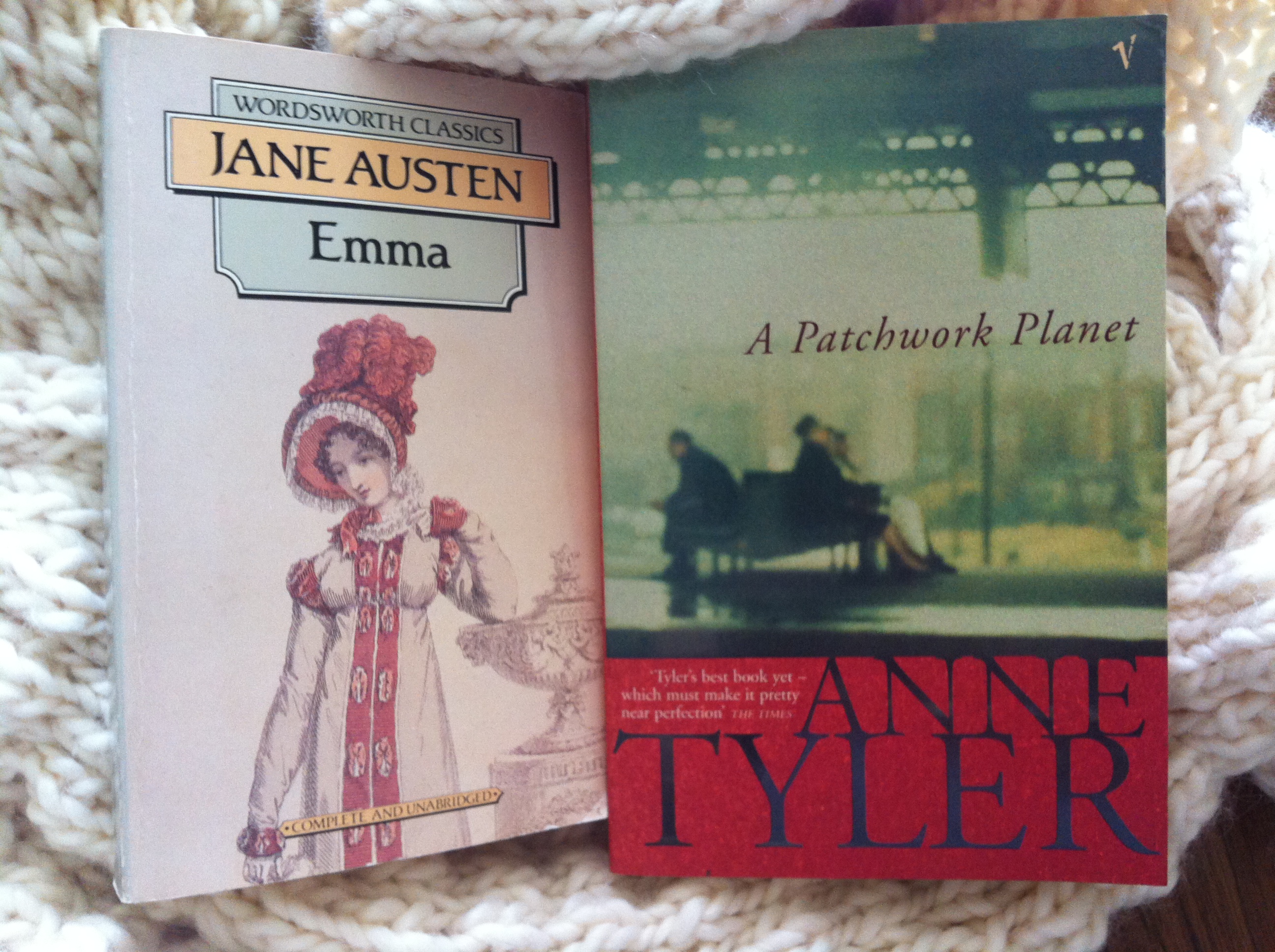
Firstly, Emma by Jane Austen (1815, my edition  Wordsworth, 1992).   I chose this novel because I remember the first time I read it, once all the characters were introduced, thinking “well, I can see exactly how this is going to play out”.  And I don’t think I’m particularly clever or insightful, I think most readers would experience the same.  It’s not that it’s a badly written book, far from it, but just that nowadays we’re used to these sorts of plotlines (romantic story arc, some misunderstanding and confusion, resolution leading to reunited lovers) and I think there’s comfort to be gleaned from that predictability.  I’m not a big reader of crime fiction, but I imagine it’s a similar sort of deal – you get to walk away from the novel with the ends nicely tied up and equilibrium restored.  And that can be very comforting.  So let me introduce you to:

“Emma Woodhouse, handsome, clever, and rich, with a comfortable home and happy disposition, seemed to unite some of the best blessings of existence; and had lived nearly twenty-one years in the world with very little to distress or vex her.”

Emma is not necessarily all that likeable – she’s a spolit snob who thinks she knows what is best for people.  But Emma grows and matures throughout the novel and becomes more humble, and fundamentally has her heart in the right place, so it’s difficult not to warm to her.  The novel is resolutely domestic, as Emma concerns herself with her neighbours and plots to arrange romantic attachments.  The plot is slight, but Emma sees Jane Austen writing as a confident and accomplished author, and the story is delivered with great verve.  There are plenty of Austen’s aphorisms to enjoy:

“It was a delightful visit;-perfect, in being much too short.” 

“I always deserve the best treatment because I never put up with any other.” 

“One half of the world cannot understand the pleasures of the other.” 

I had a tutor who specialised in Austen, and told me she enjoyed her because she was such an absolute bitch, at odds with her rather twee image.  Certainly the portrayals of the vain, boorish characters pull no punches:

“Emma was not required, by any subsequent discovery, to retract her ill opinion of Mrs. Elton. Her observation had been pretty correct. Such as Mrs. Elton appeared to her on this second interview, such she appeared whenever they met again,—self-important, presuming, familiar, ignorant, and ill-bred. She had a little beauty and a little accomplishment, but so little judgment that she thought herself coming with superior knowledge of the world, to enliven and improve a country neighbourhood”

Ouch.  So if you fancy losing yourself in the domestic and romantic concerns of Regency England, just beware that all is not as cosy as it appears.  But Emma is still a comforting read, and one that is huge fun.

Secondly, A Patchwork Planet by Anne Tyler (Vintage, 1999). I haven’t read much by this prolific and much-loved author, only this novel and Breathing Lessons, so forgive me if I seem to be saying very obvious things to established Anne Tyler fans out there. I chose it because I found it comforting read, suggesting there is hope for all of us and people are capable of giving a great deal to one another as we all muddle through life.  Anne Tyler has observed in an interview that “very small things are often really larger than the large things” and this is what she concerns herself with, the small things that hold great meaning in our lives.  A Patchwork Planet tells the story of Barnaby Gaitlin, a man whose life is not where he wants it to be, but he’s not sure what he does want.  His family struggle to forgive him after he was caught in high school breaking into peoples’ homes to go through their things and read their mail.  His ex-wife has moved away and taken their rabbit-faced daughter with her.  He works for Rent-a-Back, providing odd jobs for the elderly in the neighbourhood. He feels he is not the good person others think he is:

“Oh, what makes some people more virtuous than others? Is it something they know form birth? Don’t they ever feel that zingy , thrilling urge to smash the world to bits? Isn’t it possible, maybe, that good people are just luckier people? Couldn’t that be the explanation?”

A Patchwork Planet is peopled with eccentric characters, Barnaby’s co-workers, clients and family. Tyler writes with warmth and acceptance for people in all their guises:

“Then Mrs Alford started sorting her belongings.  That’s always a worrisome sign.  For a solid week she had three of us come in daily – me, Ray Oakley, and Martine. (“Two men for the real lifting,” was how she put it, “and a girl so as to encourage the hiring of women.”) […] Half the time she called Martine “Celeste” which was the name of our other female employee, and I was “Terry”.

“It’s Barnaby, Mrs Alford,” I said as gently as possible.

“Oh! I’m sorry! I thought your name was Terry and you played in that musical group.””

The humour in A Patchwork Planet is gentle, and never at the expense of the characters. As Barnaby muddles his way through another year of his life, you’re left with the feeling that nothing’s perfect but it’s OK.  Sometimes it’s better than OK.  And we may all be alone, but we’re all in this together.  What’s more comforting than that?

Here are the books getting cosy, wrapped in a chunky woollen scarf I knitted (and got completely carried away with, it’s about 8 feet long, good job I’m tall):

Image

“Oh, brothers! I don’t care for brothers. My elder brother won’t die, and my younger brothers seem never to do anything else.” (Oscar Wilde)

According to a skincare company trying to get me to spend more money, Friday was International Sisters Day. I don’t have a sister so my spending on moisturiser was limited, but I do have a brother. (And he buys his own moisturiser).  I have no idea when International Brothers Day is, so I thought I would theme this post around male siblings and just ignore the fact that it was supposed to be a celebration of sisterhood.  I should just point out that I chose the title quote because I love Oscar Wilde and it was about brothers, not because I’m waiting for my brother to die.  Without him in my life I would lose the one person who manages to simultaneously ridicule the things I say and do, whilst being unconditionally, unwaveringly supportive.  It’s a seemingly paradoxical combination that I’m sure many of you with siblings will recognise.  The texts I’ve chosen both feature brothers, but admittedly not a sibling relationship I found familiar. This is hardly surprising – I consider having a brother one of the great blessings of my life, and this doesn’t make for a very dynamic narrative. So the relationships depicted are dysfunctional and bordering on destructive, but this makes for two powerful tales of familial drama.

Firstly, a classic of modern American theatre, Death of a Salesman by Arthur Miller (1949, my copy Penguin 2000).  The play tells the story of Willy Loman, the salesman of the title, as he loses his grip on his life.  He is aging, always a threat to a salesman’s career, and his sanity is wavering, he is subject to flashbacks and unable to distinguish between past and present at times.  The play is a damning indictment of a consumerist culture, and written in 1948, it sadly hasn’t aged at all:

LINDA: And Willy, don’t forget to ask for a little advance, because we’ve got the insurance premium. It’s the grace period now.

WILLY: That’s a hundred… ?

LINDA: A hundred and eight, sixty-eight. Because we’re a little short again.

WILLY: Why are we short?

LINDA: Well, you had the motor job on the car…

WILLY: That goddam Studebaker!

LINDA: And you got one more payment on the refrigerator…

WILLY: But it just broke again!

LINDA: Well, it’s old, dear.

WILLY: I told you we should’ve bought a well-advertised machine. Charley bought a General Electric and it’s twenty years old and it’s still good, that son-of-a-bitch.

LINDA: But, Willy…

WILLY: Whoever heard of a Hastings refrigerator? Once in my life I would like to own something outright before it’s broken! I’m always in a race with the junkyard! I just finished paying for the car and it’s on its last legs. The refrigerator consumes belts like a goddam maniac. They time those things. They time them so when you finally paid for them, they’re used up.

Within the pressures of consumerism, Willy and his sons struggle to make the money the need to buy the things they’re convinced they need, and still create a life of meaning.  The sons of the play, Happy and Biff, are close brothers, but very different.  Happy is a ladies man, working in the commercial sector, but lonely without fully knowing why.  Biff struggles under the weight of his father’s expectations, only knowing what he doesn’t want – to follow his father into sales:

BIFF: Why does Dad mock me all the time?

HAPPY: He’s not mocking you, he…

BIFF: Everything I say there’s a twist of mockery on his face. I can’t get near him.

HAPPY: He just wants you to make good, that’s all. I wanted to talk to you about Dad for a long time, Biff. Something’s — happening to him. He — talks to himself.

BIFF: I noticed that this morning. But he always mumbled.

HAPPY: But not so noticeable. It got so embarrassing I sent him to Florida. And you know something? Most of the time he’s talking to you.

BIFF: What’s he say about me?

HAPPY: I can’t make it out.

BIFF: What’s he say about me?

HAPPY: I think the fact that you’re not settled, that you’re still kind of up in the air…

BIFF: There’s one or two other things depressing him, Happy.

HAPPY: What do you mean?

BIFF: Never mind. Just don’t lay it all to me.

HAPPY: But I think if you just got started — I mean — is there any future for you out there?

BIFF: I tell ya, Hap, I don’t know what the future is. I don’t know — what I’m supposed to want.

Arthur Miller has a great reputation for good reason.  As the Loman family implodes under the weight of failure and disappointment, the play powerfully demonstrates the forces modern life can exert to a tragic extent.  Not a light read, but sixty-five years later, still a vital one.

Secondly, and with a title that gives two sibling types for the price of one, The Sisters Brothers by Patrick de Witt (Granta, 2011).  This novel was published to great acclaim and was shortlisted for the Booker in 2011.  I found it a strange read. Apparently there were suggestions that the Coen brothers buy the film rights (something which John C. Reilly has apparently done) and that fact should give you a good idea of the tone of the novel.  Like a Coen brothers film it is full of peculiar characters and situations, viscerally real yet oddly surreal, with a dry, deadpan humour.  The novel tells the tale of Charlie and Eli Sisters, brothers  who are murderers for hire amongst the gold rush of the 1850s. They are in the pay of the sinister Commodore, who has charged them to hunt down and kill the muppetly-named Hermann Kermit Warm.  The story is narrated by Eli, the more sensitive of the two brothers who longs to leave the life and open a trading post.  He and Charlie are bound by blood and deep understanding, a shared violent history and the fact that they work effectively as a murderous team.  Charlie is an alcoholic and the more violent of the two, but at times Eli sees him anew:

“He then located a deep spot in the stream, stripped down, and leapt in, shrieking loudly at its coldness.  I sat on the bank and watched him splashing and singing; he had not had anything to drink the night before and there had been no other people around to upset his volatile nature, and I found myself becoming sentimental by this rare show of happiness. Charlie had often been glad and singing as a younger man, before we took up with the Commodore, when he became guarded and hard”

The story has an episodic nature and short chapters, but the plot gains momentum as the brothers gain on their prey and realise all may not be as it seems.  It turns out these two seemingly immoral characters have a line they will not cross, but discovering this does not help them:

“He exhaled through his nostrils. “What do you think we should do?”

“What do you think we should do?”

But neither of us knew what to do.”

As the Sisters Brothers continue on their path, not knowing where it will lead, they struggle, similarly to the Loman family, to work out a vocation for themselves that will give their lives meaning. Although their circumstances may be more extreme – and downright weird – than most of us will ever know, the fundamental need for meaning and acceptance makes their struggles recogniseable.

Here are the books with a present my brother gave me a few years back, in memory of our childhood; Gabriel the folk-singing toad from Bagpuss, my favourite character from my favourite kids programme:

Image

And as a P.S.: Those of you interested in management leadership/self-improvement/self-leadership do check out my brother’s blog here.  He hasn’t updated in ages but he assures me he’s got lots of good posts planned soon.