After a slightly disappointing golden age mystery yesterday with When the Wind Blows, I’m back on track today with Still Waters by ECR Lorac. There’s a lot of love for this author in the blogosphere, and I’m delighted that the 1949 Club hosted by Simon and Kaggsy means that I have finally picked her up.
It opens with Caroline Bourne, an artist and writer, looking at a property in the Lake District to be closer to her cousin Kate Hoggett, and Kate’s husband Giles. These two made an appearance along with Lorac’s Inspector Macdonald in an earlier book, but I felt Still Waters worked fine as an entry Lorac novel. I just hope I forget the spoilers for The Theft of the Iron Dogs before I read it (I definitely will forget).
Caroline buys Broadgarth, a smallholding, and negotiates for adjoining woodland with a ruined cottage and a deep quarry pool. This is despite the auctioneer initially ignoring her bid, and although she elevates the price she’s immediately offered £100 more than she paid outside the auction. Already it seems something is afoot…
Yet Caroline is not so suspicious and starts planning her move and which land to work, which to let. Lorac clearly has a love of the Lakes and a knowledge of smallholding, and evokes her scenes beautifully, with just enough detail but not so much as to slow the story down.
The 1949 setting is apparent not only in the £2000 that it cost Caroline to buy all this property and land, but also in references to the post-war smuggling and contraband that is still thriving. Caroline’s cottage has been looted for timber, and people gift each other precious cigarettes. As Caroline teases the serious-minded Giles:
“I have been the instrument which prevented a possible black market malefactor settling in your midst, cornering your eggs and cockerels, bidding for your bacon, skimming your cream, poaching your trout and salmon…”
It’s chasing contraband that brings Inspector Macdonald from Scotland Yard back to Lunesdale. But he quickly finds himself bound up in another mystery. Caroline’s architect friend has been attacked by the quarry:
“He left the ruin and walked on to the quarry pool, and was surprised, as Caroline had been, by its size. It looked ominous, dark and dangerous, with its enclosing ridge of rock, the dripping trees, the rain-pocked water. Macdonald noted the treacherous slippery rocks, the steep fall from the ridge, the brambles and briars, the creak and whisper of swaying boughs and shivering leaves.”
And one of the local husbands is missing:
“Abandoned wives are quite numerous, and Giles knew it, but for a farmer in Lunesdale—or anywhere else for that matter—to leave his land and his cattle was absolutely unheard of. Everybody in the neighbourhood agreed on that point.”
Lorac gently ribs the sexism woven through so many attitudes, throughout the book. Caroline observes:
“I’m a single woman, and I’ve noticed that single women are regarded as less than the dust in these parts.”
Yet women in Still Waters are intelligent, capable, good farmers, witty… Lorac makes her point with the lightest touch.
“‘You are conservative to a degree which is inconsistent with both reason and experience, Giles,’ said Kate.
He smiled tolerantly, quite unoffended with his wife’s vigorous attack.”
There is plenty of humour in the novel, yet any violence is treated with utmost seriousness.
The mystery is well-paced with a believable denouement, and I whizzed through this in an enjoyable afternoon. My high expectations were fully met and I’m looking forward to reading more Lorac soon.
This is my second post for the 1949 Club hosted by Simon and Kaggsy and I’m continuing with a theme of sinister men…
Not so long ago I read Miss Pym Disposes by Josephine Tey and now I’m returning to her once again for Brat Farrar. I’m beginning to realise that Tey doesn’t seem to do traditional golden age mysteries! In Brat Farrar we know that the titular character is pretending to be the heir to a family fortune. So the mystery isn’t whether he is Patrick Ashby, missing since age 13 after the death of his parents, but rather, will he get away with it? And as readers, do we want him to?
Aunt Bee raised Patrick’s twin Simon, their sisters Eleanor and twins Ruth and Jane, after their parents died in a plane crash. At the start of the book she is reflecting on Simon about to come of age and inherit:
“But always there had been an Ashby at Latchetts; and they had done well by the land. Here and there came a ne’er-do-well—like her cousin Walter—but Providence had seen to it that the worthless quality had been confined to younger sons, who could practise their waywardness on subjects remote from Latchetts.
No queens had come to Latchetts to dine; no cavaliers to hide. For three hundred years it had stood in its meadows very much as it stood now; a yeoman’s dwelling. And for nearly two of those three hundred years Ashbys had lived in it.”
She also considers the difference between Simon and his – presumed dead – brother.
“All she really remembered, now she thought about it, was that he was solemn and kind.
Kindness was not a common trait in small boys.
Simon had a careless generosity when it did not cost him inconvenience; but Patrick had had that inner kindness that not only gives but gives up.”
It’s eight years since Patrick vanished; struggling actor Alec Loding knows the family and thinks he has found a way to make some money. I really enjoyed how Tey introduced this reprehensible character:
“He had a pink, collapsed face that reminded one of the underside of fresh mushrooms. The flesh hung away from his good Ledingham bones with a discouraged slackness, and the incipient pouches under his eyes detracted from their undoubted intelligence. Managers who had once cast him for gay young rakes now offered him nothing but discredited roués.”
He has spotted Brat Farrar’s resemblance to Simon, and therefore Patrick, and has offered to coach him in return for a regular salary once Brat inherits. Brat isn’t sure, but he is struggling to find the work he wants. This is an interesting choice for the 1949 Club, because Brat’s circumstances are directly informed by the post-war situation:
“It seemed that there were far more people interested in stable jobs in England than stables to accommodate them. The horse world contracted as the horse lovers expanded. All those men who had lost their main interest in living when the cavalry was put down were still hale and active, and besieged stable entrances at the mere whiff of a vacancy.”
Tey loved horse racing, and there is a lot about it in this novel. I hate it, so I must admit I skipped these passages. But even if you don’t mind racing, you may want to skim – I think her editor should have been more assertive!
Brat heads to the country pile and manages to convince most people most of the time that he is Patrick. He’s helped by the ambiguity of Patrick’s note: “I’m sorry, but I can’t bear it any longer. Don’t be angry with me. Patrick.” and the fact that similarly to Patrick, he is a lot more likeable than Simon. People want him to be Patrick.
“He had an odd feeling of identity with Patrick.
Even he himself noticed this, and found it strange. He should have been filled with guilt when he considered Patrick. But his only emotion was one of partisanship; almost of alliance.”
He also doesn’t overly struggle with guilt as he takes a strong dislike to his supposed twin:
“It was because there was something about Simon Ashby that repelled him. There was something unaccountable about Simon. There he sat, being light-hearted and charming, and there sat his relations and friends silently applauding his nobility and his courage. They were applauding an “act,” but they would all be staggered to know what an act Simon was really putting on for their benefit.”
And so ultimately, Tey is exploring the moral challenges that Val McDermid mentioned in her discussion of Miss Pym Disposes. Brat Farrar is pleasant, responsible and would make a good heir to run the estate. Simon is none of those things. But he is the rightful heir, and Brat Farrar is a con man who is using an intensely painful experience in a family to his own advantage. Tey positions the reader in a way that we question what we want the outcome to be, and why.
There’s also some nice gentle humour to enjoy, lightening what is essentially quite a dark tale. My favourite characters were stubborn, scruffy, horse-obsessed little Jane, and the bookish, seemingly naïve Rector, who made a surprise marriage to a beautiful debutante, and is more worldly than people give him credit for:
“”I know,” Nancy said, agreeing. “Like walking on jelly.”
“I was going to say picking one’s way over a bog, but I think the jelly is a better description.”
“Or one of those uneven floors at fun fairs,” the Rector said unexpectedly, as Bee took her leave.
“How do you know about fun fairs, George?” his wife asked.
“They had one at the Westover Carnival a year or two ago, I seem to remember. A most interesting study in masochism.”
“You see now why I have stuck to George,” Nancy said, as she walked with Bee to the garden gate. “After thirteen years I am still finding out things about him. I wouldn’t have believed that he even knew what a fun fair was. Can you picture George lost in contemplation of the Giant Racer?””
Brat Farrar was adapted as Paranoiac in 1963 by Hammer films. From this trailer I would say it’s a very loose adaptation indeed 😀
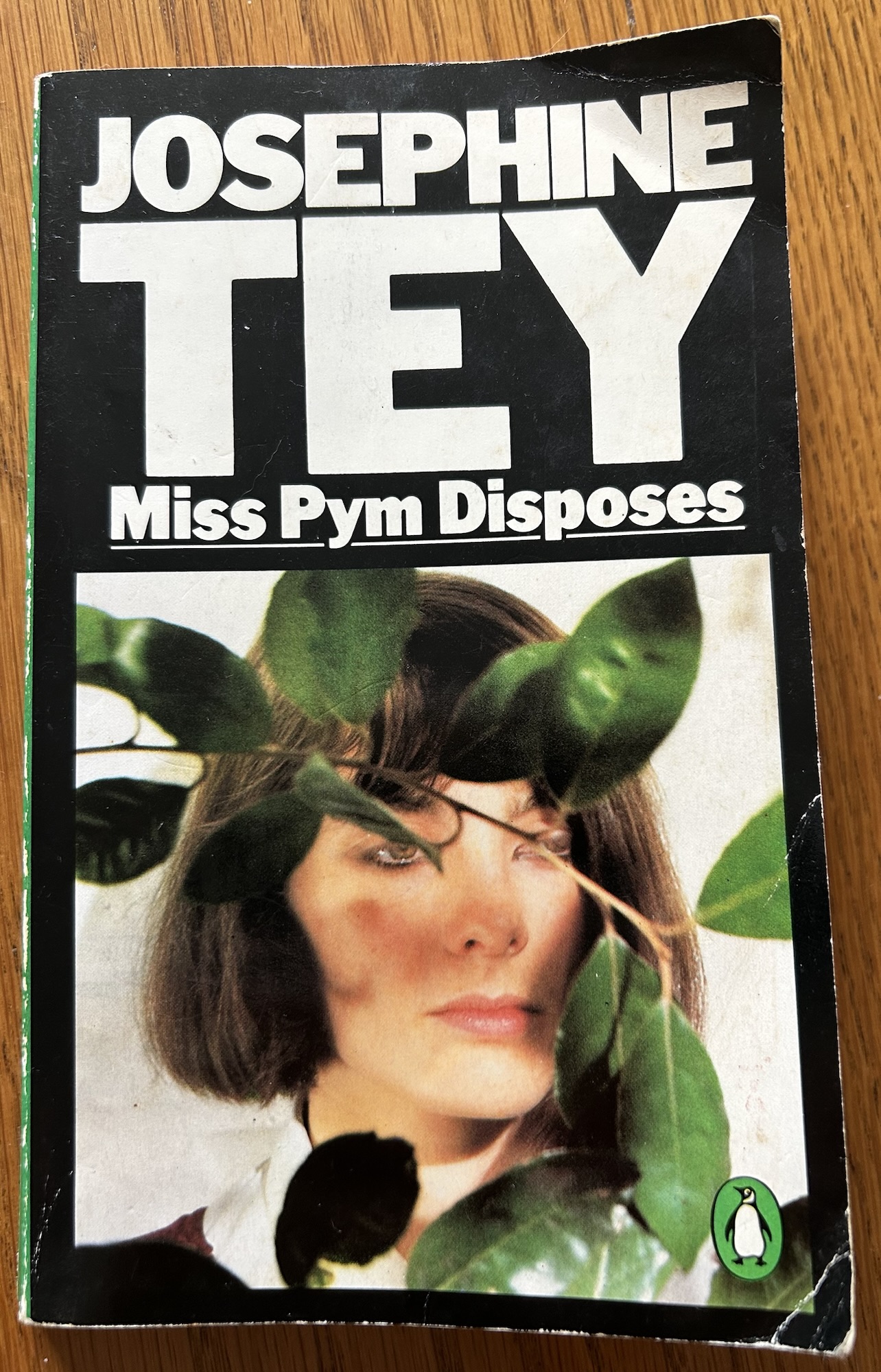
I dithered a bit about posting on Miss Pym Disposes by Josephine Tey (1946) as although I enjoyed it, I wasn’t really sure if I could recommend it onwards. It’s an unusual novel written by an established author of the era of golden age detectives, where the murder doesn’t take place until page 157 of 208. There’s also a lot of dated stereotyping and language so do bear that in mind if you decide to pick it up.
My edition is from what I think of as the golden age of soft-focus cheese from the Penguin art department, circa mid 1970s-1980s.
But it’s perfect for #SpinsterSeptember hosted by @pearjelly, set as it is in Leys Physical Training College for young ladies, where the teachers are single women, and with a titular character who is also a spinster. Lucy Pym initially works as a French teacher:
“But after four years of that her remaining parent had died, leaving her two hundred and fifty pounds a year, and Lucy had dried her eyes with one hand and given in her resignation with the other.
[…]
She read her first book on psychology out of curiosity, because it seemed to her an interesting sort of thing; and she read all the rest to see if they were just as silly. By the time she had read thirty-seven books on the subject, she had evolved ideas of her own on psychology; at variance, of course, with all thirty-seven volumes read to date. In fact, the thirty-seven volumes seemed to her so idiotic and made her so angry that she sat down there and then and wrote reams of refutal. Since one cannot talk about psychology in anything but jargon, there being no English for most of it, the reams of refutal read very learnedly indeed.”
I did enjoy Tey’s humour around Lucy leaving her job! Clearly she was highly sceptical of psychology though, which is quite surprising given that in many ways this is a psychological study. Much of the novel is spent building her cast of characters and the insular environment of the college.
“College was a bright gateway to the future for deserving youth; and if one or two found the gateway a hazard rather than an opening, then it was unfortunate but no reflection on the builders of the gateway.
“Like a convent,” Nash had said yesterday morning. “No time to think of an outside world.” That was true. She had watched a day’s routine go by. She had also seen the students’ two daily papers lying unopened in the common-room last night as they went in to supper. But a nunnery, if it was a narrow world, was also a placid one. Uncompetitive. Assured. There was nothing of the nunnery about this over-anxious, wildly strenuous life. Only the self-absorption was the same; the narrowness.”
Lucy is there because she was asked by old schoolfriend Henrietta to give a talk, and at first the 5.30am bell ringing and horrific institutional food means she plans to leave as soon as possible. But gradually she begins to enjoy herself, and decides to stay for the end of term gymnastic demo. She enjoys the company of the senior girls, including charismatic head girl Pamela ‘Beau’ Nash; her best friend, the accomplished but self-effacing Mary Innes; and Teresa Desterro who is there to study dance only and hone her considerable talent. There is also Barbara Rouse, who people are wary of although it’s not clear why, and is the favourite of the headmistress, also for reasons unclear.
“In the last few years [Lucy] had been ignored, envied, admired, kow-towed to, and cultivated; but warm, personal liking was something she had not had since the Lower Fourth said goodbye to her, with a home-made pen-wiper and a speech by Gladys Someone-or-other, shortly after her legacy. To stay in this atmosphere of youth, of liking, of warmth, she was willing to overlook for a space the bells, the beans, and the bathrooms.”
The girls are waiting to find out which jobs have been found for them by their headmistress, and there’s a shock when the plum job at “Arlinghurst. The school for girls, of course. A sort of female Eton.” goes to an unexpected candidate.
So, someone gets killed, and Lucy uses, I would say, one and a half pieces of flimsy evidence to work out who did it. But actually, I don’t think the puzzle element is of particular interest to Tey. There’s a great Backlisted podcast episode on this novel from back in 2021, with Val McDermid who is really enthusiastic about Miss Pym Disposes. She argues Tey is more interested in morality; the motivations of it and the conundrums around it, and I think she’s right. The reasons I find golden age detective novels a comfort read – a puzzle worked out neatly, justice and order restored – are not present here. The ending is really quite stark, and readers are unlikely to find the outcome reassuring although it is believable.
I do recommend MissPym Disposes, but surprisingly, not as one to be read when you’re in the mood for a golden age mystery!
To end, initially nothing sprung to mind for a suitable song, before I realised that because Teresa is Brazilian, I could include a legendary musician from that country, Caetano Veloso:
I’ve been meaning to read Celia Fremlin for a while, encouraged by JacquiWine’s excellent reviews. Happily, this coincided with my plan to read some Christmas-set golden age/cosy mysteries in December, as The Long Shadow (1975) builds its tension through a haunted group of houseguests throughout the festive period.
I immediately knew I was in for a treat with Fremlin. We join Imogen at the first party she’s attended since her husband died two months ago. We quickly learn that while she is grieving, she also recognises that Ivor was not a pleasant person. There is no sentimentality in her reflections.
“How Ivor would have loved being dead! It was a shame that he was missing it all. How he would have loved to watch the letters pouring in, day after day, by every post, in their tens and in their dozens, each one a tribute to himself.”
She also casts a critical eye over the niceties of solo party attendance:
“She’s a widow, that’s what she is. With wooden detachment, Imogen watched Myrtle’s social aplomb faltering before the task of finding something intriguing to say about Imogen: something at least as amusing as Dutch Elm disease.
She gave it up.”
There’s also some astute observations about the deeply odd ways that the English approach the bereaved:
“Even Edith Hartman from next door had at last stopped popping in with cups of tepid Oxo and soothing stories about people who had died of cancer recently.”
But soon Imogen has more to worry about than navigating social mores, as someone rings in the middle of the night, telling her they know she killed her husband.
Told from Imogen’s point of view, she is clear she didn’t kill him. She has little time to reflect though, as it’s not long before her adult step-children turn up; the somewhat reprobate son Robin, and acquisitive daughter Dot, with her husband Herbert and their two young sons, Vernon and Timmie.
More bafflingly, Robin brings an almost silent girl to the house who wafts around preparing macrobiotic food, and Ivor’s scatty second wife Cynthia flies in from Bermuda to also take up residence. Then someone starts moving Ivor’s papers and updating them, the children have faces visiting them in nightmares and see a man in a Santa costume sat in Ivor’s study, and Imogen begins to wonder if a ghost isn’t part of the company too…
“It was high time Ivor got moving. It wasn’t fair to be dead and yet to stay around like this, in every room, in every corner of the house”
As a reader we are meant to be sceptical of ghosts and suspect everyone else, and they certainly act suspiciously! All of the adults seem to be Up To Something but I certainly couldn’t work out what was going on.
The Long Shadow is well-paced at only 242 pages, with a finale that is satisfying and believable. There’s even a final comic twist right at the last sentence. It’s certainly made me keen to read more Fremlin and thankfully Faber have made more reissues available.
Although not heavily Christmas-themed, it’s a great Christmas read with its house full of extended family, things unspoken, and would be easily digested after a dinner of heavier festive fare 😊
To end, two of my favourite folk singers coming together to sing insults at each other in honour of Christmas (please note, they have updated some of Kirsty MacColl and Shane MacGowan’s name-calling, but the language remains decidedly colourful):
This is my final contribution to Kaggsy and Simon’s1952 Club which has been running all week. So far I’ve read two golden age mysteries for the club and I’m finishing with one too: Death on the Riviera by John Bude, in a pleasing British Library Crime Classics edition.
I read The Cheltenham Square Murder for the 1937 Club last year, and while I had enjoyed it, I didn’t think it was the strongest of Bude’s novels or a particularly perplexing mystery. This, I’m happy to report, was much stronger.
The story centres around the rich and privileged Nesta Hedderwick and her various assorted guests at her villa in the south of France.
“But for the nagging accusations of her weighing-machine life might have been perfect. She’d money; one of the loveliest villas in Menton; A large … collection of friends; splendid health; a sense of humour; and a virile capacity for enjoyment. Her husband, a successful but dyspeptic stockbroker, had died between the wars of ptomaine poisoning.”
Staying with Nesta are her niece Dilys; “smooth-faced bounder” Tony Shenton; Nesta’s companion Miss Pilligrew; beautiful Kitty; and a decidedly shifty artist:
“When Nesta had an artist living in the house she expected him to behave like one. Paul Latour certainly did his best to live up to the fin de siècle Bohemianism on which Nesta had directed her romantic ideas of the genre.”
Bude clearly has a lot of fun with Paul’s artistic swizz:
“A cod’s head capping the naked torso of a woman, balanced onto cactus leaves and garnished with the motif of lemons and spaghetti… Paul shrugged hopelessly.”
Although Dilys’ attitude to where she has found herself suggests Paul isn’t alone in his pretence:
“Just paste and cardboard and tinsel, like most of my aunt’s insufferable friends. Actually I find it rather boring. It gets that way after a time.”
So it seems the French Riviera is the perfect place for a counterfeiting operation, which is what brings DI Meredith and Acting-Sergeant Freddy Strang across La Manche, searching for Tony ‘Chalky’ Cobbett.
They work closely with Inspector Blampignon and refreshingly, the local police are shown to be entirely competent and pleasant to work with.
As the British and French police investigate the local forgers, Freddy runs into Dilys and they begin a very sweet romance, which brings the two threads smoothly together. When an acquaintance of the villa coterie goes missing, the police investigation widens.
One of my complaints with The Cheltenham Square Murder was that something completely and utterly obvious takes forever to be recognised by Meredith and I thought the same had happened here. Fortunately it turned out I’d fallen into exactly the assumption Bude had set up for the reader: at one point he has Meredith explain that when such an occurrence happens in mystery novels it always means the following…. a nice little meta joke with the reader which I appreciated 😊
Oddly, given the novel’s title, no-one is murdered until around page 160 of a 223 page novel. For my tastes, too long was spent on the counterfeiting and too little on people getting bumped off, but the investigation worked well and it was a steady police procedural without being plodding:
“He was visited by one of those revealing flashes of deduction that spring, not from any inspirational source, but from a clearly realised and logical appreciation of the facts.”
Death on the Riviera is well-paced and enjoyable, with enough characters for plenty of suspects without being completely baffling. The humour is gentle and light, and the setting beautifully evoked:
“It wouldn’t be easy, he realised, to take leave of this sunlit, sparkling coast with its terraced vineyards and olive groves, it palms and oleanders, it’s fantastic cacti, it’s mimosa-scented streets and impossibly blue seas. He thought of the Old Kent Road on a wet February night and shuddered.”
Today for the 1952 Club hosted by Kaggsy and Simon I’m looking at another golden age mystery. The Singing Sands by Josephine Tey features her regular detective, Inspector Alan Grant. It was found in her papers after she died and published posthumously, which usually makes my heart sink, but the novel seems pretty complete so I hope it was as she planned.
You can come across all sorts prejudices and snobberies in golden age crime and The Singing Sands has a strong one running throughout, which admittedly I’ve not encountered before in the genre: Tey is a total snob about Scotland. As far as I can work out her rules are:
Be Scottish
But speak with an English accent (by which I assume she means RP – I doubt my south London tones would cut the mustard)
Don’t be from the city
Especially don’t be from Glasgow
Be from the Highlands
Don’t be a nationalist
Really don’t be from Glasgow
I take great exception to her attitude to Glasgow – it’s a beautiful city full of friendly people. Every time I go I’m knocked out and I’m still giving serious consideration to moving there. In the end when I came across these attitudes I just rolled my eyes and skipped on, and it didn’t affect my enjoyment of the novel. But as a counterbalance I urge everyone to (re)visit wonderful Glasgow!
On with the novel! It opens with Grant struggling with his mental health and deciding to visit his cousin Laura (Lalla) and her family in the Highlands to recuperate. The background of what led to Grant reaching this point is never quite specified but he seems to be experiencing burnout/PTSD.
As he disembarks the train, the grumpy attendant is trying to rouse the passenger in berth B Seven. Grant realises he is dead, and his interest in faces (detailed extensively in The Daughter of Time which is where the title quote comes from but would have worked very well in this novel too) is piqued:
“What would bring a dark, thin young man with reckless eyebrows and a passion for alcohol to the Highlands at the beginning of March?”
He also picks up B Seven’s newspaper, which has some cryptic verse scribbled on it. Much as Grant tries to focus on his family and the fishing expeditions he had planned, his mind keeps being drawn back to B Seven. The verse leads him to visit some of the islands to identify the landmarks mentioned:
“There was nothing else in all the world but the green torn sea and the sands. He stood there looking at it, and remembering that the nearest land was America. Not since he had stood in the North African desert had he known that uncanny feeling that is born of unlimited space. That feeling of human diminution.”
Although his colleagues in London have identified the body and ruled accidental death, Grant thinks both these conclusions are questionable. Despite trying to recover from his work, he can’t let it go. He is aware that keeping his mind occupied can be useful, but it is a fine balance:
“Grant was very conscious that his obsession with B Seven was an unreasonable thing; abnormal; that it was part of his illness. That in his sober mind he would not have thought a second time about B Seven. He resented his obsession and clung to it. It was at once his bane and his refuge.”
We follow Grant as he heals, with the help of his beautiful environment, the understanding of his family, and his pursuit of the truth.
“But for B Seven he would not be sitting above this sodden world feeling like a king. New born and self-owning. He was something more than B Seven’s champion now: he was his debtor. His servant.”
The Singing Sands is not heavily plot-driven and the mystery is slight, but it is still an enjoyable read, if a slightly unusual approach to the genre. Grant’s dogged pursuit of the truth of a death which others seem quick to disregard makes him endearing, and there are lovely descriptions of the Highlands. It’s a quick read that doesn’t outstay its welcome, and it is compassionate in its portrayal of mental health.
“In matters where A was at spot X at 5:30pm on the umpteenth inst, Grant’s mind worked with the tidiness of a calculating machine. But in an affair where motive was all, he sat back and let his mind loose on the problem. Presently, if he left it alone, it would throw up the pattern that he needed.”
This is a contribution to Kaggsy and Simon’s 1952 Club, running all week. I found a few contenders in the TBR including several golden age mysteries, so I’m starting today with a pretty famous one, Tiger in the Smoke by Margery Allingham.
The titular smoke is a London pea-souper, a thick smog that chokes the airways and severely limits visibility – perfect for dastardly crimes to be committed!
“The fog was like a saffron blanket soaked in ice-water. It had hung over London all day and at last was beginning to descend. The sky was yellow as a duster and the rest was a granular black, overprinted in grey and lightened by occasional slivers of bright fish colour as a policeman turned in his wet cape.”
The story opens with Geoffrey Levett and Meg Elginbrodde crawling through the fog-bound traffic in a taxi. They are one of those wonderful postwar stiff-upper-lipped couples whose romantic chit-chat takes place along the following lines:
“Look, we’ll get out of this somehow and we’ll go through with the whole programme. We’ll have everything we planned, the kids and the house and the happiness, even the damned great wedding. It’ll be alright, I swear it, Meg.”
Love it!
The blight on their nuptials is that someone has been sending blurry photos to Meg of someone who could be her first husband Martin, presumed dead in the war. So she meets friend of the family – and Allingham’s regular detective – Albert Campion, along with Inspector Charlie Luke, at a train station.
It quickly emerges that the man is not her husband but a criminal named Duds Morrison. As the group begin to unravel what is going on and why, there is less mystery and more of a character study of a truly sinister criminal named Havoc. Inspector Luke is unnerved:
“Just then he had a presentiment, a warning from some experienced-born six sense, that he was about to encounter something rare and dangerous. The whiff of tiger crept to him through the fog.”
A gang of criminals appear and my heart sank a bit, as they all had various physical differences and I was braced for ableism. But while that is certainly present, the real menace in the book lies with Havoc, and Allingham labours over how physically perfect he is:
“His beauty, and he possessed a great deal […]
His face was remarkable, in feature it was excellent, conventionally handsome […]
Jail pallor, which of all complexions is the most hideous, could not destroy the firmness of his skin […]
He was a man who must have been a pretty boy, yet his face could never have been pleasant to look at. Its ruin lay in something quite peculiar, not in expression only but in something integral to the very structure. The man looked like a design for tragedy. Grief and torture and the furies were all there naked, and the eye was repelled even while it was violently attracted. He looked exactly what he was, unsafe.”
In other words, as beautiful and deadly as a tiger.
In comparison there is my favourite character, Canon Avril, Meg’s father:
“he asked so little of life that its frugal bounty amazed and delighted him. The older he grew and the poorer he became, the calmer and more contented appeared his fine gentle face.”
In fact, Tiger in the Smoke had an increasing amount of religious references and imagery as it went along (though it isn’t didactic at all) and I found myself reminded of Muriel Spark. I ended up googling Margery Allingham to see if she had a strong faith like Spark but couldn’t find it referenced. Tiger in the Smoke isn’t like Spark tonally, but it is certainly concerned with notions of good and evil in a similar way to her novels.
Although this is a Campion mystery, he barely features. Apparently the 1956 film cut him out entirely, and this wouldn’t be difficult at all. His sarcastic retainer Lugg also appears, and his wife Amanda along with Oates from Scotland Yard “a drooping figure in a disgraceful old mackintosh” but this could just as easily be a standalone novel.
While there isn’t a mystery as such, the plot is satisfyingly complex and the novel is expertly paced. The foggy atmosphere is used to full effect and Allingham creates a real page-turner. I was whizzing through Tiger in the Smoke to find out what happened.
It leads to a tense denouement, underpinned by a real sadness. A hugely satisfying start to my 1952 Club reading!
“Havoc was ‘police work’. There was no mystery surrounding his guilt. He was something to be trapped and killed, and Campion was no great man for blood sports.”
Maigret Mystified – Georges Simenon (1932, trans. Jean Stewart 1964) 139 pages
This is the first Maigret I’ve read, despite Simenon being such a prolific writer and despite my love of golden age detective fiction. I picked it up in a pleasingly battered old green Penguin edition and I enjoyed it greatly. I’m sure it won’t be the last time I accompany the insightful French detective in his ruminations 😊
This may well be the shortest post I ever write, given that it’s about a novella and a mystery, so I want to avoid spoilers!
Maigret is called to the scene of a murder in an office of a pharmaceutical company, Doctor Rivière’s Serums. Monsieur Couchet, the owner, has been shot dead. The mystifying element is that he was also robbed of 360,000 francs, but his chair was jammed against the safe. So did he face his murderous thief? Or did he not know of the theft? Did the same person carry out both crimes?
As the office is adjacent to a block of flats, Maigret must interview possible witnesses from the various homes in Place des Vosges.
There is the concierge who called the police; Madame Martin who seems to torture her husbands with their failure to live up to her expectations (the first of whom was the murdered man, their son now self-medicates with ether and lives close by); Mathilde who eavesdrops on everyone; new parents the de Sant-Marcs…
There are also the lovers of the victim to contend with: his second wife and his girlfriend Nine, a cabaret dancer, the portrayal of whom is pleasingly non-judgemental.
I suspect this isn’t the greatest Maigret offering, but it is a quick, entertaining and atmospheric read. I also found it a welcome antidote to the overly convoluted plot lines of many contemporary detective dramas – much as I enjoy those, it was a nice change to just see Maigret get on with it, in no time at all.
“ ‘You old rascal, Couchet!’
The words had sprung to his lips as if Couchet had been an old friend. And he felt this impression so strongly that he could not realise he had only seen him dead.”
A previous English title used for this mystery was The Shadow in the Courtyard, which to me is a much better. After all, at 139 pages, Maigret isn’t mystified for long…
“It was ten o’clock at night. The iron gates of the garden were shut, the Place des Vosges deserted, with gleaming car tracks on the asphalt and the unbroken murmur of the fountains, the leafless trees and the monotonous outline of identical roofs silhouetted against the sky.”
To end, this year sees a cinematic outing for Maigret:
You may remember, back in the mists of time (14-20 October), the 1930 Club, hosted by Karen at Kaggsy’s Bookish Ramblings and Simon at Stuck in a Book. Although I took part, I’d hoped to do two posts, but was far too disorganised with the second one. Karen kindly said I could sneak in a late entry, so here it is, very much overdue and very much overlong!
My excuse is I’m having renovations done in my tiny flat and the whole place is in disarray to say the least. It has made me clear out 19 sacks of books to the lovely charity bookshop, but the overall effect on my shelves has been negligible. Which makes me think I should just give in and accumulate books until they take over entirely and smother me. A good way to go in my opinion.
Back to 1930! Do have a look at all the wonderful posts from people who managed to post on time – it turned out to be a great year 😊
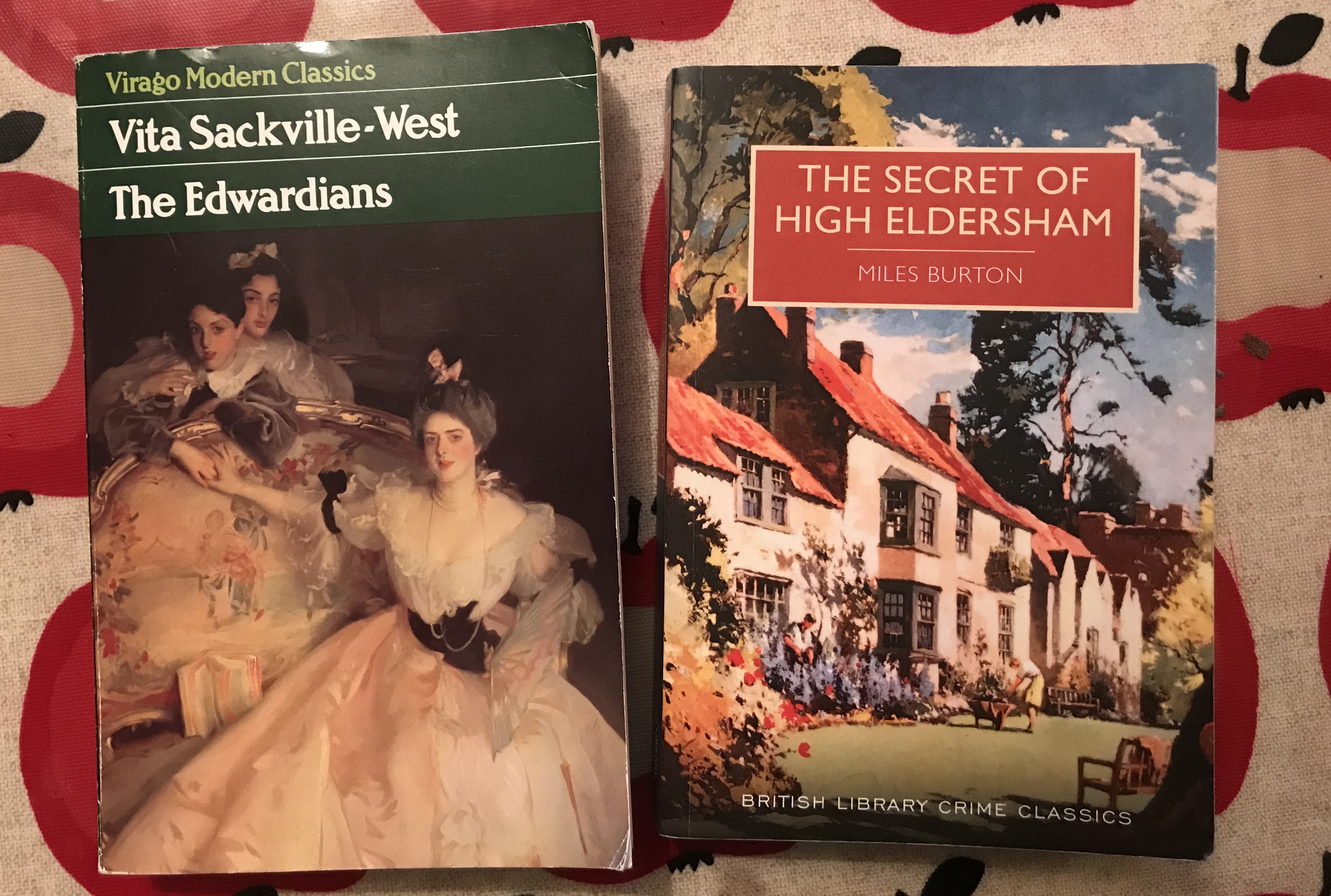
Firstly, some cosy crime courtesy of the British Library Crime Classics series, The Secret of High Eldersham by Miles Burton.
The titular village is a pretty place in East Anglia, but somewhat isolated and insular “with that curious half-mistrustful air not uncommon among the natives of East Anglia.” 😀
Strangers are not welcome in High Eldersham, and Samuel Whitehead, retired police officer and local publican, was one such stranger. Still, he seemed to have settled in relatively well right up until the point that someone stabbed him to death. Inspector Young is called in from Scotland Yard and immediately suspects one of the locals:
“He knew from experience that brutal murders, inspired by some entirely inadequate motive, were not uncommon. They were nearly always due to the workings of an unbalanced mind, brooding over some fancied grievance until the lust of blood was awakened. Then the hitherto harmless and peaceful individual became a criminal… He would await his opportunity and deliver the blow. And, the deed once perpetrated, he would return to normal sanity. It was not unlikely that the murder of Whitehead was due to such causes.”
It’s hardly a robust theory. Young is not an idiot though, and he quickly unearths the titular secret, although that doesn’t tell him who murdered the pub landlord, or why. He decides to call on his old friend Desmond Merrion “a living encyclopaedia upon all manner of obscure subjects which the ordinary person knew nothing about.”
And so the professional and amateur detective set about solving the mystery, which to modern readers won’t be much mystery at all – its very clear what’s going on. That’s not a criticism though. I suspect in 1930 it wasn’t quite so obvious, and it doesn’t matter now – the comfort of these plot-driven golden age stories is watching everything play out exactly as it’s supposed to, and I enjoyed following Young and Merrion as they discovered the extent of the dastardly deed.
While it’s not the most sophisticated in terms of plot or characterisation, The Secret of High Eldersham still has enough about it to pull you along. It also doesn’t fall foul of many of the prejudices of GA detective fiction either. Despite the bizarre opinion of East Anglians that I quoted at the beginning, in fact the residents aren’t made too yokely; there’s no racism/anti-Semitism that I can remember; and the loveliness of the female love interest isn’t dwelt upon and she’s actually allowed to have a personality.
Burton doesn’t hang about – there’s very little filler here. He gets on with telling the story and once that’s done, it ends. So, a quick, cosy crime read, perfect autumnal reading as the nights get longer for those of us in the northern hemisphere.
In my last post I looked at EM Delafield’s Diary of a Provincial Lady which included this entry:
“August 31st.—Read The Edwardians which everybody else has read months ago—and am delighted and amused. Remember that V. Sackville-West and I once attended dancing classes together at the Albert Hall, many years ago, but feel that if I do mention this, everybody will think I am boasting—which indeed I should be—so better forget about it again, and in any case, dancing never my strongest point, and performance at Albert Hall extremely mediocre and may well be left in oblivion.”
Although I don’t have much in common with the Provincial Lady’s life of ease, like her I enjoyed The Edwardians, which Sackville-West told Virginia Woolf she was writing to ‘make my fortune. Such a joke it will be, and I hope everybody will be seriously annoyed.’
Although she saw it as a joke, its not really a comic novel. It tells the story of Sebastian, heir to the country estate of Chevron, and his sister Violet. Chevron is VSW’s beloved Knole, which she couldn’t inherit due to having ovaries, and which Virginia Woolf also immortalised as the home of Orlando.
The chapters are told from the point of view of different characters, beginning with adventurer Leonard Anquetil, who is not of the same class as the rest but has been invited to Sunday dinner because they think he will be amusing.
“And now the rest of the day must be got through somehow, but the members of the house-party, though surely spoilt by the surfeits of entertainment that life had always offered them, showed no disposition to be bored by each other’s familiar company, and no inclination to vary the programme which they must have followed on innumerable Sunday afternoons since they first emerged from the narrowness of school or schoolroom, to take their place in a world where pleasure fell like a ripened peach for the outstretching of a hand. Leonard Anquetil, watching them from outside, marvelled to see them so easily pleased. Here are a score or more of people, he thought, who by virtue of their position are accustomed to the intimate society of princes, politicians, financiers, wits, beauties, and other makers of history, yet are apparently content with desultory chatter and make-believe occupation throughout the long hours of an idle day. Nor could he pretend to himself that on other days they diverted themselves differently, or that their week-end provided a deserved relaxation from a fuller and more ardent life.”
Through Anquetil, our introduction to the lives of the privileged class is a sceptical one at the least, scathing at most. Yet VSW adored Knole, and through Sebastian’s feelings for Chevron we learn how feelings of home run deep, even when that home is a vast estate populated by many.
“Everybody, from Sebastian downwards, obtained exactly what they wanted; they had only to ask, and the request was fulfilled as though by magic. The house was really as self-contained as a little town; the carpenter’s shop, the painter’s shop, the forge, the sawmill, the hot-houses, were there to provide whatever might be needed at a moment’s notice. So the steward’s room, like the dining-room and the schoolroom, was never without its fruit and delicacies.”
Meeting Anquetil has an enduring effect on both Sebastian and Violet. Sebastian’s conflicted feelings about his class, privilege and the society he operates within are brought more to the fore.
“One half of Sebastian detested his mother’s friends; the other half was allured by their glitter. Sometimes he wanted to gallop away by himself to the world’s ends, sometimes he wanted to give himself up wholly to the flattering charm of pretty women. Sometimes he wished to see his whole acquaintance cast into a furnace, so vehemently did he deprecate them, sometimes he thought that they had mastered the problem of civilisation more truly than the Greeks or Romans. “Since one cannot have truth,” cried Sebastian, struggling into his evening shirt, “let us at least have good manners.” The thought was not original: his father had put it into his head, years ago, before he died. But this brings us to Sebastian’s private trouble: he never could make up his mind on any subject. It was most distressing. He had, apparently, no opinions but only moods,—moods whose sweeping intensity was equalled only by the rapidity of their change.”
We follow Sebastian as he has affairs, becomes a fashionable man about town, and tries to figure out what he wants. In the background of this is his younger sister Violet, who seems a more determined and clear-sighted individual:
“She felt inclined to say, “Very well, if you want the truth, here it is. The society you live in is composed of people who are both dissolute and prudent. They want to have their fun, and they want to keep their position. They glitter on the surface, but underneath the surface they are stupid—too stupid to recognise their own motives. They know only a limited number of things about themselves: that they need plenty of money, and that they must be seen in the right places, associated with the right people. In spite of their efforts to turn themselves into painted images, they remain human somewhere, and must indulge in love-affairs, which sometimes are artificial, and sometimes inconveniently real. Whatever happens, the world must be served first. In spite of their brilliance, this creed necessarily makes them paltry and mean. Then they are envious, spiteful, and mercenary; arrogant and cold. As for us, their children, they leave us in complete ignorance of life, passing on to us only the ideas they think we should hold, and treat us with the utmost ruthlessness if we fail to conform.””
The plot is slight but I think it’s meant to be – one of VSW’s points is that nothing much happens to these people. I came away with a mixed picture of aristocratic life; on the one hand there is an unflinching portrayal of wasteful, privileged lives, but on the other hand, they are never entirely condemned. I suspect this mirrors VSW’s conflicted feelings on the issue, and it also stops the novel from being too judgemental and bitter.
I didn’t enjoy The Edwardians as much as the other Sackville-Wests I’ve read ( All Passion Spent and Family History) but maybe that’s because I didn’t find Sebastian particularly engaging. I felt Violet was off having a far more interesting time, living in her own flat, hanging out with Bohemians and falling in love. I would have liked to hear more about that, or even some more about their wonderfully bitchy mother. But that’s just personal preference and I do find VSW’s writing to be a great read.
To end, the classic musical Puttin’ on the Ritz was released in 1930. Imagine if you’d never heard that well known ‘reasonably straightforward syncopated 5/4 time signature’, you might struggle with it…
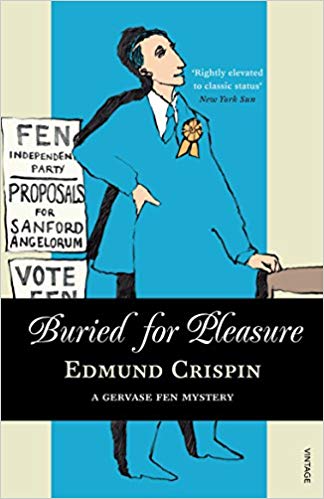
Buried for Pleasure – Edmund Crispin (1948) 176 pages
Although I’m not a big reader of contemporary crime, I do like a golden age mystery and I enjoy Crispin’s tales of amateur detective/Oxford professor Gervase Fen’s adventures. In Buried for Pleasure, Fen has left Oxford to travel to the delightfully named Sandford Angelorum, where he is standing for Parliament as an Independent.
“This panorama displeased Fen, he thought it blank and unenlivening. There was, however, nothing to be done about it except repine. He repined briefly and extracted himself and his luggage from the compartment.”
Fen stays at The Fish Inn where loud renovations undertaken by the owner blast him out of bed every morning. He seems surrounded by comely women – the bar manager, the bar maid, the local taxi driver. Thankfully once their attractiveness is established it isn’t dwelt on and there’s some good characterisation of women in this, which is not always present in GA novels. In fact, the resident detective novelist, Mr Judd, is quite scathing about the whole thing:
“Characterisation seems to me a very overrated element in fiction. I can never see why one should be obliged to have any of it at all, if one doesn’t want to. It limits the form so.”
Crispin pokes fun at everyone in this novel. Novelists, academics, and of course politicians all come in for a gentle ribbing. There is the response to Fen’s first loquacious, entirely meaningless political speech:
“ ‘You’re a natural, old boy … can you keep that sort of thing up?’
‘Indefinitely,’ Fen assured him. ‘The command of cliché comes of having had a literary training.’”
And the political system as a whole:
“ ‘Now, these Sandford people don’t know you as well as I do,’ Captain Watkyn pursued, with a confidence which their quarter-hour acquaintance did not seem to Fen entirely to justify, ‘and … they’re quite likely to elect some scoundrelly nitwit who’ll help send the country to the dogs. Therefore, they’ve got to be jollied along a bit – for their own good, d’you see?’
‘As Plato remarked.’
‘As whatsit remarked, yes.’”
This is not the GA novel to read if you’re in the mood for a good murder with plenty of suspects and clues to work out. This side of the novel – a poisoning before Fen arrives, a stabbing after he becomes resident in the village – is pretty negligible.
However, it’s funny, light, endearing, and doesn’t fall into many of the prejudices which can mar this genre, although the villagers are portrayed as a bit yokely.
Buried for Pleasure was just what I needed after the gothic tribulations of O Caledonia yesterday: complete and utter nonsense and none the worse for it 😀