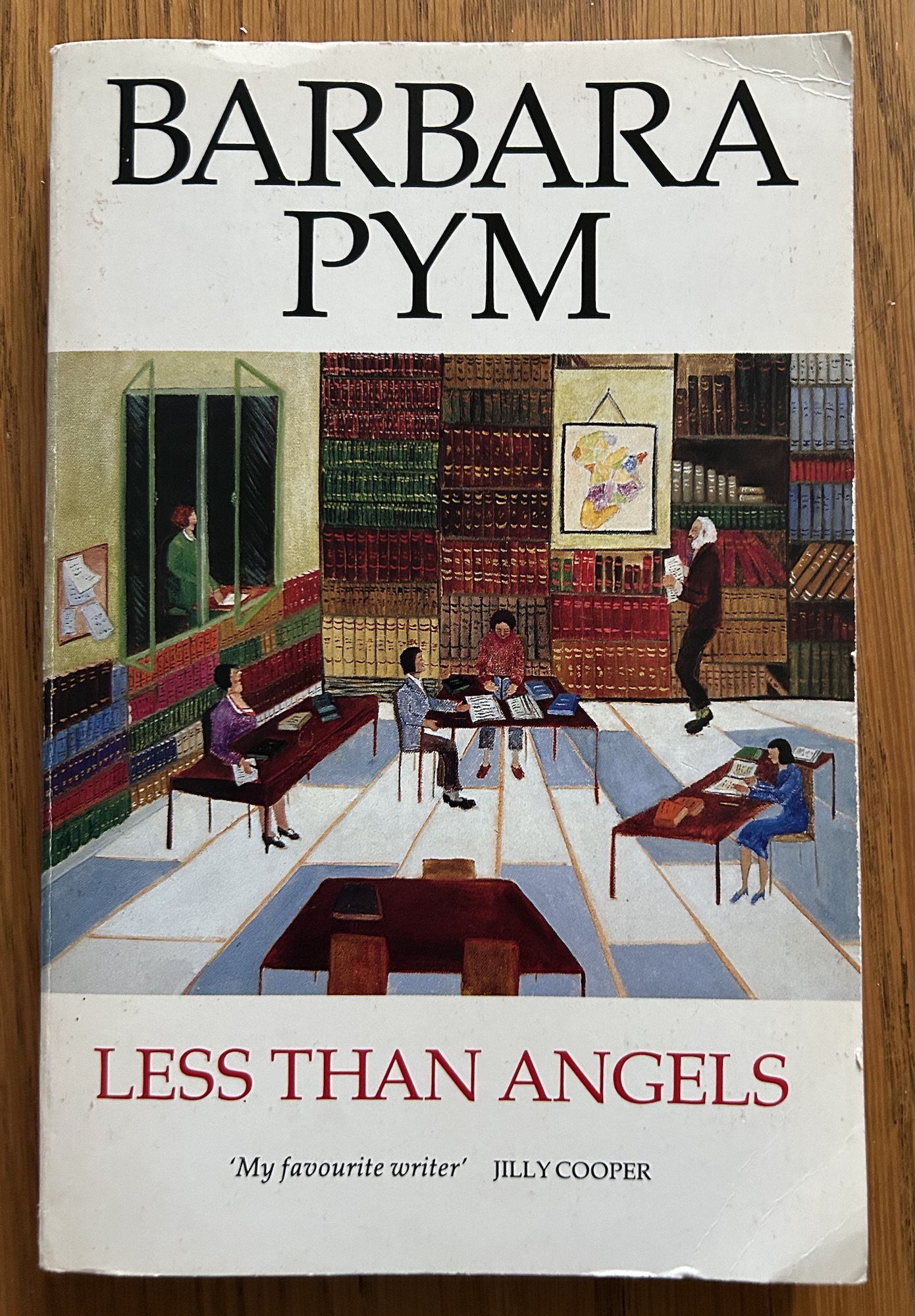
Novella a Day in May 2026 – No.10

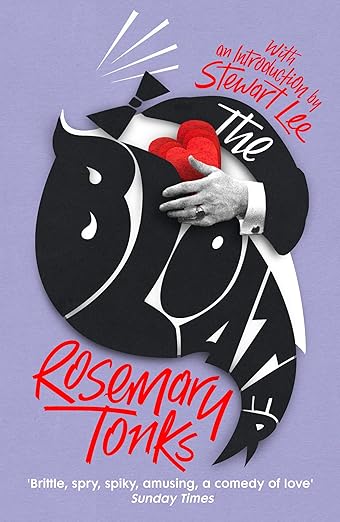
I can’t remember where I first heard about the 2022 reissue of Rosemary Tonks’ The Bloater (1968) but I remember thinking it sounded appealing. Just four short years later and here we are!

The narrator is Min, who works at the BBC Radiophonic Workshop (apparently Tonks recorded a poem with this forerunner of experimental, electronic music).

“Obviously it’s no good being slightly vulgar; you must be absolutely vulgar. Taste in the arts and theatre should never be confused with good taste, which is static and middle class.”

She is married to George, who barely gets a mention throughout the entire book. The titular Bloater is Carlos, her opera-singer tenant who is trying to seduce her, which Min seems to find in equal measure repulsive and captivating.

“And until the moment he enters it, the bedroom is only a very ordinary room with a bed in it. Then suddenly—snap pool! It’s a boudoir, it’s a dangerous liaison, it’s the fourth floor of a Lisbon brothel, it’s Madame de Pompadour and Louis XV all over again in some unaired voluptuary’s den.”

Meanwhile there is also Claudi, an older male friend caught up in the shenanigans, Fritz the cleaner, Billy her colleague and potential lover, and Jenny her colleague who is thrall to her lover ‘the guitar’. Min is jealous and adversarial towards Jenny, as she is towards so many in her life:

“She’s sitting there as though she’s just laid an egg.”

Apparently this novel took Tonks four weeks to write, with the plan of making ‘a lot of red-hot money’. While I didn’t think it was truly stream-of-consciousness as some reviews describe, I did think the somewhat plotless style wasn’t particularly suited to huge mainstream success.

For the length of a novella, I enjoyed Min’s relentless defensiveness which resulted in witty, barbed comments.  The observations are astute and the use of imagery surprising (Tonks was an experimental poet.)

Had it been longer than 142 pages, I suspect my enjoyment of The Bloater would begin to wane. Min’s immaturity means she takes out her immense fear of reflection and rejection on everyone else, which is hard to stay with over too long a period. The characterisation all-round is thin, no-one really leaps off the page as fully realised person, perhaps reflecting Min’s self-focus and fears. However, I also think if the characters were better drawn, the bitterness of the humour would be harder to take, so perhaps this was an astute comic choice overall.

There’s no doubt Tonks was a highly skilled writer, and she didn’t make The Bloater longer, she kept it short.  So claiming I wouldn’t like a novel she didn’t write really is entirely unfair! I would absolutely read more by her on the basis of this novella.

“Ah, parking! The graveyard of so many good evenings.”

To end, not the Tonks recording but a poem performance with the BBC radiophonic Workshop from around the same time:

Novella a Day in May 2026 – No.5

Following on from yesterday’s post on Gentleman Prefer Blondes, today I read the sequel But Gentlemen Marry Brunettes by Anita Loos (1927).

(Please note – some spoilers for Gentlemen Prefer Blondes!)

I’ll start with the negatives: I don’t think this quite has the sparkle of Gentlemen Prefer Blondes and it has less of the vignette style which suited Lorelei’s voice so well. I would hesitate to recommend it as a standalone novel, but as a short, diverting companion-piece to Blondes, there is still much to enjoy.

It opens with Lorelei expressing some quite modern views on marriage:

“I am full of ambitions and I think that practically every married girl ought to have a career if she is wealthy enough to have the home life carried on by the servants. Especially if a girl is married to a husband like Henry. Because Henry is quite a homebody and, if a girl was a homebody to, she would encounter him quite often.”

As Lorelei settles into married life and motherhood, Dorothy is still on hand with cynical commentary:

“And even Dorothy says that “a kid that looks like any rich father is as good as money in the bank.” I mean sometimes Dorothy becomes Philosophical, and says something that really makes a girl wonder how anyone who can make such a Philosophical remark can waste her time like Dorothy does.”

When Lorelei decides to follow a career as a writer, she heads to the Algonquin Round Table. I don’t know what Loos’ relationship was with this group, but she’s pretty biting about these literary wits:

“So then they all started to tell about a famous trip they took to Europe. And they had a marvelous time, because everywhere they went, they would sit in the hotel, and play cute games and tell reminisences about the Algonquin. And I think it is wonderful to have so many internal resources that you never have to bother to go outside of yourself to see anything.”

Lorelei decides to write about her friend Dorothy’s life, from travelling carnival, to school:

“Well, the Principal went down to Dorothy’s class and told all the girls that Dorothy had not had the advantage of a pure home, so they must form themselves into a little Committee, and help her not to stray. And after that, Dorothy really became the center of attraction, until one of the girls took a false step with a visiting football team and Dorothy lost her novelty.”

To joining the Ziegfeld Follies:

“Because hardly any broker seems to have enough Psychology to realize that the real ideal of his dreams is some small town village bell that he used to weave a romance around when he was age sixteen. But Mr. Ziegfield knows all about Psychology so that is the kind he picks out. And Dorothy says that about all Mr. Ziegfield does to “glorify” them, is to get them to comb the hay out of their hair, and give up starch in lingeray.”

For a story about Dorothy, there’s quite a lack of her biting observations, which was a shame. However, there are still some good lines:

“Gloria warned Dorothy that it would be fatal to marry a saxaphone player, without giving yourself an opertunity to get sick of him first.”

(Very reminiscent of Some Like It Hot!) And one that had a slightly Wodehouse turn of phrase:

“I mean, he could not take to drink, because he had already done that for years.”

So all in all, Loos’ wit means there is enough to enjoy if you enjoyed Blondes, and at novella-length Brunettes doesn’t outstay its welcome.

To end, we’ve had blondes and brunettes, now an extremely famous redhead, who like Dorothy was part of the Ziegfeld Follies:

Novella a Day in May 2026 – No.4

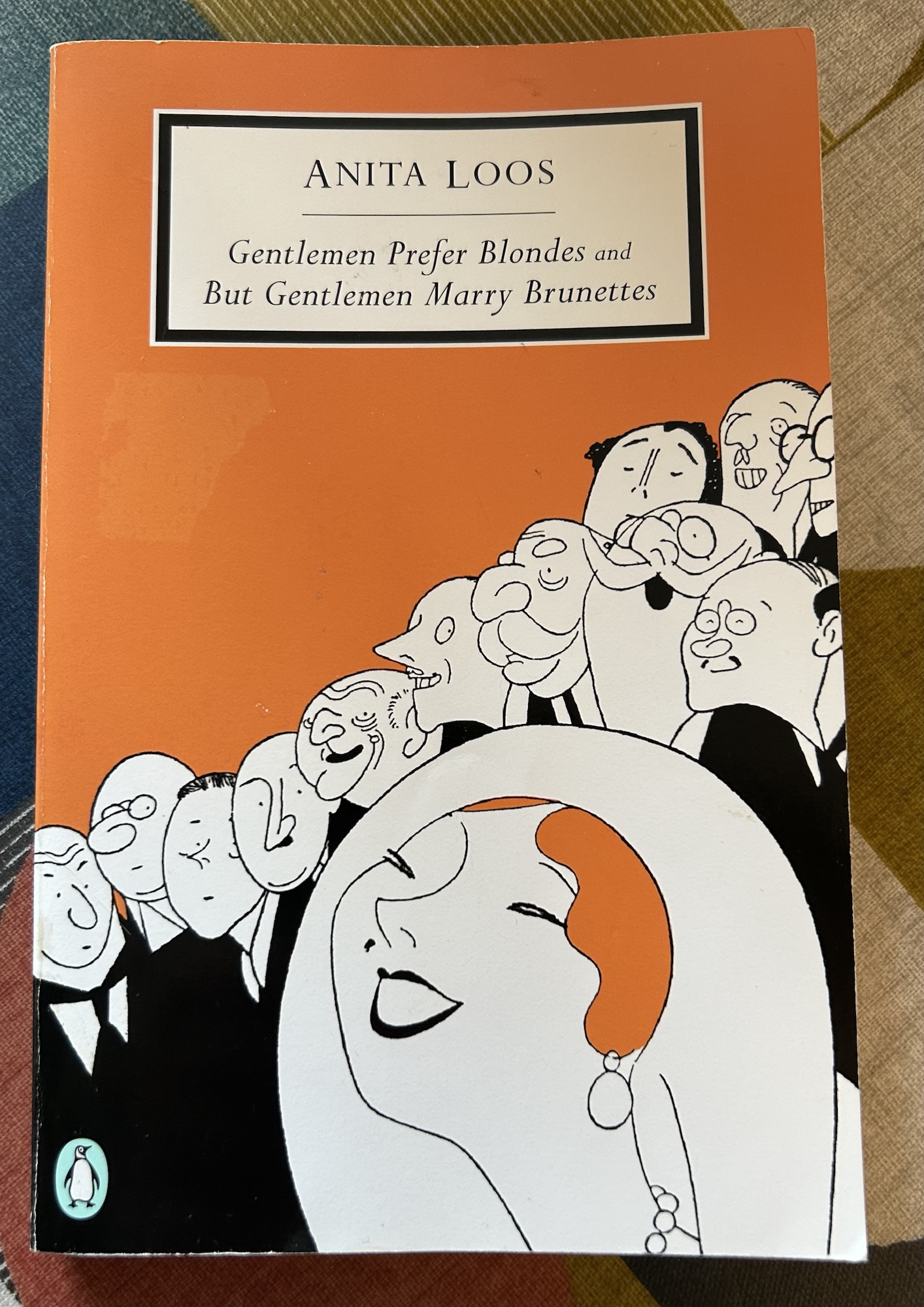
I knew of Anita Loos’ Gentlemen Prefer Blondes (1925) from the iconic 1952 filmed musical, but somehow I never got round to reading it. I found this Penguin edition of the novella plus the sequel with the original illustrations by Ralph Barton, and realised now was the time for me to spend with Lorelei Lee, gold-digging flapper.

Told in diary form, we follow Lorelei around New York and then Europe, as she dates a series of men, trying to get them to spend as much money on her as possible.

“So by the time Piggie pays for a few dozen orchids, the diamond tiara will really seem like quite a bargain. Because I always think that spending money is only just a habit and if you get a gentleman started on buying one dozen orchids at a time he really gets very good habits.”

Lorelei is also on a constant quest to improve her mind, aided by Mr Eisman who suggests she keep a diary, although it never quite works. Her attempt to host a literary salon ends thusly:

“So Sam asked if he could bring a gentleman who writes novels from England, so I said yes, so he brought him. And then we all got together and I called up Gloria and Dorothy and the gentleman brought their own liquor. So of course the place was a wreck this morning and Lulu and I worked like proverbial dogs to get it cleaned up, but Heaven knows how long it will take to get the chandelier fixed.”

She does, however, attract a novelist:

“As soon as he found out that I was literary. I mean he has called up every day and I went to tea twice with him. So he has sent me a whole complete set of books for my birthday by a gentleman called Mr. Conrad. They all seem to be about ocean travel although I have not had time to more than glance through them.”

Ultimately though, she asks her maid to read Lord Jim and then tell her what happens.

The diary forms a series of vignettes as Lorelei and her acerbic friend Dorothy ricochet from one party and one man to another, before they travel to Europe. Dorothy is quick-witted and incisive, but also much more romantic. While she falls in love on the ship to England, Lorelei bemoans the lack of spending opportunities.

“I mean I really hope I do not get any more large size imitations of a dog as I have three now and I do not see why the Captain does not ask Mr. Cartier to have a jewelry store on the ship as it is really not much fun to go shopping on a ship with gentlemen, and buy nothing but imitations of dogs.”

It is this humour and the guilessness of Lorelei’s tone that make this such an enjoyable read. She is relentlessly materialistic,  but there is nothing vicious about her.

Loos also has some serious points to make among the light comedy. Lorelei was sexually assaulted in the past, and shot her assailant. In court, she was subject to misogynistic destruction of character. As she observes:

“I mean a gentleman never pays for those things but a girl always pays.”

There is a sense that she feels that men are still getting the better deal, when all they lose is money.

“I mean I always seem to think that when a girl really enjoys being with a gentleman, it puts her to quite a disadvantage and no real good can come of it.”

The reader also questions who is using who. Lorelei wants money, but what do this succession of men really want – do any of them truly care for Lorelei and are they even taken in by her?

When she and Dorothy are in London, they are mistaken for rich and subsequently invited to a series of aristocratic homes because people want to flog them things:

“So we went to tea to a lady’s house called Lady Elmsworth and what she has to sell we Americans seems to be a picture of her father painted in oil paint who she said was a whistler. But I told her my own father was a whistler and used to whistle all of the time and I did not even have a picture of him but every time he used to go to Little Rock I asked him to go to the photographers but he did not go.”

This is a perfect example of how Loos captures Lorelei’s ignorance but she is not the butt of the joke. Not knowing who Whistler is stops her being ripped off. Similarly, I usually dislike non-standard spellings to demonstrate a character’s poor education as condescending, but with Lorelei it serves to remind the reader that she is young and naïve and not to judge her actions too harshly.

“The Eyefull Tower is devine and it is much more educational than the London Tower, because you cannot even see the London Tower if you happen to be two blocks away. But when a girl looks at the Eyefull Tower she really knows she is looking at something. And it would even be very difficult not to notice the Eyefull Tower.”

I mean, she’s not wrong…

The other way Loos achieves balance is through Dorothy’s reported comments, cutting through any suggestion of whimsy:

“Dorothy looked at me and looked at me and she really said she thought my brains were a miracle. I mean she said my brains reminded her of a radio because you listen to it for days and days and you get discouradged and just when you are getting ready to smash it, something comes out that is a masterpiece.”

Gentlemen Prefer Blondes is a clever, entertaining satire on early twentieth century materialism, relationships between the sexes, and the choices available to women. Lorelei is somehow charming, and Loos never loses sight of the comedy – a protracted farce with a diamond tiara is particularly entertaining!

I think I’ll try the sequel for tomorrow, but I understand its not quite as accomplished. Fingers crossed that it is still enjoyable…

“I mean champagne always makes me feel philosophical because it makes me realize that when a girl’s life is as full of fate as mine seems to be, there is nothing else to do about it.”

The tone of the film is frothier, but of course I’ll end with the trailer of Marilyn Monroe as Lorelei and Jane Russell as Dorothy:

“She had adored her husband, and was very fond of her French pepper-mill.” (Margery Sharp, The Foolish Gentlewoman)

It’s been a busy month trying to get to grips with my new job, but I’m delighted to contribute to Dean Street December, hosted by Liz at Adventures in Reading, Running and Working from Home. This reading event provides a lovely end to the reading year, and it encouraged me to get The Foolish Gentlewoman by Margery Sharp (1948) off the TBR, which Dean Street Press publish as part of their Furrowed Middlebrow imprint.

I really enjoy Margery Sharp’s comic eye, and there’s a perfect example early in this novel in a description of the family’s Sealyham:

“His shaggy eyebrows and meditative gaze gave him an old-gentleman look; he sat there like a retired Colonel, newspaper laid aside, contemplating Socialism.”

The terrier’s family are hodgepodge: widowed fifty-five year old Isabel Brocken, “sentimental, affectionate, uncritical,” and her priggish brother-in-law Simon:

“Mr Brocken was not conceited enough to perceive in himself any compensating charms. To be loved without reason did not flatter him. He put up with Isabel’s affection, as he put up with Isabel, because he had to.”

As well as two younger people staying at the house: Isabel’s nephew Humphrey and her companion Jacqueline, both recovering from the recent war.

This unlikely group live a life of very little strife, ensconced in Isabel’s old family home of Chipping Lodge, sat in a suburb of London which escaped the bombs. (Unlike Simon’s house which is why he finds himself having to tolerate other people, while it is rebuilt.)

Keeping them in domestic order are the self-contained housekeeper Mrs Poole and her teenage daughter Greta.

Their domestic peace is shattered when Isabel invites her old school friend Tilly Cuff to stay indefinitely. The motivation stems from a perceived injustice she did to Tilly years ago, and a plan to make amends. For Tilly does not seem to have thrived:

“No-one ever fell in love with Tilly, not even curates.”

Simon, Humphrey and Jacqueline are horrified. Firstly by Isabel’s plan to leave Tilly all her money, and secondly by Tilly herself:

“Is she to be allowed to beggar herself for the sake of a peculiarly offensive incubus?”

Sharp is always good at villains without caricature, and Tilly is a perfect example. She is manipulative and mendacious, particularly towards Greta Poole. It is Greta and her mother that provide the greatest emotional engagement in the novel: Tilly’s treatment of them shows her to be a real threat, and Simon’s attitude towards them shows him not to be irredeemably hard-hearted.

Yet Tilly is also shown to be vulnerable, lonely and defensive. Although she is powerful in her ability to completely destabilise the entire household, really she has less resources, personal and financial, to draw on than anyone else.

I found The Foolish Gentlewoman to be a surprising page-turner, as I wanted to see how the household would escape Tilly! And yet, things didn’t quite pan out as I expected. Sharp has fun with confounding reader’s expectations:

“To set one’s foot on a tragic stage, and find that the part thrust into one’s hand belonged to a domestic comedy: to read on, and perceive in prospect a crisis after all potentially tragic: to turn the last page upon anticlimax. How inartistic, and yet how life like!”

Yes, anti-climatic in a sense, but wholly satisfying and enjoyable. I particularly liked the happy ending arranged for Simon:

“With no less than five persons had Mr Brocken narrowly escaped, if not intimacy, a degree of acquaintance that would have allowed any one of them to become a nuisance to him.”

A gentle joy made readily available thanks to the excellent Dean Street Press and Furrowed Middlebrow.

Novella a Day in May 2025: No.12

The Maintenance of Headway – Magnus Mills (2009) 152 pages

I remember quite clearly when Magnus Mills’ first novel The Restraint of Beasts, was published in 1998 and shortlisted for the Booker. He was a London bus driver, and so the story made the regional news and I realised he actually drove my local routes. In The Maintenance of Headway, Mills draws on this occupational experience and there was plenty I recognised, as well as thankfully some I didn’t!

The title refers to “the notion that a fixed interval between buses on a regular service can be attained and adhered to.”

This deceptively simple idea is in fact impossible to achieve.

“In this city it’s different. The streets are higgledy-piggledy and narrow; there are countless squares and circuses, zebra crossings and pelicans. Go east from the arch and you’ve got twenty-three sets of traffic lights in a row. All those shops, and all those pedestrians pouring into the road. Then there are the daily incidentals: street markets, burst water mains, leaking gas pipes, diesel spillages, resurfacing road works, ad hoc refuse collections, broken-down vehicles, troops on horseback, guards being changed, protest marches, royal cavalcade and presidential motorcade. Shall I go on?”

This was already starting to sound very familiar 😀

The bus drivers know maintaining headway is impossible, but they are subject to the inspectors, who also know its impossible. Various measures are taken each day to attempt to meet the impossible. At one point, one of the managers tells the narrator off for arriving six minutes late, in theory.

“’See how it accumulates? See the potential for outright bedlam? Your failure to be punctual could make a million people late for work!’

Frank sat behind his desk and bristled with imaginary rage.

‘Sorry,’ I said.

‘That’s alright,’ he replied. ‘Don’t let it happen again though.’”

Similar surrealism exists away from the depot on the bus journeys themselves:

“Strictly speaking there existed an imaginary line in front of which passengers weren’t supposed to stand. This was difficult to enforce, however, when people simply kept piling into the vehicle. In the past I tried making announcements in which I’d asked them ‘not to stand forward of the imaginary line,’ but they never took any notice.”

The city is never specified but there are various allusions to London: three stations, one Gothic flanked by two utilitarian “Cinderella and her ugly sisters” sounds like St Pancras, King’s Cross and Euston; the “southern outpost” is Crystal Palace; the “bejewelled thoroughfare” is Oxford Street. There are also frequent references to the obsolete, conductor-staffed “Venerable Platform Bus” which are the much-missed Routemaster buses. These various allusions add to the atmosphere that Mills is so adept at creating, of a world at once recognisable and oddly disconcerting.

If you’re yet to try Mills then Headway may not be the best place to start as I didn’t find it quite as sparkling as some of his other work. However, I’ve been a fan of his since The Restraint of Beasts, and if you are too there’s plenty to enjoy: the deadpan humour; the surreal quality never quite articulated; a dark edge questioning free will; a bleakness offset by a light touch. I’ll read anything he writes and it always feels like time well spent. Ironically, this is often an elusive quality to his characters.

“If the bus happens to arrive on schedule it’s good for the public record but little else. Nobody believes the timetables. Waiting for buses is therefore paradoxical.”

“People think because a novel’s invented, it isn’t true. Exactly the reverse is the case.” (Anthony Powell, Hearing Secret Harmonies)

I did it! This is the final instalment in my 2024 resolution to read a book per month from Anthony Powell’s A Dance to the Music of Time sequence. I’d been put a bit behind by labyrinthitis but I finished on 31 December. I’d hoped to write and post this the same day but I got distracted by my Christmas jigsaw puzzle on The World of Virginia Woolf 😀

Published between 1951 and 1975, and set from the early 1920s to the early 1970s, the sequence is narrated by Nicholas Jenkins, a man born into privilege and based on Powell himself. The twelfth volume, Hearing Secret Harmonies, was published in 1975 and opens in 1968.

Much of Hearing Secret Harmonies is concerned with the past but it opens by introducing a new character, the sinister Scorpio Murtlock who is camping on Nick and Isobel’s land with some of his followers. Nick, always such an astute observer of people, is not taken in by Murtlock’s charisma:

“When Murtlock smiled the charm was revealed. He was a boy again, making a joke, not a fanatical young mystic. At the same time he was a boy with whom it was better to remain on one’s guard.”

“Murtlock himself possessed to a marked degree that characteristic – perhaps owing something to hypnotic powers – which attaches to certain individuals; an ability to impose on others present the duty of gratifying his own whims.”

It’s a masterstroke of Powell’s writing that while Murtlock remains elusive, he is also deeply unnerving. There’s no doubt as to how dangerous he could be, fully realised by the novel’s end.

Nick then attends two dinners which work well as devices for him to meet past friends and acquaintances, drawing them into the final sequences, and alerting the reader as to has left the Dance for good. There is a sense of time folding in on itself:

“Members, his white hair worn long, face pale and lined, had returned to the Romantic Movement overtones of undergraduate days.”

And of course Widmerpool, Nick’s talisman of sorts, reappears. He is quite extraordinary: a former beacon of the Establishment now refuting his knighthood, asking to be called Ken, wearing a grubby red polo neck to formal occasions and focussing on the power of 1960s youth movements for societal change. His involvement with Scorpio Murtlock seems inevitable…

This final volume works well in balancing reflections of the past without becoming overly contrived. There is a sense of reflection occurring organically, without being maudlin, sentimental or nostalgic. Powell is far too astute and insightful for the ending to take such tones.

There’s also a great deal of humour, from larger set pieces with Murtlock’s naked dancing cult providing a bathetic contrast with the central image of the novel sequence:

“It was not quite the scene portrayed by Poussin, even if elements of the Season’s dance was suggested in a perverted form; not least by Widmerpool, perhaps naked, doing the recording.”

To smaller moments such as disagreement over paintings at a retrospective of Deacon’s work:

“Well Persepolis isn’t unlike Battersea Power Station in silhouette.”

And Nick’s various assessments of himself:

“Pressures of work, pressures of indolence.” (my life frustrations in a sentence!)

“These professional reflections, at best subjective at worst intolerably tedious,”

I have really enjoyed reading A Dance to the Music of Time and it hasn’t been an arduous undertaking at all. I’m sure it will reward re-reading; there are so many allusions and subtleties that have certainly passed me by. For me, the sequence peaked with the war trilogy, but each novel held its own joys, working on an individual level as well as part of a whole sequence. I’m going to really miss Nick, even though he remained half-hidden to me throughout the twelve volumes.

“Two compensations for growing older are worth putting on record as the condition asserts itself. The first is a vantage point gained for acquiring embellishments to narratives that have been unfolding for years beside one’s own, trimmings that can even appear to supply the conclusion of a given story, though finality is never certain, a dimension always possible to add.”

“Reading novels needs almost as much talent as writing them.’ (Anthony Powell)

This is the eleventh instalment in my 2024 resolution to read a book per month from Anthony Powell’s A Dance to the Music of Time sequence. Published between 1951 and 1975, and set from the early 1920s to the early 1970s, the sequence is narrated by Nicholas Jenkins, a man born into privilege and based on Powell himself.

The eleventh volume, Temporary Kings, was published in 1973 and is set towards the end of the 1950s. I can’t believe I’m at the penultimate volume!

I’m writing this as I recover from labyrinthitis; today is the first time I’ve been able to sit up after two and a half days flat on my back. So I’m not sure how much sense this post will make, but I wanted to get it written in November. Please bear with me!

Temporary Kings is set for the most part at a cultural conference in Venice in 1958, which Nick has been sent to somewhat unwillingly, by Mark Members who has organised it but can’t be bothered to go himself.

I felt a sense of slowing down, as old acquaintances arrive and new people join the dance; it is almost a series of character sketches. Given Powell’s enormous talent for incisive but never cruel summations of people in just a few lines, this made for an enjoyable read.

For example, how’s this for a description of Louis Glober, a filmmaker:

“What did not happen in public had no reality for Glober at all. In spite of the quiet manner, there was no great suggestion of interior life. What was going on inside remained there only until it could be materially expressed as soon as possible.”

I also liked the new character of Dr Brightman, an academic who:

“had made clear a determination to repudiate the faintest suspicion of spinsterish prudery that might, very mistakenly, be supposed to attach to her circumstances.”

The Widmerpools turn up trailing controversy in their wake: Kenneth has lost his seat as an MP and so given a knighthood and a seat in the Lords (sigh…) and Pamela has been embroiled in a sex scandal. I do enjoy Pamela’s relentless creation of discomfort wherever she goes:

“She had the gift of making silence as vindictive as speech.”

On returning to the UK, Nick finds the conference hard to shake off:

“The conference settled down in the mind as a kind of dream, one of those dreams laden with the stuff of real life, stopping just the right side of nightmare, yet leaving disturbing undercurrents to haunt the daytime, clogging sources of imagination – whatever those may be – causing their enigmatic flow to ooze more sluggishly than ever, periodically cease entirely.”

There is an unsettling feeling to the scenes, and sense of so much unknown among the characters which could implode at any moment. Somehow it doesn’t entirely, but I felt a creeping sense of doom alongside the belief that things will just carry on.

We also have Stringham’s suspected death in a POW camp confirmed. More than any other, that character broke my heart.

Towards the end of the novel, Nick reflects:

“One’s fifties, in principle less acceptable than one’s forties, at least confirm most worst suspicions about life, thereby disposing of an appreciable tract of vain expectation, standardised fantasy, obstructive to writing, as to living […] After passing the half-century, one unavoidable conclusion is that many things seeming incredible on starting out, are, in fact, by no means to be located in an area beyond belief.”

This is a terrible post and I’ve missed so much out! I blame my ears 😉 But I hope it’s given something of the sense of the novel.

Paula’s recent Winding Up the Week post alerted me to this wonderful article about Violet Pakenham, Anthony Powell’s wife and her role in the production of Dance. It’s also a great portrait of postwar Bohemian family life. I really recommend it and you don’t have to have read any of Powell to enjoy it.

To end, a song from 1972 but a UK hit the same year as Temporary Kings was published. I chose it from many 1973 hits because after 11 volumes, Nick still remains somewhat elusive to me as a reader:

“It is not what happens to people that is significant, but what they think happens to them.“ (Anthony Powell)

This is the tenth instalment in my 2024 resolution to read a book per month from Anthony Powell’s A Dance to the Music of Time sequence. Published between 1951 and 1975, and set from the early 1920s to the early 1970s, the sequence is narrated by Nicholas Jenkins, a man born into privilege and based on Powell himself.

The tenth volume, the wonderfully titled Books Do Furnish a Room, was published in 1971 and is set just after World War Two. (If you google, there are some marvellous images of Anthony Powell in his book-furnished study, reclining on a red chaise longue 😊)

It opens with Nick back at Oxford, researching a book on Burton’s Anatomy of Melancholy and meeting old tutor Sillery. At the end of the novel he again returns to an educational establishment from his past, organising a place for his son at Eton and meeting old tutor Le Bas. Between times, he is in London, part of a literary scene, where people are trying to re-establish themselves after the upheaval of the preceding years.

“The war had washed ashore all sorts of wrack of sea, on all sorts of coasts. In due course, as the waves receded, much of this flotsam was to be refloated, a process to continue for several years, while the winds abated. Among the many individual bodies sprawled at intervals on the shingle, quite a lot resisted the receding tide. Some just carried on life where they were on the shore; others – the more determined – crawled inland.”

After the focus on companies of men in the war trilogy, much of this novel reads like an extended character study of one person: author X Trapnel. And what a character he is – uncommonly bearded (for the time), wearing a safari suit, tie embossed with nude ladies, and dyed black RAF greatcoat, he carries a skull-topped sword stick.

“When he began to talk, beard, clothes, stick, all took shape as necessary parts of him, barely esoteric, as soon as you were brought into relatively close touch with the personality. That personality, it was at once to be grasped, was quite tough.”

And yet:

“The practical expression of the doctrine of ‘panache’… played a major part in Trapnel’s method of facing the world.”

As with all Powell’s characterisations, his presentation of Trapnel is clear-sighted but never nasty. He has a way of being unsentimental but never unpleasant; discerning but non-judgemental. He seems to enjoy people as they are.

“No brief definition is adequate. Trapnel wanted, among other things, to be a writer, a dandy, a lover, comrade, and eccentric, a sage, virtuoso, a good chap, a man of honour, hard case, spendthrift, an opportunist, a raisonneur; to be very rich, to be very poor, to possess a thousand mistresses, to win the heart of one love to whom he was ever faithful, to be on the best of terms with all men, to avenge savagely the slightest affront, to live to a hundred full years and honour, to die young and unknown but recognised the following day as the most neglected genius of the age.”

Around Trapnel swirl the other characters and events of this time. He is employed by publishers Quiggin and Craggs to write for a new magazine, Fission. The ever-present Widmerpool is an investor, and his beautiful wife Pamela continues to bring disdain and chaos with her wherever she goes.

Widmerpool is an MP, as is Nick’s brother-in-law Roddy Cutts, and I enjoyed this brief portrait of Nick’s visit to Westminster:

“We rose from the table, exchanging the claustrophobic pressures of the hall where the meal had been eaten, for a no less viscous density of parliamentary smoking rooms and lobbies, suffocating, like all such precincts, with the omnipresent and congealed essence of public contentions and private egotisms; breath of life to their frequenters.”

Where of course he and Roddy run into Widmerpool:

“The two MP’s were in sharp competition as to whose passion for directness and simplicity was the more heartfelt, at least could be the more forcibly expressed.”

There are also some great descriptions of the seedier parts of London (now very swish areas, but back then poorer and war torn).

Books Do Furnish a Room is quite a contrast to the immediately preceding war novels and a really effective evocation of a chaotic and impoverished postwar London literary scene. I can’t believe there’s only two more left in the sequence for me to read.

“It turned out in due course that Trapnel impersonations of Boris Karloff were to be taken as a signal that a late evening must be brought remorselessly to a close.”

“One often felt ungrateful in literary matters, as in so many others.” (Anthony Powell)

This is the ninth instalment in my 2024 resolution to read a book per month from Anthony Powell’s A Dance to the Music of Time sequence. Published between 1951 and 1975, and set from the early 1920s to the early 1970s, the sequence is narrated by Nicholas Jenkins, a man born into privilege and based on Powell himself.

The ninth volume, The Military Philosophers, was published in 1968 and is set in the latter part of World War Two. It forms the final part of the war trilogy within the sequence, after The Valley of Bones and The Soldier’s Art.

Nick is working in Whitehall as a military liaison during the later stages of the war, and Powell captures the quirks and foibles of his colleagues in these powerful – for some – administrative roles. He demonstrates how soldiers are still people with all their flaws; and how everyday concerns run alongside such enormous ones as the fate of nations and the likelihood of imminent death.

During an air raid, Nick reflects:

“Rather from lethargy than an indifference to danger, I used in general to remain in my flat during raids, feeling that one’s nerve, certainly less steady than at an earlier stage of the war, was unlikely to be improved by exchanging conversational banalities with neighbours equally on edge.”

While I don’t suppose Powell was anti-war or anti-establishment, he brings his clear sight to all he portrays, including the venerated men of war. An imposing portrait of the man who came to personify the previous war is described:  

“Kitchener’s cold and angry eyes, haunting and haunted, surveying with the deepest disapproval all who came that way.”

And in a rare instance of Powell describing a real-life character (though never named), Field-Marshall Montgomery is all too believably portrayed:

“An immense, wiry, calculated, insistent hardness […] one felt that a great deal of time and trouble, even intellectual effort of its own sort, had gone into producing this final result. The eyes were deep set and icy cold.”

There’s absolutely no jingoism in The Military Philosophers. Nick is a loyal soldier, but he doesn’t automatically equate the behaviour of his country with honourable deeds:

“The episode strongly suggested that the British, when it suited them, could carry disregard of all convention to inordinate length; indulge in what might be described as forms of military bohemianism of the most raffish sort.”

Truly terrifying is the development of Widmerpool in this volume. Already a deeply unnerving character, Powell has him arrive in the volume with some levity:

“‘You must excuse me,’ he said. ‘I was kept by the Minister. He absolutely refused to let me go.’

 Grinning at them all through his thick lenses, his tone suggested the Minister’s insistence had bordered on sexual importunity.”

Later we are reminded of Widmerpool’s absolute lack of any morality, when he describes the Kattyn Forest Massacre as merely “regrettable”.

By the end, he is truly sinister, observing “I have come to the conclusion that I enjoy power.” He informs Nick that he will revel in the command of empire overseas. The racism is explicitly stated; the violence of imperialism implied.

Various associates from Nick’s past reappear in his life. We learn that Nick’s childhood friends Stringham and Templar are both most likely dead, and sadly so is my favourite character General Conyers, succumbing to a heart attack after chasing looters and trying to stop the theft of a refrigerator.  

Stringham’s niece, Pamela Flitton, plays a significant role in this volume, essentially by sleeping with a lot of different men and being furious the whole time. Let’s just say her taste in partners leaves a lot to be desired…

There are lighter moments too, and I particularly enjoyed Nick’s colleague Finn risking both a court martial and being stripped of his VC, in his desperation to collect a fresh salmon and using a military car to do so.

The volume ends with the Victory Service at St Paul’s, and then Nick going to collect some civilian clothes at Olympia. It is a subdued ending, deliberately so.

“Everyone was by now so tired. The country, there could be no doubt, was absolutely worn out.”

I found the tone very moving, reflective of all the loss that had been experienced through the war years and all that must now be endured in the immediate post-war period.

“The London streets by this time were, in any case, far from cheerful: windows broken: paint peeling: jagged, ruined brickwork enclosing the shells of roofless houses. Acres of desolated buildings, the burnt and battered City lay about St Paul’s on all sides.”

“Everything alters, yet does remain the same.” (Anthony Powell)

This is the eighth instalment in my 2024 resolution to read a book per month from Anthony Powell’s A Dance to the Music of Time sequence. Published between 1951 and 1975, and set from the early 1920s to the early 1970s, the sequence is narrated by Nicholas Jenkins, a man born into privilege and based on Powell himself.

The eighth volume, The Soldier’s Art, was published in 1966 and is set in 1941.Unlike the previous few novels, this only had three chapters, the middle one depicting Nick’s leave in London, bookended by his experiences in the army while still billeted in Northern Ireland.

As I mentioned in the previous volume’s post, Nick doesn’t really fit in with army life. But he doesn’t particularly labour on this, or feel sorry for himself. I enjoyed this exchange when he runs into Bithel again:

“’Told me you were a reader – like me – didn’t you?’

‘Yes I am. I read quite  a lot.’

I no longer attempted to conceal the habit, with all its undesirable implications. At least admitting to it put one in a recognisably odd character of persons from whom less need be expected than the normal run.”

In this volume I felt I saw a much fuller picture of Nick’s touchstone Widmerpool. Is machinatious a word? If it isn’t, the character of Widmerpool suggests it should be, because his machinations inform his behaviour through and through.

Nick is acting as his secretary, desperate to get away.

“Indeed, it was often necessary to remind oneself that low spirits, disturbed moods, sense of persecution, were not necessarily the consequences of serving in the army, or being part of a nation at war, with which all inclusive framework depressive mental states now seemed automatically linked.”

Nick manages to stay out of Widmerpool’s connivances due to the latter’s egomaniacal need for control. However, he can observe his senior officer’s behaviour at much close quarters than before, including:

“An amateur soldier in relation to tactical possibilities, and … a professional trafficker in intrigue”

“[My] incredulity was due, I suppose, to an underestimation, even after the years I had known him, of Widmerpool’s inordinate, almost morbid self-esteem.”

By the end of the novel Widmerpool is moving on, and I had a horrible feeling that by the end of this novel sequence he might be Prime Minister…

Another of Nick’s schoolfriends is present in the company. Stringer, maintaining his sobriety, turns up as a mess waiter.

“Friendship, popularly represented as something simple and straightforward – in contrast with love – is perhaps no less complicated, requiring equally mysterious nourishment”

Stringer is an intriguing character, with a deep sense of sadness about him. We’ve never learnt what led him to self-medicate with alcohol, and now he is sober he seems to have an extreme resignation to life. He seems too equanimous, knowing no joy. I find him quite haunting.

In the middle chapter Nick uses his leave to visit friends in London. His wife Isobel and young child get a passing reference. If I was Isobel I’d be mightily annoyed that my husband spent his army leave in Blitz-torn London rather than in the country with his newly-expanded family, but maybe she’s more tolerant than I am.

This middle section was hugely moving. Powell conveys the tragedy of war, of lives cut short without warning. Of the senseless waste and cruel arbitrariness of it all. He does it all with understatement which perfectly drives home the horror, and how this became a regular occurrence for so many. It was an astonishing chapter.

It is in army life that Powell finds his comedy and satire. This was probably the most sad, most moving, and most silly and funny of all the volumes I’ve read so far.

I particularly enjoyed a completely daft dinner scene between two Colonels, one called Eric, one called Derrick. Powell uses the rhyming names to full effect, having both of them end their sentences with the other’s name, as they engage in a furious, but politely mannered argument.

“Both habitually showed anxiety to avoid a junior officer’s eye at meals in case speech might seem required. To make sure nothing so inadvertent should happen, each would uninterruptedly gaze into the other’s face across the table, with all the fixedness of a newly engaged couple, eternally enchanted by the charming in appearance of the other.”

There’s also Nick’s experience of inciting the wrath of a General, when he admits he doesn’t like Trollope and prefers another author:

“‘There’s always Balzac, sir.’

‘Balzac!’

General Liddament roared the name. It was impossible to know if Balzac had been a very good answer or a very bad one.”

The more I read of this sequence the more impressive I find it. Powell’s wit, humanity, clear-sightedness, and ability to balance the various aspects of life are really extraordinary. And he does it all with such a light touch.

“All the same, although the soldier might abnegate thought and action, it has never been suggested that he should abnegate grumbling.”

To end, I’m feeling quite smug for working out that I can shoehorn in an 80s pop video by choosing one by some of the Blitz Kids (and fair to say 80s pop videos did not generally follow an Anthony Powell-esque light touch 😀 ):