“From the end spring new beginnings.” (Pliny the Elder)

This week I thought I’d look at the endings of novels, as a companion piece to my last blog post, which looked at beginnings.  Doing this without giving away huge spoilers may be a bit of a challenge but I’ll do my best!

Firstly, Brokeback Mountain by Annie Proulx (4th Estate, 1999). I’m going to assume a certain amount of knowledge here as there was a hugely successful film made of this short story, but I’ll still try not to tell you exactly what happens.  The ending is this:

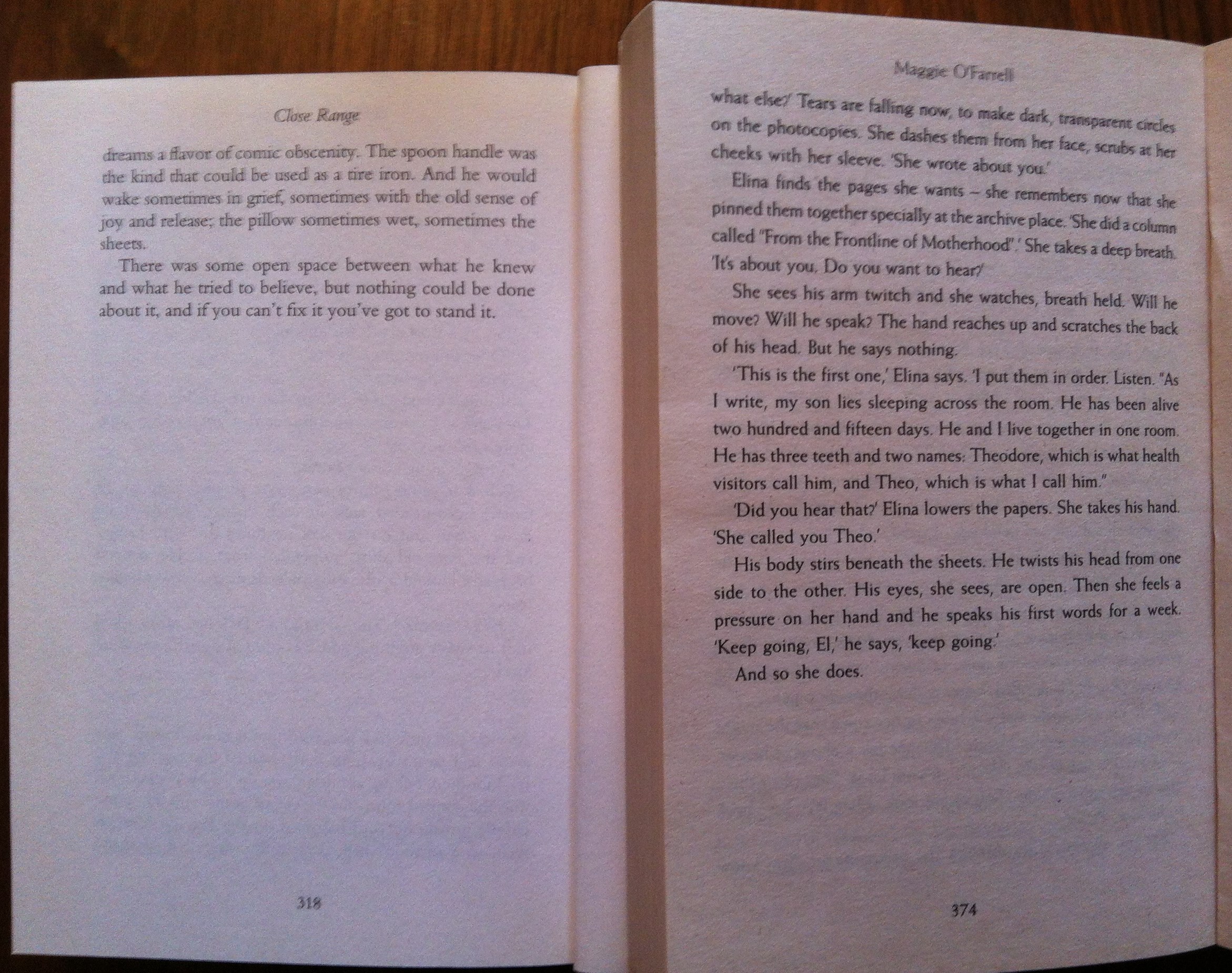
“There was some open space between what he knew and what he tried to believe, but nothing could be done about it, and if you can’t fix it you’ve just got to stand it.”

This is from the point of view of Ennis, a cowboy in 1960s America, who falls in love with his co-worker, Jack, when they are ranchers on the titular mountain.  The two of them are emotionally illiterate, they have no words with which to try and understand their experience.  This end line is just perfect for their story; Proulx’s sparse writing style with simple imagery like “open space” portrays their terse love affair (conducted mainly outdoors)and Ennis’ contained character exactly.  The language is all the more powerful for its simplicity “you’ve just got to stand it” capturing the heart-breaking stoicism of someone who ultimately feels powerless to lead an authentic life, to close that gap between what he knows and what he tries to believe.

It’s a story of a romance, but it’s determinedly unromantic:

“The room stank of semen and smoke and sweat and whiskey, of old carpet and sour hay, saddle leather, shit and cheap soap.  Ennis lay spread-eagled, spent and wet, breathing deep, still half tumescent, Jack blowing forceful cigarette clouds like whale spouts…”

Reading Proulx is often like this, a multi-sensory, unflinching experience. She also has a great ear for dialogue, adding to the sense of her stories’ authenticity.  Proulx has spoken about how highly she values the short story form, and so what you get in Brokeback Mountain is a perfectly crafted gem, where not one word is wasted.

Proulx has spoken warmly of the film adaptation of the story, particularly Heath Ledger’s portrayal of Ennis. Here is how that ending was interpreted in Ang Lee’s sensitive 2005 film version of the story:

Secondly, The Hand that First Held Mine by Maggie O’Farrell.  I read this fairly recently, and I found the last lines quite moving, so I thought I’d include them here.  They are:

“ “Keep going, El,” he says, “keep going.”

And so she does.”

These simple phrases capture a lot.  The story is one of families, the secrets and lies that can make up the relationships people hold with their nearest and dearest.  It’s a dual narrative, telling the story of Lexie Sinclair who leaves home to be with the worldly Innes Kent in London in the 1950s, and Elina, living in contemporary London, trying to hold on to a sense of self in the disorienting aftermath of having a baby:

“Elina jerks awake.  She is puzzled by the darkness, by the way her heart is fluttering in her chest.  She seems to be standing, leaning against a wall of surprising softness.  Her feet feel a long way away from her.  Her mouth is dry, her tongue stuck to her palate.  She has no memory at all of what she is doing here , standing in the dark, dozing like this against a wall.  Her mind is blank, like a ream of unmarked paper.  She turns her head suddenly, with a great heaving, everything swerves on its axis because she sees the window, she sees Ted next to her, she sees that she is not in fact standing.  She is lying.  On her back, hands clasped over her chest, a stone lady on a tomb.”

Elina’s partner is Ted, and as Elina finds her way back into the world it gradually emerges that Ted’s parents have not told him the whole truth about his life.  As Elina and Ted attempt to unravel the mystery, the two narratives converge.

I don’t want to say too much more for fear of spoilers, but what I will say is that THTFHM is a highly readable examination of the absolute havoc families can wreak on each other; of how powerful the truth can be, and its forceful drive towards exposure no matter what.  All the pain and turmoil often sits alongside love, and in the end all we can do is keep going.  The last few lines are an understated, realistic and hopeful ending.  The novel details the complexities of the ties that bind within a well-paced plot that ensures the reader keeps going until the last line.
Image

“Beginnings are always messy.” (John Galsworthy)

This week I started my final year at uni.  Things could get a little patchy on the blog front from here on in, but I really want to try and keep it going on a regular basis, so hopefully service will be uninterrupted by essays, tutorials, presentations, deadlines, exams….eek.  In honour of the new term, I thought I’d look at beginnings in books.  Not that this is a great new beginning for me – as a mature student I’ve been here many, many times before, so much more than is necessary.  But a beginning it is, and so on we go!

Firstly, Behind the Scenes at the Museum by Kate Atkinson (Black Swan, 1995).  This was Kate Atkinson’s first novel; nowadays she is well-known as the author of the Jackson Brodie novels (Case Histories, One Good Turn, When Will There Be Good News, Started Early Took My Dog) but this was before she turned her hand to detective fiction.  Let us just pause for a minute to consider the BBC trailer for their excellent adaptation of the Brodie novels:

Was that just an opportunity to gratuitously observe the craggily gorgeous and highly talented Jason Isaacs without his top on?  Yes it was.  (But I do recommend both the books and the TV series). Now back to books.  BTSATM is told from the point of view of Ruby, from the moment of her conception.  The novel begins:

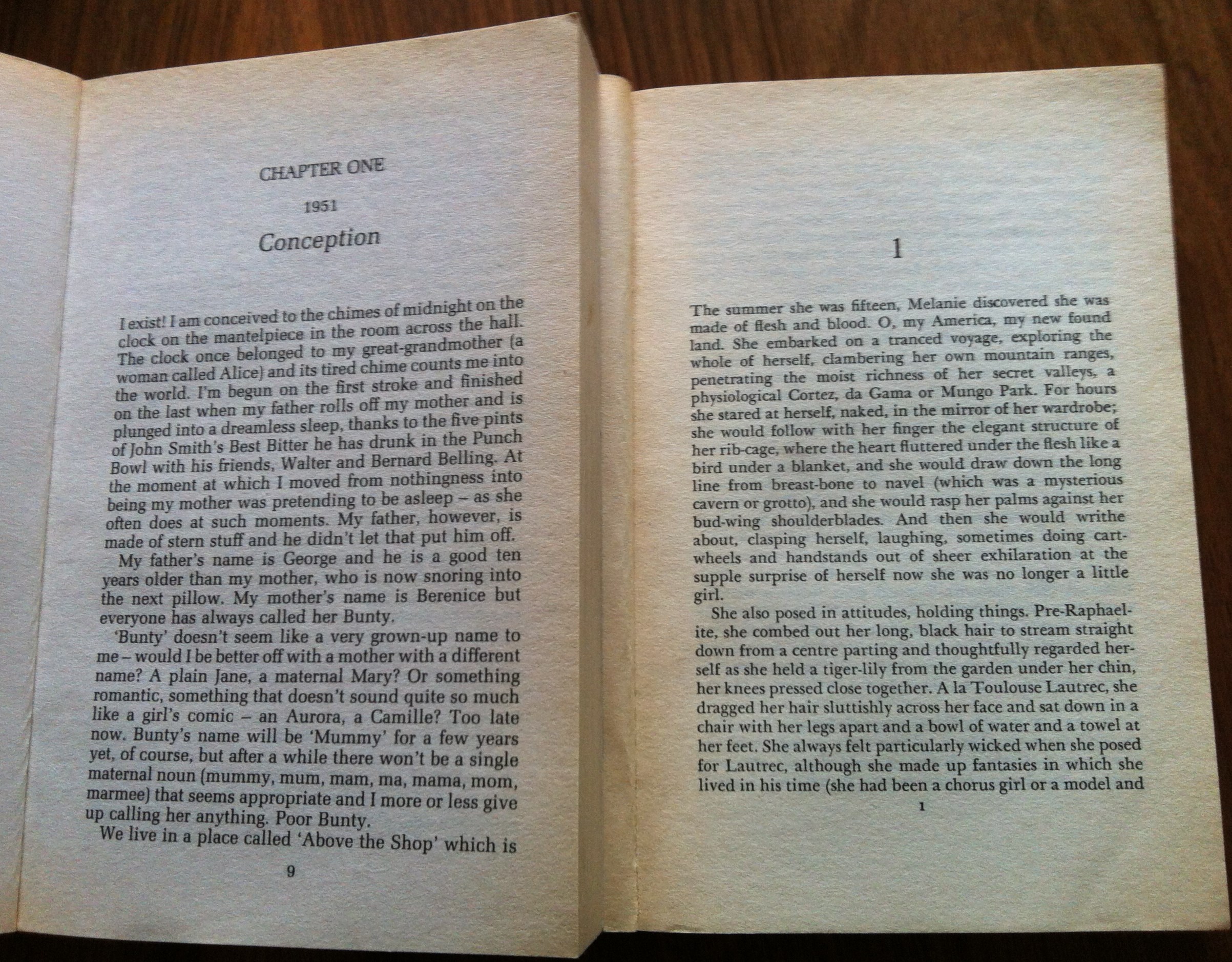
“I exist!  I am conceived to the chimes of midnight on the clock on the mantelpiece in the room across the hall.  The clock once belonged to my great-grandmother (a woman called Alice) and its tired chime counts me into the world.  I’m begun on the first stroke and finished on the last when my father rolls off my mother and is plunged into dreamless sleep, thanks to the five pints of John Smith’s Best Bitter he has drunk in the punchbowl with his friends, Walter and Bernard Belling.  At the moment at which I moved from nothingness into being my mother was pretending to be asleep – as she often does as such moments.  My father, however, is made of stern stuff and he didn’t let that put him off.”

When I was thinking of books to write about for this theme, this is the passage that immediately sprung to mind.  I think it’s just brilliant, and such a confident debut.  The two word opening sentence is really bold and creates a lively, engaging voice for Ruby.   The rest of the paragraph introduces so much about the rest of the story; it’s an enormously skilled piece of writing.  Firstly, the fact that it’s narrated from conception, that the foetal Ruby will be able to hear her mother’s thoughts, tells you that the story is not conventional.  Secondly, two of the women from Ruby’s family are already introduced, and the story will tell Ruby’s life but also be interwoven with the stories of other women in her family: her mother, grandmother and great-grandmother will all feature in third-person narratives alongside Ruby’s first person tale.  Thirdly, although the tale is highly inventive, it is not whimsical, and instead grounded in an earthy realism, as evidenced by Ruby’s unromantic beginnings.  And finally, as the end sentence shows, there’s a good dose of humour in there too.

BTSATM won the Whitbread book of the year in 1995, and I hope this beginning has given you a taste of why.  As Ruby takes you through the story of her life up to present day (around 1993), her unique voice creates vivid portraits of her family, and why and how things got to be the way they are.  All of Kate Atkinson’s novels are highly readable and expertly plotted, I urge you to give her a go.

Secondly, Angela Carter’s second novel, The Magic Toyshop (1967, my copy Virago 1994). Carter was a truly unique, arresting voice in fiction and I don’t always find her writing comfortable, but then I don’t think I’m supposed to.  The novel begins:

“The summer she was fifteen, Melanie discovered she was made of flesh and blood.  O, my America, my new found land.  She embarked on a tranced voyage, exploring the whole of herself, clambering her mountain ranges, penetrating the moist richness of her secret valleys, a physiological Cortez, da Gama or Mungo Park.  For hours she stared at herself, naked, in the mirror of her wardrobe; she would follow with her finger the elegant structure of her ribcage, where the heart fluttered under the flesh like a bird under a blanket…”

While the opening to BTSATM told you a lot about the novel, I think this opening tells you more about Carter as a writer.  She had a skill for making the everyday somewhat disconcerting, and I think the opening line shows this.  It states a truism, but you know there’s more happening than is immediately apparent.  Carter was concerned with women’s sexuality, but in a way that her characters are not necessarily sexual in response to other people – when others become involved, things become complicated and the sexual response less clear (her novel Love brutally details this type of experience). She often wrote in a magic realist style, and while this isn’t evident in this paragraph, the simile “like a bird under a blanket” demonstrates her odd approach to images, and how unsettling she can be.  Although the paragraph appears celebratory, a bird under a blanket is a horrible image of unnatural surroundings, containment and probably death.  To put this alongside a 15 year old girl who goes on in the paragraph to laugh “out of sheer exhilaration” at herself is disturbing, and hints at the violence that often lurks in Carter’s worlds.

Needless to say, this adolescent idyll doesn’t last long.  That night, Melanie finds out her parents have died in a plane crash, and she and her brother and sister have to move to London to live with her uncle Philip and her aunt Margaret, the latter of whom never speaks. Philip is a tyrant, and owns the toyshop of the title, where he works on puppet shows.  Despite the title, this is not a fairytale: “She turned over some of the stock.  Repelled yet attracted by the ferocious masks, she finally tried on one or two, but there was no mirror where she could see herself, although she felt peculiarly feline or vulpine according to the mask she wore.  They even seemed to smell of wild animals.” Creepy.  Carter is not an easy writer, but her inventiveness and intelligence make the challenge worthwhile.  If you fancy giving her a go but want something less intense, I recommend her picaresque later novels, Nights at the Circus and Wise Children.  There’s no-one like her.

003 (2)


“Autumn is a second spring when every leaf is a flower.” (Albert Camus)

Despite it being unseasonably warm here in London right now, the nights are drawing in and today I stepped on a conker, so I’ve decided officially that autumn is here.  I love autumn: the colours of the trees, the crispness of the air, the crispness of the apples…

Usually I try and make my choices not too obvious, but I’m going totally obvious with my first choice this week, Keats’ Ode to Autumn (1819).  You can read the whole poem here.  It begins with one of the most famous lines in English literature:

Season of mists and mellow fruitfulness, 
        [… ]to load and bless
        With fruit the vines that round the thatch-eves run;
    To bend with apples the moss’d cottage-trees,
        And fill all fruit with ripeness to the core;
          To swell the gourd, and plump the hazel shells
        With a sweet kernel…

I’ve mentioned before that I’m not a really a fan of the Romantics, and while this is an idealised, bucolic portrait of autumn, the beauty of the writing is undeniable. I love the fecund imagery: loading, bending, filling, swelling, plumping.  It gives a dynamism to the imagery but also a heady sense of autumnal bounty.  Keats builds on this headiness in the next stanza, personifying autumn as a soporific state:

 Thy hair soft-lifted by the winnowing wind;
  Or on a half-reap’d furrow sound asleep,
      Drows’d with the fume of poppies,

[…]by a cyder-press, with patient look,
          Thou watchest the last oozings hours by hours.

This is such a brilliant piece of writing, I feel quite sleepy just reading it.  “soft-lifted”, “drows’d” and “oozing” layer dreamy, slow motion action to great effect.  In the next stanza this motion is slowed down further, as autumn moves into winter, effectively dying:
   

Hedge-crickets sing; and now with treble soft

      The red-breast whistles from a garden-croft;
          And gathering swallows twitter in the skies.

The sound of the grasshoppers (“hedge-crickets”), robins and swallows heralding the coming winter is in keeping with the gentle imagery that has gone before, and creates an effective sense of how the death of a season is a slow fade, not a sudden change.  Keats takes us through the whole season, and while he may present an autumn that doesn’t really exist, it is still immediately recogniseable.  And it makes me want to drink scrumpy…

For my second choice I thought I’d choose a book based around academia, as for lots of people this is what the change in season at this time of year symbolises.  On Beauty by Zadie Smith (Penguin, 2005) is set in a fictional New England university town, Wellington. It follows two families, the Belsey’s and the Kipps, and their impact on each other’s lives, in a loose reworking of Howard’s End by EM Forster. Howard Belsey is a liberal art history professor, his nemesis the conservative Sir Monty Kipps.  When Sir Monty is given a visiting post at Wellington, the two families collide; the wives becoming friends, the children already romantically intertwined.  I’ll be honest, I didn’t much rate Smith’s first novel, the much-hyped White Teeth, but by On Beauty (despite the verging-on-pretentious title) she’s really getting into her stride.  She captures perfectly the pragmatism that constantly invades the high-minded idealism of academia:

“by next Tuesday these kids would have already sifted through the academic wares on display in the form of courses across the Humanities Faculty, and performed a comparative assessment in their own minds, drawing on multiple variables including the relative academic fame of the professor; his previous publications up to that point; his intellectual kudos; the uses of his class; whether his class really meant anything to their permanent records or their grad school potential; the likelihood of the professor in question having any real-world power that might translate into an actual capacity to write that letter that would effectively place them – three years from now – on an internship at the New Yorker or in the Pentagon or in Clinton’s Harlem offices or at French Vogue…”

However, the novel is not just a satire on academia.  Smith uses the setting to consider themes of identity, race, art, aging, love, all bound together by a strong intellect and comic sensibility:

“At this distance, walking past them all, thus itemizing them, not having to talk to any of them, flaneur Howard was able to the love them and, more than this, to feel himself, in his own romantic fashion, to be one of them.  We scum, we happy scum! From people like this he had come. To people like this he would always belong.  It was an ancestry he referred to proudly at Marxist conferences and in print; it was a communion he occasionally felt on the streets of New York and in the urban outskirts of Paris.  For the most part, however, Howard liked to keep his ‘working class roots’ where they flourished best: in his imagination.”

As Howard’s life unravels around him, the various members of the two families are each going on their own journeys towards realising who they are and who they will become. On Beauty is a big novel that considers big themes, I hope Smith’s observation of “a sprinkle of mirthless intellectual laughter, the kind one hears at bookshop readings” is not a proleptic reference to the reception the novel received – I somehow doubt it.

Just a little footnote point of interest: On Beauty is a family affair, with Smith’s husband, Nick Laird, providing the poetry, her brother Doc Brown, MCing a spoken word night some characters attend, and Smith herself appearing briefly as a “feckless novelist on a visiting fellowship”. For intelligent rap/comedy with something to say, I highly recommend Doc Brown’s YouTube channel.