Novella a Day in May 2019 #12

Two More Pints – Roddy Doyle (2014, 115 pages)

Last year as part of NADIM I looked at Two Pints by Roddy Doyle, so I thought this year I’d look the sequel. Like its predecessor, it is written entirely as dialogue between two friends meeting for the titular drinks, and set on specific dates, this time between September 2012 and June 2014. Once again, a warning for swearing – well, it is Roddy Doyle after all 😀

The issues in this period, lest we forget, include the financial crisis, horsemeat in burgers, elections of the new Pope and the deaths of various celebrities. All this occurs alongside family events and disagreements over football.

 – Fiscal cliff.

– He’s shite.

– Wha?!

– He’s just copying the other fella.

– Wha’ the fuck are yeh talkin’ about?

– The rapper.

– Wha’ rapper?

– Fiscal Cliff.

The humour doesn’t detract from the realities though.

– My young one is in trouble. An’ her fella.

– Ah, no.

– The mortgage, yeh know.

– They can’t handle it?

– They’re fucked, God love them. They’ve been into the bank an’ tha’, to try an’ sort somethin’. But –

– No joy?

– It’s fuckin’ madness.

I was disappointed not to hear more about Damien, the grandson from Two Pints who was fracking in the back garden with a magimix, but I think at such a turbulent time, Doyle chose to focus very much on current affairs. The dialogue still felt entirely authentic though, and never heavy-handed.

The conversation is wide-ranging, and even poetry gets a mention, despite the short shrift it was given in Two Pints:

– See Seamus Heaney died.

– Saw tha’. Sad.

– Did yeh ever meet him?

– Don’t be fuckin’ thick. Where would I have met Seamus Heaney?

– That’s the thing, but. He looked like someone yeh’d know.

– I know wha’ yeh mean – the eyebrows an’ tha’.

– He always looked like he liked laughin’.

– One o’ the lads.

– Except for the fuckin’ poetry.

– Wha’ would possess a man like tha’ to throw his life away on poetry?

– Although fair enough – he won the Nobel Prize for it.

– He’d probably have won it annyway.

– For wha’ – for fuck sake.

– I don’t know. Football, plumbin’ – annythin’. Tha’ was what was special about him.

Another affectionate portrait of the people of Dublin, and Ireland at a particular moment in time.

Novella a Day in May 2019 #11

It was a few years ago now that I looked at Embers, Sandor Marai’s 1942 novel set over one evening. If, like me, you liked Embers – the more famous novel in the UK – then I think you’ll like Esther’s Inheritance too. It is a similarly constrained piece of writing, also set primarily over one evening, focussed on an anticipated guest.

“We are bound to our enemies, nor can they escape us.”

However, the psychology of this novella was harder for me to manage as a reader.

Esther lives in the house she inherited from her father with her ancient retainer Nunu:

“Nunu thinks she knows everything about me. And maybe she does know the truth, the simple ultimate truth we dress up in so many rags all our lives.”

As a young woman Esther loved Lajos – now, around 20 years later, he has telegrammed to say he will visit the next day. This sends her back to his letters and her memories of the past.

“I marvelled at the fierce workings of this aimless energy. In each of his letters he addressed me with power enough to move anyone – especially a highly sensitive woman – indeed, whole crowds, even masses. It wasn’t that he had anything particularly ‘significant’ to say… He was always writing about the truth, about some imagined truth that he had just realised and urgently wanted me to know.”

But Lajos is utterly vacuous:

“Later we discovered that Lajos himself had never read, or had simply scanned the authors and thinkers, the works and ideas that he so emphatically recommended, wagging his head and chiding us with good-humoured severity. His charm acted on us like a cheap wicked spell.”

Yet when he arrives with an entourage of vague and bitchy hangers-on Esther still feels drawn –  possibly less to him than she once was, but certainly to how he made her feel.

“But there was a time when I was close to him when my life was as ‘dangerous’ as his. Now that this danger has passed I can see that nothing is as it was, and that such danger was in fact the one true meaning of life.”

The full extent of Lajos’ previous betrayal is revealed during the visit, as is a betrayal by another. There is a suggestion at one point that possibly Lajos had authentic feelings for Esther for a brief moment, for whatever they were worth.

Esther is fully aware of what Lajos is like and all he has done, and yet when he inevitably makes the move for his latest self-serving rip-off scheme she seems ready to capitulate. It really is rather baffling.

I only write about books I recommend and I do recommend this because Marai is such a beautiful writer. But a lot of the psychology and plot of this novella depends on the charm of Lajos, which is difficult to convey on the page and was completely lost on this reader. Maybe I’m not subtle enough for Esther’s Inheritance. I suspect in some ways this would work well as a film, where a charismatic actor could bring Lajos’ charm to life.

“When somebody appears out of the past and announces in heartfelt tones that he wants to put ‘everything’ right, one can only pity his ambition and laugh at it”

Novella a Day in May 2019 #10

The Hunting Gun – Yasushi Inoue (1949, trans. Michael Emmerich 2013) Pushkin Press 106 pages

Published by the wonderful Pushkin Press, The Hunting Gun tells of the fallout from an extramarital affair via three letters, from the daughter of the woman involved, the betrayed wife, and finally the woman herself when she knows she is going to soon die.

The letters are sent to a poet who has published the titular poem about a man he once saw.

“He had simply struck me, as he came along the path with his shotgun over his shoulder and a pipe in his mouth, as having a sort of pensiveness about him that one did not ordinarily see in hunters- an atmosphere that seemed, in the crisp early-winter morning air, so extraordinarily clean that after we had passed each other I couldn’t help turning back.”

The man, Misugi Josuke, recognised himself in poem and has sent three letters he received to the poet, in order to explain why he had that atmosphere about him.

The first letter is from Shoko, the daughter of Saiko, with whom Misugi had an affair. Shoko only learns about the affair from reading her mother’s diary.

“And then I heard, very distinctly, the sound of that stack of words I had seen in her diary the night before SIN SIN SIN, piled as high as the Eiffel Tower – crashing down on top of her. The whole weight of the building she had erected from her sins in the course of the past thirteen years, all those floors, was crushing her exhausted body, carrying it off.”

Shoko’s letter is full of anger and betrayal, at both her mother and Misugi, the family friend. In contrast, Misugi’s wife, Midori, is surprisingly measured and even funny. But she acknowledges she has known for many years, and the hurt is not as fresh as that first day.

“I am sure you have had the experience of going for a swim in the ocean in early autumn and discovering that each little movement you make causes you to feel the water’s chillness more intensely, and so you stand there without moving. That was precisely how I felt then: too frightened to move. Only later did I arrive at the happy conclusion that it was only right to deceive you the way you had deceived me.”

Finally we hear from Shaiko, mother to Shoko, best friend to Midori and lover of Misugi, writing a letter to be opened after her death.

“Even after I die, my life will still be waiting here hidden in this letter until it is time for you to read it, and the second you cut the seal and lower your eyes to read its first words, my life will flare up again and burn with all its former vigour, and then for fifteen or twenty minutes, until you read the very last word, my life will flow as it did when I was alive into every limb, every little corner of your body, and fill your heart with various emotions. A posthumous letter is an astonishing thing, don’t you think?”

The Hunting Gun is a short, simply constructed novel that manages to convey emotions and characterisation of real complexity. The affair is shown to involve so many more people than just the immediate couple, and how the fallout and hurt from such a betrayal cannot be anticipated. Inoue shows the capacity human beings have for causing deep, irreparable sadness in one another, but the tone is never judgemental. A beautifully observed novella.

“Why, when we had just formed a united front, so to speak, to battle for our love, why, at a moment that should have been the most fulfilling, did I tumble into that helpless solitude?”

Novella a Day in May 2019 #9

Just Like a River – Muhammad Kamil al-Khatib (1984, trans. Michelle Hartman and Maher Barakat, 2003) 110 pages

Just Like a River was Syrian writer Muhammad Kamil al-Khatib’s first novel, set in Damascus in the 1980s. It forms another stop on my much-neglected Around the World in 80 Books reading challenge, hosted by Hard Book Habit. The novella looks at the lives of a group of Syrians, with different chapters from different viewpoints. In this way, al-Khatib builds a picture of the individuals, Damascus, and the wider Syrian political situation.

Dallal is the young daughter of Yunis, a Chief Sergeant in the army. She struggles with the expectations placed on women where she lives and idealises life overseas:

“Young European women live alone. They rent rooms and come home at night when they like. Over there, men do not harass women in the streets but are polite like Doctor Morton White.”

Ha! Unfortunately we know she is sadly mistaken, in both this and in her assessment of her professor. He is self-centred and shallow, and exoticises Syrian women without really bothering to get to know a single one:

“He had illusions that he would discover Arab women through Dallal. He would explore this Middle East that was shrouded in secrets.”

By returning to characters over various chapters al-Khatib deepens the individual portraits. Yusuf is in love with Dallal and his friend Zuhayr at first seems a real misogynist. Then it becomes apparent that his flippancy hides a deeper hurt, and he is as cynical about men as he is women:

“What do we offer them other than a mirror image of our fathers’ backwardness? We act as if we are only thieves or guards of their hymens.”

The portrayal of women is sympathetic, so Dallal is seen as young and naïve rather than ignorant and prideful. Her friend Fawziya is hurt yet optimistic:

“Fawziya was a disappointed woman. Her tempestuous love affair with Sami caused her to have a general disrespect for men, coupled with a longing for some certain, but unknown, man… She and her mother dealt with things just as one might expect two destroyed women in solidarity with each other would. They were two women betrayed by both men and time, and who persevered, waiting for a certain something, a certain man, a certain incident. This is why they spent so much time reading coffee cups and interpreting dreams.”

As they all deal with the day-to-day concerns of family conflict and unspoken feelings, the political situation is building in the background. When he is called to the army, Yusuf is not particularly concerned. As it becomes clear that the conflict may be escalating, he meets it with grim humour:

“ ‘They don’t give us good weapons or enough of them. Look, can’t you see how the bombs fall down like paper?’

Yusuf laughed. ‘I fear that we, not the missiles, are paper,’ he said.”

Just Like a River is an evocative and memorable portrait of a group of people struggling against the forces directing their lives, and themselves. If that makes it sound heavy or depressing, it isn’t. It looks at huge themes straight on, but does so with compassion and understanding.

Novella a Day in May 2019 #8

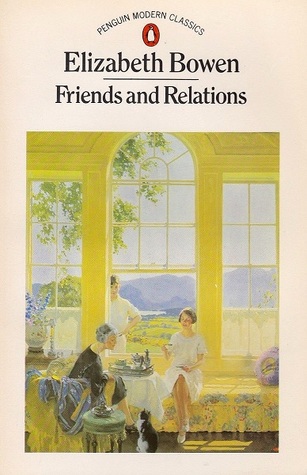
Friends and Relations – Elizabeth Bowen (1931, 159 pages)

Following on from yesterday, another Irish novella today, this time by Elizabeth Bowen, whose longer novels I’ve greatly enjoyed and two of which I wrote on for Reading Ireland 2017.

Friends and Relations opens with the wedding of Laurel Studdart to Edward Tilney. Laurel is beautiful and not particularly nervous about the wedding: she spends the morning playing cards with her father. This sets a major theme for the novel, around lack of passion in marriage and how much importance should be attached to it.

The reception is at the family home in the Malvern hills, Corunna Lodge. The only discordant note in this upper middle-class idyll is the groom’s slightly scandalous mother:

“Edward remained throughout wonderfully self-possessed; perhaps because of this he did not make an entirely good impression. Lady Elfrida, in claret-coloured georgette, also over-acted a little. Besides being a divorcee, which should but does not subdue, she was the bridegroom’s mother – and one apt to play always a little too gracefully a losing game.”

Laurel’s sister Janet sits on various committees and has roped her Wolf Cubs into helping out at the wedding. She is pragmatic and sensible, yet it is her choice of beau in Rodney Meggatt just a few months later which introduces conflict into the family. Rodney’s uncle Considine was named as co-respondent in Lady Elfrida’s divorce proceedings. Lady Elfrida fails to see what all the fuss is about:

“She did not consider the situation awkward at all. Not nowadays when everybody was different, everyone else dead.”

Lady Elfrida is a wonderfully self-centred creation. She doesn’t seek to hurt others, but barely acknowledges how her actions impact on people, such as Edward’s enduring sense of shame, or when she broke Considine’s heart.

“She had perhaps injured him, perhaps even vitally…Under her dry-eyed farewell look, her last tragic un-regret, in Paris, he had certainly desiccated.”

Similarly self-focussed is Theodora Thirdman, schoolgirl and guest at the wedding, given to prank phone calls and later a flatmate of Edward’s best man’s sister, determined to demand the love she craves.

“she had passions for women – awkward, such a tax on behaviour, like nausea at meals.”

As the years pass, Edward doesn’t want any connection between his children and Considine, but events conspire against him when his children visit their aunt and uncle, who are now living in Considine’s manor house, Batts:

“At one time his children were not to be at Batts with Considine…on any account. But since a first epidemic had swept the Tilney family, this had relaxed. He wished his children would not call Considine ‘Uncle’ and that Hermione Meggatt need not appropriate Lady Elfrida as ‘Grandmother’. Between these whirlpools of sensibility, these reefs of umbrage, the two families had, however, steered for ten years an uneventful course.”

This is a densely written novel with a focus on character rather than plot. Things do happen, particularly in one eventful week following a typically unsubtle manoeuvre by Theodora, but it is primarily people and their relationships that change and develop.

Bowen often leaves it for the reader to fill in the gaps – more than once I had to go back and check I hadn’t missed something. But no, it’s just that she doesn’t lay everything out explicitly, including her characters’ thoughts and motivations. This could be frustrating, but I thought it worked well in capturing the sense of a well-to-do family at a historical time when things are left unsaid and everything simmers below the surface.

“You must see what families are; it’s possible to be so ordinary; it’s possible not to say such a lot.”

There are comedic moments, particularly with Theodora, and in some ways it could be read as a comedy of manners, but Friends and Relations is more subtle than that, and contains a great deal of pain and sadness too. Not my favourite of the Bowens I’ve read, but definitely worth a look for her highly skilled writing and astute insights into human beings.

Novella a Day in May 2019 #7

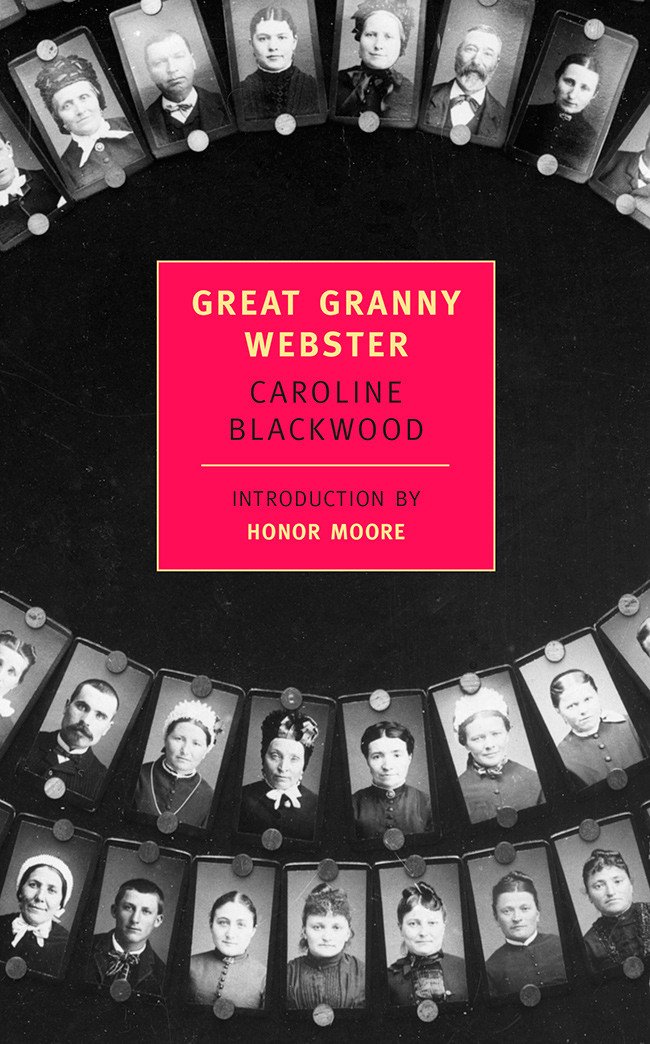
Great Granny Webster – Caroline Blackwood (1977, 96 pages)

My blogging slump meant I completely failed to take part in Cathy and Niall’s Reading Ireland 2019 (#Begorrathon) in March, and so I’m including a few Irish novellas this month. The first of these is by an author I’ve never heard of, which seems extraordinary given her quite astonishing life story.

The titular matriarch of this novel is a wonderfully Gothic creation:

“She had arranged her hair in two grey tufts that lay on her forehead like a couple of curly horns, so that what with the exaggerated narrowness of her elongated face, and her uniquely over-long upper lip, she often reminded me of a melancholy and aged ram.”

The narrator is sent to Hove to recuperate with her great-grandmother in 1947 when she is 14, as it’s thought the sea air will help her recuperate from an operation.  It’s totally bizarre that her family would think this a good idea, as Great Granny Webster lives in severe austerity in a damp and gloomy house, alone except for her aged and devoted retainer, Richards.

“All she wanted from each new day that broke was the knowledge that she was still defiantly there – that against all odds she had still managed to survive in the lonely, loveless vacuum she had created for herself.”

Unsurprisingly, this is not a warm and affectionate portrait of the generations of a family. It is however, witty, astute, sad, and incisive. Great Granny Webster is entirely uncompromising:

 “ ‘There really is nothing more unattractive than the sight of a young woman displaying a repulsive amount of arm. I am not going to mention this subject again.’

Great Granny Webster always told the truth. She never once referred to my sleeves or my arms again.”

We later learn that her daughter (the narrator’s grandmother) completely lost all sense of reality, trapped in the family castle at Dunmartin. The echoes of previous generations are heard down the years. As an adult, the narrator is contacted by her fragile, enchanting Aunt Lavinia who is having similar problems:

“One day Aunt Lavinia rang me up to say it was too maddening, she was in prison. When I sounded astonished she admitted that it wasn’t exactly a prison, but it was just as bad, for she was being detained in a hospital where she had been put by the police.”

What Blackwood captures brilliantly is how in families, people can be superficially polar opposites but underneath it all, so very alike, much to their own alarm:

“Aunt Lavinia’s house was very warm. She liked to have log-fires burning and her central heating turned on even in the summer. Although her bedroom was rather like a hot-house and fragrant with the smell of her lillies, I had exactly the same feeling of chill I had experienced in the bleak, cold, flowerless drawing room of Great-Granny Webster when that old lady had predicted that eventually I would be very like her.”

In such a short space, Blackwood achieves fully-rounded portraits of three generations of women in an idiosyncratic noble family. Great Granny Webster is, like its anti-heroine, bleak, funny and unique.

I read this in an old Picador edition, but I’m delighted to say the wonderful NYRB Classics have re-issued it.

Novella a Day in May 2019 #6

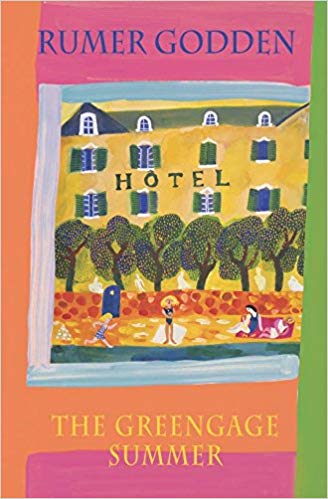
The Greengage Summer – Rumer Godden (1958, 187 pages)

I really enjoyed my first experience of Rumer Godden last year, and so it was that I picked up The Greengage Summer with high expectations, which were fully met 😊

The story is narrated by thirteen-year-old Cecil describing how she, her older sister Joss and younger sister Hester, plus ‘The Littles’ brother Willmouse and sister Vicky, are left to essentially fend for themselves at the Les Oeillets hotel in champagne country, after their mother develops septicaemia from a horsefly bite and is hospitalised.

“Perhaps it was this first sight that made me always think of the garden at Les Oeillets as green, green and gold as was the whole countryside of the Marne where, beyond the town, the champagne vineyards stretched for miles along the river, vineyards and cherry orchards, for this was cherry country too, famous for cherries in liqueur. Mother had been thinking of battlefields; she had not thought to enquire about the country itself; I am sure she had not meant to bring us to a luxury corner of France where the trees and the vines changed almost symbolically in the autumn to gold.”

It is reminiscent of Kingfishers Catch Fire, in that it is told from the perspective of someone looking back, who has been rescued from a foreign country by a man – Uncle William in this instance – with interjections from the present.

“ ‘You are the one who should write this,’ I told Joss, ‘it happened chiefly to you’; but Joss shut that out, as she always shuts things out, or shuts them in, so that no-one can guess.

‘You are the one who likes words,’ said Joss. ‘Besides…’ and she paused. ‘It happened as much to you.’

[…]

‘But you were glad enough to come back,’ said Uncle William,

We never came back,’ said Joss.

So what happened to cause them to leave themselves behind in Les Oeillets? I don’t want to give too much of the plot away…

The children are captivated by Eliot, a charming debonair English man who is having an affair with Mademoiselle Zizi, the hotel owner. Madame Corbert, the manager, is jealous, desiring Zizi herself. This is explained to them by Paul, the not much older but very much wiser hotel boy. These intrigues would be difficult enough, but Joss suddenly blooms, her beauty throwing things even further into disarray.

“I know now it is children who accept life; grown people cover it up and pretend it is different with drinks”

Some things around the hotel, or rather, around one of the guests, don’t add up, and it will be a rude awakening to the cruelties of the adult world for the children when they find out the truth. And it is the truth to a great extent – the author’s introduction to my edition explains the experience her family had, on which she based the story.

“For us champagne will always have a ghost; it can never be a wine for feasts but one for mourning.”

The Greengage Summer is a well-paced, atmospheric read with excellent characterisation. It’s no wonder it was quickly adapted into a film in 1961, starring Susannah York as Joss and Kenneth More as Eliot:

Novella a Day in May 2019 #5

Breaking Away – Anna Gavalda (2009, trans. Alison Anderson 2011) 143 pages

Breaking Away is a simply plotted novella which appears deceptively straightforward in its storytelling, but builds towards a meaningful resolution.

Garance is in her late twenties and cadges a lift to a wedding with her brother Simon and annoying sister in law Carine. The characterisation of Carine starts the novella off on an enjoyably bitchy note as the chaotic Garance, who has stayed up all night playing poker and is waxing her legs on the backseat, offends beauty pharmacist Carine’s sensibilities.

“Carine is utterly perplexed. She consoles herself by stirring sugarless sugar into a coffee without caffeine.”

They stop and pick up another sibling, Lola, who likes to conspire with Garance to wind up Carine. At which point I began to feel for Carine – maybe she wouldn’t be such a nightmare if the siblings weren’t so cliquey and excluding. At this point though, the portrait of Carine does modify slightly.

“She may be a first class pain but she does like to please others. Credit where credit is due.

And she really doesn’t like to leave pores in a state of shock. It breaks her heart.”

Their fourth sibling, Vincent, isn’t at the wedding, so the three of them leave Carine and bunk off to go and collect him. Garance reflects on her various siblings’ trials and tribulations and how their upbringing has influenced who they are. She decides her parents are culpable:

 “Because they’re the ones who taught us about books and music. Who talked to us about other things and forced us to see things in a different light. To aim higher and further. But they also forgot to give us confidence, because they thought that would come naturally. That we had a special gift for life, and compliments might spoil our egos.

They got it wrong.

The confidence never came.

So here we are. Sublime losers.”

But the humour in the novella stops it being self-pitying. In fact, the four of them are doing OK. They’re just enjoying taking a rare moment to spend time together.

Breaking Away captures a moment in time for the four siblings, and has an elegiac quality, for time past and relationships that must inevitably change. The tone isn’t sad however, more resolute; it’s about how love endures beyond all the external changes.

“What we were experiencing at that moment – something all four of us were aware of – was a windfall. Borrowed time, an interlude, a moment of grace. A few hours stolen from other people.”

To end, plenty of songs are name-checked in Breaking Away, including this one which “taught us more English than all our teachers put together”:

Novella a Day in May 2019 #4

A Month in the Country – JL Carr (1980) 85 pages

A Month in the Country is why I read novellas: beautifully written, acutely observed, exploring huge themes in a tightly constructed story that is an absolute gem.

Set just after World War I, shell-shocked soldier Tom Birkin arrives in the Yorkshire town of Oxgodby to uncover a medieval mural in the local church, much to the consternation of Reverend Keach:

“ ‘It wasn’t in the contract,’ he hedged, somehow managing to imply that neither were my stammer and face-twitch.”

[…]

“I looked like an Unsuitable Person likely to indulge in Unnatural Activities who, against his advice, had been unnecessarily hired to uncover a wall-painting he didn’t want to see, and the sooner I got it done and buzzed off to sin-stricken London the better.”

Tom hopes that a quiet summer of regular work, quiet and solitude will help him heal:

“The marvellous thing was coming into this haven of calm water and, for a season, not having to worry my head with anything but uncovering their wall-painting for them. And, afterwards, perhaps I could make a new start, forget what the War and the rows with Vinny had done to me and begin where I’d left off. This is what I need, I thought – a new start and, afterwards, maybe I won’t be a casualty anymore.

Well, we live by hope.”

He is employed due to a legacy, which has also employed another soldier, Moon, to find a grave just outside the church walls. Moon works out pretty quickly where the grave is so spins out his task to enable him to excavate remains he has identified at the site. The two recognise one another as kin due to their war experiences, without discussing what happened to either of them.

“This was a fairly typical beginning to most days – a mug of tea in Moon’s dug-out, usually not saying much, while he had a pipe… he would look speculatively at me. Now who are you? Who have you left behind in the kitchen? What befell you Over There to give you that God-awful twitch? Are you here to try to crawl back into the skin you had before they pushed you through the mincer?”

Carr writes about the technicalities of restoration so cleverly. Details are included to make Birkin’s voice authentic, but without it being overwhelming or seeming clunky. What he also captures is Birkin’s love of his work:

“But for me, the exciting thing was more than this. Here I was, face to face with a nameless painter reaching from the dark to show me what he could do, saying to me as clear as any words ‘If any part of me survives from time’s corruption, let it be this. For this is the sort of man I was.’”

Birkin makes friends with residents in Oxgodby: Mr Ellerbeck the station master, his young daughter Kathy, and Anne Keach, the reverend’s wife, who seems as lost as Tom. Written from the point of view of Birkin looking back, there is an elegiac quality to the story, particularly evoked through the descriptions of nature:

“For me that will always be the summer day of summers days – a cloudless sky, ditches and roadside deep in grass, poppies, cuckoo spit, trees heavy with leaf, orchards bulging over hedge briars. And we nimbled along through it”

Restoration, healing, judgement, the transitory nature of experience, time, life’s fragility… all these themes are explored in just 85 pages. And yet A Month in Country never seems limited or superficial. Absolutely deserving of its classic status.

A Month in the Country was adapted into a film in 1987. I watched it after reading this and it is a broadly faithful adaptation but not entirely successful in capturing the sense of the summer, or the relationships between the characters. Definitely worth a watch though, with an excellent cast (especially Patrick Malahide as Reverend Keach):

Novella a Day in May 2019 #3

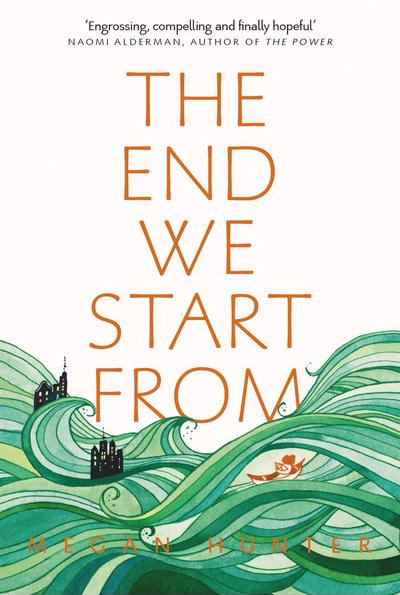
The End We Start From – Megan Hunter (2017) 127 pages

The End We Start From is poet Megan Hunter’s first novel, and she brings a poet’s precision to her longer-form writing. The words on the page are sparse and she knows how to use them to convey maximum meaning and build atmosphere.

The narrator is a young woman who has just given birth. The day her son arrives in the world is the day London disappears in floods, and so the newly-expanded family head north to her in-laws.

“R’s father N will not turn the television off. I stay in the kitchen, the only screenless room, with my smarting pulp on a cushion and the baby mushed against my breast.

R’s mother G will not stop talking. This not-stopping seems to be the first side-effect.

Everything has been unstopped, is rising to the surface.”

Referring to characters just by their initials adds to the general sense of disorientation as the woman adapts to her wholly new life. She views the horrors of what is happening to society at a step removed, aware but also wrapped up in her new baby. This means that while the novella is dystopian, it doesn’t have the relentless quality of some dystopian fiction. Instead it feels quietly unsettling and unnerving.

“It is bad, the news. Bad news as it always was, forever, but worse. More relevant. This is what you don’t want, we realise. What no-one ever wanted: for the news to be relevant.”

There is also a dark humour at moments, in the contrast between their old and new lives.

“He has not researched the best camp. He has not spent hours poring over comparative reviews of refugee camps. He wants none of them.”

The stark style of Hunter’s writing captures the fractured experience in the aftermath of a natural disaster. The reading experience is a series of startling images and arrested sentences that build to effective portrayal of new motherhood in extreme circumstances.

“Whatever I imagine, it is something else.

Where I expect desolation there is the atmosphere of a jumble sale.

Where I envisage welcomes and tea, smiles and Blitz spirit, there is grey concrete, wailing people dragging themselves across the road, photo-boards of the missing.

Our city is here, somewhere, but we are not.

We are all untied, is the thing.

Untethered, floating, drifting, all these things.

And the end. The tether, the re-leash, is not in sight.”