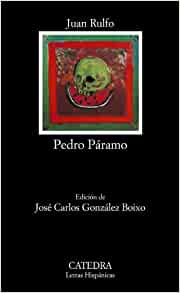
Pedro Páramo – Juan Rulfo (1987, trans. Margaret Sayers Peden 1993) 122 pages
I’m embarrassed to say I’d never heard of Pedro Páramo, as in the introduction to my edition Susan Sontag proclaims it “one of the masterpieces of twentieth century world literature”. Apparently it was huge influence on Gabriel García Márquez when he wrote 100 Years of Solitude. Eek, how have I not heard of it? I might have been intimidated had I known of its reputation, but as it was, I just picked it up because I thought it looked interesting and found all this out afterwards (I always read introductions at the end).
It opens with a man named Juan Preciado travelling towards an unknown town:
“I had come to Comala because I had been told that my father, a man named Pedro Páramo, lived there. It was my mother who told me. And I had promised her that after she died I would go see him.”
He meets a man who may be his brother, who tells him his father is both “living bile” and also dead, so he won’t be able to fulfil his mother’s wish to get what his father owes him.
Soon it becomes apparent that Pedro Páramo is not the only one who’s dead; Comala is a ghost town, filled with spirits of previous occupants. Juan can never be sure if anyone he meets is living or dead, and whether they are speaking of the present or the past.
As the various apparitions tell their stories the narrative moves back and forth across time and we learn of the events that led Comala to change from a thriving centre to a desolate no man’s land. Pedro is cruel and powerful, and that combination is devastating.
“the day you went away I knew I would never see you again. You were stained red by the late afternoon sun, by the dusk filling the sky with blood. You were smiling.”
I know a lot of people find magic realism off-putting, but I would urge you to give Pedro Páramo a try. The story of corruption and personal tragedy being acted out on the inhabitants of a town is grounded in a recognisable reality and the engaging story is easy to follow despite its complexity.
I know I’ve not said much about it here, but I really enjoyed discovering Comala alongside Juan so I don’t want to go into too much detail! The characters are intriguing and the story constantly surprising. Pedro Páramo is a richly detailed, mutli-layered novel that I’m sure will reward re-reading.
 madame bibi lophile recommends
I hadn’t heard of it either, Madame B, but it definitely sounds fascinating. And I haven’t read my copy of One Hundred Years… yet, so I maybe should read this one first!
LikeLiked by 1 person
Yes, they’d be really interesting to read close to one another. Maybe I should try a re-read of 100 Years as it’s been a long time…
LikeLiked by 1 person
I only came across this novella a year or so ago when another blogger listed it in their end-of-year round-up as one of their favourite reads that year. Magic realism is not my favourite thing, but you’re making a great case for it here. It does sound very effective indeed!
LikeLiked by 1 person
It’s honestly not too magical. It’s mainly that he’s conversing with ghosts, but they’re still people talking about earthly events. It works well!
LikeLike
Such an intriguing premise. I’m one of those readers who tends to steer clear of magic realism but this sounds like an exception to break that rule. I hadn’t heard of it either.
LikeLiked by 1 person
It’s definitely one to make an exception for – the magic realism element isn’t overwhelming. I promise!
LikeLiked by 1 person
*scribbling sounds on TBR list*
AND he’s written sooo many books. I wonder how many of them would be contenders for NADIM!
LikeLiked by 1 person
I think he only wrote one other novella – The Golden Cockerel. One for next year!
LikeLiked by 1 person
I’m with you in the I-have-never-heard-of-him team!
The French blurb says it’s a modern classic, one of the most important book of the 20thC. Yikes. How did I miss that too?
LikeLiked by 1 person
Good to know I’m not alone Emma! It’s strange that its so lauded and yet not so familiar.
LikeLike
Well if you are embarrassed about not knowing about this author, then I need to be to. And I also avoid introductions until the end – too much of an influence on the reading otherwise! I would normally swerve away at the thought of ‘magic realism’ but you make a great case here, so will give it a try some time. 😀
LikeLiked by 1 person
I’m feeling better since other bloggers have said its new to them too! Totally agree about introductions, plus I think I get more out of what they’re saying if I know the book. I don’t mind magic realism but I know its not for everyone…
LikeLiked by 1 person
I knew I’ve read and reviewed it but I had no idea it was in 2011. The height of my blogging, as it would seem. I can only dream of receiving as many comments and discussions as I did back then. Oh well. It’s a stunning book. It has such strong imagery, doesn’t it?
I’m attaching my review because of Rulfo’s photos. I hope that’s not too obnoxious.
https://beautyisasleepingcat.com/2011/09/19/juan-rulfo-pedro-paramo-1955-a-classic-of-mexican-literature/#comments
LikeLiked by 1 person
Not obnoxious at all Caroline! thank you for the link, I will pop over and see your review.
It really does have such strong imagery, he creates this odd, other world so beautifully.
LikeLiked by 1 person
He does. They made it into a movie. Back then one could watch it on YouTube.
LikeLiked by 1 person