Trigger warnings for suicide and rape
In a move that will shock no-one who’s read this blog in the past year, I totally failed to post as planned for Stu’s Spanish & Portuguese Lit Month in July. I did however read some Spanish and Portuguese language lit, and Stu has extended the month to include August so away we go!
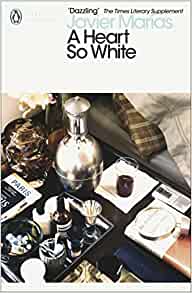
I decided to use S&PLM as an incentive to dust off Javier Marías, who has been languishing in my TBR forever. I read A Heart So White (1992, trans. Margaret Jull Costa 1995) and The Infatuations (2011, trans. Margaret Jull Costa 2013).
What struck me reading both is that I’ve not really read anyone else with a style like Marías. He interweaves philosophical musing within a basic plot and manages this without any loss of pace. The plots are essentially a study of how people relate to one another, rather than event-driven and it works seamlessly.
For the sake of brevity (ha!) I’ll just look at A Heart So White here, in which newly-married Juan muses on the nature of romantic love and his relationship with his father Ranz.
“Ever since I contracted matrimony (the verb has fallen into disuse, but is both highly graphic and useful) I’ve been filled by all kinds of presentiments of disaster […] when they contract matrimony, the contracting parties are, in fact, demanding of each other an act of mutual suppression or obliteration”
This occurs near the start of the novel and I was really taken aback by the matter-of-fact tone regarding a subject that society generally sentimentalises. Marias builds the story using vignettes as Juan observes two arguing lovers on his honeymoon, returns to work as a translator, and stays with a friend in New York who has humiliating experiences through the personal ads. I wondered if AHSW was going to be a cynical and bitter tale of people behaving appallingly towards each other. However, despite observations such as:
“Any relationship between two people always brings with it a multitude of problems and coercions.”
Overall I found the tone resolutely clear-sighted and pragmatic, rather than bitter.
Ranz is a complex, slippery character. His first wife died and his second wife killed herself. Juan is the son of his third marriage. They are not close – Juan finds his father distant and self-focussed:
“He spoke slowly, as he usually did, choosing his words with great care (Lothario, alliances, shadows), more for effect and to ensure that he had your attention than for the sake of precision.”
[…]
“This was the whispered advice that Ranz gave me: ‘I’ll just say one thing,’ he said. ‘If you ever do have any secrets or if you already have, don’t tell her.’ And smiling again, he added: ‘Good luck.’”
Juan does find out the mysteries of his father’s past, largely with the help of his new wife Luisa. However, this does not create a sense of resolution, because I don’t think that’s what the novel is about. It’s not about neat endings, but rather the messy business of human relationships and how these are never neatly tied up, whether through legal institutions like marriage or even the finality of death.
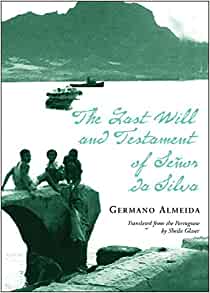
Secondly, a Portuguese-language novel, The Last Will and Testament of Senhor da Silva Araújo by Germano Almeida (1991 trans. Sheila Faria Glaser2004), which despite its mammoth title was only novella length. It was also an opportunity for me to visit another stop on my Around the World in 80 Books reading challenge, as Almeida is a Cape Verdean writer.
This was my first experience of Almeida’s writing and I really enjoyed his chatty, slightly irreverent tone. The titular 387-page document belongs to a successful importer-exporter, and the novella opens with its reading. Much to everyone’s surprise, the business is bequeathed not to Carlos, Senhor da Silva Araújo’s nephew, but rather his illegitimate daughter, unacknowledged in his lifetime.
“Still, it might have struck one as strange, or might have set the neighbours talking when, rather extraordinarily, on hearing over the radio the news of the passing of the esteemed merchant from this our very own marketplace, one of the most vibrant pillars of our city – Sr. Napumoceno da Silva Araújo- Dona Chica began to run around the house screaming and crying out, My protector, my god, What will become of me etc., a display different in every way from the measured grief she had shown on the death of her Silvério who, may he rest in peace, though no model of virtue was no scoundrel either.”
(The only thing that jarred for me in this novella was that Senhor da Silva Araújo rapes Dona Chica, his cleaner, before the two go on to have a mutually satisfying sexual arrangement. Patriarchal fantasy I would say.)
The story moves back and forth across time with ease, building a portrait of a man who rose from shoeless poverty to leading businessman. He remains contradictory and somewhat unknown despite telling his life story in his own words. Although this could make for an unsatisfying read, for me this was the novella’s strength. It captured how complex people are, and how we can remain a mystery even to ourselves.
Senhor da Silva Araújo is not particularly likable. There are possibly some shady deals in his background. Despite being in love at certain points (much to the surprise of those who knew him), he is ignorant regarding women. He treats his nephew Carlos unfairly:
“Carlos has turned out to be an ungrateful relation and as the good man I am and always have been, I have the moral obligation never to forgive him.”
Yet Carlos is not perfect either, and Senhor da Silva Araújo is not wholly despicable:
“But the truth is, it began to be noted that Sr. Napumoceno sent for quicklime from Boa Vista at his own expense and donated to the City Council for construction projects for the poor. When he was questioned directly, he neither confirmed nor denied this”
There is one scene of awful misunderstanding with his daughter that is truly upsetting in its pathos. Overall, this is a portrait of a life lived, successfully in some ways, pitiably in others; a man weak and oblivious to others; who knew some happiness and some heartbreak. Hard to achieve in a novella length but Almeida manages it with skill.
To end, Seu Jorge singing one of my favourite Bowie songs in Portuguese:
 madame bibi lophile recommends
I’m planning to review Marias as well ‘The Infatuations’, which I did not like quite as much as ‘A Heart So White’, but I think you describe very well that fascinating way in which he can weave story with little riffs about… well, pretty much anything.
LikeLiked by 2 people
It’s so impressive isn’t it? Such a hard thing to do and he makes it look easy. I’ll look forward to your review of The Infatuations.
LikeLiked by 1 person
And Margaret Jull Costa makes it look effortless and natural in English, which is even more amazing!
LikeLiked by 1 person
Yes, so true! It’s a real art.
LikeLike
A Heart So White is the one that appeals most of these two. Pragmatism combined with an understanding that endings are often messy suggests a good deal of insight into relationships.
LikeLiked by 1 person
He did show a lot of insight – almost shockingly clear-sighted at times! But I didn’t find him at all cynical, which I wouldn’t have enjoyed very much.
LikeLiked by 1 person
A couple of intersting choices, Madame B. I tried The Infatuations but failed miserably (twice!) so maybe I need to give a different one of his books a try….
LikeLiked by 1 person
From the two I’ve read I think you do need to be in the mood for Marias – his diversions could be very frustrating if it’s not where your head is at when you pick him up!
LikeLiked by 1 person
Lovely to see you reading and writing about Javier Marias, one of my favourite living writers. (I keep hoping he will secure the Nobel Prize at some point.) You’ve captured his themes and style very well — all those meandering, philosophical musings, wrapped up in such dreamlike prose.
LikeLiked by 1 person
He must be a good contender for the Nobel Prize! What of his would you suggest I read next Jacqui?
LikeLike
Apologies for the very late reply! I would suggest either The Man of Feeling, which is in a similar vein to these two, or All Souls, which is set in the world of Oxford academia – a slyly humorous novel in many respects!
LikeLiked by 1 person
Lovely, thanks Jacqui! Also no need to apologise, I appreciate you taking the time to reply 😊
LikeLike
I’ve been collecting and eyeing his books for awhile now, so I can relate to the need for a “reason” to finally make time for them. My first introduction to his work was via Margaret Atwood; I can’t recall which of his books she recommended, but it brought his work onto my reader’s radar. There’s an interview with him on CBC Writers & Company which I remember enjoying too: https://www.cbc.ca/radio/writersandcompany/javier-mar%C3%ADas-on-secrets-and-betrayal-in-politics-and-fiction-1.4352045
LikeLiked by 1 person
That’s interesting, I didn’t know Margaret Atwood was a fan. I’ve tried the link and I can listen in the UK – hooray! Thank you very much, I’ll look forward to hearing him talk about his work.
LikeLiked by 1 person
Thank you for letting me know, I always hesitate to share podcasts because I can’t tell if it’s going to lead to frustration but, so far, CBC links (even videos, like for “Canada Reads”) seem to work in England. LMK what you think about the episode/interview!
LikeLiked by 1 person