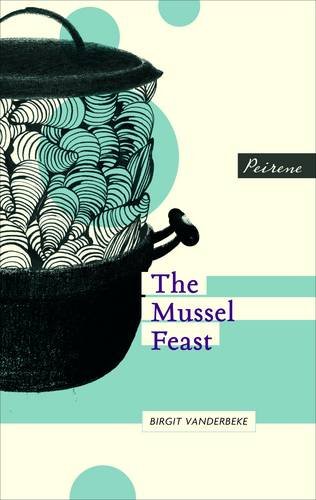
The Mussel Feast – Birgit Vanderbeke (1990 trans. Jamie Bulloch 2013 Peirene) 105 pages
Trigger warning: discussion of domestic violence
Peirene Press are one of my favourite publishers, with a focus on European contemporary novellas which so far have given me some wonderful reading experiences. The Mussel Feast is no exception, as it carefully and precisely builds a picture of a family tyrannised by the father, over the course of one evening.
Narrated by the teenage daughter of the family as she prepares the titular celebratory meal alongside her mother and brother, they await the return of their father who has bagged a promotion. The daughter doesn’t much like mussels, but it is how the family traditionally celebrates.
“Anyway, the noise came from the pot and as I glanced over I couldn’t help looking at the clock, too: it said three minutes past six. And at that moment my mood changed abruptly. I stared at the noisy pot […] it was a distinctly strange noise, which made me feel creepy; we were already twitchy and nervous, and now there was this noise.”
The father is late back, and the narrator reflects on what is happening that evening and on what has gone before:
“He couldn’t stand my mother’s knackered face, and so she switched to her after-work face, which she would paint on quickly in the bathroom at half-past five, before my father came home. But this after-work face only lasted for an hour and needed reapplying.”
Everyone in the family remains unnamed, fitting with thesense that they are all trying to fulfil a role for the father and that who they actually are is of secondary importance:
“We all had to switch for my father, to become a proper family as he called it, because he hadn’t had a family, but he had developed the most detailed notion of what a proper family should be like, and he could be extremely sensitive if you undermined these notions.”
The father is a deeply inadequate man, ashamed of his past in the GDR, and trying to convince his family of his superiority. His children don’t conform to gender stereotypes which annoys him. His wife isn’t pretty enough by his standards. The fact that he squanders their money and is fairly useless all round, is by-the-by:
“My mother earned money and did menial work, boiling the nappies in a huge pot, and cooking and shopping and children, all of which drove him nuts; my father was not cut out for such trivial jobs , and back then we would have frozen if my mother hadn’t lugged sacks of coal.”
By the time the following passage came I already had a clear idea of what was going on in this family, but I still found the matter-of-fact tone in describing such abuse truly shocking:
“He was extremely assured in his taste; he didn’t like his taste being questioned. I couldn’t bear the wall unit, as I told them that evening, due to my head having been smashed against it on a number of occasions.”
The tension in the novella builds expertly as, like the family, we wait for the father to return. The ending is ambiguous, but we know there are huge ramifications, because at the start of the novella the narrator tells us:
“what came in the wake of our abortive feast was so monumental that none of us have got over it yet”
Birgit Vanderbeke wrote this just before the fall of the Berlin Wall because “I wanted to understand how revolutions start.” In The Mussel Feast, it is a long time coming and also a matter of a few moments:
“Suddenly I no longer wanted him to come home, […] Mum looked at me, not as horrified as I’d expected, but with her head to one side, and then she smiled and said, well, we’ll see, and she didn’t sound as if she’d find it surprising or even terrible if he didn’t come home.”
The Mussel Feast has become a set text in Germany and deservedly so – the domestic setting is completely compelling but also has wider resonance which it carries lightly, the metaphorical never undermining the portrayal of abuse.

 madame bibi lophile recommends