Novella a Day in May 2023 – No.31

The Hunters – Claire Messud (2001) 86 pages

Earlier in the month I read A Simple Tale, the first of two novellas by Claire Messud collected under the title The Hunters. I was so impressed I wanted to read more by her, so on this last day I decided to return and read the titular tale.

It is very different to the previous story, although there are thematic links, and while I didn’t love it quite so much, it definitely convinced me that Messud is a skilled, versatile writer that I should explore further.

An unnamed narrator, whose gender is never revealed, takes a flat in Kilburn for three months while they undertake some research into poetic considerations of death. (There were extended descriptions of Kilburn which as a Londoner had me rolling my eyes at the snobbery/inaccuracy but I’ll be generous and say Kilburn has changed a lot in the 22 years since this was written so maybe it was a bit less lovable in 2001).

They are recovering from a broken heart, and desire nothing more than to be left alone. In Rear Window style, the flat looks out onto other flats, and this is what most appeals:

“I was at a time in which I desired exactly that: the suggestion of society, without its actual impingement into my carefully controlled existence. This is why, also, the people flitting among their trappings in the houses opposite so appealed to me: they were at once there and not there, a sign that life continued, even if it had nothing to do with me.”

Unfortunately for the narrator, they are unable to keep a pane of glass between themselves and other people, because their downstairs neighbour arrives on their doorstep. Ridley Wandor is a woman who lives in the ground floor flat with her mother and three rabbits (the titular Hunters). She is not glamorous; she has greasy hair, indistinct features, and a worn garish shellsuit. She smells of her pets. Her awkward manner is irritating and the narrator refers to her as an “oblique suet of a woman”.

Yet Ridley has power. She explains to her neighbour that as a carer, all her clients keep dying. The narrator is fearful of her:

“As if I knew – I did know, of course I knew; whether that knowing was a premonition or a predetermination – that I would not be able to escape her. That’s assault of the doorbell, which had so set me to trembling, was but the first of many such assaults;”

I can’t say too much more about what happens for fear of spoilers, but what Messud does in the story is to brilliantly confound expectations. The echoes of well-known horror/suspense films are there: Rear Window, Misery, possibly even Psycho. The narrator falls for these tropes and takes the reader with them.

Then, the narrator is very clear in explaining, they were wrong. They met Ridley at a time when they were vulnerable, defensive and not very generous. They thought of her as an “oblique suet”; a cruel and unthinking, dehumanising conclusion. Once they are in a better place, they view the story differently. They stop falling back on tales already told and subsequently see Ridley as an individual, deserving of respect:

“Which is why, you see, it must be told. Precisely in order to transcend its storyness, to make clear that this is not the invented story of a woman who existed only in my imagination, but the real story of a flesh-and-blood, breathing, sentient creature, someone far more real than I ever wanted or allowed her to be.”

The destabilising of the narrative isn’t remotely frustrating. Rather it widens the story to demonstrate the need to see life afresh and also to remember Anaïs Nin’s assertion: “We see the world not as it is, but as we are.”

The Hunters is a plea to not lose compassion at those times when we are not feeling compassionate; to be kind to those who encroach when we really want to be left alone – because we never know what is happening for someone at the times when they cross our path.

The positioning of the reader is very cleverly done in this respect. I didn’t like the narrator much at the start: snarky, judgemental, selfish. Yet as they had explained clearly, they were in a bad place, a place of pain. By the end of the story they are happier, and more pleasant as a result. So I shouldn’t be so quick to judge…

The Hunters is an evocative, sad, unnerving story that I’m certain will stay with me.

So that’s it – another month of novellas that has gone by in a flash! It was definitely looking unlikely at several points that I’d manage it but I’m glad I did. Thank you so much to everyone who has liked, commented and shared, I really do appreciate it.

It’s been great to see Simon doing his BookADayinMay posts too, and his achievement is far more impressive because he reads and posts the same day, whereas I give myself a headstart that somehow never manages to offset the panic/feeling of impending failure 😀

Last year after I’d finished I decided to read a massive tome, namely Ulysses. I thought I’d do the same this year (but first a Daphne Du Maurier novel, because I was disappointed not to manage Ali’s #DDMReadingWeek) and I’d appreciate some guidance from the lovely bookish blogosphere…

The chunksters longest languishing in the TBR are: The Magic Mountain; Parade’s End; Bleak House; Sophie’s Choice. I also have a recent acquisition of the thousand-page, single sentence Ducks, Newburyport. I think I’m tending towards Parade’s End but any and all opinions on which I should choose are welcome! If it’s Ducks… I have a seven hour train journey to Aberdeen at the end of June, so it may even get read 😀

Novella a Day in May 2023 – No.30

Four Soldiers – Hubert Mingarelli (2003 transl. Sam Taylor 2018) 155 pages

I really loved Hubert Mingarelli’s A Meal in Winter when I read it six years ago and so I was overjoyed to find a copy of Four Soldiers in my beloved local charity bookshop. This had a lot in common with its predecessor, being a sparse tale of servicemen which focussed on their humanity rather than their role in conflict. But it was resolutely its own tale too.

The four soldiers are friends thrown together by circumstance during the Russian Civil War in 1919. Resourceful, skilled Pavel, naïve gentle giant Kyabine, quiet, thoughtful Sifra and the narrator Benia. They keep each other company during the tedium of waiting for orders, close to the Romanian border:

“Because we didn’t know where we would be tomorrow. We had come out of the forest, the winter was over, but we didn’t know how much time we would stay here, nor where we would have to go next. The war wasn’t over, but as usual we didn’t know anything about the army’s operations. It was better not to think about it. We could already count ourselves lucky to have found this pond.”

What is so striking about the soldiers is how terribly young they are. We are never told their ages, but their behaviour, their lack of experience, their superstitions – all emphasise that they are little more than children caught up in something far beyond their control, for which they may have to pay the highest price.

Their concerns are ordinary, not political or idealistic. They play dice; they swim; they smoke; Pavel has nightmares; they take turns to sleep with a watch that contains a picture of a woman that they think brings them luck.

Mingarelli doesn’t seek to explain how they ended up there or what they hope for beyond it. By focussing on the present he is able to convey how caught they are by circumstance, how hope lingers but is unexpressed.  

“Barely had we finished drinking that tea before we became nostalgic for it. But, all the same, it was better than no tea at all.”

The simplicity of the plot, imagery and prose is so finely balanced. Mingarelli conveys a vital story that needs no adornment while at the same time driving home its importance and universality.

“I advanced. But I did so evermore sadly. The sadness was stronger than me. It was because of the smell of potatoes slung over my shoulder. It didn’t evoke anything precise, that smell. Not one specific event, in any case. What it evoked was just a distant time.”

Four Soldiers isn’t remotely sentimental or sensationalist, and it’s the ordinariness it depicts that makes it so devastating, and humane.

“The silence and the darkness covered us.

Then suddenly, almost in a whisper: ‘I wrote at the end that we had a good day.’

It was very strange and sweet to hear him say that, because, my God, it was true, wasn’t it? It had been a good day.”

Susan at A Life in Books, a great champion of novellas whose reviews are a significant contributor to my ever-spiralling TBR, has written about Four Soldiers here.

Novella a Day in May 2023 – No.29

The Murderess – Alexandros Papadiamantis (1903, trans. Peter Levy 1983) 127 pages

Trigger warning: mentions infanticide

I’ve long been interested in how witches are portrayed. It’s seems so often bound up with women on the edge of (patriarchal) society – single, childless, conventionally unattractive, isolated; perhaps with the suggestion of healing knowledge that threatens male medical practitioners. It’s something brilliantly sent up in the Blackadder II episode Bells where Blackadder gives up on his doctor who prescribes courses of leeches for everything, and instead visits the wilds of Putney (!) to consult the wise woman:

In The Murderess, Alexandros Papadiamantis draws on some of these stock characteristics and makes his protagonist an older woman, a mother who is also a healer, whose actions cause her to become a murderer living in wild environments. Like many ghouls, she has several names: Hadoula, Jannis Frankissa, Frankojannou.

“She provided herbs, she made ointments, she gave massages, she cured the evil eye, she put together medicine for the sick, for anaemic girls, for pregnant women and women after childbirth and for those with women’s diseases.”

At the start of the novella she is completely sleep-deprived, helping her daughter care for her sickly newborn:

“For many nights Frankojannou had permitted herself no sleep. She had willed her sore eyes open, while she kept vigil beside this little creature who had no idea what trouble she was giving, or what torture she must undergo in her turn, if she survived.”

Papadiamantis takes us back and forth in time to show the oppression of a patriarchal society. Female babies mean dowries to be found, and once married, hard lives keeping homes and raising children, often with little or no support from male spouses.

Something inside Hadoula snaps, and she kills her granddaughter, unable to contend with the life the child will have ahead of her:

“Frankojannou’s brain really had begun to smoke. She had gone out of her mind in the end. It was the consequence of her proceeding to higher matters. She leant over the cradle.”

This is the start of her killing the young female babies and children of the island. It is set on Papadiamantis’ home island of Skiathos, its beauty contrasting with the horrors:

“Below her the river cut deep through the Acheilas ravine, and its stream filled all the deep valley with soft murmurs. In appearance it was motionless and lakelike, but in reality perpetually in motion under the tall and long-tressed planes. Among mosses and bushes and ferns it prattled secretly, kissed the trunks of trees, creeping like a serpent along the length of the valley, green-coloured from leafy reflections, kissing and biting at once the rocks and the roots, a murmuring, limpid stream, full of little crabs which ran to hide in piles of sand, while a shepherd, letting little lambs graze on the dewy greenery, came to lean down over the water.”

The Murderess is carefully balanced: it doesn’t condone Hadoula but nor does it make her a monster. She is a desperate woman driven by the life she has led and the oppression she foresees for women in her society, to undertake the most monstrous of acts.

Papadiamantis makes it clear she has lost her sanity (although she continues to act by her own rationality), and also that she has guilt and regret, but also never remotely excuses or justifies what she does.

The story has a fabulist element but without detracting from Hadoula’s murders. I felt the author was drawing on centuries of storytelling to reframe the witches of folklore and ask what it was in societies that had brought them to that role in the first place?

“But mostly she was gathering herbs to forget the grief which tormented her.”

A challenging and haunting tale.

Novella a Day in May 2023 – No.28

La Bastarda – Trifonia Melibea Obono (2016 trans. Lawrence Schimel 2018) 88 pages

My Around the World in 80 Books reading challenge is getting more difficult – but definitely possible – the closer I get to finishing, because I decided I’d only count books written by a person from that country, rather than just set there. This means I’m dependent on what is available in translation. So I was excited to come across La Bastarda, written by an author from Equatorial Guinea, and grateful to The Feminist Press for publishing it.

I didn’t realise until I’d finished it and googled further, that it’s a famous novella, banned in Equatorial Guinea and with its own Wikipedia page. It’s a wonderful read, so evocative and with a clear and compelling narrative voice. (The English translation also has a really interesting afterword by the historian Abosede George.)

The story is told by Okomo, who lives with her grandparents in a village close to the border with Gabon. The family is polygamous which makes the home crowded and busy, but she is isolated due to the circumstances of her birth:

“My mother got pregnant when she was nineteen and died while giving birth, her death brought about by witchcraft. From that moment I was declared a bastarda – a bastard daughter. I had been born before my father paid dowry in exchange for my mother. That’s why society looked at me with contempt and people called me ‘the daughter of an unmarried Fang woman’ or ‘the daughter of no man’.”

As an older teenager she is beginning to question the life mapped out for her and what she wants. She is keen to locate her father but this is absolutely forbidden by her grandfather Osá who lectures her on the history of the Fang people and her responsibilities:

“[My grandmother] told me to ask Osá if there were any women in our tribe since he had failed to mention any in his collection of heroes, but I didn’t obey.”

Okomo isn’t interested in her appearance or in marrying a man, running a home and having children, all of which are expected of her. She knows she may have an ally in her mother’s brother, the only person who has ever shown her any affection. But he is somewhat ostracised too:

“Uncle Marcelo was an isolated man who lived outside of society because he was a fam e mina or a ‘man-woman’ the men of the tribe accused him of this both in public and in private.”

While Okomo is trying to work all this out, she is drawn into the sphere of three older girls, and discovers her sexuality. She falls in love with Dina, who reciprocates her feelings. But in a small village, where same-sex relationships are taboo, theirs is a love with great risk attached to it.

La Bastarda is a tense narrative where the dangers for the girls and for Marcelo are made very clear. But it is also a story of first love, coming of age, self-discovery and the nurturing of chosen families. It addresses huge issues in such a short space without ever losing sight of the individual characters. A finely balanced story of defiance and resilience.

Novella a Day in May 2023 – No.27

The Stepford Wives – Ira Levin (1972) 139 pages

Earlier in the month when I read The War of the Worlds, I mentioned I rarely read sci-fi. If I rarely read sci-fi, I never read horror. So this is definitely the month for going outside my comfort zone and learning to love it 😊

The Stepford Wives is such a well-known classic that I’m assuming everyone knows what the story is. I did, and didn’t diminish the horror or the tension in any way. I will keep this review very brief though, to try and avoid spoilers as far as possible…

The story is told from the point of view of Joanna, a photographer with a young family, who moves to the insular suburb:

“She wished: that they would be happy in Stepford. That Pete and Kim would do well in school, and that she and Walter would find good friends and fulfilment. That he wouldn’t mind the commuting – though the whole idea of moving had been his in the first place. That the lives of all four of them would be enriched, rather than diminished, as she had feared, by leaving the city – the filthy, crowded, crime-ridden, but so alive city.”

It takes Joanna longer than she hoped to settle in to Stepford. None of the women in the town are very sociable, spending endless hours cleaning their homes which they claim leaves them little time for anything else:

“That’s what she was, Joanna felt suddenly. That’s what they all were, all the Stepford wives: actresses in commercials, pleased with detergents and floor wax, with cleansers, shampoos, and deodorants. Pretty actresses, big in the bosom but small in the talent, playing the suburban housewives unconvincingly, too nicey-nice to be real.”

She does make one friend Bobbie, who is determined to leave the area:

“Is that your idea of the ideal community? I went into Norwood to get my hair done for your party; I saw a dozen women who were rushed and sloppy and irritated and alive; I wanted to hug every one of them!”

Meanwhile her husband Walter seems quite content, joining the local Men’s Association with the other local patriarchs who seem determined to keep clearly delineated lines between the sexes.

Slowly the realisation of what is happening in Stepford dawns on Joanna. She is resistant to the gaslighting that surrounds her – but it is already too late?

The Stepford Wives is truly horrifying. Not only because the tension is built so expertly by Ira Levin (the novella form seems particularly suited to this) and not only because of the actual events portrayed. But because – as the blistering introduction by Chuck Palahnuik in my edition makes completely clear – we may all already be living in Stepford…

Novella a Day in May 2023 – No.26

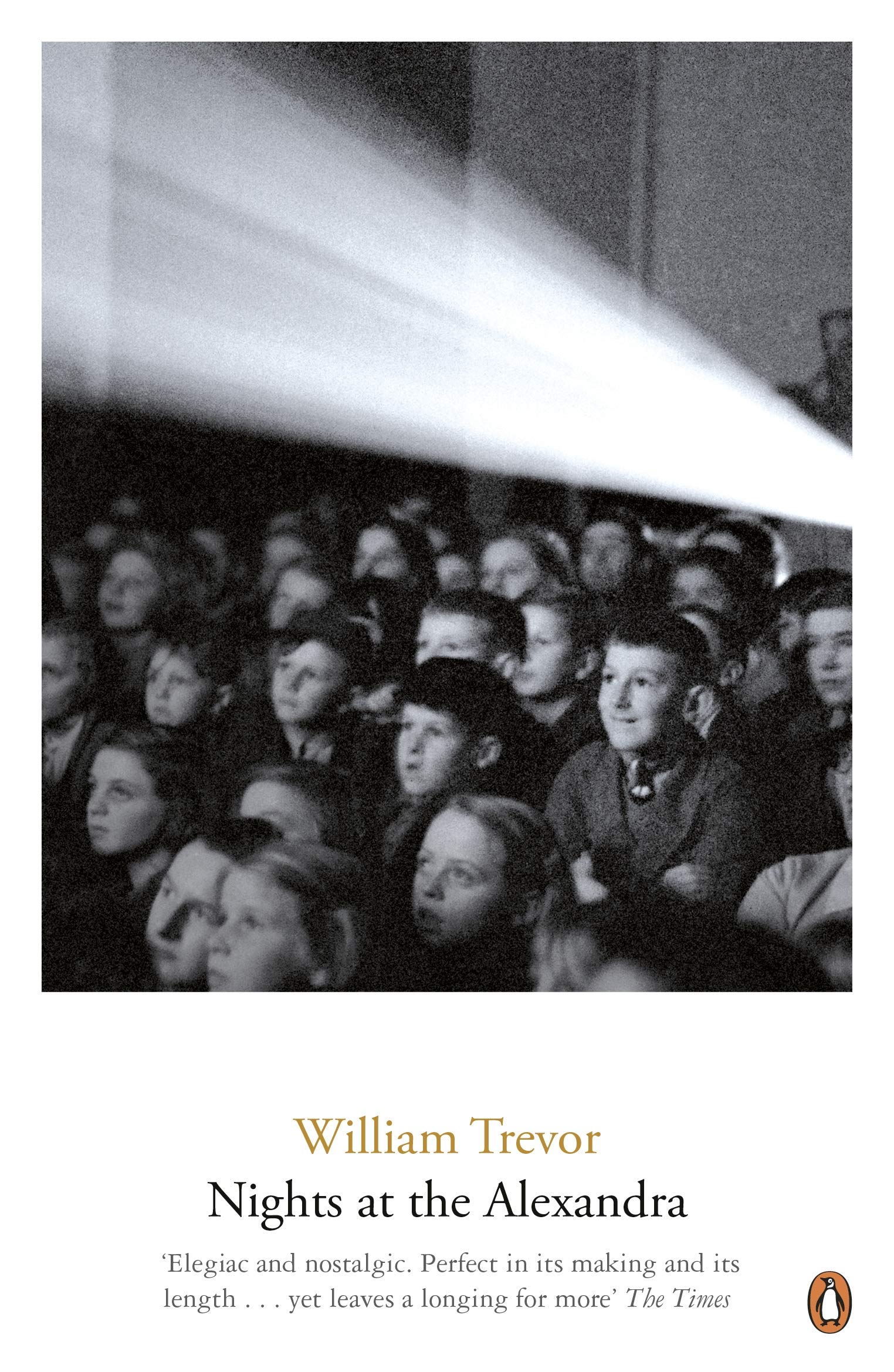
Nights at the Alexandra – William Trevor (1987) 71 pages

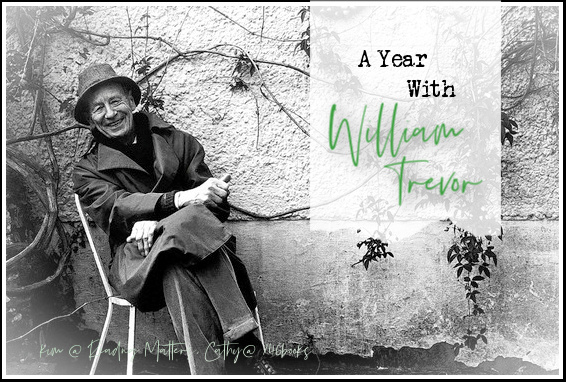
Many of you will be aware that Cathy at 746 Books and Kim at Reading Matters are hosting their wonderful A Year with William Trevor reading event throughout 2023.

Earlier this month, Cathy reviewed Trevor’s novella Nights at the Alexandra, and it sounded so completely wonderful I knew I’d have to get to it before the end of May. I did and it was all I anticipated.

It opens with 58 year-old Harry remembering his life as a young adult, just about to leave school, during World War II. The Messingers – she English, he German – have moved to Ireland to avoid the prejudice their relationship would encounter in their countries of birth. She is much younger than her husband, and glamourous.

“I remember that more distinctly than any other moment in my life. She was already in the car when she spoke, and her tone of voice was not one normally employed when making a request. With a gentle imperiousness, she commanded what she wished, and before she drove away she glanced at me once, a smile flickering across her thin features.”

Harry is from a Protestant family, living in a Catholic town. He is expected to follow his father into the timberyard business – something his elder sister has already done by working in the office and which she bitterly resents.

“The family atmosphere was as it always was: my grandmothers silent in their dislike of one another, my brothers sniggering, my mother tired. Annie resentful, my father ebullient after an hour or so in the back bar of Viney’s hotel.”

Harry does not want to follow his father in any way. He is desperate for something else, without knowing what it is. The Messingers – particularly Mrs Messinger – with their large house, cigarettes and tea, affection and childlessness, stories and difference, offer this to Harry.

They offer him further escape when Mr Messinger decides to build the titular cinema in the town, named after his wife. Harry is able to have a job, and refuse the timberyard once and for all.

Nights at the Alexandra has such a subtle and finely-wrought tone. The relationships between the characters are beautifully evoked and in less-skilled hands could have easily descended into cliché. Instead Trevor gives us a story of human lives with all their pain and love, longing and helplessness, that somehow grants his characters some peace too. There are also moments of deadpan humour:

“My father lent his observations weight through his slow delivery of them, his tone suggesting revelations of import yet to come. But invariably this promise remained unfulfilled.”

Now, it could be said Reader, that my tears are not worth very much. I’ve always been a crier anyway, and currently I’m bereaved and pre-menopausal, so it doesn’t take much to set me off. But I wept at the end of Nights at the Alexandra. It was so completely realised, so moving and poetic, unsentimental and sympathetic. Perfection.

Novella a Day in May 2023 – No.25

Ms Ice Sandwich – Mieko Kawakami (2013 trans. Louise Heal Kawai 2017) 92 pages

A nine-year old boy tells the story of a short period of time where he has a crush on the young woman who works at the sandwich shop in the local shopping centre. He never speaks to her but lines up to stare at her and buy a sandwich.

“‘Ms Ice Sandwich’ is a name I made-up, of course. I thought of it minute I first saw her. Ms Ice Sandwich’s eyelids are always painted with a thick layer of a kind of electric blue, exactly the same colour as those hard ice lollies that have been sitting in our freezer since last summer. There’s one more awesome thing about her – if you watch when she looks down, there’s a sharp dark line above her eyes, as if when she closed her eyes, someone started to draw on two extra eyes with a felt-tip pen but stopped halfway. It’s the coolest thing.”

The story could so easily be creepy or at least unnerving but it really isn’t. He’s young, quite lonely, and navigating that period of older childhood as friends change and he tries to work out who he is. His mother is distracted, his elderly grandmother is extremely frail, and his father has died.

Child narrators are so difficult to get right, but I really thought Kawakami pulled it off. The boy uses the striking imagery that children sometimes access “Bicycles are lined up like mechanical goats.” without it feeling too knowing for someone of his age. I thought this was done especially well when he is trying to describe his feelings for Ms Ice Sandwich:

“Like when you’re holding a cat and you touch it soft belly. Or sticking your finger in a jar of jam and stirring, then slowly sinking in all the rest of your fingers. Or licking the sweet condensed milk at the bottom of your bowl of strawberries. Or when a blanket brushes the top of your feet. Or when butter turns transparent when it melts over your pancakes. As I stand gazing at Ms Ice Sandwich, all of these things are happening to me, one on top of the other, right there.”

The boy doesn’t try to build a relationship with Ms Ice Sandwich and I think it would have lessened the story if he did. Instead we see his gently burgeoning friendship with classmate Tutti, who is also bereaved for a parent, and some very touching scenes between him and his grandma, so delicately realised.

“The little bit of golden sun that shines through the shoji screens on the window lights up the white areas of Grandma’s quilt, making a faint shadow of leaves, and each time the wind blows outside, the shadow pattern of leaves shakes a little bit. I go over to Grandma and I hold my breath for a moment. The room goes very quiet.”

Ms Ice Sandwich captures a particular time in a young boy’s life with sensitivity and compassion. By capturing ordinary moments between people so precisely it demonstrates something universal that carries far beyond childhood.

Skin Deep – Antonia Lassa (transl. Jacky Collins) Blog Tour

After eleven years of blogging, it’s finally happening: I’m taking part in a blog tour 😀

And most delightfully, it coincides perfectly with my month of daily novellas. Skin Deep by Antonia Lassa (2023 transl. Jacky Collins 2023) comes in at 114 pages, making this Novella a Day in May 2023 – No.24.

One reason I don’t do blog tours usually is because I only blog about books I enjoy, so I can’t guarantee to take part. However, I trusted wonderful indie Corylus Books to see me right, and they did 😊 I thought Skin Deep was a great read.

It’s a challenge to have a detective story in so few words but the story didn’t feel diminished in any way by this. Yes, the solution is straightforward but I would much rather that than an overly convoluted, protracted story where I lose all sight of what’s happening and why on earth the person was killed in the first place.

Here is the blurb from Corylus Books:

“When police arrest eccentric loner Émile Gassiat for the murder of a wealthy woman in a shabby seaside apartment in Biarritz, Inspector Canonne is certain he has put the killer behind bars. Now he just needs to prove it. But he has not reckoned with the young man’s friends, who bring in lawyer-turned-investigator Larten to head for the desolate out-of-season south-west of France to dig deep into what really happened.

Larten’s hunt for the truth takes him back to the bustle of Paris as he seeks to demonstrate that the man in prison is innocent, despite all the evidence – and to uncover the true killer behind a series of bizarre murders.

Skin Deep is Antonia Lassa’s first novel to appear in English.”

All three protagonists are very believable and well-drawn. Although Canonne leaps to a lazy conclusion regarding the killer, he doesn’t doggedly stick to it. There is a lightness of touch in his portrait, including his contemplations of life and relationships, triggered by his missing tooth.

“The moment they went into the apartment, Canonne said to himself that they had got their man. The reason being that the place was impeccably tidy, more like the methodically kept home of a cold blooded serial-killer rather than a young man of twenty-six.”

This othering of Émile Gassiat because his lifestyle and sexual preferences don’t fit the stereotype of those of a good-looking young man is part of the wider themes in the book around difference and acceptance.

Larten is the perfect detective for the job in this regard, as he is comfortable with being viewed as Other and uses it to his advantage:

“Just as a small question-mark can alter the course and meaning of an entire sentence, no matter how complex and articulate it might be, Larten wanted those feminine touches that he included in his appearance or in his clothing, to act as a question mark at the end of each of the ‘sentences’ that constituted his identity. Something that would trouble others, getting them to question their own identity or fall for his charms. An invitation to dive into the unknown.”

He’s also a competent and driven detective who balances detailed investigation with an acute understanding of people.

“Larten could only add his own intuition, an argument that was not worth much in court but to which he clung. His intuition had failed him on very few occasions in his life, perhaps because he was a good wine taster.”

Skin Deep is such an accomplished crime novella. It balances poetic passages and societal commentary alongside characterization and plot with ease. Both the seedy seaside and cosmopolitan city were clearly evoked. I’m not a huge reader of contemporary crime and when I do read it, it is usually in translation – I would love to read a series of Larten novels as this camper-van dwelling wine enthusiast completely won me over.

Here are the stops from the rest of the tour, do check out the reviews for this great read:

Novella a Day in May 2023 – No.23

Marie – Madeleine Bourdouxhe (1943 trans. Faith Evans 1997) 141 pages

The striking cover of Marie and the fact that it is published by Daunt Books was enough to convince me to pick up this novella, and I’m so glad I did. I’m not familiar with Belgian writer Madeleine Bourdouxhe’s work but the afterword explained she was a friend of Simone de Beauvoir and Victor Serge, among others, and she was part of the resistance during the war, so I’m glad to have finally discovered her.

Marie was published in 1943 and details the sexual awakening of a young married housewife (the original title was A La Recherche de Marie, maybe it was felt Anglophone readers wouldn’t get the reference to Proust?) It has an elegiac tone at times – not only for Marie but for everyone she encounters and for the city of Paris – and I felt the spectre of war was certainly present.

It begins with Marie and her husband Jean on holiday in the south of France, away from their Parisian home:

“It wasn’t as hot as earlier on, but as the afternoon came to an end, everything remained steeped in torpor, retaining the heat of the whole day. There is something ineffable around Marie that was making her happy. Jean was next to her, serving her coffee, giving her a cigarette: and intimate little scene, on the balcony of a hotel, overlooking the sea.”

Marie seems very devoted to her husband, but the authorial voice – which shifts between tenses –  suggests he not entirely worthy:

“There was definitely strength in his character – or rather, there were bouts of strength. Jean had a way of claiming his due, or more than his due: a somewhat egotistical way of deciding, of drinking, of eating, of sitting, of occupying his place.”

During this holiday Marie finds herself strongly sexually attracted to a man around ten years younger than her. Their affair continues beyond the holiday season and Bourdouxhe is wonderful at minutely analysing unspoken moments between people:

“They mutually accept this great silence, and the richness, the sincerity that lies within it. They also know that in that moment they are seeing everything from the same point of view and that, for both of them, that red sail on the sea stands out as clearly, as harshly, as cruelly, as the thing that is deep inside them.”

There is a lot to this seemingly straightforward tale. The lover remains nameless and none of the characters are as fully drawn as Marie. She is absolutely Bourdouxhe’s focus, through which she explores the roles of women, sexuality, agency, choice.

The war also creates a sense of foreboding for everyone the story touches. Having googled, I know the town that Marie and Jean find themselves in at one point was 90% destroyed in 1940.

Marie is a woman with a rich inner life and a sensual response to her surroundings. As she starts to externalise some of this, Bourdouxhe shows how unknown people can be even to those closest to them, the pressure of societal forces for women, and the challenge in making an inner and outer life congruous with one another.

Marie is a powerful novella and I’m looking forward to exploring this author further.

“She weeps the strange, bitter tears of an exhausted woman who is gradually letting herself be worn out by a symbol.”

Novella a Day in May 2023 – No.22

Small Things Like These  – Claire Keegan (2021) 110 pages

Claire Keegan’s short story collection Antarctica was the only work of hers I had read, but I remembered being really impressed by it. When Small Things Like These got so much love in blogosphere I knew I needed to pick her up again. Thankfully the planets aligned and I found a copy of it in a charity shop the very month I was focussing on novellas 😊

Bill Furlong is a coal merchant who lives a quiet life with his wife and young daughters in a 1980s Irish town. However, there is something in his past that means Bill has a sense of being an outsider. Perhaps it is this that means his compassion for people who are finding life harder and are homeless or struggling to make ends meet, or may be self-medicating with alcohol, is in contrast to those around him.

“Some nights, Furlong lay there with Eileen going over small things like these. Other times, after a day of heavy lifting or being delayed by a puncture and getting soaked out on the road, he’d come home and eat his fill and fall into bed early, then wake in the night sensing Eileen, heavy in sleep, at his side – and there he’d lie with his mind going round in circles, agitating, before finally he’d have to go down and put the kettle on, for tea.”

There is a Magdalene laundry in the town, and events conspire so that Bill becomes aware of the horrors that are taking place, sanctioned by state and church. His wife voices the general attitude when she says:

“‘If you want to get on in life, there’s things you have to ignore, so you can keep on.’”

However for Bill it is not so easy. The revelation comes at a time when he is questioning the purpose of his life, the daily toils and the wider meaning. So it is understandable that he is the one to break out from the conspiracy of wilful ignorance and silence that allows the abuse to continue.

“What would life be like, he wondered, if they were given time to think and reflect over things? Might their lives be different or much the same – or would they just lose the run of themselves?”

There is no way that the physical and psychological torture of the laundries can be captured in a 110 page novella, if ever, although there a couple of very distressing scenes. But I don’t think this is Keegan’s point. Instead she uses our pre-existing knowledge of the laundries to focus on putting us in the position of an ordinary person at that time. She demonstrates why he might take action, and what he could lose by doing so. The ambiguous ending, not without hope but not suggesting that Bill will avoid devastation, doesn’t allow for easy resolution.

Keegan is asking the reader to consider: what would you do? How much will you stand for, and how much are you prepared to lose? Knowing that throughout history atrocities have taken place while societies looked away, it is a powerful and enduring challenge.

“It would be the easiest thing in the world to lose everything, Furlong knew.”