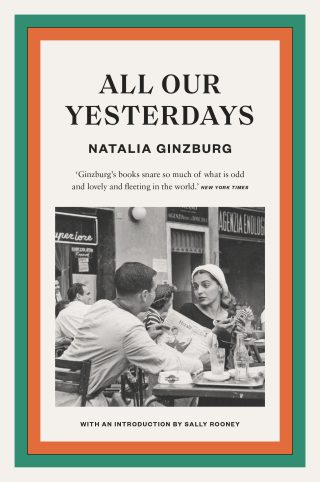
Daunt Books are such an interesting publisher and I was keen to read Natalia Ginzburg having heard wonderful things in the blogosphere, so I swooped on All Our Yesterdays (1952, transl. Angus Davidson 1956) when it turned up in my local charity bookshop. I think I’d read somewhere that this wasn’t the best place to start with this author, but I absolutely loved it.
The novel follows two families living in a northern Italian town from the 1930s, through the war years to peacetime. Although the blurb on the French flaps of my edition suggests Anna, the daughter of the poorer family, is the protagonist, really Ginzburg follows them all to a greater or lesser extent, with no overarching plot other than the sequence of years.
Although this approach sounds like a shortcoming, it works so well. It’s not a documentary novel but it gestures towards this with an omniscient neutral(ish) viewpoint and only reported speech. This felt unusual to read, but is so clever in capturing the everyday experiences of those living through extraordinary circumstances.
Anna’s siblings are Concettina, Ippolito, and Giustino. Concettina is popular with boys but struggles to find a purpose in life; Ippolito channels his energies into anti-Fascist activities with his friend from the richer family across the road:
“Emanuele and Ippolito did not even know Italy, they had never seen anything except their own little town, and they imagined the whole of Italy to be like their own little town, an Italy of teachers and accountants with a few workmen thrown in, but even the workmen and the accountants became rather like teachers in their imagination.”
Their lives are equally dictated by world events and by commonplace ones. Anna falls pregnant by her boyfriend and marries an eccentric older man, Cenzo Rena, moving with him to the southern village of Borgo San Costanzo. Her affair with her self-involved, callow boyfriend was no great passion, and while her marriage to Cenzo Rena attracts approbation, he is a warmer, more generous man than the one her own age.
“She was alone with Giuma’s face that gave her a stab of pain in her heart, and every day she would be going back with Giuma amongst the bushes on the river bank, every day she would see again that face with the rumpled forelock and the tightly closed eyelids, that face that had lost all trace both of words and of thoughts of her.”
These are people destined to be on the outskirts of war. Cenzo Rena holds a lot of sway in his local area and does help Jewish people fleeing the Nazi occupation, but on the whole the story of All Our Yesterdays is not one involving soldiers or revolutionaries. It is about ordinary people and for them the conflicts of war are reported facts not lived experience. The latter for them includes a lot of mundanity:
“And the bread in town was rationed and was a kind of soft, grey dough that you couldn’t ever digest, the bread was like the soap and the soap was like the bread, both washing and eating had become very difficult.”
Yet this doesn’t mean the story isn’t affecting, or that the characters avoid tragedy. There are some truly tragic events that are hugely affecting. Ginzburg manages to be even-handed in her treatment of her characters but not detached. Her writing is warm but unsentimental as she demonstrates that flawed people are as worthy of love and mourning as idealised ones.
In case I’ve made it sound unremittingly serious, I should mention that there humour in All Our Yesterdays too. There are romantic entanglements that are treated with a degree of levity, and eccentric housekeepers/family retainers with various foibles. All life is here.
I can’t think of another writer who approaches Ginzburg’s style, and looking back on it I can’t explain how she does what she does. This was a story that snuck up on me, the deceptively simple storytelling drawing me in more than I realised until I was totally immersed. An extraordinary novel.
“Fanfares of trumpets usually announced only small, futile things, it was away fate had of teasing people. You felt a great exultation and heard a loud fanfare of trumpets in the sky. But the serious things of life, on the contrary, took you by surprise, they spurted up all of a sudden like water.”
To end, of course there’s a very famous song I could post on the theme of Yesterday, but instead, to continue the mix of despair alongside levity: have you seen a parrot singing Creep by Radiohead?
Life has caused me to fall behind on blog writing, so unusually I’m writing this a few weeks after having read the book. Thankfully I found this one really stayed with me and I can get it in just in time for the last week of Women in Translation Month 😊
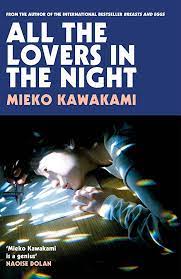
Having really enjoyed Mieko Kawakami’s Miss Ice Sandwich (2013) during my novella reading in May, I was delighted to find a copy of All the Lovers in the Night (2011, transl. Sam Bett and David Boyd 2022) in my local charity bookshop. It’s very different to my previous read of hers, and while I didn’t enjoy it as immediately as Ms Ice Sandwich, it did grow on me.
Fuyuko Irie is in her thirties and lives alone. She used to work in an office but her alienation from her colleagues means she prefers working at home. Her colleague/friend Hijiri is supportive of her talents and sends her regular work as a freelance proofreader, this work suiting her precise and solitary nature.
But this means that Fuyuko is even more isolated and achingly lonely. Kawakami is so good at capturing that modern urban alienation for people living surrounded by others but unable to connect, the feelings compounded when in the midst of a crowd.
“As I passed below the haloes of green and red traffic signals, I was taken by this strange view of the evening, the city streets full of people – people waiting, the people they were waiting for, people out to eat together, people going somewhere together, people heading home together. I allowed my thoughts to settle on the brightness filling their hearts and lungs, squinting as I walked along and counted all the players of this game that I would never play.”
It looks like things could change for Fuyuko when she meets Mitsutsuka, a physics teacher. Light is important to Fuyuko – every Christmas Eve (her birthday) she walks the streets at night looking at the illuminations. As Mitsutsuka explains the workings of light to her, they begin a tentative friendship, with brief points of connection offering glimmers of hope:
“‘Um, do you think the light you’re thinking about and the light I’m talking about are, um, the same thing?’
‘Of course they are, Mitsutsuka said with a smile. ‘We’re talking about the same light.’”
In a flashback chapter we learn more about Fuyuko’s background, and why she finds herself in the situation she does. There is an event in the past that Fuyuko describes without naming it in the way that I think most readers would, suggesting she doesn’t fully recognize her trauma or why she is making subsequent self-destructive decisions.
Kawakami subtly demonstrates how Fuyuko could change things for herself, but also how wider society makes this extremely difficult for her. She and Hijiri are women who have made very different choices and present themselves very differently to the world, but both struggle under the expectations placed on women and the fact that these are not an easy fit for either of them. A brief meeting with old school friend Noriko suggests traditional choices are not always happy ones either.
“I’d been on my own for ages, and I was convinced that there was no way I could be any more alone, but now I’d finally realised how alone I truly was. Despite the crowds of people, and all the different places, and a limitless supply of sounds and colours packed together, there was nothing here that I could reach out and touch. Nothing that would call my name. There never had been, and there never would be. And that would never change, no matter where I went in the world.”
All the Lovers in the Night is a slow burn novel, despite being only just longer than novella length. As I mentioned at the start, it was a story that grew on me and I found Fuyuko’s voice more compelling the more I read. A few weeks on and she’s really stayed with me.
Despite the sadness and alienation running through All the Lovers in the Night, I thought it ended with a suggestion of hope. That incrementally things can change, and improve. That imperfect people can make poor decisions but might still be moving towards a brighter time while doing so.
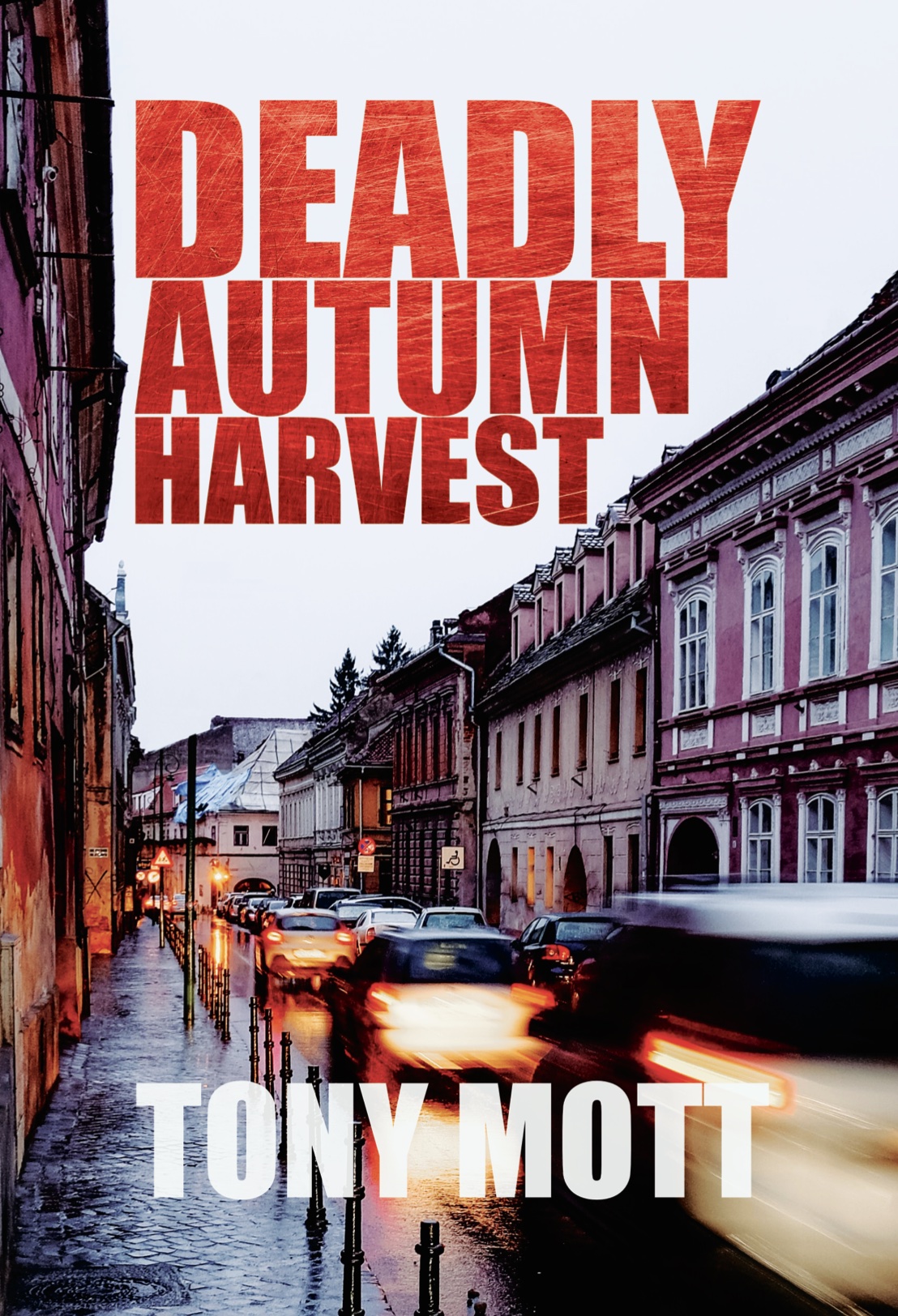
When I took part in a blog tour for Corylus Books earlier in the year, it was for a novella, which helpfully chimed with my Novella a Day in May reading. The bookish stars have aligned again for my taking part in a Corylus Books blog tour, as Deadly Autumn Harvest (2020) by Romanian author Tony Mott fits perfectly with my plans for #WITMonth reading, translated as it is by lovely blogger Marina Sofia (2023).
Here is the blurb from Corylus Books:
“A series of bizarre murders rocks the beautiful Carpathian town of Braşov. At first there’s nothing obvious that links what look like random killings. With the police still smarting from the scandal of having failed to act in a previous case of a serial kidnapper and killer, they bring in forensic pathologist Gigi Alexa to figure out if several murderers are at work – or if they have another serial killer on their hands. Ambitious, tough, and not one to suffer fools gladly, Gigi fights to be taken seriously in a society that maintains old-fashioned attitudes to the roles of women. She and the police team struggle to establish a pattern, especially when resources are diverted to investigating a possible terrorist plot. With the clock ticking, Gigi stumbles across what looks to be a far-fetched theory – just as she realises that she could be on the murderer’s to-kill list.”
I don’t read much contemporary crime because I don’t want to read about women being killed in various gruesome ways. I’m relieved to say I thought Deadly Autumn Harvest got the balance right between giving enough detail so that the horrors were realised, but with nothing being gratuitous. There was a responsibility in how the victims were portrayed, so you got a sense of them as people and the injustice in how their lives ended.
Forensic pathologist Gigi Alexa is an intriguing figure too. Cascading curly blonde hair and resolutely dressed in bright colours, I thought she was an idiosyncratic and believable investigator, good at her job and super-committed, yet not entirely detached:
“Usually, by the time she got to see the bodies, they had been drained of any semblance of life or a back story, they were mere puzzles to be solved. But today it had all been a little too close for comfort.”
She’s also a scientist who is not above a bit of superstition:
“Three bad omens. She counted them. First, she stumbled over her slippers as she got out of bed, so she went to the bathroom in her bare feet. Then she stepped into the sand that Morty had scattered from his litter tray. Thirdly, once she got into the kitchen, her coffee machine refused to get going so she would have to boil up Greek coffee instead. Three signs of bad luck on a Tuesday – no doubt more would follow.”
As Gigi and her team investigate the murders, she has to contend with various frustrations in the male-dominated environment. She’s not surrounded by idiots though. I liked her relationship with her boss CI Matei, and Emil, her colleague in pathology. There was also some humour (alongside remembrance of previous toxicity) in the reappearance of her impeccably turned-out ex, Superintendent Vlad Tomescu. (Slight spoiler, skip the next sentence and quote if you don’t want to know!) Gigi becomes single during the novel and her sardonic reflections on this state also lightened the tone:
“She didn’t miss him at all. It would be a while yet before she started missing the warmth of someone to curl up with in bed. Maybe during the winter. Except maybe by then she would have invested in an electric blanket.”
The mystery is very well-paced and the novel isn’t overlong at just 225 pages. We are there at the moment of the killings at various points, before we are returned Gigi and her team’s investigation. Although I’d be amazed if anyone guesses the connection before Gigi, we’re given a fair chance to guess the perpetrator. I’d like to proclaim I worked out who did it, but I suspected absolutely everyone at some point 😀
Deadly Autumn Harvest is a quick, compelling read with a truly chilling murderer pursued by a team of believable, well-rounded investigators.
Finally I should just say that Deadly Autumn Harvest definitely made me want to visit Braşov! I’ve never been, it sounds absolutely beautiful and with Gigi and her team on the case there won’t be any serial killers left to spoil my holiday – perfect.
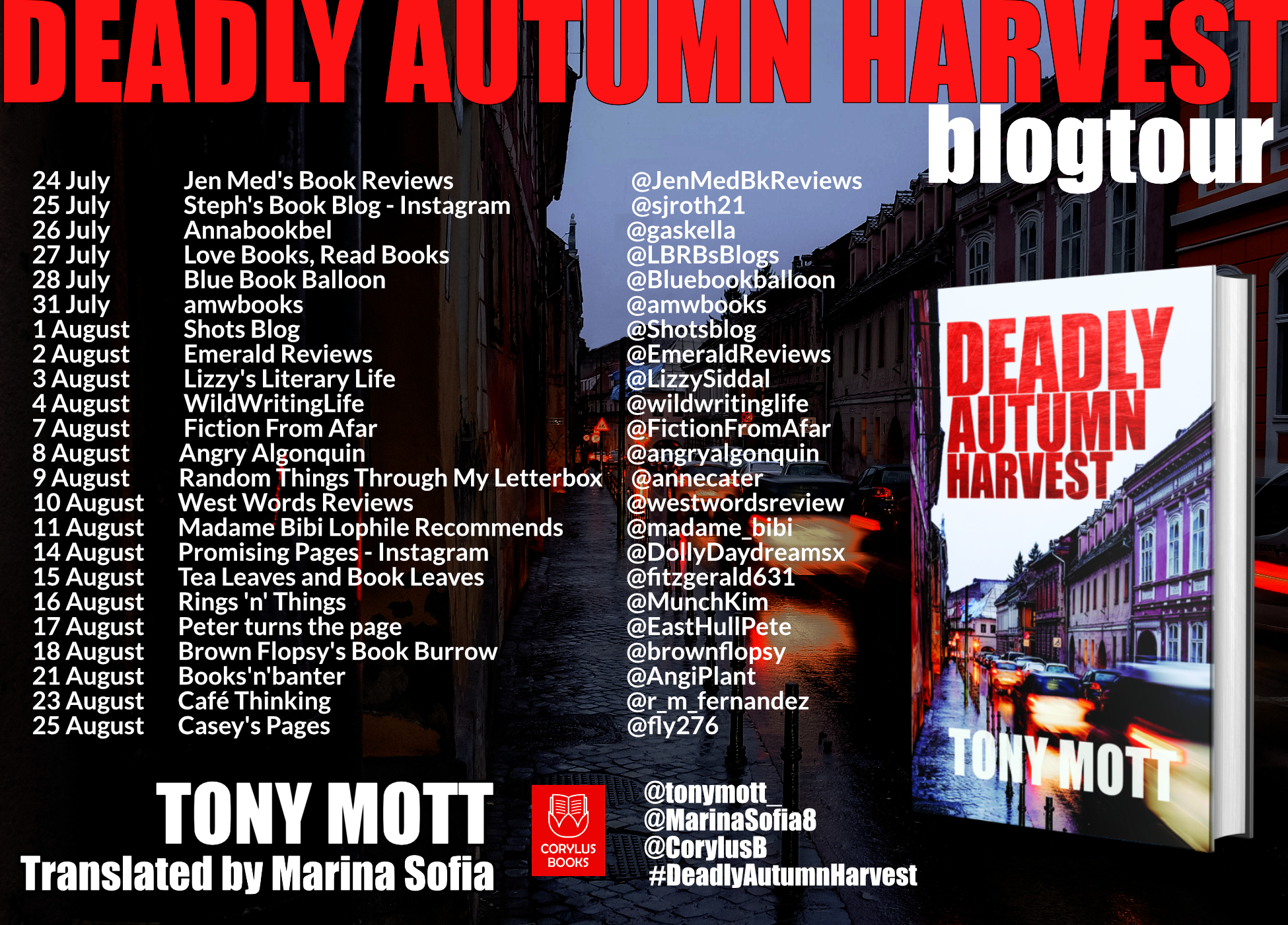
Here are the stops from the rest of the tour, so do check out how other bloggers got on with Deadly Autumn Harvest:
I had such a book hangover after Bleak House. I couldn’t settle to anything. A friend of mine who loves a certain 80s singer has a phrase when she hears other warblers: “He’s alright, but he’s not George Michael.” Well, I kept picking up books that were alright, but they weren’t Bleak House. So few books are, I find…
Then I remembered that when Simon did his books of the year round up last year, I’d recognised two were on my TBR pile. Surely books good enough to make the final cut would see me right? Of course they did 😊 Hooray for bloggers and their brilliant recommendations!
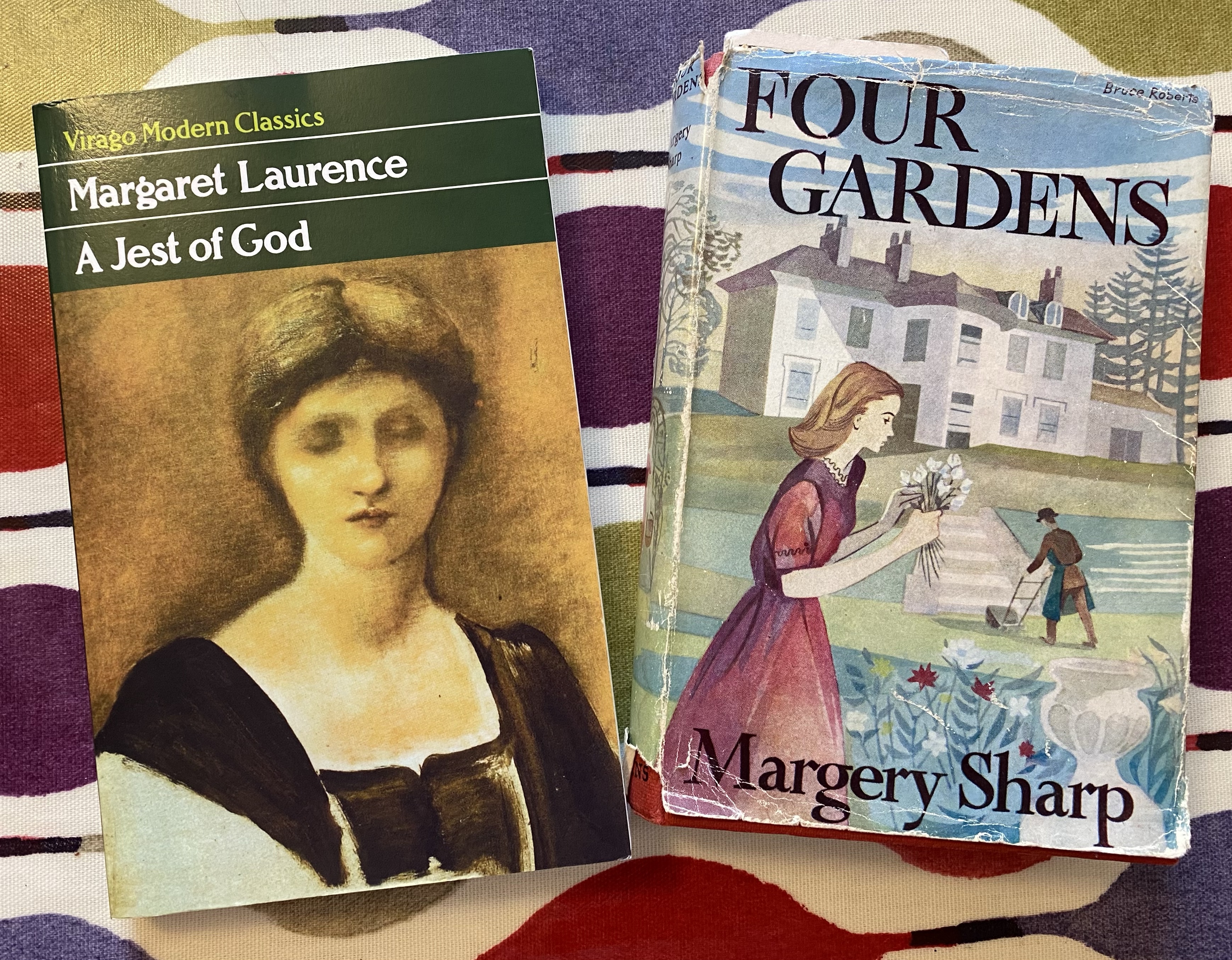
Firstly, the novella which made the top of Simon’s list, A Jest of God by Margaret Laurence (1966). This was the second in Laurence’s Manawaka sequence, but thankfully they can all be read as standalones as I’d not read anything by her before. On the strength of this, I’ll definitely be seeking out her writing again.
A Jest of God is an intimate character study of Rachel Cameron, a thirty-four-year-old teacher who lives with her emotionally manipulative mother above the Manitoba funeral business her father ran until he died.
The novel is narrated in the first-person, and Rachel’s mind is an oppressive and tense place to be. She is highly anxious and self-censoring:
“There. I’m doing it again. This must stop. It isn’t good for me. Whenever I find myself thinking in a brooding way, I must simply turn it off and think of something else. God forbid that I should turn into an eccentric. This isn’t just imagination. I’ve seen it happen. Not only teachers, of course, and not only women who haven’t married. Widows can become extremely odd as well, but at least they have the excuse of grief.”
This anxiety and second-guessing is not helped by her mother’s behaviour, which is self-pitying, judgemental and highly manipulative. Rachel recognises this, but is at a loss as to how to extricate herself:
“Her weapons are invisible, and she would never admit even to carrying them, much less putting them to use.”
“All such words cling to the mind like burrs to hair, and I can never seem to brush them away, as I know I should do.”
Rachel’s mother is not an out-and-out baddie though, and Laurence expertly demonstrates the vulnerability and fear that underlies her machinations. Similarly, Rachel does not always behave well. In one particular scene early in the book, she actually behaves despicably and doesn’t make amends despite her instant remorse. She is a complex, contradictory character, wholly believable. Laurence treats her tenderly but unflinchingly; without judgement but also without sentiment.
Rachel could so easily be a stereotype: a lonely single woman, living with her mother. But Laurence side-steps clumsy characterisation, or easy dismissal of Rachel, by delicately exploring the true meaning of the adjective so often attached to unmarried women approaching middle-age: she is desperate. She is absolutely desperate and despairing. She is lonely, and feels trapped in the life she has always known, with no way out. She wants things to be different, but she doesn’t know how. She is deeply, existentially sad.
1966 is a time of societal change, when women like Rachel could feel stifled by convention and also have some sexual freedom. So when Nick, and old schoolfriend appears, there are brief moments of physical connection. But in only seeing things from Rachel’s point view, the reader is able to realise how little intimacy there is. And that is what Rachel needs, more than the sex which Nick offers. Yet she doesn’t know how to achieve this:
“I talk to him, when he is not here, and tell him everything I can think of, everything that has ever happened, and how I feel and for a while it seems to me that I am completely known to him, and then I remember I’ve only talked to him like that when I’m alone. He hasn’t heard and doesn’t know.”
In some of Nick’s reported speech, the reader picks up on things Rachel ignores. She is so bound in her own intense feelings, she can’t really hear the cues Nick gives, over her relentless inner voice.
“He’s thirty-five, not fifteen. His past such gauche public performances. What he worried about Rachel? I’m not worried. I’m perfectly alright. Well, relax, then. I am relaxed. Oh? Shut up. Just shut up.”
A Jest of God is such an accomplished novel that is also so approachable. I found Rachel’s voice got under my skin very quickly and distinctly, and I had to read on. I think it works very well as short novel, longer would have been too oppressive and difficult to sustain I suspect. But at the length it is it remains powerful and impactful, and not as depressing as I’ve made it sound!
Ultimately there is resilience and change for Rachel, even some defiance. And there are brief moments of humour, such as Rachel trying to duck her colleague Calla’s constant invitation to attend Tabernacle with her:
“At least I have postponed it, and perhaps by that time some reasonable excuse will come along, or I’ll be dead.”
A stunning novel: a precise and compassionate character study, clever and humane. I’m so glad to have discovered Margaret Laurence at long last.
“Something must be the matter with my way of viewing things. I have no middle view. Either I fixed on a detail and see it as though it were magnified – a leaf with all its veins perceived, the fine hairs on the back of a man’s hands – or else the world recedes and becomes blurred, artificial, indefinite, an abstract painting of a world.”
Secondly, after being in Rachel’s head, I looked forward to some comic relief from an author I always enjoy: Margery Sharp. Four Gardens (1935) was number ten in Simon’s list. But this wasn’t as comic as some of her other novels; it had a slightly elegiac tone and the relationships included a certain sadness. But it wasn’t a sad novel overall, and I sunk into Four Gardens with pleasure.
Four Gardens follows the life of Caroline Chase from late teens to middle-age and the titular spaces she finds herself in. The device with gardens isn’t remotely heavy-handed and for a significant section of the novel they barely feature. But Caroline is a gardener, given half a chance, and it is instinctive and natural to her:
“Her step, as she now redescended to the rose garden, was therefore a proper gardeners tread – slow, considerate, with long abstracted pauses for survey and meditation. She also, without thinking, removed her hat and gloves.”
This is her first garden, one she trespasses into, and as she meets her first love there, it has a dreamlike quality. Perhaps this is why her love of gardening is so easily disregarded when she leaves behind youthful folly to marry the determinedly sensible Henry:
“For all these things in themselves – love at first sight, undying devotion, and general aloofness – were very exciting indeed; it was only in connection with Henry that they became so curiously prosaic.”
And so for many years Caroline doesn’t garden at all. She runs a house and she raises her son and daughter in the town where she has always lived. She is the creator of a safe space for her children and an unwavering routine for her staid but affectionate husband.
Despite the love she feels for her family and the tranquillity of her home life, I did find an element of melancholy to Caroline’s domestic arrangements. Her family are near and dear, but there seemed to be very little intimacy: she and Henry rarely communicate about anything beyond practical considerations, and she doesn’t really understand her children at all. She also despises her closest friend in the village, Ellen Watts – a monstrous and wholly believable creation. Caroline reflects very little though, and so any concerns are quickly subsumed in the relentless demands of domesticity:
“Thinking – the deliberate exercise of the brain – did not come naturally to her.”
But I wouldn’t want to give the impression that Four Gardens is ponderous or heavy-going in any way. It felt quite a realistic presentation of Edwardian contentment, though not without Sharp’s gentle jibes, such as this discussion of wallpaper where Caroline evokes her husband’s approval to counteract her mother’s reservations:
“Mrs Chase was at once silenced. […] It would have seemed perfectly reasonable to her that Caroline, who was in the house all day, should have suited her surroundings to the taste of a man who was out of it.”
I did want Caroline to exert herself in some way, to stake a claim beyond her roles meeting everyone else’s needs. Finally she does it, when she starts growing runner beans during World War I, and realises how much she is nurtured by time with her plants:
“there was usually a quiet space, between twelve and half-past, when the first work of the house was finished and before the children’s dinner became a pressing consideration; and these thirty minutes Caroline began to guard and cherish as a precious treasure.”
The war years are beautifully evoked by Sharp, with all their worry alongside self-serving censorious behaviour of some in the village. After the war, everything changes. Caroline finds herself mistress of a large house, with a garden she can’t touch unless she wants to incur the wrath of a succession of gardeners:
“The garden was looking well. But it always did look well, and gave her no special pleasure […] It was perfectly designed and perfectly kept, and to Caroline completely uninteresting.”
Meanwhile, her children are vaguely affectionate, patronising strangers. They change the names she loves, Lily becoming Lall and Leonard, Leon. They are academically accomplished and having had money their whole lives, utterly contemptuous of it. These Bright Young Things live by a morality that is absolutely baffling to Caroline, and there is a lovely echo of an earlier scene between Caroline and her mother in a later conversation between Caroline and Lall. The reader can see they are so much more alike than either realises, dramatic irony at its lightest.
I’m not one for biographical readings of novels but something of the tone of Four Gardens – affectionate, gentle, slightly sad – did make me consider the dates. In Caroline, Sharp is writing about her parents’ generation, so maybe that explains it… or maybe it has nothing to do with it at all, who knows?
Caroline’s fourth garden finally sees her able to do as she pleases. I couldn’t help feeling she might really surprise her children, and herself 😊 A warm, engaging story of a woman’s outwardly ordinary adult life during great societal change.
To end, Paul Newman adapted A Jest of God as Rachel, Rachel for his directorial debut. This very odd trailer doesn’t make it seem overly appealing:

 madame bibi lophile recommends