Last year I only just managed a post for AusReadingMonth and in fact the month had already ended in Australia, so I was determined to do better this year, for AusReading Month 2023 hosted by Brona at This Reading Life. So I’m pleased to be posting on the first day of October, and I’m hoping to get a couple more reads in before the end of the month – a three hour train journey to Newcastle this week should help me on my way…

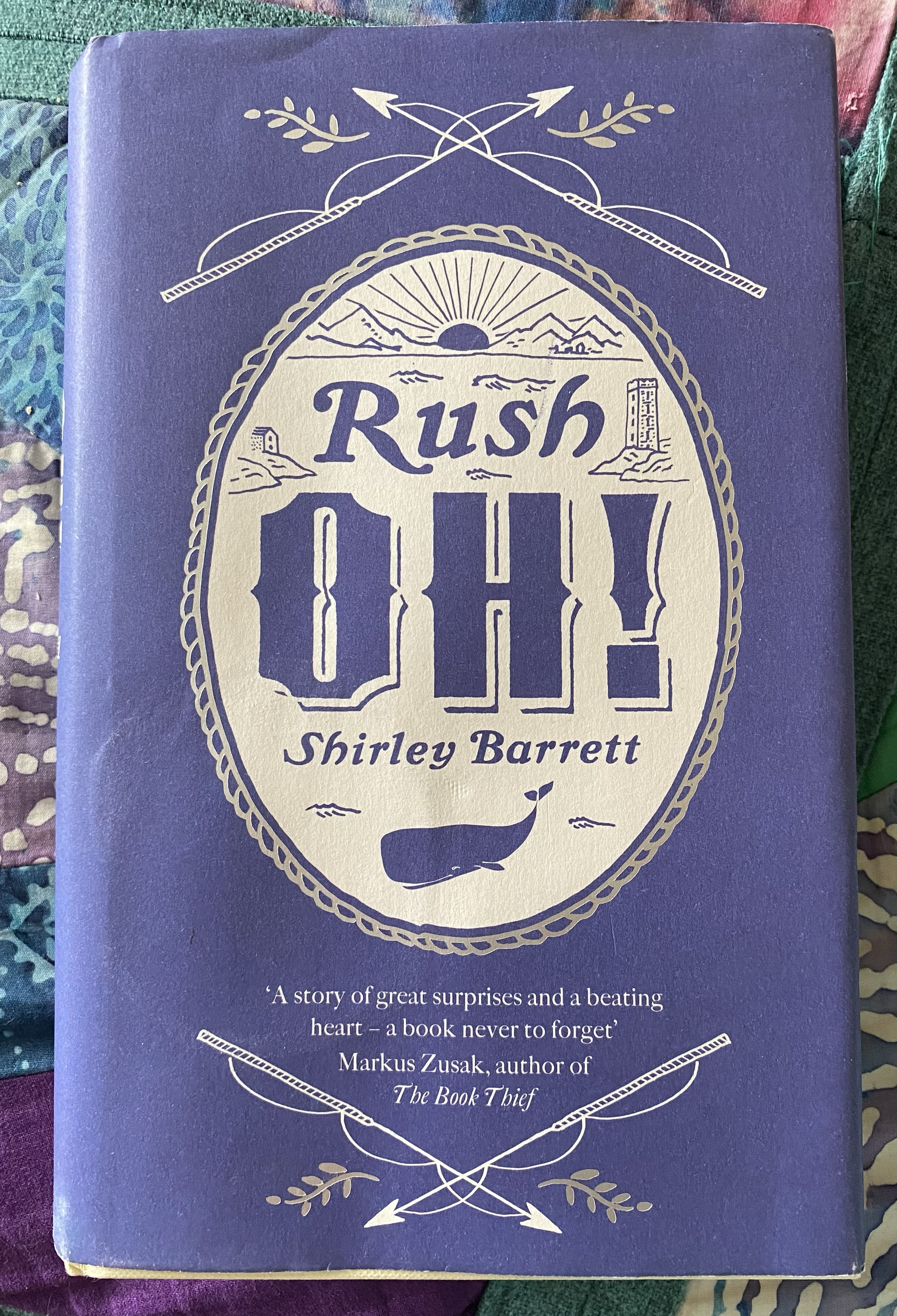
Now, I am definitely not in the market for a novel about whaling, but I remember Rush Oh! by Shirley Barrett getting a lot of love in the blogosphere when it came out in 2015, so I was persuaded to give it a try. Barrett was born in Melbourne and lived in Sydney, she was a filmmaker as well as an author and Rush Oh! was her first novel.
Rush Oh! is loosely based on a famous New South Wales whaling family, but Barrett explains in an Author’s Note at the end that she made a lot of changes and it is a work of fiction. There were a few passages I had to skip and one particular scene, but generally I found not too traumatic a read. It’s told from the point of view of nineteen-year-old Mary Davidson, the eldest daughter of a famous whaler, George ‘Fearless’ Davidson.
As Mary isn’t a whaler, and the season of 1908 is a particularly bad one, there isn’t much whale slaughter. When it does occur, Mary and her sister Louisa are horrified at “the ghastly brutality” they witness, Louisa refusing to speak to her father. Many years later, when George harpoons a whale without the need to bring it in for earning money, Mary finds this entirely unconscionable as killing for its own sake. Rush Oh! remains well-balanced and I didn’t feel Barrett was putting modern sensibilities into a historical figure.
The Davidson’s live in Eden and George sails from Twofold Bay with his crew which includes five Aboriginal men. They are helped in their work by a “gentlemen’s agreement” with a pod of Orcas, who herd Humpback and Sperm whales into the bay, knowing they will get a share of the spoils.
“I awoke suddenly to hear a distant but determined smack! It was a Killer whale flop-tailing, surely? Smack! There it was again, and no doubt about it this time. I jumped out of bed and hurried out to the veranda – my father was running stiff-legged down to the sleeping huts, shouting, ‘Rush oh! Get up, boys! Rush oh!’”
The Orcas are well-known to the family, who give them names: Hooky, Humpy, Typee, Jackson, led by Tom:
“In spite of his distinguished years, his demeanour was ever that of a cheeky schoolboy, the sort that might steal your apples or throw rocks at you from across the street, but nonetheless a good boy in his heart and loved by all who knew him. As well as his duties as Chief Scallywag and Rouseabout, it was Tom who would generally take it upon himself to alert my father and his men whenever he and his companions had herded a whale into the bay.”
For the Aboriginal crew members, the Orcas are recognised as ancestors.
Into this world arrives handsome John Beck, an ex-Methodist-minister. Mary falls hard for him, but as her mother has died and she has a fractious relationship with her sister, she turns to novels and etiquette articles for advice on how to talk to men:
“I had often notice to certain archness deployed by the heroines when addressing members of the opposite sex and I strived to emulate this tone whenever the opportunity arose, which was infrequently. […] In desperation, I had even attempted to engage my uncle Aleck in repartee, but it was difficult to sparkle when constantly having to repeat things in a louder voice.”
Poor Mary. She is awkward and surrounded by older fisherman and her relatives, trying to eke out paltry food supplies to feed them all. She is looking back on this time from 30 years hence, and there is no bitterness in her tone. Rather there is a gentle humour and acceptance of who she was then and who she is now.
Her youth and naivete are also demonstrated in the style of the tale, with little sketches throughout (Matt Canning was the illustrator) and sometimes tying herself in knots with her syntax:
“I fear it will only invite comparisons with Mr Melville that will not be flattering. (I mean, they will not be flattering to me; they will be perfectly flattering to Mr Melville).”
But she is intelligent and funny and she cares for her family; I found her believable and charmingly honest. The humour could be gently mocking at times:
“The age at which Uncle Aleck started whaling was a variable thing, but it was consistent in the fact that it was always younger than anybody else’s.”
But really it was fond more than anything, such as the fishermen’s reaction to John Beck’s sermonising:
“‘Father, since you asked, I have not been buffeted by temptation in a long time,’ said Uncle Aleck.
‘Me neither,’ admitted Arthur Ashby.
‘I would very much like to be buffeted by temptation, but sadly no one is buffeting me,’ said Salty.
‘I wonder if we could get onto the business of praying for a whale,’ said my father.”
Rush Oh! doesn’t fall into the info-dump trap of some historical fiction and wears its research lightly, evoking the setting beautifully and not losing sight of the story at all. My only reservation was that the point of view varies without stating so: Mary describes scenes she wasn’t present for. Although she states at one point this is because she heard about it from John Beck, it didn’t quite work for me.
But this is a minor quibble about an original and engaging tale with a clear-voiced narrator. The ending was left somewhat open on a couple of storylines and while I know that could irritate some readers I thought it worked really well in terms of allowing Mary a life beyond the story without everything tied off neatly.
Shirley Barrett wrote one other novel before she died in 2022. I understand The Bus on Thursday is very different to Rush Oh! but the strength of this novel has made me keen to read it.
To end, I do try and shoehorn in an 80s pop video where I can, and this one seemed apt:
 madame bibi lophile recommends
How did I not know she died???! That is so sad. I have this one on my digital TBR, where it’s been hiding since 2015. Might be time to dust it off…
LikeLiked by 1 person
I was so shocked too Kim, because I felt like this was published not very long ago, but of course it was eight years. I hope you enjoy this if you get to it.
LikeLiked by 1 person
So glad you enjoyed this gem of a book. Although I read it years ago, it’s one I think about surprisingly often.
If you haven’t seen Shirley Barrett’s 1996 film, Love Serenade, try to find it. It’s bizarre but brilliant.
LikeLiked by 1 person
I just watched the trailer on YouTube and it does look bizarre, but very tempting! I’ll see if I can get the full film. Lovely to hear how this book has stayed with you Kate.
LikeLike
I registered this when it was all over social media but wasn’t much attracted to it – partly the hype, partly the subject matter – but I might have to think again after reading your review.
LikeLiked by 1 person
It’s very accomplished for a first novel Susan, but maybe this is because Shirley Barrett was already an established screenwriter before she turned to novels. The subject matter is off-putting, but I found it easy enough to skip certain sections and its not too extensive. I hope you enjoy it if you give it a try!
LikeLiked by 1 person
Well, the subject matter is something which probably wouldn’t appeal to me, Madame B, but you make a good case for reading it despite that! Somehow I’ve managed to miss both author and book, but I do like the quotes!
LikeLiked by 1 person
The subject matter is awful, but it’s not the focus of the book thankfully, or it would have been a rapid DNF for me! Glad you enjoyed the quotes Kaggsy 🙂
LikeLiked by 1 person
Thanks for your review. I enjoyed the music clip too and it was a very apt choice for the subject matter.
This sounds an interesting book, although, like you, I would struggle with some of the details of the whaling. The passages you quote would make me want to read it even though it is not at all the sort of subject matter or genre (historical fiction) that I would normally read.
Hope October is a good reading month for you; maybe you should plan some more long railway journeys; I love an opportunity for a read on a train.
LikeLiked by 1 person
Thank you! Glad you enjoyed the quotes and the music. Whaling is a horrible topic but thankfully the details were easy to avoid.
I do love reading on a train too! I’m looking forward to the Newcastle journey. Wishing you a great reading month ahead 🙂
LikeLike
I really enjoyed Rush Oh! when I read it several years ago. Glad you liked it.
LikeLiked by 1 person
Thanks! Good to hear you enjoyed it too.
LikeLiked by 1 person
Crud! I thought Aus Month was in November. grrr there’s my plans shot! Lol “Rush Oh! doesn’t fall into the info-dump trap of some historical fiction and wears its research lightly,” you said it so well here! The orcas and the Aboriginals interest me very much. Interesting-sounding book.
LikeLiked by 1 person
Don’t worry! On her masterpost Brona says the end dates are fluid, so you can definitely squeeze some reads into November if you want 🙂
It was a really interesting book, I don’t read much historical fiction but I felt I learnt something along the way without the story getting lost at all.
LikeLiked by 1 person
I’ll read her post after work. Thanks for letting me kniw
LikeLiked by 1 person
I had forgotten all about Australia reading month, so I’m not likely to join in. This does sound interesting, though I can’t I would have been drawn to a novel about a whaling family either. Mary sounds like a character I would like.
LikeLiked by 1 person
I think you would like Mary Ali. She’s a strong individual but not always confident in herself, she’s very appealing.
LikeLike
That quotation about flattery made me laugh aloud! This sounds like quite a rewarding read and good thing that the event encouraged you to take time for it.
LikeLiked by 1 person
Glad you enjoyed it Marcie! There’s a lot of gentle humour in the novel.
LikeLike
One of my former bookshop colleagues loved this too. After reading Moby-Dick a few years ago I was tempted to read it as well, but I needed a little break from whales! I hadn’t realised she was a screenwriter (thanks Kate) I thoroughly enjoyed Love Serenade when it first came out – quirky and off-beat from memory. And very sad to read that she died last year.
LikeLiked by 1 person
Yes I can understand you’d be whaled-out after Moby-Dick! Great to hear you enjoyed Love Serenade too – I’ll hunt it down as it does sound really entertaining.
LikeLiked by 1 person
Pingback: AusReading Month Masterpost 2023
Pingback: Winding Up the Week #347 – Book Jotter
I’m reading this after seeing whales for the first time in Canada, so I’m all for a gripping yarn; I love the ancestery of orca’s.
LikeLiked by 1 person
That’s amazing Jane! What an experience to have.
LikeLiked by 1 person
This sounds very good but I am still worried about whaling being the background of it all–not sure if I’d be able to handle it, though from your review I think if one skips and skims a bit, it is manageable.
LikeLiked by 1 person
Totally understandable Mallika. It is manageable, I skipped what I needed to and still really enjoyed it, but your trepidation makes sense!
LikeLike