“All human beings, driven as they are at different speeds by the same Furies, are at close range equally extraordinary.” (Anthony Powell)

It’s month three in my 2024 resolution to read a book per month from Anthony Powell’s A Dance to the Music of Time sequence. Published between 1951 and 1975, and set from the early 1920s to the early 1970s, the sequence is narrated by Nicholas Jenkins, a man born into privilege and based on Powell himself.

Either I’m getting used to Powell’s syntax, or as he developed as a writer he found a fondness for full stops, because I found The Acceptance World (1955) had a much more comprehensible prose style than its two predecessors.

As usual Powell doesn’t explicitly state when the story is set, but a reference early on to “the country’s abandonment of the Gold Standard at about this time” means it starts around 1931. Economics feature heavily in The Acceptance World and the privileged circles Nick moves in are not entirely immune. There are frequent references to “the slump” taking a toll. Unfortunately political satire never seems to date;

“’Intelligence isn’t everything,’ I said, trying to pass the matter off lightly. ‘Look at the people in the Cabinet.’”

Schoolfriends and university friends reappear: Templer, Widmerpool, Stringham and Manners. The title is taken from recurring talisman/character Widmerpool’s new job. Templer tells Nick “’Widmerpool is joining the Acceptance World. […] he is going to become a bill-broker.’” This work, like most City work, makes absolutely no logical sense and reaps large financial rewards. Essentially Widmerpool accepts the transitory debts of companies and takes them on based on their reputation. Later in the novel Nick sees this principal applying more widely:

“The Acceptance World was the world in which the essential element – happiness, for example – is drawn, as it were, from an engagement to meet a bill. Sometimes the goods are delivered, even a small profit made; sometimes the goods are not delivered, and disaster follows; sometimes the goods are delivered, but the value of the currency is changed. Besides in another sense, the whole world is the Acceptance World as one approaches thirty; at least some illusions are discarded. The mere fact of still existing as a human being proved that.”

The tone felt more sombre in this volume. Having spent time with Nick through his schooldays and at debutante parties in the first two volumes, he is now nearing thirty. Europe’s economic and political situation, while not given lengthy consideration, is creeping into everyday life. On a smaller scale, there are divorces, disillusionment and alcoholism amongst his peer group. If this sounds too depressing, Powell’s satire keeps a sharp, humorous eye on proceedings, such as Stringham’s divorce:

“Soon after the decree had been made absolute, Peggy married a cousin, rather older than herself, and went to live in Yorkshire, where her husband possessed a large house, noted in books of authentically recorded ghost stories for being rather badly haunted.”

He also sets a humorous tone from the beginning, detailing a meeting with his Uncle Giles in an unprepossessing Bayswater hotel:

 “He spoke slowly, as if, after much thought, he had chosen me from an immense number of other nephews to show her at least one good example of what he was forced to endure in the way of relatives.”

The ‘her’ in quote above is Mrs Erdleigh, a dreamy woman who reads cards: “She seemed hardly to take in these trivialities, though she smiled all the while, quietly, almost rapturously, rather as if she were enjoying a warm bath after a trying day shopping.”

The novel expands on Nick’s circumstances of work a bit further, although it remains all a bit vague. He has published a novel but he says very little about it:

“‘I liked your first,’ said Quiggin.

 He conveyed by these words a note of warning that, in spite of his modified approval, things must not go too far where books were concerned.”

There is also consideration of women, as Nick begins an affair with an old friend. His observations are callow generalisations, but I don’t think the reader is supposed to find Nick particularly insightful or wise in this regard. In contrast, his observations about men are astute, from the comic summation:

“Like most men of his temperament, he held, on the whole, rather strict views regarding other people’s morals. […] In any case he was not greatly interested in such things unless himself involved.”

To a thoughtful consideration of those slightly older than him affected by the previous war:

“He seemed still young, a person like oneself; and yet at the same time his appearance and manner proclaimed that he had had time to live at least a few years of his grown-up life before the outbreak of war in 1914. Once I had thought of those who had known the epoch of my own childhood as ‘older people’. Then I found there existed people like Umfraville who seemed somehow to span the gap. They partook of both eras, specially forming the tone of the post war years; much more so, indeed, than the younger people. Most of them, like Umfraville, were melancholy; perhaps from the strain of living simultaneously in two different historical periods.”

I really enjoyed The Acceptance World and there’s so much I haven’t covered here. I’m starting to find returning to the sequence like sinking into a big squashy chair. Although it’s not a comfort read, Powell’s writing, his comedy and insights, and the (now) familiar world he creates are a joy to return to.

I’m also beginning to really understand the complexity and subtlety of what Powell is doing in A Dance to the Music of Time. His style is so deceptive; he seems to be writing about nothing while in fact he’s writing about everything:

“I began to brood on the complexity of writing a novel about English life, a subject difficult enough to handle with authenticity even of a crudely naturalistic sort, even more to convey the inner truth of the things observed.”

To end, in honour of Mrs Erdleigh:
“One of the luckiest things that can happen to you in life is, I think, to have a happy childhood.” (Agatha Christie)

My Name is Leon by Kit de Waal was published to great acclaim in 2016, and it was one of those books I kept meaning to read but putting off. I thought the story of a boy in the 1980s care system, trying to be reunited with his baby brother who has been adopted, would be unbearably sad.

Kit de Waal grew up in Birmingham with an Irish mother and father from St Kitts, and she holds dual Irish/British citizenship. So I decided that this year’s Reading Ireland 2024 aka the Begorrathon, hosted by Cathy at 746 Books was the time to finally get to it, and I’m so glad I did!

At the start of the novel Leon is almost nine years old and living with his mum Carol, with his father absent in prison. Carol’s just had a baby, Jake, who has blonde hair and blue eyes, unlike Leon who is mixed race. Leon is devoted to his younger sibling, and tries to take care of him as best he can.

“After a few weeks, Carol says Leon can’t go to school because it’s too wet and rainy. That means Leon can play all day and put the television on and make toast if he’s hungry. Carol leaves him in charge when she goes to the phone box and when she comes back she’s out of breath and asks him if the baby’s alright. Leon would never let anything happen to the baby so she worries for nothing.”

A child’s point of view is hard to get right but I thought de Waal created a really authentic voice for Leon (if you look at her Wiki page you’ll see her lifetime of experience that led to her writing this novel.) Leon is old beyond his years, but there is still so much he doesn’t understand.

“He hopes that Jake won’t grow up to be like his dad and say dangerous things in a quiet voice. Leon only smiled because it was polite. If the man comes back, Leon won’t smile a second time. He will be on his guard and he’ll protect Carol and Jake and then he won’t get shouted out.”

Carol has a complete breakdown, and so Leon and his brother are put into foster care, a situation Leon is familiar with.

“Social workers have two pretend faces, Pretend Happy and Pretend Sad. They’re not supposed to get angry so they make angry into sad. This time, they’re pretending to care about him and Jake and his mum.”

Maureen is the experienced carer who takes them both in and I thought she was a wonderful creation. Loving and caring, tough and optimistic. She’s flawed but she gets the important things – authentic, deep care for a child – right.

“He’s heard Maureen swearing loads of times, like when she called Margaret Thatcher a bloody cow because of the miners. And once she said Margaret Thatcher could kiss her arse and Leon laughed and got caught earwigging. Maureen says that if he keeps listening to people’s private conversations his ears will shrivel into prunes and drop off. Leon always checks his ears at night just in case.”

When a couple adopt Jake, we witness Leon’s heart shattering. Maureen objects to the siblings being split up, but the decision by social services is that it is better to have one child adopted – the blonde-haired, blue-eyed baby – than none at all. And in case this seems like a period piece, just a few years ago, a social worker told someone I know that children aged over seven and in care were ‘on the scrap heap’ because the majority only want to adopt babies.

“Maureen wipes Leon’s face with the corner of her dressing gown but because it’s made of the same silky stuff as the cushions his face is still wet and begins to itch.

‘You will be alright, Leon. You will be alright.’

Leon uses the tea towel again because it’s better for tears.”

The rest of the novel sees Leon plotting to reunite his family. This involves stealing money and stockpiling supplies. He’s confused, troubled, and furious. He’s intelligent, kind and vulnerable.

At the same time, he has many adults who care for him. Maureen and her purple-haired sister Sylvia; The Zebra his social worker “but out of all the social workers he’s ever had, she looks at him the most. And when he looks away, she stops speaking until he turns round.” When he discovers the local allotments, he makes friends with further adults. Tufty provides a black male role model, and there is also Mr Devlin, an Irish man whose traumatic past the reader picks up more quickly than Leon.

de Waal balances this story perfectly. The urban setting (which some readers on goodreads have assumed is London but I definitely thought was Birmingham, including the Handsworth riots), is evoked with authentic 1980s details including Curly Wurlys and BMXs. The realities of Leon’s life, racism, and police brutality are not shied away from, but they are shown to sit alongside kindness, compassion and selflessness.

“Leon eats his toast sitting on the carpet by the patio doors. It’s supposed to be summertime but the sky is the same colour as the garden slabs, dull and grey, like the road to school, the cut-through to the precinct or the dirty lane between the tower blocks and maisonettes.”

All the adults in Leon’s young life are flawed, but none are judged harshly. Carol is shown to be extremely unwell. The social workers take damaging decisions but it’s not through disregard of the children. Those who care for Leon make mistakes and struggle to take care of themselves at times, while providing love and respite for a young person with the odds stacked against him.

My Name is Leon is a story of someone learning how to mend a broken heart at an age when you really wish they had no idea of such pain. It’s a story of resilience and all that human beings can give one another, despite our myriad imperfections. I shoudn’t have left it lingering in the TBR for so long.

To end, the trailer for the BBC adaptation of My Name is Leon, which I’ll try and find to watch now. The cast looks stellar – Lenny Henry (who narrated the audiobook and bought the rights), Christopher Eccleston and the peerless Monica Dolan alongside Cole Martin in his first acting role as Leon:

“I must love a loathed enemy.” (Romeo and Juliet, Act 1 Scene V)

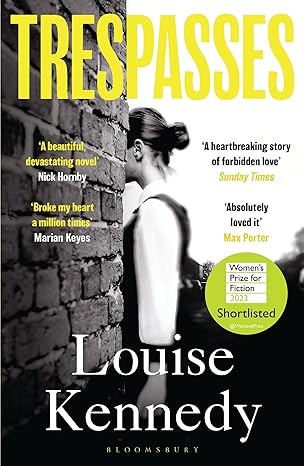
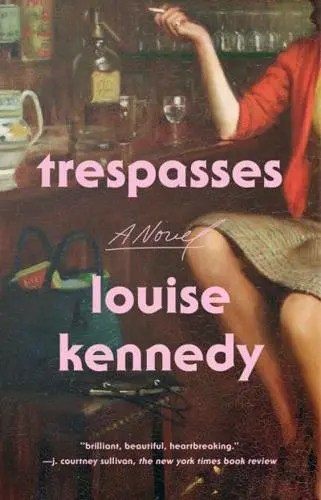
I’m not sure there’s much I can add to the cacophony of praise that Trespasses by Louise Kennedy (2022) has garnered. In fact I did consider not writing a post at all. But in the end because it moved me so much I thought I’d jot a few thoughts down as part of Reading Ireland 2024 aka the Begorrathon, hosted by Cathy at 746 Books. It’s also a stop on my Around the World in 80 Books reading challenge.

A summary of the plot doesn’t do this finely-crafted tale justice.

Cushla Lavery is a Catholic teacher, twenty-four years old and working at a school in a garrison town in 1970s Northern Ireland. She also helps out at her family’s pub, which is where she meets Michael Agnew – around twice her age, Protestant, and married. The attraction is instant and mutual.

“Countless times she had replayed the evening in her head, searching for the word or gesture or pronunciation that had repelled him, that had shown she was too young, too unsophisticated, too Catholic. It seemed piteous now that she had opened her college Irish books at Penny’s messy, elegant table, desperate to impress him. Perhaps she had been too obviously besotted with him.”

They know they have to keep their relationship secret. At the height of the Troubles, they are different religions and Michael already attracts attention through his work as a barrister defending those accused of killing members of the Royal Ulster Constabulary (RUC).

This is a time when politics and violence are woven through the daily lives of people in an immediate way. Cushla has to tread carefully around British soldiers in the pub, the threat of their brutality insidious and palpable. On the way to a party with her colleague and friend Gerry, they are stopped at an army checkpoint. At the flat where Cushla and Michael meet, she tells him not to sit with the lights on and curtains open, and her trepidation is not only due to their forbidden relationship…

Meanwhile, other aspects of life don’t stop. Her grieving mother Gina is self-medicating with gin. A boy in Cushla’s class, Davy McGeown, is bullied because he is from a mixed-marriage family and he ‘smells’ – his mother can’t hang the washing out because the neighbours throw dog dirt at it. His vulnerability is noticed by the priest Father Slattery, who everyone knows shouldn’t be left alone with children.

“Michael said there were all kinds of families. Cushla’s was an unhappy one. What was his like?”

The strain of daily life, living under the misuse of power both political and religious, is brilliantly realised. The narrative is incredibly tense, and the 1970s details are vivid.

The contrast of these tensions with the tender love between Cushla and Michael is subtly portrayed and never jars. Their relationship is believable, and while Michael is known to be “Fond of the women, by all accounts. Sure he’d charm the knickers off you.” he never seems creepy. Cushla is young but not naïve. They know what they have is unlikely to end well and yet they cling to it, the human need for love asserting itself over all that would seek to subdue it.

“She was overcome with a feeling of utter defeat. She wanted to lie on her bed and sleep, but had been unable to say no to him. It wasn’t because he had been kind to her. It was because each time she saw him she was afraid it would be the last time.”

It was the resilience Kennedy portrays which ultimately I found so moving. Not only with Cushla and Michael but in those that surround them, and particularly with Davy McGeown, a bright child caught up in a situation he barely comprehends.

“Booby trap. Incendiary device. Gelignite. Nitroglycerine. Petrol bomb. Rubber bullets. Saracen. Internment. The Special Powers Act. Vanguard. The vocabulary of a seven-year-old child now.”

Kennedy is not remotely sentimental but she is compassionate. She doesn’t judge people or the situation. Through creating recognisable, fully realised characters struggling to live the best way they can, Trespasses is a stunning exploration of the endurance of human spirit.

“For the umpteenth time Cushla wished her parents had called her Anne or Margaret or Rose – not Mary, with its connotations of Marian shrines and rosaries – any name that didn’t mark her out as so obviously a Catholic. She felt guilty for the thought which, she realised, also marked her as a Catholic.”

“I refuse to join any club that would have me as a member.” (Groucho Marx)

I’m not a big reader of crime fiction (outside of the golden age), but Susan’s review of A Little London Scandal by Miranda Emmerson (2020) piqued my interest. At the time I bought a copy for my Dad’s wife, and then when I saw the paperback in a charity shop recently I swooped. It turns out Miranda Emmerson has adopted Wales as her home country, living in south Wales with her family and completing a PhD at the University of Cardiff. Which means the month of Reading Wales aka the Dewithon, hosted by Paula at Book Jotter, is the perfect time to pick this up!

Set in 1960s Soho, Emmerson brilliantly evokes the area before the gentrification and chain stores that characterise the area today. Anna Tredway works as a dresser in the Galaxy Theatre with faded and disillusioned actors. She lives alone above a café and is missing her partner Aloysius who is in Jamaica following a family bereavement.

“Anna had her neighbourhood. Covent Garden for raspberries and carrots – even at five o’clock in the morning. Seven Dials for rags – shift dresses and corduroy skirts and a hundred shades of polyester blouse. Monmouth St for coffee bars – so many coffee bars – musicians and actors and students out on dates. The city thought itself a monument to pleasure, but its citizens knew better.”

Anna is drawn into a very different side of London society when a male sex worker, fleeing a police raid, is found dead in Waterloo Gardens, in the grounds of the Hellenic Club. The Hellenic is one of the men-only clubs around Pall Mall, and its members include Richard Wallis, an MP who has just managed to hang onto a seat despite being caught up in a previous scandal with another sex worker:

“He was still a little staggered by the way in which influence could appear in someone’s life. Power, really. And, then, how quickly it could disappear. What he felt now were the ripples of something he used to have.”

Anna knows Nik Christou from the café. A young, vulnerable sex worker, gentle and intelligent, far away from his home in the north of England.

“Nik liked to notice mistakes in things. He loved to sit in the pictures and watch the same film over and over again. Thinking about the people in it and if it all made sense. If the guilty were guilty and the innocent, innocent.”

When Nik is arrested for the murder, Anna can’t let it go. She works with DS Hayes, a policeman with whom she has a spiky relationship, to fight Nik’s corner.

They make an enjoyable and recognisably human team. It became apparent that I’d missed a previous book with these characters (Miss Treadway and the Field of Stars) but it didn’t matter. A Little London Scandal can stand entirely on its own and the characterisation was strong enough for those of us that missed the first instalment.

Anna is well-meaning but uncertain and aware of her limitations. Hayes is not a typical 1960s policeman but managed not to seem anachronistic:

“He couldn’t banter. His dirty jokes would have seemed tame in the mouth of a 12-year-old. He never physically hurt a suspect and he refused – uncomfortably and with an enormous amount of embarrassment -to take bribes. Every day he was a policeman and every day he somehow failed at being a policeman.”

I also really liked the portrayal of Wallis’ wife Merrian, stuck in the role of a perfect MPs wife – domestic, supportive and silent – and failing to perform:

“Merrian sat for a while in the hall and watched the dust motes move in the shadow of the stained glass above the door. She felt calm when she sat in darkness. When the house was still, when she was alone, no one could get at her.”

Emmerson weaves this disparate cast together expertly. The situations never feel forced and the societal pressures on them all  – at a time of change when things aren’t changing quite fast enough – are evoked believably through the characters’ experiences rather than using them as clunky pawns to hammer home certain points.

“The memory of not knowing what to do in certain places. The fear of getting it wrong. It infects people, like a cold.”

The crime/thriller aspects were well-paced and not predictable. But it was the characters and societal commentary which kept me reading. I was really rooting for these flawed, sympathetic people to find some peace.

“Sometimes that whole world turns out to be exactly what you thought it would and still it’s just a bit shocking.”

To end, a 1960s song about Anna: