Blog Tour: Nightingale & Co by Charlotte Printz (2023, transl. Marina Sofia 2024)

I do enjoy a cosy crime novel, and one with a 1960s Berlin setting ticked so many boxes I jumped at the chance to take part in this blog tour from the ever-wonderful Corylus Books.  I hope they carry on asking me to take part in these tours even though I feel like my posts for their books are getting very formulaic: “I loved it! I want more translations!” Take a guess as to whether this one will be any different… 😉

Nightingale & Co. is the first in a series written by Charlotte Printz and translated by a blogger many of you know, Marina Sofia. Here is the blurb from Corylus Books:

“Berlin, August 1961.

Since the death of her beloved father, Carla has been running the Nightingale & Co detective agency by herself. It’s a far from easy job for a female investigator.

When the chaotic, fun-loving Wallie shows up at the door, claiming to be her half-sister, Carla’s world is turned upside down. Wallie needs Carla – the Berlin Wall has been built overnight, leaving her unable to return to her flat in East Berlin.

Carla certainly doesn’t need Wallie, with her secret double life and unorthodox methods for getting results. Yet the mismatched pair must find a way to work together when one of their clients is accused of murdering her husband.

Nightingale & Co is the first in a cosy historical crime series featuring the sisters of the Nightingale & Co detective agency in 1960s Berlin.”

The story gets off to a fun, engaging start. Carla receives a call from her aunt Lulu telling her she’s waving an airgun on the set of the Billy Wilder film One, Two, Three, seemingly in a deeply flawed attempt to secure a role. As Carla sets off across Berlin at pace, the 1960s city is evoked organically, without seeming like an info-dump.

This trailer for the film includes some external shots:

Yet despite the joy of these opening scenes, we are quickly shown the psychological impact of living in Berlin as the Wall goes up:

“‘They’re building a wall,’ said Lulu. The words were like a punch to her stomach. Carla felt faint. Ulbricht had lied to them. That was why there were so many guards at the Brandenburg Gate yesterday. How naïve of them to believe it was merely for the film set.”

Carla lives with her mother in the same building that houses the agency her father built. The domestic scenes with her bitter, passive-aggressive, baiting parent were so well-realised. Printz really captured the psychological warfare that people can tie themselves into, unable to see an escape route however desperately they want one. Carla is also grieving her father, who died in the crash which left her with enduring head injury symptoms.

When her half-sister Wallie arrives having been cut off from her home in the East by the rapid installation of the Wall, she couldn’t be more different. Physically Carla is compared to Audrey Hepburn, Wallie to Marilyn Monroe. Wallie gives free rein to all her appetites and doesn’t mind dubious means to achieve her ends, while Carla is controlled and keen to remain above reproach. Carla’s mother is entirely charmed by Wallie, although she believes her to be a cousin of her dead husband.

In less skilled hands the contrasting sisters could seem cliched and merely vehicles for dramatic tension. But both Carla and Wallie were entirely believable and well-rounded. The tensions between them arising from Carla not knowing about Wallie’s existence until she turns up on the doorstep, and what this means for her memories of her father, was lightened by their very different attitudes. Their growing but begrudging respect for one another as they find themselves an effective team made them an endearing pair.

The central strand of the story concerns Alma, a beautiful rich woman who asks the agency for help due to her husband’s domestic violence. Carla is sympathetic but realistic about Alma’s options:

“I’m afraid that’s no motive for divorce. A man who beats his wife is regarded by the courts as quick tempered and they usually advise the wife not to annoy him.”

The 1960s are a time of change but some changes aren’t occurring quickly enough. (I was reminded this week that it wasn’t until 1975 that women in Britain were allowed their own mortgage!)

When Alma’s husband is killed and her subsequent behaviour leads to her arrest, the sisters investigate. The plot is satisfyingly complex without being overly convoluted and frustrating.

The shadows of the war, less than twenty years previous, still loom large and Printz manages to capture how the fallout is interwoven with the modernising present.

 “Hadn’t they learnt anything from the past? It wasn’t enough to just stand there and repeat slogans. Everyone had to contribute.”

It’s hard to judge a translation when you don’t speak both languages, but I was struck by how Marina Sofia managed a sensitive balance in providing an English translation that flowed so well, yet also kept sense of place and contributed to Berlin being evoked so clearly in my mind. The significances of formal/informal address were conveyed without any clunkiness.

What I really enjoyed in Nightingale & Co was the mix of compassion and cynicism displayed by both the sisters in their different ways. It made them, and the story, humane without being sentimental, hopeful in the face of horrors.

“In the end, that was all that anyone wanted: forgiveness. And to be loved. Which made everyone predictable.”

So in summary: I loved it! I want more translations!

Here are the rest of the stops on the tour, do check out how other bloggers found Nightingale & Co:

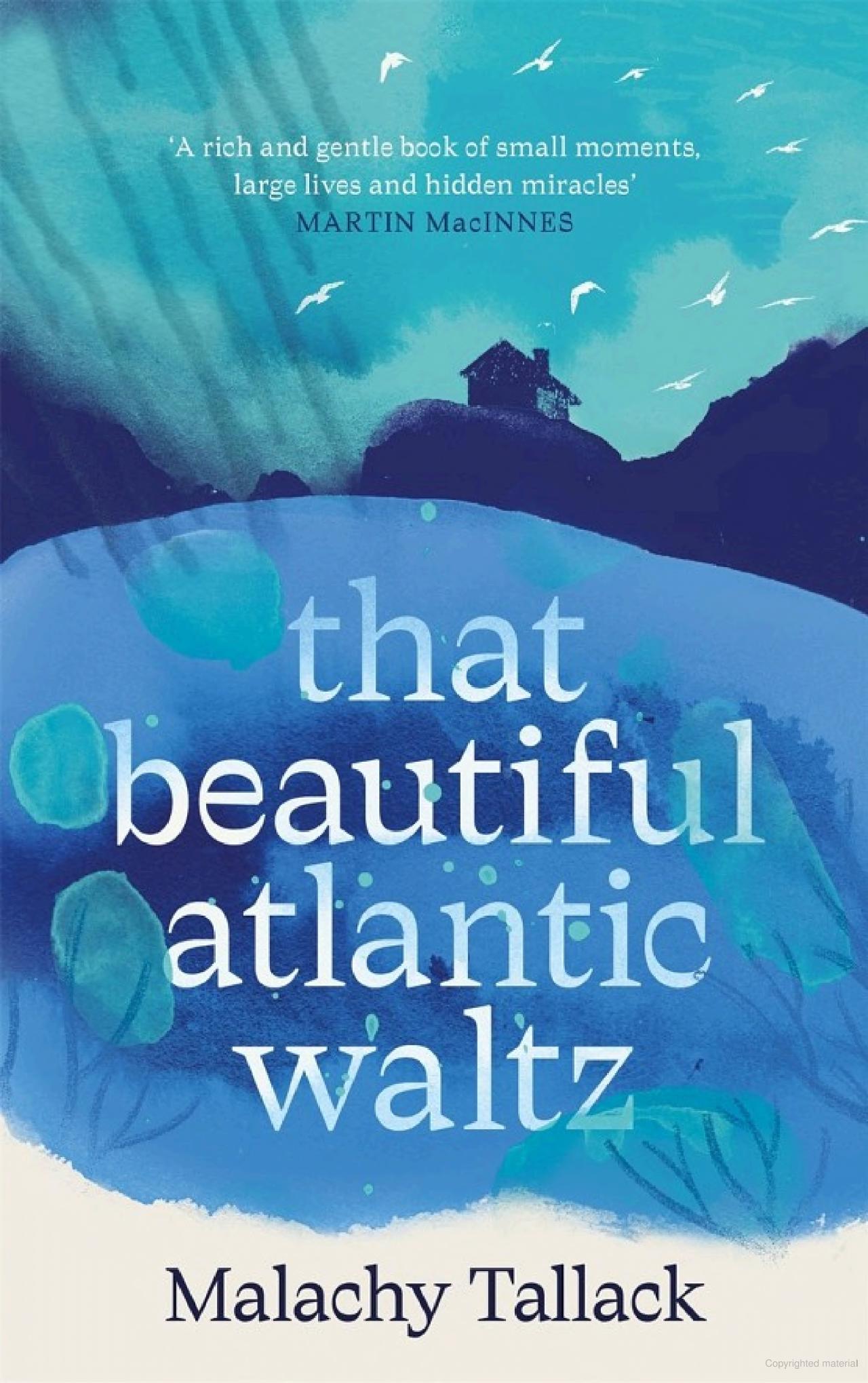
“The only thing he ever hoarded, other than solitude, was music.” (Malachy Tallack, That Beautiful Atlantic Waltz)

I wanted to read That Beautiful Atlantic Waltz by Malachy Tallack (2024) ever since I heard about it on Susan’s blog where it also made her Books of the Year. Everything about it appealed: the Shetland setting, the portrait of a life quietly lived, the theme of friendship and the concise but descriptive style. My hopes were ridiculously high; they were also fully met.

There are two timelines, one which begins in the late 1950s with Sonny on a whaling ship, following his marriage to Kathleen and family life with their son Jack and her uncle Tom, ending in the 1970s. The other follows solitary Jack in late middle-age, in the present day.

Apart from a brief few weeks in Glasgow, Jack has always lived in the same house on the croft in Shetland:

“He had so many memories of this room that it seemed not separate from him at all but a part of who he was and who he had always been. He had done so much of his living in this room.”

He is for the most part content with his life: taking walks, keeping his part time job ticking over, listening to his beloved country music and writing songs no-one will hear.

Tallack is a musician and he writes beautifully about music and all it can mean to people; how listening to it can be transcendental and how writing it can be a solitary act which simultaneously opens you up to the world. Jack’s handwritten songs punctuate the story and expand his portrayal beyond his immediate situation.

“To love was an act of imagination. It was to create possible futures, to build new and better selves. When love ended, those futures and those selves were what was lost. Jack knew something of loving from writing love songs. And he knew something of heartbreak, too.”

Jack is not especially damaged or traumatised, but he is a man whose solitary nature has found a space where it is never needed to be otherwise. He grew up in a house where feelings, worries and hopes were not discussed. His father Sonny is a man quick to anger who finds:

“So often feelings came to him like that: in a knot he was ill equipped to undo.”

While his more gregarious mother Kathleen doesn’t know how to broach her son’s silence:

“She listened, feeling the tears creep down her cheeks, not thinking of anything in particular, just hearing that cumbersome music, with a closed door between herself and her son.”

Life changes for Jack when someone leaves a kitten on his doorstep. He doesn’t want the cat but sometimes we share our lives with those we could never imagine choosing, and so Jack finds himself no longer living alone but with energetic, cheeky Loretta (named after Lynn). And his life begins to expand in ways he could not foresee.

In That Beautiful Atlantic Waltz, Tallack has crafted a story of such humane understanding and kindness. It isn’t remotely sentimental in its portrayal of the capacity of human beings to reach one another and to change.

An absolute gem.

To end, the author performing his titular song:

“I began to understand the world outside the shadows of the family tree.” (Zuheir el-Hetti, The Baghdad Villa)

I’m hoping to complete my Around the World in 80 Books reading challenge this year. I want each book to be written by someone from that country and so at this stage I need to actively seek the books rather than just see what comes into my path. However, The Baghdad Villa by Zuheir el-Hetti (2016, transl. Samira Kawar 2023) did turn up in my local charity bookshop, helping me to add Iraq to my list.

Set in 2003 after the American invasion and toppling of Saddam Hussein, the narrative is from the point of view of Ghosnelban, a young woman from an aristocratic family who is racketing around the titular building, remembering the glory days of her relatives as life outside the grounds changes beyond all recognition.

“We had been brought up according to strict rules of speech and behaviour. The use of words that breached the limits of politeness and respect was prohibited. We had carefully preserved that strict moral linguistic code, which we shared with our few gradually vanishing acquaintances and relatives, fearing that its demise would signal the loss of our identity.”

Ghosnelban’s only company is her one remaining member of staff, the housekeeper Mamluka, and her brother Silwan, who is very unwell.

“He had been a soldier in an army that had been epically crushed in the battle to free the oil-rich desert. He came back to us, but did not return, because he had left his mind there, on the road between Basra and Nasiriya. He came back filled with horrifying nightmares, leaving behind all that was human. Then he began to endlessly narrate what he had experienced and seen on that accursed road, like an endless black waterfall.”

Ghosnelban knows her situation is unsustainable. At the start of the novel she receives a bullet in the post – a warning to leave her home or be killed. She meditates on seven artworks on the walls, Masters collected by her grandfather, each painting giving its name to a chapter in the book.

Ghosnelban is not likable. She is an elitist who freely admits to othering people who are not like her “Truly, did the lives of such human beings have meaning?” At the same time, clinging onto her elitism in the face of overwhelming destruction of her way of life is an act of defiance and resistance.

“I was, after all, the descendant of a highborn family and had learned to sculpt hatred and to turn it into a lethal weapon that I threw everyone to confront the vulgarity prevailing around me.”

As much as I didn’t like Ghosnelban, her voice was so distinctive and strongly evoked from the start, I was quicky drawn into her story. And as this develops, of course she becomes more complex than the superior, condescending snob the reader is initially introduced to.

She finds freedom in a friendship with sex worker Regina:

“I wanted to escape my own skin into which I had been placed by my family and it’s ancient history. She didn’t know who I was, was completely ignorant of my family’s history… and was totally uninterested in lineage.”

We also learn of Ghosnelban’s experience of love and passion with someone whose position makes the match entirely unsuitable. Perhaps it is this that encourages her to try and find who is when not defined by her family:

“My grandparents seemed supremely elegant, but cheerless. Their gazes expressed a hauteur that seemed natural to them, two people who never allowed colourful emotions to draw close […. ] Tears were an absolutely forbidden weakness. Displays of yearning were cheap. Love was demonstrated through action, not mawkishness; smiling was a feeling, not a meaningless stretching of the lips. We had learned that list by heart, and I remembered it nostalgically.”

While Ghosnelban seems to retreat into inaction, gazing at her grandfather’s paintings and reflecting, el-Hetti brilliantly builds the sense of impending threat and violence from which she cannot escape. Ghosnelban is not stupid and she knows she has to take a decision or inaction becomes a decision. For such a reflective, interior narrative, The Baghdad Villa becomes unbearably tense.

The Baghdad Villa is a compelling, complex character study which widens to explore the impact on individuals during moments of rapid societal and political change.  It demonstrates how moments of great humanity can exist in the most extreme circumstances; as well as the extremes to which human beings can be driven.

Much to my surprise, it became a real page-turner as I hoped Ghosnelban wouldn’t be destroyed along with her family’s villa. On finishing, I knew I was really going to miss Ghosnelban’s snooty, fierce and vulnerable voice.

“People think because a novel’s invented, it isn’t true. Exactly the reverse is the case.” (Anthony Powell, Hearing Secret Harmonies)

I did it! This is the final instalment in my 2024 resolution to read a book per month from Anthony Powell’s A Dance to the Music of Time sequence. I’d been put a bit behind by labyrinthitis but I finished on 31 December. I’d hoped to write and post this the same day but I got distracted by my Christmas jigsaw puzzle on The World of Virginia Woolf 😀

Published between 1951 and 1975, and set from the early 1920s to the early 1970s, the sequence is narrated by Nicholas Jenkins, a man born into privilege and based on Powell himself. The twelfth volume, Hearing Secret Harmonies, was published in 1975 and opens in 1968.

Much of Hearing Secret Harmonies is concerned with the past but it opens by introducing a new character, the sinister Scorpio Murtlock who is camping on Nick and Isobel’s land with some of his followers. Nick, always such an astute observer of people, is not taken in by Murtlock’s charisma:

“When Murtlock smiled the charm was revealed. He was a boy again, making a joke, not a fanatical young mystic. At the same time he was a boy with whom it was better to remain on one’s guard.”

“Murtlock himself possessed to a marked degree that characteristic – perhaps owing something to hypnotic powers – which attaches to certain individuals; an ability to impose on others present the duty of gratifying his own whims.”

It’s a masterstroke of Powell’s writing that while Murtlock remains elusive, he is also deeply unnerving. There’s no doubt as to how dangerous he could be, fully realised by the novel’s end.

Nick then attends two dinners which work well as devices for him to meet past friends and acquaintances, drawing them into the final sequences, and alerting the reader as to has left the Dance for good. There is a sense of time folding in on itself:

“Members, his white hair worn long, face pale and lined, had returned to the Romantic Movement overtones of undergraduate days.”

And of course Widmerpool, Nick’s talisman of sorts, reappears. He is quite extraordinary: a former beacon of the Establishment now refuting his knighthood, asking to be called Ken, wearing a grubby red polo neck to formal occasions and focussing on the power of 1960s youth movements for societal change. His involvement with Scorpio Murtlock seems inevitable…

This final volume works well in balancing reflections of the past without becoming overly contrived. There is a sense of reflection occurring organically, without being maudlin, sentimental or nostalgic. Powell is far too astute and insightful for the ending to take such tones.

There’s also a great deal of humour, from larger set pieces with Murtlock’s naked dancing cult providing a bathetic contrast with the central image of the novel sequence:

“It was not quite the scene portrayed by Poussin, even if elements of the Season’s dance was suggested in a perverted form; not least by Widmerpool, perhaps naked, doing the recording.”

To smaller moments such as disagreement over paintings at a retrospective of Deacon’s work:

“Well Persepolis isn’t unlike Battersea Power Station in silhouette.”

And Nick’s various assessments of himself:

“Pressures of work, pressures of indolence.” (my life frustrations in a sentence!)

“These professional reflections, at best subjective at worst intolerably tedious,”

I have really enjoyed reading A Dance to the Music of Time and it hasn’t been an arduous undertaking at all. I’m sure it will reward re-reading; there are so many allusions and subtleties that have certainly passed me by. For me, the sequence peaked with the war trilogy, but each novel held its own joys, working on an individual level as well as part of a whole sequence. I’m going to really miss Nick, even though he remained half-hidden to me throughout the twelve volumes.

“Two compensations for growing older are worth putting on record as the condition asserts itself. The first is a vantage point gained for acquiring embellishments to narratives that have been unfolding for years beside one’s own, trimmings that can even appear to supply the conclusion of a given story, though finality is never certain, a dimension always possible to add.”