“Two English meals a day would have done for me.” (Antal Szerb, The Pendragon Legend)

This month I started off my reading for Kaggsy and Lizzy’s #ReadIndies event with an author that the event had led me to discover last year: Gertrude Trevelyan. So it seemed apt to end this month’s reading with another author #ReadIndies had introduced me to last year: Antal Szerb. In 2024 reading Love in Bottle in February led to Journey by Moonlight for the 1937 Club in April. This time I’m looking at The Pendragon Legend (1934, transl. Len Rix 2006) which is published by the always reliable Pushkin Press.

The Pendragon Legend is Szerb’s first novel, and utterly bonkers. As I was reading it I remembered why I had enjoyed my previous Szerb reads so much: his wit, fun, intelligence without superiority, gentle ribbing without malice, make him such a joy.

The narrator Janos Bátky is a young scholar who spends his time hanging around the British Library Reading Room. Luckily for him, he has no need for money:

“My nature is to spend years amassing the material for a great work and, when everything is at last ready, I lock it away in a desk drawer and start something new.”

His current interest is Rosicrucians: “Nothing interests me more than the way people relate emotionally to the abstract.”  This ancient secretive organisation’s interests include: “Changing base metals into gold, deliberately prolonging the life of the body, the ability to see things at a distance, and a kabbalistic system for solving all mysteries.”

This leads to him being introduced to the Earl of Gwynedd who invites Janos to stay at Pendragon Castle and make use of his library. Janos heads off to Wales with some acquaintances in tow, unheeding the warnings of a mysterious telephone call… (why do people never heed mysterious telephonic warnings??)

Shortly into his stay there are both earthly concerns when bullets are stolen from his gun and metaphysical concerns where he seems to be haunted:

“Just to be clear on this: not for a moment did I think it could be any sort of ghostly apparition. While it is a fact that English castles are swarming with ghosts, they are visible only to natives – certainly not to anyone from Budapest.”

(This isn’t the only time Janos confuses England and Wales, despite the fact he encounters similar ignorance when people insist he must be German and that Hungary doesn’t exist: “’Come off it. Those places were made up by Shakespeare.’”)

There are femme fatales, reluctant heroes, knowing castle staff… my favourite character was the capable and blunt Lene Kretsch:

“This was how our friendship began: I set myself on fire and she put me out. I’d been sitting by the hearth with The Times. I’ve never been able to handle English newspapers – apparently one has to be born with the knack of folding these productions into the microscopic dimensions achieved by the natives – and, as I flicked a page over, the entire room filled with newsprint.”

And so The Pendragon Legend is a mystery, a thriller, a Gothic ghost story, a fable, and with the arrival of the Earl’s niece Cynthia, a romance, despite Janos’ callowness:

“I can never feel much attraction to a woman whom I consider clever – it feels too much like courting a man.”  

Maybe Cynthia has more tolerance for him as she comes from a family where: “At most, the Pendragons tolerate women within the limits of marriage, and even then without much enthusiasm.”

Szerb satirises romance along with all the other tropes and genres he employs, but always with affection and never with any disdain. Somehow Janos and assorted friends bumble their way through the mystery, despite the poisonings, blackmail and hauntings which dog their steps.

My one reservation is that it became a bit too esoteric towards the end, but this is a matter of personal taste and feels a bit mean-spirited in the face of such an affectionate and fun tale.

If you fancy a pacy, ridiculous, learned adventure, The Pendragon Legend is for you.

“I was filled with the tenderness I always feel – and which nothing can match – when I encounter so many books together. At moments like these I long to wallow, to bathe in them, to savour their wonderful, dusty, old-book odours, to inhale them through my very pores.”

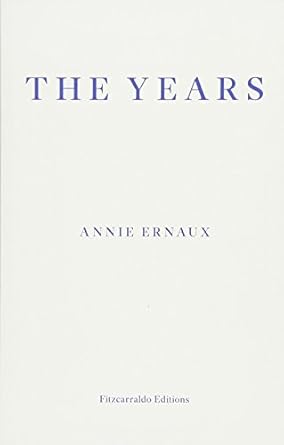
“Words burst forth, recognised at last, while underneath other silences start to form.” (Annie Ernaux, The Years)

#ReadIndies is running all month hosted by Kaggsy and Lizzy and it has meant I’ve finally got to a book that I’ve been meaning to read for ages: The Years by Annie Ernaux (2008, transl. Alison L. Strayer 2018) published by Fitzcarraldo Editions.

A further incentive was that I really want to see the theatre adaptation which is currently running, and now I’ve read the book I have bought my ticket 😊

The Years is a book which deliberately avoids categorisation. Told in chronological order from 1941 to 2006 but in a fragmentary style, it is a memoir/autobiography/autofiction where Ernaux never uses the first person. She refers to ‘she’ for the more personal memories triggered by photographic images, and ‘we’ for considerations of the society and cultural influences experienced by ‘she’ at the time.

Growing up, she is aware of the poverty of her family, and dreams of escape. Ernaux captures so well the confusion of trying to find an authentic escape, trying to determine what she truly wants, alongside what advertising tells her she wants:

“Meanwhile, as we waited to be old enough to wear Rouge Baiser lipstick and perfume by Bourjois with a j as in joy, we collected plastic animals hidden in bags of coffee, and from Menier chocolate wrappers, Fables of La Fontaine stamps that we swapped with friends at break time.”

“It seems to her that education is more than just a way to escape poverty. It is a weapon of choice against stagnation in a kind of feminine condition that arouses her pity, the tendency to lose oneself in a man.”

There are strong feminist themes running throughout The Years, as she grows up on the brink of societal change. At the start:

“Nothing, not intelligence, education, or beauty mattered as much as a girl’s sexual reputation, that is, her value on the marriage market, which mothers scrupulously monitored as their mothers had done before them.”

Yet the 1960s are on their way… Ernaux pulls no punches in detailing the tyranny of menstrual cycles, and of “kitchen table abortions” before the contraceptive pill arrives and pregnancy terminations are legalised.

“Between the freedom of Bardot, the taunting of boys who claimed that virginity was bad for the health, and the dictates of Church and parents, we were left with no choices at all.”

The Years is lightened by humour too, such as this wry observation regarding her young feminist:

“Two future goals coexist inside her: (1) to be thin and blonde, (2) to be free, autonomous, and useful to the world. She dreams of herself as Mylène Demongeot and Simone de Beauvoir.”

The Years is a powerful evocation of a woman’s life at a specific time. Ernaux demonstrates so clearly how lives are bound up with the culture and the wider political forces in which they take place. It is impossible to consider the life in The Years without considering France in the same period. Yet this is an observation which occurs as she looks back, not at the time:

“Between what happens in the world and what happens to her, there is no point of convergence. They are two parallel series: one abstract, all information no sooner received them forgotten, the other all static shots.”

But as she grows older:

“What is most changed in her is the perception of time and her own location within it.”

And yet,plus ca change plus c’est la même chose, as Ernaux notes consumerism and its false promises endure:

“More than a sense of possession it was this feeling people sought on the shelves of Zara and H&M, instantly granted upon acquiring things, a supplement of being.”

The fragmentary style in The Years is perfect example of an experimental style being grounded by the story it wishes to tell, rather than being employed just for the sake of being different or to demonstrate the author’s cleverness. It conveys the experience of memory as well as the memories themselves. As a reader you are drawn into the layering of images, feelings and experiences in such a direct and immersive way, with all the intimacy of a first-person narrative despite the fact that Ernaux never articulates ‘I’.

“Everything will be erased in a second. The dictionary of words amassed between cradle and death bed, eliminated. All there will be is silence and no words to say it. Nothing will come out of the open mouth, neither I nor me. Language will continue to put the world into words. In conversation around a holiday table, we will be nothing but a first name, increasingly faceless, until we vanish into the vast anonymity of a distant generation.”

“‘Hope’ is the thing with feathers.” (Emily Dickinson)

This week as part of Kaggsy and Lizzy’s #ReadIndies event I’m looking at book published by Taproot Press, “an Edinburgh-based publisher committed to presenting challenging, contemporary voices from both Scotland and beyond.”

I was keen to read Hope Never Knew Horizon by Douglas Bruton (2024) as Susan’s review and Kaggsy’s review were both glowing. It sounded truly inventive and unlike anything else I could remember reading.

There are three strands to the story, united by the theme of hope. It opens in 1891 with the Wexford Whale, beached off the coast of Ireland, caught and ultimately sent to the Natural History Museum. One of the locals is sure there is money to be made, but his love interest is sceptical:

“And all Ned Wickham’s spittle-words slap against the walls of the Wexford Arms like the sea in a breached harbour, and they fall back on Ned Wickham and wash over him, and soon enough he slumps in his chair and falls into sleep. And if you lean into the sleeping drunk and listen sharp as pins, you can sometimes still hear the man talking, all his words sluiced and slopping”

The second strand follows Emily Dickinson in the 1850s, through the eyes of her housekeeper Margaret. She sees what no-one else seems to, that Emily is in love with her sister-in-law Susan:

“If I delayed in passing the letter on to Miss Emily it was only briefly and only so I might have something of that love to myself a while.”

The third strand is set in 1880s London, narrated by Ada Alice Pullen, model to famous artists of the day and stage actress under the name of Dorothy Dene. She is painted by Frederick Leighton for the most part, and enters into a Pygmalion-type relationship with him (there is an amusing scene where they are visited by George Bernard Shaw who apparently did base the famous play at least partly on their experience):

“How could I not love the man who made that possible, who took me to the highest point of the world and showed me what was to be conquered – now that I had conquered his heart?”

But it is George Frederic Watts who will capture her as Hope forever.

Bruton is so good at evoking the various voices in his tale. Cheeky, knowing Ada; reverential Margaret, and the various voices that make up the whale strand, which runs up to the twenty-first century, where the whale skeleton has been cleaned and repaired and reinstated at the Hintze Hall. Throughout the bones’ history, people have heard their “hopeful song”:

“Do not think for a moment that the bones in those boxes sat quiet and still […] and if you asked that museum assistant what that sound was he would shrug and say it was like the shushing of the sea, the same that you hear when holding a seashell to the ear, and it was the kick and kick of water and a moaning sound, like music that is wayward and wordless and wild.”

Historical fiction can be hard to pull off and in this short novella Bruton avoids info-dumping. The historical details emerge organically from the narratives, keeping the various stories’ momentum throughout. Similarly, his beautiful prose style never weighs the stories down. There is stunning imagery but it always serves the characters voices.

He also manages the issue of fictionalising real people and events adroitly, not only through an epilogue but also in Margaret’s acknowledgement of her narrative’s shortcomings:

“She din’t actually say that about her heart surely breaking but in what she did say was the sense of what I have written or the feeling anyway.”

“I have perhaps invented a life for her that is more to do with my hopes than hers.”

Which of course aren’t shortcomings at all. We all have faulty memories and we all interpret. Margaret’s story may be hers as much as Emily’s, and it is so moving in her love and hopes for her mistress.

The narratives are united by a theme of love as well as hope. Ada and Frederick’s relationship is filled with love even when not expressed; the whale strand ends on a very moving evocation of the love of teaching and learning. The various parts are finely balanced and I found Hope Never Knew Horizon immensely moving across all three timelines.

What Bruton shows is that hope is an enduring and fundamentally human experience. We live with uncertainty and while there is uncertainty there is hope. He demonstrates that hope can exist alongside the realities of the life that has to be lived. Hope Never Knew Horizon is a gentle, compassionate book to be treasured.

Hope the Whale

“Hope” is the thing with feathers by Emily Dickinson

Hope by George Frederic Watts

“An Edwardian lady in full dress was a wonder to behold, and her preparations for viewing were awesome.” (William Manchester)

Last year Kaggsy and Lizzy’s brilliant #ReadIndies event led to me discovering Gertrude Trevelyan’s novels Two-Thousand Million Man-Power (1937) and William’s Wife (1938). These are published by Boiler House Press, part their Recovered Books series edited by Brad Bigelow, founder of www.neglectedbooks.com, which brings “forgotten and often difficult to find books back into print for a new generation to enjoy.”

#ReadIndies 2025 felt a perfect opportunity to return to Gertrude Trevelyan and her 1934 novel, As It Was In The Beginning, also part of the Recovered Books series.

This was quite different in style to her other novels I’d read, sustaining stream-of-consciousness. This approach lent itself perfectly to the story, as a woman lies dying in a nursing home, remembering her life.

“Alone with the white sheets and the polished floor and the fire crackling jerkily in the sunken grate and the sun beating against the yellow blinds, and the dull white furniture. All quite clean. Everybody finished up and gone.”

Millicent is well-to-do, formerly Lady Chesborough. She isn’t particularly likeable: she is grouchy, ill-tempered, and rude to the nursing staff. We are privy to her dismissive, judgmental thoughts about those who care for her.

“Oh, so it isn’t the pink-cheeked one this time. Thin and sallow. Dark. Sister, that’s it. Scrubbed all the pink out with the carbolic. Suppose a Sister has been scrubbed longer than a nurse.”

Millicent is also vain about looking younger than she is, about her slender frame and her hair. The reader is aware that she may no longer look as she thinks she does. In this way her vanity is almost defiant, a refusal to accept what is happening to her. It is also bound up in her affair with a younger man, Phil, who used her for money after her husband died.

“That slow smile that seemed to pick things up and weigh them and find they weren’t worth your while and put them down with gentle derision: knowing it was nothing, but not wanting to hurt too much.”

Millicent’s awareness of Phil’s caddishness comes and goes. Her reminiscences are interwoven with her present, muddling her memories with visits from her niece Sonia, the doctor on his rounds and the nurses she is so rude about.

This so well done, meaning the reader becomes a detective, working out what is real, what is imagined, what is memory; what is Millicent’s self-delusion from the time and what is delusion now.

We are then taken back to her marriage with Harold, and Trevelyan deals frankly with Millicent trying to fit in with the expectations for a privileged woman at the start of the last century, and how this stifles her needs and wants, including sexual desire.

“It wasn’t a woman Harold married, but a shell: that’s the truth of it. Something correct in white satin, labelled The Bride.”

Trevelyan doesn’t demonise Harold, but shows how he and Millicent are both products of their time. (Although never specified, I’ve assumed Millicent was born around the 1880s, to be in her fifties or thereabouts when the novel was published, and coming of age in Edwardian England.) They are unable to voice what is lacking for them, and struggle to understand this lack when they have done all that is expected. Millicent has a brief outburst of passion which shocks Harold, and they retreat into distance.

“It was that way of appropriating his surroundings; everything having to fit into a relationship with himself. My house. My wife. Yes, that’s it: Harold’s wife, not myself. That’s what I felt, all those years. My wife, my dog: though he was courteous enough: I’m not fair to Harold. Never could be fair to him. He was too fair himself in that cold way. Not that I ever wanted him to be anything but cold: it was just that which made things bearable: that routine of courteous remoteness we’d settled into.”

This leaves her vulnerable to the later manipulations of Phil, who offers her sexual passion in return for her money.

As Millicent leaves the present further behind, the narrative focuses more and more on her reminiscences. It is expertly done, as the nurses and the clinical surroundings fade further away.

We learn of her childhood, and her struggles as she is taught societal expectations. Her relationship with her first love, a childhood friend, is affected negatively when she becomes old enough to have to put her hair up and can no longer play with him as they used to, as she is now considered a woman rather than a girl.

Millicent’s past explains her choices – and lack thereof – so clearly. As a child she found her body cumbersome. She feels she failed Harold by not giving him a child. She worries she is not enough for Phil because she is nearly old enough to be his mother.

“Don’t want to be a little girl. Don’t want to be a grown up either, grown-ups are silly. They don’t know anything. Don’t ask so many questions: that’s when they don’t know things. Don’t be silly, you’ll know that when you grow up, you’ll find that out soon enough, plenty of time for that when you’re older, little pitchers have long ears, little girls should be seen and not heard curiosity killed the cat.”

Trevelyan uses Millicent to explore the disproportionate focus put on (privileged Edwardian) women’s appearance as their main role and contribution. She has her vanities because society has told her this is her value. There is a sense that as she leaves her body behind, Millicent is achieving the freedom she always wanted.

“I don’t know why people should look at me like that. I suppose they can see I’m not anything. I don’t see how they can see I’m not anything. They’re all solid and I’m hollow, but they can’t see that.”

I would absolutely urge anyone to pick up Trevelyan, but As It Was In The Beginning is probably not the best starting point. I’m fine with stream-of-consciousness, but I thought the first part with the memories of Phil was slightly too long and could have done with an edit. The other two novels I have read by her I thought were stronger, and more approachable in style.

However, I thought stream-of-consciousness was perfect for this story. As It Was In The Beginning provides a powerful exploration of the role of women at that time in a way that is intensely personal, while making astute observations about society. Trevelyan is such an accomplished writer who always manages to drive home her wider points without ever losing sight of her characters. I’m so glad Boiler House Press have rescued three of her novels as she deserves to be so much better known.