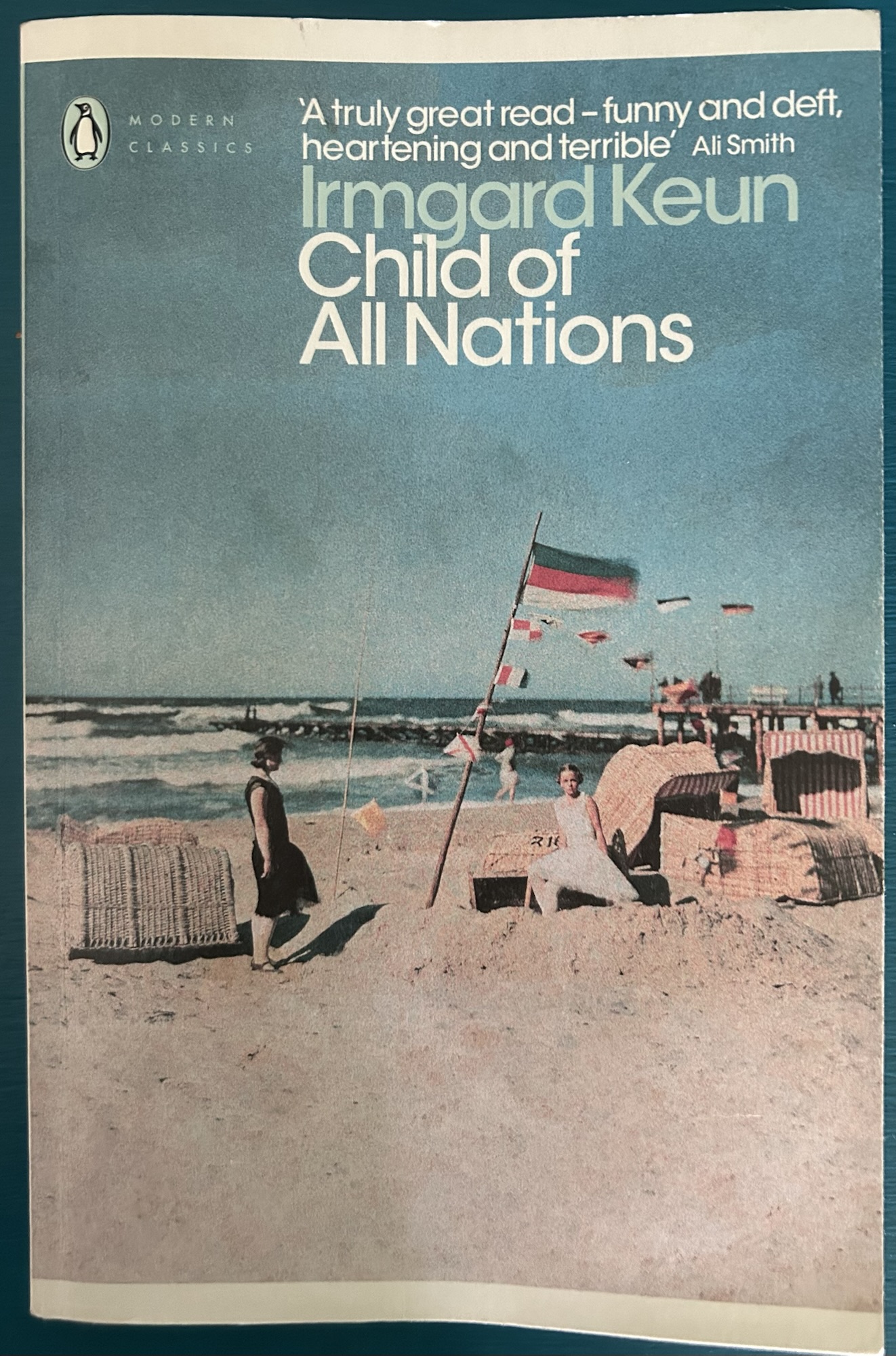
Child of All Nations – Irmgard Keun (1938 transl. Michael Hofmann 2008) 183 pages
I’m sticking with a child’s perspective with today’s novella, by an author I’ve been meaning to read for so long. Child of All Nations by Irmgard Keun is told from the point of view of nine-year-old Kully as she and her parents ricochet around immediate pre-war Europe.
“We left Germany when my father couldn’t stand it anymore, because he writes books and articles for newspapers. We emigrated to find freedom. We’re never going to go back to Germany. Anyway, we don’t need to, because the world is a very big place.”
There’s no doubt that Kully’s father is an important and talented writer, as we see from the responses he gets from other adults. However, he is also self-centred, feckless, and disregards his wife and child to the point of cruelty.
“Sometimes my father loves us, and sometimes he doesn’t. When he doesn’t, we can’t do anything about it, my mother and me. Nothing is any good when he doesn’t love us. Then we’re not allowed to cry in his presence or laugh, mustn’t give him anything, or take anything from him either. Any steps we might take only have the effect of delaying even more the time when he will love us again. Because he always comes back to us.”
From my twenty-first century perspective, they’d be better off without this man and his relentless need for the stimulation of the new, spendthrift ways and constant affairs with other women.
“I look a lot like my mother, only she has bluer eyes than me, and bigger legs, and she’s bigger all round. She wears her hair combed back, and in a knot at the back of her head. My hair is short and unruly. My mother’s much prettier than I am, but I don’t cry so much.”
However, the child’s perspective is so clever in the characterisation of the father, because he is never demonised. Thus, trailing round various countries; being abandoned as surety in various hotels and restaurants; and dragged into his schemes to get loans on promises of work which never appears; are not judged, because Kully just accepts things as they are.
He is also complicated in that his uselessness with money comes from a total material disregard. So while he gambles and drinks away their money, he also gives a lot of it away to people in a worse position than he is. This behaviour, and his writing, shows a compassion for others which unfortunately doesn’t extend to those closest to him.
“My father often tells fibs to get a bit of peace and quiet… Sometimes, though, he performs miracles and everything he says comes true.”
What Keun also does well is presenting Kully’s voice directly, so that while it is unmediated and so distinct, adult readers are still able to pick out where she echoing what adults have said to her:
“We only eat once a day, because that’s cheaper, and it’s perfectly adequate. I’m always hungry anyway, even if I eat seven times a day.”
You just know that an adult, most likely her father, has told her that one meal is “perfectly adequate”.
Written in 1938, the shadow of war looms large. Unsurprisingly, Kully only just grasps some of it and her naivete is heartbreaking:
“I’m not afraid, because I’ve got my mother with me, the waiter who brings us our breakfast in the morning has said he’s not afraid either, and there isn’t going to be any war. And if there is, and we’re put in a camp, then he will continue to bring us our meals.”
What is apparent to the reader now, too, is that some of the countries Kully’s family head to as places of safety are not going to remain as such.
There’s a heartbreaking scene where just briefly, Kully’s mother gets what she wants: a small place with a kitchen where she can cook her own food. But inevitably, Kully’s father is bored within days and it is all taken away again.
What Kully recognises, which her father fails to understand, is that constant movement does not automatically mean freedom:
“Because we never have any money, we feel imprisoned by any hotel in any city, and from the very first day we think of our liberation.”
Child of All Nations documents an episodic, transitory life and the lack of plot is reflective of this, with the novella form suiting the story well. Kully’s voice was so clear from the first page and she remains resilient and with astonishing equanimity to the end. Knowing that the Europe in which Kully moves was about to change beyond all recognition gives it an extra resonance, and I think Keun already knew this too.
So, my first Keun read was a success, and I’m keen to read more!
 madame bibi lophile recommends
So hard to hit the right tone and style with child narration. Showing the father from the point of view of a loving child is a very effective way of portraying his selfishness.
LikeLiked by 2 people
Absolutely, so hard to navigate the voice and the father’s characterisation. She manages it so well.
LikeLiked by 1 person
It’s great isn’t it? It’s a while since I read it but I remember thinking how well she’d captured the child’s voice. I’ve read a few of Keun’s titles now – After Midnight was the first one, I think, and I loved it.
LikeLiked by 1 person
That’s good to hear, I definitely want to read more by her. I’ll look out for After Midnight!
LikeLiked by 1 person
Sounds very well done – a child’s voice is not easy to keep believable. Hard to believe now that in 1938 some people still felt war was avoidable.
LikeLiked by 1 person
It’s so well done. I definitely think the author knew war was going happen. It could be me reading something that isn’t there, but I don’t think so.
LikeLiked by 1 person
Good review. I just requested it based on your review.
LikeLiked by 1 person
I hope you enjoy it!
LikeLiked by 1 person
Wow, this sounds very moving – and, you can tell from those quotes, very well done. A child’s perspective is so tricky, but can be a triumph. What you say about the father never being demonised by the child, but leaving us to read between the lines, is very effective.
LikeLiked by 1 person
It is really moving, especially as we know what is looming ahead. The characterisation is very believable and subtly done.
LikeLike
I love the sounds of this one (I’m not sure I’ve noted this author before), particularly the thoughtful management of the child’s perspective on adult decisions. As a related story, have you read Judith Kerr’s When Hitler Stole Pink Rabbit? One of the quotations brought back that story. (Also, I think the kids might be similar ages.) Fab blurb by Ali Smith there too.
LikeLiked by 1 person
Oh no I haven’t, I’ll look out for it, thank you!
LikeLike
Pingback: Review: Child of All Nations: A Novel by Irmgard Keun – Hopewell's Public Library of Life