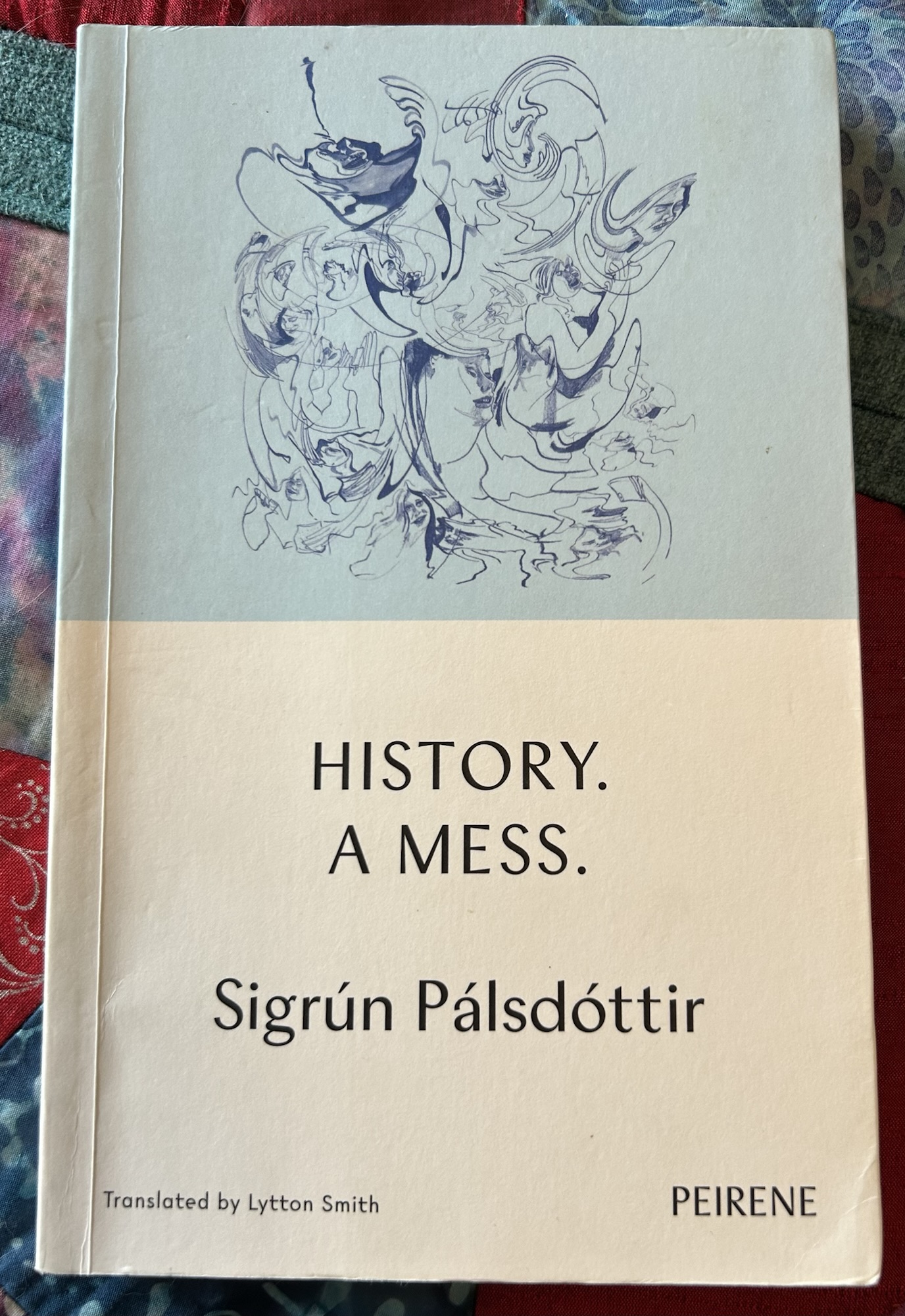
History. A Mess. – Sigrún Palsdóttir (2016 transl. Lytton Smith 2019) 173 pages
History. A Mess. Is narrated by a young unnamed PhD student. As the story opens, she is ecstatic as the research drudge job she had been given by her supervisor, transcribing the journal of a seventeenth-century artist known as SB, seems to have yielded a tremendous discovery: evidence of the first female artist in England.
“Frenzied jubilation thrilled through my body, words burst within me freighted with tremendous power, inside my head sentences and then pages formed one after the other so that by the time I stepped out of the building into the outside courtyard, my introduction was well underway.”
However, we soon learn that something went badly wrong. Five years on, she hasn’t handed in her thesis and she is back in Iceland with her husband Hans, barely leaving her house.
“Even if that person can seem occasionally distant, like Hans, so lost in his world that if you don’t reach out, grasp hold of him, he floats away, as he’s doing now, as I’m letting him do. I’m still trying to figure out what his reaction would be if I reached out for him and laid my cards on the table. Cards on the table. I suspect that his reaction would be sensible. And prudence is no use to me now. My problem calls for a radical solution.”
The fractured, repetitive quality to the sentences are indicative of the narrator’s struggles. The story becomes more hallucinatory and untethered as she seems to unravel further and further.
Some scenes are described that are so florid as to be clearly unreal. Others are grounded in the everyday so we don’t know whether have occurred or not – a skilled positioning of the reader alongside the narrator.
The story can be hard to follow at times, but from the hallucinations we’re able to unpick that she seems to be locking herself in a cupboard in her living room for much of the day. Her parents are around, and her mother is a major figure in her life.
Later in the novel she does leave her home to visit her mother for help in working out what to do about her thesis. Her walk there through the Reykjavik streets collapses reality and hallucination and seems never-ending, like a walk in dream.
“How often can you go over and over a dream in your mind until the scenario begins to crack apart, its images crumbling, their lifetime becoming nothing more than the moment it takes to call them up?”
History. A Mess. Is not an easy read. It is disorienting and confusing, but the writing is taut and so skilled that it never seems to be losing sight of itself. There also remains enough plot to keep pulling the story through, as well as a neat twist at the end.
A repeated refrain in the book is from Andre Breton, and summarises the novella succinctly:
“Everything leads us to believe that there exists a spot in the mind where the real and the imaginary will cease to appear contradictory.”
 madame bibi lophile recommends
I am intrigued, although not completely sure whether I want to read this or not! I wasn’t sure whether you actually enjoyed reading this or whether you admired the prose while possibly being fairly relieved to have completed it?
Only four more books to go – you are so nearly there and must now need to go book shopping! 😁
LikeLiked by 1 person
Good point! I think I admired it rather than enjoyed it, but I am pleased to have read it. When I was younger I’d slog through everything but these days I’m quite happy to DNF if I’m not getting on with a book.
LikeLike
Distinctly disorientating but this one did ring bells for me having watched my partner disappear into a small abstruse area of research as every PhD student seems to although not as spectacularly as our narrator does!
LikeLiked by 1 person
PhDs are such a challenge! People really struggle, I hope universities are putting in more support. I can imagine it would resonate with many post-grad students.
LikeLiked by 1 person
I appreciate it when writers recognise that a disorienting sort of narrative is best presented in a slim volume. Generally (except with one by…oh, was it Jane Gardam or Hilary Mantel…which stands out as a longer work in which the narrator is experiencing a sort of mental unravelling) they are quick reads, something to experience in a single-sitting ideally (or just a couple of commutes). Confining us (or securing us, depending how we feel about it heheh) in the narrator’s POV opens up particularly interesting possibilities in terms of how we interpret their reality. Would you read another by her?
LikeLiked by 1 person
Yes I completely agree – I have to stay in the narrative/style so really need to read these types of books in one sitting. I definitely would read another by her, I thought this was very well done.
LikeLike
Gosh, that does sound fascinating, if a little complex. As you say in your comment, definitely best read in one sitting I suspect so that you can stay inside the book from start to finish.
LikeLiked by 1 person
It was so interesting. Definitely complex but still enough to hang onto as a reader!
LikeLiked by 1 person
Hmm, the premise sounds interesting, but hallucinatory passages often drive me to drink, or actually, cake! Not sure about this one…
LikeLiked by 1 person
I think you’d need a lot of cake for this one FF 😉
LikeLiked by 1 person
😂
LikeLiked by 1 person
Not sure if this one is for me.
LikeLiked by 1 person
It’s definitely one you have to be in the mood for Cathy. I can imagine trying it at another time and getting nowhere! But I thought it worked well.
LikeLiked by 1 person