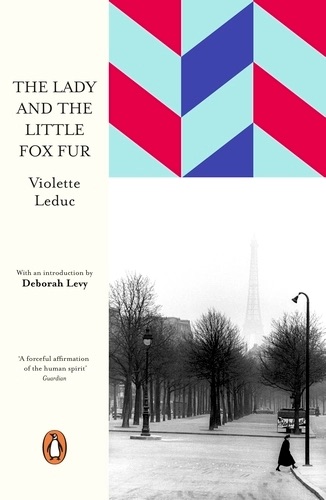
The Lady and the Little Fox Fur – Violette Leduc (1965, transl. Derek Coltman 1967) 80 pages
I found this novella, only slightly longer than a short story, incredibly moving. It follows the daily life of a frail, impoverished woman, living in a dilapidated attic room in Paris which shakes every few minutes when the Métro passes overhead.
Violette Leduc is not an author I know, but in the Introduction to my edition Deborah Levy describes her novels as “works of genius and also a bit peculiar.” Certainly Leduc has a way of skipping between images and realities that continually pulled me up short. Despite its brevity The Lady and the Little Fox Fur can’t be read quickly; the sentences have to be considered.
“Her coat was turning green with age. So much the better: it was a proof that her verdigris candlesticks in the pawn shop had not abandoned her. When the sun came out, there were two torches to light her way, the sun itself and its reflection in the window of Joris’, the shop that accepted la Semeuse coupons.”
That strange logic about the candlesticks demonstrates the frayed reasoning of The Lady, but also Leduc’s skill in layering images to evoke scenes and draw elements of her story together so clearly.
Her stylistic skill never distances the characters. A long time is spent on the hunger of The Lady, both physical and psychological. She is desperate for food, and she is desperately lonely. Every day she roams around her home city, unseen and disregarded.
“Wheat pancakes, fifty francs. The batter was spreading across the hotplate, the woman was scraping away the drips and making the edges neater with the point of her knife. But she would draw her nourishment later on from the crowd in the Métro: one cannot have everything.”
“They were workmen whose job it was to keep the flagstones level, and they put up with her there because they didn’t know she was there. The bollard she was sitting on had such stability, the place itself was so historic that she became a peasant woman who had ridden in from the Perche country to sell a farmhorse many centuries ago.”
The second part of the novella sees her take out a raggedy fox fur, which she found in rubbish when hunting for an orange to eat, to sell for food.
“There were moments when she had no saliva left to remember with, not even the pale pink water ices that her parents used to eat.”
It is desperation which drives her, as the fox fur provides warmth and companionship. Like a child, she anthropomorphises the inanimate object (as she does bugs in the floorboards and some of her furniture), showering him with kisses and affection.
The Lady and the Little Fox Fur could have been unbearably sentimental, but Leduc’s way of writing meant it wasn’t so. The Lady doesn’t pity herself and the portrayal evokes compassion and empathy rather than sympathy. She endures, repeatedly, throughout the challenges of her daily life.
“Happily, she noted, it was still not six o’clock: she was the ribbon in a little girl’s hair, fluttering in the breeze. After six, the wind in Paris grows stronger and disarranges all our principles.”
 madame bibi lophile recommends
This sounds quietly heartrending.
LikeLiked by 1 person
Yes, that’s it exactly.
LikeLiked by 1 person
Sounds very powerful
LikeLiked by 1 person
It was, I really felt for her.
LikeLiked by 1 person
I read this back in 2011 (review here https://www.stuckinabook.com/lady-and-little-fox-fur/) and think I need to go back – I found it rather stilted and not what I was hoping for. And I’ve never been able to shake the gross image of her nosebleed from my mind! But your review makes me want to revisit sometime.
LikeLiked by 1 person
Thanks for leaving the link Simon, I enjoyed your review! I didn’t find it stilted, but then I went in with low expectations because sometimes I find the old Penguin translations exactly that. This one seemed a bit better than most.
I hope if you revisit, it works for you!
LikeLike
I loved this one too when I read it a couple of years ago; ‘frayed reasoning’ is a perfect way to describe her mind, with its slightly eccentric but never sentimental outlook!
LikeLiked by 1 person
Great to hear you loved this too Jane! She’s such a unique character.
LikeLiked by 1 person
It sounds like it leaves you with a feeling similar to that evoked by Ananda Devi’s novella (the one you read earlier in May), but from a different age group.
Her name sounds very familiar…I think I have one of her books…but I don’t recognise the titles I see in French online. I will have a look (and tread carefully if I take the plunge).
Just a few days left, but I bet they are feeling like the longest?
LikeLiked by 1 person
I hadn’t made that connection but you’re right, it’s not a dissimilar feeling. People living on the edge and trying not to lose their spirit in the face of all they are up against.
I’m feeling like it’s doable now! I think around about days 18-20 felt the longest 🤣 although no reflection on the books, just my stamina!
LikeLike
I can see why you felt this short book seemed weightier than the number of pages would indicate. There is a poignant, plaintive feeling powerfully evoked by those quotes. Another one has been added to my list! 😊
LikeLiked by 1 person
She really does manage to evoke so much in so few pages. I hope you enjoy it!
LikeLike
I’ve just reread your (excellent) review having now read this for myself. I did enjoy it but I did also find I had to read it slowly. For such a slight book, the density of the images and the unusual, sort of stream of consciousness but not quite, meant I could only read a little at a time. It felt a bit like eating rich truffles! ‘Quietly heartrending’ – I would definitely echo that.
LikeLiked by 1 person
Thanks so much for letting me know how you found it! I’m so pleased you enjoyed it. It really is dense – it’s a small book but not a quick read, as you say.
LikeLike
It’s a very moving book, I agree Madame B (I covered it when it was reissued). Leduc was indeed a strange one and her other books were quite controversial (it’s decades since I read them!) She definitely warrants rediscovery though, I feel.
LikeLiked by 1 person
That’s so interesting Kaggsy! I’ll look forward to exploring her further.
LikeLiked by 1 person