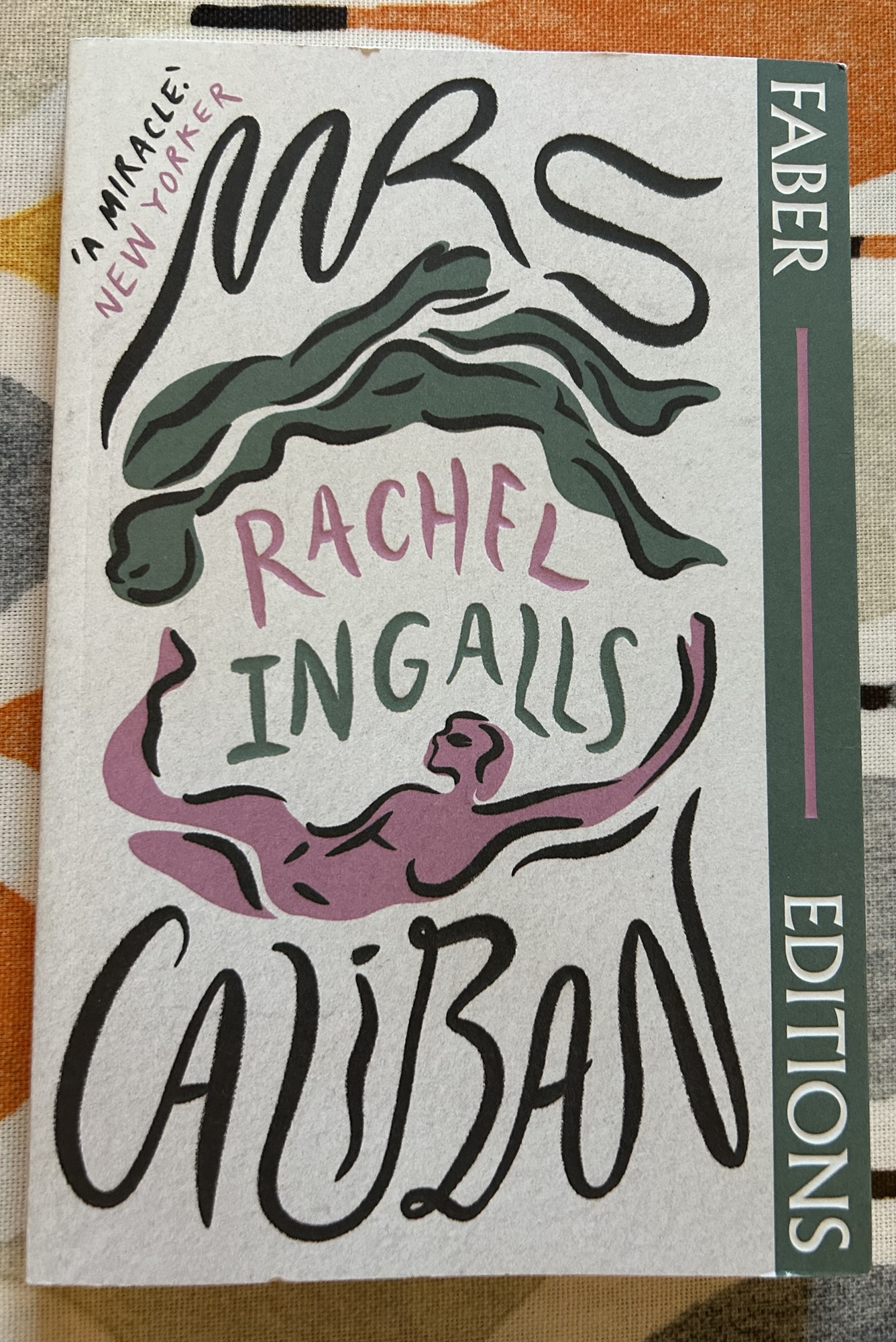
Mrs Caliban – Rachel Ingalls (1982) 117 pages
Earlier in the month when I reviewed Bear, Cathy mentioned Mrs Caliban. Well, it was just sat there as part of the same Waterstone’s display where I picked up Another Marvellous Thing, and it would take a stronger reader than me to walk away… 😀 It is also part of the lovely Faber Editions series and so a very pleasing thing in itself. By coincidence, Jacqui reviewed her favourite Faber Editions yesterday, including Mrs Caliban, so do check out her post.
In the opening passage of the novella Dorothy’s husband Fred is leaving for work:
“He remembered that he had wanted to take the paper with him. Dorothy didn’t bother to say that she hadn’t finished with it yet herself. She just went back and brought it to him.”
I thought that was such an immensely clever detail. In so few words Ingalls has conveyed the distance between the couple, Dorothy’s domestic role, her apathy, and her lack of met needs.
Dorothy is a homemaker, but that home is hanging on in appearance only. She has experienced two immense bereavements – her young son Scotty during surgery, and a subsequent miscarriage. It is this grief which has largely contributed to forcing her and Fred apart.
“And so it went on: silences, separateness, the despair thinking out conversations that they knew would be hopeless.”
We quickly learn that unsurprisingly, Dorothy’s mental health may be suffering. She is hearing messages directly addressed to her from the radio:
“She hadn’t thought she was going crazy, not straight away. She believed it was just her own thoughts forcing themselves into the low pitched sounds and their insistent rhythm.”
This affects the reading of the rest of the novella: it is Dorothy’s perception of events, but did it actually happen? This is left ambiguous and works well, because in a sense it doesn’t matter. What does matter is Dorothy’s experience.
When Dorothy hears that “Aquarius the monster man” has escaped from a nearby facility, she isn’t sure if it is a general news alert or one of her personal messages.
“She came back into the kitchen fast, to make sure that she caught the toasting cheese in time. And she was halfway across the checked linoleum floor of her nice safe kitchen when the screen door opened and a gigantic six foot seven inch frog like creature shouldered its way into the house”
Again, I thought that was so clever, moving immediately from the small domestic concern to something so fantastical, linking the two together in that immediate moment with the ‘And’.
Dorothy and the creature become friends and almost immediately lovers, with her nicknaming him Larry. He lives in the house and is easy to hide because Dorothy and Fred essentially have separate spheres.
(Incidentally, I’ve seen Dorothy referred to as Dorothy Caliban, including in the Foreword to this edition, but I don’t remember Dorothy and Fred’s surname being mentioned in the story. More than likely I missed it, but I thought the title was a reference to her bond with Larry, a Caliban-type creature, with him ambiguous in the way that Shakespeare’s creation could be too.)
What is interesting is that if Larry is Dorothy’s fantasy, what that fantasy says. He is physically strong and they have a sexual bond, but he is also unfailing polite and respectful, is interested in her, and enjoys helping with domestic tasks. The feminism running through Mrs Caliban is evoked skilfully and is undeniable.
Additionally, if he is Dorothy’s fantasy, Larry is violent towards those who seek to harm him. Although we never see Dorothy especially angry, why wouldn’t she be? Both her children died, her husband runs off having affairs, and she’s left with a house to manage – for whom?
“She had no interests, no marriage to speak of, no children. Now, at last, she had something.”
In case I’ve made this sound very heavy, there is plenty of humour in Mrs Caliban too:
“Most of the time, if she couldn’t explain something to him straight away, he didn’t push it. The last time she’d been stuck was when he said he didn’t understand ‘radical chic’.”
Although ultimately I found it a sad novella. In the same way that The Tempest doesn’t fit easily into particular genres, neither does Mrs Caliban. Like the play with the ‘monstrous’ Caliban, this story can be comedic, tragic, dramatic, and fantastical. Like The Tempest, it features a lot of grief and loss.
Prospero, main protagonist of The Tempest, is a man and a sorcerer, who is able to own his anger and command his environment. Dorothy commands her environment – it is domestic and it is what she is expected to do. But she is denied so much agency, and her relationship with Larry is the start of her claiming some back.
Ingalls is such a skilled writer and Mrs Caliban has enough ambiguity that it can be read a number of ways. Ultimately I read Mrs Caliban as a grief narrative, where the grieving person starts to find their way in the world again after it has irrevocably changed, but the sadness remains.
 madame bibi lophile recommends
I’ve read several very positive reviews of this one since Faber reissued it. It sounds extraordinary – clever, moving and witty.
LikeLiked by 1 person
That’s it exactly Susan! It’s really impressive.
LikeLiked by 1 person
I thought this was great, it packed a lot in!
LikeLiked by 1 person
It really does!
LikeLike
It does sound as if this weaves together a lot of strands – grief, feminism, empty marriage – very well. Impressive!
LikeLiked by 1 person
She achieves a lot in a small space. It never feels crammed in or under-explored.
LikeLiked by 1 person
I loved this one. You now need to see The Shape of Water to compare and contrast!
LikeLiked by 2 people
Oh yes! I’ve always meant to because I do like Sally Hawkins a lot.
LikeLiked by 1 person
Oh, I love love LOVE that movie (and even people who were sure they weren’t, but somehow I managed to convince them…also loved it) and now that only makes me want to read Mrs. Caliban even more.
LikeLiked by 1 person
Right, I really need to get watching, clearly! I hope you enjoy Mrs Caliban 😊
LikeLike
I’m delighted to see how much you got out of this one! It really is the most intriguing book, and, as you rightly indicate, different readers may well tune into different themes.
That’s such a great observation about the opening passage: “He remembered that he had wanted to take the paper with him. Dorothy didn’t bother to say that she hadn’t finished with it yet herself. She just went back and brought it to him.” It’s clear that Dorothy automatically accepts how her own needs must come second to those of her husband. A familiar story for many women of her generation…
LikeLiked by 1 person
It’s so impressive how multi-layered it is for such a short work, isn’t it?
I thought the opening passage was masterful. I think you’re right, unfortunately Dorothy’s situation – fantastical element aside – must have resonated with so many women at the time.
LikeLike
This is such a good review – I’ve long intended to read this, because domestic settings being disrupted by the fantastic is my favourite thing, and young persuaded me all the more.
LikeLiked by 1 person
That’s great Simon, I really hope you enjoy it!
LikeLike