Novella a Day in May 2025: No.21

Western Lane – Chetna Maroo (2023) 161 pages

I am not interested in sport of any kind. I’m not anti-sport either, it just completely passes me by. So a novel about squash is not one I’d leap on. But of course Western Lane isn’t about squash; I don’t really know any more about the game than I did before reading the novella. What it explores, against the background of 11 year-old Gopi’s squash playing, is grief, family relationships, and tentative healing.

“It was with a feeling of having been rescued that I raised my racket and served.”

Gopi lives with her widowed father and her two older sisters, beautiful Kush and angry Mona, whose rage is palpable as she tries to keep the home running after the death of their mother.

Their father takes them to the titular sports centre, seemingly at a loss as to how to provide support for his daughters when he is in so much pain himself. Of the three, it is Gopi who throws herself into the game.

“I began dreaming of Western Lane. I saw the white walls and the blossom outside. At night I got out of bed and went over to the windows where there was a bit of light coming through the curtains. I sat on the floor with my racket, my back against the radiator. It was silent now because it was no longer on. I fixed a new grip onto my racket inexpertly, then peeled the tape off and fixed it again.”

The characterisation is so well realised. Her father is distant and quiet, and yet still such a presence on the page. The adult reader understands more of his grieving that Gopi does, and his floundering underscored by deep love and kindness is so moving.

There is a restrained supernatural element which runs through the story. All the family at some times feel a sense of the person who is gone. This is never explained away, nor does it grow into a metaphysical/magic realist type story. Instead it serves to demonstrate how the absence of their mother/wife is a constant presence for them all:

“Maybe, I thought, she would arrive eagerly only to find that things were too solid, and that we – our bodies – were too hard for her. I wondered would our touch bruise her. Would our talk hurt her ears. When we moved would we seem to fly past her, causing her to fall back.”

They all struggle with well-meaning friends and relatives interfering at various points and the pain of this becomes deeper as it threatens Gopi’s friendship with Ged, a white boy, and her father’s friendship with Ged’s mother.

“While Ma was alive, whenever we did something we weren’t supposed to, our relatives would bring Ma’s feelings into it, as if she was easy to hurt. But she wasn’t. It didn’t matter now. Now she was gone, our capacity to hurt her seemed infinite.”

The novella builds towards a climax of a squash tournament, as Gopi tests herself for the first time against unknown players in an unfamiliar setting. But really I didn’t feel it needed this construct. The family relationships, the tensions and strains, and Gopi trying to manage huge feelings provided enough drive to the plot.

Maroo’s writing is beautifully restrained throughout the whole novella and so thankfully, Western Lane doesn’t end on a lifted-onto-shoulders-waving-the-cup moment, but something much more ambiguous and real. This wasn’t unsatisfying and the story felt whole. I was left hoping that things worked out for them all.

“The world seemed big and luminous with some secret that would soon be known to me.”

Novella a Day in May 2025: No.20

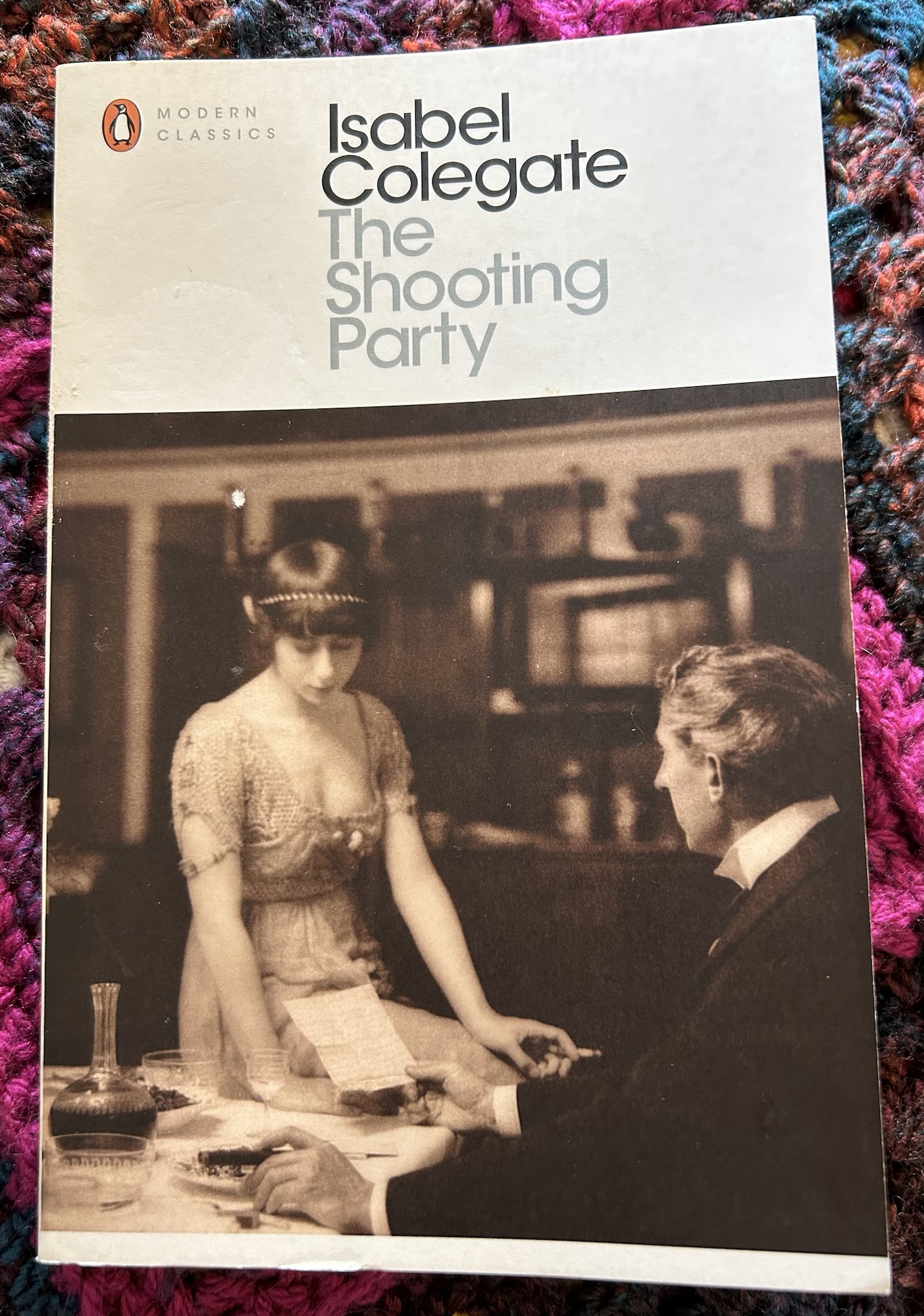
The Shooting Party – Isabel Colegate (1980) 191 pages

I’ll get my complaint about The Shooting Party out of the way first: there were about eleventy-million characters, far too many for a novella, and trying to keep them straight made my brain hurt. If ever a book needed a family tree/character list at the beginning it was this one. But other than that I really enjoyed it, so on with the post!

The Shooting Party was written in the latter part of the twentieth century but captures a bygone age just before the outbreak of World War I.  Colegate relies on our knowledge as readers that the lives she presents are on the brink of being changed irrevocably.

“I can’t say I positively want a war; and yet one gets the feeling sometimes – life is so extraordinarily pleasant for those of us who are fortunate enough to have been born in the right place – ought it to be so extraordinarily pleasant? – and for so few of us? And isn’t there sometimes a kind of satiety about it all – and at the same time greed?”

The titular event is taking place at Sir Randolph Nettleby’s Oxfordshire estate. Over the course of three days a group of privileged people will convene in the slaughter of hundreds of birds. It is absolutely grotesque, but thankfully Colegate spends very little time on the details of bloodsports, being more interested in the relationships between the characters. There were a few passages I skipped but it remained very readable.

Sir Randolph is aware that the world is changing. He despairs at the falling away of the old order as the world becomes increasingly mechanised and industrialised. The country estates are losing workers and he worries at the decline of the countryside.

He is quite a gentle patriarch in many ways, despite being so much a man of his time. Colegate doesn’t laugh at her characters, but there is humour throughout and I don’t think we’re supposed to take them entirely seriously all the time:

“Sir Randolph, unlike Minnie who aspired to it, considered cosmopolitanism a vice. It was alright to know your way around Paris, Sir Randolph thought, and to visit Italian picture galleries or the relics of the classical world, but generally speaking a man should stick to one country and be proud of it. If one wanted to travel there was always the Empire.”

His grandson Osbert doesn’t do well at school and the family are despairing at getting him ready for Eton, yet it is Sir Randolph who sticks up for him:

“Sir Randolph said, ‘Leave him alone. There’s no malice in him. Give him time and he’ll come along all right.’ He spoke as he might have spoken of one of his black, curly-coated retrievers, and like the retrievers Osbert in due course came along.”

Osbert has a pet duck named Elfrida Beetle and a source of tension throughout the novel is whether she will survive or get caught up with the wild ducks that the party are determined to shoot to pieces. There is also an impending sense of doom, beyond the war, as we know from the start of the novel that there is “an error of judgement, which resulted in a death”. Yet the final day of the shoot starts peaceably enough, as Sir Randolph reflects in his study:

“Freed from time, he felt influenced towards the familiar state of watchful calm, from which he was aroused by the slow crescendo and then rapid diminuendo of the breakfast gone being sounded by Rogers, an acknowledged master on the instrument.”

His wife Minnie was a favourite of the now-dead King, (another character reflects: “A pity English royalty was always so philistine.”) and like her husband she has a strong sense of duty and decorum. Unlike her husband she’s also quite a frivolous character, but this suits her role as hostess and she sees more than she says. She gets on well with her granddaughter Cicely, who shares her silliness, if not her circumspection.

“Olivia did not find Cecily boring. She liked her liveliness and suspected her of having more courage than she herself had ever had. Cecily might well choose to be unconventional; something to which Olivia had never aspired, in her actions at least. Her thoughts, generally speaking, she kept to herself.”

Olivia is Lady Lilburn married to Bob, a man so dull that even as I’ve just finished the reading the novella I can’t remember anything about him except a funny scene with him fussing over cufflinks. Another couple are Lord and Lady Hartlip, long married and quite prepared to indulge each other’s extra-marital dalliances. Where Lord Hartlip draws the line is Lady Hartlip’s compulsive gambling, which she has learnt to hide from him. Thus Colegate shows that privilege and comfort don’t equal happiness for all. In fact, happiness seems elusive to so many of these characters.

Apparently one of criticisms of The Shooting Party on publication was that it tried to shoehorn in all the Edwardian political issues and the characters were ciphers in service of these. I think this is a little unfair. As I mentioned at the start, there are soooo many characters that I can see where this criticism came from: a rich Jewish businessman subject to Anti-Semitism; a member of European aristocracy; bored wives; flighty debs; gamekeepers entrenched in the social order; a new generation coming up of self-made men… but I found them all believable and Colegate is interested in the person behind the type.

Colegate evokes the daily routines of life in a large country estate so well, and balances the inevitable elegiac quality with the practicalities of living; the sad desperation of some of the characters with humour. As the day moves on personalities are exposed and relationships change forever.

Novella a Day in Day 2025: No.19

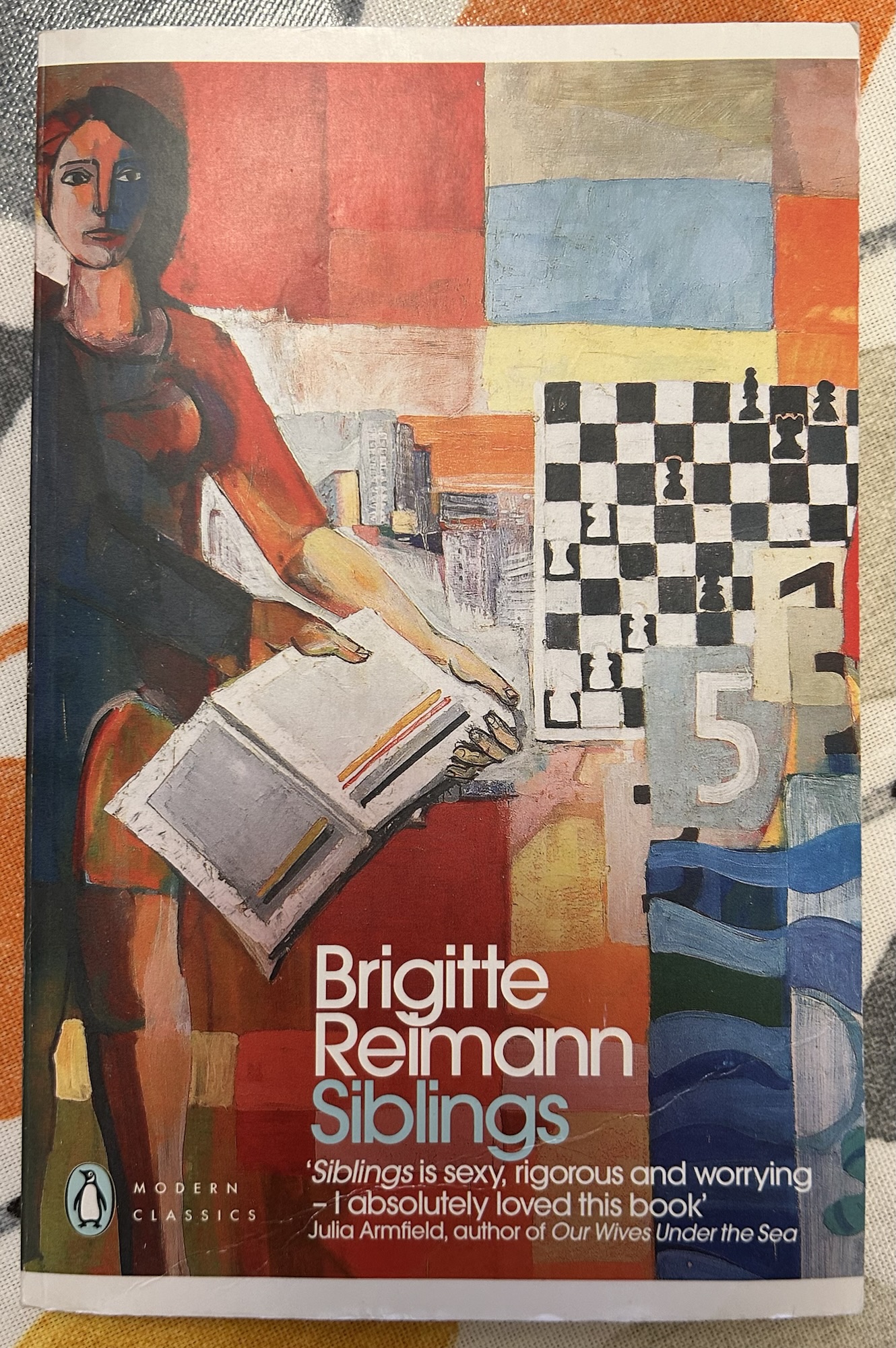
Siblings – Brigitte Reimann (1963, transl. Lucy Jones 2023) 129 pages

Summarising Siblings makes it sound incredibly clunky. A brother and sister living in the GDR find themselves separated ideologically as one of them wants to leave for the West. However, Brigitte Reimann’s writing is so skilled that the relationship between the siblings is rounded. The novella never feels like a construct in order to explore two forms of government in opposition to one another.

We know from the start that there has been some sort of significant betrayal. It opens:

“As I walked to the door, everything in me was spinning.

He said, ‘I won’t forget this.’ He was standing very straight and not moving in the middle of the room. He said in a cold, dry voice, ‘I’ll never forgive you.’”

The story is told from the point of view of Elisabeth (Betsy/Lise) and each chapter opens with the current situation (1960, prior to the Berlin Wall being built) before looking back in time. We learn of her close relationship with her brother Uli.

“I trusted him in every way and was vain enough to think I knew everything or almost everything he thought and planned. But in truth, back then, which was only the day before yesterday, I didn’t have a clue about the person closest to me.”

They are young people from a previously privileged family (who voted for Hitler), although they no longer have access to their industrialist family’s assets or wealth. Elisabeth is an artist and has a job working in an industrial plant painting the workers and teaching, which she enjoys despite the frustrations of dealing with colleagues and pressures from the Stasi.

“As soon as I’ve warmed myself in the lap of my family for a few days, I feel homesick for its adventurous, daring atmosphere; and for the sight of the huge, white and yellow excavators; for the mountains of sand blown haphazardly by the wind, under which lies the dark brown, damp coal seam; and for the drivers up in their peaceful cabins, shields lowered, patiently shovelling tonnes of earth…”

Uli is an engineer but he is unable to get a job due to being blacklisted by association with a professor who defected, despite him knowing nothing about the defection. Unlike Elisabeth and her boyfriend Joachim who works for the Party, Uli struggles with the immense bureaucracy and lack of choices he has in the GDR.

The siblings’ brother Konrad went to the West with his wife, and Elisabeth sees this as a huge betrayal, despising the materialism she feels drove the decision.  He was part of Hitler Youth, while Elisabeth and Uli were both small children during the war. Hence her feelings about the West and her immediate family are bound up with and complicated by Germany’s recent past.

A further complication is that Elisabeth and Uli have stayed close throughout their lives and she describes Uli romantically, dwelling on his handsomeness and appealing qualities more than on those of Joachim. I found her response in this way to her brother odd and unnerving, but I don’t know if that is a cultural difference or a deliberate decision by Reimann to make the siblings’ bond overly intense.

Uli tries to explain to Elisabeth the difference between him and Konrad; why he needs to leave, despite still believing in socialism:

“‘Before I’m ground to pieces here,’ he added, not quite as loudly, not quite as confidently. ‘I’ll always stand up for the public ownership of industry over there.’

‘Even in your shipyard?’

‘Even in my shipyard.’ He paused then smiled uncertainly.

‘How come your shipyard?’ I said quickly. ‘You’ll have to stop using communist phrases, you know.’”

Having Uli still believe in the system of government but finding himself unable to live under it complicates the opposing views of the siblings and exposes the layers of experiences which can lead to vastly different life decisions.

Another clever decision is to not paint the GDR as a bleak wasteland. As well as Elisabeth’s romantic view of the plant, the natural environment is beautifully evoked:

“The morning sun had moved on, and the sky stood flat and pale blue above the trees lining the avenue; from the kitchen window, above the cottages, I could see stables and small courtyards nestling closely together in this bucolic area of town. Raindrops sparkled on the walnut tree branches and the tips of its leaves in the slanting sunshine.”

The narrative circles back to end where it began, perhaps indicating the circular nature of the political arguments that neither Uli or Elisabeth will win. By the time we return, the reader is fully aware of the various ambivalent, contradictory bonds which tie Elisabeth and Uli. Siblings is a heartbreaking portrait of how wider political pressures can fracture the closest of relationships, irretrievably.

“‘I can’t explain anything to you,’ he said after a while. ‘Because our views on freedom, among other things, are too far apart.’”

Novella a Day in May 2025: No.18

Across the Common – Elizabeth Berridge (1964) 186 pages

Back in 2023, I started off Novella a Day in May with Elizabeth Berridge’s The Story of Stanley Brent. I ended the post by saying I had Across the Common in the TBR and maybe I’d get to it later in the month 😀 Just two short years later…

Across the Common is told from the point of view of Louisa as she returns to her suburban childhood home, after leaving her artist husband Max.

“My grandfather had built the house in the eighties. It was tall and big and excelled in useless crenellations; in the front an immense stretch of holly hedge gave the house its name.”

Her two aunts, Seraphina and Rosa, still live in this Gothic pile and they are soon to be joined by Aunt Cissie:

“Since the war, which had robbed her of her second husband and her only son, something had shifted in her. A new, unbalanced cynicism revealed itself by a sarcastic twist of the mouth, a semiquaver of a shrug.”

Quite a contrast to Aunt Seraphina:

“it was all in her sigh: her lost opportunities for adventure, for love, for self-expression. She was more of a child than I had ever been, and I loved her again for her wild and illogical longings, her aching desire for drama.”

They live in an insular world. Cissie had left, so her worldliness means she wants a television on her return, but otherwise the aunts are preserved in a world long gone. The Hollies has always existed as a refuge for the women in the family, such as Louisa’s grandmother:

“She had merely withdrawn into the world of The Hollies, where unpleasant things like passion and unworthy emotions and reality were kept out by the high walls, lapped by the half tamed acres of the common.”

Louisa initially returned to her aunts for their familiarity and the need she feels to unravel who she is, based on experiences in her past which led to her leaving:

“I only wanted to remember it in order to remember something else, like turning the cut-glass top of a decanter bottle in the sun, to catch the sudden prismatic dazzle. This something lay with the aunts; it was an unease that spoiled relationships, a strange Braithwaite ambiance that lay like fallout over the family.”

However, she begins to realise that her past may be more complex than she realised, and there are secrets within the family to understand. The Gothic atmosphere is heightened when a solicitor passes on a sinister warning in a letter from her long-deceased father:

“Don’t, for your own sake, be misled by the cultivated exteriors of your aunts. They can smother, they can crush, they can exterminate.”

There’s also the fact that Louisa’s aunts are among the few people her husband struggles to tolerate:

“It was the Braithwaites, my mother’s family, who came outside Max’s indulgence. They filled him with a kind of detached horror. He was ruthless about them. Is ruthless. For he blames them for everything awry in me.”

Yet they are never caricatures of eccentric older women, but carefully drawn and fully realised. All three aunts were fabulous creations.

Berridge builds an atmosphere that feels both stifling and menacing, without being overtly threatening or devoid of love. There is humour here too, and I particularly enjoyed Aunt Seraphina’s habit of pilfering plant cuttings from Regent’s Park.

The Big Family Mystery is believable, providing enough plot to draw the story along, with Louisa’s growing understanding of her family history and herself being well-paced.

I have another Berridge in the TBR so hopefully it won’t take me two more years to get to it! She is so accomplished and her idiosyncratic characterisation is a joy.

“The Braithwaite way of life was a kind of anarchy that could scarcely be contained within one house.”

Novella a Day in May 2025: No.17

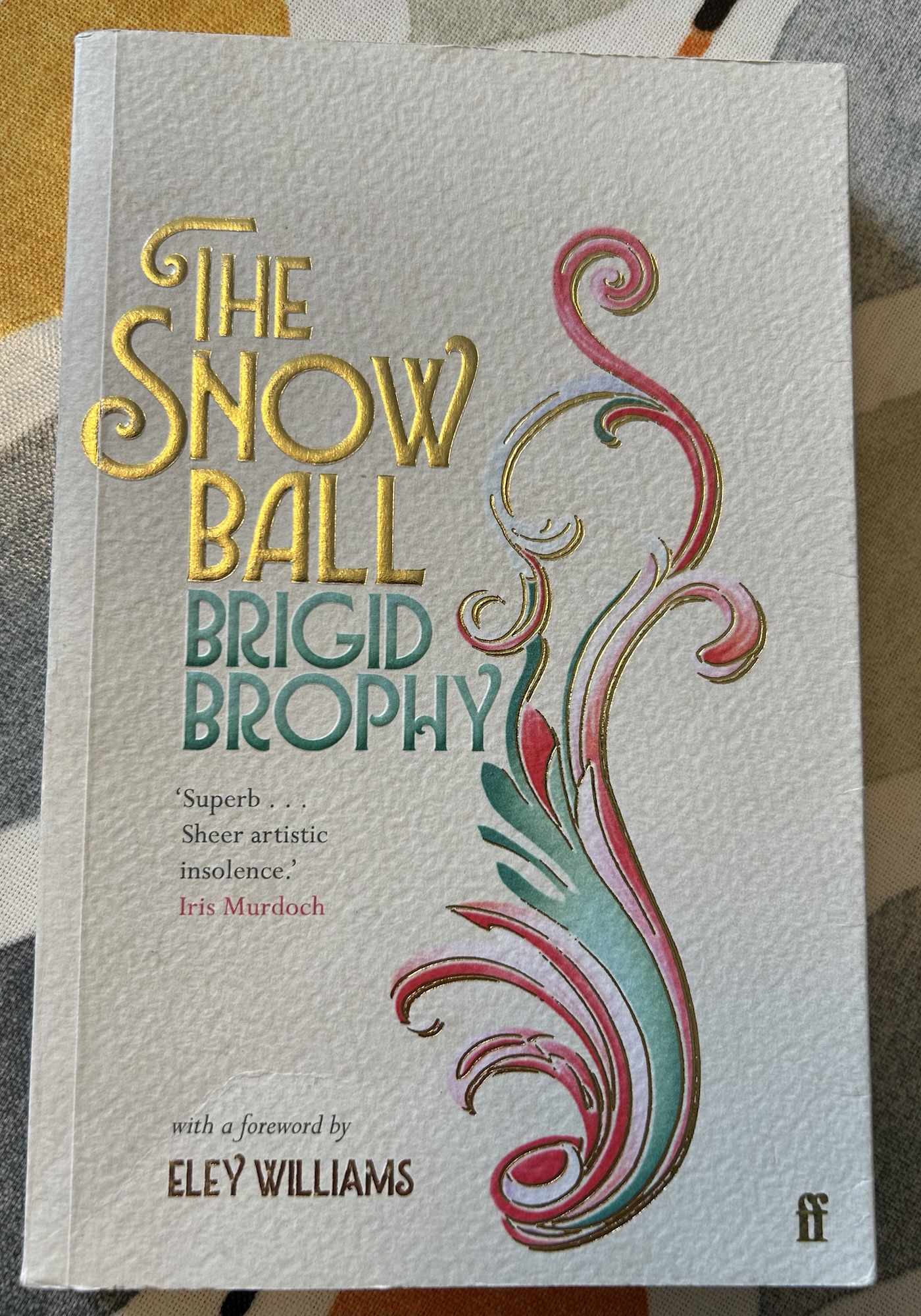
The Snow Ball – Brigid Brophy (1964) 196 pages

Brigid Brophy is an author who I’ve been meaning to try for a while, and The Snow Ball was a compelling introduction. It has an otherworldly quality, set over the course of one evening at the titular event and based on Mozart’s Don Giovanni.

An eighteenth-century fancy dress ball is being thrown by Anne and her fourth husband Tom-Tom at their Georgian London residence.  We follow Anna, Anne’s friend and confidant, throughout the evening. She is dressed as Donna Anna.

“Everyone grew a year older at once on New Year’s Eve, even those whose birthdays had been the day before. They gathered, Anna decided, for consolation: wearing historical costume to offset the advance of history.”

The incongruity and inaccuracy of the visual experience is used by Brophy to great effect, emphasising the unreality of the evening and showing how easily appearances can crack.

“Anna descended the grand staircase, knowing that Voltaire and Lady Hamilton were waiting for her in the crowd at the bottom. The noise, the scents, the very warmth of the people’s skins came to her as unmistakably twentieth century.”

Brophy has some startling images too, truly original turns of phrase. The décor is somewhat Rococo, with crumbling gold cherubs adorning the walls:

“It was as though between this room and Anna there was a genetic resemblance, a line of descent: as though it were a womb: into which, a newly born cherub in her early forties, she was always welcome to creep back.”

As this middle-aged cherub moves around the party she draws the attention of a man dressed in a black mask as Don Giovanni. She is also watched by Ruth, young and inexperienced, attending her first ball dressed as Cherubino and writing in her diary throughout the night:

“Feel there is something awful about all the people in the world, can’t think what they are here for—they don’t seem to matter—they are like atoms—they just move around without aim attracted or repelled by each other; hardly matters which. Anna K. is the most attractive woman I have ever seen. I detest her.”

We follow the seductions of the night, the dances people engage in both literally and metaphorically. Anna is a slightly subdued character next to the driven sexuality of Don Giovanni or the gregarious sociability of her friend Anne. Yet she is compelling as she tries to work out what happiness looks like for her as a recently divorced woman, against a background of revelry.

(Unlike its source inspiration, the seduction in The Snow Ball is explicitly successful and mutually consensual.)

The Snow Ball is eerie and unnerving while being recognisable. Its characters take pragmatic decisions surrounded by elevated theatricality – at one point peppermint creams rain down. It felt like a masque, but grounded in believable people rather than stock caricatures. It was hugely clever but not alienating and it’s definitely made me keen to pull Brophy’s The King of a Rainy Country out of the TBR.

“‘Have you noticed what a metaphysical ball this is?’ he said. ‘All these people bumping into one another and asking “Who are you?” even when they’ve known each other for years.’”

Novella a Day in May 2025: No.16

Tokyo Express – Seichō Matsumoto (1958 transl. Jesse Kirkwood 2022) 149 pages

Tokyo Express is very much a howdunit and whydunit, as the whodunnit is seemingly fairly obvious from the start. This was my first time reading crime master Seichō Matsumoto and I was hugely impressed.

A young couple are found dead on Kashii beach near a shrine, having drunk cyanide. The local Fukuoka police are quick to decide a double suicide. There is nothing to suggest otherwise, but one of the team, Torigai Jūtarō, a long-standing and rather dishevelled detective, isn’t so sure.

“His overcoat was as battered as the clothes beneath it, his face unshaven, and his tie twisted and worn.”

Reminiscent of Lieutenant Columbo (whom he predates), Torigai is sharp-minded and unegotistical too. He starts trying to unravel how the couple came to be on the beach at that time. The young woman called Toki is dressed in a kimono and was a waitress at a restaurant in Akasaka; the man in Western clothes was Kenichi Sayama, an employee at Ministry X, currently under investigation for corruption. They were witnessed getting on the titular train by two of Toki’s colleagues, and it seems pretty clear that their bearing witness was engineered by a businessman called Tatsuo Yasuda.

Quicky Torigai establishes that a lot rests on that train journey and the timings of what happened when. He’s also baffled by a receipt from the buffet car found on Sayama’s body which recorded a food order for just one person.

“A scene formed in Torigai’s mind: the dark silhouette of a man, silently and briskly leading a woman to the beach, and the woman saying: What a lonely place.”

When Kiichi Mihara turns up from Tokyo, an outwardly very different detective takes over. The case is attracting attention due to the corruption in the Ministry, and Mihara works for the Second Division which investigates white collar crime.

“There was something in his cordial tone that reminded Torigai of an insurance salesman.”

The two investigators agree that the deaths are suspicious, and they also realise Yasuda is likely involved. However, trying to crack his alibi about where he was and when proves extremely difficult.

“Yasuda was always consulting the railway timetable. Did that perhaps mean he knew it secrets? In any case, his familiarity with the train times had to signify something. What if Yasuda’s entire alibi was built on it?”

This is one of the most procedural of police procedurals I’ve ever read. Everything hinges on the tight timing of trains, ferries and planes (a premise that would not remotely work in the UK as it depends on all the transport running to time, which as Magnus Mills pointed in out in my earlier read this month, will never occur). Torigai fades into the background, as Mihara tries to pick it all apart but keeps hitting brick walls.

“That crack in the wall had been nothing but a mirage. Mihara felt crushed. He held his head in his hands and, for a moment, could only stare at the piece of paper in front of him.”

I knew a bit about Tokyo Express before reading it, including that all the timings are based on the actual timetables of the time in the novel, and I wondered if it would be impossible to follow/bogged down in the logistics. But Seichō Matsumoto does a great job of carrying the reader along and there’s even a few surprises in store. The relationship between the two detectives is warm and endearing. I don’t know if they appeared in his subsequent novels, but even if not, I’d be keen to read more by this author.

“Mihara liked to ride the trams of Tokyo. Often, he would board without a specific destination in mind. Odd as it might seem, whenever he was at a loss for ideas, he would simply sit on the tram and allow his thoughts to roam. The tram’s steady trundle, its gentle swaying, induced in him an almost euphoric state of contemplation.”

Novella a Day in May 2025: No.15

The Skin Chairs – Barbara Comyns (1962) 200 pages

I really enjoy Barbara Comyns. Her voice is so distinct, uniquely hers. She can present traumatic events – in The Skin Chairs, parental death, bullying and poverty – with an equanimity of tone which offers an idiosyncratic resilience.

The Skin Chairs is narrated by ten-year-old Frances. It opens with her going to stay with horrible relatives to give her mother a break from her six children; four girls and two boys. Frances’ Aunt Lawrence is a bully and her daughter Ruby is completely cowed by her, while her daughter Grace is her favourite and as such, completely unbearable.

“It was no wonder that the Lawrence family were so spiteful; it was dreadfully catching and gave one such a feeling of power.”

Frances’ stay with her relatives is extended as while she is away, her father dies. Ultimately her mother and her siblings move into a new house nearby called The Hollies. This gives the Lawrences a distressing amount of power over Frances’ mother, who struggles to adapt to her straitened circumstances.

“She never went shopping, although she ordered meat when the butcher called at the house (the fishmonger soon stopped calling because he said it wasn’t worth it when we always ordered herrings), and I think she would have considered it the final degradation to have been seen carrying a shopping basket.”

Her mother does learn to cook, but even that isn’t quite right:

“Mrs Hand prepared vegetables and we washed up, so she had none of the drudgery. Delicious iced cakes appeared on the table at teatime, vol-au-vent, lobster croquettes and chicken soufflés at midday and savoury supper in the evening. The little ones became bilious and, when Polly discovered that we had spent nearly a month’s supply of money in a week, we went back to stews and rice puddings, fish pie and baked apples.”

There isn’t much plot, except as Frances takes us through her days. Dramas are generally short-lived. The family struggle for money, and Frances struggles with her schoolwork.

We get to know others on the village. There is an appalling ongoing thread with a mother neglecting her child so she can have an affair with a Major. There is also the utterly eccentric Mrs Alexander who bombs around in a bright yellow car, wears gold shoes polished daily by her chauffeur, and keeps a menagerie of animals in cages:

“She had once kept a bear, but people had complained because it used to break into church during the services, and it had to be given to a zoo. ‘I sometimes wonder why I ever returned to England, so many unpleasant things happen here’.”

As with all the Comyns I’ve read there is cruelty present. Not least with the chairs, belonging to a General and said to be made from human skin. The cruelty is never dismissed although no-one is demonised, and Frances’ child’s view doesn’t obfuscate. It is presented without sensation.

Thankfully there is kindness too. Mr Blackwell arrives in the village, incredibly rich and kind to Frances during a time of acute distress. He doesn’t meet the Lawrences’ standards however:

“Then Aunt Lawrence told us the man was not a ‘gent’ at all, but a retired brass-founder. He was rolling in money, he owned an appalling Birmingham accent and would be quite impossible to know. I imagined him rolling in brassy coins all alone and felt sorry for him planning to live in a village where no one would know him.”

The horrible central image of The Skin Chairs suits Comyns well. She is so clever at presenting the domestic, but making it unnerving and almost Gothic. Yet The Skin Chairs is also gentle, and the characters – even the dreadful ones – treated with compassion. I’ve a few other Comyns’ languishing in the TBR and this made me keen to get them!

Novella a Day in May 2025 No.14

La Femme de Gilles – Madeleine Bourdouxhe (1937, transl. Faith Evans 1992) 122 pages

La Femme de Gilles is a curious read from a twenty-first century perspective. The protagonist Elisa is entirely bound up in her husband Gilles. Her existence is wholly for him: cooking for him, keeping his house, bearing his children that she loves only as an extension of him, sexual pleasure derived solely from pleasing him. It’s the extremity of these feelings at the obliteration of any personal motivation for her actions outside of Gilles that make her so extraordinary to my eyes.

So when Gilles starts an affair with Elisa’s sister Victorine, outwardly Elisa does very little:

“Whatever happened, whatever had already happened, the main thing was not to make a fuss, simply to watch, and act in subtle little ways to keep intact the love with which she’d surrounded him, and to which he would return one day. There was no escape from a love as strong as hers.”

Elisa’s initial realisation is heartbreaking, as she turns her back on Gilles and Victorine to get ready and accompany them to the cinema:

“One by one she fixed her gaze on some of the objects around her, things that made up her familiar world, then her eyes lit on her own hands as they closed the bag, and she saw they were trembling. Precisely at that moment Elisa knew that behind her back there was another world, a world that was complicated, threatening, unknown.”

In a such a short space, Bourdouxhe creates an acute psychological portrait, primarily of Elisa, but also of her unintentionally cruel husband and her vacuous sister:

“Afterwards it’s a question of trying to make sense of things, sense of life, and life doesn’t touch Victorine, it will never mark her smile or her eyes, which will stay young, clear, innocent for a long time. Unconscious offenders are the most dangerous of criminals.”

Yet she also sustains a real momentum to a story which primarily takes place in Elisa’s tortured head, and follows her inaction. It feels pacy and tense, even as Bourdouxhe steps outside of the narrative to directly address her characters:

“You are alone with the greatest pain you have ever known.”

Poor Elisa really is isolated. She can’t speak with her husband, her sister or her mother. The villagers in the remote area where she lives become aware and gossip about her. But Elisa doesn’t really want to leave, she just wants things to be as they once were:

Going from one place to another – is that really the world, or is it rather something very small, invisible, confused, something buried inside of us, something that we always take with us wherever we are, whether we’re here, or whether we are there? Whether we are far away or at home?”

La Femme de Gilles is an immersive read with incisive characterisation. Apparently Simone de Beauvoir was a fan (I tried to find what she said about it in the The Second Sex but my edition has a rubbish index). In her first novel, Bourdouxhe created a haunting narrative which I’m sure will stay with me.

Novella a Day in May 2025: No.13

Bear – Marian Engel (1976) 167 pages

Back when I was an undergrad in English literature, my tutor accused me of being squeamish on the subject of incest in Jacobean drama and skirting round it. My argument (and he did like it when I argued with him, he was a very sweet man) was that it was more interesting to consider incest as metaphor for Jacobean political corruption and the decay of society rather than just a play about a brother and sister with a warped relationship. The reason I mention this now is that in Bear by Marian Engel, a woman has sex with a bear.

Now maybe my tutor would think I’m being squeamish about bestiality here, but I really don’t think that it is what Engel is writing about or interested in. For me, Bear is a novel about a woman learning self-acceptance, and how to live her life on her own terms.

Lou is a librarian and archivist working for the Historical Institute, where she stays buried in her basement office:

“For although she loved old shabby things, things that had already been loved and suffered, objects with a past, when she saw that her arms were slug-pale and her fingerprints grained with old, old ink, that the detritus with which she bedizened her bulletin boards was curled and valueless, when she found that her eyes would no longer focus in the light, she was always ashamed, for the image of the Good Life long ago stamped on her soul was quite different from this, and she suffered in contrast.”

She is lonely and her life is unsatisfying, particularly romantically. When the Institute is bequeathed an estate in a remote part of Canada, Lou is asked to travel there in order to take an inventory. What she isn’t told until she gets there is that the inventory includes a bear.

The house of Colonel Jocelyn Cary is isolated and strange, octagonal and filled with ephemera. Lou works steadily and there are some lovely descriptions of the library. Gradually she and the bear grow used to one another. Throughout the story the bear remains unknowable, quite a sad creature. He isn’t anthropomorphised and in this way Lou has to take responsibility for all her actions. She can’t claim to be responding to the bear.

“In case the bear was disappointed (for she had discovered she could paint any face on him that she wanted, while his actual range of expression was a mystery), she went out, plastered with mosquito lotion, and took him down to the shallowest part of the channel, where the water was warm.”

The main healing that occurs for Lou is through having to leave her basement office and interact with the natural world to survive. She has to run a boat, cook from scratch, fish, and share her environment with various creatures for company.

“She settled into a routine. She worked all morning, then in the afternoon disappeared into the bush to walk on carpets of trilliums and little yellow lilies; hepatica and bunchberries. The basswoods had put out huge leaves. Often, scarved and gloved against the black flies, she lingered by the beaver pond. The goshawks stared at her from their barkless elm with impenetrable eyes.”

Bear is the story of Lou reconsidering her choices and learning to listen to her own voice when she experiences the world away from other people (particularly men), surrounded by wildness. Her vulnerability is moving and emotionally engaging. What psychological change occurs for her is believable and unsentimental, while remaining hopeful.

From looking online, it seems a shame in a way that Bear features bear sex, because although it’s actually a tiny part of the story, of course it’s that for which the novel is known. It is a fable – in real life Lou would have likely been killed by the bear fairly quickly. Engel’s writing is much more subtle and the themes so much more complex than some summaries would suggest. Probably I have obfuscated a bit, but I’m certain my tutor won’t read this post 😉

“Is a life that can now be considered an absence a life?”

Those of you who follow Dorian Stuber on social media will know he’s a great advocate for this novel. You can read an essay he wrote on it here.

Novella a Day in May 2025: No.12

The Maintenance of Headway – Magnus Mills (2009) 152 pages

I remember quite clearly when Magnus Mills’ first novel The Restraint of Beasts, was published in 1998 and shortlisted for the Booker. He was a London bus driver, and so the story made the regional news and I realised he actually drove my local routes. In The Maintenance of Headway, Mills draws on this occupational experience and there was plenty I recognised, as well as thankfully some I didn’t!

The title refers to “the notion that a fixed interval between buses on a regular service can be attained and adhered to.”

This deceptively simple idea is in fact impossible to achieve.

“In this city it’s different. The streets are higgledy-piggledy and narrow; there are countless squares and circuses, zebra crossings and pelicans. Go east from the arch and you’ve got twenty-three sets of traffic lights in a row. All those shops, and all those pedestrians pouring into the road. Then there are the daily incidentals: street markets, burst water mains, leaking gas pipes, diesel spillages, resurfacing road works, ad hoc refuse collections, broken-down vehicles, troops on horseback, guards being changed, protest marches, royal cavalcade and presidential motorcade. Shall I go on?”

This was already starting to sound very familiar 😀

The bus drivers know maintaining headway is impossible, but they are subject to the inspectors, who also know its impossible. Various measures are taken each day to attempt to meet the impossible. At one point, one of the managers tells the narrator off for arriving six minutes late, in theory.

“’See how it accumulates? See the potential for outright bedlam? Your failure to be punctual could make a million people late for work!’

Frank sat behind his desk and bristled with imaginary rage.

‘Sorry,’ I said.

‘That’s alright,’ he replied. ‘Don’t let it happen again though.’”

Similar surrealism exists away from the depot on the bus journeys themselves:

“Strictly speaking there existed an imaginary line in front of which passengers weren’t supposed to stand. This was difficult to enforce, however, when people simply kept piling into the vehicle. In the past I tried making announcements in which I’d asked them ‘not to stand forward of the imaginary line,’ but they never took any notice.”

The city is never specified but there are various allusions to London: three stations, one Gothic flanked by two utilitarian “Cinderella and her ugly sisters” sounds like St Pancras, King’s Cross and Euston; the “southern outpost” is Crystal Palace; the “bejewelled thoroughfare” is Oxford Street. There are also frequent references to the obsolete, conductor-staffed “Venerable Platform Bus” which are the much-missed Routemaster buses. These various allusions add to the atmosphere that Mills is so adept at creating, of a world at once recognisable and oddly disconcerting.

If you’re yet to try Mills then Headway may not be the best place to start as I didn’t find it quite as sparkling as some of his other work. However, I’ve been a fan of his since The Restraint of Beasts, and if you are too there’s plenty to enjoy: the deadpan humour; the surreal quality never quite articulated; a dark edge questioning free will; a bleakness offset by a light touch. I’ll read anything he writes and it always feels like time well spent. Ironically, this is often an elusive quality to his characters.

“If the bus happens to arrive on schedule it’s good for the public record but little else. Nobody believes the timetables. Waiting for buses is therefore paradoxical.”