Novella a Day in May 2025: No.11

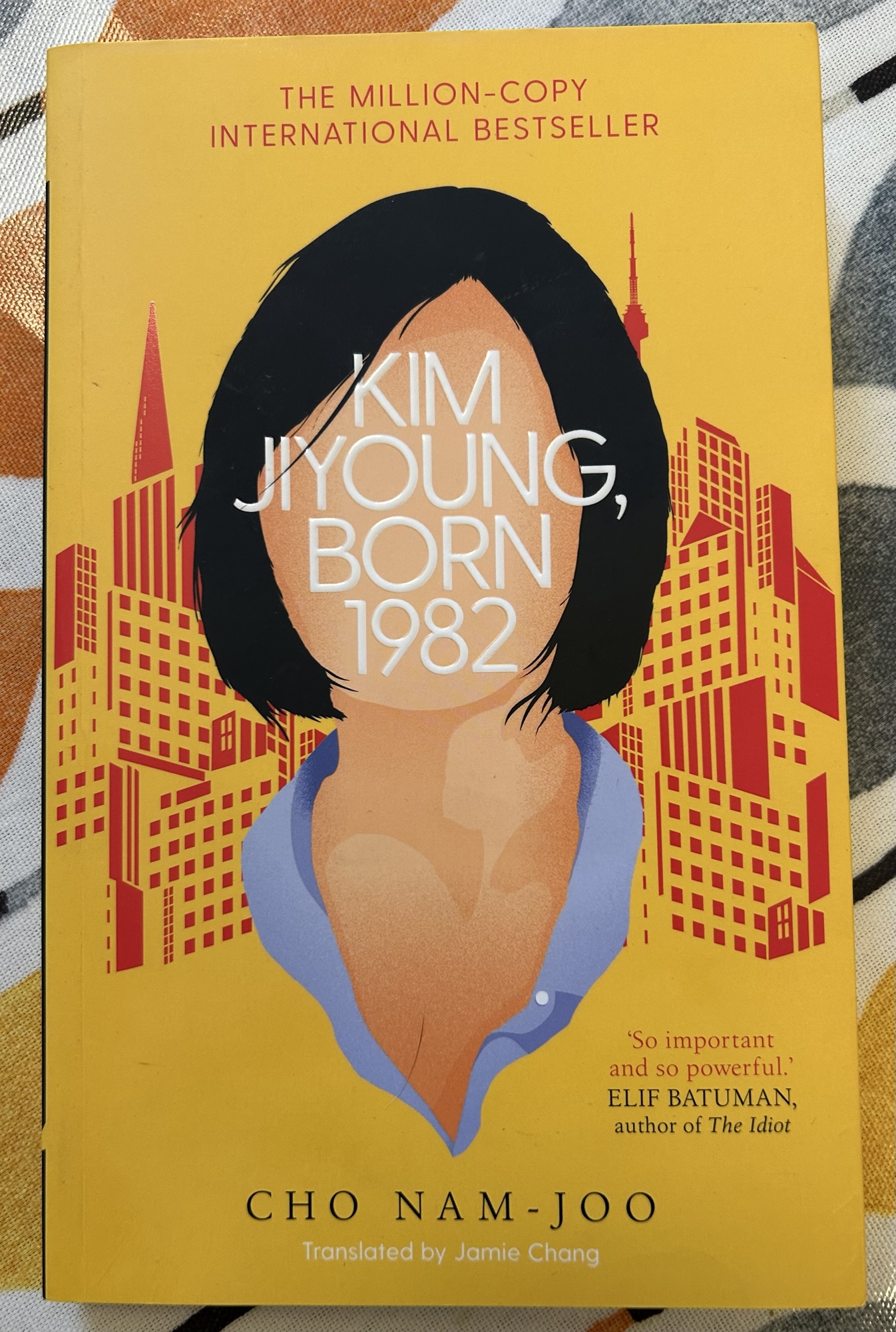
Kim Jiyoung, Born 1982 – Cho Nam-Joo (2016, transl. Jamie Chang 2018) 163 pages

I’m hard to please with issue-driven novels. Often I find them clunky and unconvincing, which leaves me wondering why the authors didn’t write an essay or long-form article instead.

And yet, Kim Jiyoung, Born 1982, which was very clear on the issues driving the novella to the extent of providing footnotes at various points, worked for me. Possibly because, as the title suggests, it almost presents like a piece of reportage or a case study.

The book opens in Autumn 2015, where young married mother Kim Jiyoung has started behaving oddly. At times she speaks like someone else, such as her mother. Her husband Daehyun is worried:

“Her odd behaviour continued sporadically. She’d send him a text message riddled with cute emoticons she never normally used, or make dishes like ox-bone soup or glass noodles that she neither enjoyed nor was good at.”

We are then taken back through Kim Jiyoung’s life in chronological order: Childhood 1982-1994; Adolescence 1995-2000; Early Adulthood 2001-2011; Marriage 2012-2015; before being brought up to date in 2016.

Jiyoung’s upbringing is fairly traditional. Her mother is bright and capable, and worked low-paid jobs which helped send her brother to medical school. Similarly, Kim Jiyoung’s brother is favoured:

“The brother had chopsticks, socks, long underwear, and school and lunch bags that matched, while the girls made do with whatever was available. If there were two umbrellas, the girls shared. If there were two blankets, the girls shared. If there were two treats, the girls shared. It didn’t occur to the child Jiyoung that her brother was receiving special treatment, and so she wasn’t even jealous. That’s how it had always been.”

And yet, in many ways her parents are progressive:

“Growing up, the sisters were never once told by their parents to meet a nice man and marry well, to grow up to be a good mother or and good cook. They’d done quite a lot of chores around the house since they were young, but they thought of it as helping out their busy parents and taking care of themselves, not learning how to be good women.”

Yet as she grows older, Jiyoung has to manage a different type of male entitlement, for which she is blamed:

“Entering high school meant a sudden expansion of her geographical and social world, which taught her that it was a wide world out there filled with perverts.”

One of the most challenging periods in Kim Jiyoung’s life is trying to find a job. It proves practically impossible:

“Jiyoung went to countless interviews after that, where interviewers made references to her physical appearance or lewd remarks about her outfit, stared lecherously at certain body parts and touched a gratuitously. None of these interviews led to a job.”

So the issue driving Kim Jiyoung, Born 1982 is pretty clear: the socio-cultural pressures exerted on women – and more specifically, South Korean women – from birth (or even before, as her grandparents wanted her to be a boy) and throughout their lives.

The footnotes actually work really well, demonstrating the wider context of Kim Jiyoung’s life, and also how those wider forces can impact the individual.

The bestselling nature of Kim Jiyoung, Born 1982 and its translation into 18 languages (according to my edition, it may be more now) is indicative of the relevance and reality of Kim Jiyoung’s life. Somehow it isn’t depressing or bleak, possibly given the matter-of-fact style, but it does demonstrate the ongoing need for change.
Novella a Day in May 2025: No.10

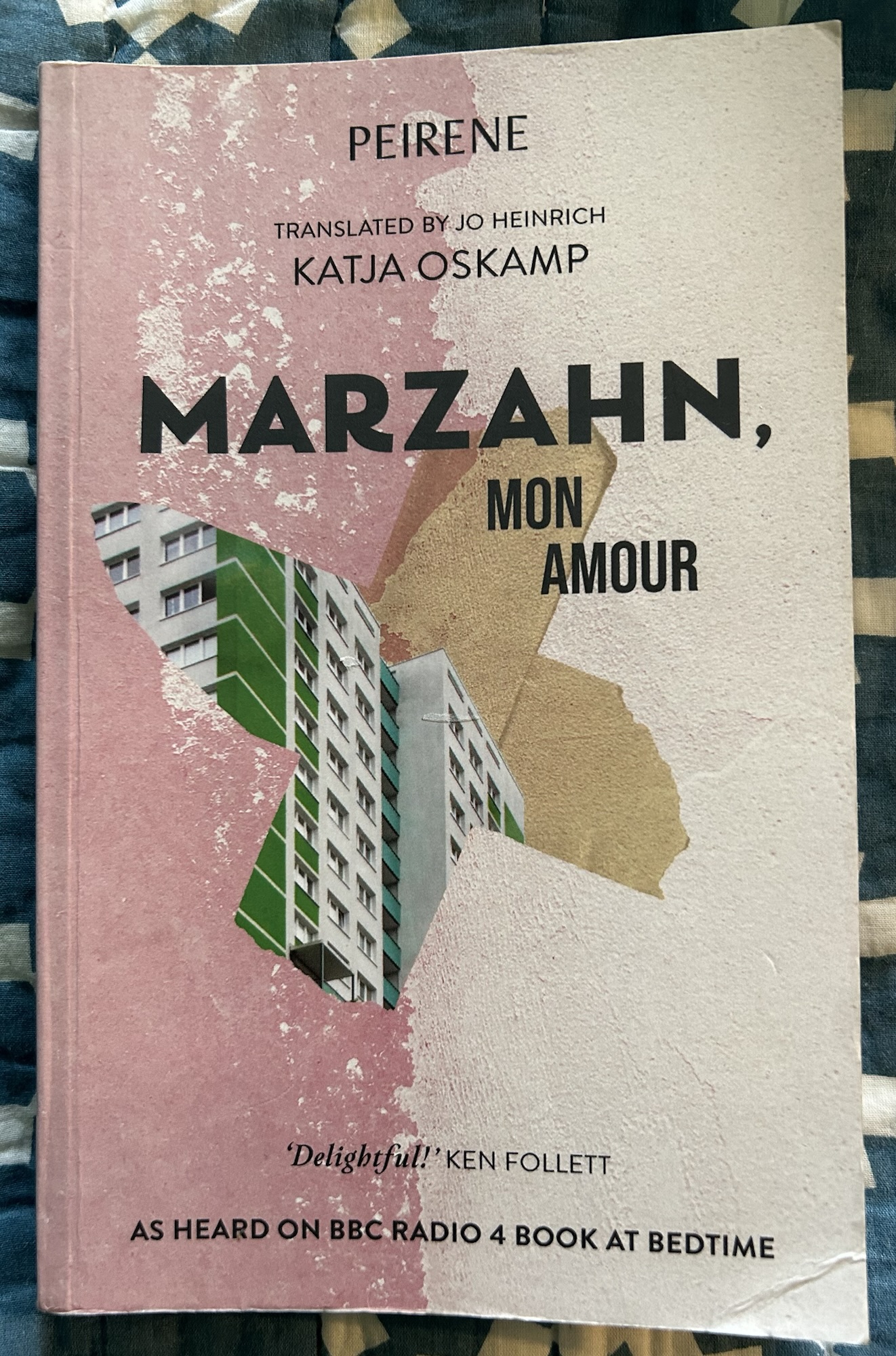
Marzahn, Mon Amour – Katja Oskamp (2019, transl. Jo Heinrich 2022) 141 pages

Marzahn, Mon Amour is a novella I’d been meaning to read for a while and I’m delighted to have finally got to it. Based on the author’s experience of retraining as a chiropodist in her middle-age, it is essentially a series of character sketches of her clients.

Initially her training is a struggle and she’s unsure of her new career:

“We had reached a low point, at people’s feet, and even there we were failing.”

“From writer to chiropodist – what a spectacular come down. I had forgotten how much people, the looks on their faces and their well-meant advice, got on my nerves.”

But on qualifying she gets a job in a salon in the titular area of Berlin, and begins to find her vocation:

“As always, the weather here in Marzahn, once the biggest expense of plattenbau prefab tower blocks in the former East Germany, seems more intense than in the centre. The seasons have more of a smell about them.”

Her boss is Tiffy “a grandmother, albeit a non-practising one”; Flocke is the chaotic nail technician. The chapters take the names of her clients, and Oskamp expertly captures a sense of the person in very few words:

Herr Paulke: “whenever I laughed at something that Herr Paulke said in his matter-of-fact way, emotion almost imperceptibly flashed across his face, a mix of incredulity, pride and shame. He was no longer used to anyone paying him any attention.”

The Mon Amour affection the author feels for her clients shines through. Often these are elderly people, disregarded by society, and Oskamp gets to know them over a period of months and even years. The act of caring for their feet is intimate, especially for those who may now be alone and not have much gentleness in their lives.

They all have stories to tell, such as Gerlinde Bonkat, who arrived as a refugee:

“She formulates crystal clear, quotable sentences and speaks an accentless German, with a faintly Nordic hint to its melody.”

Which isn’t to say Oskamp likes all her clients. Herr Pietsch is a former government worker who fails to realise his days of power are over: “All your life you’ve mistaken your position for your personality.” And there’s a disturbing portrait of a mother and daughter who visit where there is a query of elder abuse.

But generally Marzahn, Mon Amour is a gentle read.

“Frau Frenzel is seventy years old. She views the world with a cheerful contempt and won’t let anything or anyone spoil her mood. She reminds me of a hedgehog, with her nose perkily pointing upwards, lively button eyes and grey spiked mullet straight out of the 80s […] Amy, with whom Frau Frenzel shares her life, is a short haired dachshund.”

A lovely read and a wonderful tribute to the writer’s clients.

Novella a Day in May 2025: No.9

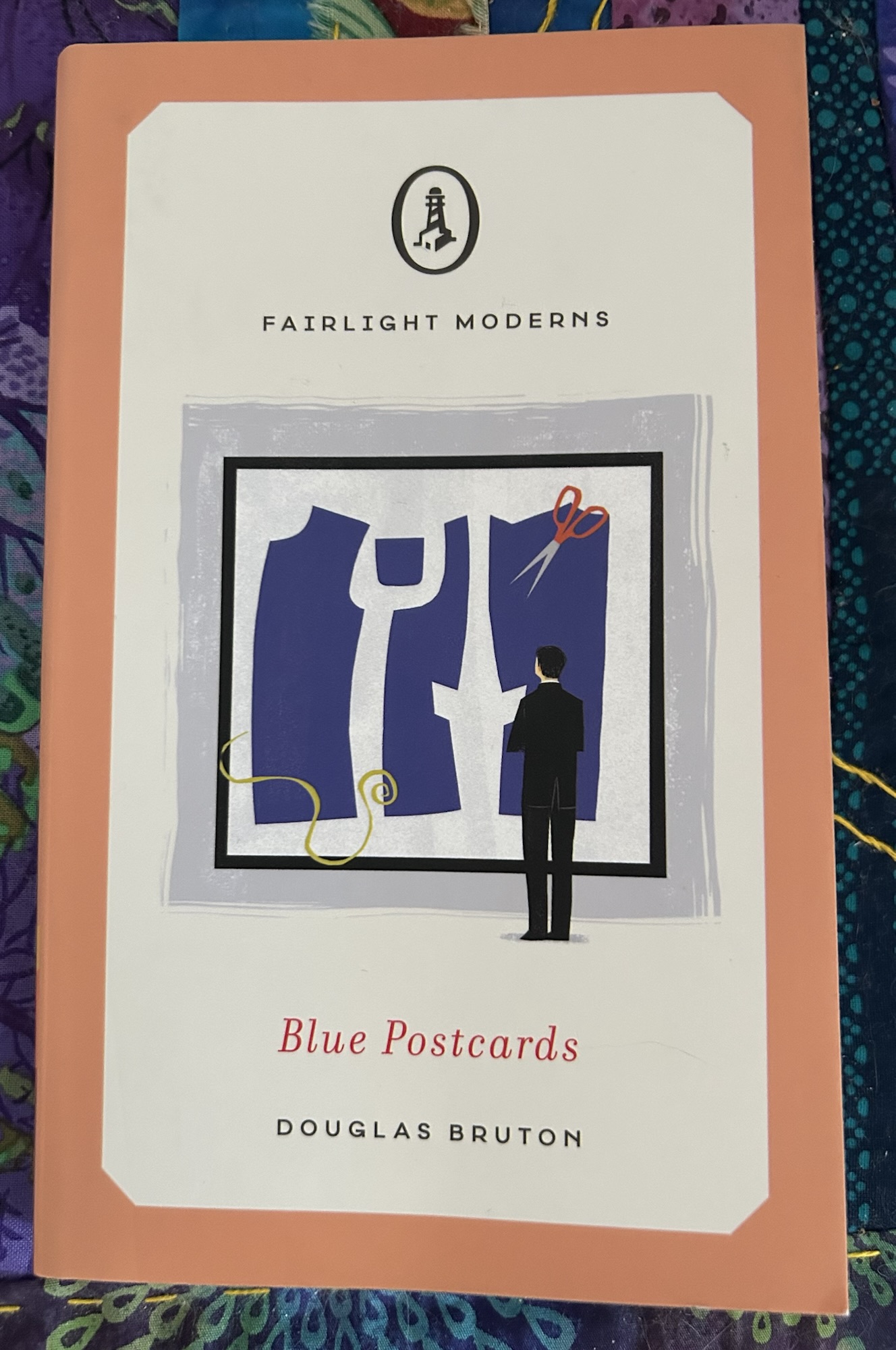
Blue Postcards – Douglas Bruton (2021) 151 pages

Earlier in the month I read With or Without Angels and I’d thought I might save Blue Postcards by the same author until the end of May, but in the end I couldn’t wait 😊Especially as Simon read this as part of his #BookADayInMay and loved it. You can read his review here.

Having now read three of Douglas Bruton’s books the word that comes up for me is tender. His writing is so gentle and subtle, entirely without sentiment but so careful in its construction and treatment of his characters. His tenderness is not a way to turn away from difficult feelings or events, but rather a way to look at them clearly and compassionately.

Blue Postcards is made up of 500 numbered paragraphs/postcards, split into five sections of 100. Almost all of them contain the word ‘blue’ (I recognised one which didn’t, there may be more). If this sounds overly contrived, it really isn’t. As you read, it flows easily and the various story threads are woven together seamlessly.

The contemporary thread involves a man who buys a blue postcard from a stall near the Eiffel Tower. The postcard is by Yves Klein, the French artist who created International Klein Blue. It is addressed to his tailor Henri, and they form the threads in the 1950s.

The narrator of the contemporary thread describes himself as ‘old’. He is aware that as he ages, his eyes perceive yellow and blue differently:

“31. Sometimes I wonder if going back to Nice I would find the sky so blue or if the blue that I found there back in 1981 had something to do with being young or something to do with memory.”

He begins a tentative relationship with Michelle, who sold him the card. Or perhaps not; he is an unreliable narrator and a theme of the book is truth, lies, fiction, and the fallibility of memory.

Henri the tailor sews blue Tekhelet threads secretly into all his suits, to bring his patrons luck.

“109. […] When I am talking about Henri I hope it is understood that we are in his time and not really in our time. If this was a film we might see Henri through a blue filter to show that his time is different.”

Yves Klein is building international success and needs a suit to look the part:

“184. Henri stands in front of the mirror next to Yves Klein in his tacked and pinned-together new suit. ‘You have to imagine it finished and pressed as sharp as knives and not a loose thread anywhere to be seen.’ Henri holds onto the sleeve of the jacket and his blue dream is briefly real.”

The postcards move back and for the between the timelines but this is never confusing or disorienting. There is a reflective, almost melancholic (blue?) tone running through both. They explore the transitory; how our experiences are constantly shifting as we rewrite the past from a changing present and our changing understanding.

The tone is lightened by the Yves Klein strand; his self-promotion and blatant lies therein are audacious, and even breathtaking with his Leap Into the Void.

There is also tragedy that we know exists in Henri’s past. A Jewish man in 1950s France is going to have unspeakable recent memories. The theme of grief runs across the timelines, both for those who have died and for what can never be regained.

I’ve not done any justice to this novella at  all. It is so rich in themes and style, and yet so approachable and readable. I can only urge you to read it for yourself!

“267. I do not think a stone can be said to belong to a person. I tell her about the stone and how I picked it up out of a river and it was blue until it dried and then it was only blue in possibility. I tell her that I like that most especially, that blue can be something that adheres in a thing and at the same time can be something hidden. I do not tell her that I think love is something the same.”

To end, the author reading from his work:

Novella a Day in May 2025: No.8

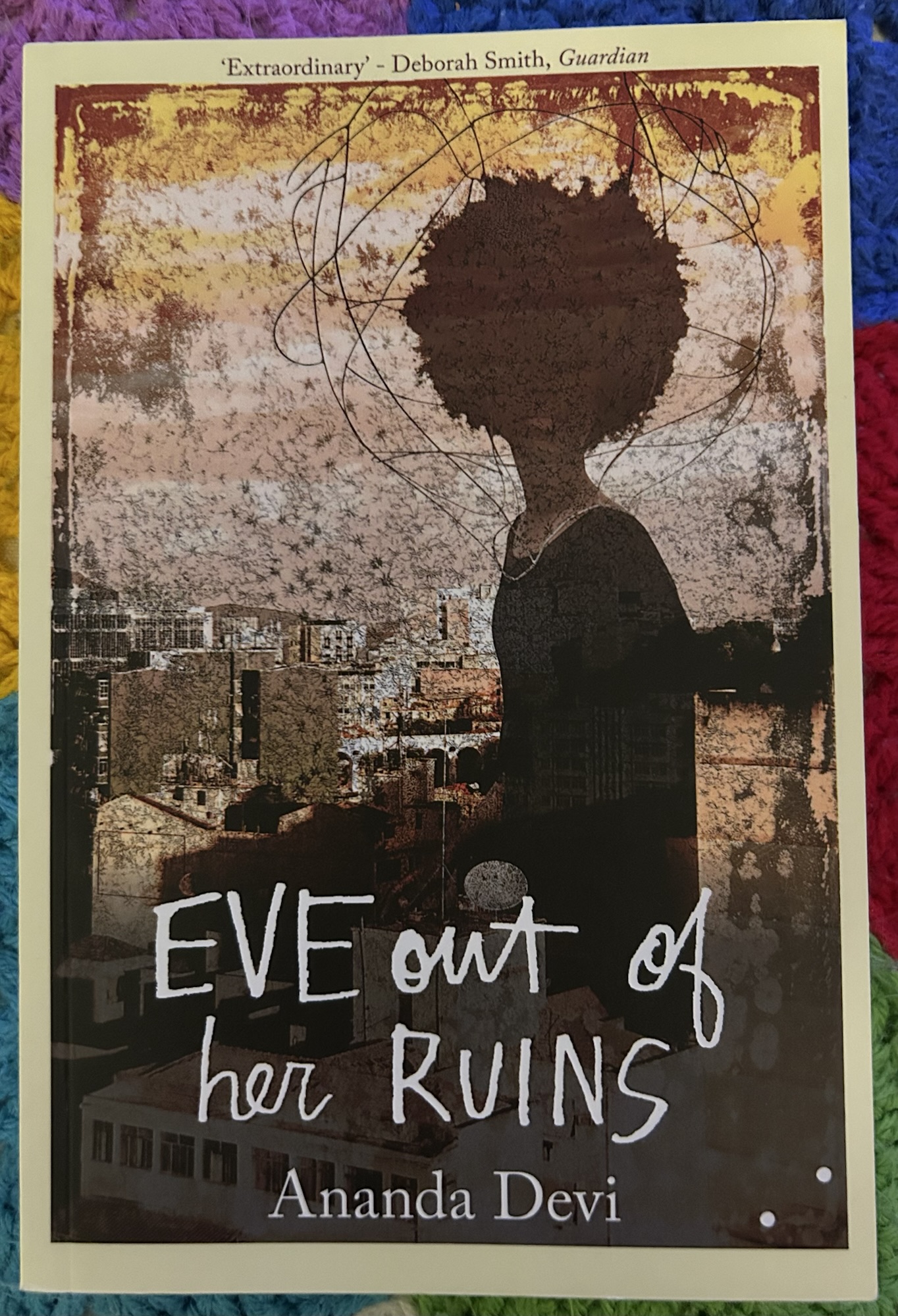
Eve Out of Her Ruins – Ananda Devi (2006, transl. Jeffrey Zuckerman, 2016) 164 pages

I picked up Eve Out of Her Ruins as I hadn’t read any Mauritian literature before and I’m enjoying seeking out new-to-me authors as part of my Around the World in 80 Books reading challenge.

The story is told from the point of view of four young people: Eve, Saad, Savita and Clélio who live in Troumaron, a cité geographically close to and societally far away from the capital Port-Louis. As Saad observes:

“Our cité is our kingdom. Our city in the city, our town in the town. Port Louis has changed shape; it has grown long teeth and buildings taller than its mountains. But our neighbourhood hasn’t changed. It’s the last bastion.”

Saad runs with the gangs to not draw attention to himself, but he loves poetry ever since he discovered Rimbaud, and he dreams of being a writer and escaping the ghetto.

“Just as the island unfurled it’s blues and oranges, so the words unfurled still more vividly purple rages in my head.”

He is in love with Eve, who learnt early on that although she had nothing, she still had something to sell. She has been trading her body to boys and then men, for school supplies and other things she needs, since she was a child. At 17, she is still a child, but a worn-out one.

“Saying no is an insult, because you would be taking away what they’ve already laid claim to.”

“I think I look like lots of things — organic, or mineral, or strange and sloughed off, but I don’t look like a woman. Only a reflection of a woman. Only an echo of a woman. Only the deformed idea of a woman.”

Eve’s sex work is portrayed carefully. It’s not explicit but nor is it obfuscated. I thought this was responsible without being overly harrowing or voyeuristic.

Clélio likes to sing from the rooftops, but is bewildered at how to escape the cité when he is already known to the police. He pins his hopes on his elder brother who has escaped to France, while simultaneously recognising that his brother’s life may not be going well, and he is unlikely to return to collect Clélio as he promised.

“I am Clélio. Dirt poor bastard, swallower of everyone else is rusty nails. What can you do? Nobody changes just like that.”

Eve and her friend Savita are in love, and it is Savita who recognises that Eve is getting more and more closed off as she tries to protect herself from the impact of her sex work and the domestic violence her father metes out at home. It is also Savita who recognises that as they get older, the boys’ anger is growing and the girls are increasingly vulnerable.

Saad sees this too, but knows Eve won’t listen to him however desperately he tries to reach her. There is real tension in the narrative as the sense of imminent violent explosion grows.

Eve Out of Her Ruins is a tough read and a million miles away from the paradisical tourist resorts of Mauritius. It is not poverty porn though, or voyeuristic. The voices of the young people ring true and lack any self-pity. The reader is not asked to pity them, but recognise their resilience and feel the desperation of seeking a way out when the odds are against you.

“They tell me I’ll succeed. But success does not mean the same thing for everyone. It’s a slippery word. In my case, it simply means that locked doors could open just a bit and I could, if I sucked in my stomach, slip through and escape Troumaron.”

In the Author’s Preface, Devi explains “I loved them and wanted to find a way out for them. I couldn’t, not for everyone. So I have left a trail of crumbs for some of them to follow.” Hence, there is hope in Eve Out of Her Ruins, it is not relentlessly bleak. But neither is it unrealistic or sentimental. It definitely doesn’t promise a happy-ever-after for the youngsters of Troumaron.

“I read in secret, all the time. I read in the toilets, I read in the middle of the night, I read as if books could loosen the noose tightening around my throat. I read to understand that there is somewhere else. A dimension where possibilities shimmer.”

Novella a Day in May 2025: No.7

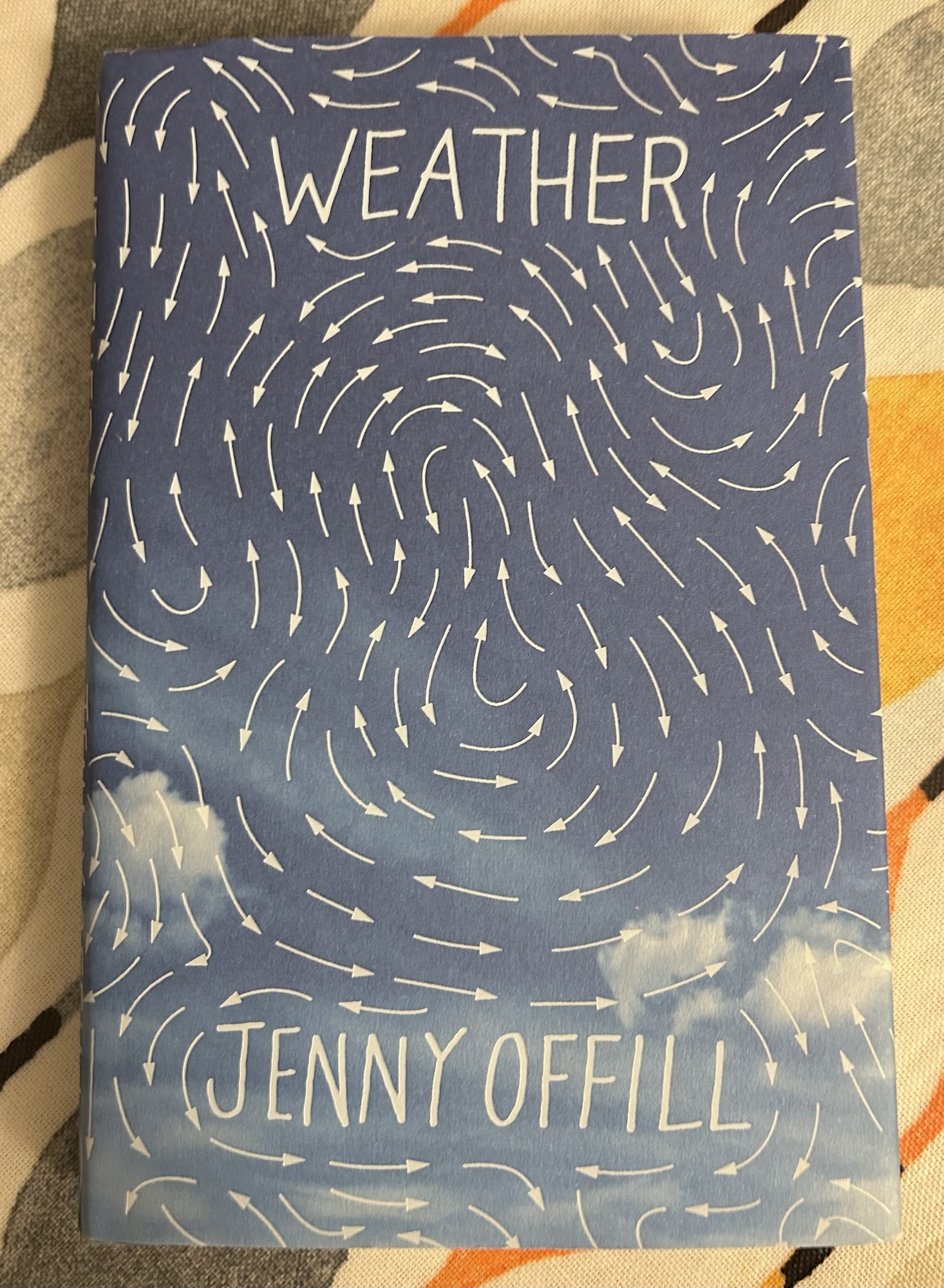
Weather – Jenny Offill (2020) 201 pages

I have broken my self-imposed page limit for defining a novella (70-200 pages) by including Jenny Offill’s Weather, which breaches by one whole page. I regret nothing: I had really enjoyed her Dept. of Speculation when I read it for this project back in 2020 and was pleased to be picking her up again.

Lizzie is a college librarian, looked down upon by other librarians because she doesn’t have formal qualifications. She has a lovely husband Ben, and a son Eli. Her brother Henry, now sober, reappears and her mother rings occasionally causing tensions but nothing extraordinary. Still, family life can be exhausting:

“I’m too tired for any of it. The compromise is that we all eat ice cream and watch videos of goats screaming like women.”

Lizzie takes a job with her old college professor Sylvia, who hosts a podcast about climate change.

“Once I took Eli. We stood and looked at some kind of meadowland. He waited patiently until we could go back to the car.

Children cannot abide a vista, Sylvia said.”

Wading through Sylvia’s email correspondence is heavy-going “I’m really hoping all these people who write to Sylvia are crazy, not depressed.” and in the wake of ongoing environmental destruction and the election of a President whose second term we are now in, Lizzie starts to become a doomsday prepper.

“My book ordering history is definitely going to get me flagged by some evil government algorithm. Lots and lots of books about Vichy France and the French Resistance and more books than any civilian could possibly need about spycraft and fascism. Luckily, there is a Jean Rhys novel in there and a book for Eli called How to Draw Robots. That’ll throw them off the scent.”

But while Weather is absolutely about anxiety and fear of what is happening now and what will happen in the future, Lizzie’s voice remains witty and self-deprecating:

“Then one day I have to run to catch a bus. I am so out of breath when I get there that I know in a flash all my preparations for the apocalypse are doomed. I will die early and ignobly.”

Like the Dept. of Speculation, Weather is written in a fragmentary style, with the focus primarily on the female narrator. We remain inside her head as she struggles to sustain family life, work, and the wider demands of living now. I thought Offill balanced all of this expertly.

The humour never detracted from the seriousness of the wider issues, but it also carefully portrayed Lizzie trying to find a way to live when the world – both big and small – seems overwhelming.

“My husband is reading the Stoics before breakfast. That can’t be good, can it?”

Novella a Day in May 2025: No.6

Brian – Jeremy Cooper (2023) 180 pages

Brian by Jeremy Cooper is a book which I knew I would absolutely love. I’m always in the market for tales of loners finding their tribe and building tentative friendships, and Brian had the added bonus of being largely set at the British Film Institute (BFI) cinema on the South Bank. I’m not sure how long I’ve been a member of the BFI but I think it’s about 25 years. Like Brian, when I joined it was called the National Film Theatre (NFT) and it’s a place that has brought much joy over the years.

Brian works at Camden Council, enjoying the predictability of his self-devised filing system and trying to avoid socialising with his colleagues. He lunches every day at the same place with its friendly but unobtrusive manager Lorenzo, and heads home to his flat. He just about keeps his anxiety at bay, most of the time.

“Keep watchful. Stick to routine. Protect against surprise.”

We later learn of Brian’s early childhood trauma that has contributed to his way of living, without him being overly pathologized.

“Learn quick as lightning from your mistakes or die, his mother melodramatically threatened him as a boy. And meant it, he had come to understand.”

He changes his routine one day to attend a revival of a film he’d missed the first time round, Clint Eastwood’s The Outlaw Josey Wales. This outing changes his life, as he finds the joy of the BFI programmes and how to not be in his flat, or entirely in his own company, in a way which isn’t overwhelming.

“Brian made the vital discovery that night that something he needed to be true proved to be so: that a nakedly emotional film on themes and feelings close to his own story did not necessarily shake alive his stifled memories of the past.

He was safe. The narratives of others were not his.”

In the foyer he notices a group of regulars chatting:

“Participation in the gathering of buffs appeared to be unconditional – the fact that they were all white males, no women, was more a matter of endemic social habit than the individual prejudice of the buffs, Brian felt, in recognition of his own narrow conventions.”

Cooper’s creation of the buffs is carefully balanced. They are enthusiasts, who welcome other enthusiasts. There is no gate-keeping of film, no declarations of what is a ‘good’ film. Any snobbery is side-stepped. As Brian discovers and develops an abiding love of mid-twentieth century Japanese film, he does so with feeling, without having to intellectualise it, although he always reflects and makes notes afterwards.

“Brian tended to experience film in the moment of watching, for what it meant to him right then, regardless of when it was made or set or how accurate in pretension it might or might not be.”

Time passes, and the BFI becomes another of Brian’s routines, but with the new contained within it: all the films to experience and explore. Alongside this, his relationships with the other buffs develop, albeit at snail’s pace:

“To Brian the most extraordinary occurrence during the first decade of his every-evening visit to the BFI was the incremental formation of what he had come to accept as friendship.”

Brian definitely had an extra resonance for me, describing a London I recognised, journeys I’ve undertaken and a particular place which has a special place in my heart. There were so many echoes, from grieving the closure of the Museum of the Moving Image to Brian being an inpatient at UCLH the same time as I worked there. But I hope my response won’t alienate anyone reading this post. It has such wide-ranging appeal beyond the specifics.

Brian is a beautifully tender novel about community, friendship, and passion. It shows the deep value of a life well-lived, when outwardly that life seems unremarkable, because it is quiet and deliberately demands so little of others. It is a novel about the value of art in our lives and the value of people in our lives, accepted on their own terms.

“Brian recognised for that his entire pre-BFI life he had been a mouse, a termite, shut in dark tunnels of his own creation. Not that he had now become a lion, of course not. More of a squirrel.”

There’s a lovely interview with Jeremy Cooper about writing Brian on the BFI website here.

Novella a Day in May 2025: No.5

Minna Needs Rehearsal Space – Dorthe Nors (2013, transl. Misha Hoekstra 2014) 89 pages

I really enjoyed Dorthe Nors’ Mirror, Shoulder, Signal as the final novella when I first undertook this month-long challenge back in 2018. Since then I’ve read her short story collection Karate Chop, and was delighted to find Minna Needs Rehearsal Space in my beloved charity bookshop. I think it has been published in editions with Karate Chop, but this Pushkin Press edition was standalone.

This is definitely a novella where the style will alienate some readers. It’s written entirely in a series of short sentences.

“Minna walks around in bare feet.

The flat is full of notes.

Bach stands in the window.

Brahms stands on the coffee table.

The flat’s too small for a piano, but

A woman should have room for a flute.”

At first I wasn’t sure I could read a whole novella like this, but then I suddenly clicked with the rhythm and it seemed a lot less jarring.

Minna is a musician living in Copenhagen, trying to write a “paper sonata” and struggling to find a place to work. She is struggling more widely too: with ambivalence towards potential motherhood; with her tightly-wound sister; with her boyfriend who has just dumped her by text.

This spurs Minna to do some dumping of her own, as she unfriends people on social media.

“Minna eats a cracker.

Karin’s missive awaits.

Karin wants to be nasty.

Karin wants to upset her applecart, but

Minna’s cart has no apples.”

She ends up packing Ingmar Bergman’s Billeder as the director becomes almost a Greek chorus/silent interlocutor, when Minna heads for Bornholm and the sea.

The short sentences act as constant present-tense status updates, a commentary on our online living. Yet by piling on the banal observations, gradually a more subtle picture emerges between the sentences. Minna’s frustrations and vulnerabilities shine through.  It’s a brave approach which for me worked well, but I already knew I liked Nors’ observations, characterisation and humour.

Minna Needs Rehearsal Space is a reminder to look beyond what is immediate to a whole picture; one that is always changing in the present and is much more complex than the surface would have us believe.

“Minna’s broken heart dwells in the breast of an optimist.”

Novella a Day in May 2025: No.4

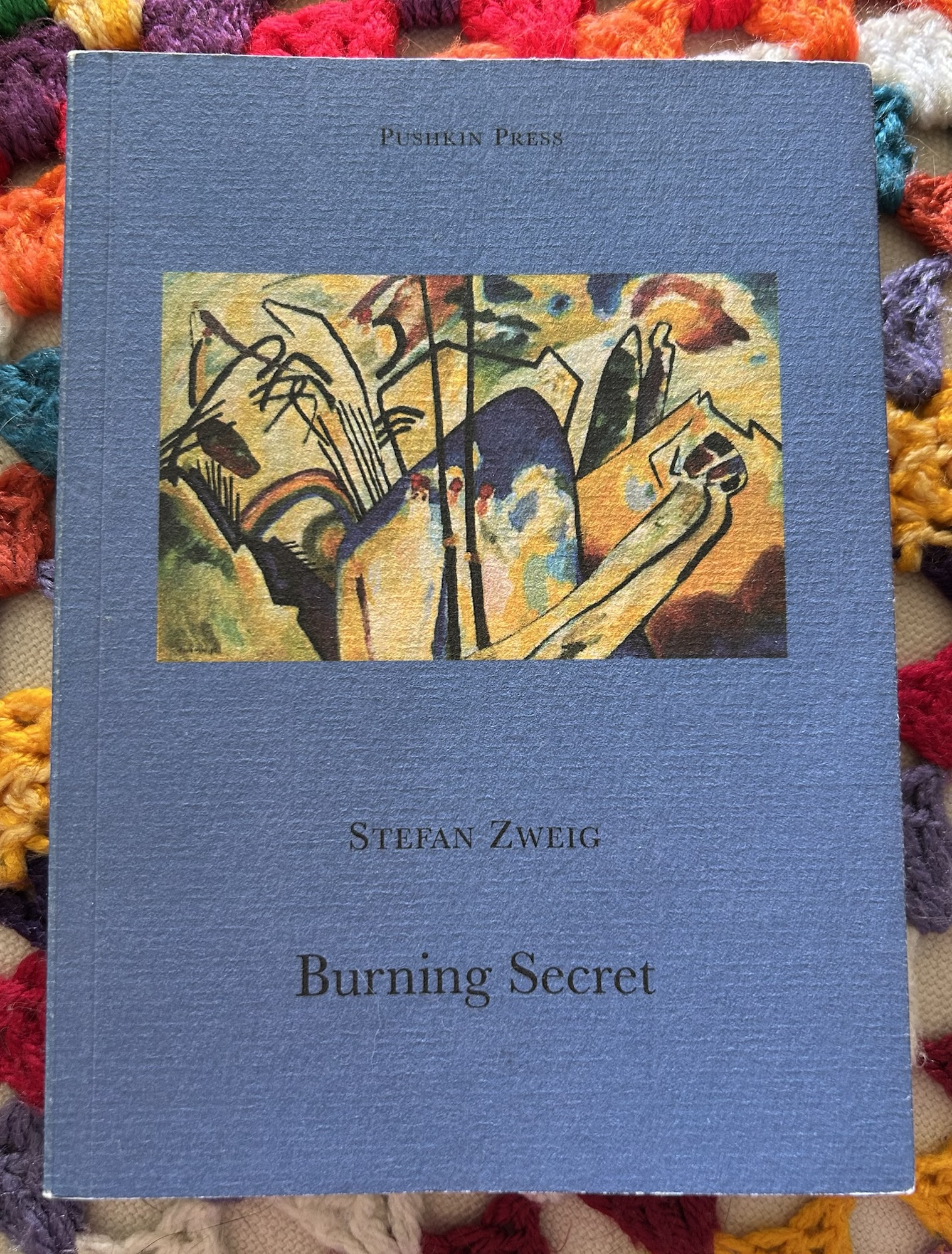
Burning Secret – Stefan Zweig (1913, transl. Anthea Bell 2008) 117 pages

Stefan Zweig is such an exquisitely tender writer. His precise, compassionate observations are deep with humane understanding. It makes him a perfect novella writer.

Burning Secret has a very simple structure. Edgar is twelve years old and recuperating from an illness in the spa town of Semmering. He is lonely and disregarded, bored and unnurtured.

“His face was not unattractive, but still unformed; The struggle between man and boy seemed only just about to begin, and his features were not yet kneaded into shape, no distinct lines had emerged, it was merely a face of mingled pallor and uncertainty.”

Unfortunately for Edgar, the Baron, an irredeemable cad and bounder, arrives in Semmering.

 “He felt no inclination to be alone and avoided it as far as possible; he didn’t really want to become any better acquainted with himself. He knew that, if he was to show his talents to best advantage, he needed to strike sparks off other people to fan the flames of warmth and exuberance in his heart. On his own he was frosty, no use to himself at all, like a match left lying in its box.”

This vacuous young man plans on whiling away his time in a meaningless love affair, and his sights soon settle on Edgar’s mother. As she is initially resistant to his charms, he callously decides to leverage Edgar in order to win favour.

“The Baron easily won his confidence. Just half-an-hour, and he had that hot and restless heart in his hands. It is so extraordinarily easy to deceive children, unsuspecting creatures whose affections are so seldom sought.”

Poor Edgar. He falls hook, line and sinker.

“A great, unused capacity for emotion had been lying in wait, and now it raced with outstretched arms towards the first person who seemed to deserve it. Edgar lay in the dark, happy and bewildered, he wanted to laugh and couldn’t help crying.”

For the Baron it is all a game. He has no feelings for Edgar or his mother, the latter only prey with which to amuse himself. He views her ruthlessly, identifying her snobbery and pretentions and knowing how to exploit these by emphasising his nobility. He gives no consideration to her marriage or vulnerabilities as a woman who will be judged much more harshly than he if they have an affair.

What he doesn’t reckon on is Edgar’s dawning, imperfect realisation, and the fury of a hurt child. What follows is a coming-of-age story where the lessons are learned through emotional brutality.

And yet, the resolution is hopeful, and without bitterness. It feels realistic and reflective, not undermining what has gone before but demonstrating human endurance too.

In less subtle hands Burning Secret could be sentimental and mawkish. With Stefan Zweig, it is emotionally devastating.

“He didn’t understand anything at all about life, not now he knew that the words which he thought had reality behind them were just bright bubbles, swelling with air and then bursting, leaving nothing behind.”

Novella a Day in May 2025: No.3

With or Without Angels – Douglas Bruton (2023) 107 pages

Having loved Hope Never Knew Horizon by Douglas Bruton when I read it in February for #ReadIndies, I was keen to try more by him. With or Without Angels is an intriguing novella, attempting to capture the process of creating art at the end of life.

Written in the third person but mainly from the point of view of “the old artist”, Bruton portrays Alan Smith’s memories and thoughts as he works on his final piece, The New World, which was a response to Giandomenico Tieplo’s Il Mondo Nuovo. (In the Afterword Bruton explains that Alan’s widow had read the novella and she encouraged publication, with permission for the art to be reproduced.)

The New World is a series of images and they are reproduced in the book, after the fictional prose passages which evoke the creation of them. So for the first one, a photograph taken on a trip to Tate Modern:

“Out on the street the air was wet and chill and shifting. It smelled of bus exhausts and damp wool and faintly of cigarettes. And his wife it smelled of, too. Something with flowers in her perfume. Patchouli maybe – a shrub of the mint family – something of wet soil or apples that are past ripe, the smell of a cork pulled from a bottle of strong red wine. It’s the last of the senses to go, smell. He had heard that somewhere and was comforted that when all else failed he would know his wife was at his side by her smell.”

The smell of patchouli is something that is returned to at different sections along with other recurring motifs. This was so clever; it evoked the layering of memory and movement back and forth in time as someone contemplates the past from a present where they know their future is limited. (Also, a special thank you to the woman who stood next to me on the tube and was wearing patchouli as I read this 😊)

Time collapses in on itself at various points for the artist, disorienting but without him losing sight of his work.

“Some things are so familiar that you expect them to be there even when they are not and cannot be. The blue hat had been eaten into holes by moths. But he is sure that he has seen it hanging on the last hook in the hall as recently as a week ago.”

Bruton never attempts to interpret the work or lay claim to an absolute meaning in The New World. He is too subtle for that, and part of what With or Without Angels explores is that there are no final answers to be gleaned from a work of art.

“It’s not that he fears the questions. He wants them to be asked. That’s part of the point. It’s the answers that he frets over. He has come to a time in his life where the answers are like Brighton’s running pebbles under his feet.”

There’s also no sentimentality in the artist nearing the end of his life. Instead it is a gentle, tender, compassionate portrait.

“The thing she did with her hair […] and how he felt when he saw her do that, somehow there was meaning and hope and love in that. The old artist does not tell anyone this, not even his wife, but maybe she knows.”

With or Without Angels captures so much in so few pages. It is a remarkable work which manages to explore enormous themes with such a light touch, without ever seeming superficial.

The New World link at the start of this post will take you to Alan Smith talking about the work.

Novella a Day in May 2025: No.2

Day two of NADIM and I’m delighted that Simon at Stuck in a Book will be reading a book a day for the month too!

The Victorian Chaise-Longue – Marghanita Laski (1953) 99 pages

It’s been years since I read the very powerful Little Boy Lost by Marghanita Laski, and I kept meaning to get back to her. The Victorian Chaise-Longue is a short tale of domestic terror, and would appeal to anyone who is a fan of Daphne du Maurier’s short stories, or The Yellow Wallpaper.

It opens with Melanie who has recently given birth, and is now recovering from tuberculosis, being patronised by her doctor and her husband.

“‘Now listen to me,’ he said. ‘Because you’ve managed to be a good obedient girl so far, we’ve been able to conquer what might have been a very nasty little flare up, and if you let yourself get perfectly well and we keep a steady eye on you, there’s no reason why anything of the sort should ever occur again.’”

And…

“‘How clever you are, darling,’ said Melanie adoringly. ‘You make me feel so silly compared with you.’

‘But I like you silly,’ said Guy, and so he does, thought Dr. Gregory, watching them. But Melanie isn’t the fool he thinks her, not by a long chalk, she’s simply the purely feminine creature who makes herself into anything her man wants her to be.”

So as you can see, the horror is there from page one 😀

They decide that Melanie could do with a change of view, and so she lies down on the titular furniture, which she had found in a junk shop before she became unwell. It’s heavy and ugly, but she had been taken by it; she had also experienced a memory which wasn’t hers when looking at it, which she quickly brushed aside.

When she wakes up, she is still on the chaise-longue, but in a different room and a different era, with a harsh woman who calls her Milly not Melly. At first she believes herself to be dreaming, but:

“It was real, that touch of flesh. There was no conceivable atmosphere of dream of which that touch of rough dry flesh could be a part.”

Melanie is trapped there, feeling even more unwell, cared for by the woman who turns out to be Milly’s sister Adelaide, and a stereotyped housemaid.

Milly is in some sort of disgrace, incurring her sister’s barely concealed wrath. As she tries to piece together what has happened, Melanie recognises parallels with her own life:

“Sin changes, you know, like fashion.”

I mentioned at the beginning Daphne du Maurier and the feminist classic by Charlotte Perkins Gilman. The Victorian Chaise Longue perhaps suffers by these comparisons. It’s not quite as horrifyingly unnerving as du Maurier’s stories, or as overt in its wider themes as The Yellow Wallpaper. But it is an engaging, quick read, which doesn’t offer trite answers to Melanie’s predicament or the wider issue of women’s bodies so often being constrained by forces more powerful than they are.