“The cup of tea on arrival at a country house is a thing which, as a rule, I particularly enjoy.” (PG Wodehouse)

I feel like it wasn’t so long ago I read and enjoyed Old Baggage by Lissa Evans (2018), but as I blogged about it I can see it was six years ago! Where does the time go…? Anyway, it was Susan’s enticing review of Small Bomb at Dimperley (2024) which reminded me that I really should pick up Evans again, and as it turned out, now was exactly the right time.
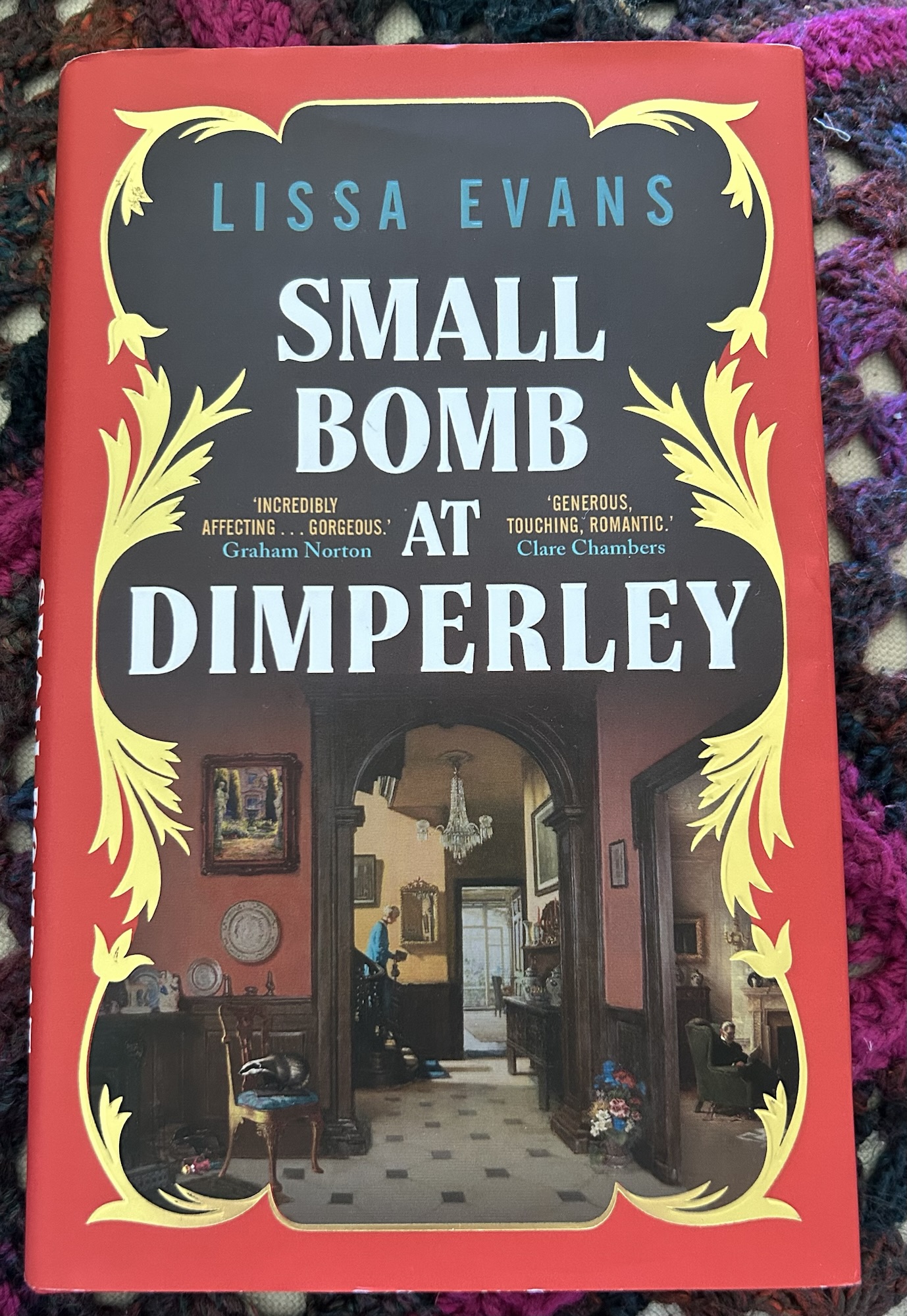
Set immediately after World War II, the titular country pile is falling down around its much-reduced inhabitants’ ears. Home of the “lesser nobility” Vere-Thissets, their wastrel heir Felix has died in the war and they are awaiting the return of his diffident brother Valentine to take up the reins.

Dowager Lady Irene Vere-Thisset is struggling with post-war societal changes, including:

“A farmer named Jeffries who habitually spoke to Irene with familiarity which suggested they’d first met when queuing at a whelk stall and who had actually clapped her on the back last year when she had been presenting the trophy for best heifer at the county fair.”

During the war the house had been a maternity hospital, and Mrs Zena Baxter has stayed on, with her now two-year-old daughter Allison:

“It was quite galling to be forced to admire a piece of shrapnel that had somehow landed in Addenham churchyard and which was kept in a velvet-lined box as if it were a saint’s jawbone, when she herself had been dug out of the basement shelter of Hackney Young Women’s Hostel five hours after the building had suffered a direct hit.”

Zena is organised and capable, which is just what Dimperley needs, the only other remaining staff being Hersey who arrived at age fifteen and is now fighting off retirement. Zena has ended up as secretary to Alaric Vere-Thisset, as he writes an interminable history of the family despite the fact that:

“no Vere-Thisset had ever raised an army, or invented anything, or written a proper book, or endowed an institution, or even become a Member of Parliament.”

Meanwhile, Felix’s widow Barbara is struggling to get to know her daughters after they have been in the US for several years, escaping the conflict. Poor Barbara is physically defeated by much of everyday life, and has been left to undertake many of the noblesse oblige responsibilities without acknowledgement or thanks.

No-one thinks Valentine can make a go of running this money-pit, including Valentine:

“Lacking in either personal magnetism or the sort of skills that were needed for the forging and maintenance of useful connections. He was, as his father had noted, a poor rider, a below-average shot, an indifferent golfer and rather unfortunately ‘the image of my Uncle Fenwick’, though Irene had been unable to confirm the latter since every picture of Uncle Fenwick had been removed from the family album after the incident”

But what has been overlooked is that none of these attributes actually matter. Personal magnetism and charm are vastly overrated qualities, and what Valentine lacks in these he makes up for in decency, hard work and humility. He’s also likely dyslexic, and this alongside being forced to write with his non-dominant right hand at school means he is consistently underestimated.

We follow the family as Valentine and Zena try to take Dimperley by the scruff of the neck, and all of them attempt to work out a place for themselves in the ever-shifting new world of Labour governments, working women and – horror of horrors – an expanding National Trust (!)  

Small Bomb at Dimperley wears its research lightly, so you never get an info-dump but rather a believably evoked sense of the immediate postwar period. What is foregrounded is the characters, and they are all wonderful. The more eccentrically comic Alaric and Barbara are never condescended to – their behaviour is laughed at but never they themselves. They are treated with insight and compassion, as is Lady Irene despite her clinging to archaic attitudes. The depth of characterisation creates flawed, believable people who I really invested in.

Small Bomb at Dimperley demonstrates how everyone deserves to find their place of repose – somewhere to be cared for, to love and to be loved. It shows how this occurs in a variety of ways and is not the preserve of the glamorous or the charismatic. Evans is so good at creating engaging circumstances and people who she treats with such humanity, humour and warmth.

“You couldn’t give half the population a gun and send them away for five years and then expect their slippers still to fit when they came home.”

It’s been a while since I ended with an 80s tune, so here’s a song about a more modest abode than Dimperley:

“Keep the circus going inside you.” (David Niven)

I really enjoyed Elisa Shua Dusapin’s debut novel Winter in Sokcho so I was looking forward to picking up Vladivostok Circus (2022, transl. Aneesa Abbas Higgins 2024) for Women in Translation Month this year. The two novels share the setting of tourist attractions out of season, and of carefully evoked relationships defined as much by distances as by intimacies.

Nathalie is twenty-two and has graduated in costume design in Belgium. She arrives in Vladisvostok – a place she knows from childhood – to spend time with an acrobat trio who are working on their Russian bar performance. They will be performing at Ulan-Ude, seeking to perform a triple jump four times in a row.

“They communicate in Russian, constantly interrupting each other. Anton gives directions, demonstrates a move to Nino, who listens, hands on hips, visibly impatient. Anna climbs back onto the bar. Their movements synchronise. Anna sets the beat, a rhythmic pulse, rising and falling, like a breath being pushed out and sucked back into the lungs, a beating heart at the centre of the ring.”

Ukrainian trampoline champion Anna is their new ‘flyer’ after the previous acrobat, Igor, was injured in an accident five years previously. Nino is from a German circus family and has worked with Anton since he was eight years old. They are both haunted by what happened with Igor.

The four of them are left in the empty winter circus with manager Leon, and Dusapin expertly portrays the barren environment absent of tourists and glitter, smelling of the departed animals.

Nathalie feels awkward from the start, when she arrives before she is expected. She is unsure of her designs and she talks too much, straining the polite interest of the men. Anna is openly hostile and there is a shaved cat called Buck wandering around, adored by Leon. The atmosphere is unsettling and uneasy.

“By the end of the evening, they all have their headphones on. They each go back to their own room listening to music. I put my headphones on too, but without any music. I sit there, focusing on the sounds inside my own head. It makes me feel closer to the others somehow.”

Gradually however, the relationships deepen. This occurs in a believable way, by increments and without sentimentality.

“‘Aren’t you ever scared?’ I ask after a while.

‘All the time,’ he says. ‘I’m terrified with every new jump. Scared of getting hurt. Scared of hurting Anna. I’m scared of the audience too; I get stage fright.’”

Physical forms are flawed in this novel: Anna worries she is too heavy, Anton is nearing retirement, both men nurse injuries and Nathalie has psoriasis. This emphasises human frailty, building tension throughout this short novel as the group strive for their bodies to achieve this dangerous spectacle.

I think Winter in Sokcho is the stronger novel and if you’ve not read this author before then I would recommend that as the place to start. But there is still plenty to enjoy in Vladivostok Circus; Dusapin is so good at creating an unnerving quality to her settings and characterisation which somehow still manages to be entirely believable and warm.

“It occurs to me that my materials can have an impact on their act too. Smoothing out the skin, tapering the body, enabling it to rise more quickly and to a greater height. And at the same time, accelerating the fall.”

“I am merely the canvas on which women paint their dreams.” (Rudolph Valentino)

I’m going through a bit of a reading slump at the moment, not a terrible one as I’m finding I can focus on my comfort reads, but I’m struggling with anything that needs more concentration. It’s very frustrating.

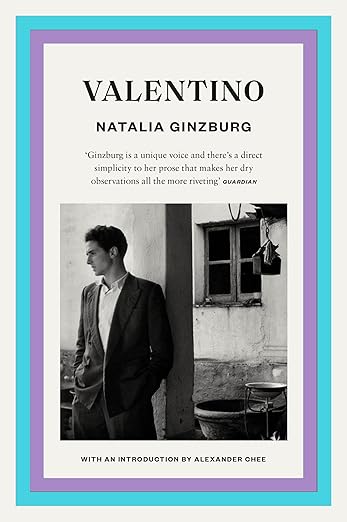
I wanted to take part in August’s Women in Translation Month, so I was hoping to recover my reading mojo in time. Having enjoyed All Our Yesterdays and The Dry Heart by Natalia Ginzburg previously, I thought her direct style would suit my addled brain well. Valentino (1957 transl. Avril Bardoni 1987)) is essentially a short story, just 62 pages in my edition (a Daunt Books reissue) and I whizzed through it on a short train journey to visit a friend in Sussex.

The story is narrated by Caterina, sister of the titular character:

“My father believed that [Valentino] was destined to become a man of consequence. There was little enough reason to believe this, but he believed it all the same and had done ever since Valentino was a small boy and perhaps found it difficult to break the habit.”

Valentino is vain and feckless, entirely undeserving of the faith his parents put in him and the sacrifices the whole family have made to finance his medical studies. He fritters away his time and routinely gets engaged to ‘teenagers wearing jaunty little berets’.

So when he announces his latest engagement, no-one takes it particularly seriously:

“It had happened so often already that when he announced he was getting married within the month nobody believed him, and my mother cleaned the dining room wearily and put on the grey silk reserved for her pupils’ examinations at the Conservatory and for meeting Valentino’s perspective brides.”

However, this engagement to Maddelena sticks. She is older, unattractive and incredibly rich. Valentino’s parents are heartbroken at his avariciousness being made so apparent. Caterina is more equanimous and she soon realises that Maddelena is caring and hard-working. Valentino is not worthy of his bride.

“It was not easy to explain to my sister Clara the turn that events had taken. That a woman had appeared with lashings of money and a moustache who was willing to pay for the privilege of marrying Valentino and that he had agreed.”

What follows is a carefully realised study of the family members and their dynamics, particularly around Valentino’s marriage. Caterina’s direct voice conveys the hurt Valentino inflicts, not through cruelty but through utter obliviousness and self-focus, without demonising him.

In such a short space, Ginzburg achieves a really moving portrait of familial relationships and how these exist under the pressures exerted by society.  There is sadness in the tale but also a deadpan humour. Caterina presents the situation without judgement, enabling a real depth to the characterisation.

Ginzburg is such an intelligent, insightful writer who never seeks to alienate readers with her cleverness. She presents knotty complexity with a deceptive simplicity of style. If you’ve never read her, Valentino is a good place to start.

“My emotions at that time were neither profound nor melancholic and I was confident that sooner or later things would improve for me.”

To end, Rudolph Valentino playing ‘a youthful libertine’ and dancing a tango, over 100 years ago: