I’m going through a bit of a reading slump at the moment, not a terrible one as I’m finding I can focus on my comfort reads, but I’m struggling with anything that needs more concentration. It’s very frustrating.
I wanted to take part in August’s Women in Translation Month, so I was hoping to recover my reading mojo in time. Having enjoyed All Our Yesterdays and The Dry Heart by Natalia Ginzburg previously, I thought her direct style would suit my addled brain well. Valentino (1957 transl. Avril Bardoni 1987)) is essentially a short story, just 62 pages in my edition (a Daunt Books reissue) and I whizzed through it on a short train journey to visit a friend in Sussex.
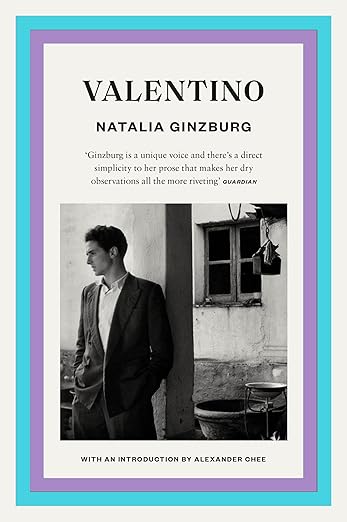
The story is narrated by Caterina, sister of the titular character:
“My father believed that [Valentino] was destined to become a man of consequence. There was little enough reason to believe this, but he believed it all the same and had done ever since Valentino was a small boy and perhaps found it difficult to break the habit.”
Valentino is vain and feckless, entirely undeserving of the faith his parents put in him and the sacrifices the whole family have made to finance his medical studies. He fritters away his time and routinely gets engaged to ‘teenagers wearing jaunty little berets’.
So when he announces his latest engagement, no-one takes it particularly seriously:
“It had happened so often already that when he announced he was getting married within the month nobody believed him, and my mother cleaned the dining room wearily and put on the grey silk reserved for her pupils’ examinations at the Conservatory and for meeting Valentino’s perspective brides.”
However, this engagement to Maddelena sticks. She is older, unattractive and incredibly rich. Valentino’s parents are heartbroken at his avariciousness being made so apparent. Caterina is more equanimous and she soon realises that Maddelena is caring and hard-working. Valentino is not worthy of his bride.
“It was not easy to explain to my sister Clara the turn that events had taken. That a woman had appeared with lashings of money and a moustache who was willing to pay for the privilege of marrying Valentino and that he had agreed.”
What follows is a carefully realised study of the family members and their dynamics, particularly around Valentino’s marriage. Caterina’s direct voice conveys the hurt Valentino inflicts, not through cruelty but through utter obliviousness and self-focus, without demonising him.
In such a short space, Ginzburg achieves a really moving portrait of familial relationships and how these exist under the pressures exerted by society. There is sadness in the tale but also a deadpan humour. Caterina presents the situation without judgement, enabling a real depth to the characterisation.
Ginzburg is such an intelligent, insightful writer who never seeks to alienate readers with her cleverness. She presents knotty complexity with a deceptive simplicity of style. If you’ve never read her, Valentino is a good place to start.
“My emotions at that time were neither profound nor melancholic and I was confident that sooner or later things would improve for me.”
To end, Rudolph Valentino playing ‘a youthful libertine’ and dancing a tango, over 100 years ago:
 madame bibi lophile recommends
Firstly, I hope the slump improves soon, Madame B – I’ve had periods like that when you just can’t get into anything substantial, and I usually just go with the flow until I can. As for Ginzburg, I still haven’t read anything by her, but I do like the sound of this!
LikeLiked by 1 person
Thanks Kaggsy! I think going with the flow is good advice – no point fighting it!
I hope you enjoy Ginzburg if you get to her, Daunt are doing a great job with the reissues.
LikeLiked by 1 person
This sounds beautifully crafted. So sorry about the slump. My reading’s fine but I seem unable to watch any challenging films so I have a glimmer of how it feels.
LikeLiked by 1 person
It is Susan, so well written.
Thank you – I hope our book/film slumps resolve soon!
LikeLiked by 1 person
I can definitely identify with that sort of reading slump too. I agree with Kaggsy’s advice but hope you find your reading revs again soon. I’ve just finished nearly (I think) the last one of Ginzburg’s, certainly in translation, Family Lexicon. Her terse but potent prose somehow keeps you reading when other styles just can’t hit the spot; I’m glad you found the same with Valentino.
LikeLiked by 1 person
Thanks so much, I’m definitely hoping for an improvement soon!
Great to hear how highly you rate Ginzburg. I’m looking forward to reading more by her – I’ll look out for Family Lexicon.
LikeLike
I have yet to make a start on #WITMonth, but I do recommend The Remembered Soldier by Anjet Dannje, translated by David McKay. She’s a Dutch author and the book is set in the Netherlands. It’s excellent.
LikeLiked by 2 people
Thanks Lisa! After your tempting review I tried my library but sadly they don’t have it. So it’s on my bookshop.org wishlist!
LikeLiked by 1 person
Hope the slump soon passes! I must say I’m so glad the fashion for that style of Valentino’s trousers has passed!
LikeLiked by 1 person
Thanks FF 😊
Haha! I must admit I’m really not a fan of the opposite style either – the super tight, ankle swinging trousers. Thankfully that fashion seems to be passing too!
LikeLiked by 1 person
I’m so glad you liked this novella! It’s one of her sharpest, I think, and you’re right to highlight her deadpan humour, which definitely comes through. I can’t recall if you’ve read Sagittarius (my NYRB Classics edition contained both novellas), but if not, it’s well worth seeking out.
LikeLiked by 1 person
I think I found her humour more evident in this that the others I’ve read. I’ve not read Sagittarius yet, so great to hear you rate it Jacqui.
LikeLike
This used to be a regular event for me in the summertime, with the humidity, when we didn’t have any relief of A/C at home. I hope you’re able to get back to other reading soon, because it’s disconcerting when you feel that your choices are not your own, that something you want to do is just out of your reach somehow. This part of your review particularly intrigues me; I’ve read two of her other books, but not this one:
“Caterina’s direct voice conveys the hurt Valentino inflicts, not through cruelty but through utter obliviousness and self-focus, without demonising him.”
LikeLiked by 1 person
Thanks Marcie, I think the slump is slowly lifting now – at least I hope so!
It’s a very careful characterisation of Valentino. He could be despicable but he really isn’t, through Caterina’s eyes.
LikeLike