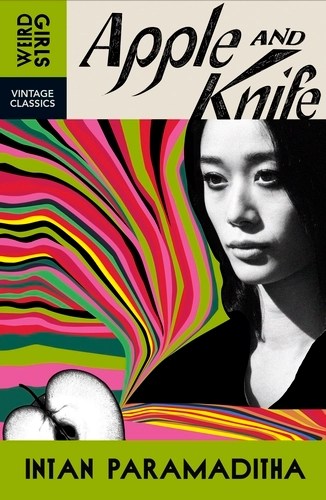
“What could be more terrifying than a devil who speaks the truth?” (Intan Paramaditha, Apple and Knife)

I’m determined to finish my Around the World in 80 Books reading challenge this year, and yes, I did say that last year too 😀 It has got more challenging as time has gone on because I’m dependent on what has been translated, so I was delighted to find Indonesian writer Intan Paramaditha included in the Vintage Classics Weird Girls series (even if I do bristle a bit at the condescending title).

Apple and Knife (2018, transl. Stephen J Epstein 2018) is a collection of short stories, mostly set in the modern day but quickly destabilised into gothic, fairytale (in the Grimm sense) realities. They are united by a visceral, forthright sensibility.

“I want drops of blood to be ink on my book, encrusted in the lines of destiny that twist and spin history on my palm. I want to make sacrifices like blood does, play with puddles, ooze sores, flare in anger.”

The collection opens with The Blind Woman Without a Toe, a reworking of the Cinderella story, told from the point of view of one of her step-sisters. This put me in mind of fellow Weird Girls author Angela Carter, particularly The Bloody Chamber. However, Paramaditha’s voice is resolutely her own, and part of the impact of the horror occurs because a recognisable reality grows uncontrollably into something dark and unmanageable.

I’m always interested in portrayals of witches, those women who live on the fringes and often offered women healthcare. In Scream in a Bottle, Gita is a researcher who travels to Cadas Pangeran in search of a witch named Sumarni.

 “It’s as if time is gnawed away by termites here. The hours melt into the night, and the tick of the clock no longer matters.”

It soon emerges that Sumarni’s main work is ending unwanted pregnancies.

“She seems almost a smile, but no smile is reflected in her grey eyes. Gita watches as those eyes become the sky. Clouds gather within; they let loose rain, but no thunder.”

As this story develops across a few pages, Sumarni explains an element of her work that is otherworldly, both menacing and protective, a commentary on the silencing of female voices and experience. It is deeply unnerving.

One of the most disturbing tales for me was Beauty and the Seventh Dwarf, which features violent (consensual) sex and self-mutilation. But I never had the sense that Paramaditha was being gratuitously shocking. She uses the bloody and the violent to explore the insidious control of women’s bodies in the modern world; the fabulist framing highlighting recognisable horrors rather than obscuring them.

“Bathed in the blue glow, her mangled features made me feel as though I was looking at a mermaid who had been dashed against the rocks by the waves. Yet I was shipwrecked, and she was not rescuing me.”

I’ve only scratched the surface here of the settings and themes in the collection, but hopefully I’ve given a flavour of what to expect. Not a comfort read but an interesting one! I’d like to read longer fiction by this author now, to see what she does with more space to explore. Luckily her first novel has also been translated:

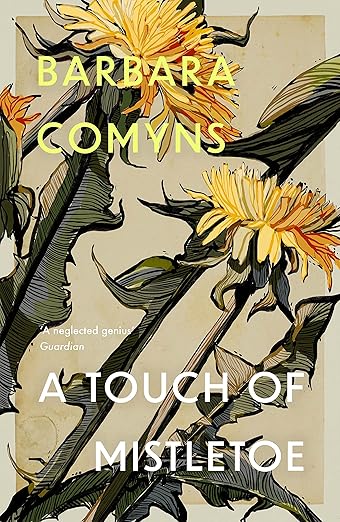
“I suppose we don’t know much except from the books we have read, but at least we want to live.” (Barbara Comyns, A Touch of Mistletoe)

I’d planned to read Barbara Comyns’ A Touch of Mistletoe (1967) in December for obvious reasons, but I fell behind with my plans as always. Despite the title it’s not a Christmas book at all, and instead it’s got my 2026 reading off to a great start.

A Touch of Mistletoe is thought to be semi-autobiographical, as it follows sisters Vicky and Blanche Green from teenagers in the 1920s, to extreme poverty in the 1930s, through to marriage and motherhood in wartime, ending in the 1950s. Certainly a semi-feral childhood is something Comyns has explored before:

“Our mother rather lost interest in us after the thirst got hold of her and, although our grandfather was vaguely fond of us, he certainly wasn’t interested.”

While their brother Edward seems fairly content in a disengaged way, the sisters are desperate to leave their Warwickshire home. Vicky wants to go to art school, but the solicitor who controls her inheritance from her father does not think this is an appropriate use of funds. Blanche is yet to come of age:

“Blanche could not draw, but she had the very special gift of romantic beauty. She was extremely tall and willowy, with a flowing mass of almost black hair, classical features and a pale moon face, her skin as fine as the skin inside egg shells.”

Comyns is so adept with those arresting similes. Another that struck me later was:

“He looked like an ugly bird who had been given beautiful dogs eyes by mistake”

And:

“He was a great admirer of Cézanne and I did not say that he usually left me feeling rather cold and I thought his paintings looked as if he lived on sour apples.”

Vicky escapes to Amsterdam but finds herself an unpaid housekeeper for a filthy home, looking after bull terriers. (I must admit I skim-read some of the passages to do with the dogs, it was pretty awful.) She escapes, and after briefly returning home where her mother has swopped alcohol for incessant cleaning, the sisters finally get to London.

“It took us months to get used to the insidiousness of London grime and the hard water.”

They live in poverty, sharing a bed in boarding house, along with cockroaches and rats. They very nearly starve entirely, and the descriptions of hunger, inadequate clothing and squalid rooms put me somewhat in mind of Jean Rhys. Unlike Rhys the sisters are less dependant on men for money favours, and Comyns retains a cheeriness all of her own:

“Our bed sitting room was in a large Victorian house in quite a pleasant square with a garden in the centre where lime trees grew. Our room was on the hall floor and was painted a brilliant orange and blue, even the cheap china was orange and blue. The divan cover was a large damask table cloth dyed black. We thought it a wonderful room with its gas fire and ring with a little tin kettle on it.”

A striking detail of this time was their meagre meals: “To avoid spending shillings we used candles; but it was a slow way to cook—about twenty minutes to get an egg to boil.”

The situation doesn’t last forever, as Blanche finds work as a lady’s companion and Vicky falls in love with an art student. The description of married life here is very similar to Our Spoons Came from Woolworths. While Vicky’s husband Gene initially seems just as selfish as Charles in Spoons:

“Our marriage was such a happy one, perhaps partly due to the fact that Gene always had his own way over everything”

It gradually emerges that in fact he is very unwell. I thought the portrayal of serious mental illness – along with their mother’s alcoholism previously – was dealt with without judgement. There are parts of A Touch Of Mistletoe which are of their time and while I don’t think intended to be derogatory, are not language we use now. But the descriptions of Gene are sympathetic, and the outdated treatment he has sounds horrific but is never sensationalised.

Vicky worries about providing for their son Paul:

“He needed so much—good food, fresh air, clothes, education—there was no end to it and all I had to offer was love.”

Yet somehow they muddle through, with the help of kindly friends and neighbours, as well as Marcella, the family’s housekeeper of many years. Throughout it all Comyns retains her signature tone of unnerving guilelessness.

Later, Vicky remarries but her husband Tony also struggles with alcohol. Blanche has also had marriage troubles, and both feel they are entering old age as 40 looms (!)

The experience of London during the war is brilliantly evoked, as it was in Mr Fox, with enormous terrors sitting alongside the surprising smaller details:

“One evening, I think it was our wedding anniversary, we went to a famous restaurant where they had pheasant on the menu, but, when the waiter brought it to our table, it was only Spam pressed into the shape of a bird’s wing.”

A Touch of Mistletoe is longer than other Comyns I’ve read (336 pages) as she usually tends towards novella length, and I wondered if her beguiling, eccentric tone could sustain a longer novel. I needn’t have doubted. It was an absolute joy to spend longer than usual with a captivating writer whose voice is entirely her own.

To end, I can’t think of an appropriate 80s tune, so instead here’s the trailer for a film I saw twice last year, once at my local Odeon and then again with a Q&A with the writers/lead actors and director at the wonderful Prince Charles in December. It’s a gentle, beautifully observed film about grief and regret, friendship and kindness, and it’s got some silly jokes in it too. If you’ve not caught The Ballad of Wallis Island yet I do recommend it: