This week I thought I’d use Kaggsy and Lizzy’s #ReadIndies event to focus on one indie publisher, and finally get to four books that have long been languishing in the TBR. Pushkin Press“publish some of the twentieth century’s most widely acclaimed and brilliant authors” and they are one of my favourite indies, ever-reliable. Which hasn’t stopped four from their Collection series remaining unread by me for far too long!
Today I’m starting with The Buddha’s Return by Gaito Gazdanov (1949-50, transl. Bryan Karetnyk 2014). Gazdanov was a Russian writer exiled in France and this short novel, described by the publishers as “part detective novel, part philosophical thriller, and part love story” is set in Paris, as much as it is set anywhere – reality is not a consistent concept in this story at all.
The narrator is a student who is experiencing prolonged periods of hallucinations. He tells us from the start that he is an unreliable storyteller:
“Nowhere was there any logical pattern in this, and the shifting chaos clearly failed to present even a remote semblance of any harmonious order. And so, accordingly, at that point in my life, which was marked by the constant attendance of chaos, my inner existence acquired an equally false unwavering character.”
We slide back and forth between a recognisable reality of his poverty-stricken life in Paris and his disturbing, disorienting visions, without always knowing which is which. Early on in the novel he falls to his death from a sheer mountainside, later he is arrested and interrogated by the Central State. The government’s accusations of treason are entirely surreal and illogical, yet this is also what makes them horribly believable.
There is political commentary running through the novel, but the kaleidoscopic nature of the narrative means it is not a sustained satire on any particular country, ruler or party, but rather a wider condemnation:
“The ignorant, villainous tyrants who so often ruled the world, and the inevitable and loathsome apocalyptic devastation apparently inherent in every era of human history.”
Around halfway through, more of a plot emerges as Pavel Alexandrovich, an older man whom the student befriended, is murdered and his golden statuette of Buddha stolen. As the last person to see Alexandrovich alive, the student falls under suspicion. The real-life interrogation by the investigators has shades of the surreal fantasy interrogation by the Central State:
“If we can find the statuette, you’ll be free to return home and continue your research on the Thirty Years War, the notes on which we found in your room. I must say, however, that I completely disagree with your conclusions, and in particular your appraisal of Richelieu.”
As that quote shows, there is humour in The Buddha’s Return and this lightens a tale which has a lot of dark elements: visceral war scenes, squalor, and of course murder.
Apparently, The Buddha’s Return was originally published in instalments and I can see it would work well in this format. I enjoyed it but for me the more plot-driven second half arrived at just the right time, when I’d started to feel it was losing momentum. As it was I enjoyed this consistently surprising tale which still had enough recognisable humanity in it to be involving, and I’d be keen to read more by Gazdanov.
“I have a suspicion that you just dreamt the whole thing up. It’s because you read too much, eat too little and spare hardly any thought for the most important thing at your age: love.”
It’s month two in my 2024 resolution to read a book per month from Anthony Powell’s A Dance to the Music of Time sequence. It was published between 1951 and 1975, and set from the early 1920s to the early 1970s. The sequence is narrated by Nicholas Jenkins, a man born into privilege and based on Powell himself.
After reading A Question of Upbringing in January, I think I’ve adapted to Powell’s unusual prose style with long, meandering sentences. I had to remind myself in A Buyer’s Market (1952) that it was likely that very little was going to happen. Once I’d readjusted to the lack of plot, the style made more sense. It has the feel of extended reminiscences, with the reader listening in.
In A Buyer’s Market, Nick has left university and is working for a publishing house focussed on art books. That is about as much as we hear of his career, as the novel is concerned with the social life of the upper classes and the parties that form part of the season for debutantes. The time isn’t specified but it seems to be around the late 1920s.
Sometimes I joke with my mother that she gave birth 77 years too late. That, had I been born in 1900, it would have worked perfectly for me in terms of an adulthood in the era of my tastes in books, films, fashion, decor and architecture. But, as I don’t fancy being poor before the invention of the NHS, I’d have to be born into much richer circumstances and become a flapper. Well, A Buyer’s Market thoroughly disabused me of that notion. Goodness me, the round of parties seemed unutterably tedious. It says something for Powell’s writing that the novel wasn’t tedious at all.
The novel begins, after a brief flashback scene, with Nick attending a dinner party at Lady Walpole-Wilson’s:
“her comparative incapacity to control her own dinner parties, at which she was almost always especially discomposed, seemed to me a kind of mute personal protest against circumstances – in the shape of her husband’s retirement – having deprived her of the splendours, such as they were, of that position in life owed to her statuesque presence; for in those days I took a highly romantic view, not only of love, but also of such things as politics and government: supposing, for example, that eccentricity and ineptitude were unknown in circles where they might, in fact, be regarded – at least insofar as the official entertaining of all countries is concerned – almost as the rule rather than the exception.”
(Please note the quote above is one sentence!)
At this point Nick believes he is in love with Barbara Goring, but it is when she plays a prank on Nick’s old Eton associate Widmerpool, that he rapidly changes his mind. This is not through sympathy for Widmerpool to whom he still has ambivalent feelings, but there remain hints at the greater role he will play in Nick’s life:
“I did not, however, as yet see him as one of those symbolic figures, of whom most people possess at least one example, if not more, round whom the past and the future have a way of assembling.”
Nick and Widmerpool are having coffee at a street stand when they bump into Mr Deacon, an old artist friend of Nick’s parents, who is touting disarmament pamphlets with a young woman, Gypsy Jones. Nick’s old schoolfriend Stringham arrives, and this unlikely quintet go to a second party at Mrs Andriadis’ – a more bohemian affair than the dinner, but one where Nick identifies “almost exactly the same chilly undercurrent of conflict”.
If the cynicism wasn’t apparent enough in this volume’s title, Powell makes his feelings abundantly clear. The parties of this circuit are not joyful affairs, they are occasions where everyone wants something: spouses, social advancement, career advancement, money.
“Everyone used to say that dances bored them; especially those young men – with the honourable exception of Archie Gilbert – who never failed to respond to an invitation, and stayed, night after night, to the bitter end. Such complaints were made rather in the spirit of people who grumble at the inconvenience they suffer from others falling in love with them.”
It all sounds a bit desperate and boring.
Later in the novel Nick attends a party at Sir Magnus Donner’s castle, where many of the characters from the party appear again. It is a small social set but not an intimate one. Sir Magnus seems particularly unlikable and even sinister. One of my favourite passages was Nick’s spiky assessment of his host:
“Sir Magnus himself did not talk much, save intermittently to express some general opinion. His words, wafted during a comparative silence to the father end of the table, would have suggested on the lips of a lesser man processes of thought of a banality so painful – of such profound and arid depths, in which neither humour, nor imagination, nor indeed, any form of human understanding could be thought to play the smallest part – that I almost supposed him to be speaking ironically, or teasing his guests by acting the part of a bore in a drawing room comedy. I was far from understanding that the capacity of men interested in power is not necessarily expressed in the brilliance of their conversation.”
I mentioned when reading A Question of Upbringing that it was the satire that saved the novel for me and it is the same here. I doubt Anthony Powell saw himself as a subversive but he definitely has an assessing gaze regarding the privileged upper classes. I also thought it was notable what he doesn’t comment on. The need for an abortion is detailed but not judged, gay male characters have their sexuality mentioned in passing but again not judged. Both these were still illegal in the UK when this novel was published.
Although the theme of the novel is about commodification and how “Human life is lived largely at surface level”, I did feel the reader had a growing intimacy with Nick. Barely present in his own story in the first volume, in A Buyer’s Market Nick reported more of his own speech, motivations and feelings. This strengthened the storytelling and I’m looking forward to seeing what he does next.
To end, after reading this novel, not even Liza can persuade me to come to the debutante’s ball:
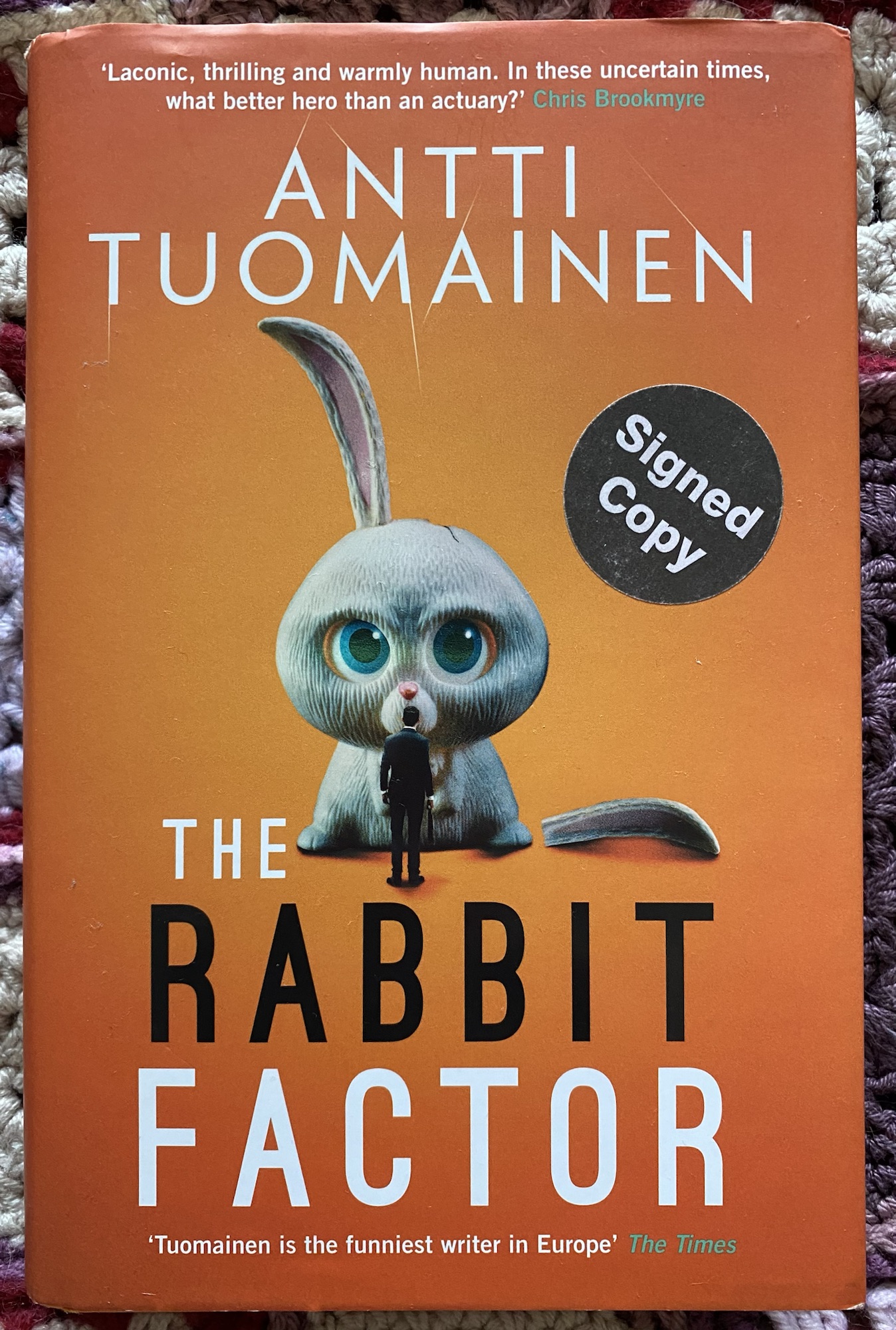
This is my first contribution to Kaggsy and Lizzy’s wonderful #ReadIndies event, running all month. The Rabbit Factor by Antti Tuomainen (2021, transl. David Hackston 2021) is published in the UK by Orenda Books, who describe themselves on their website as: “a small independent publisher based in South London. We publish literary fiction, with a heavy emphasis on crime/thrillers, and roughly half the list is in translation.”
The Rabbit Factor is the first in a trilogy about actuary Henri Koskinen, which had somehow completely passed me by until I read Annabel’s review of the final part, The Beaver Theory. A little while later I saw The Rabbit Theory in my local charity bookshop and took it as A Sign. (As I have mentioned before, I’ll take pretty much anything as A Sign in that shop, and it always results in me buying more books 😀 )
Henri is a man who likes a well ordered, predictable life: “At the age of forty-two I had only one deep-held wish. I wanted everything to be sensible.”
His job as an actuary suits him, using mathematics to predict risk. Unfortunately, what doesn’t suit him is the modern workplace – open plan, noisy and full of corporate-speak about self-actualisation. He is forced into resigning by his boss who hides his bullying behind pseudo-beneficent jargon.
Not long after, Henri is told his brother Juhani has died and he has inherited YouMeFun, an adventure park (not an amusement park) in Vantaa. Unfortunately, before he died his brother inherited their parents’ chaotic approach to life and so Henri finds himself faced with:
“An unbearable lack of organisation, staggering maintenance bills, unproductive use of man hours, economical recklessness, promises nobody could keep, carts that quite literally moved at tortoise speed? I raised my fingers to my throat and checked the position of my tie. It was impeccable.”
Juhani was also in hock to gangsters, two of which – Lizard Man and henchman AK – keep turning up to menace Henri with horrible regularity and conviction. No less threatening, but considerably less violent, is police officer Osmala who similarly seems very interested in YouMeFun and Henri. And so Henri finds himself under enormous pressure and with only his maths skills to fall back on.
“I resigned because I couldn’t stand watching my workplace turn into a playground. Then I inherited one.”
I think maybe this novel passed me by because it can be classified under Nordic-noir, and I don’t read a great deal of that. What I read I enjoy, but I choose carefully because I am a delicate flower and not really in the market for gruesome crimes. Now, there are gruesome deaths in The Rabbit Factor, but I managed these fine. The details aren’t dwelt upon and they are surrounded by such surreal silliness that the focus is more on the ridiculousness of Henri’s situation than violence.
The tone is also not noirish. One of the blurbs in my edition mentions the Coen brothers, and this is a good parallel: while there is darkness to the tale, there is also humour and humanity. Henri’s unlikely colleagues include Esa, the US-marine obsessed security officer; sweet Kristian who is unable to see that his total ineptitude is what prevents him from becoming general manger; Minttu K who seems to know about marketing if she could only stop self-medicating with alcohol; Venla who never arrives for a shift; and quietly efficient Johanna who runs the kitchen and actually seems able to do her job.
There is also Laura Helanto, manager and frustrated artist, who causes feelings to arise in Henri that he doesn’t fully understand. It’s a confusing time for him all round…
“But recent events have taught me that what once seemed likely, as per the laws of probability, is more often than not in the realm of the impossible. And vice versa: what once I would have been able to discount through a simple calculation of probability ratios and risk analysis is now in fact the entirety of my life.”
I really enjoyed The Rabbit Factor. The deadpan narration of Henri is so well-paced that it manages to also be completely engaging. His focus on detail grounds the ridiculousness of his situation so it remains believable, carrying the reader along on Henri’s absurd journey.
“Even as a child I saw mathematics as the key. People betrayed us, numbers did not. I was surrounded by chaos, but numbers represented order.”
The characterisation is equally finely balanced. Henri and his colleagues could so easily be caricatures but instead you end up rooting for these disparate individuals. Tuomainen isn’t remotely sentimental but he is kind to the people he creates. The humour is derived from the situation, never laughing at the people themselves. They change under Henri’s stewardship, and he in return finds himself behaving in ways that surprise him more than anyone:
“I say something I could never have imagined hearing myself say. ‘This doesn’t make any sense. But it has to be done.’”
Last year I decided I would buy one book a month from an independent publisher or bookshop. I think Henri would agree that the probability of my next two purchases in this regard being his adventures in The Moose Paradox and The Beaver Theory are pretty high…
To end, I was so tempted to choose Chas & Dave’s Rabbit, as I absolutely loved that song when I was little (it was released when I was four years old, and I thought they were singing about actual rabbits). But alas, my adult sensibilities prevent me from adding a song about silencing women to the blog 😀 So instead here is a literature-inspired song about drugs rabbits:
Happy Colette’s birthday! Regular readers will know how much I love Colette, and today I thought I’d look at two of her novellas which I had languishing in the TBR, La Vagabonde (The Vagabond) and L’Entrave (The Captive). Both follow periods in the life of Renée Néré, based on Colette’s experiences after her marriage to Willy ended.
Renée has left her philandering husband Adolphe Taillandy and has no regrets about doing so. However, this has left her with no money, and so she has turned from her beloved writing to earn money on the stage.
“I had savoured the voluptuous pleasure of writing, the patient struggling with the phrase until it becomes supple and finally settles down, curled up like a tamed animal, the motionless lying in wait for a word by which in the end one ensnares it.”
She is in her early thirties, and painfully aware of aging in an industry that depends on appearance and artifice. Renée has a “face which is losing the habit of being looked at in daylight” and which poverty will not help. She enjoys the stage though, and the people in it.
“They swagger, tightly buttoned in a full-skirted overcoat of the fashion of two seasons ago; for the essential, the indispensable thing, is the possession not of a clean suit but of a ‘really classy’ overcoat which covers everything: threadbare waistcoat, shapeless jacket, trousers yellowed at the knees; a dashing, flashy overcoat, which makes an impression on the director or the agent, and which in the last resort enables one to throw off that ‘things aren’t shaping well’ in the jaunty tone of a man of means.”
Colette is not sentimental about the poverty or hardships of such a life. Early on she writes of the gradual but inevitable degradation of young chanteuse Jadin, in a way that is clear-sighted but heartbreaking.
Into Renée’s world comes Maxime Dufferein-Chautel, a rich feckless admirer. What follows is a love affair of sorts, one in which Renée never quite resolves her ambivalence.
“He does not want my well-being, this man, he merely wants me.”
“There are days when solitude, for someone of my age, is a heady wine which intoxicates you with freedom, others when it is a bitter tonic, and still others when it is a poison which makes you beat your head against the wall.”
Maxime is not unpleasant or abusive, but he is pretty dull:
“I forgive him all this ordinariness for the sake of a simplicity which has nothing humble about it, and because he finds nothing to say about himself.”
And Renée is painfully aware that getting into a relationship with him may require more than she is willing to give. As her friend Hamond points out:
“Be frank, Renée, be clear sighted, and tell me whether all your sacrifices [within marriage] haven’t only lost their value in your eyes since you recovered your free will? You assess them at their true worth now that you no longer love.”
Renée is offered a tour and vacillates about whether to go. Ultimately she does and her letters to Maxime form the latter part of the novella, although we never see Maxime’s replies. The Vagabond is determinedly Renée’s story and her voice.
“This evening I should not feel sleepy, and the spell of a book – even a brand new book with that smell of printers ink and paper fresh from the press that makes you think of coal and trains and departures! – even that spell will not be able to distract me from myself.”
Despite The Vagabond’s various urban settings, there is still plenty for fans of Colette’s depictions of the natural world to enjoy, such as this description of early Spring in Paris:
“Towards the end of the afternoon, a mauve mist veils the avenues so that you do not know where they end, and the unexpected discovery of a wild hyacinth, with its three slender bells of artless blue swaying in the wind, has all the charm of a stolen joy.”
The Vagabond is slightly plotted with very little happening. It is not a slight tale though, but rather a distinctive plea for female independence alongside a consideration of how to reconcile this with romantic love and material necessity.
“Are you not he who, thinking he is giving, takes for himself? You came to share my life. To share, yes: to take your share!”
The Captive (1913, transl. Antonia White 1964) is set three years later. Renée is now financially solvent due to a legacy and whiling away her time in the south of France. She is still living the itinerant hotel-based life, unable to fully adjust to her new circumstances: “when a dog has been kept a long time on a lead, it does not go prancing off the moment you undo the catch of its chain”.
She finds herself with an unlikely trio of friends. There is young May, self-mythologising and fragile:
“Nature has drawn all the features of laughter itself in her round childish face; a Cupid’s bow mouth that tilts up at the corners like her mischievous eyes, a short little nose with quivering nostrils. But gaiety is not a perpetual fidgeting that betrays a lack of security, it is not chatter full of recriminations, nor is it a craving for everything that intoxicates. Gaiety, it seems to me, is something calmer, something healthier, something more serious.”
There is also May’s brutish lover Jean, and their friend, the opium-addicted Masseau.
“Yes, I’ve had enough of those people, it’s true. But, besides beginning to know myself, I’m also beginning to know the advantages and disadvantages of this extraordinary part of the world where mornings are enchanting and the nights, however starry, make one shiver in the discomfort of a double climate. Here cold nights are not invigorating and warm nights throb with fever rather than with passion.”
At the beginning of the novel Renée is determined to remain celibate. However, for reasons that entirely escaped this reader, she is attracted to Jean.
“A kiss, and everything becomes simple and enjoyable and superficial – and also a trifle coarse.”
She leaves Nice for Geneva to try and resist him, but they are eventually reunited. Their affair is wholly unsatisfactory for both of them. Colette explores the experience of a relationship based on sexual attraction without emotional intimacy, when the latter is also desired by both but remains elusive.
“I have insulted this lover, out there alone in the soft spring night, restoring his own identity; I have insulted him by giving him my body and supposing that this was enough. He has returned the insult.”
Like The Vagabond, it is Renée’s thoughts and experiences that the reader is privy to. We know very little about Jean and even less about what he thinks and feels. While he is not likeable, the portrayal of the affair is quite even-handed, as Renée acknowledges how little she is able to give of herself. What she does give may be as much a performance as any she made on the stage:
“You pretend to love me, you do love me. Every minute your love creates a woman better and more beautiful than myself whom you forced me to resemble.”
Somehow I didn’t find The Captive too depressing, although I’m not entirely sure why. There is something resilient about Renée even when she seems to be taking such sad decisions. Although she is adrift at this point in her life, I felt there was some hope she’d start to feel more anchored within herself soon.
“The darkness is ebbing. A faint wind stirs the trees, bringing a green smell of trampled grass. Behind the plane trees, the mound of the fortifications is emerging from the dusk and the sky is taking on the colour of a field of blue flax the subdued, slightly grey, slightly melancholy tint over summer dawn over Paris.”
To end, I was looking for archive footage from Folies Bergère to reflect Renée’s career, which led me to loads of cabaret footage, which led me to loads of Cabaret footage, which led me to this performance by Liza Minelli. Basically all roads lead to Liza 😀 I’ll never not be astonished by how the chair doesn’t move until she wants it to – the woman must have abs of steel:
This is the first of her novels I’ve read and on the strength of this I definitely want to read more. Novella length, it tells the story of Kōko, a 36-year-old single mother to eleven-year-old Kayako. Told in the third person from Kōko’s perspective, it is a compelling examination of one woman’s inner world and her barely articulated resistance to the expectations placed on her.
Early in the novel, Kōko suspects she is pregnant. She is ambivalent about Osada, the father, as she is about most things. But gradually she realises that she wants to keep the child:
“Maybe she was reaching an age when it was senseless to want a fatherless child; but, precisely because of her age, she didn’t want to make a choice that she would regret till the day she died. Lately she was more convinced than ever that there was no point in worrying about what people thought. She would soon be thirty-seven. The only person watching Kōko at thirty-seven was Kōko. When this obvious fact finally came home to her it was still a surprise – what a very lonely fact it was!”
Geraldine Harcourt’s informative introduction explains that pregnancy at that age in Japan around this time could still be viewed as shameful even within marriage, so Kōko’s decision is doubly transgressive.
Kōko is an intriguing character, as she lives an unconventional life which places her in opposition to so many, by barely doing anything. Her lack of decision-making is an act of quiet but determined resistance.
Her sister Shoko is much more conventional and doesn’t approve; Kōko’s daughter Kayako much prefers to spend time with her more affluent, conformist aunt. Kōko tries to explain to Shoko:
“No, that’s not it – don’t think I’ve liked using choosing a different world from other people. I know I’ve been stubborn – but not about Kayako alone. All my life, though I often haven’t known which way to turn, I have managed to make choices of my own. I don’t know if they were right or wrong. I don’t think anyone can say that.”
But really she hasn’t made that many choices. She married because of pregnancy; husband Hatanaka organised the divorce years later, unsurprisingly as Kōko didn’t love him, still holding a candle for her lover Doi. She doesn’t enjoy her job teaching piano, but she also takes no steps to do anything else. She doesn’t take great care of herself and she doesn’t have many friends or interests.
Two driving forces in her life are her love for her brother, who died many years earlier, and sexual desire. The latter has led to her current predicament, the former suggests one reason that may be contributing to her lack of attachments.
“A little over a year ago, Kōko had understood something for the first time: the in the end she had let everything slip away from her, that in reality she hadn’t a single resource. It was an alarming discovery.”
Her lack of attachment includes reality – we are taken into Kōko’s dreams and daydreams, woven in seamlessly but disconcertingly. As we move back and forth in time, learning about Kōko’s childhood, marriage, griefs and pains, Tsushima builds a picture of a woman who may not be completely likable but who is recognisably human and flawed, and muddling through the best way she knows how.
I was really rooting for Kōko to find a more articulate agency, and the penultimate scene was unbearably tense in this regard. Child of Fortune is never didactic yet absolutely achieves a compelling portrait of a woman fighting for her life, against immense societal pressure.
“Kōko was shaken by the realisation that even now, more than twenty years later, she still lacked any compelling reason to go on living. And by the fact that the will to live was still there.”
To end, Kōko has fond memories of a visit to Karuizawa, which does look lovely:
PS When I was looking for a title quote for this post, I found this great conversation between Tsushima and Annie Ernaux.
I’ve decided that 2024 will be the year of a reading project I’ve been considering for a while – a book per month throughout the year from Anthony Powell’s A Dance to the Music of Time sequence. Published between 1951 and 1975, and set from the early 1920s to the early 1970s, the sequence is narrated by Nicholas Jenkins, a man born into privilege and based on Powell himself.
What’s that you say? I have half-completed reading projects still languishing? I have a spiralling TBR that doesn’t need 12 more books added to it? Be gone! You are clearly a pragmatist and such attitudes have no place in my reading life 😀
In the first novel, A Question of Upbringing (1951), we follow Nick Jenkins from his school days at a thinly-disguised Eton to his university days at a thinly-disguised Balliol College, Oxford. Starting at School, we meet Jenkins’ friends Stringham and Templer, and hear of their frustrations with housemaster Le Bas.
“’He started life as a poet,’ Stringham said. ‘Did you know that? Years ago, after coming back from a holiday in Greece, he wrote some things he thought were frightfully good. He showed them to someone or other who pointed out that, as a matter of fact, they were frightfully bad. Le Bas never got over it.’
‘I can’t imagine anything more appalling than a poem by Le Bas,’ said Templer, ‘though I’m surprised he doesn’t make his pupils learn them.’
‘Who did he show them to?’ I asked.
‘Oh, I don’t know,’ said Stringham. ‘Henry James, or Robert Louis Stevenson, or someone like that.’”
The boys are varying degrees of privileged, from uber-wealthy to moderately wealthy, from landed gentry to new money. The societal hierarchies are complex and imperfectly understood, even by those in their midst:
“Clearly some complicated process of sorting out was in progress among those who surrounded me: though only years later did I become aware of how early such voluntary segregations begin to develop; and of how they continue throughout life.”
In theory I have limited patience for such stories, after the enormous damage Eton-educated men and their cronies have done in UK politics. Yet I found myself enjoying A Question of Upbringing. I think because Powell doesn’t suggest the superiority of anyone he’s writing about or the systems in place, casting a satirical eye over it all.
For example, when Nick begins his travels, he finds himself hopelessly ill-equipped to comprehend any culture beyond his own:
“I had seen a provincial company perform The Doll’s House not many months before, and felt, with what I now see to have been quite inadmissible complacency, that I knew all about Ibsen’s countrymen.”
It is during these travels that he meets Widmerpool again, a boy somewhat disregarded as figure of fun at school, who shows himself to be more astute than Nick and the other pupils allowed for.
“Later in life, I learned that many things one may require have to be weighed against one’s dignity, which can be an insuperable barrier against advancement in almost any direction.”
Nothing of huge significance seemingly happens in A Question of Upbringing, but it wouldn’t surprise me if events somehow cast a long shadow in later volumes. As a standalone novel, Powell keeps the narrative compelling by picking out certain moments and impressions, rather than plodding through years with equal weighting. It’s a short novel, only 223 pages in my edition and this length worked well – satisfying but also with a sense of setting the scene for later novels.
It took me a while to adjust to Powell’s dense writing style; he likes long sentences of several clauses. Once I had got used to this though, I found myself swept along.
“The evening was decidedly cool, and rain was half-heartedly falling. I knew now that this parting was one of those final things that happen, recurrently, as time passes: until at last they may be recognised fairly easily as the close of a period. This was the last I should see of Stringham for a long time. The path had suddenly forked. With regret, I accepted the inevitability of circumstance. Human relationships flourish and decay, quickly and silently, so that those concerned scarcely know how brittle, or how inflexible, the ties that bind them have become.”
Nick is an enigmatic narrator. In this first volume he describes many people and events, observes whole scenes, without appearing to have spoken or acted himself at all. We learn very little about him. I found myself wondering why Powell had opted for an omnipresent narrator over an omniscient one, when Nick barely seems present. But that’s not a criticism, just what seemed a curious choice. Maybe Nick will emerge from his own story in the subsequent volumes. I’m looking forward to finding out.
To end, a dance from the 1950s, looking back to the 1920s:
‘Tis the season of gluttony and excess, but how about some amuse-bouche in the form of festive short stories, before settling down with a chunkster tome to while away the long winter evenings?
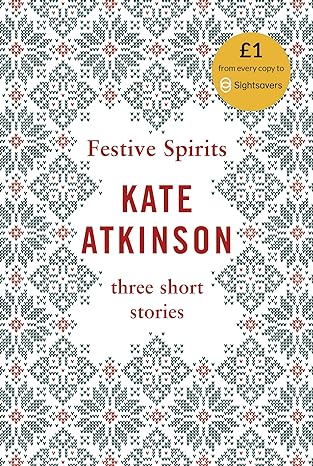
Festive Spirits by Kate Atkinson (2019) features three very short stories. It’s a small hardback which is sold in aid of Sightsavers.
Given their very concise length, I can’t say too much except they’re all as inventive and witty as you would expect from Atkinson.
In Lucy’s Day, a busy, exhausted mother attends her children’s nativity play.
“The Nativity was a dishevelled construct made mostly, as far as Lucy could tell, from lollipop sticks, cotton wool and hamster bedding. And lentils. The school used lentils a lot in its artwork, as well as pasta and beans. You could have made soup from some of the collages Beatrice and Maude brought home.”
In Festive Spirit, a woman reflects on her unhappy marriage to her successful husband and takes metaphysical steps in keeping with the time of year:
“When he was a boy he didn’t know anyone who got their hands dirty for a living. Now he was an MP everyone he knew had dirty hands.”
The final story, Small Mercies, returns to familiar domesticity and captures the sadness and loneliness experienced by so many at this time of year. But there is a glimmer of hope for middle-aged Gerald.
“It was difficult to make out his mother’s words, laced as they were with emotion and free alcohol.”
Festive Spirits is a quick but very worthwhile read. Kate Atkinson is great at short stories and these capture the time of year without sentimentality but also without any bitter irony. Highly enjoyable.
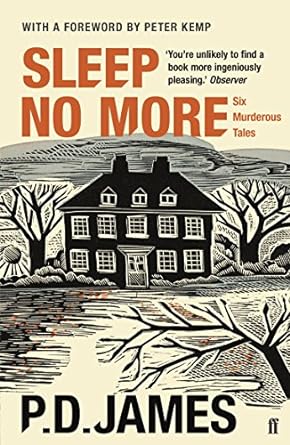
PD James’ collection Sleep No More: Six Murderous Tales (2017) features two stories set at this time of year. The Murder of Santa Claus is the longest in the collection and probably the weakest (the denouement is someone explaining to the murderer how they know they did it) but still so much to enjoy.
It begins with Charles Mickledore, an author of cosy crimes, (“I’m no HRF Keating, no Dick Francis, not even a PD James.”) looking back on Christmas 1939 when he was 16. He goes to stay with a distant relative, Victor Mickledore, in a country house, with other guests who don’t know each other that well.
There’s a faithful secretary, an aging starlet, the couple Victor booted out of their home, and a dashing pilot. There are long-held resentments regarding Victor possibly killing someone in his car and paying off his valet as an alibi.
“The paper tore apart without a bang and a small of object fell out and rolled over the carpet. I bent down and picked it up. Wrapped neatly in an oblong of paper was a small metal charm in the shape of a skull attached to a key ring; I had seen similar ones in gift shops. I opened the paper folded round it and saw a verse hand printed in capitals.”
The verse is a death threat of course, which Victor disregards and insists the Christmas traditions will go ahead as usual, including his routine of dressing up as Santa and delivering presents. The title tells us all will not end well…
It’s hard to write a satisfying whodunit in a short story form and as I mentioned, this was a bit clunky. But PD James is such a brilliant crime writer it was still highly readable, and she clearly had a lot of fun with the cosy crime tropes and characters. The Christmas setting made for a real treat too.
The first story in the collection, The Yo-Yo, also features an older man looking back on his youth and remembering a murder. The difference here being there is no mystery, as he witnessed the event directly.
“I found the yo-yo the day before Christmas Eve, in the way one does come across these long-forgotten relics of the past, while I was tidying up some of the unexamined papers which clutter my elderly life. It was my seventy-third birthday and I suppose I was overtaken by a fit of momento mori.”
It was Christmas years earlier in 1936 when he was being driven from his boarding school to spend the festive period with his indifferent grandmother, that the story takes place.
James expertly paces the story to the climax of the murder, and then demonstrates the fallout with equal precision. A recurring theme through all six stories is of people getting away with murder (no Commander Dalgliesh here to find the culprits!) and whether justice occurs only within the law, despite it, or not at all.
“We walked back to the car together, almost companionably, as if nothing had happened, as if that third person was walking by our side.”
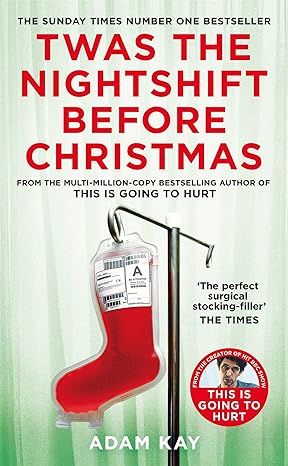
Finally, not short stories but an honourable mention to Adam Kay’s ‘Twas the Night Shift Before Christmas (2019) detailing his experiences working as a doctor over the Christmas period for several years. I haven’t read his hugely successful book This is Going to Hurt or watched the tv series with Ben Whishaw – having worked in the NHS for several years I find portrayals either inaccurate and infuriating or authentic and stress-inducing. I feared Kay’s would be the latter. But for some reason I was tempted by this little stocking filler, and he managed to take me right back, but entertain me rather than induce vicarious trauma. Highly recommended, as long as you don’t mind a lot of swearing 😀
“Sunday 26 December 2004
Full marks to the anaesthetist wearing a badge that says: ‘He sees you when you’re sleeping, he knows when you’re awake.’”
To end, I’m never ahead of the game on anything, but this year I snapped up on pre-order the Christmas album by these two titans of contemporary folk music:
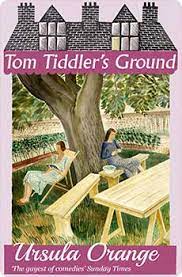
It tells the story of Constance Smith and her childhood friend Caroline Cameron, who find themselves living together again in the early days of World War II. Caroline is urbane and worldly, leaving behind her life in London with her husband John. She is entirely self-focussed and amoral, but also quite caring regarding people. Despite her shortcomings, I really liked her.
Constance could not be more different. We are introduced to her early on through the thoughts of the billeting officer who is trying to persuade people in the quiet village of Chesterford to take evacuees:
“Mrs Latchford grimaced and lit a cigarette. A thoroughly unenviable job altogether, and she felt she deserved a few minutes respite with nice, schoolgirlish, foolish Constance Smith. Foolish? Well, of course, it always looked a little foolish to see a woman of over thirty behaving like an enthusiastic bride, even after two years of marriage. But apart from that and her volubility and her poppings out and her nippings in and all her silly mannerisms, was Constance at all foolish? Certainly she handled the relations-in-law-in-the-village situation well, or rather did not handle it at all, but accepted it so naturally and pleasantly that she might really be said to be on the best of terms with her sister-in-law, Mary Hodges, the local greengrocer’s wife.”
Her husband Alfred is an utterly self-centred snob, intent on social climbing and ashamed of his sister. He married well-to-do Constance for social advancement and he doesn’t love her. Caroline sees this clearly on arrival in the village with her daughter Margeurite.
The other evacuee is Mrs Gossage, who seems entirely disinterested in everyone, including her baby son Norman.
We follow this unlikely group of housemates as they adjust to their much-changed living arrangements. The story moves between the characters but is told primarily from Caroline’s point of view, which I thought worked well. She has good insights into other people and is entirely clear-sighted about herself too:
“There was a certain note in her voice that led Caroline to suspect that Lavinia belonged to that large class of people who find children sweet, but rather prefer they should go and be sweet upstairs in the nursery. It was an attitude she entirely sympathised with and absolutely hated people for.”
Constance as narrator would be far too guileless to carry the reader along. And of course, Caroline’s arrival in the village offers an outsider’s view on the characters and various intrigues. But what is lovely too, is Caroline’s changing attitude towards the village. Initially she is greatly amused by everyone, but as time moves on she starts to see them as real people, her “strange lapses into sincerity” possibly becoming longer lasting. This isn’t a trite city-girl-learns-the-true-value-of-Things-when-forced-into-small-town-life tale however. Orange is not at all sentimental about people:
“Caroline, looking at the expression on Mary’s face, marvelled at the extraordinary cruelty of the thoroughly respectable woman.”
“There was no doubt Constance, in her misery, was very pathetic. There was no doubt she was also rather irritating.”
But there’s not a bitter tone either. I found the characters recognisable and portrayed with human understanding. Caroline would be rather a controversial figure for the time, but Orange doesn’t judge her.
“It’s my red finger-nails that put the idea of asking me into her head, I’m sure.”
I liked the fact that Caroline didn’t overly judge herself, which would seem somehow hypocritical, but she does recognise that her actions hurt people, which she regrets.
There are serious concerns in Tom Tiddler’s Ground; adultery, bigamy, child neglect and lack of choices for women. Somehow Orange balances that with a knowing humour without belittling the issues at all.
My favourite character was George, Constance’s gentle, drifting brother:
“What could you do with a man who loved women, who loved domestic life, but who (according to Constance) had never seemed to want to marry anyone in particular? A man who obviously adored other people’s children, but who had none of his own? A man who had plenty of personality and probably (under all that indolence) considerable abilities, but who had never settled any profession or career? The only answer was – nothing, you could do nothing with him. And […] that was, of course, what George preferred. Caroline liked him enormously.”
We learn more about George’s background, who to my twenty-first century eyes had PTSD from World War I. Orange builds to a satisfying denouement, tying up many characters pasts with the present in a way that promises a better future, despite the war.
I really loved Tom Tiddler’s Ground, and got very excited about the thought of exploring Ursula Orange further, thinking the humour and characterisation made her another Margery Sharp. However, Stacy Marking’s excellent introduction to this edition explains the publishers took exception to Caroline as a character, and so she adjusted her style for later books, which also contained more snobbery (somewhat in evidence here but not overly stressed – Mrs Gossage is definitely treated with condescension, but also compassion). If anyone has read any other novels by Ursula Orange I’d love to know how you found them, especially as DSP publish some other titles.
“‘I suppose we ought to be thinking about Christmas,’ said Constance, a few days later. Everybody became conscious of a very strong disinclination to think about anything of the sort.”
To end, it’s a time of year when Nat King Cole is on heavy rotation, and quite right too. Here he is singing about orange (sort of 😉 )
Literary Wives is a quarterly online book club which considers the question: What does this book say about wives or about the experience of being a wife? You can read all about the club and its previous choices on whatmeread’s blog here. When I saw on Naomi’s blog that the December choice would be Hamnet by Maggie O’Farrell (2020) I thought this would be a great incentive to pick it off the TBR and join in!
Hamnet is historical fiction, taking the death of William Shakespeare’s only son at age 11 as its inspiration. It’s generally thought that this bereavement was the impetus behind Hamlet. But Hamnet Shakespeare had a mother too, and she is the focus of the novel:
“Every life has its kernel, its hub, its epicentre, from which everything flows out, to which everything returns. This moment is the absent mother’s: the boy, the empty house, the deserted yard, the unheard cry. […] It will lie at her very core, for the rest of her life.”
The plot moves back and forth between the present illness and then death of Hamnet, and the life of his mother Agnes Hathaway (as named in her father’s will although historical discussions usually refer to her as Anne). She is a misfit in late sixteenth-century Stratford society. She has a dowry, but her behaviour – flying hawks, understanding the healing powers of herbs, taking long walks – is problematic.
“She grows up feeling wrong, out of place, too dark, too tall, too unruly, too opinionated, too silent, too strange. She grows up with the awareness that she is merely tolerated, an irritant, useless, that she does not deserve love, that she will need to change herself substantially, crush herself down if she is to be married.”
She doesn’t have to crush herself down though, because the local Latin tutor finds her fascinating and doesn’t ask her to change.
“He is, he prides himself, adept at dissembling, at reading the thoughts of others, at guessing which way they will jump, what they will do next. Life with a quick-tempered parent will hone these skills at an early age.”
And Agnes marries into this unhappy home without quite knowing what she is getting into. She finds a way for her (never named) husband and her to survive her father-in-law’s temper and raise their three children. Like her husband, she sees and understands more than most people, although her skills come from a different source, an innate and psychic knowledge.
“They are women, mostly, and she seats them by the fire, in the good chair, while she takes their hands and holds them in her own, while she grinds some roots, some plant leaves, a sprinkling of petals. They leave with a cloth parcel or a tiny bottle, stoppered with paper and beeswax, their face is easier, lightened.”
Reading Hamnet was an interesting experience for me. I kept thinking: ‘Is this overwritten? Am I enjoying this or not?’ and for quite a while I wasn’t sure. Ultimately I decided it was overwritten but that I was still enjoying it 😀 I think this was because the overwritten aspects seemed to be an enthusiasm by O’Farrell to immerse the reader in the historical setting, rather than prove how clever she was and delight in her own brilliance. The scenes after Hamnet dies I found truly moving.
Agnes is a wonderful character, strong and fully realised. Anne Hathaway tends to be somewhat disregarded – the wife who stayed at home while her brilliant husband gallivanted around the City writing poems to dark ladies and fair youths. Hamnet makes Agnes a formidable woman while not rewriting history.
I liked the portrayal of Shakespeare too – limited contemporary accounts suggest he was good fun when he did go to the tavern, but these occasions were rare. That he was quiet and gentle, and very frugal, focussed on setting up financial security in Stratford. This is who O’Farrell has portrayed here.
What does this book say about wives or about the experience of being a wife?
The marriage in Hamnet is not always happy but it is always grounded in a deep love for one another. It is a marriage between two strongly individual people who endure tragedy and their very different ways of managing it.
Agnes doesn’t lose herself when she becomes wife. She doesn’t lose her identity within that of being Mrs Shakespeare, even though she’s married to a writer whose wider adoration is so extensive it has its own noun. Agnes is definitely not one for Bardolatry, grounded as she is by the demands of domestic family life and her own work.
Agnes marries for love the man of her choosing. Within a society that restricts women’s roles and where her skills in particular could be quite a danger for her, she perseveres along her own path. She shows how wives can be the lynchpin of a family, and the importance of unconditional love.
“What she desires is for him to stay at her side, for his hand to remain in hers. For him to be there, in the house, when she brings this baby into the world. For them to be together. What she desires, though, does not matter. He is going. She is, however secretly, sending him away.”
To end, the RSC is currently staging an adaptation of Hamnet and I enjoyed seeing the posters all over the tube as I sat there reading the book:
Happy Birthday Beryl Bainbridge, who would have been 91 today! I thought I wouldn’t manage a post for Reading Beryl Week hosted by Annabookbel as I had a couple of false starts. I love Beryl but the two I had in the TBR didn’t work for me – probably the wrong time (I seem to be catching #AllTheWinterViruses).
Then I thought I’d let fate decide (admittedly I knew the odds were stacked in my favour, but I just like to pretend to myself that I’m not always going to buy a book 😀 ) and I went to the consistently wonderful charity bookshop across the road from me… of course they had plenty on their shelves, including one I keep meaning to read, An Awfully Big Adventure (1989).
I could just squeeze it in because Beryl generally wrote very short novels; this one comes in at 197 pages. So I’m counting it towards Novellas in November too, hosted by Cathy at 746 Books and BookishBeck.
Set just after the war, young Stella is encouraged to pursue dramatic interests by her Uncle Vernon, who feels she needs an outlet for all her feelings:
“Emotions weren’t like washing. There was no call to peg them out for all the world to see.”
But despite Stella’s emotional reactivity, she is also strangely detached. Uncle Vernon and Aunt Lily raised her, but she is not intimate with them. She never talks to them about what is happening for her or how she feels.
This theme of the distances between people continues when Stella joins an acting troupe at the local theatre, helping backstage and playing small parts. There are complex histories, resentments and intrigues between the players, which Stella only partly grasps.
“Bunny agreed with Meredith that there was nothing wrong with Dawn Allenby apart from her love of beauty, an affliction she was ill-equipped to fight. He put it in a nutshell when he said she was the sort of girl who, if there had been a meadow handy, would have been out there in a flash picking cowslips.”
Stella is naïve and self-focussed, which means the reader sees much more than she does. She can make sharp observations but lacks the sophistication to fully comprehend their meaning. She falls for Meredith, the nicotine-stained, spiky director:
“She suspected it was education and breeding that enabled him to keep his face and his feelings separate.”
But she is so wrapped up in her own feelings she barely registers how little she knows of him, or his lack of any interest in her:
“Endeavouring to be what she imagined was his ideal, she altered her demeanour several times a day.”
The reader knows Stella will never, ever be Meredith’s ideal. But Stella remains wilfully ignorant and intent on very shaky self-reinvention. I would say this seems to be a recurrent theme in Bainbridge – the psychological warfare people can wage on one another, though self-involved disregard of others, rather than outright mendacity.
Also typical of Bainbridge is the witty, pithy turn of phrase and humour threaded throughout the darkness.
“She plumped out my vowels. I tend to have flat ones. It’s to do with catarrh as much as region.”
Apparently An Awfully Big Adventure was partly biographical with Bainbridge drawing on her time working at the Liverpool Playhouse. It certainly felt very authentic, with lots of detail about the daily drudge of postwar life, such as when Stella wants a bath:
“It meant paraffin had to be fetched from Cairo Joe’s chandlers shop next door to the Greek Orthodox Church, and then the stove lugged two flights of up the stairs and the blanket nailed to the window with tacks. In the alleyway beyond the back wall stood a row of disused stables and a bombed house with the wallpaper hanging in shreds from the chimney breast, and sometimes women, no better than they ought to be, lured men into the ruined shadows.”
An Awfully Big Adventure is ultimately very dark. Stella’s seduction by seasoned actor PL O’Hara is treated by Stella with the same detachment with which she views nearly all her relationships. But the consequences will be tragic, and again, the reader is left to realise far more than Stella.
For newcomers to Bainbridge, this would be a good place to start. It covers many of the themes she returns to and is so tonally distinctive, in the way her novels are. For those who are already fans, she is at the height of her powers here. An Awfully Big Adventure was one of the five books that gained her a Booker nomination, which she never won.
“In the end everyone expected a return on love, demanded a rebate of gratitude or respect. It was no different from collecting the deposit on lemonade bottles.”
To end, An Awfully Big Adventure was adapted to film in 1995. I have a vague memory of seeing it in the cinema at the time. This trailer has reminded me how perfectly cast it was, and how much I miss Alan Rickman’s performances:










 madame bibi lophile recommends