“Nothing puts things in perspective as quickly as a mountain.” (Josephine Tey)

Today for the 1952 Club hosted by Kaggsy and Simon I’m looking at another golden age mystery. The Singing Sands by Josephine Tey features her regular detective, Inspector Alan Grant. It was found in her papers after she died and published posthumously, which usually makes my heart sink, but the novel seems pretty complete so I hope it was as she planned.

You can come across all sorts prejudices and snobberies in golden age crime and The Singing Sands has a strong one running throughout, which admittedly I’ve not encountered before in the genre: Tey is a total snob about Scotland. As far as I can work out her rules are:

  1. Be Scottish
  2. But speak with an English accent (by which I assume she means RP – I doubt my south London tones would cut the mustard)
  3. Don’t be from the city
  4. Especially don’t be from Glasgow
  5. Be from the Highlands
  6. Don’t be a nationalist
  7. Really don’t be from Glasgow

I take great exception to her attitude to Glasgow – it’s a beautiful city full of friendly people. Every time I go I’m knocked out and I’m still giving serious consideration to moving there. In the end when I came across these attitudes I just rolled my eyes and skipped on, and it didn’t affect my enjoyment of the novel. But as a counterbalance I urge everyone to (re)visit wonderful Glasgow!

On with the novel! It opens with Grant struggling with his mental health and deciding to visit his cousin Laura (Lalla) and her family in the Highlands to recuperate. The background of what led to Grant reaching this point is never quite specified but he seems to be experiencing burnout/PTSD.

As he disembarks the train, the grumpy attendant is trying to rouse the passenger in berth B Seven. Grant realises he is dead, and his interest in faces (detailed extensively in The Daughter of Time which is where the title quote comes from but would have worked very well in this novel too) is piqued:

“What would bring a dark, thin young man with reckless eyebrows and a passion for alcohol to the Highlands at the beginning of March?”

He also picks up B Seven’s newspaper, which has some cryptic verse scribbled on it. Much as Grant tries to focus on his family and the fishing expeditions he had planned, his mind keeps being drawn back to B Seven. The verse leads him to visit some of the islands to identify the landmarks mentioned:

“There was nothing else in all the world but the green torn sea and the sands. He stood there looking at it, and remembering that the nearest land was America. Not since he had stood in the North African desert had he known that uncanny feeling that is born of unlimited space. That feeling of human diminution.”

Although his colleagues in London have identified the body and ruled accidental death, Grant thinks both these conclusions are questionable. Despite trying to recover from his work, he can’t let it go. He is aware that keeping his mind occupied can be useful, but it is a fine balance:

“Grant was very conscious that his obsession with B Seven was an unreasonable thing; abnormal; that it was part of his illness. That in his sober mind he would not have thought a second time about B Seven. He resented his obsession and clung to it. It was at once his bane and his refuge.”

We follow Grant as he heals, with the help of his beautiful environment, the understanding of his family, and his pursuit of the truth.

“But for B Seven he would not be sitting above this sodden world feeling like a king. New born and self-owning. He was something more than B Seven’s champion now: he was his debtor. His servant.”

The Singing Sands is not heavily plot-driven and the mystery is slight, but it is still an enjoyable read, if a slightly unusual approach to the genre. Grant’s dogged pursuit of the truth of a death which others seem quick to disregard makes him endearing, and there are lovely descriptions of the Highlands. It’s a quick read that doesn’t outstay its welcome, and it is compassionate in its portrayal of mental health.

“In matters where A was at spot X at 5:30pm on the umpteenth inst, Grant’s mind worked with the tidiness of a calculating machine. But in an affair where motive was all, he sat back and let his mind loose on the problem. Presently, if he left it alone, it would throw up the pattern that he needed.”

“London is too full of fogs and serious people.” (Oscar Wilde)

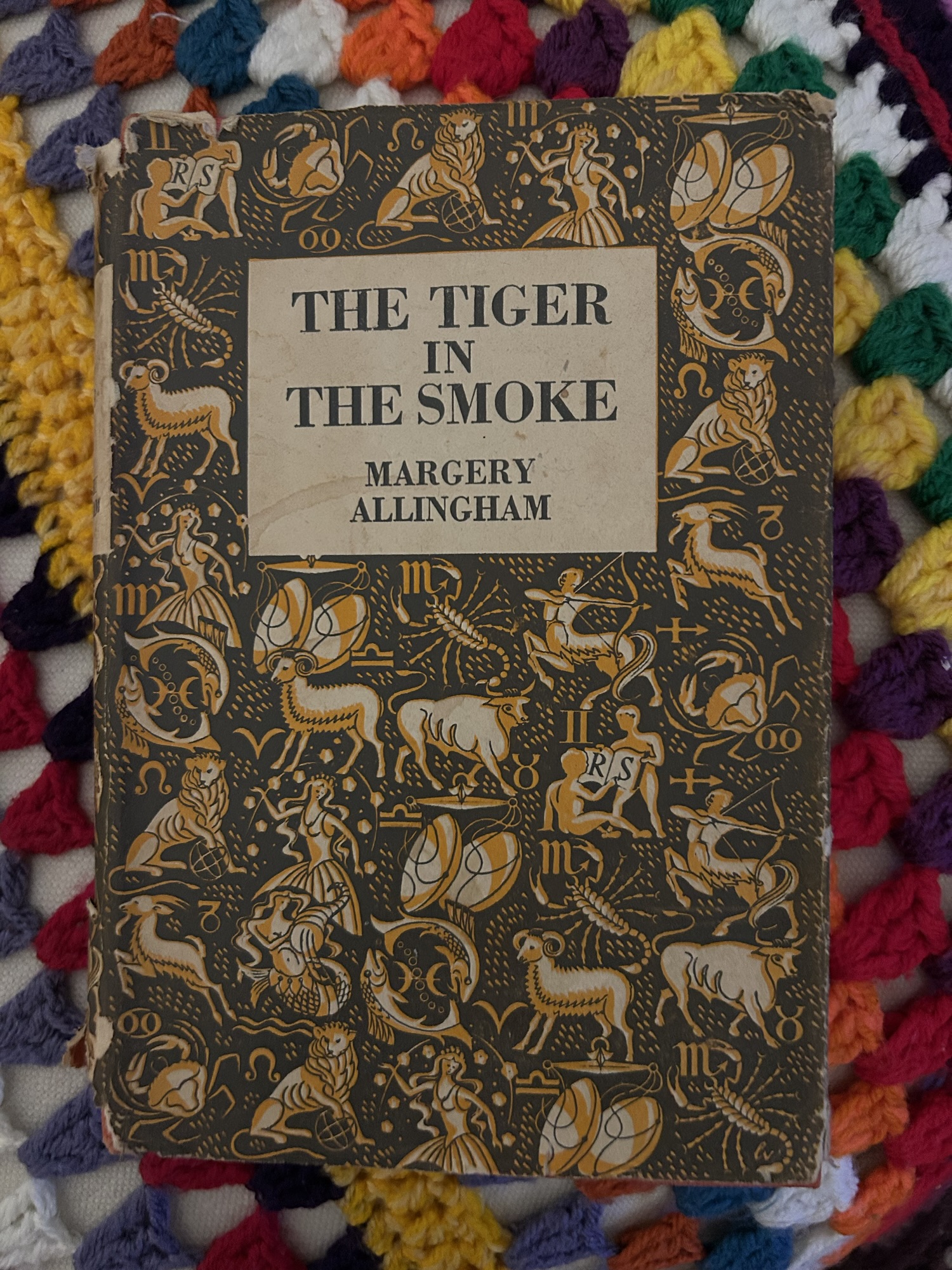
This is a contribution to Kaggsy and Simon’s 1952 Club, running all week. I found a few contenders in the TBR including several golden age mysteries, so I’m starting today with a pretty famous one, Tiger in the Smoke by Margery Allingham.

The titular smoke is a London pea-souper, a thick smog that chokes the airways and severely limits visibility – perfect for dastardly crimes to be committed!

“The fog was like a saffron blanket soaked in ice-water. It had hung over London all day and at last was beginning to descend. The sky was yellow as a duster and the rest was a granular black, overprinted in grey and lightened by occasional slivers of bright fish colour as a policeman turned in his wet cape.”

The story opens with Geoffrey Levett and Meg Elginbrodde crawling through the fog-bound traffic in a taxi. They are one of those wonderful postwar stiff-upper-lipped couples whose romantic chit-chat takes place along the following lines:

“Look, we’ll get out of this somehow and we’ll go through with the whole programme. We’ll have everything we planned, the kids and the house and the happiness, even the damned great wedding. It’ll be alright, I swear it, Meg.”

Love it!

The blight on their nuptials is that someone has been sending blurry photos to Meg of someone who could be her first husband Martin, presumed dead in the war. So she meets friend of the family  – and Allingham’s regular detective  – Albert Campion, along with Inspector Charlie Luke, at a train station.

It quickly emerges that the man is not her husband but a criminal named Duds Morrison. As the group begin to unravel what is going on and why, there is less mystery and more of a character study of a truly sinister criminal named Havoc. Inspector Luke is unnerved:

“Just then he had a presentiment, a warning from some experienced-born six sense, that he was about to encounter something rare and dangerous. The whiff of tiger crept to him through the fog.”

A gang of criminals appear and my heart sank a bit, as they all had various physical differences and I was braced for ableism. But while that is certainly present, the real menace in the book lies with Havoc, and Allingham labours over how physically perfect he is:

“His beauty, and he possessed a great deal […]

His face was remarkable, in feature it was excellent, conventionally handsome […]

Jail pallor, which of all complexions is the most hideous, could not destroy the firmness of his skin […]

He was a man who must have been a pretty boy, yet his face could never have been pleasant to look at. Its ruin lay in something quite peculiar, not in expression only but in something integral to the very structure. The man looked like a design for tragedy. Grief and torture and the furies were all there naked, and the eye was repelled even while it was violently attracted. He looked exactly what he was, unsafe.”

In other words, as beautiful and deadly as a tiger.

In comparison there is my favourite character, Canon Avril, Meg’s father:

“he asked so little of life that its frugal bounty amazed and delighted him. The older he grew and the poorer he became, the calmer and more contented appeared his fine gentle face.”

In fact, Tiger in the Smoke had an increasing amount of religious references and imagery as it went along (though it isn’t didactic at all) and I found myself reminded of Muriel Spark. I ended up googling Margery Allingham to see if she had a strong faith like Spark but couldn’t find it referenced. Tiger in the Smoke isn’t like Spark tonally, but it is certainly concerned with notions of good and evil in a similar way to her novels.

Although this is a Campion mystery, he barely features. Apparently the 1956 film cut him out entirely, and this wouldn’t be difficult at all. His sarcastic retainer Lugg also appears, and his wife Amanda along with Oates from Scotland Yard “a drooping figure in a disgraceful old mackintosh” but this could just as easily be a standalone novel.

While there isn’t a mystery as such, the plot is satisfyingly complex and the novel is expertly paced. The foggy atmosphere is used to full effect and Allingham creates a real page-turner. I was whizzing through Tiger in the Smoke to find out what happened.

It leads to a tense denouement, underpinned by a real sadness. A hugely satisfying start to my 1952 Club reading!

“Havoc was ‘police work’. There was no mystery surrounding his guilt. He was something to be trapped and killed, and Campion was no great man for blood sports.”

“Admit that you deserve forgiveness.” (Niamh Mulvey, The Amendments)

This is my final post for Reading Ireland Month, hosted by Cathy at 746 Books. I’ve really enjoyed my reading for the event with so many strong, memorable voices, and this choice was no exception.

I heard about The Amendments by Niamh Mulvey (2024) through Susan’s review.  It was so appealing I decided it would be my indie bookshop purchase of the month (I need to stop saying I have a resolution to buy one book a month from an indie bookshop or publisher, because it’s never just one 😀 ) and it was a great choice.

There are three main timelines throughout the novel. In London, 2018 Nell’s partner Adrienne is pregnant with their first child and Nell is spiralling with anxiety and ambivalence.

“Adrienne, unfortunately, was not just an object, not just a saviour, not just a happy ending. Adrienne, it turned out, was a person with her own dreams and needs and desires. And those were: more life, more love, which was to say, which is to say – a baby.”

In Ireland, 1982 Nell’s mother Dolores has left home and moved to Dublin, where she becomes involved in a feminist group campaigning for pro-choice reproduction rights (one of the amendments of the title, the other taking place in 2018).

“‘The biggest problem in this country is that people are so scared of asking questions. I don’t know why we’re all so afraid of each other.’

Mary laughed suddenly as if she had only just realised this. She looked at Dolores, as if they were both sharing in this joke, this realisation, together, and Dolores laughed too, though she was uncertain, she felt there was so much she did not yet see.”

In Ireland 2001, studious Nell is struggling with her sexuality and has joined an all-female religious organisation hoping for answers:

“She returned to school that September feeling as if the things she used to count on were all changing in ways she did not at all approve of and this disapproval extended to include her own feelings.”

It is the escalation of events at this time which drive the novel. Nell is so confused, so full of feelings she doesn’t know what to do with, and this builds to a tragedy truly awful and very believable.

Loving Adrienne and recognising that her unresolved feelings from this time threaten her present, Nell agrees to couples therapy. But in order to be entirely honest with both herself and Adrienne, Nell needs to return home to Dolores.

Dolores has deep regrets from her past too, as well as her contemporary worries about Nell. What Mulvey demonstrates so clearly is how much can go unsaid even in relationships grounded in a deep love, and how damaging this can be.

“Dolores wakes up every day of her life with a feeling of worry around Nell, the pain is like a muscle that aches with overuse.”

In exploring the characters’ past and moving them towards a more hopeful future, Mulvey juggles the timelines and the themes with great subtlety. Multiple timelines are always tricky but these were finely balanced throughout and each enhanced the understanding of the other.

The healing that occurs felt hopeful without being sentimental. Nell achieves self-acceptance, if not quite self-forgiveness; resolution if not redemption.

I thought The Amendments was hugely accomplished and very readable. The various female characters were all well-realised and the plotting tight. Mulvey treats her characters with such humane compassion and I was rooting for them to be able to do the same.

“She looks at herself in the mirror and she reflects that all living things want to survive. And it is such a relief to include herself in that humble category of all living things.”

To end, an interesting interview with the author expanding on the societal context of The Amendments:

“People were capable of being many things at once.” (Sarah Gilmartin, Service)

I was a bit wary approaching Service by Sarah Gilmartin (2023) as I’d not long finished an issue-driven novel which I thought never quite managed to create characters who existed believably beyond the issue itself. Service has been described as a #MeToo novel, looking as it does at sexual assault and the structures that enable predators to not only get away with it, but thrive. However, when I saw it in my much-beloved charity bookshop during Cathy’s Reading Ireland Month it seemed perfect timing, and I also remembered that Susan had rated it.

The story is told from the point of view of three characters in alternating chapters.

Hannah, now in her thirties and selling her home as she and her husband divorce, looking back on time when she was a student and a waitress at T, a swanky restaurant reaping the rewards of boomtime Dublin;

“And there was Daniel, of course, we all loved Daniel. The skill, the swagger, the hair, even the naff red bandana that he sometimes wore during prep. We were in awe of him, of the fact that he didn’t seem to care about anything except the food. Serious cooking and good times, that was the dream we sold at T, over and over again.”

Daniel, the celebrity chef who oversaw T, now accused on Facebook of rape by an employee and facing criminal trial;

“Tomorrow the farce begins in earnest. Tomorrow I’ll see that ungrateful wench in person for the first time since she sat at her computer and pressed destroy.”

And his wife Julie, there throughout it all and trying to keep a home running for their teenage sons.

“I knew that you were not the kind of man who would come in the door of an evening and ask about your family. You were too full of your own stories, your voice set to megaphone inside your head, while the rest of us whispered asides. I knew this and I still said yes.”

This isn’t a he said/she said thriller – the way the stories and voices are presented it’s clear that Daniel did it. I thought this was a clever decision, as it frees Gilmartin instead to really focus on the characters’ lives within the various systems of enablement surrounding Daniel. He doesn’t see himself as a predator: why would he, when he is venerated – his toxic, controlling behaviour lauded?

“In that long, hot room that was fuelled by aggression and banter and occasional lines of speed, everything was sexualized.”

Daniel’s narrative is unreliable of course, and Gilmartin cleverly presents it in a way that the reader isn’t sure if he believes it himself. Is he consciously lying, or does he not recognise his actions as rape? He’s deluded enough to think all women want him really, and whether they say ‘no’ to him is a matter of indifference – like everything else they say. In a misogynistic culture where women are commodified and discardable the minute they reach thirty, their careers in front-of-house dependent not on skills or talent but on the approval of the straight-male gaze, where his own wife refers to ‘sluts’, he probably sees what he does as his entitlement.

I’ve seen some readers saying they vacillated with regard to the characters, but this wasn’t my experience with Hannah or Daniel. Where I did change somewhat was with Julie. I found her internalised misogyny infuriating, along with her astounding naivete that somehow a man who has plenty of women willing to sleep with him would therefore not assault anyone.

“How did I not know my husband was a predator? Somehow, I have no answer, beyond some ferocious thought, that all these years have meant nothing, marriage to mirage.”

“How do you weigh up the infinite exhibits of a decades-long marriage?”

But ultimately I saw her as a victim in the situation too, and it is Julie who pinpoints a fundamental societal attitude, so long ingrained, which silences women:

“I always had that ability, learned at such a young age – not to make a scene, not to dramatise, not to look for attention. Only the wrong kind of girls looked for attention.”

There is real tension in Hannah’s narrative as you know what is going to happen while desperately wishing it wouldn’t, and I thought the scene was handled sensitively and entirely non-gratuitously. The immediate fallout and enduring trauma are both believably portrayed.

When I initially read Service, I wondered if a limitation was the voices not being overly distinct from one another, but now, a few days on, I find Daniel’s voice has really stayed with me, the insidious toad (except I quite like toads). So unfortunately through not being able to shake him off I’ve realised my mini-criticism was mistaken!

The ending offered some hope while not being entirely unrealistic which I appreciated, not needing unrelenting bleak narratives right now. In an Author’s Note, Gilmartin explains that the barriers in the current legal system mean that the trial in the book would be unlikely to even occur in real life.

A girl like you.

It could be said in many different ways.”

“We cannot know from whose mouths the echoes of our lives will chime.” (Doireann Ní Ghríofa, A Ghost in the Throat)

I felt quite intimidated approaching A Ghost in the Throat by Doireann Ní Ghríofa (2020) for Cathy’s Reading Ireland Month. A piece of auto-fiction woven around a 18th century Irish-language lament, it sounded quite a challenge. Well, I picked it up and absolutely whizzed through it, finding it so compelling and intensely readable.

“When we first met, I was a child, and she had been dead for centuries.”

At the start of the book, Doireann Ní Ghríofa has three small children and is in the relentless, hazy, exhausting world of trying to keep a home for her family. She captures brilliantly the physical and emotional demands – particularly on women and on women’s bodies – of parenting. I’ve never had children and her visceral (but not shocking or gratuitous) portrait felt very real and immersive.

She loves motherhood and she finds pleasures in the domestic day to day, despite the pressures and demands of both:

“I coax many small joys from my world: clean sheets snapping on the line, laughing myself breathless in the arms of my husband, a garden slide bought for a song from the classifieds, a picnic on the beach, three small heads of hair washed to a shine, shopping list after  completed shopping list – tick tick tick – all my miniscule victories.”

But we are in no doubt that Ní Ghríofa’s life is not easy. She needs support, female support, and she finds it with eighteenth-century poet Eibhlín Dubh Ní Chonaill and her lament for husband – Caoineadh Airt Uí Laoghaire (The Keen for Art Ó Laoghaire) – who was killed by the British.

As Doireann Ní Ghríofa reads and re-reads the poem she has loved since childhood, she despairs at the limited translations and lack of information about the author:

How swiftly the academic gaze places her in a masculine shadow.”

As an Irish-language poet herself, Ní Ghríofa has translated her own poems and so she begins to translate the lament. It becomes something of an obsession, or at least a preoccupation, haunting her sleep-deprived life:

“between the twin forces of milk and text, weeks that soon pour into months, and then into years.”

She also juggles the demands of her own writing:

“I watched poems hurrying towards me through the dark. The city had lit something in me, something that pulsed, vulnerable as a fontanelle, something that trembled, as I did, between bliss and exhaustion.”

Ní Ghríofa brilliantly weaves in aspects of the lament alongside her own life. We learn of the difficulties she experienced in the past, as well as the challenges of her life now. There is a repeated refrain “this is a female text” as she explores how women’s lives have been obscured and disregarded throughout the centuries, and particularly women’s narratives:

“literature composed by women was not stored in books but in female bodies, living repositories of poetry and song.”

One of my favourite examples was this one:

“A family calendar scrawled with biro and pencil marks, each in the same hand – this is a female text.”

Ní Ghríofa writes about her family while keeping them obscured, respecting their privacy. This echoes her attempts to piece together Eibhlín Dubh Ní Chonaill’s life, existing as it did in spaces between the records of the men in her family. Eibhlín Dubh Ní Chonaill remains obscure and Ní Ghríofa has to use her imagination to fill in the considerable gaps.

Another echo is that Ní Ghríofa clearly adores her husband and children, and at one point rues the fact that she can’t write poetry for her husband the way Eibhlín Dubh Ní Chonaill does for hers. But actually I thought these very simply expressed sentences were a lovely tribute to him:

“With him, at last, I began to laugh. He entered my life with neither fanfare nor glamour. There was no elopement. He simply fell into step by my side, with his easy smile, his old t-shirts, his worn jeans, and his steady footfall.”

Although time is never specified, there is a sense of Ní Ghríofa’s family growing older and her work on the translation nearing an end, despite the frustrations:

“Such dedication, if nothing else, has permitted me to grow in slow intimacy with the poet herself, to discover the particular swerve of her thoughts and the pulse of her language.”

The translation is given at the end of the book.

I thought A Ghost in the Throat was incredibly accomplished. It manages to simultaneously convey the horrors witnessed by Eibhlín Dubh Ní Chonaill for English-speaking readers; the challenges of twenty-first century motherhood and female artistry; and the broader themes of women’s voices, lives and creativity being marginalised, with such a light touch. The writing is poetic but never overwritten and Ní Ghríofa’s voice so warm, honest and engaging.

“I have held her and held her, only to find that she holds me too, close as ink on paper and steady as a pulse.”

To end, the author reading from her work while sat in her car:

“Waiting for something to happen in the deathly, unhappy silence.” (Edna O’Brien, The Country Girls)

This is the first of what I hope will be a few posts for Cathy’s annual Reading Ireland Month aka The Begorrathon.

I really enjoyed August is a Wicked Month by Edna O’Brien when I read it a few years ago, and resolved to read The Country Girls trilogy. Admittedly it’s taken me a while but I have finally picked up the first in the trilogy, and O’Brien’s debut novel, The Country Girls (1960). Cathy and Kim are also hosting A Year with Edna O’Brien throughout 2025 so I’m joining in with that too 🙂

The girls of the title are Cait and Baba, growing up in 1950s rural Ireland, and the tale is told by Cait. Once again, I found O’Brien so intensely readable. She is great at small details that illuminate so much, without overwriting:

“Slowly I slid onto the floor and the linoleum was cold on the soles of my feet. My toes curled up instinctively. I owned slippers but Mama made me save them for when I was visiting my aunts and cousins; and we had rugs but they were rolled up and kept in drawers until visitors came in the summer-time from Dublin.”

Cait lives with her parents and man-of-all-work Hickey, on their farm which is hanging on by a thread, not helped by her father going on frequent alcohol benders. Her mother is loving but they all live in fear of her father’s return and the violence he brings.

“Her right shoulder sloped more than her left from carrying buckets. She was dragged down from heavy work, working to keep the place going, and at night-time making lampshades and fire-screens to make the house prettier.”

Baba’s family is better off financially, but they have their own sadnesses including her mother also self-medicating with alcohol. Baba can be a spiteful bully, but Cait experiences a growing awareness of how much Baba needs her too.

“Coy, pretty, malicious Baba was my friend and the person whom I feared most after my father.”

Village life is not idyllic in O’Brien’s world. There is a lot of poverty, there is violence, deep unhappiness and gossip. The girls are subject to the sexual attentions of much older men, even as they are at school.

Cait is academic and wins a scholarship to a convent school. Baba’s family pay for her to have a place too, and so the girls leave their village for the first time.

Baba despises the school with her whole being:

“Jesus, tis hell. I won’t stick it for a week. I’ll drink Lysol or any damn thing to get out of here. I’d rather be a Protestant.”

O’Brien brilliantly creates the cold, the disgusting food, the boredom and the oppressive rules laid down by the nuns.

“The whole dormitory was crying. You could hear the sobbing and choking under the covers. Smothered crying.

The head of my bed backed onto the head of another girl’s bed; and in the dark a hand came through the rungs and put a bun on my pillow.”

Eventually Baba engineers a way for her and Cait to leave, which to my twenty-first century eyes was very funny, but perhaps contributed to the banning of the book in Ireland and the burning of it by a priest when it was first published.

So in disgrace, the girls make their way to Dublin and all the seductions of city life, which Baba in particular is keen to embrace.

“Forever more I would be restless for crowds and lights and noise.”

The scandal The Country Girls created in 1960 seems very dated now. The only part I found concerning was a relationship that Cait begins with Mr Gentleman, a married man much older than she is, when she is still at school. This continues throughout the novel; it remains unconsummated but is wholly inappropriate and what we would now call grooming.

Apparently O’Brien wrote this in three weeks which is just extraordinary. Her evocations of environment and people, her ear for dialogue and her fluidity of style are all so well observed.

The novel ends on an anti-climax which initially I found an odd decision, but reflecting on it I think it is one of its strengths. It emphasises O’Brien’s choice to write about the realities of life for young women at that time, the life she knew. It insists on its truth, more than overly dramatic scenes, to engage the reader.

I’m looking forward to catching up with Cait and Baba in The Lonely Girl – hopefully it won’t take me another two years!

“I was not sorry to be leaving the old village. It was dead and tired and old and crumbling and falling down. The shops needed paint and there seemed to be fewer geraniums in the upstairs windows than there had been when I was a child.”

To end, a great interview with the author from the time of her memoir being published. She discusses The Country Girls around 11 minutes in:

“Two English meals a day would have done for me.” (Antal Szerb, The Pendragon Legend)

This month I started off my reading for Kaggsy and Lizzy’s #ReadIndies event with an author that the event had led me to discover last year: Gertrude Trevelyan. So it seemed apt to end this month’s reading with another author #ReadIndies had introduced me to last year: Antal Szerb. In 2024 reading Love in Bottle in February led to Journey by Moonlight for the 1937 Club in April. This time I’m looking at The Pendragon Legend (1934, transl. Len Rix 2006) which is published by the always reliable Pushkin Press.

The Pendragon Legend is Szerb’s first novel, and utterly bonkers. As I was reading it I remembered why I had enjoyed my previous Szerb reads so much: his wit, fun, intelligence without superiority, gentle ribbing without malice, make him such a joy.

The narrator Janos Bátky is a young scholar who spends his time hanging around the British Library Reading Room. Luckily for him, he has no need for money:

“My nature is to spend years amassing the material for a great work and, when everything is at last ready, I lock it away in a desk drawer and start something new.”

His current interest is Rosicrucians: “Nothing interests me more than the way people relate emotionally to the abstract.”  This ancient secretive organisation’s interests include: “Changing base metals into gold, deliberately prolonging the life of the body, the ability to see things at a distance, and a kabbalistic system for solving all mysteries.”

This leads to him being introduced to the Earl of Gwynedd who invites Janos to stay at Pendragon Castle and make use of his library. Janos heads off to Wales with some acquaintances in tow, unheeding the warnings of a mysterious telephone call… (why do people never heed mysterious telephonic warnings??)

Shortly into his stay there are both earthly concerns when bullets are stolen from his gun and metaphysical concerns where he seems to be haunted:

“Just to be clear on this: not for a moment did I think it could be any sort of ghostly apparition. While it is a fact that English castles are swarming with ghosts, they are visible only to natives – certainly not to anyone from Budapest.”

(This isn’t the only time Janos confuses England and Wales, despite the fact he encounters similar ignorance when people insist he must be German and that Hungary doesn’t exist: “’Come off it. Those places were made up by Shakespeare.’”)

There are femme fatales, reluctant heroes, knowing castle staff… my favourite character was the capable and blunt Lene Kretsch:

“This was how our friendship began: I set myself on fire and she put me out. I’d been sitting by the hearth with The Times. I’ve never been able to handle English newspapers – apparently one has to be born with the knack of folding these productions into the microscopic dimensions achieved by the natives – and, as I flicked a page over, the entire room filled with newsprint.”

And so The Pendragon Legend is a mystery, a thriller, a Gothic ghost story, a fable, and with the arrival of the Earl’s niece Cynthia, a romance, despite Janos’ callowness:

“I can never feel much attraction to a woman whom I consider clever – it feels too much like courting a man.”  

Maybe Cynthia has more tolerance for him as she comes from a family where: “At most, the Pendragons tolerate women within the limits of marriage, and even then without much enthusiasm.”

Szerb satirises romance along with all the other tropes and genres he employs, but always with affection and never with any disdain. Somehow Janos and assorted friends bumble their way through the mystery, despite the poisonings, blackmail and hauntings which dog their steps.

My one reservation is that it became a bit too esoteric towards the end, but this is a matter of personal taste and feels a bit mean-spirited in the face of such an affectionate and fun tale.

If you fancy a pacy, ridiculous, learned adventure, The Pendragon Legend is for you.

“I was filled with the tenderness I always feel – and which nothing can match – when I encounter so many books together. At moments like these I long to wallow, to bathe in them, to savour their wonderful, dusty, old-book odours, to inhale them through my very pores.”

“Words burst forth, recognised at last, while underneath other silences start to form.” (Annie Ernaux, The Years)

#ReadIndies is running all month hosted by Kaggsy and Lizzy and it has meant I’ve finally got to a book that I’ve been meaning to read for ages: The Years by Annie Ernaux (2008, transl. Alison L. Strayer 2018) published by Fitzcarraldo Editions.

A further incentive was that I really want to see the theatre adaptation which is currently running, and now I’ve read the book I have bought my ticket 😊

The Years is a book which deliberately avoids categorisation. Told in chronological order from 1941 to 2006 but in a fragmentary style, it is a memoir/autobiography/autofiction where Ernaux never uses the first person. She refers to ‘she’ for the more personal memories triggered by photographic images, and ‘we’ for considerations of the society and cultural influences experienced by ‘she’ at the time.

Growing up, she is aware of the poverty of her family, and dreams of escape. Ernaux captures so well the confusion of trying to find an authentic escape, trying to determine what she truly wants, alongside what advertising tells her she wants:

“Meanwhile, as we waited to be old enough to wear Rouge Baiser lipstick and perfume by Bourjois with a j as in joy, we collected plastic animals hidden in bags of coffee, and from Menier chocolate wrappers, Fables of La Fontaine stamps that we swapped with friends at break time.”

“It seems to her that education is more than just a way to escape poverty. It is a weapon of choice against stagnation in a kind of feminine condition that arouses her pity, the tendency to lose oneself in a man.”

There are strong feminist themes running throughout The Years, as she grows up on the brink of societal change. At the start:

“Nothing, not intelligence, education, or beauty mattered as much as a girl’s sexual reputation, that is, her value on the marriage market, which mothers scrupulously monitored as their mothers had done before them.”

Yet the 1960s are on their way… Ernaux pulls no punches in detailing the tyranny of menstrual cycles, and of “kitchen table abortions” before the contraceptive pill arrives and pregnancy terminations are legalised.

“Between the freedom of Bardot, the taunting of boys who claimed that virginity was bad for the health, and the dictates of Church and parents, we were left with no choices at all.”

The Years is lightened by humour too, such as this wry observation regarding her young feminist:

“Two future goals coexist inside her: (1) to be thin and blonde, (2) to be free, autonomous, and useful to the world. She dreams of herself as Mylène Demongeot and Simone de Beauvoir.”

The Years is a powerful evocation of a woman’s life at a specific time. Ernaux demonstrates so clearly how lives are bound up with the culture and the wider political forces in which they take place. It is impossible to consider the life in The Years without considering France in the same period. Yet this is an observation which occurs as she looks back, not at the time:

“Between what happens in the world and what happens to her, there is no point of convergence. They are two parallel series: one abstract, all information no sooner received them forgotten, the other all static shots.”

But as she grows older:

“What is most changed in her is the perception of time and her own location within it.”

And yet,plus ca change plus c’est la même chose, as Ernaux notes consumerism and its false promises endure:

“More than a sense of possession it was this feeling people sought on the shelves of Zara and H&M, instantly granted upon acquiring things, a supplement of being.”

The fragmentary style in The Years is perfect example of an experimental style being grounded by the story it wishes to tell, rather than being employed just for the sake of being different or to demonstrate the author’s cleverness. It conveys the experience of memory as well as the memories themselves. As a reader you are drawn into the layering of images, feelings and experiences in such a direct and immersive way, with all the intimacy of a first-person narrative despite the fact that Ernaux never articulates ‘I’.

“Everything will be erased in a second. The dictionary of words amassed between cradle and death bed, eliminated. All there will be is silence and no words to say it. Nothing will come out of the open mouth, neither I nor me. Language will continue to put the world into words. In conversation around a holiday table, we will be nothing but a first name, increasingly faceless, until we vanish into the vast anonymity of a distant generation.”

“‘Hope’ is the thing with feathers.” (Emily Dickinson)

This week as part of Kaggsy and Lizzy’s #ReadIndies event I’m looking at book published by Taproot Press, “an Edinburgh-based publisher committed to presenting challenging, contemporary voices from both Scotland and beyond.”

I was keen to read Hope Never Knew Horizon by Douglas Bruton (2024) as Susan’s review and Kaggsy’s review were both glowing. It sounded truly inventive and unlike anything else I could remember reading.

There are three strands to the story, united by the theme of hope. It opens in 1891 with the Wexford Whale, beached off the coast of Ireland, caught and ultimately sent to the Natural History Museum. One of the locals is sure there is money to be made, but his love interest is sceptical:

“And all Ned Wickham’s spittle-words slap against the walls of the Wexford Arms like the sea in a breached harbour, and they fall back on Ned Wickham and wash over him, and soon enough he slumps in his chair and falls into sleep. And if you lean into the sleeping drunk and listen sharp as pins, you can sometimes still hear the man talking, all his words sluiced and slopping”

The second strand follows Emily Dickinson in the 1850s, through the eyes of her housekeeper Margaret. She sees what no-one else seems to, that Emily is in love with her sister-in-law Susan:

“If I delayed in passing the letter on to Miss Emily it was only briefly and only so I might have something of that love to myself a while.”

The third strand is set in 1880s London, narrated by Ada Alice Pullen, model to famous artists of the day and stage actress under the name of Dorothy Dene. She is painted by Frederick Leighton for the most part, and enters into a Pygmalion-type relationship with him (there is an amusing scene where they are visited by George Bernard Shaw who apparently did base the famous play at least partly on their experience):

“How could I not love the man who made that possible, who took me to the highest point of the world and showed me what was to be conquered – now that I had conquered his heart?”

But it is George Frederic Watts who will capture her as Hope forever.

Bruton is so good at evoking the various voices in his tale. Cheeky, knowing Ada; reverential Margaret, and the various voices that make up the whale strand, which runs up to the twenty-first century, where the whale skeleton has been cleaned and repaired and reinstated at the Hintze Hall. Throughout the bones’ history, people have heard their “hopeful song”:

“Do not think for a moment that the bones in those boxes sat quiet and still […] and if you asked that museum assistant what that sound was he would shrug and say it was like the shushing of the sea, the same that you hear when holding a seashell to the ear, and it was the kick and kick of water and a moaning sound, like music that is wayward and wordless and wild.”

Historical fiction can be hard to pull off and in this short novella Bruton avoids info-dumping. The historical details emerge organically from the narratives, keeping the various stories’ momentum throughout. Similarly, his beautiful prose style never weighs the stories down. There is stunning imagery but it always serves the characters voices.

He also manages the issue of fictionalising real people and events adroitly, not only through an epilogue but also in Margaret’s acknowledgement of her narrative’s shortcomings:

“She din’t actually say that about her heart surely breaking but in what she did say was the sense of what I have written or the feeling anyway.”

“I have perhaps invented a life for her that is more to do with my hopes than hers.”

Which of course aren’t shortcomings at all. We all have faulty memories and we all interpret. Margaret’s story may be hers as much as Emily’s, and it is so moving in her love and hopes for her mistress.

The narratives are united by a theme of love as well as hope. Ada and Frederick’s relationship is filled with love even when not expressed; the whale strand ends on a very moving evocation of the love of teaching and learning. The various parts are finely balanced and I found Hope Never Knew Horizon immensely moving across all three timelines.

What Bruton shows is that hope is an enduring and fundamentally human experience. We live with uncertainty and while there is uncertainty there is hope. He demonstrates that hope can exist alongside the realities of the life that has to be lived. Hope Never Knew Horizon is a gentle, compassionate book to be treasured.

Hope the Whale

“Hope” is the thing with feathers by Emily Dickinson

Hope by George Frederic Watts

“An Edwardian lady in full dress was a wonder to behold, and her preparations for viewing were awesome.” (William Manchester)

Last year Kaggsy and Lizzy’s brilliant #ReadIndies event led to me discovering Gertrude Trevelyan’s novels Two-Thousand Million Man-Power (1937) and William’s Wife (1938). These are published by Boiler House Press, part their Recovered Books series edited by Brad Bigelow, founder of www.neglectedbooks.com, which brings “forgotten and often difficult to find books back into print for a new generation to enjoy.”

#ReadIndies 2025 felt a perfect opportunity to return to Gertrude Trevelyan and her 1934 novel, As It Was In The Beginning, also part of the Recovered Books series.

This was quite different in style to her other novels I’d read, sustaining stream-of-consciousness. This approach lent itself perfectly to the story, as a woman lies dying in a nursing home, remembering her life.

“Alone with the white sheets and the polished floor and the fire crackling jerkily in the sunken grate and the sun beating against the yellow blinds, and the dull white furniture. All quite clean. Everybody finished up and gone.”

Millicent is well-to-do, formerly Lady Chesborough. She isn’t particularly likeable: she is grouchy, ill-tempered, and rude to the nursing staff. We are privy to her dismissive, judgmental thoughts about those who care for her.

“Oh, so it isn’t the pink-cheeked one this time. Thin and sallow. Dark. Sister, that’s it. Scrubbed all the pink out with the carbolic. Suppose a Sister has been scrubbed longer than a nurse.”

Millicent is also vain about looking younger than she is, about her slender frame and her hair. The reader is aware that she may no longer look as she thinks she does. In this way her vanity is almost defiant, a refusal to accept what is happening to her. It is also bound up in her affair with a younger man, Phil, who used her for money after her husband died.

“That slow smile that seemed to pick things up and weigh them and find they weren’t worth your while and put them down with gentle derision: knowing it was nothing, but not wanting to hurt too much.”

Millicent’s awareness of Phil’s caddishness comes and goes. Her reminiscences are interwoven with her present, muddling her memories with visits from her niece Sonia, the doctor on his rounds and the nurses she is so rude about.

This so well done, meaning the reader becomes a detective, working out what is real, what is imagined, what is memory; what is Millicent’s self-delusion from the time and what is delusion now.

We are then taken back to her marriage with Harold, and Trevelyan deals frankly with Millicent trying to fit in with the expectations for a privileged woman at the start of the last century, and how this stifles her needs and wants, including sexual desire.

“It wasn’t a woman Harold married, but a shell: that’s the truth of it. Something correct in white satin, labelled The Bride.”

Trevelyan doesn’t demonise Harold, but shows how he and Millicent are both products of their time. (Although never specified, I’ve assumed Millicent was born around the 1880s, to be in her fifties or thereabouts when the novel was published, and coming of age in Edwardian England.) They are unable to voice what is lacking for them, and struggle to understand this lack when they have done all that is expected. Millicent has a brief outburst of passion which shocks Harold, and they retreat into distance.

“It was that way of appropriating his surroundings; everything having to fit into a relationship with himself. My house. My wife. Yes, that’s it: Harold’s wife, not myself. That’s what I felt, all those years. My wife, my dog: though he was courteous enough: I’m not fair to Harold. Never could be fair to him. He was too fair himself in that cold way. Not that I ever wanted him to be anything but cold: it was just that which made things bearable: that routine of courteous remoteness we’d settled into.”

This leaves her vulnerable to the later manipulations of Phil, who offers her sexual passion in return for her money.

As Millicent leaves the present further behind, the narrative focuses more and more on her reminiscences. It is expertly done, as the nurses and the clinical surroundings fade further away.

We learn of her childhood, and her struggles as she is taught societal expectations. Her relationship with her first love, a childhood friend, is affected negatively when she becomes old enough to have to put her hair up and can no longer play with him as they used to, as she is now considered a woman rather than a girl.

Millicent’s past explains her choices – and lack thereof – so clearly. As a child she found her body cumbersome. She feels she failed Harold by not giving him a child. She worries she is not enough for Phil because she is nearly old enough to be his mother.

“Don’t want to be a little girl. Don’t want to be a grown up either, grown-ups are silly. They don’t know anything. Don’t ask so many questions: that’s when they don’t know things. Don’t be silly, you’ll know that when you grow up, you’ll find that out soon enough, plenty of time for that when you’re older, little pitchers have long ears, little girls should be seen and not heard curiosity killed the cat.”

Trevelyan uses Millicent to explore the disproportionate focus put on (privileged Edwardian) women’s appearance as their main role and contribution. She has her vanities because society has told her this is her value. There is a sense that as she leaves her body behind, Millicent is achieving the freedom she always wanted.

“I don’t know why people should look at me like that. I suppose they can see I’m not anything. I don’t see how they can see I’m not anything. They’re all solid and I’m hollow, but they can’t see that.”

I would absolutely urge anyone to pick up Trevelyan, but As It Was In The Beginning is probably not the best starting point. I’m fine with stream-of-consciousness, but I thought the first part with the memories of Phil was slightly too long and could have done with an edit. The other two novels I have read by her I thought were stronger, and more approachable in style.

However, I thought stream-of-consciousness was perfect for this story. As It Was In The Beginning provides a powerful exploration of the role of women at that time in a way that is intensely personal, while making astute observations about society. Trevelyan is such an accomplished writer who always manages to drive home her wider points without ever losing sight of her characters. I’m so glad Boiler House Press have rescued three of her novels as she deserves to be so much better known.