Blog Tour: Nightingale & Co by Charlotte Printz (2023, transl. Marina Sofia 2024)

I do enjoy a cosy crime novel, and one with a 1960s Berlin setting ticked so many boxes I jumped at the chance to take part in this blog tour from the ever-wonderful Corylus Books.  I hope they carry on asking me to take part in these tours even though I feel like my posts for their books are getting very formulaic: “I loved it! I want more translations!” Take a guess as to whether this one will be any different… 😉

Nightingale & Co. is the first in a series written by Charlotte Printz and translated by a blogger many of you know, Marina Sofia. Here is the blurb from Corylus Books:

“Berlin, August 1961.

Since the death of her beloved father, Carla has been running the Nightingale & Co detective agency by herself. It’s a far from easy job for a female investigator.

When the chaotic, fun-loving Wallie shows up at the door, claiming to be her half-sister, Carla’s world is turned upside down. Wallie needs Carla – the Berlin Wall has been built overnight, leaving her unable to return to her flat in East Berlin.

Carla certainly doesn’t need Wallie, with her secret double life and unorthodox methods for getting results. Yet the mismatched pair must find a way to work together when one of their clients is accused of murdering her husband.

Nightingale & Co is the first in a cosy historical crime series featuring the sisters of the Nightingale & Co detective agency in 1960s Berlin.”

The story gets off to a fun, engaging start. Carla receives a call from her aunt Lulu telling her she’s waving an airgun on the set of the Billy Wilder film One, Two, Three, seemingly in a deeply flawed attempt to secure a role. As Carla sets off across Berlin at pace, the 1960s city is evoked organically, without seeming like an info-dump.

This trailer for the film includes some external shots:

Yet despite the joy of these opening scenes, we are quickly shown the psychological impact of living in Berlin as the Wall goes up:

“‘They’re building a wall,’ said Lulu. The words were like a punch to her stomach. Carla felt faint. Ulbricht had lied to them. That was why there were so many guards at the Brandenburg Gate yesterday. How naïve of them to believe it was merely for the film set.”

Carla lives with her mother in the same building that houses the agency her father built. The domestic scenes with her bitter, passive-aggressive, baiting parent were so well-realised. Printz really captured the psychological warfare that people can tie themselves into, unable to see an escape route however desperately they want one. Carla is also grieving her father, who died in the crash which left her with enduring head injury symptoms.

When her half-sister Wallie arrives having been cut off from her home in the East by the rapid installation of the Wall, she couldn’t be more different. Physically Carla is compared to Audrey Hepburn, Wallie to Marilyn Monroe. Wallie gives free rein to all her appetites and doesn’t mind dubious means to achieve her ends, while Carla is controlled and keen to remain above reproach. Carla’s mother is entirely charmed by Wallie, although she believes her to be a cousin of her dead husband.

In less skilled hands the contrasting sisters could seem cliched and merely vehicles for dramatic tension. But both Carla and Wallie were entirely believable and well-rounded. The tensions between them arising from Carla not knowing about Wallie’s existence until she turns up on the doorstep, and what this means for her memories of her father, was lightened by their very different attitudes. Their growing but begrudging respect for one another as they find themselves an effective team made them an endearing pair.

The central strand of the story concerns Alma, a beautiful rich woman who asks the agency for help due to her husband’s domestic violence. Carla is sympathetic but realistic about Alma’s options:

“I’m afraid that’s no motive for divorce. A man who beats his wife is regarded by the courts as quick tempered and they usually advise the wife not to annoy him.”

The 1960s are a time of change but some changes aren’t occurring quickly enough. (I was reminded this week that it wasn’t until 1975 that women in Britain were allowed their own mortgage!)

When Alma’s husband is killed and her subsequent behaviour leads to her arrest, the sisters investigate. The plot is satisfyingly complex without being overly convoluted and frustrating.

The shadows of the war, less than twenty years previous, still loom large and Printz manages to capture how the fallout is interwoven with the modernising present.

 “Hadn’t they learnt anything from the past? It wasn’t enough to just stand there and repeat slogans. Everyone had to contribute.”

It’s hard to judge a translation when you don’t speak both languages, but I was struck by how Marina Sofia managed a sensitive balance in providing an English translation that flowed so well, yet also kept sense of place and contributed to Berlin being evoked so clearly in my mind. The significances of formal/informal address were conveyed without any clunkiness.

What I really enjoyed in Nightingale & Co was the mix of compassion and cynicism displayed by both the sisters in their different ways. It made them, and the story, humane without being sentimental, hopeful in the face of horrors.

“In the end, that was all that anyone wanted: forgiveness. And to be loved. Which made everyone predictable.”

So in summary: I loved it! I want more translations!

Here are the rest of the stops on the tour, do check out how other bloggers found Nightingale & Co:

“The only thing he ever hoarded, other than solitude, was music.” (Malachy Tallack, That Beautiful Atlantic Waltz)

I wanted to read That Beautiful Atlantic Waltz by Malachy Tallack (2024) ever since I heard about it on Susan’s blog where it also made her Books of the Year. Everything about it appealed: the Shetland setting, the portrait of a life quietly lived, the theme of friendship and the concise but descriptive style. My hopes were ridiculously high; they were also fully met.

There are two timelines, one which begins in the late 1950s with Sonny on a whaling ship, following his marriage to Kathleen and family life with their son Jack and her uncle Tom, ending in the 1970s. The other follows solitary Jack in late middle-age, in the present day.

Apart from a brief few weeks in Glasgow, Jack has always lived in the same house on the croft in Shetland:

“He had so many memories of this room that it seemed not separate from him at all but a part of who he was and who he had always been. He had done so much of his living in this room.”

He is for the most part content with his life: taking walks, keeping his part time job ticking over, listening to his beloved country music and writing songs no-one will hear.

Tallack is a musician and he writes beautifully about music and all it can mean to people; how listening to it can be transcendental and how writing it can be a solitary act which simultaneously opens you up to the world. Jack’s handwritten songs punctuate the story and expand his portrayal beyond his immediate situation.

“To love was an act of imagination. It was to create possible futures, to build new and better selves. When love ended, those futures and those selves were what was lost. Jack knew something of loving from writing love songs. And he knew something of heartbreak, too.”

Jack is not especially damaged or traumatised, but he is a man whose solitary nature has found a space where it is never needed to be otherwise. He grew up in a house where feelings, worries and hopes were not discussed. His father Sonny is a man quick to anger who finds:

“So often feelings came to him like that: in a knot he was ill equipped to undo.”

While his more gregarious mother Kathleen doesn’t know how to broach her son’s silence:

“She listened, feeling the tears creep down her cheeks, not thinking of anything in particular, just hearing that cumbersome music, with a closed door between herself and her son.”

Life changes for Jack when someone leaves a kitten on his doorstep. He doesn’t want the cat but sometimes we share our lives with those we could never imagine choosing, and so Jack finds himself no longer living alone but with energetic, cheeky Loretta (named after Lynn). And his life begins to expand in ways he could not foresee.

In That Beautiful Atlantic Waltz, Tallack has crafted a story of such humane understanding and kindness. It isn’t remotely sentimental in its portrayal of the capacity of human beings to reach one another and to change.

An absolute gem.

To end, the author performing his titular song:

“I began to understand the world outside the shadows of the family tree.” (Zuheir el-Hetti, The Baghdad Villa)

I’m hoping to complete my Around the World in 80 Books reading challenge this year. I want each book to be written by someone from that country and so at this stage I need to actively seek the books rather than just see what comes into my path. However, The Baghdad Villa by Zuheir el-Hetti (2016, transl. Samira Kawar 2023) did turn up in my local charity bookshop, helping me to add Iraq to my list.

Set in 2003 after the American invasion and toppling of Saddam Hussein, the narrative is from the point of view of Ghosnelban, a young woman from an aristocratic family who is racketing around the titular building, remembering the glory days of her relatives as life outside the grounds changes beyond all recognition.

“We had been brought up according to strict rules of speech and behaviour. The use of words that breached the limits of politeness and respect was prohibited. We had carefully preserved that strict moral linguistic code, which we shared with our few gradually vanishing acquaintances and relatives, fearing that its demise would signal the loss of our identity.”

Ghosnelban’s only company is her one remaining member of staff, the housekeeper Mamluka, and her brother Silwan, who is very unwell.

“He had been a soldier in an army that had been epically crushed in the battle to free the oil-rich desert. He came back to us, but did not return, because he had left his mind there, on the road between Basra and Nasiriya. He came back filled with horrifying nightmares, leaving behind all that was human. Then he began to endlessly narrate what he had experienced and seen on that accursed road, like an endless black waterfall.”

Ghosnelban knows her situation is unsustainable. At the start of the novel she receives a bullet in the post – a warning to leave her home or be killed. She meditates on seven artworks on the walls, Masters collected by her grandfather, each painting giving its name to a chapter in the book.

Ghosnelban is not likable. She is an elitist who freely admits to othering people who are not like her “Truly, did the lives of such human beings have meaning?” At the same time, clinging onto her elitism in the face of overwhelming destruction of her way of life is an act of defiance and resistance.

“I was, after all, the descendant of a highborn family and had learned to sculpt hatred and to turn it into a lethal weapon that I threw everyone to confront the vulgarity prevailing around me.”

As much as I didn’t like Ghosnelban, her voice was so distinctive and strongly evoked from the start, I was quicky drawn into her story. And as this develops, of course she becomes more complex than the superior, condescending snob the reader is initially introduced to.

She finds freedom in a friendship with sex worker Regina:

“I wanted to escape my own skin into which I had been placed by my family and it’s ancient history. She didn’t know who I was, was completely ignorant of my family’s history… and was totally uninterested in lineage.”

We also learn of Ghosnelban’s experience of love and passion with someone whose position makes the match entirely unsuitable. Perhaps it is this that encourages her to try and find who is when not defined by her family:

“My grandparents seemed supremely elegant, but cheerless. Their gazes expressed a hauteur that seemed natural to them, two people who never allowed colourful emotions to draw close […. ] Tears were an absolutely forbidden weakness. Displays of yearning were cheap. Love was demonstrated through action, not mawkishness; smiling was a feeling, not a meaningless stretching of the lips. We had learned that list by heart, and I remembered it nostalgically.”

While Ghosnelban seems to retreat into inaction, gazing at her grandfather’s paintings and reflecting, el-Hetti brilliantly builds the sense of impending threat and violence from which she cannot escape. Ghosnelban is not stupid and she knows she has to take a decision or inaction becomes a decision. For such a reflective, interior narrative, The Baghdad Villa becomes unbearably tense.

The Baghdad Villa is a compelling, complex character study which widens to explore the impact on individuals during moments of rapid societal and political change.  It demonstrates how moments of great humanity can exist in the most extreme circumstances; as well as the extremes to which human beings can be driven.

Much to my surprise, it became a real page-turner as I hoped Ghosnelban wouldn’t be destroyed along with her family’s villa. On finishing, I knew I was really going to miss Ghosnelban’s snooty, fierce and vulnerable voice.

“People think because a novel’s invented, it isn’t true. Exactly the reverse is the case.” (Anthony Powell, Hearing Secret Harmonies)

I did it! This is the final instalment in my 2024 resolution to read a book per month from Anthony Powell’s A Dance to the Music of Time sequence. I’d been put a bit behind by labyrinthitis but I finished on 31 December. I’d hoped to write and post this the same day but I got distracted by my Christmas jigsaw puzzle on The World of Virginia Woolf 😀

Published between 1951 and 1975, and set from the early 1920s to the early 1970s, the sequence is narrated by Nicholas Jenkins, a man born into privilege and based on Powell himself. The twelfth volume, Hearing Secret Harmonies, was published in 1975 and opens in 1968.

Much of Hearing Secret Harmonies is concerned with the past but it opens by introducing a new character, the sinister Scorpio Murtlock who is camping on Nick and Isobel’s land with some of his followers. Nick, always such an astute observer of people, is not taken in by Murtlock’s charisma:

“When Murtlock smiled the charm was revealed. He was a boy again, making a joke, not a fanatical young mystic. At the same time he was a boy with whom it was better to remain on one’s guard.”

“Murtlock himself possessed to a marked degree that characteristic – perhaps owing something to hypnotic powers – which attaches to certain individuals; an ability to impose on others present the duty of gratifying his own whims.”

It’s a masterstroke of Powell’s writing that while Murtlock remains elusive, he is also deeply unnerving. There’s no doubt as to how dangerous he could be, fully realised by the novel’s end.

Nick then attends two dinners which work well as devices for him to meet past friends and acquaintances, drawing them into the final sequences, and alerting the reader as to has left the Dance for good. There is a sense of time folding in on itself:

“Members, his white hair worn long, face pale and lined, had returned to the Romantic Movement overtones of undergraduate days.”

And of course Widmerpool, Nick’s talisman of sorts, reappears. He is quite extraordinary: a former beacon of the Establishment now refuting his knighthood, asking to be called Ken, wearing a grubby red polo neck to formal occasions and focussing on the power of 1960s youth movements for societal change. His involvement with Scorpio Murtlock seems inevitable…

This final volume works well in balancing reflections of the past without becoming overly contrived. There is a sense of reflection occurring organically, without being maudlin, sentimental or nostalgic. Powell is far too astute and insightful for the ending to take such tones.

There’s also a great deal of humour, from larger set pieces with Murtlock’s naked dancing cult providing a bathetic contrast with the central image of the novel sequence:

“It was not quite the scene portrayed by Poussin, even if elements of the Season’s dance was suggested in a perverted form; not least by Widmerpool, perhaps naked, doing the recording.”

To smaller moments such as disagreement over paintings at a retrospective of Deacon’s work:

“Well Persepolis isn’t unlike Battersea Power Station in silhouette.”

And Nick’s various assessments of himself:

“Pressures of work, pressures of indolence.” (my life frustrations in a sentence!)

“These professional reflections, at best subjective at worst intolerably tedious,”

I have really enjoyed reading A Dance to the Music of Time and it hasn’t been an arduous undertaking at all. I’m sure it will reward re-reading; there are so many allusions and subtleties that have certainly passed me by. For me, the sequence peaked with the war trilogy, but each novel held its own joys, working on an individual level as well as part of a whole sequence. I’m going to really miss Nick, even though he remained half-hidden to me throughout the twelve volumes.

“Two compensations for growing older are worth putting on record as the condition asserts itself. The first is a vantage point gained for acquiring embellishments to narratives that have been unfolding for years beside one’s own, trimmings that can even appear to supply the conclusion of a given story, though finality is never certain, a dimension always possible to add.”

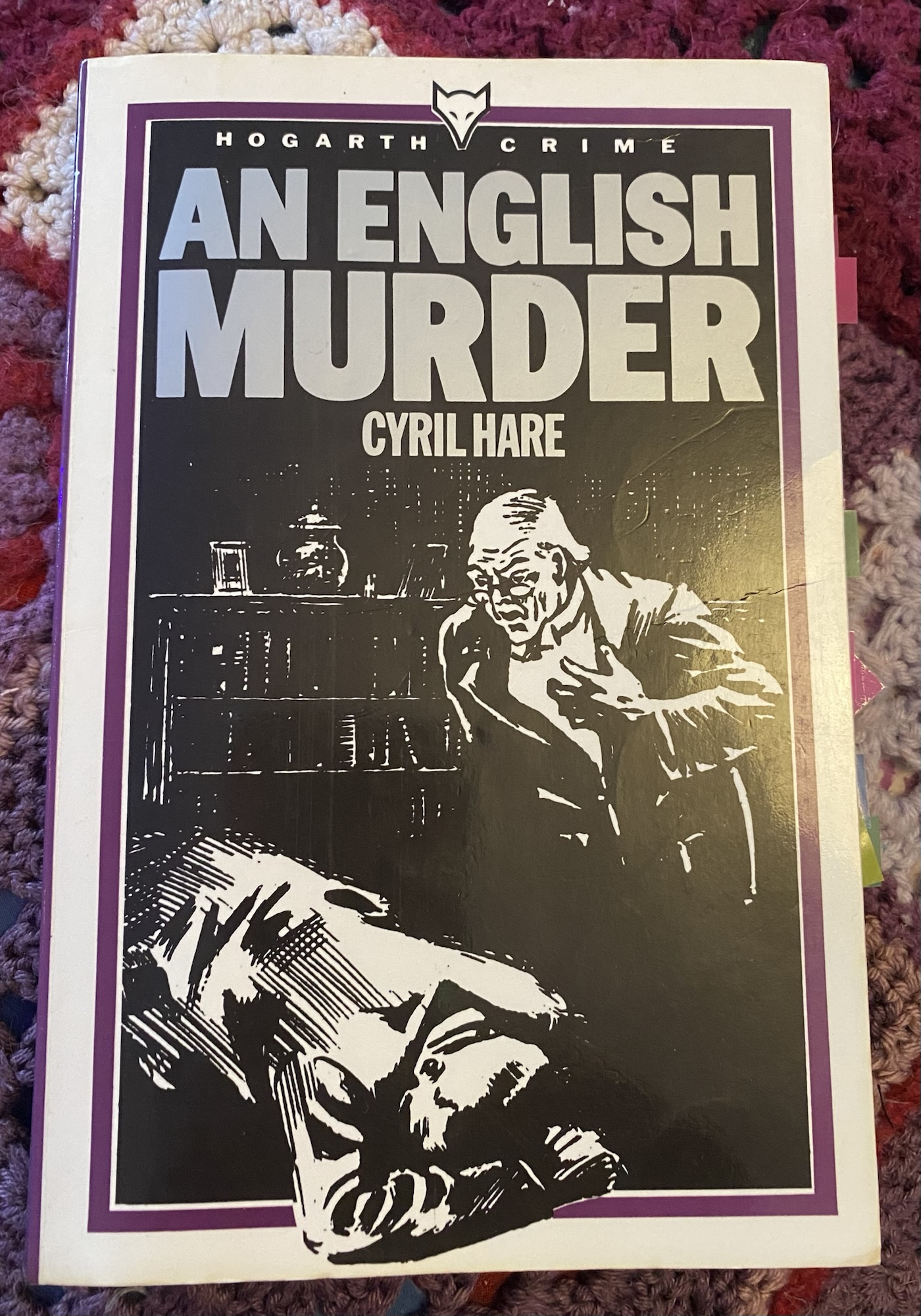
“Some things have happened in this house that are not to be cured by pots of tea.” (Cyril Hare, An English Murder)

I enjoy a golden age mystery at Christmas. It’s my comfort reading at any time of year, but I always try and read one at Christmas, when the tropes of being snowed in (and what will the thaw reveal?!), country houses, groups of people with various tensions trapped together, jovial facades and traditions hiding mendacity and murderers, work especially well.

Unfortunately I had a couple of false starts. The first two I tried promised much of the above, but for various reasons didn’t quite work. Thankfully, a recent addition to the TBR, Cyril Hare’s An English Murder (1951), came to the rescue.

The title of the mystery is very apt: Hare takes a humorous but incisive view of postwar English society, making his points without rancour. Published only six years after the war, perhaps too harsh a criticism would not have been well-received by a generation who went through horrors in service of country, but at the same time things were changing and Hare captures this well.

The story opens:

“Warbeck Hall is reputed to be the oldest inhabited house in Markshire. The muniment room in the north-eastern angle is probably its oldest part; it is certainly the coldest. Dr. Wenceslaus Bottwink, Ph.D. of Heidelberg, Hon.D.Litt. of Oxford, sometime Professor of Modern History in the University of Prague, corresponding member of half a dozen learned societies from Leyden to Chicago, felt the cold sink into his bones as he sat bowed over the pages of a pile of faded manuscripts, […] The real obstacle that was worrying him at the moment was the atrocious handwriting in which the third Viscount Warbeck had annotated the confidential letters written to him by Lord Bute during the first three years of the reign of George III. Those marginalia! Those crabbed, truncated interlineations! Dr. Bottwink had begun to feel a personal grievance against this eighteenth-century patrician.”

Dr Bottwink is a concentration camp survivor. He is learned and wise, and really wants to be left alone with his papers “in response to an instinct that drove him to seek refuge from the horrors and perplexities of the present in the only world that was entirely real to him.”

Unfortunately for him, he will be drawn into the Warbeck family’s Christmas, including having to deal with the revolting Robert, heir apparent:

“I don’t think I shall greatly enjoy sitting down at table with Mr. Robert Warbeck.”

Sir?

“Oh, now I have shocked you, Briggs, and I should not have done that. But you know who Mr. Robert is?”

“Of course I do, sir. His lordship’s son and heir.”

“I am not thinking of him in that capacity. Do you not know that he is the president of this affair that calls itself the League of Liberty and Justice?”

“I understand that to be the fact, sir.”

“The League of Liberty and Justice, Briggs,” said Dr. Bottwink very clearly and deliberately, “is a Fascist organization.”

“Is that so, sir?”

“You are not interested, Briggs?”

“I have never been greatly interested in politics, sir.”

“Oh, Briggs, Briggs,” said the historian, shaking his head in regretful admiration, “if you only knew how fortunate you were to be able to say just that!”

One of the drawbacks of golden age crime is that you often come across anti-Semitism. It was a relief to see Dr Bottwink quickly established as the reluctant detective, and Robert and his organisation given short shrift.

Also present in the house are Sir Julius, cousin to Lord Warbeck and Chancellor of the Exchequer in the new socialist government, whose budget is likely to mean Warbeck Hall will be sold; his Scotland Yard bodyguard, Rogers; Lady Camilla Prendergast (who for unfathomable reasons is attracted to Robert); Mrs. Carstairs, politically ambitious for her husband; Briggs the ancient retainer steeped in duty to the class system and struggling with all changes; and his daughter Susan. I have a terrible memory with too many characters in mystery novels and this number was just right – enough for various suspects but not so many that I had trouble keeping them straight.

Hare lightens the story with gentle humour. Dr Bottwink’s outsider status means there are plenty of digs at English social mores, as well as direct from the authorial voice too, such as this sickbed reunion between Lord Warbeck and Robert:

“When they met they shook hands as English people should. But there is something rather absurd about shaking hands with a man who is lying down. Eventually he compromised by placing one hand lightly on his father’s shoulder.

“Sit down over there,” said Lord Warbeck gruffly, as though a little ashamed at his son’s display of emotion.”

I also enjoyed Rogers’ resolute imperturbability in the face of any heightened emotions from his political employer. Mrs Carstairs provides broader humour through unstintingly loquacious self-interest:

““She overran [Lord Warbeck’s library] like an occupying army, distributing her fire right and left and reducing the inhabitants to a stunned quiescence.”

If you’ve struggled with the social demands of Christmas dragging you away from your reading, you will certainly identify with Dr Bottwink. Far away from his beloved manuscripts, his considered, intelligent attempts at small talk fail miserably in the face of English ignorance:

Camilla laughed. “That was very simple of you, Dr. Bottwink,” she said. “Did you really expect a Cabinet Minister to know the first thing about constitutional history? He’s much too busy running his department to bother about a thing like that.”

“I fear that my knowledge of England is still imperfect,” said the historian mildly. “On the Continent it used not to be uncommon to find professors of history in Cabinet posts.””

On the first night Robert gets horribly drunk and offends even those more favourably disposed towards him. Dr Bottwink’s assessment of him remains unchanged:

“A disregarded spectator in the shadows, Dr. Bottwink gazed at him with cold and steady dislike, remembering other men who had professed principles not so very different from those of the League of Liberty and Justice, who had been noisy and genial in their cups, and had thereafter committed crimes beyond all reckoning.”

Unsurprisingly someone soon bumps Robert off with cyanide in his drink. But as it snows steadily, cutting everyone off, are the others safe? Will Dr Bottwink find the culprit in time, and if he does will anyone listen to him?

An English Murder was well-paced and a quick read.  I hadn’t read Cyril Hare before but on the strength of this I’d be keen to read more. The Guardian included An English Murder in its Top Ten golden age detective novels and I can see why.  

“When I am told that I cannot possibly think anything, my nature is so contradictory that I immediately begin to think about it.”

To end, Dr Bottwink’s knowledge of William Pitt helps him solve the mystery. He may take issue with the historical accuracy this portrayal:

“Have you practised swooning?” (Ruby Ferguson, Apricot Sky)

This is my contribution to Dean Street December, a month-long celebration of this wonderful indie publisher, hosted by Liz at Adventures in Reading, Running and Working from Home.

Dean Street Press’ imprint Furrowed Middlebrow focuses on early and mid-twentieth century women writers, and it’s from this collection that I’ve chosen my read, Apricot Sky by Ruby Ferguson (1952 – please note for Simon and Kaggsy’s 1952 Club running next year!)

I must confess that rather than a DSP edition, my copy is a nice little hardback I found in my local charity shop, inscribed with the author’s love to Flossie and John 😊 I picked up her later novel The Leopard’s Coast at the same time, also given with the author’s love, so I wonder if Flossie and John lived near me and their books have been cleared out…?

Aside from the Jill pony books I read as a child, I only knew Ruby Ferguson from Lady Rose and Mrs Memmary  (1937) republished by Persephone Books. But I’d enjoyed that so much that I felt confident enough to swoop up the two books when I saw them; and what a total joy Apricot Sky turned out to be.

Set in 1948 in the Highlands of Scotland, the story follows the MacAlvey family through the events of one summer. A descriptive passage on the first page sets the tone:

“The charm of islands which changed their colour every few minutes, of lilac peaks smudged on the farthest horizon, of white-capped waves on windy days, of distant steamers chugging romantically on their ways, of little boats with faded brown sails scudding before the breeze, of sudden storms pouring fiercely across the terrific expanse of sky and water, of thousands of seabirds planing and diving, of floods of sunshine scattering millions of diamonds upon the rippling waves, all this made-up the view about which the MacAlvey’s visitors had so much to say while the MacAlvey’s themselves listened indulgently and with inward amusement.”

The MacAlvey’s are a nice family living a life not without trials but without any great drama, comfortably well-off and settled.

“Kilchro House was noted for its hospitality. It was a gay house where a gay family gave charming entertainment and never tried to descend into banality by prattling about themselves.”

The MacAlvey’s younger daughter Raine is due to marry Ian, brother of the Laird of Larrich. This is the thread which runs through the novel, as the wedding gathers apace for the September ceremony.

Raine’s older sister Cleo is back from three years in America, everyone expecting her much changed, but her heart stayed with her Highland home, and Neil, the Laird. Whenever she sees him she becomes utterly tongue-tied, and feels entirely inadequate alongside the charms of Inga Duthie, a sophisticated widow who is new to the area.

“Cleo MacAlvey could think of no worse desolation than that those she liked should not like her. She was a great deal more diffident than her sister Raine, who barged through life without caring whether people liked her or not, and was about as introverted as a fox-terrier puppy.”

Alongside these adult concerns are the younger children, left to their own devices. Primrose, Gavin, and Archie were orphaned by the war and live with their grandparents. The whole summer stretches before them:

“At Strogue there was no promenade and no cinema or skating-rink and only about three shops, and you couldn’t move without getting yourself in a mess with tar and fish and stuff left about, but everything you did there was full of exhilaration and had a way of turning out quite otherwise than you expected.”

They love boats and beaches and being out of doors. The only blight on their idyll is distant cousins Elinore and Cecil who come to stay for a few weeks. They are refined and self-contained, and in the case of Elinore, an unmitigated snob.

The children’s adventures are reminiscent of the Famous Five: there are islands, swimming and a big focus on picnics. There is post-war rationing to contend with, but it is seemingly straightforward to overcome – they frequently manage sweets, pies, jam, sandwiches and fizzy drinks.

For the adults, the trials are tedious houseguests in the shape of Dr and Mrs Leigh, and the appalling Trina, married to their son James. Mrs MacAlvey loves having guests though, and loves her family and her garden. Her part of the world gives her all she needs and she feels no desire to venture any further:

“She found herself unable to picture it, for she had never been to England, and always thought of it as being full of successful people living in Georgian houses.”

Despite being so rooted in her domestic life, she remains blissfully unaware of what her grandchildren get up to all day, and how tortured poor Cleo is by her unspoken love for Neil:

“Nobody talked about their feelings at Kilchro House, it was considered one stage worse than talking about your inside.”

I thoroughly enjoyed my summer with the MacAlvey family in a beautifully evoked part of the world, far away from chilly London. The stakes were soothingly low, and the humour was gentle. Any drama was short-lived, and things worked out exactly as they should.

If you are looking for a warm-hearted, escapist read, Apricot Sky will serve you well.

“‘All right,’ said Raine, holding out a ten-shilling note. ‘I’ll try anything once, even altering the course of history.’”

“If I waited for perfection… I would never write a word.” (Margaret Atwood)

This is the second of my two posts for Margaret Atwood Reading Month 2024 (#MARM2024) hosted by Marcie at Buried in Print.

I really wanted to get this posted in time, but those of you who read my previous post will know I’m currently getting over labyrinthitis. So the same disclaimer applies: please bear with me and apologies in advance for inadequacy/incoherence!

Old Babes in the Wood (2023) is a collection of short stories split into three sections. Tig & Nell contains three stories about the titular couple, My Evil Mother contains eight stories and the final section returns to Nell & Tig with four stories.

I find it hard enough to write about short stories even when my ears aren’t making life extremely trying, so I’m just going to focus on the final section for this post. The Nell & Tig stories explore what it means to be part of a long-established, now elderly couple and the challenges of aging, illness and bereavement.

These issues form a large part of my working life, and I thought Atwood nailed it with her characteristic insight, wit, compassion, and lack of sentimentality. I’m not one for biographical readings generally, but it is worth noting that Graeme Gibson, Atwood’s partner of 45 years, died in 2019 and Old Babes in the Wood is dedicated to him.

In A Dusty Lunch, Nell is sorting through Tig’s father’s belongings. The Jolly Old Brigadier – JOB – fought in the war and covered his PTSD with relentless joviality which didn’t quite fool anyone.

“The Brig had been shunted off to peacetime babysitting, a headquarters here, a headquarters there, a defence attaché in Washington decorating cocktail parties, but for what? Soldiers in peacetime are superfluous: celebrated once a year for something they once were, avoided in the here and now for what they have become.”

As Nell sorts through his belongings she realises the myriad stories that make up a life, and how many remain unspoken and therefore unrealised by even those closest to the person. She has no idea what to do with the deeply meaningful accoutrements of a life that hold no meaning for her, including the ghosts that haunted the Brig.

“What about the silent people, some alive, some dead, who sit in armchairs but aren’t really there, […] Because they’re part of it too.”

This will resonate with anyone who has had to sort through the material contents of another’s life. By placing it with the war generation, further emphasis is given to silent enduring traumas and the cost of choices made for domestic life in peacetime.

Widows is an epistolary episode, capturing the inadequacy of responses to the bereaved as Nell writes to her friend Stevie:

“You were always a well-meaning busy body. I don’t fault you for it – you have a kind heart, you are filled to the brim with good intentions, but I don’t want any casseroles or oblique, probing questions, or visits from professionals, or nieces talking me into buying an assisted-care condo. And no, I do not wish to go on a cruise.”

And really, responses can only ever be inadequate in the swirling disorientation of immense grief:

“Time has ceased to be linear, with life events and memories in a chronological row, like beads on a string. It’s the strangest feeling, or experience, or rearrangement. I’m not sure I can explain it to you.”

In Wooden Box, Nell is working out how to manage the demands of the everyday, when her whole life has been entirely disrupted by Tig’s death:

“It’s like being a student again: the same disorganisation and fecklessness and sudden bursts of intention, the same formless anxiety, the same bare bones meals. How easily she has slipped back sixty years, give or take: grazing, dubious leftovers, no ceremony.”

The titular box is one Tig made in school, with a few bits and pieces in it, which evade Nell as to their meaning. She is baffled and overwhelmed as to what to do with them, the box symbolic of her entire widowhood.

The final story which gives its name to the collection, Nell and her sister Lizzie are sorting through their childhood summer cabin, layers of memories alongside layers of dust and ancient belongings. In line with the fairytale title, Nell recognises her magical thinking, whereby Tig is both absent and ever-present.

“It’s an optical illusion, the retreating figure dwindling, growing smaller and smaller and then disappearing in the distance. Those retreating stay the same size. They aren’t really diminished, they aren’t really gone. It’s just that you can’t see them.”

Old Babes in the Wood is as accomplished as you’d expect. The collection overall is a varied one, including elements of sci-fi, fairytale and even whimsy (in The Dead Interview Atwood communes with George Orwell via Mrs Verity, a medium.) Atwood completely understands the form of whatever she turns her hand to. She always has something interesting to say and she does so with humane understanding.

To end, Margaret Atwood reading one of the earlier Tig & Nell stories, Morte de Smudgie:

“Reading novels needs almost as much talent as writing them.’ (Anthony Powell)

This is the eleventh instalment in my 2024 resolution to read a book per month from Anthony Powell’s A Dance to the Music of Time sequence. Published between 1951 and 1975, and set from the early 1920s to the early 1970s, the sequence is narrated by Nicholas Jenkins, a man born into privilege and based on Powell himself.

The eleventh volume, Temporary Kings, was published in 1973 and is set towards the end of the 1950s. I can’t believe I’m at the penultimate volume!

I’m writing this as I recover from labyrinthitis; today is the first time I’ve been able to sit up after two and a half days flat on my back. So I’m not sure how much sense this post will make, but I wanted to get it written in November. Please bear with me!

Temporary Kings is set for the most part at a cultural conference in Venice in 1958, which Nick has been sent to somewhat unwillingly, by Mark Members who has organised it but can’t be bothered to go himself.

I felt a sense of slowing down, as old acquaintances arrive and new people join the dance; it is almost a series of character sketches. Given Powell’s enormous talent for incisive but never cruel summations of people in just a few lines, this made for an enjoyable read.

For example, how’s this for a description of Louis Glober, a filmmaker:

“What did not happen in public had no reality for Glober at all. In spite of the quiet manner, there was no great suggestion of interior life. What was going on inside remained there only until it could be materially expressed as soon as possible.”

I also liked the new character of Dr Brightman, an academic who:

“had made clear a determination to repudiate the faintest suspicion of spinsterish prudery that might, very mistakenly, be supposed to attach to her circumstances.”

The Widmerpools turn up trailing controversy in their wake: Kenneth has lost his seat as an MP and so given a knighthood and a seat in the Lords (sigh…) and Pamela has been embroiled in a sex scandal. I do enjoy Pamela’s relentless creation of discomfort wherever she goes:

“She had the gift of making silence as vindictive as speech.”

On returning to the UK, Nick finds the conference hard to shake off:

“The conference settled down in the mind as a kind of dream, one of those dreams laden with the stuff of real life, stopping just the right side of nightmare, yet leaving disturbing undercurrents to haunt the daytime, clogging sources of imagination – whatever those may be – causing their enigmatic flow to ooze more sluggishly than ever, periodically cease entirely.”

There is an unsettling feeling to the scenes, and sense of so much unknown among the characters which could implode at any moment. Somehow it doesn’t entirely, but I felt a creeping sense of doom alongside the belief that things will just carry on.

We also have Stringham’s suspected death in a POW camp confirmed. More than any other, that character broke my heart.

Towards the end of the novel, Nick reflects:

“One’s fifties, in principle less acceptable than one’s forties, at least confirm most worst suspicions about life, thereby disposing of an appreciable tract of vain expectation, standardised fantasy, obstructive to writing, as to living […] After passing the half-century, one unavoidable conclusion is that many things seeming incredible on starting out, are, in fact, by no means to be located in an area beyond belief.”

This is a terrible post and I’ve missed so much out! I blame my ears 😉 But I hope it’s given something of the sense of the novel.

Paula’s recent Winding Up the Week post alerted me to this wonderful article about Violet Pakenham, Anthony Powell’s wife and her role in the production of Dance. It’s also a great portrait of postwar Bohemian family life. I really recommend it and you don’t have to have read any of Powell to enjoy it.

To end, a song from 1972 but a UK hit the same year as Temporary Kings was published. I chose it from many 1973 hits because after 11 volumes, Nick still remains somewhat elusive to me as a reader:

“We may safely assume that all tales are fiction.” (Margaret Atwood)

This is the first of what I’m hoping will be two posts for Margaret Atwood Reading Month 2024 (#MARM2024) hosted by Marcie at Buried in Print, as I aim to read the two short story collections I have in the TBR.

Stone Mattress: Nine Wicked Tales (2014) turned out to be perfect autumn reading with its edge of darkness, verging on Gothic at times.

The first three tales are connected. Alphinland sees fantasy writer Constance negotiate heavy  snow after the death of her husband; in Revenant, the poet she loved in her youth, Gavin, tries to manage the frustrations and isolations of older age; in Dark Lady one of his lovers with whom he cheated on Constance is back living with her twin brother.

All of these are grounded in reality, but Atwood weaves through touches of unreality to destabilise any certainty the reader has about what is being portrayed. Constance’s fantasy world is entirely real to her, and there are hints that it is an effective means of controlling people. But is this psychological or metaphysical?

“How did he manage to work his way out of the metaphor she’s kept him bottled up in for all these years?”

Atwood’s portrayal of Constance and Gavin allows for some light satire as to the vagaries of literary trends, and the uses writers make of their art. Gavin enjoyed the male privilege of 1960s bohemianism and is disappointed that the world has moved on alongside his aging body:

“His regret is that he isn’t a lecherous old man, but he wishes he were. He wishes he still could be. How to describe the deliciousness of ice cream when you can no longer taste it?”

Dark Lady portrays the life of an aging muse, using the Shakespeare reference to make Jorrie a slightly ghoulish presence. As her brother Tin reflects on her appearance:

“at least he’s been able to stop her from dyeing [her hair] jet black: way too Undead with her present day skin tone, which is lacking in glow despite the tan-coloured foundation and the sparkly bronze mineral-elements powder she so assiduously applies, the poor deluded wretch.”

“He has to keep reminding her not to halt the sparkly bronze procedure halfway down her neck: otherwise her head will look sewed on.”

Gavin’s nostalgia for the sexual politics of the 1960s is given further short shrift in the titular tale. I was delighted to learn that the idea came about on an Artic cruise, where Atwood’s late husband started to work out how to murder someone on a ship and get away with it. Atwood decided to finish the tale and the logistical details are closely observed.

All the tales are memorable, and the collection finishes on one that feels truly terrifying as an external threat builds towards vulnerable people in a nursing home. Like the tales that have preceded it, Torching the Dusties is touched with the fantastical while staying rooted in the recognisable. Wilma has Charles Bonnet syndrome, hallucinating due to her failing eyesight:

“she locates the phone in her peripheral vision, ignores the ten or twelve little people who are skating on the kitchen counter in long fur-bordered velvet cloaks and silver muffs, and picks it up.”

Atwood relentlessly builds the tension in the tale, ending it on a jovial note that is brilliantly inappropriate.

There’s so much here for Atwood fans to enjoy: the sharp observations (particularly on ageing), the wry societal commentary; the mischievous humour, and of course the fierce intellect. She’s clearly having fun here and encouraging her readers to have fun too. I’m looking forward to the other collection I have to read, Old Babes in the Wood (2023).

“I’ve always looked at myself from above, as pleased as an omniscient narrator.” (Empar Moliner, Beloved)

Trigger warning: mentions childhood sexual abuse

This is my contribution to the wonderful Novellas in November 2024 hosted by Cathy at 746 Books and Beck at Bookish Beck.

I heard about Beloved by Empar Moliner (transl. Laura McGloughlin 2024) through Stu at Winston’s Dad’s blog. I was immediately tempted and it seemed a good choice for my resolution to buy a book a month from an indie press/bookshop. The lovely 3TimesRebel Press even included a tote bag 😊

The striking cover illustration is by Anna Pont, a Catalan artist. She died from cancer earlier this year and all the proceeds from Beloved are being donated to cancer research.

The paw is courtesy of Fred aka Horatio Velveteen aka Mike Woznicat (as like the comedian Mike Wozniak he has a handsome moustache). Anyway, enough of my blithering about my cat. On with novellas!

Remei is in her early 50s and going through menopause. She is married to a musician ten years younger and at the start of the novella she has a revelation:

“Falling oestrogen, combined with lactose intolerance and loss of near sight, makes me see the world through the light wings of a dragonfly. Because of this I can see, with utter clarity, that my man is going to fall in love with this other woman.”

The novella follows Remei as she works out how she will manage this, as she tries to cope with her bodily changes and memories of a traumatic past at the same time.

She is a witty, forthright, slightly sardonic narrator. I really enjoyed the distinctive voice of this resilient woman.

“I must point out I find modesty overrated: I’m still a good deal. What’s more, until now I’ve performed pre-feminist sexual positions with total dedication and delight.”

Her husband, whom she calls Neptune, is not as clearly drawn. But this is not his story: we are firmly in the first person narration of Remei. She and her husband don’t seem hugely well-suited:

“I like music much more than him and I’m an illustrator. But he likes comics much more than me and he’s a musician.”

“I like everyone, in one way or another. He likes hardly anyone, in one way or another.”

“That’s how we see life too, he and I. Me: everything and right now, so nothing is left over. Him: only what fits, even if what is discarded will rot.”

But she loves him and she loves being a mother to their daughter. Her career is successful, although not quite in the way she planned. However, she is not entirely happy. She self-medicates with alcohol:

“My whole life is a gallop between the pretentious and the epic, depending only on how many drinks I’ve had.”

As she goes for runs with her friends, she reflects on the sexual abuse of her childhood, sanctioned by her family. She is estranged from her brother, after she spoke about what was happening and they were taken into care. Remei seems very much alone, despite all the people that surround her.

She is blisteringly honest about her attitude to her husband and the confusion of feelings as she recognises future events:

“Do I want him to continue to love me as much as ever? Yes. No. I want to float along, no more. I want him to be frozen.”

There is a lot of humour too. Remei never demonises Cris, the young colleague of her husband, but wryly observes her behaviour:

“Punctual, efficient, her ovaries functioning at top speed.”

Beloved shows how control is only sustained through the lightest of ties. Remei is a functional alcoholic who could tip over at any time; she realises her relationship with her daughter is on the brink of change as the latter grows older and more aware; she attempts to control her body with running but aging is relentless; and she takes steps to manoeuvre her husband and Cris in a way that will allow her to cope with the affair, but where will this leave her?

Remei is so flawed, so honest, so tenderly vulnerable and spikily self-sufficient, I was really rooting for her to find a way through all the hurt.

To end, the ever wonderful Tracy Chapman singing about changes in life: