Novella a Day in May 2022 No.29

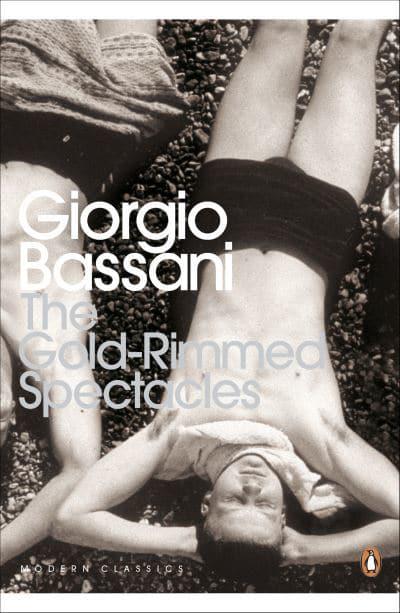
The Gold-Rimmed Spectacles – Giorgio Bassani (1958 trans. Jamie McKendrick 2012) 125 pages

I’ve been meaning to read Giorgio Bassani for a while and have The Garden of the Finzi-Continis in the TBR. This project in May seemed the ideal opportunity to read the first of his novels set in Ferrara, The Gold-Rimmed Spectacles. From this first encounter I can say I found Bassani to be a truly devastating writer.

The titular eyewear belongs to Dr Athos Fadigati, who has left Venice to settle in Ferrara. His story is told by a narrator looking back to when he was a young man and knew the doctor:

“It was in 1919, just after the other war. Because of my age, I who write this can only offer a rather vague and confused picture of that period. The town centre caffes spilt over with officers in uniform; lorries bedecked with flags continually passed by […] in front of the north face of the castle, a huge, scarlet advertising banner had been unfurled, inviting the friends and enemies of Socialism to come together to drink APERITIF LENIN”

The doctor is well-liked in the town, affable and competent at his work, a breath of fresh air after the old-fashioned medics previously available. In a small town though, people take an interest in everyone’s business, and no-one can work out why Dr Fadigati is single, or where he goes of an evening. When they realise he is gay, no-one cares so long as he is discreet. An insidious homophobia that can easily become explicit and threatening.  

“Yes – they said – now that his secret was no longer a secret, now that everything was as clear as could be, at least one could be sure how to behave towards him. By day, in the light of the sun, to show him every respect; in the evening, even if pressed chest to chest against him in the throng of Via San Romano, to show no sign of recognising him.”

Dr Fadigati starts commuting to Bologna along with the young university students of the town. He is such a sweet, kind man, who only wants to connect with others.

“He was happy, in the end, with the least thing, or so it seemed. He wanted no more than to stay there, in our third-class compartment, with the air of an old man silently warming his hands in front of a big fire.”

Unfortunately, the students – who have known him and been cared for by him their whole lives – do not always behave well: “little by little, without meaning to, all of us began to show him scant respect”. This includes a humiliating exchange with one of the young men, Deliliers, who doesn’t respect the doctor’s privacy and alludes to his sexuality in derogatory ways.

Things escalate during the annual family holiday to Riccione. The narrator sees the doctor and Deliliers together, and the town can no longer ignore the doctor’s sexuality. Around the same time, the narrator faces increasing antisemitism, demonstrated by fellow holiday-maker Signora Lavezzoli’s support of Hitler. The family find themselves treading a similar tightrope to the one Dr Fadigati has had to navigate, trying to stay safe amongst a discriminatory and prejudiced society.

“Romantic, patriotic, politically naive and inexperienced like so many Jews of his generation, my father, returning from the Front in 1919, had also enrolled in the Fascist Party. He had thus been a Fascist ‘from the very beginning’, and at heart had remained one despite his meekness and honesty. But since Mussolini, after the early scuffles, had begun to reach an agreement with Hitler, my father had started to feel uneasy.”

The Gold-Rimmed Spectacles makes full use of the reader’s knowledge of history. It is a deeply upsetting read, showing how quickly unspoken prejudice can escalate and be supported by wider political and legal frameworks. It demonstrates how easy it is for ordinary people to become part of widespread evil – one of the narrator’s friends decides to join the government, not through any ideological belief but because it is a useful opportunity. The ease with which it happens and the casual acceptance of the racial laws, is horribly believable.

Bassani uses the story of Dr Fadigati to fully drive home the consequences of the rise of Fascism and Nazism. It’s remarkable in portraying the tragedy that ensues in a deeply emotional but also carefully restrained way.

“The setting sun, cleaving through a dark cope of cloud that lay low on the horizon, vividly lit up everything: the Jewish cemetery at my feet the apse and bell tower of the Church of San Cristoforo only a little further on, and in the background high above the vista of brown roofs, the distant bulk of the Estense Castle and the Duomo. It was enough for me to recover the ancient, maternal visage of my hometown, to reclaim it once again all for myself, that atrocious feeling of exclusion that had tormented me in the last days to fall away instantly. The future of persecution and massacres that perhaps awaited us – since childhood I had heard them spoken of as always a possible eventuality for us Jews – no longer made me afraid.”

I’m so glad I finally picked up Bassani and I’ll be returning to him for sure. Just as soon as I’ve recovered from this novella, which could take some time…

Novella a Day in May 2022 No.28

Thérèse Desqueyroux – François Mauriac (1927, trans. Gerard Hopkins 1972) 115 pages

Today’s choice sees me return to my much-neglected Le Monde’s 100 Books of the Century reading challenge with a classic of French literature.

The novella opens with Thérèse Desqueyroux being acquitted of trying to poison her husband.

“The smell of fog and of baking bread was not merely the ordinary evening smell of an insignificant country town, it was the sweet savour of life given back to her at long last. She closed her eyes and breathed deeply of the perfume of the sleeping earth, of wet, green grass. She tried not to listen to the little man with the short legs who never once addressed his daughter.”

As she journeys back to her home among pine forests in Landes in south-west France, she reflects on her marriage to Bernard and life so far.

“All around us was the silence: the silence of Argelouse! People who have never lived in that lost corner of the heath-country can have no idea what silence means. It stands like a wall about the house, and the house itself seems as though it was set solid in the dense mass of the forest, whence comes no sign of life, save occasionally the hooting of an owl. (At night I could almost believe that I heard the sob I was at such pains to stifle.)”

There is never any doubt that she tried to poison him. Her family know it and Bernard knows it. However, there is never an obvious reason given for her drastic action. It was an unhappy marriage, a strategic match between Catholic middle-class families, but Thérèse seems to have gone along with it happily enough, mainly due to her fondness for Bernard’s sister Anne (some commentators have suggested Thérèse is gay). She doesn’t love Bernard and she feels no desire for him, but surely history would be littered with bumped-off spouses if that were a reason for murder.

“When all was said, Bernard wasn’t so bad. There was nothing she detested more in novels than the delineation of extraordinary people who had no resemblance to anyone whom one met in normal life.”

When she returns to her husband, she is surprised to learn that the plan is for her to stay, but on what terms?

Thérèse Desqueyroux is a beautifully written, intriguing novel that raises questions without seeking trite answers, including who pays the price for male power; how to create agency when you have almost no choices; the nature of justice.

‘But if I did give you a reason it would seem untrue the moment I got it into words…’

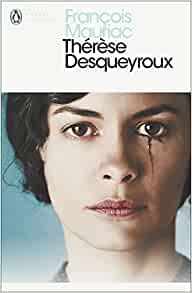
As the cover of the Penguin Classics edition shows, this novella was adapted to film (for the second time) in 2012. This trailer suggests a wonderfully shot, faithful adaptation:

Novella a Day in May 2022 No.27

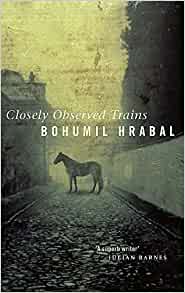
Closely Observed Trains – Bohumil Hrabal (1965, trans. Edith Pargeter 1968) 91 pages

I’m flagging a bit with my Novella a Day challenge, but I’m telling myself there’s only a few more days to go. I’m still really enjoying it, but my post-covid brain is struggling. This meant when I sat down to read Closely Observed Trains, I thought for ages that it wasn’t working for me due to my rubbish concentration levels. Then suddenly it clicked, and as a result it broke my heart.

The story is narrated by Miloš Hrma, young apprentice on the railways during 1945 in Bohemia (one more stop on my Around the World in 80 Books reading challenge.)

“The dive-bombers were disrupting communications to such an extent that the morning trains ran at noon, the noon trains in the evening, and the evening trains during the night, so that now and then it might happen that an afternoon train came in punctual to the minute, according to the timetable, but only because it was the morning passenger train running four hours late.”

This slightly surreal comedic tone continues throughout the novel as we learn about Miloš’ colleagues: lascivious dispatcher Hubička and pigeon-loving station master Lánksý. There is a lot of silliness – Hubička is caught up in a daft sex scandal, Lánksý can be pompous and ridiculous.

But there is a serious side too. Miloš is returning to work after cutting his wrists. There is a lot of animal suffering and at first I was baffled as to why, before realising it was a way of introducing violence and victimhood to a novel about war which doesn’t include warfare.

As Miloš and his colleagues continue their ordinary lives, the troop trains trundle past to the Eastern front.

“This year the Germans had lost control of the airspace over our little town. When I rode along the footpath to the fuselage of the aircraft the snow was glittering on the level fields, and in every crystal of snow there seemed to be an infinitely tiny second hand ticking, the snow crackled so in the brilliant sunlight, shimmering in many colours.”

Closely Observed Trains presents a narrator with a distinct young voice: vulnerable, inexperienced, sceptical and funny. It finely balances unreality and humour alongside humanity and pathos. It’s deeply serious but written lightly, showing how bravery and heroism can exist in the unlikeliest places.

It could be my aforementioned foggy covid brain, but as I was writing this post I started to feel a bit teary by the end. This really was the most affecting novella.

Novella a Day in May 2022 No.26

Heartburn – Nora Ephron (1983) 179 pages

Earlier in the month, Simon, my fellow Novella a Day in May-er, reviewed Heartburn by Nora Ephron. When I subsequently saw a copy in my favourite charity bookshop I decided it was A Sign. (Admittedly I’ll decide practically anything is A Sign if it means I get to buy a book off the back of it 😀 )

I’ve never read Nora Ephron because I’m not a huge fan of rom-coms (I especially don’t understand You’ve Got Mail. Tom Hanks essentially plays Jeff Bezos, who destroys Meg Ryan’s lovely family bookshop, yet apparently that’s all OK and they get together anyway???) But the quotes Simon pulled were so entertaining that I thought I’d enjoy her novel more, which was a correct assumption.

Heartburn is a fictional account of the breakdown of Nora’s second marriage to her husband Carl Bernstein (as in Woodward and Bernstein, as in Watergate). Her alter ego in this novel is Rachel, a cookery writer who is seven months pregnant and married to Mark:

“Every afternoon, Mark would emerge from his office over the garage and say he was going out to buy socks, and every evening he would come home empty-handed and say, you would not believe how hard it is to find a decent pair of socks in this city. Four weeks it took me to catch on! Inexcusable, especially since it was exactly the sort of thing my first husband said when he came home after spending the afternoon in bed with my best friend Brenda, who subsequently and as a result became my mortal enemy.

[…]

It is of course hideously ironic that the occasion for my total conversion to fidelity was my marriage to Mark, but timing has never been my strong point.”

This matter-of-fact, self-deprecating style continues throughout the novel. Rachel takes us through the painful aftermath of discovering her husband cheating as she sees friends, returns to her beloved New York from the decidedly unloved Washington, catches up with her therapy group and shares recipes with the reader.

Rachel is not remotely self-pitying but then nor does she pity anyone else:

“Show me a woman who cries when the trees lose their leaves in autumn and I’ll show you a real asshole.”

“Beware of men who cry. It’s true that men who cry are sensitive to and in touch with feelings, but the only feelings they tend to be sensitive to and in touch with are their own.”

This sometimes goes too far and there are some discriminatory comments, thankfully very few but still surprising in a book from the 1980s.

Ephron’s humour stays the right side of pithy, and doesn’t descend into bitterness. Ultimately, I think she wanted to make the reader laugh and through doing so change the story from one of anguish and pain.

“That’s the catch about betrayal, of course: that it feels good, that there’s something immensely pleasurable about moving from a complicated relationship which involves minor atrocities on both sides to a nice, neat, simple one where one person has done something so horrible and unforgivable that the other person is immediately absolved of all the low grade sins of sloth, envy, gluttony, avarice and I forget the other three.”

There’s very little plot here, and I think the main enjoyment is not from the story (which is pretty ordinary) or the characterisation (which isn’t complex) but from a strong authorial voice, so distinct and entertaining.

“It has a happy ending, but that’s because I insist on happy endings.”

Heartburn was adapted by Nora Ephron into a screenplay for this 1986 film, which I find surprising as this trailer seems to bear only a passing resemblance to the book. Two strong leads though…

Novella a Day in May 2022 No.25

Freetown – Otto de Kat (2018, trans. Laura Watkinson 2020) 142 pages

At first I thought Freetown by Otto de Kat was going to be a very different novella, and I wasn’t sure about it. It opens with Maria talking to ex-lover Vincent about the disappearance of Ishmaël, a refugee from Sierra Leone who delivered her papers and subsequently became like a son to her.

This beginning made me think the novella was likely to be description of the search for Ishmaël and an exploration of his life. I wasn’t sure that such a story could be adequately told in such a short form. But instead, Ishmaël’s disappearance serves as the motivator for Maria and Vincent to reconsider their shared history.

Maria approaches Vincent as a confidant partly because of their previous intimacy, partly because of his work as a psychotherapist. The chapters are labelled with the two characters names and each serves as silent interlocutor to the other. Maria explains how Ishmaël came into her life:

“The conversation didn’t exactly flow, not that first time. He just nodded and gave me a hint of a smile. All that rain made it look more like crying. I gave him 10 euros, and thanked him for delivering our newspaper ….

I told him to come back if he was ever out of work. And that maybe I could help him. I’ve often wondered why I said that.”

When Vincent takes over the narrative we realise he is still very attached to Maria, and that he’s not really got over their separation:

“That is why I kept going. I am hoping they will find something new, go and do something else. I never managed that myself. I just ended up in a vague fog. I live by touch, doing everything by half measures in a state of semi consciousness.”

As the story progresses we learn more about Vincent and Maria’s relationships, with each other and with their spouses. Ishmaël however, remains elusive. Although at the beginning of the story Maria proclaims him family, we don’t really get to know him and it is questionable how much Maria did:

“All the time I knew him, he was always waiting… Always ready to go, to keep on running. That too.”

This doesn’t mean her grief is any less though, and there is a sense of grieving throughout Freetown. Both Vincent and Maria seem to carry a lot of sadness for times past. Ultimately, they seem to be telling one another stories of loss.

The theme is emphasised through what is missing from the narrative. Ishmaël initially seems to be established as the central character, but remains an absent presence throughout. Maria and Vincent rarely speak within one another’s narratives despite being spoken to.

“He’s been gone a year now, and I simply cannot explain who he really was. But whenever I attempt to characterise him, I just end up saying something about myself.”

Freetown is about the stories we tell ourselves, our need for personal narratives and how we constantly reconstruct these. It shows how we try and make sense of the world when it doesn’t always make sense, and how unknowable even the closest people in our lives can be.

It also suggests that despite these limitations we keep on trying, because human connection – however fleeting and flawed – is worth it even with the pain of its loss.

“He nearly always succeeded in telling me a story I understood.”

Novella a Day in May 2022 No.24

The Love Child – Edith Olivier (1927) 138 pages

The Love Child has been reissued as part of the British Library Women Writers series, a wonderful endeavour which has my fellow Novella a Day in May-er Simon Thomas as series consultant 😊

From the opening of The Love Child, I knew I was in for a treat:

“Agatha Bodenham had unconsciously moved a pace or two from the others, and she stood, isolated, near the head of her mother’s grave while the clergyman finished the service. She was wearing a dress of the shape and the tone of black which her dressmaker thought suitable for morning orders, and her hat was quite without character.”

Such a clever opening, and such detailed characterisation in so few words. This continues with clear-sightedness, yet with compassion too.

“She and her mother were women of peculiarly reserved natures, finding it hard to make friends, and holding their country neighbours at a distance. So reserved, too, that they had been barely intimate with each other, living through their days side by side without real mingling of experiences or sharing of confidences. Indeed, they had neither experiences nor confidences to share.”

Now her mother has died, Agatha is deeply, despairingly lonely. It has always been a lonely life in many ways, and she has never had many friends. Then she remembers a childhood imaginary companion, Clarissa. She wills Clarissa back to her, and the scamp – fleet of foot, irrepressible of nature – reappears. It’s not unheard of to retreat into fantasy at times of stress, but what lifts this from the psychological to the fantastical is that other people can see Clarissa too.

“She hardly believed it herself when she thought about it. She just didn’t think about it at all – she lived, and for the first time in her life.”

This presents a particular problem for Agatha as to how to explain Clarissa’s presence, the solution of which is the title.

“There was a special flavour about this scandal, because nobody believed it, however often it was repeated. The thing was unthinkable. To look at Agatha was to know that the policeman’s story was an impossible one, and yet its very impossibility made it the more amusing.”

Clarissa grows up with Agatha and the two are very much bound together. Clarissa encompasses all the behaviours that were supressed in Agatha long ago: appetites for food, for books, for life. However, as a person with those traits grows older, they are naturally going to want to experience more and varied things. Agatha feels Clarissa moving away from the insular world they have created together to beyond Agatha’s limits.

“Now Clarissa would be the guiding spirit, and it appeared she would at once step out of the artificial world which Agatha had created for them to live in, and go to the everyday world which had always been so comfortably and remotely outside, a world which seemed to Agatha at once more commonplace and more disconcerting than their own.”

In many ways The Love Child is a very sad novel. Agatha is so lonely and the solution to that loneliness is one that will cause her further pain. It’s not made clear in the novel whether Agatha is experiencing mental ill health or a truly wondrous manifestation. In a sense it doesn’t really matter because what is being portrayed, in a compelling and involving way, is the quiet desperation that could exist within an ordinary woman’s life in this period.

Agatha has no troubles or ostensible difficulties to contend with, but what she has is an entirely unfulfilled life and no idea of how to live differently. Her solution is extreme, and in many ways is one borne out of fear. She has been equipped with almost no life skills, and a fear of the wider world. It is no wonder that her solution is one that possibly lives only in her own head, and thrives in her domestic realm.

“Agatha thought she liked picnics, and in the long winter evening she often played at going to them with Clarissa. She felt rather differently about them in the summer, preferring them at a distance, like most things.”

I found The Love Child to be a sensitive and inventive novel. It was also highly readable and made me keen to seek out more of Edith Olivier’s work.

Novella a Day in May 2022 No.23

The Country of the Pointed Firs – Sarah Orne Jewett (1896) 158 pages

There’s been a few tough reads this NADIM, and The Country of the Pointed Firs was definitely an antidote to that. Telling the story of a writer’s summer spent in coastal Maine, it’s essentially a series of character sketches that form a love letter to the people and the place.

The writer lodges with Mrs Todd, a kind-hearted woman at the centre of the local community of Dunnet, due to her trade in herbal remedies:

“Sometimes I saw a pale young creature like a white windflower left over into midsummer, upon whose face consumption had set its bright and wistful mark; but oftener two stout, hard worked women from the farms came together, and detailed their symptoms to Mrs Todd in loud and cheerful voices, combining the satisfactions of a friendly gossip with the medical opportunity.”

The writer finds solace and companionship in the area, both from her welcoming landlady and the environment:

“The tide was in, the wide harbour was surrounded by its dark woods, and the small wooden houses stood as near as they could get to the landing. Mrs Todd’s was the last house on the way inland. The gray edges of the rocky shore were well covered with sod in most places and the pasture bayberry and wild roses grew thick among them. I could see the higher inland country and the scattered farms.”

Very little happens in The Country of Pointed Firs, but among others we meet Mrs Todd’s elderly and sprightly mother who lives with her son on a nearby island; the affectionate local doctor; a grieving elderly fisherman; a Captain telling tales of spiritual experience; and hear the story of a heartbroken anchorite…

All the characterisation is affectionate and believable and Maine is beautifully evoked. A lovely read.

To end, I’ve mentioned before my enduring love of undemanding tv detective shows. For me, the thought of a writer in Maine conjures up one person in particular:

Novella a Day in May 2022 No.22

Troubling Love – Elena Ferrante (1992 trans. Anne Goldstein 2006) 139 pages

Although the popularity of Elena Ferrante’s Neapolitan quartet baffled me a bit, I had better luck with her stand-alone novella The Lost Daughter.  This meant I was keen to try Troubling Love, and having finished it I did think that maybe I should give the quartet another try…

Delia’s mother Amalia has died in odd circumstances – drowned, found wearing only her bra, a glamourous one that Delia thinks it out of keeping with her mother’s style. As she returns home to Naples from Rome for the funeral, Delia finds herself reflecting on her past and trying to piece together what happened with her mother, both then and more recently.

“The streets of topographic memory seemed to me unstable, like a carbonated drink that, if shaken, bubbles up and overflows. I felt the city coming apart in the heat, in the dusty grey light, and I went over in my mind the story of childhood and adolescence that impelled me to wander along the Veterinaria to the Botanic Gardens, or over the cobbles of the market of Sant’Antonio Abate, which were always damp and strewn with rotting vegetables.”

Delia reflects on her childhood and her abusive father, who possessively and violently guarded his attractive wife. Delia’s memories of her painful home life are conflicted and contradictory. She despises her father but also harbours a lot of anger and resentment towards her mother.

“We, on the other hand, thought that our father, because of everything he did to her, should leave the house one morning and be burned to death or crushed or drowned. We thought it and hated her, because she was the linchpin of these thoughts.”

The past and present become overlaid as Delia visits her (still violent) father and meets a childhood friend she hasn’t seen in years. She chases a man through the streets thinking he has the answers as to what her mother was doing before she died. As she explores further, memory and identity become confused and less clearly delineated.

“Sometimes that place, which belonged to a less reliable memory, consisted of a dimly lighted staircase and a wrought-iron banister. At other times it was a patch of light striped by bars and covered by a fine screen, which I observed crouching underground, in the company of a child named Antonio, who held me tightly by the hand. The sounds that accompanied it, like the soundtrack of a film, were pure commotion, sudden banging, as of things formerly in order that abruptly collapse.”

Troubling Love isn’t so much a mystery story as an exploration of grief, memory, identity, and the slippery nature of all of these things. It doesn’t offer easy answers. It looks at how so much of this is bound up with family, and how this can be difficult to reconcile.

“Childhood is a tissue of lies that endure in the past tense: at least, mine was like that.”

Troubling Love was adapted to film in 1995. I’ve not seen it, but the trailer looks faithful:

Novella a Day in May 2022 No.21

Mr Fox – Barbara Comyns (1987) 175 pages

Having read Barbara Comyns recently for the 1954 Club, I was delighted to pick her up again for this reading project. How I loved Mr Fox – there is no-one with a voice quite like Barbara Comyns.

The novella opens with Caroline and her small daughter living in a flat with Mr Fox. They are not romantically involved, but the pragmatic Mr Fox suggests it would work as a financial arrangement. His work is sporadic, varied, and not always entirely legal:

“It wasn’t always holidays Mr. Fox was enjoying when he went away. Sometimes he went to prison, not for crime but because he didn’t pay his rates to the borough council. He thought it a pity to waste money on rates and preferred going to prison – it was Brixton he went to. He once suggested I went to prison instead of paying my rates, but I didn’t like the thought of being shut up and when I made a few enquiries about Holloway I heard it was perfectly beastly there and not to be compared to Brixton.”

I really enjoy Comyns’ characters which she somehow manages to make guileless yet never fey. They are survivors but never in a remotely aggressive or self-pitying way.

Caroline’s husband has left and she’s not sorry. She is caring for her small daughter Jenny and worried about money. Mr Fox is a savvy and useful friend, but can also be moody and unreasonable.

“I hoped Mr. Fox didn’t think I’d runaway and left Jenny on his hands; he might even put her in an orphanage and it would take months to get her out again.”

This is the end of the 1930s, and so we know times are going to get much more difficult for these London-dwellers. Comyns captures the bombing in her own inimitable way:

“So I had to spend the day wandering about without any shoes. I passed some of the time filling sandbags in the street; heaps of people were doing it and it seemed a fashionable thing to do.”

Of course, the war brought opportunities for people like Mr Fox, and essentially he is a spiv. Caroline seems both aware and entirely unaware of what Mr Fox is up to, and helps him in the unlikely trade of second-hand pianos. After a time in the suburbs which makes them miserable, they return to the city:

“I began to enjoy an almost empty London. Shopping became almost a pleasure and sometimes we would go to the theatre and there would be hardly anyone there; and it was the same in restaurants. Often in the evening we would take the dogs for a walk in Hyde Park and it would be deserted and lovely. Once when we were walking home a flying bomb stopped right over our heads, and as we turned and ran in the opposite direction a great explosion came and then an enormous amount of dust. The dogs were more upset than we were.”

Comyns has such a unique and unlikely view on things I’ve no idea how typical the experiences in Mr Fox are, but I understand it was based on her real-life situation during that time. She doesn’t shy away from the difficulties of life but presents them in such a surprising way I’m often astonished rather than saddened. Mr Fox was still an emotionally affecting novel though, and such an entertaining one. I was sorry to reach the end.

“Perhaps it was just as well to get the sad part of my life over at one go and have all the good things to look forward to.

Novella a Day in May 2022 No.20

Sphinx – Anne Garréta (2015, trans.Emma Ramadan 2015) 121 pages

Sphinx is a novella which details a young protagonist falling in love with A***. Anne Garréta is a member of the OuLiPo and the particular constraint that she writes to in Sphinx is for both for lover and beloved to be genderless.

The narrator is taken to a club on Place Pigalle where they immediately fall for the charms of the dancer A***. Garréta evokes a seedy and glamorous nightlife that is both enticing and repellent:

“The wheezing of the ceiling fan, the rumble from the nearby stage, the sight of the red velvet sofa covered in holes, burned through buy cigarettes, and the feeling of exile between blue walls defiled with the imprints of dirty hands, brought me all the closer to that single, splenetic feeling so difficult to define: melancholia. I relished it to the point of drunkenness.”

Sphinx is a love story which I felt engages the mind rather than the emotions of the reader. This is because the narrator – although currently working as a DJ – is an academic and seems to approach documenting affairs of the heart in the same way as they would writing a research paper.

“I can’t define A*** as being anything other than both frivolous and serious, residing in the subtle dimension of presence without insistence.”

This includes some overblown, tortured sentences at times:

“Is there anything more vertiginous than gustative reminiscence?”

In her fascinating translators note at the end of the novella, Emma Ramadan explains how the constraints around gender (which is much more demanding for a French writer than an English-language writer) means that this tone needs to be adopted, and then:

“It becomes part of the narrator’s identity – he or she is a rather pretentious bourgeois(e) scholar who does not shy away from praising his or her own intelligence”

So although not overt, there is a thread of humour running through Sphinx, whereby we are not supposed to take the narrator nearly as seriously as they take themselves. And it is a novella that is definitely all about the narrator, not about A***. While limiting the characterisation of A*** serves the constraints around which Sphinx is written, it also succeeds in capturing the self-obsession that can be projected onto a supposed loved one.

“Perhaps I had only ever delighted in my own suffering, which I considered the purification of passions that, deep down I judged as absurd.”

Although Sphinx made me think more than it made me feel, and generally I hope for a reading experience that does both, I did find myself drawn into the narrator’s story, in spite of their distancing voice. I also thought the night-time scene was captured beautifully.

“I was about to turn 23, and for the three years the night crowd had passed before my eyes, I had seen reputations be made and dismantled. I had seen temporary passions transport places and individuals to the apex, and then, burning what they had once adored, those notorious night owls who make up the club scene would abandon them for no apparent reason for other idols destined for glory just as brief.”