Novella a Day in May 2020 #9

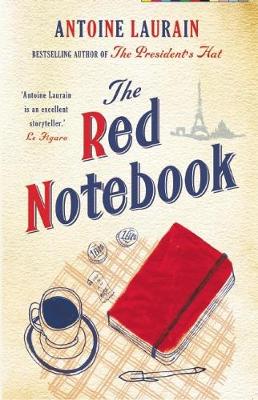
The Red Notebook – Antoine Laurain (2014, trans. Emily Boyce and Jane Aitken 2015) 159 pages

The Red Notebook walks a very thin line and I suspect for some readers it will have crossed that line, from whimsical romance at a distance, to creepy stalker tale. Looking at goodreads most seem to have gone for the former, and that’s how I read it too, but I’m not entirely unsympathetic to the latter view.

Anyway, I’ll put my psychological reservations to one side and let you know about a charming novella that conjures Paris beautifully, features a cameo from Patrick Modiano, and plays into that old romantic trope of lovers that are destined for one another.

Laure is a widow in her 40s who mugged for her mauve handbag and ends up in hospital in a coma. Bookseller Laurent – similar name, similar age to Laure – finds her bag after the mugger has dumped it having removed ID, purse and mobile phone. He tries to hand it in but police bureaucracy means he ends up holding on to it, trying to piece together the owner from its contents:

“a little fawn and violet leather bag containing make-up and accessories, including a large brush whose softness he tested against his cheek. A gold lighter, a black Montblanc ballpoint (perhaps the one used to jot down her thoughts in the notebook), a packet of licorice sweets…a small bottle of Evian, a hairclip with a blue flower on it, and a pair of red plastic dice.”

The titular notebook is part of the contents, and it is a diary which Laurent reads to try and find clues to who Laure is:

“I’m scared of red ants.

And of logging on to my bank account and clicking ‘current balance’.

I’m scared when the telephone rings first thing in the morning.

And of getting the Metro when its packed.

I’m scared of time passing.

I’m scared of electric fans, but I know why.”

Laurent has some success in piecing together Laure’s life, and in the process we learn about them both. Laurent has a teenage daughter who is brattish but loving, and a girlfriend to whom he’s not entirely committed. He likes his job and he’s interested in literature.

He’s also increasingly interested in Laure and a sequence of events lead to him collecting her dry cleaning and cat-sitting for her (!) It was at this point I thought things had gone too far, but then Laurain manages to tip the balance of power in a believable turn of events that meant the story kept me on side.

If you’re in the mood for some escapism across the channel and some gentle romance, then The Red Notebook could be just the ticket.

Novella a Day in May 2020 #8

Where You Once Belonged – Kent Haruf (1990) 187 pages

I adore Kent Haruf. Our Souls at Night is one of my all time favourite novels (novellas). And yet Where You Once Belonged didn’t quite hit the spot for me. I can’t decide if its because it didn’t work or if its because I didn’t want it to have the ending it had, however believable. I’m writing this a few weeks after reading it and I deliberately left it a while, thinking I’d know by now, but I don’t.

Anyway, Haruf is a wonderful writer and you should definitely read Where You Once Belonged, and everything else he’s written too 😊

Set in the fictional town of Holt, Colorado where Haruf sets all his work, Where You Once Belonged tells the story of Jack Burdette from the point of view of one of his school friends.

The story opens with Burdette returning to Holt as a prodigal son, the charismatic chancer who ripped everybody off and fled. There’s a wonderfully understated comic scene in which the Deputy Sheriff is alerted to Burdette’s whereabouts:

“Willard allowed his feet to droop from the desktop and slowly he sat up in the chair. He leaned forward and began to brush the fingernail clippings from his shirtfront onto the green blotter on the desk. He was making a neat pile. ‘Something bothering you, Ralph? You sound a little excited.’

‘What?’ Bird said.

He was standing behind the office counter, panting and sweating, his face red as beets and his eyes looking as though they belonged in the head of an alarmed poodle.”

This is a brilliant way to set up the drama of Jack Burdette. Holt is a small town, what does the reader care what happened there? But in this way Haruf sucks us right in to the drama of Burdette’s story.

Jack Burdette is a legend in the town. A huge, macho, charismatic man who excelled at football and it getting everyone else to make his life as easy as possible.

“He was taller and stronger – taller and stronger than anybody else in the school. By the time we graduated the spring of 1960 he was six feet four and weighed two hundred and forty pounds… He was like a full-grown man among mere children, a colossus amongst pygmies… He was a kind of high-school boy’s high school boy: the supreme example of what was possible and absolute.”

He only graduates because Wanda, the woman who loves him – who he uses mercilessly – writes his school  papers for him. When he leaves school he works at the farmers co-op, gets quickly promoted, and remains a big fish in a small pond.

These types are always hard to create in fiction, as its hard to get the reader to buy into the charisma of the character, as so much charisma relies on the face-to-face energy of a person. But with Burdette we know things went badly wrong from the start of the story and that he is back looking bloated and jaundiced, so we are not expected to ever buy into him.

Yet his friend, Pat Arbuckle, who runs the local paper and therefore believably wants to document all that occurs in Holt, shows how people enjoyed Burdette, without really ever knowing him.

“For we had all begun to expect the unusual of him by that time, while he, for his part, had already learned – if acting on bent and sheer heedless volition  can be said to be a form of learning – not to disappoint the expectations of anyone. Least of all his own.”

Where You Once Belonged is an effective portrayal of small town life and how local legends grow up. Burdette remains unknowable, and in this way the reader is positioned in the same way as most of the town.

“the center of that constant and admiring group of backslapping men, while he told his jokes and stories and they all laughed.”

Yet unlike the townspeople, we realise that Burdette is almost evil. He causes deep, tragic hurt to more than one person and appears to care for precisely no-one. When he arrives back in Holt, the inhabitants are angry, but the reader – certainly this one – is scared as to how it will play out. Burdette is unpredictable, and he is cruel, whether intentionally or through utter disregard for other people…

As I said at the start, I didn’t like the ending of this, but I think that’s my sentimentality rather than Haruf’s misjudgement 😉 As always with Haruf, the town and its people are closely, compassionately observed and completely believable.

The writing was precise and beautiful. I only wish he’d written more.

Novella a Day in May 2020 #7

Monsieur Linh and His Child – Philippe Claudel (2005, trans. Euan Cameron 2011) 130 pages

I only knew Philippe Claudel as a film director until Emma’s review of Monsieur Linh and His Child put his work as a novelist on my radar. Do head over to Emma’s review as she has lots of interesting things to say about this novella. She also rightly pointed out it would be a perfect read for NADIM, so here it is!

Monsieur Linh arrives in an unspecified French port town as a refugee from an East Asian war. His son and daughter-in-law were killed, and he has fled with his baby granddaughter, Sang Diû.

“Six weeks. This is how long the voyage lasts. So that when the ship arrives at its destination, the little girl has already doubled the length of her life. As for the old man, he feels as if he has aged a hundred years.”

Monsieur Linh is a lonely and isolated figure. His fellow refugees cook for him but do so without any warmth or affection. He is deeply traumatised and lives only for his granddaughter.

One day, walking in the unfamiliar town with its cars, strange food, odd smells and a language he doesn’t understand, he meets Monsieur Bark, when they sit on the same park bench. Monsieur Bark is a widower who is grieving deeply for his wife.  He smokes and talks incessantly, although Monsieur Linh cannot understand a word.

“When Monsieur Bark speaks, Monsieur Linh listens to him very attentively and looks at him, as if he understood everything and did not want to lose any of the meaning of the words. What the old man senses is that the tone of Monsieur Bark’s voice denotes sadness, a deep melancholy, a sort of wound the voice accentuates, which accompanies it beyond words and language, something that infuses it just as the sap infuses a tree without one seeing it.”

The language barrier does not mean that there is a lack of understanding between the two men. Claudel demonstrates without sentimentality how a true friendship develops between them, affectionate and accepting and full of meaning for both. These two deeply traumatised men are able to help each other heal in a way that is wholly believable and deeply moving.

Monsieur Linh and His Child is a wonderful, heartwarming story about the nature of unconditional love, friendship, and how we can help alleviate others’ pain without words. It’s about the humanity that bonds us all, and that is a timely reminder in today’s political climate. Highly recommended.

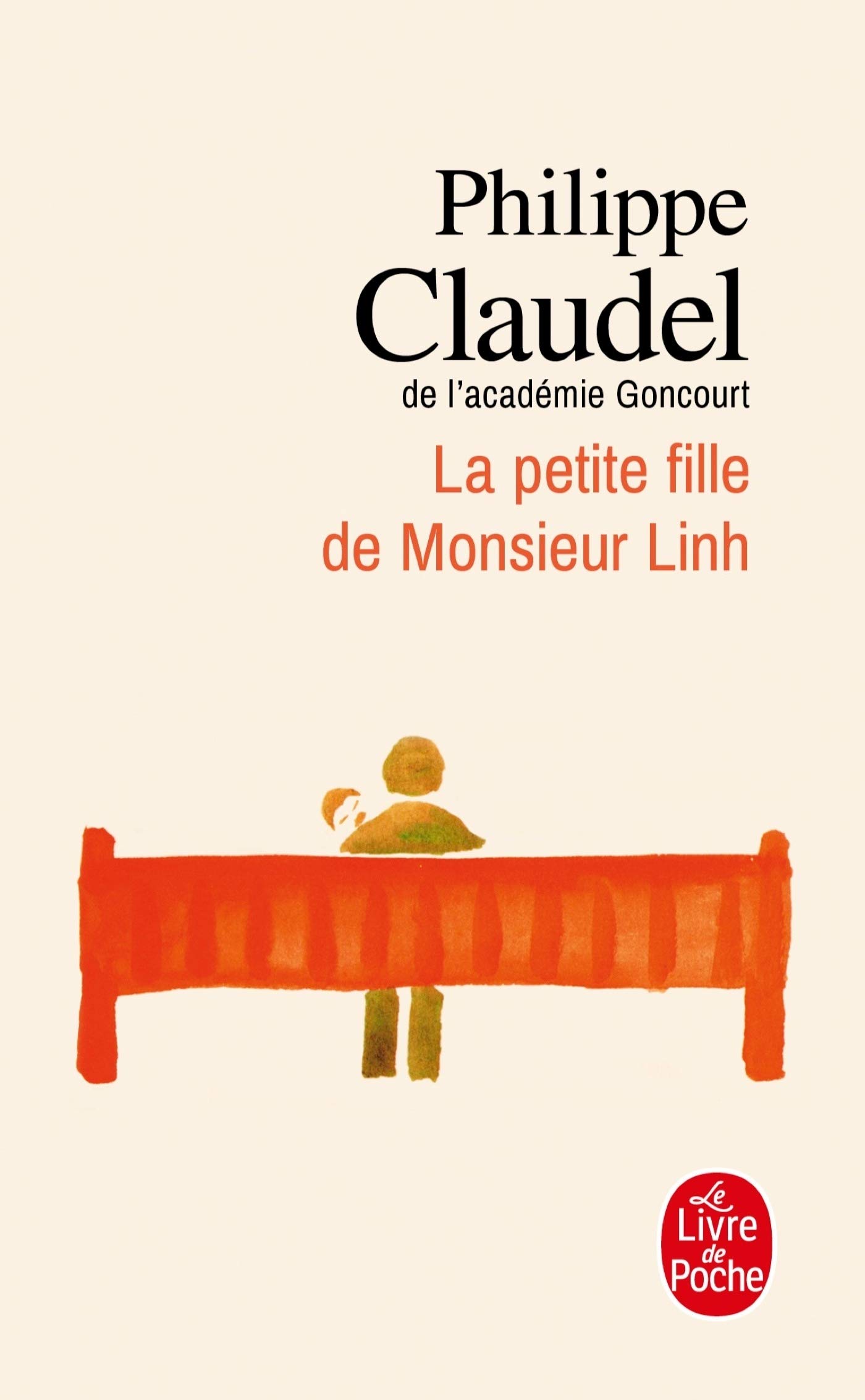
Here is the French cover, because as Emma rightly pointed out, the UK edition is ugly:

Novella a Day in May 2020 #6

Ghost Wall – Sarah Moss (2018) 149 pages

Trigger warning: discusses domestic abuse

Ghost Wall is the first of Sarah Moss’ work that I’ve read, despite hearing wonderful things about her in the blogosphere. My excuse is I kept getting her confused with another author with whom I’ve had a mixed experience, in other words, I’m an idiot 😀 Turns out the blogosphere was absolutely right, Moss is an immensely skilful writer.

Ghost Wall begins with a young woman being sacrificed, probably in pre-Christian England. That brief but deeply disturbing description over, the story picks up in the latter part of the twentieth century.

Silvie is spending the summer with her parents and some students re-enacting Iron Age life: living in a hut, cooking foraged food over fires.

“When I woke up there was light seeping around the sheepskin hanging over the door. They probably didn’t actually have sheep, the Professor had said, but since we weren’t allowed to kill animals using Iron Age technologies we would have to take what we could get and sheepskins are a lot easier to pick up on the open market than deerskins. While I was glad…I thought the Professor’s dodging of bloodshed pretty thoroughly messed up the idea that our experiences that summer were going to rediscover the lifeways of pre-modern hunter gatherers.”

Silvie’s teenage scepticism brings a dry humour to what would otherwise be a very bleak tale. Her father is a bus driver obsessed with British pre-history. He is a misogynist and domestically violent, and he uses this period in history to justify his beliefs and actions:

“women in the family way and feeding babies the way nature intended as long as they could, which was also what he said whenever he caught me or Mum buying sanitary protection. Women managed well enough, he said, back in the day, without spending money on all that, ends up on the beaches in the end, right mucky.  Or they died, I said, in childbirth, what with rickets and no caesarians, but you won’t be wanting me pregnant, Dad, for authenticity’s sake? … Hush, said Mum, cheek, but she was too late, the slap already airborne.”

The experiment simultaneously excites and challenges Sylvie’s father. He is not wholly unsympathetic – Moss shows how it is the limitations placed on him that lead to his frustration, but plenty of people have those without beating their nearest and dearest. He is a racist and a fantasist:

“He wanted his own ancestry, wanted a lineage, a claim on something. Not people from Ireland or Rome or Germania or Syria but some tribe sprung from English soil like mushrooms.”

Yet Silvie shares her father’s interest in history, and his intelligence. She doesn’t despise everything about the experiment and she has better knowledge than the slightly disengaged archaeology students who are helping out.

 “The edges of the wooden steps over the stile touch your bones, an unseen pebble catches your breath. You can imagine how a person might learn a landscape with her feet. But we hadn’t yet crossed any bog and I was pretty sure it would feel different in winter.”

Silvie’s mother is utterly cowed – as far as we can tell – by the man she married.

“Mum often spoke of sitting down as a goal, a prize she might win by hard work, but so rarely achieved that the appeal remained unclear to me.”

Although in some ways a resolutely domestic tale – albeit in a replica Iron Age hut – what emerges from the context of the human sacrifice at the beginning to Silvie and her mother’s subservient roles in the experiment, is how women have frequently paid the price of the systems and structures that powerful men erect to serve their own ends while claiming a higher purpose.

Moss slowly builds the tension in this novel as the experiment exerts pressure on the family and exposes its faultlines. I found it unbearably tense and a perfect example of the power of a novella which is tautly written.

It is this power which means this could be a very triggering read for people and I do advise to proceed with caution, but if you’re in a position to read it, Ghost Wall is an immersive and gut-wrenching read.

Novella a Day in May 2020 #5

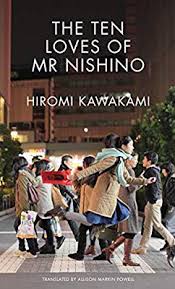
The Ten Loves of Mr Nishino – Hiromi Kawakami (1995, trans. Allison Markin Powell 2019) 195 pages

I really enjoyed the previous novels by Hiromi Kawakami that I’ve read, Strange Weather in Tokyo and The Nakano Thrift Shop, so I approached The Ten Loves of Mr Nishino with high expectations. Although this was still highly readable and full of well-realised, idiosyncratic characters, I didn’t find it quite as satisfying as the others. I think this is because I misunderstood the title. I thought Nishino was the subject and the Loves were the object. But, in having the Ten Loves tell their stories in individual chapters, it turns out they are the subject, Nishino the object – an enigmatic object who remains mysterious to the end.

This is not a novella about the romance of love, though it is about the impact of romantic encounters. Kawakami is interested in how people relate to each other and the effect that we have on people’s lives that we can’t recognise or fully comprehend. She’s not interested – at least not here – on rose-tinted explorations of romantic love. The first chapter is from the point of view of a married woman who has an affair with Nishino:

“What is love, really? People have the right to fall in love, but not the right to be loved. I fell in love with Nishino, but that’s not to say he was required to fall in love with me. I knew this, but what was so painful was that my feelings for Nishino had no effect on his feelings for me. Despite this pain, I longed for him more and more.”

We then go back in time to when Nishino was at school, and learn something of his painful past:

“A strange air drifted around Nishino. An air that none of the other kids in class had. I had the impression that, if I were to try and push that air around, there would be no end to it. The more I tried to push it, the deeper I would get caught up in it. And no matter how hard I pushed, I would never reach Nishino on the other side.”

Nishino is someone who is never without a partner, and sometimes these women overlap. The women’s perspectives on each other add to the narrative; one of his loves is stunningly beautiful, but we only learn this from his subsequent girlfriend, as the woman herself would never describe herself that way.

Despite his womanising, it is Nishino who comes across as vulnerable, much more so than the women, even when he causes them pain.

“I wanted to flee from Nishino as quickly as possible. This desire welled up from the bottom of my heart. I still couldn’t put my finger on what the sense of discomfort was – all I knew for sure was that it was present. And no matter how hard I tried, I simply couldn’t make it go away – that cold and awful uneasiness.

I wanted to flee. This simple thought flooded my mind. The same way that I had wished I could love him.”

Through ten very different women, we catch glimpses of Nishino but we never see him fully. This captures the central question of the novella: how much do we ever know another person? It’s not a bitter question though, or a desolate one. Rather it is one of compassion. I came away from Ten Loves… with a sense not of the importance of romantic love, but of kindness. Because at the point you touch another person’s life, you have no idea of what has gone before and what they carry with them.

Novella a Day in May 2020 #4

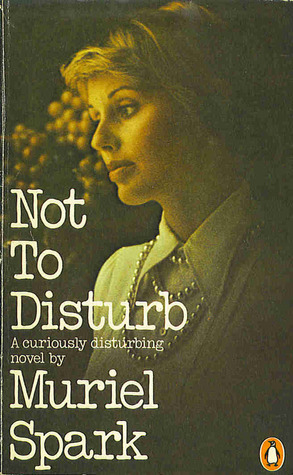
Not to Disturb – Muriel Spark (1971) 96 pages


I really enjoy Muriel Spark. I like her creepy, unsettling tales, her dark humour, the ways things are not fully explained… Not to Disturb has all of this in bucketloads, but it means it’s a very hard book to review! At times I wasn’t sure what story I was reading, and now I’ve finished it I’m still not sure. I enjoyed it immensely, but in the wrong mood this could be a very frustrating read.


It’s set in a Genevan villa on a stormy night. The villa is home to the Baron and Baroness Klopstock who are locked in a room with their secretary, Vincent. The Baron’s brother is nursed in the attic and punctuates the night with howling.


Meanwhile, the servants are in their quarters discussing the evening ahead and already referring to the Klopstocks in the past tense. Heloise, the heavily pregnant maid, is reflecting on who of many possibilities could be the father of her unborn child which may be Pablo the handyman’s, but is cut short by Monsieur Clovis:


“ ‘We have serious business on hand tonight, my girl, so shut up,’ says the chef. ‘We have business to discuss and plenty to do. Quite a vigil. Has anybody arrived yet?’ “


Quite what the business is and why the servants know about it advance is never fully specified. We know there will be a death though, because the butler tells us:


“ ‘There was sure to be something unexpected,’ says Lister. ‘But what’s done is about to be done and the future has come to pass. My memoirs up to the funeral are as a matter of fact more or less complete. At all events, its out of our hands. I place the event at about 3am so prepare to stay awake.’


‘I would say 6 ‘o’clock tomorrow morning. Right on the squeak of dawn,’ says Heloise.


‘You may well be right,’ says Lister. ‘Women in your condition are unusually intuitive.’”


There’s also the couple at the gatehouse who are completely oblivious to the machinations, three people in a car lurking around the grounds waiting for Vincent, and everyone is staying up all night so they look bedraggled and upset when the press arrive as planned in the morning.


Not to Disturb is farcical, sinister and satirical. There’s a fairly horrible almost-rape scene but generally  things verge on the metaphysical rather than the visceral. It’s baffling and unsettling and I whizzed through it with great enjoyment. If ever a novelist was ill-suited to write a novel called Not to Disturb, it’s Muriel Spark 😀


If you’ve come to the end of this post and feel I’ve not told you anything useful about the novella, I’m really sorry! But in that way I may have conveyed some of the experience of reading Not To Disturb


Novella a Day in May 2020 #3

Dept. of Speculation – Jenny Offill (2014) 177 pages

Dept. of Speculation chronicles the breakdown of a marriage from a wife’s perspective. It’s fragmentary, made up of short paragraphs and chapters, but still makes for a satisfying read. The structure effectively captures a sense of thoughts and memories, without someone trying to work everything out and explain it all in a clear narrative, because who thinks like that?

The narrator is a writer who somehow finds themselves subject to domestic demands and teaching rather than working on her own art:

“For years I kept a Post-it note above my desk. WORK NOT LOVE! was what it said. It seemed a sturdier kind of happiness.”

“My plan was to never get married. I was going to be an art monster instead. Women almost never become art monsters because art monsters only concern themselves with art, never mundane things. Nabokov didn’t even fold his own umbrella. Vera licked his stamps for him.”

Her husband is never demonised. He’s Nice.

“He’s from Ohio. This means he never forgets to thank the bus driver or pushes in front at the baggage claim. Nor does he keep a list of those who infuriate him on a given day. People mean well. That is what he believes. How then is he married to me? I hate often and easily.”

He’s not a fully realised character, and I think this is quite deliberate. The focus is on the narrator, her thoughts, feelings and needs. Possibly its her frustration and disappointment in her life that contributes to the relationship breakdown, but we don’t know, because she can’t have that distance or perspective on it yet.

We do know that she is struggling. How she refers to herself changes from ‘I’ to ‘the wife’. Her sense of self seems as fragmented as the narrative. She loves her husband and child, but is acutely aware of her distance from them too.

“Soon everyone is asleep but me. I lie in our bed and listen to the hum of the air conditioner and the soft sound of their breathing. Amazing. Out of dark waters, this.”

Her husband’s Ohio courtesy only extends so far: he has an affair. As the couple try and pick up the pieces – and work out if they even want those pieces any more – the rage and bewilderment of the narrator is palpable. Yet there is humour in this book too:

“At night they lie in bed holding hands. It is possible if she is stealthy enough that the wife can do this while secretly giving the husband the finger.”

Uncompromising but compassionate, hopeful but real, Dept. of Speculation is a compelling short read.

Novella a Day in May 2020 #2

From a Low and Quiet Sea  – Donal Ryan (2018) 181 pages

Last year I read The Spinning Heart by Donal Ryan for NADIM and was so impressed by his writing. From a Low and Quiet Sea has absolutely confirmed this view. He is such an understated, sensitive and evocative writer, he’s fast becoming a real favourite.

The story begins with Farouk, and his decision to take his family and leave his homeland after the political situation becomes intolerable.

“He’d measured the weights of his conflicting duties carefully, he’d told his friend in the letter, and he’d measured and measured again, and he’d mourned the time when such duties weren’t in conflict one against the other but were all part of a good life and all given to the same end, but this was now how the world was, and he was left with no choice to get his daughter and his wife to safety.”

Unfortunately Farouk’s story plays out in a way that we would expect from watching the news. Ryan shows the devastation of political violence for this family without ever being mawkish or sentimental. It is unquestionably a tragedy, and it is insane that such tragedy has become predictable. Farouk’s PTSD is captured with tenderness and compassion:

“And late one evening he walked from the camp to the water’s edge and he stood beneath the smirking moon and looked out across the sea, and he wondered at the stillness of it, as though its breath were held, as though it were too ashamed to reveal anything of itself to him, to admit the violence latent in it, to the things it held”

The narrative then shifts perspective to that of Lampy, a young man living with his mother and grandfather. He is nursing a broken heart after the love of his life goes off to Dublin to study at Trinity:

“Twenty-three years old, in the name of God, and still being babied. His mother would be twisting a tea-towel in her hands, back and forth, as though trying to wring some peace from it, some way of settling herself.”

Lampy is somewhat lost. He never knew his father and doesn’t quite fit in with his family at home. His mother and grandfather adore him but are cut from very different cloth:

“His grandfather was wicked; when he was in form his tongue could slice the world in two.”

Lampy’s story is ordinary, but in his own way he is quite desperate, and this is the power of his story. Ryan demonstrates the deep pain that can lie behind the people we meet every day, leading routine lives.

Finally, John is reflecting on his past: his family’s grief for a brother who died suddenly, the bullying of his younger brother, and his life of violence and disappointment.

“My little brother Henry, who came along behind us as an afterthought, a tiny, soundless incarnation of a short renaissance in my parents’ feelings for one another. He was always scared, his smallness and his way of slinking about unseen, inhabiting the background like a soft hiss of white noise behind the ceaseless hum and hubbub of life.”

John is not likable, and nor is he meant to be. It is his story, of a man that causes disruption and disintegration wherever he goes, that brings all three men together.

Its extraordinary that in a short novel split into the three parts, the characterisation of Farouk, Lampy and John is so well developed and fully realised. The way the strands tie together is believable and not at all clunky.

From a Low and Quiet Sea is a stunning novella, perfectly crafted and intelligently written. Unflinching yet beautiful.

Novella a Day in May 2020 #1

Convenience Store Woman – Sayaka Murata (2016, trans. Ginny Tapley Takemori 2018) 163 pages

It’s always with some trepidation that I embark on Novella a Day in May, as I’m never sure I’ll make it to the end. This year the feeling is even more marked, as with all that is happening in the world I’m finding it hard to read as well as write blog posts. But I do really enjoy NADIM, so I’m making a start and I’ll try not to berate myself if I don’t finish this year. Onwards! 

I shouldn’t really worry about not feeling ready or particularly organised, as the world has a way of laughing at such endeavours. I read Convenience Store Woman a while ago and thought I’d get it written up well in advance of NADIM 2020. Then somehow the document got overwritten  – and by somehow I mean I stupidly overwrote it – and I couldn’t recover it. So I’m writing this months after I initially read the novella. It speaks to its strength that even with my terrible memory I could recall how good it is and how much I enjoyed it.

Keiko is in her mid-thirties and has been working in a convenience store half her life. For all of her life, she has never fitted in:

“My parents were at a loss what to do about me, but they were affectionate to me as ever. I’d never meant to make them sad or have to keep apologizing for things I did, so I decided to keep my mouth shut as best I could outside home. I would no longer do anything of my own accord, and would either just mimic what everyone else was doing, or simply follow instructions.”

Within the highly ordered, routine environment of the Hiiromachi Station Smile Mart convenience store, Keiko finds her approach works well.

“For the first time ever, I felt I’d become a part of the machine of society. I’ve been reborn, I thought. That day, I actually became a normal cog in society.”

However, as a woman approaching middle-age, Keiko comes under pressure to become a different type of normal cog. She is always single, with no interest in sex. She will not be getting married or having children any time soon, and the job that was at first tolerated by others, is now thought odd as it is not a career. Her sister has helped by thinking up a lie she can use, that she has health issues that suit a part-time job, or elderly parents that need her support, but still Keiko finds herself coming under closer scrutiny for her life choices.

A new employee at the store, Shiraha, may offer a solution. He is a misogynist with ill-thought out social theories and is completely unlikable. However, if they live together, Shiraha gets a place to stay and Keiko can pretend to fit in. What could possibly go wrong?

Keiko is a truly unique character. She is detached to an almost disturbing extent – whacking a playmate over the head with a shovel as a child, idly wondering about knifing her nephew to keep him quiet. Ultimately though, she is a convenience store woman to her core:

“A convenience store is not merely a place where customers come to buy practical necessities, it has to be somewhere they can enjoy and take pleasure in discovering things they like. I nodded in satisfaction and walked briskly around the store checking the displays. […] I could hear the store’s voice telling me what it wanted, how it wanted to be. I understood it perfectly.”

Convenience Store Woman is funny and almost surreal in places, but it is also an incisive look at what it means to be a woman struggling to find a place of acceptance within a society that oppresses who she truly is.

“You are a lost generation.” (Gertrude Stein to Ernest Hemingway, 1920)

Miracle of miracles, I have managed to join in with the 1920 Club, hosted by Karen at Kaggsy’s Bookish Ramblings and Simon at Stuck in a Book. My reading capacity is still not great due to all that’s happening in the world and my work remains manic, so I thought I might not make it, but here we go on it’s final day: a hastily written and fairly incoherent contribution from me 😊

Firstly, Queen Lucia by EF Benson, the first in his hugely popular Mapp and Lucia series. Back when we were allowed in bookshops, I’d picked up a lovely box set of the first three novels from my favourite charity bookshop so I’m glad the 1920 Club gave me an incentive to get started.

We meet Emmeline Lucas arriving back in her home of Riseholme from London, and deciding to send her fly on ahead with her luggage, in order to cause a stir amongst her neighbours:

“dramatic instincts that formed so large a part of her mentality, and made her always take by right divine, the leading part in the histrionic entertainments with which the cultured of Riseholme beguiled, or rather strenuously occupied, such moments that could be spared from their studies of art and literature, and their social engagements.”

Immediately we know all we need to know: nothing happens in Riseholme, and Lucia is the centre of nothing happening.

“Mrs Lucas amused herself, in the intervals of her pursuit of Art for Art’s sake, with being not only an ambassador but a monarch…Mrs Lucas, busy and serene, worked harder than any of subjects, and exercised control that was both popular and autocratic.”

Lucia is an unmitigated snob with pretensions of cultured appreciation: she is called Lucia in deference to her constantly peppering her talk with Italian phrases, a language she doesn’t speak; she names the rooms in her house after Shakespeare plays; she visibly winces at what she perceives to be poorly played music, in order to demonstrate her delicate sensibilities to her audience.

Lucia is of course, completely clueless. She is bourgeois and has no appreciation of art except in using it to structure her own artifice for the other equally clueless inhabitants of Riseholme. Her neighbours are both in thrall to her and object to her unchallenged reign. Georgie is her BFF  who resents and adores Lucia (Benson can’t say he’s gay but devotes a good paragraph to explaining why there is no romantic interest between them); Mrs Daisy Quantock her frenemy and rival for being the epicentre of whatever the next Big Thing in Riseholme will be.

“the hours of the morning between breakfast and lunch were the times which the inhabitants of Riseholme chiefly devoted to spying on each other. They went about from shop to shop on household business, occasionally making purchases which they carried away with them in little paper parcels with convenient loops of string, but the real object of those excursions was to see what everybody else was doing, and learn what fresh interests had sprung up like mushrooms during the night.”

The plot is slight, as it’s meant to be, I think; Benson is showing the intrigues of an entirely ordinary, respectable English village. Daisy and Lucia jostle for the favour of a Guru, later Lucia is nearly dethroned when a genuine prima donna buys a holiday home in the village.

When the guru first made an appearance, my heart sank, expecting casual racism in spades. While there is undoubtedly some of that present, my sense on reading the novel was the portrayal was supposed to play to stereotypes. Without giving away spoilers, I think I was right, and what is being satirised is the ignorance of Riseholme residents.

Although the portrayal of Lucia and her acolytes is clear-sighted and relentless, it’s not cruel. Benson exposes their pretentions but he never leaves his characters devastated, only slightly chastened and all to quick to bounce back into their risible ways. This is gentle, genteel comedy and it’s never unkind.

I can’t say I found Queen Lucia laugh-out-loud funny, but I know fans of the series think the later books are better. It certainly raised a smile, had wonderful characterisation and provided some much-needed escapism during these troubled times.

The BBC adapted Mapp and Lucia in 2014. I’m not entirely convinced from this trailer, although Steve Pemberton looks perfectly cast as Georgie:


Secondly, as a big fan of Golden Age detective fiction, I have to include some as 1920 was a significant year in the genre, when Agatha Christie published Poirot’s first outing The Mysterious Affair at Styles. From the reviews I’ve read from other bloggers joining in with the 1920 Club it sounds a great read which I’ll definitely be catching up on. Another GA title from this year which I’ve chosen for this post is Freeman Wills Croft’s first novel, The Cask. You can read it in full here.

It begins with the titular cask arriving in London on a steamer. As a Londoner I enjoyed the description of the working docks, a time long gone:

“His goal was St. Katherine’s Docks, where the Bullfinch was berthed, and, passing across Tower Hill and round two sides of the grim old fortress, he pushed on till he reached the basin in which the steamer was lying. She was a long and rather low vessel of some 800 tons burden, with engines amidships, and a single black funnel ornamented with the two green bands that marked the Company’s boats. Recently out from her annual overhaul, she looked trim and clean in her new coat of black paint.”

Very different now, when it’s all massively overpriced flats and restaurants:

Image from Wikimedia Commons

The cask is discovered to hold gold sovereigns and a human hand. Broughton, the clerk from the shipping company sent to check some cargo for a fussy client, seemed to me to have rather a cavalier attitude towards the grisly contents:

“That a serious crime had been committed he felt sure, and that it was his duty to report his discovery immediately he was no less certain. But there was the question of the consignment of wines.”

All the same, it’s not long before Inspector Burnley of Scotland Yard is on the trail. The first seven chapters depict a farcical chase around London after the extraordinarily well-travelled cask, before it is finally found and the murder victim therein exposed.

Burnley has to travel to France to investigate further, which I found rather glamorous considering it took a whole day, two trains and a ferry to get to Paris. There are also trips to Belgium and to Glasgow as Burnley and his French counterpart Inspector Lefarge piece together the activities of the titular container.

Despite it being an early title in the genre, there’s still some GA tropes to enjoy in this novel, including a diagram in Chapter VI of something I’m not sure really needed elucidating, but I’m very fond of maps and room plans in GA crime so I welcomed it nonetheless:

Blessedly, there aren’t too may of the prejudices often found in GA crime, despite my fears when the French setting became apparent. But Burnley likes France and is friends with Lafarge, which was a pleasant surprise. The working classes however, are somewhat colourfully portrayed:

“‘See ’ere, boss,’ the words now poured out of his mouth in a rapid stream, ‘I’ll tell you the truth, I will, swelp me Gawd. Listen to me.’”

As a lifelong Londoner I can assure you this is *exactly* how we sound, swelp me Gawd.  Thankfully Croft soon abandons attempts at depicting the lower orders loquaciousness:

“Palmer’s statement, divested of its cockney slang and picturesque embellishments was as follows:—”

The Cask is a good, solid mystery. The puzzle is set up and we follow the police as they piece together what happened, step by step. If that makes it sound boring, it really isn’t. All the clues seem to point to one suspect but like the police, we’re really not sure he did it. I enjoyed this as an undemanding read but one that sustained my interest and attention, which is praise indeed at the moment, as I have the attention span of a particularly distractible goldfish.

To end, if there’s one thing associated with the 1920s, it’s the flapper. Here’s a clip from the 1920 silent film of that name, the whole of which is available to view on YouTube, and from this trailer looks quite fun: