Last year I undertook to blog on a Novella a Day in May, which I really enjoyed. I’m hoping to do it again this year, but I fear I may end up delaying it until 2020. To tide me over I’m going to do a mini-version with a favourite writer who wrote short novels: Colette each day for a week, starting today as it’s her birthday.
I’ll begin obviously, with Colette’s first novel, Claudine a l’ecole which I read in English translation, Claudine at School (trans. Antonia White 1956). Claudine is fifteen and in her final year at school. She lives in Burgundy with her father, who is distant but loving, interested mainly in slugs. As a result, Claudine is left to her own devices; her voice is strong and distinctive but she can also be something of a bitch, manipulating people and freely giving out slaps and other violence to her classmates.
“My name is Claudine, I live in Montigny; I was born there in 1884; I shall probably not die there.”
There are some lovely descriptions of the countryside which Colette clearly had great feeling for:
“The charm, the delight of this countryside composed of hills and valleys so narrow that some are ravines, lies in the woods – the deep, encroaching woods that ripple and wave away into the distance as far as you can see….Green meadows make rifts in them here and there, so do little plots of cultivation.”
A new teacher arrives at the school, Aimee Lanthenay, and Claudine is immediately entranced:
“My English mistress seemed adorable to me that night under the library lamp. Her cat’s eyes shone like pure gold, at once malicious and caressing, and I admired them, not without reminding myself that they were neither kind nor frank nor trustworthy. But they sparkled so brilliantly in her fresh face and she seemed so utterly at ease in this warm, softly-lit room that I already felt ready to love her so much, so very much, with all my irrational heart. Yes, I’ve known perfectly well, for a long time, that I have an irrational heart. But knowing it doesn’t stop me in the least.”
Claudine is aware of her own attractions and confident in them, including her appeal to the school’s District Superintendent Dutertre, who she sees clear-sightedly as something of a lech. Ultimately however, she loses Aimee to her Headmistress:
“The class was well-trained now. All the girls even down to those in the Third Division knew that, during recreation, they must never enter a classroom in which the mistresses had shut themselves up… we found them so tenderly entwined, or so absorbed in their whisperings, or else Madame Sergent holding her little Aimee on her lap with such a total lack of reserve that even the stupidest were nonplussed”
The treatment of sexual attraction between women is dealt with frankly in the novel. It is never apologised for, explained away as schoolgirl crushes, or treated as anything extraordinary. Claudine is at once inexperienced but wise and somewhat cynical beyond her years:
“In a week she will possess another fiancée who will leave her at the end of three months; she is not cunning enough to hold the boys and not practical enough to get herself married. And, as she obstinately insists on remaining virtuous, this may go on for a long time.”
The plot is minimal, the novel is Claudine’s diary of her final school year and all that entails. Yet Claudine’s distinctive voice propelled me along as I wanted to see what the precocious teenager would do next.
“Papa was sending me to Paris to a rich childless aunt… How should I do without the country; with this hunger for green, growing things that never left me?”
Today is Margery Sharp’s birthday, which I know thanks to Jane from Beyond Eden Rock; I’ve joined in the celebrations with Jane the last few years and I find starting the year with Margery is a sound way to begin if ever there was one 😊
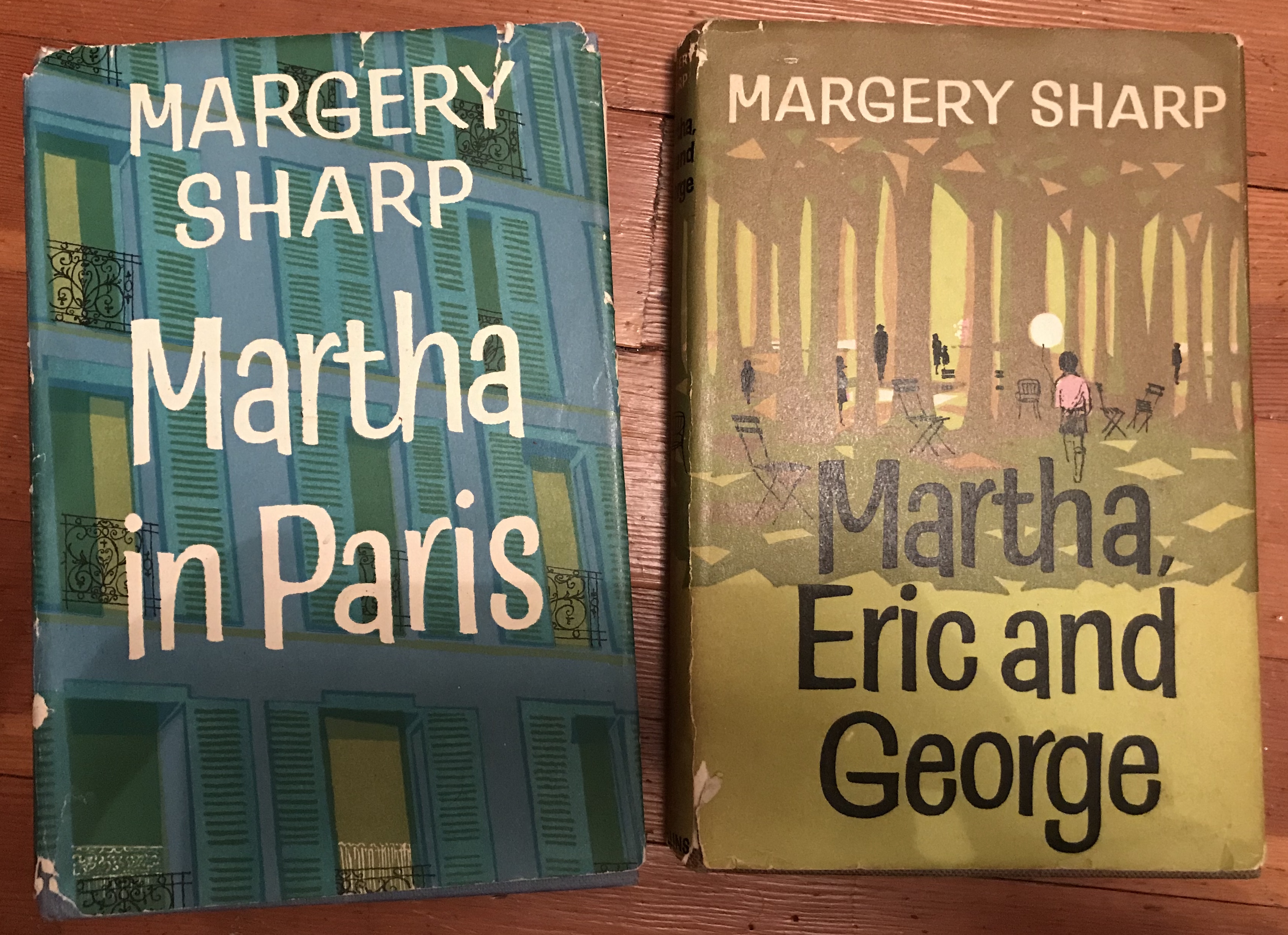
Two years ago I looked at The Eye of Love, which introduced the character of Martha, a strong-willed, self-possessed child. Sharp continues Martha’s story in two sequels, which I thought I’d look at today. These short novels work well individually but also when read together, as I did, the second giving more satisfying conclusion to the story.
Firstly, Martha in Paris (1962) which sees Martha aged 18, pursuing her art under the patronage of her childhood friend Mr Joyce, who recognises her for the genius she is and the future star she will become. He feels that to develop as an artist, she must go to Paris. Martha isn’t keen on Paris, but the prospect of staying forever with her sweet-natured Aunt Dolores means she agrees to go:
“Contrary to Mr Joyce’s prophesy, she learned to speak practically no French at all. She learnt to understand it; but […]it wasn’t as though she had anything she particularly wanted to say. The power of expressing thoughts, or emotions, was unnecessary to her; and not to be able to answer questions a positive advantage.”
Martha is still very much the stolid child we met in The Eye of Love. She is single-minded and focussed entirely on her work. She has feelings for a few people but they are deeply buried, clear-sighted and unsentimental. She is inexpressive because in the main other people are of no real consequence to her; she is indifferent to them and so has no need to seek an understanding with them.
She seems an unlikely candidate for love, but fellow Brit, bank clerk Eric Taylor falls for Martha. Or rather, he falls for who he thinks Martha is: a shy, self-effacing virgin like himself. Martha doesn’t deliberately mislead him, because she doesn’t really bother with him at all.
“Eric Taylor, in love, still wasn’t ready to make love. He felt himself he hadn’t yet quite got the hang…a parting pressure of the hand was the most he attempted; which upon Martha, who had a grip like a navvy’s, left no impression at all.”
Despite these inauspicious circumstances, their relationship develops because Martha is drawn to visit Eric and his mother at their flat, due to the prospect of nice bath. Now onto huge SPOILERS – if you don’t want to know, you’ll need to skip to the end of the post.
Inevitably, these two naïve people end up in a predictable fix: Martha gets pregnant. She carries on going to art class and doing well; she is overweight and wears baggy smocks so her pregnancy is easy to hide. She also decides that although she enjoys sex, she loves her work more, and so she is done with that side of life.
“It was time for Martha to gather her forces. No prospect had ever appalled her more, not even that of painting Christmas cards at Richmond, than this loyally-offered prospect of honourable matrimony.”
Martha is not an easily likeable character, as she disregards almost everyone she encounters. However, she never does this out of cruelty and never intends to hurt anyone. If you like Saga Noren from The Bridge (which I do), you’ll like Martha.
Some things have dated in Martha in Paris: a rather flippant treatment of the prospect of rape and a horrible racist phrase used in passing by one character. But in its treatment of sexual politics and gender roles it is remarkably progressive for its time. Martha is shown to find joy in sex without love. She is also shown to prioritise her career over all else. Sharp suggests that Martha behaves as men have done for centuries, and asks if we judge her harshly, are we doing so because she is a woman who resolutely fails to fulfil traditional gender roles?
Sharp continues to expand on the theme of gender expectations in the sequel Martha, Eric and George (1964); as a comic writer she does this explicitly but with wit so it’s never didactic.
“Young men are not accustomed to being loved and left, abandoned to bear alone the consequences of their folly, just as if they were young women.”
But this is exactly what happens to Eric Taylor. Martha leaves the baby with him and his mother to be raised, while she returns to England to focus on her painting.
“No dashing hussar abandoning a village maiden could have behaved more cavalierly. Not that Martha was in any other sense dashing, far from it; her outstanding characteristic was rather a blunt stolidity which only Eric in his innocence could have seen as virginal shyness.”
His mother, as Martha foresaw, embraces this new challenge to become a doting grandmother. She also revels in her status as rescuer of a poor abandoned baby.
“There were no such compensations for Eric. For once, it was the man who paid.”
Martha meanwhile, has become a hugely successful artist. Events conspire to send her back to Paris ten years after she left her son on the Taylors doorstep. She has no plans to see Eric or her son ever again, but of course things work out otherwise. George has grown up very much like his mother in temperament: self-possessed and single-minded. Martha has no maternal feelings whatsoever.
“She desired neither husband nor lover, nor to be admired, nor to make other women envious. All she wanted was to be unencumbered.”
What will happen to this disparate trio? I think Sharp is brilliant at endings: things work out well, without diminishing the characters or retreating into sentimentality. Martha, Eric and George was no exception to this.
To end, a sentiment with which Martha would certainly not agree:
I don’t normally do book haul posts but I thought I would just this once, to celebrate the end of my 2018 book-buying ban, which much to my amazement I stuck to for the entire year – not one book did I buy. (Actually, that’s not strictly true, I bought 6 books during the year, but all for other people, and not in a cheating I’ll-read-this-first-then-give-it-away-and-claim-it-was-a-present-all-along way, honest!)
But before I sound too smug (and I do feel pretty smug tbh, I have terrible willpower and never manage to stick to any resolution), it wasn’t a total success. The aim of the ban was for me to read the unread books I own, as my flat was starting to look like this:
There’s definitely a vast improvement, but the discovery of the library fiction section and a terrible reading slump in the latter part of the year meant I didn’t get through as many books as I hoped. So while the ban is over I’m planning to still try and exercise some restraint and get that TBR pile down further.
Anyhoo, on 1 January I ordered some books online which are winging their way to me, and then yesterday, for the first time in over a year, I set foot in the lovely bibliophile’s crack den charity book shop which is almost directly opposite my flat. This is what I came away with:
Yes, 10 books is me exercising restraint. You can see where the need for the ban came from, can’t you? And to be honest, I’m slightly regretting not buying the five or so (OK, it was more like 15) books I additionally considered but returned to the shelves because I am a whole new woman.
The first thing that caught my eye was this little collection of mini-plays by Michael Frayn, out on display because it was in a gimmicky sleeve and who’s going to fall for that and decide they immediately need this book? *cough*
I enjoy reading plays and Michael Frayn is a safe pair of hands, so I think this will be fun.
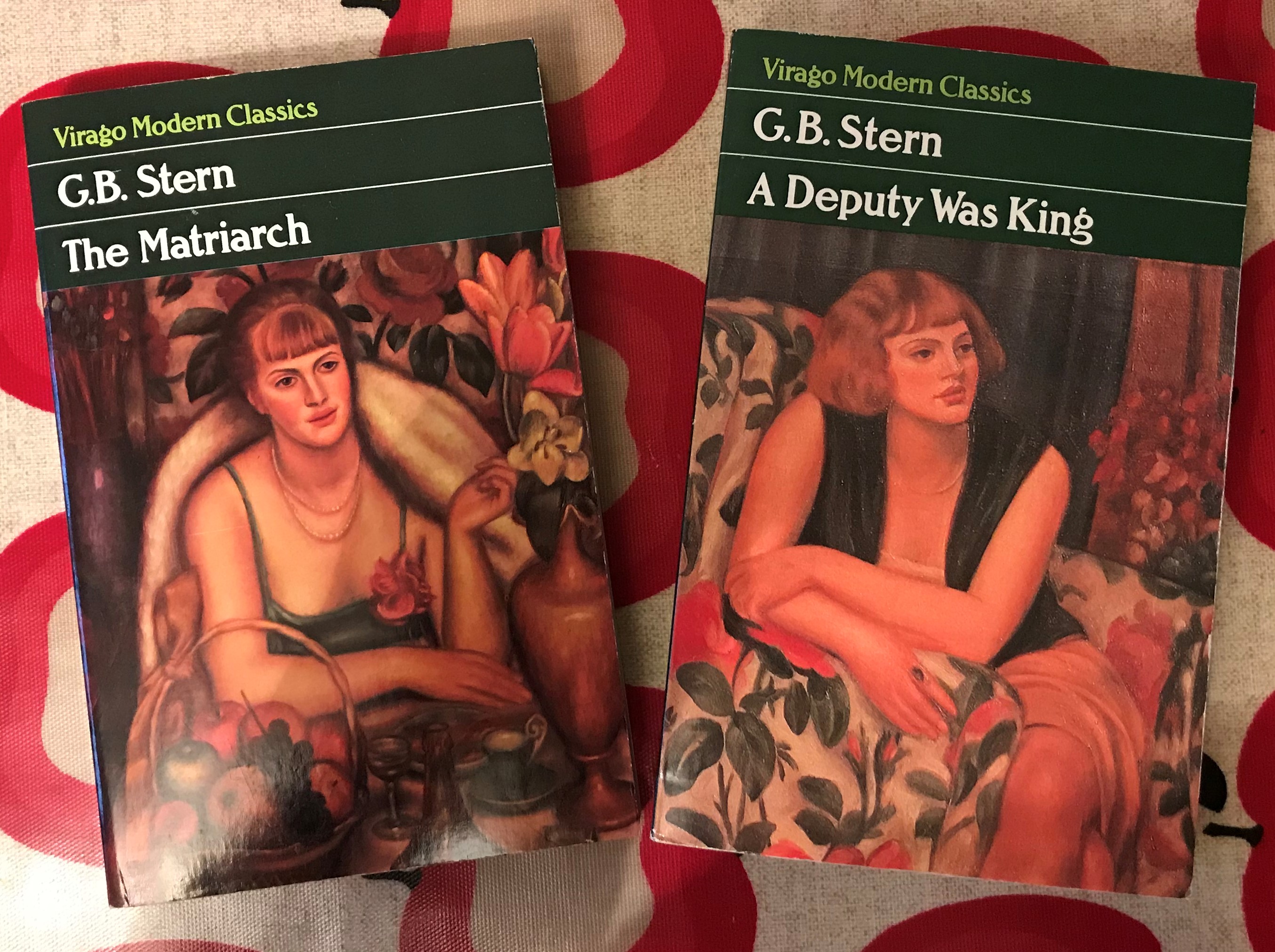
One of the many joys of charity bookshops is hunting down those green Viragos, and I found a lovely pair of GB Sterns in great condition. I’ve never read any GB Stern but I remembered her name from Jane at Beyond Eden Rock’s Birthday Book of Underappreciated Lady Authors. Part of my new-found restraint would generally include not buying more than one book by an author I’ve not read, but that lasted all of 5 minutes. They were green Viragos! In lovely condition! My willpower can only take so much…
These are the first two in the Rakonitz chronicles and the blurb on the back is really tempting, so I’m looking forward to these.
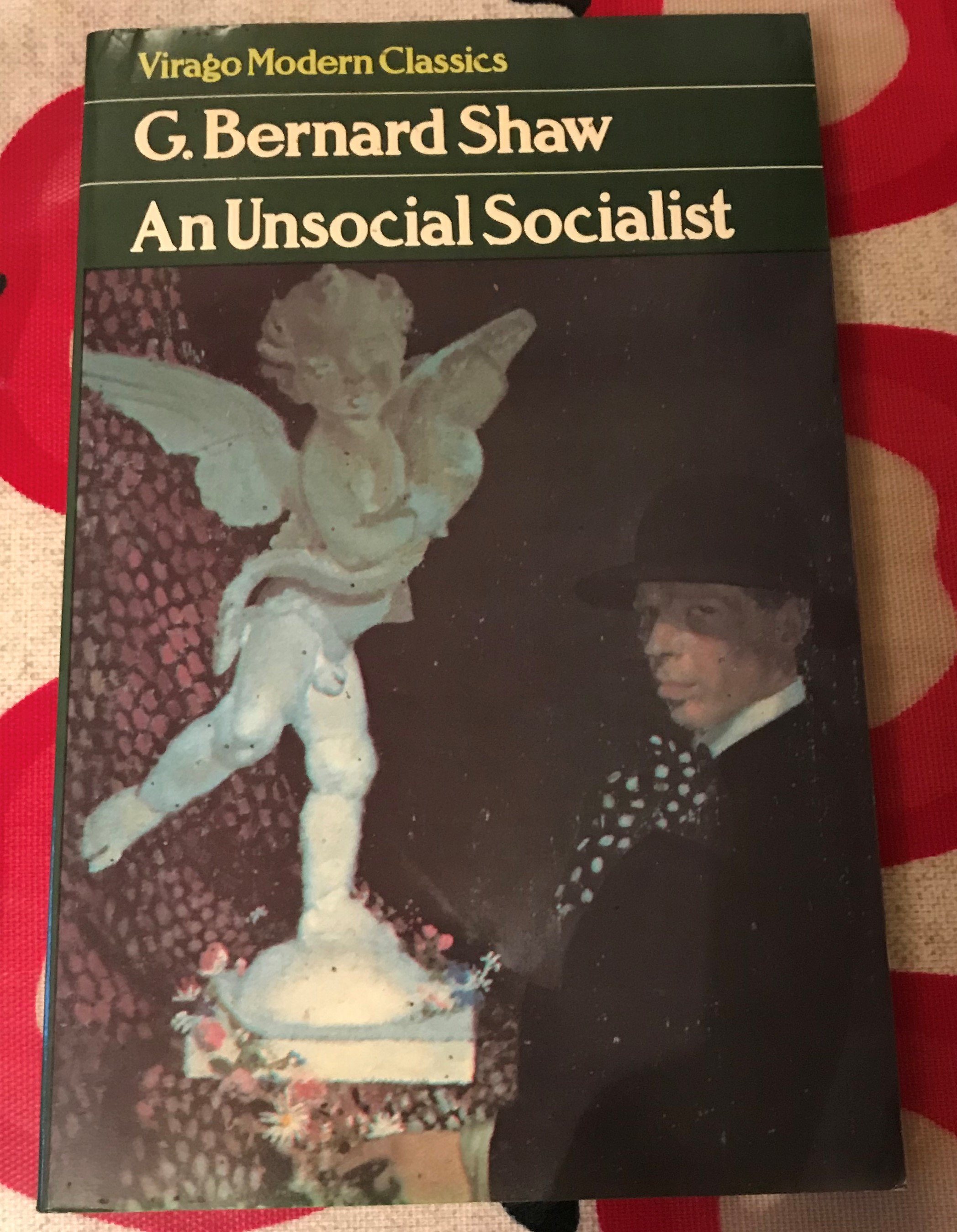
I bought one more green Virago:
I’m not a massive fan of Shaw but the blurb on the back says ‘Shaw’s view was that the false idealisation of women by men enslaved both sexes’ and he’s dismantling this in a comic way, so maybe this will be where I learn to like him.
Sticking with the theme of buying books because I trust the publishers, I picked up these by NYRB and Peirene:
The Delius is apparently a single 117-page long sentence, which frankly sounds horrific, but I trust Peirene and the translator is Jamie Bulloch who does great work so I’m still hopeful. And I do love a novella, which leads me to these:
The Auschwitz Violin, to my cynical mind, looked like an awful lot of other books with similar titles/themes which publishers love, but its novella length means I’ll give it a go, and it does look promising. The Vesaas I’ve never heard of but the reviews quoted on the back cover are rapturous and I enjoy Scandinavian literature so I’m looking forward to this.
Finally, I was pleased to come across Jill by Philip Larkin because Ali’s review last month reminded me that I wanted to read some of Larkin’s prose. Infuriatingly, that mark on the cover was caused by me trying to peel a label off, which I did carefully but it still damaged the cover:
When I’m in charge of the world, stickers will be banned from book covers, that’s a promise. Then I’ll try and sort out world peace and stuff, it’s all about priorities 😀
So, that’s my first book haul of the year! Looking back on the 2018 ban I would say I’ve learnt these things:
At the ripe old age of 41 I can still surprise myself
I might actually have some willpower after all
Its satisfying to see the TBR diminishing
I’m never going to not have piles of books
Which means I need to move somewhere with really cheap property prices to house them all
I still can’t be trusted in a charity bookshop
How about you, dear reader? Any bookish resolutions for 2019? Have you read any of my haul? Where would recommend I start?
Here’s to a wonderful year ahead with many great reads for all of us 😊 Apropos of absolutely nothing, but just because I’ve been listening to her a lot since 2019 started, here is Kate Bush doing a reggae cover of an Elton John song whilst playing a ukulele*. Because she can, because she’s awesome:
A definite theme of the blog this year has been me being late for reading events. This will probably be my final post of 2018 so it’s apt to end on yet another belated entry, this time for Rebecca West Day in Jane at Beyond Eden Rock’s Birthday Book of Underappreciated Lady Authors, which was 21 December.
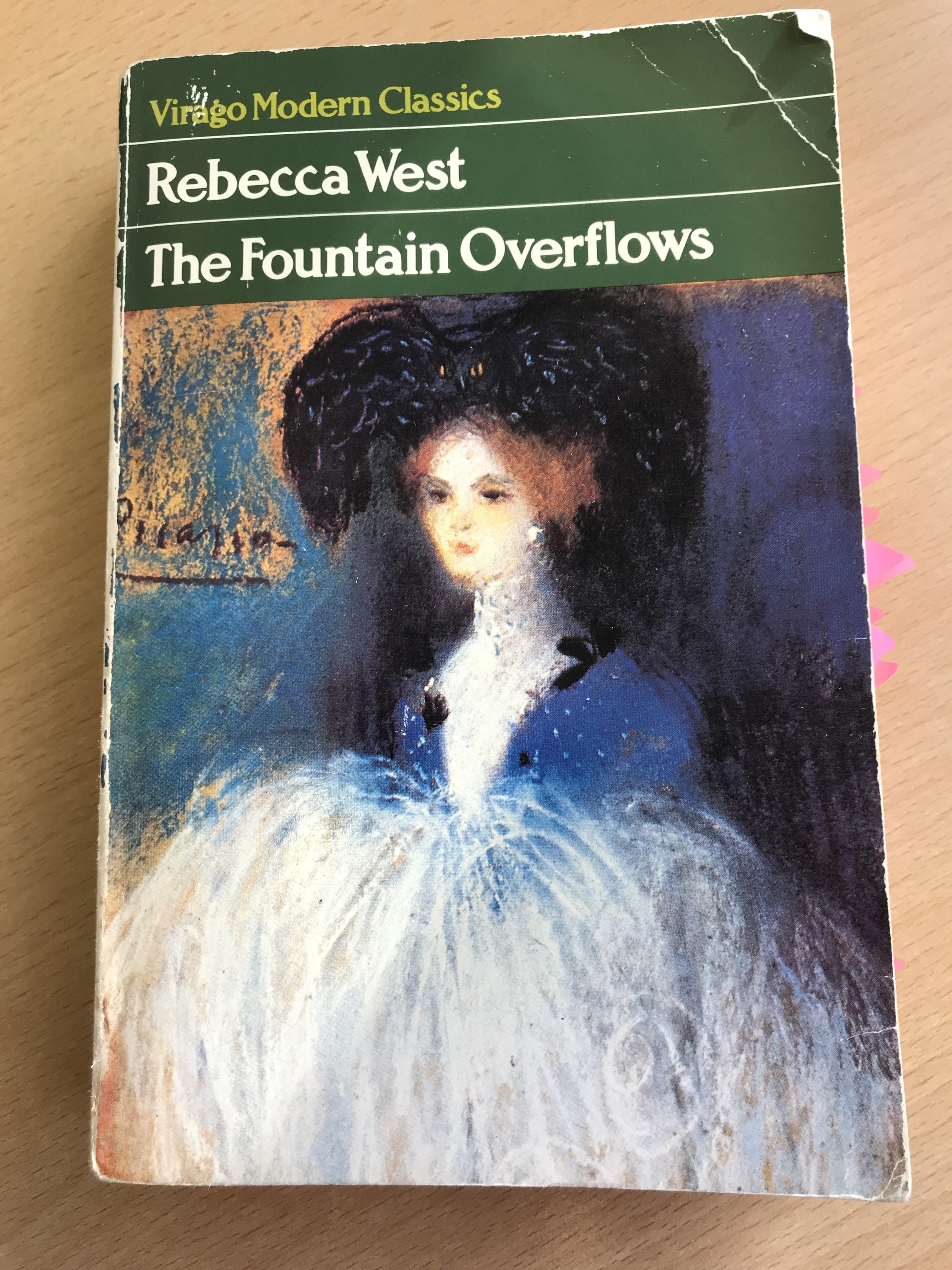
I’d hoped to do a post on two books, but the second half of this year has also seen me sluggish in both reading and blogging, so it’s just the one novel, The Fountain Overflows (1956), the first in the trilogy about the Aubrey family.
The story starts in 1900 and is narrated by Rose, one of four children of Piers and Clare. Piers is a gambling addict, and so although he and his wife are from genteel backgrounds, they survive on the brink of absolute destitution. The children grow up moving from place to place.
“We were experts in disillusion, we had learned to be cynical about fresh starts even before we ourselves made our first start”
Despite this, the children are not timid or anxious, but rather self-reliant and independent. Their mother is devoted to their father, as they all are, and the children clear-sightedly see their struggles.
“But I did not trust her. I loved her. Still I could see that she had been tripped by the snare of being grown up, she lay bound and struggling and helpless […] we children could always deceive her. Had it not been so we could not have provided for her happiness half as well as we did.”
West achieves a delicate balance in the portrayal of the Aubrey adults. It would be very easy to create to caricatures of a selfish, wastrel father and downtrodden female victim:
“ ‘Oh I am getting old and ugly, but it is not that. I cannot compete with debt and disgrace, which is what he really loves.’ “
Yet Clare never seemed especially weak to me. Her focus is music, and this takes priority over everything else. Rose and her sister Mary are gifted and practice incessantly, their brother Richard Quin is also talented but more interested in juggling and sports; their poor sister Cordelia has no talent and refuses to acknowledge it, egged on by a music teacher who is in love with her and so blind to her faults.
The Aubrey household is an intellectual one, with priorities very different to those around them in the south London suburb where they live.
“’You are allowed to read the newspapers now. I hope you will not attach too much importance to them. They give you a picture of a common-place world that does not exist. You must always believe that life is as extraordinary as music says it is.’”
West can be a colourful writer and there are elements of that here, with supernatural events and poltergeists related as matter-of-factly as trips to the House of Commons and music concerts. There isn’t a strong over-arching plot but enough to pull the reader along. The story has sadness in it, as any family with an addict in it will know, but it is not depressing because Rose’s voice is strong, unapologetic and funny in it’s unblinking assessment of those who surround her:
“Her colouring recalled a doll left out in the rain, she had the dislocated profile of a camel”
However, as a reader I found it very hard to indulge Piers as much as his wife and children did. To me he was utterly selfish and self-focussed even without his gambling, without the slightest scruple as to the risk he placed his family in.
“I had a glorious father, I had no father at all.”
The Aubrey’s practical cousin Rosamund and Aunt Constance frequently live them as they are also subject to a husband who refuses to provide, although in a very different way to Piers. There is plenty here about what led to first-wave feminism in the UK without being didactic. The men are fairly appalling but not judged harshly (except by me). Rather, West’s focus is the constraints which prevent women being able to sort things for themselves. There’s also a recurring focus on women’s clothes and how the start of the twentieth century saw female oppression made explicit through the fashions:
“ ‘Any tragic scene in those days necessarily appeared grotesque, because of the clothes worn by the women […] Today she would have the right to look like that, plain and distraught and like a hen, but she was compelled by the mode of the day to make herself as absurd as a clown by wearing a hat the size of a tea-tray, which dipped and jerked and swayed as often as she did, which was perpetually.”
Hence the Virago cover:
All in all I greatly enjoyed meeting the idiosyncratic, independent-minded Aubrey family. The characters were wholly believable, the evocation of a lost time done without nostalgia, and West had plenty to say about wider Edwardian society. I’ll look forward to spending more time with the Aubreys through the two sequels.
“We had very often been sharply warned against sentimentality, and though we might have been able to define it only vaguely as the way one should not play Bach, we recognised it.”
And so it just remains for me to wish you all the festivities of your choosing and leave you with a non-Christmassy song (because you may well be sick of them by now) from a great Christmas film which I watched yesterday, Scrooged:
Today is Rumer Godden Day in Jane at Beyond Eden Rock’s Birthday Book of Underappreciated Lady Authors. I’m so grateful that this prompted me to read the two by Godden I had in the TBR, as she’s quickly become a new favourite. Godden is such an accomplished writer; her books are so readable and her use of language is stunning.
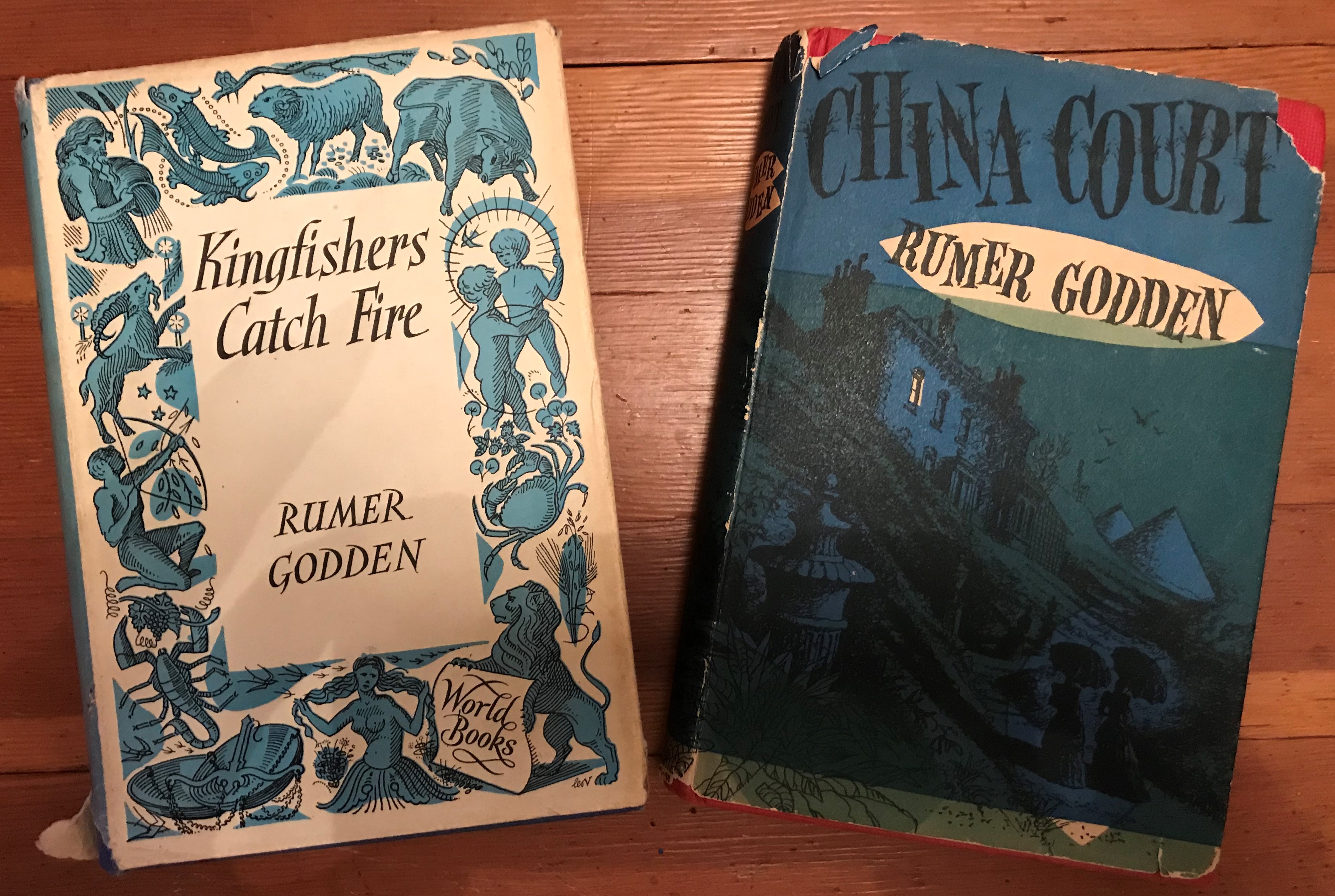
Firstly, Kingfishers Catch Fire (1953), which I started reading with some trepidation. I expected a novel about a 1950s English woman living in India to be filled with white entitlement and comic/exoticised portraits of the locals. Thankfully, Godden is far too sophisticated an author to do anything so crass, and the comic portrait is resolutely reserved for the clueless but well-meaning white foreigner, Sophie.
“To the Pundit, Sophie was precisely like any other European or American, only more friendly; the friendliness alarmed him. ‘These people are poor and simple…’ he began, but Sophie interrupted him.
‘We shall be poor and simple too,’ she said with shining eyes.
[…]
Sophie would not listen. Like many people there were some words about which she was sentimental; one of these was ‘peasant’. ‘Peasants are simple and honest and kindly and quiet,’ she said. ‘They don’t want what they don’t possess. They have the wisdom to stay simple. They don’t want to change.’”
This idealistic young woman crashes into Kashmir with her two children, estranged from her husband and determined to establish a life for herself. Yet the portrait of Sophie is a subtle one: she is oblivious to the needs of her children and to the cultural differences between her and her neighbours, but somehow not arrogant, just hopelessly naïve.
“Teresa could not count how many times they had moved, but each time the small ballast of hopes and plans they had collected was thrown overboard and everyone they had known was left behind.
Moo did not care. Like a little seed that is blown and can grow anywhere, on a rocky ledge, in a crack of earth, he lived a contained contented small life of his own no matter where he went. To Moo it did not matter but Teresa had roots, they were tender, soft and trailing…”
Poor Teresa. She is sensible and understands so much more than her adult parent. She also cares for Moo, who is probably on the autistic spectrum and in his own world.
In describing how Sophie and her children live in Kashmir, Godden adopts an interesting approach by having the story interjected with later reflections from Sophie and her family. So the narrative will be interrupted with comments like “‘But you were not qualified to teach Urdu,’ said Toby afterwards.” It’s not a technique I’ve seen before and it doesn’t jar as much as I would expect. The effect is to temper Sophie’s idealism and blind actions. It works to offset what sceptical readers (ie me) might be thinking: ‘but that’s just ridiculous, she’ll never make that work…’ etc. It keeps the story grounded even when the main protagonist ricochets from one ill-conceived action to the next.
Godden wrote Kingfishers Catch Fire based on her own experiences of India and her love of the land is obvious:
“There were no ceilings, only cross beams stuffed with dried furze as in most Kashmiri peasant houses. There was no glass in the windows, only hanging window shutters, no water system of course, no lighting, but it was a rarely beautiful little house. In summer it was hung with vines and honeysuckle and white-scented roses, and all around it were flowering trees….Above it all the mountain reared its head while below, lay the lake and its reflections and, far, the horizon of snow peaks.”
The plot is a deceptive one. I was enjoying what I thought was comic novel about the escapades of a fairly clueless woman; then suddenly things took a very dark turn and I found myself racing towards the end, desperate to know what happened and for things to work out well.
I loved the ending. This pithy comment on stealthy imperialism summed it up for me:
“The missionaries worked for the people but did not respect them. For all their love and zeal the wanted to bend them, bend them out of their own truth”
The message I took from Kingfishers Catch Fire was one of resolutely sticking to your own truth, whilst acknowledging and respecting other people’s. I just loved it.
Behold my slightly battered, kitschy-covered editions:
Secondly, China Court (1961). This is another story of a dilapidated house and the woman who loves it, but otherwise very different to Kingfishers Catch Fire. The titular pile is the Victorian home of five generations of the Quin family set in the Cornish moors and built on the proceeds of china clay works.
“When one of the…rose bowls or vases is rung it gives off a sound, clear, like a chime, the ring of true porcelain, so China Court gives off the ring of a house, a true home.”
The story begins with the death of Mrs Quin, the matriarch who has resolutely stayed in China Court against all her family’s wishes (except her granddaughter) and looks at what happens after her death as her family besiege the house for the reading of the will.
The story moves back and forth across the generations. There is no indication when this will happen; scenes cut between the various family members, all in present tense. Again, this stylistic experiment doesn’t jar nearly as much as I would expect. Instead it captures a sense of the house holding all the members of the family at any one time, the echoes of their steps and their voices all layered upon one another.
“Homes must know a certain loneliness because all humans are lonely, shut away from one another, even in the act of talking, of loving. Adza cannot follow Eustace in his business deals and preoccupations as she cannot follow Mcleod the Second or Anne or Jared – no one can follow Eliza. Mr King Lee, kissing Damaris, has no inkling of the desolation he has brought her, just as Groundsel only half guesses Minna’s; Jared hides himself from Lady Patrick, and John Henry and Ripsie, in their long years together are always separated by Borowis
[…]
Loneliness can be good. Mrs Quin learns that in the long companionship of the years after Tracy goes, when she and Cecily are alone in the house; companionship of rooms and stairs, of windows and colours; in the gentle ticking away of the hours, the swinging pendulum of the grandfather clock. ‘I was happy,’ Mrs Quin could have said. Contented loneliness is rich because it takes the imprint of each thing it sees and hears and tastes”
This for me was the central theme of China Court: the value of everyday domesticity. The characters who recognise it are fulfilled and live rich lives that outwardly appear narrow but in reality connect with something fundamental that enables a wider kinship with others.
The portraits of the individuals run seamlessly and as the novel progresses they weave together for a complex depiction of family, and how histories are cyclical, building on what has gone before.
Mrs Quin is an avid gardener, and as in Kingfishers…there are beautiful descriptions of the natural world, but also of food and the various meals the family have taken together over the years.
“Now Cecily brought in saffron cake, buttered scones hot in a silver dish, brown bread and butter thin as wafers, quince jelly and strawberry jam from China Court quinces and strawberries; she had made shortbread, fruitcake and because Tracy likes them as a child, thin rolled ginger-snaps filled with cream.”
Gradually the family histories build towards a brilliant denouement in the present day of the novel. It’s dramatic but believable and once again I found myself racing towards the end. And the end is where I encountered my first reservation about Godden’s writing. To discuss it I’ll have to include a SPOILER so skip to the end of this paragraph if you don’t want to know. Here it is: an act of domestic violence takes place, an act which is quickly forgiven and leads to sex. I think it’s a dramatic device to shock a couple who aren’t communicating well (a recurring theme in the novel) towards honesty and resolution, but reading this almost 60 years after it was written was just horrible. I know from films of the time that slaps and spankings were freely given, but I’d be very surprised if this worked for modern readers.
This one incident aside, China Court is a wonderful portrait of a house and a family, beautifully evoked and fully realised with fondness but without sentimentality.
“ ‘We were truly kin,’ says Mrs Quin, and it is true that Tracy is like her grandmother in many ways; for instance, both, from the moment they first see it, are enslaved by China Court.”
To end, regular readers will know there are no depths to which I won’t sink in order to shoehorn in an 80s pop video. So please pardon the pun that has enabled my childhood hair icons to be this week’s choice:
Yet again I’m posting late for a readathon. I hope Caroline at Beauty is a Sleeping Cat and Lizzy at Lizzy’s Literary Life I will allow for my tardiness with this late entry for German Literature Month 2018. I really need to get a grip on my blogging!
I had a couple of DNFs in my reading for GLM 2018, which really isn’t like me. One novel I suspect will never be for me, the other I think just the timing was wrong. Either way, it was with some relief that I turned to the safest of hands, Stefan Zweig, to finish my GLM reading on a high.
In Fantastic Night and Other Stories (1906-1929 trans. Anthea Bell 2004) the wonderful Pushkin Press have collected together five of Zweig’s short stories which are compulsively readable. I don’t want to say too much as Zweig is such a subtle writer that the joy, I think, is going into his writing without an idea of plot or subject, to just see how he unfurls a story of such beauty and psychological insight before you. So I’ll just give a flavour of the first two, the longest in the collection.
In the titular story, a series of events in one evening sees a nihilistic playboy learn the value of living beyond one’s own pleasures:
“Those yearnings that then stirred unconsciously in me at many moments of half-realisation were not really wishes, but only the wish for wishes, a craving for desires that would be stronger, wilder, more ambitious, less easily satisfied, a wish to live more and perhaps suffer more as well.”
Such is the skill of Zweig’s writing that this spoilt and vacuous man undergoes a transformative experience without it seeming rushed or contrived.
“Life is a great and mighty phenomenon and can never be hailed with too much delight. It is something only love grasps, only devotion comprehends.”
Letter From an Unknown Woman I knew from the Max Ophuls 1948 film, starring the luminous Joan Fontaine (some kind soul has uploaded the whole thing to YouTube here); I had no idea it was based on a Zweig short story.
The premise is as simple as the title suggests: a man receives a letter from a woman he has no memory of, proclaiming her enduring love for him. Her young son has died from influenza and she is writing a letter to him to be sent after she has also succumbed to the virus.
Once again, Zweig manages a feat of characterisation. A woman spends her life devoted to a man who does not know of her existence: how is she not a doormat, the tale ridiculous and sentimental? Primarily because the woman is determined and unapologetic. She has a strength that comes through so clearly and is undeniable.
“I know that what I am writing here is a record of grotesque absurdities, of a girl’s extravagant fantasies. I ought to be ashamed of them, but I am not ashamed, for never was my love purer and more passionate than at this time. I could spend hours, days, in telling you how I lived with you though you hardly knew me by sight.”
She never makes excuses, for her life spent in this unrequited state or for her work as a prostitute, which she views as reasonable and profitable for her. She also does not make excuses for the object of her affection, who she sees clear-sightedly:
“You did not recognise me, either then or later. How can I describe my disappointment? This was the first of such disappointments: the first time I had to endure what has always been my fate; that you have never recognised me. I must die, unrecognised […] I understand now, (you have taught me!) that a girl’s or woman’s face must be for man something extraordinarily mutable. It is usually nothing more than the reflection of moods which pass as swiftly as an image vanishes from a mirror.”
She is also never bitter. There is no regret or rancour in her words. She chose her love, and lived it as fulfilled as it could be, given the man it was for:
“You care only for what comes and goes easily, for that which is light of touch, is imponderable. You dread being involved in anyone else’s destiny. You like to give yourself freely to the world – but not to make any sacrifices.”
These words are not angry, but just stating fact. Zweig demonstrates why she loves him, what makes him compelling to her, and why these same traits mean he can never love her back.
Zweig’s short stories are masterful. How he manages to get so much telling detail, such beauty and such insight into such economical writing is truly astonishing.
Secondly, Beware of Pity (1939) which was Zweig’s longest work, telling the story of the soldier Anton Hofmiller, who asks a young girl to dance at a party in the second decade of the twentieth century, unaware that she has a spinal cord injury which means she walks with braces and crutches.
“I had never been deeply moved by anything…Now, all of a sudden, something had happened to change me – nothing outwardly visible, nothing of any apparent importance. But that one angry look, when I had seen hitherto unsuspected depths of human suffering in a lame girl’s eyes, had split something apart in me, and now a sudden warmth was streaming through me, causing mysterious fever that seemed to me inexplicable…All I understood of it at first was that I had broken out of the charmed circle within which I had lived at my ease until now, and I was on new ground which, like everything new, was both exciting and disturbing.”
Out of pity, he repeatedly visits Edith Kekesfalva and is drawn into her life, and that of her father, a rich man driven to distraction over the fate served to his daughter:
“His obstinacy, his egocentric obsession, as if nothing in this world, which is full to the brim of unhappiness anyway, exists but his own and his child’s misfortune”
Hofmiller is callow; he doesn’t know what to do with the situation he finds himself in. The family doctor, Dr Condor, tries to warn him:
“pity is a double-edged weapon. If you don’t know how to handle it you had better not touch it, and above all you must steel your heart against it.”
But Hofmiller blunders onwards into more than one “compassionate lie” which will see all their lives unravel. How he behaves is completely believable, completely understandable, and completely devastating. For the modern reader who may not make such ableist assumptions as Hofmiller, certain situations that he crashes into seem to a certain extent avoidable, but he is naïve and well-meaning and completely oblivious.
Beware of Pity is a devastating read. The title warns of impending tragedy, but Zweig takes it a step further, by framing the story as a man looking back over what happened to a time before World War I, when World War II is just about to start. He shows how such notions of pity, honour and tragedy become swallowed whole under the terror and mass devastation of mechanised warfare. Ultimately though, Zweig suggests the need to keep hold of our humanity in such circumstances, however painful it may be.
“There are two kinds of pity. One, the weak and sentimental kind, which is really no more than the heart’s impatience to be rid as quickly as possible of the painful emotion aroused by the sight of another’s unhappiness, that pity which is not compassion, but only an instinctive desire to fortify one’s own soul against the sufferings of another; and the other, the only one at counts, the unsentimental but creative kind, which knows what it is about and is determined to hold out, in patience and forbearance, to the very limit of its strength and even beyond.”
To end, an Anglophone artist who was hugely influenced by German culture, singing one of his most famous songs in German:
Oh dear, I still haven’t quite got my blogging momentum back. I planned a few posts for German Literature Month 2018, hosted by Caroline at Beauty is a Sleeping Cat and Lizzy at Lizzy’s Literary Life but here we are at the end of the month and this is my first. Somehow I have a feeling improving my blogging is definitely going to feature on my New Year’s resolution list…
It certainly isn’t lack of good reading that is the cause of my blogging dip, as I really loved Zbinden’s Progress by Christoph Simon (2010, trans. Donal McLaughlin 2012), from the ever-reliable publisher AndOtherStories. It also fits with my love of novellas at only 172 pages long, and is one more stop on my Around the World in 80 Books Reading Challenge, hosted by Hard Book Habit, as much to my own surprise, I’ve not been to Switzerland yet.
The premise of the novel is incredibly simple: octogenarian widower Lukas Zbinden is walking down the stairs of the retirement home where he lives, holding onto the arm of a new carer, Kazim. As they make their way down seemingly interminable flights, Lukas recounts his life. Kazim is a silent interlocutor, as you feel many people are with Lukas Zbinden. He was happily married, to a woman who converted him to the joys of walking, although she preferred country walks and her irrepressible husband prefers sociable city walks:
“Emilie always said the one really essential thing was to remain lively, active and interested, and always open to whatever’s going on both in nature and within oneself. We could talk much more about that Kazim, if we went for a walk.”
“Emilie liked trees standing randomly in a landscape; I like trees in rows. I’ve nothing against cow pastures being built on, even to be replaced by hangars and shopping streets providing free entertainment. I yearn for tranquillity but can’t actually bear it.”
Lukas is an entertaining, endearing man although not without his faults. He is still fully engaged with life, enjoying the people he shares the home with, poking his nose into their business, and trying to convert everyone to the joys of ambulation.
“Do you know what it means to go for a walk? Going for a walk is acquiring the world. Celebrating the random. Preventing disaster by being away.”
He’s also aware of his own failings, and the progress of the title is psychological as well as physical. He misses his wife, he knows his relationship with his son isn’t that great, and he’s trying to be a better person.
“Emilie was so full of beautiful things she could share with others. Her whole life was sharing with others, just as I wish that for my own life. Believe me when I say that, it’s why I’m working on becoming inwardly rich. So that every time I’m with someone, I can share something with that person.”
Zbinden’s Progress was just the right book at the right time for me. Things are pretty bleak right now – watching the news is an endurance task. This novella is sweet but not sentimental, life-affirming but realistic. The overall message is that it’s never too late to reach out to people, to enrich your life and theirs with a connection. It’s also about how love, in its many forms, endures. And it’s about finding the right hobby:
“What counts is that you have the right leisure activity. An activity with which you can live when it gets very dark; that gives you support in the face of major challenges; for which there are no requirements in terms of age and ability; that requires no proof of an unimpaired ability to think; an activity during which you can die peacefully.”
Sounds like reading to me (so long as the dark is metaphorical not literal).
Zbinden’s Progress is funny and sad, but more the former than latter. It is about simple joys, and about finding what for you makes a life well lived.
“the end of my path is becoming more and more identifiable. I’ve started taking my leave of people, but they tell me it’s still too early for that.”
If I’ve failed to give you a good sense of this book, perhaps this will help – a pictorial representation by the author, helpfully enclosed with my copy:
Secondly, a book I read mainly for curiosity value, ThreePenny Novel by Bertolt Brecht (1934, trans. Desmond I Versey with verses trans. Christopher Isherwood, 1937). I know Brecht mainly as a playwright, and I’ve seen ThreePenny Opera a few times so I was curious to see what he did with the characters in novel form.
Macheath, ‘Mack the Knife’ is still the main focus, his famous activities of the ThreePenny Opera shrouded in rumour as he has established himself as a businessman, running a series of ‘B Shops’ which sell stolen goods incredibly cheaply. Brecht was a Marxist and his work is undoubtedly didactic, but he does it with bone-dry humour:
“years obscured by that semi-darkness which makes certain portions of the biographies of our great businessmen so poor in material; ‘giants of industry’ usually seem to rise, suddenly and astonishingly, ‘straight up’ out of the darkness after so-and-so many years of ‘hard and necessitous life’ – but whose life is usually not mentioned.”
Another businessman is Peachum, Polly’s father, who manages a group of professional beggars, ruthlessly and cynically:
“After a victory one must send out mutilated, dirty, miserable soldiers begging; but after a defeat they must be smart and clean and spruce. That’s the whole art.”
Polly marries Macheath, and Peachum is not happy. He wanted her to marry a man named Coax, who is organising a shipping scam to rip off investors and the Navy.
“His daughter was to blame for everything. Through her boundless sensuality, doubtless inherited from her mother, and as a result of culpable inexperience, Polly had thrown herself into the arms of a more sinister individual. Why she had immediately married her lover was a mystery to him. He suspected something terrible.”
Everything and everyone is terrible in ThreePenny Novel. The corruption is relentless. The coveting and accumulation of money is the only motivator and is pursued without scruple, facilitated by the bankers and financiers. It is incredibly bleak: sociopathic Macheath rises to the top through entirely legal means.
In this world there is no room for morals, compassion, or consideration. I didn’t find it depressing though. ThreePenny Novel is a satire, and so it’s wry portrayal of people and events lightens it enough. I thought it was a bit overlong (as I nearly always do for anything over 200 pages) but on finishing the novel I did find myself questioning what I could do to be less of a cog in corrupt capitalist machines so it was certainly effective from the political point of view, comrades 😊
Brecht’s work may seem dated: a Marxist treatise set in late Victorian London. But I really don’t think it is. Judge for yourself if this still seems relevant:
“There are some people who have the capacity for remaining entirely uninfluenced by the feelings of others, who can remain completely immune from actualities and can speak their thoughts openly and freely, without regard for time and place. Such men are born to be leaders.”
To end, there was only one song I could possibly end on. Here it is in the 1989 version of The ThreePenny Opera (trigger warnings for mentions of rape, murder, blood, assault, and stylised violence):
This is my contribution to Margaret Atwood Reading Month, hosted by Naomi at Consumed by Ink and Marcie at Buried in Print. Do join in with #MARM!
As a teenager I fell in love with Atwood and read all her novels and short stories, most of her poetry and a collection of interviews. Then I’m not sure what happened, the MaddAddam trilogy didn’t appeal to me as much and I probably hadn’t read any Atwood since The Blind Assassin in 2000. In this year of my book-buying ban, I found I had two Atwoods in the TBR, so here they are.
Firstly, The Heart Goes Last (2015), my first Atwood in about 18 years, and from the first page I realised I needed her back in my life. She is such an accomplished writer that you know you’re in safe hands. She knows what she’s doing: the characters will be believable, the plot will carry you through, she has something important to say. What more could you want? This being Atwood, the story is terrifying, funny, and horribly believable.
Charmaine and Stan are living in their car. Time and place are unspecified, but there’s every reason to assume it’s now, in the United States. The recession has bitten and they have lost their jobs and their homes, along with many others. Poverty and deprivation have led to rising crime and they are at risk of violent attack. Unsurprisingly, their marriage is under strain:
“Charmaine says why don’t they go jogging? They used to do that when they had their house: get up early, jog before breakfast, then a shower. It made you feel so full of energy, so clean. But Stan looks at her like she’s out of her mind, and she sees that yes, it would be silly, leaving the car unattended with everything in it…and putting themselves at risk because who knows what might be hiding in the bushes? Anyway where would they jog? Along the streets with the boarded-up houses?”
Then one day, when Charmaine is working in a bar, she sees aa television advert for Positron. Positron offers a place to live and full employment.
“She can feel the griminess of her body, she can smell the stale odour coming from her clothes, from her hair, from the rancid fat smell of the chicken-wings place next door. All of that can be shed, it can peel off her like an onion skin, and she can step out of that skin and be a different person.”
Living in Positron means alternating one month in the town, one month in the prison called Consilience. Stan is from a tough background and his brother Con is a criminal. This means Stan is far from naïve, but he is also desperate:
“They’re like the early pioneers, blazing a trail, clearing a way to the future: a future that will be more secure, more prosperous, and just all-round better because of them! Posterity will revere them. That’s the spiel. Stan has never heard so much bullshit in his life. On the other hand, he sort of wants to believe it.”
Charmaine and Stan sign away their lives to the project – there’s no leaving once you’re in – and settle into their new lives. The aesthetic is an idealised 1950s Doris Day film, with surveillance. Gradually they both, in very different ways, begin to understand the dark side of the Positron project, and of each other.
“He hadn’t recognised it when they’d been living together – he’d underestimated her shadow side, which was mistake number one, because everyone has a shadow side, even fluffpots like her.”
The plot that develops is darkly comic, and deeply sinister. Needless to say, the uses of technology in Positron are not ethical, and the question is, where do you draw the line? The answers to this question become more and more murky as the novel progresses.
Charmaine and Stan are not always sympathetic but they are believable, including why they would sign their lives away. The rise of the far right in today’s politics can seem bewildering at best and terrifying most of time, but Atwood has Stan address the reason people support their freewill being circumscribed, in no uncertain terms:
“Not that he gives much of a flying fuck about freedom and democracy, since they haven’t performed that well for him personally.”
There’s also a great deal about gender politics in The Heart Goes Last. I can’t say too much about it for fear of plot spoilers, but I greatly enjoyed this pithy observation by Charmaine when she’s taken out for dinner by a powerful man who wants to seduce her:
“She blots the corner of her eye, folding the trace of black mascara up in the serviette. Men don’t like to think about makeup, they like to think everything about you is genuine. Unless of course they want to think you’re a slut and everything about you is fake.”
The ending is perfect: a twist that shows in miniature the broader themes of the novel, ending with an unresolved question for a character and the reader. It doesn’t allow a comfortable feeling of being in a better, wiser position than the characters but instead asks: when faced with a moral dilemma, do you really know what you would do?
Secondly, The Penelopiad (2005), a novella (hooray!) in which Atwood retells the story of Penelope, faithful wife of Odysseus (part of Canongate’s Myth Series). Penelope narrates the story from Hades. She was the faithful wife of Homer’s myth, but also had her eyes wide open with regard to her warrior husband:
“Of course I had inklings, about his slipperiness, his wiliness, his foxiness, his – how can I put this? – his unscrupulousness, but I turned a blind eye. I kept my mouth shut; or, if I opened it, I sang his praises. I didn’t contradict, I didn’t ask awkward questions, I didn’t dig deep. I wanted happy endings in those days, and happy endings are best achieved by keeping the right doors locked and going to sleep during the rampages.”
This captures much of the themes of The Penelopiad, that is, that Penelope’s feelings for her warrior husband are not straightforward, and also, that the story of events depends on who is doing the telling, what they leave in and what they miss out. The Odyssey is a cornerstone of Western civilisation, but it is not the only version. Penelope’s Odysseus is a wily cheat, far from heroic. Helen is a vain bitch:
“Of course, she was very beautiful. It was claimed she’d come out of an egg, being the daughter of Zeus who’d raped her mother in the form of a swan. She was quite stuck up about it, was Helen.”
When Odysseus is away fighting the Trojan War, Penelope runs his estates extremely well and keeps her suitors at bay. Her son Telemachus is a brat and Penelope feels more kinship with her 12 maids, many of whom she has known since they were babies. The maids form a Greek chorus throughout the story, speaking in verse between chapters. We know that Telemachus will kill them all on his father’s return, and Atwood is intrigued as to why these powerless (poor, female) people are treated so brutally:
“Let them dangle, let them strangle –
Blame it on the slaves!”
Penelope is shown as having to carefully navigate a position that sees her wealthy but powerless, having to pick her way through a minefield of social constraints that could see her branded a whore in her husband’s absence. Her faithfulness is not out of loyalty to Odysseus but self-preservation in a patriarchal society.
There are massive themes in this novella and they are as relevant as ever when the most powerful man in the world has a constant refrain of ‘fake news!’. By the end of The Penelopiad Penelope is shown to possibly not be a reliable narrator, but then, is anyone? Don’t we all have our own versions? Atwood reminds us that for each story told, it is worth considering what gain is to be made. And she does so with irreverent glee:
“Who is to say that the prayers have any effect? On the other hand, who is to say they don’t? I picture the gods, diddling around on Olympus, wallowing in the nectar and ambrosia and the aroma of burning bones and fat, mischievous as a pack of ten-year-olds with a sick cat to play with and a lot of time on their hands.”
Taking part in #MARM has made me check Atwood’s bibliography to see what I’ve missed: I’ve still got her three most recent short story collections, Hag-Seed and the MaddAddam trilogy to catch up on. I’m really grateful to #MARM for reminding me just how much I love her writing and giving me my Atwood impetus back again!
Happy Hallowe’en Everyone! I’m not really one for scary fiction as I’m far too easily spooked, but I have managed to find two books in the TBR that were perfect Hallowe’en reading and not too much for my delicate sensibilities.
Firstly, I finished The Bloody Chamber by Angela Carter (1979), her collection of short stories which rework the classic tropes of fairytales into Carter’s own disturbing, sexual, feminist, Gothic stories. I’ve written about The Snow Child, The Werewolf and The Tiger’s Bride before, but somehow not got round to finishing the collection. This year of the book-buying ban (nearly finished!) is all about ploughing through the TBR pile so this was a good opportunity to get the collection dusted off and finished.
Angela Carter is a writer people have strong feelings about, so I’ll start with a disclaimer: I am firmly in the ‘for’ camp. I think she’s brilliantly inventive, political, funny and deeply unnerving. I never find her comfortable read, and I love that. So if you’re in the ‘agin’ camp you might want to skip through to my second choice of David Mitchell 😊
If you’re a fan like me, The Bloody Chamber will give you all you desire. The titular story is a heady mix of sexual awakening and mortal danger as a young woman marries an older French Marquis (natch):
“For the opera, I wore a sinuous shift of white muslin tied with a silk string under the breasts. And everyone stared at me. And at his wedding gift.
His wedding gift, clasped around my throat. A choker of rubies, two inches wide, like an extraordinarily precious slit throat.”
The story is a retelling of Bluebeard, but as the woman is a Carter heroine, she is not a naïve virgin wandering blindly into a danger but someone who understands more than she knows, and she knows that there is something very wrong with her husband:
“I felt a strange, impersonal arousal at the thought of love and at the same time a repugnance I could not stifle for his white, heavy flesh that had too much in common with the armfuls of arum lilies that filled my bedroom in great glass jars, those undertakers lilies with the heavy pollen that powders your fingers as if you dipped them in turmeric. The lilies I always associate with him; that are white. And stain you.”
I don’t think it’s too much of a spoiler to say Bluebeard doesn’t quite have things work out for him the way he hoped. Carter uses the retelling of familiar tales to give women agency: they are not there to be eaten by wolves, seduced by royalty when unconscious, or rescued by a heterosexual love interest. Neither are they the pure-as-snow heroines who survive to enter marriage; when they survive it is as women with complex motives and strategic means of never relinquishing control. They are to be reckoned with.
If this sounds didactic, it really isn’t. Carter never loses sight of spinning a good yarn, and she does so with humour. This is most apparent in Puss in Boots, a first person narrative voiced by the eponymous feline, a cheeky servant who does his master’s bidding while never losing sight of his own ends:
“So Puss got his post at the same time as his boots and I dare say the Master and I have much in common for he’s proud as the devil, touchy as tin-tacks, lecherous as liquorice and, though I say it as loves him, as quick-witted a rascal as ever put on clean linen.”
Puss also recalls The Barber of Seville, in comic exuberance, machinations, and names:
“Figaro here; Figaro, there, I tell you! Figaro upstairs, Figaro downstairs and–oh, my goodness me, this little Figaro can slip into my lady’s chamber smart as you like at any time whatsoever that he takes the fancy for, don’t you know, he’s a cat of the world, cosmopolitan, sophisticated; he can tell when a furry friend is the Missus’ best company. For what lady in all the world could say ‘no’ to the passionate yet toujours discret advances of a fine marmalade cat?”
While she’s undoubtedly burlesque, Carter is a writer with serious concerns, and plenty to say about the position of women, both in the fairytale tradition and society as a whole. It’s far from all she has to say, but for me at this time, it was the main message I took away. For this reason I’ll finish with a quote from The Erl-King:
“When I realized what the Erl-King meant to do to me, I was shaken with a terrible fear and I did not know what to do for I loved him with all my heart and yet I had no wish to join the whistling congregation he kept in his cages although he looked after them very affectionately, gave them fresh water every day and fed them well. His embraces were his enticements and yet, oh yet! they were the branches of which the trap itself was woven.”
Secondly, Slade House by David Mitchell (2015); it was Cathy’s recent review which prompted me to get my copy down from the shelf. Like Carter, Mitchell is clearly having fun with this work. It’s not typical of him – for one thing, at 233 pages its about a third the size of his usual tomes – but it does still have many of his trademarks: references to his other works, interconnected stories, time shifts. It’s a companion piece to The Bone Clocks; that novel remains buried in my TBR somewhere but I didn’t find that not having read it affected my enjoyment of Slade House at all. You’ll be pleased to hear this is a short review as I desperately try and avoid spoilers…
The first story, The Right Sort (which began life as a Twitter story, which you can read here) is set in 1979 and is told by Nathan Bishop, who is accompanying his mother to Slade House. Nathan is lonely and isolated: his father has left and he doesn’t really have friends. He may be on the autistic spectrum:
“Mum lets go of my wrist. That’s better.
I don’t know what her face is saying.”
Once they arrive at Slade House, Nathan’s mum goes into the vast pile with Lady Grayer, while Nathan spends time with her son Jonah. The experience has a blurry, unreal quality, possibly due to the fact that Nathan has taken one of his mother’s Valium:
“A dragonfly settles on a bulrush an inch from my nose. It’s wings are like cellophane and Jonah says ‘Its wings are like cellophane’ and I say, ‘I was just thinking that,’ but Jonah says ‘Just thinking what?’ so maybe I just thought he’d said it. Valium rubs out speech marks and pops thought-bubbles. I’ve noticed it before.”
In the following story, Shining Armour, corrupt copper Gordon Edmonds is half-heartedly investigating the disappearance of Nathan and his mum, as a man has awakened from a coma and was the last person to speak to them, nine years earlier. Another nine years later and a student paranormal society are interested in Slade House:
“Todd the mathematician works it out first. ‘Christ, I’ve got it. The Bishops vanished on the last Saturday in October 1979; fast-forward nine years and Gordon Edmonds vanishes on the last Saturday in October 1988; fast-forward another nine years and you get…’ He glances at Axel, who nods. ‘Today.’
I can’t help feeling things are not going to work out well for the curious students…
What is going on at Slade House? Why can’t it be found on maps? What happens every nine years? Who is responsible? And is anyone going to stop them?
“ ‘That’s the only prize worth hunting. And what we want, what we dream of. The stage props change down the ages, but the dream stays the same: philosophers’ stones, magic fountains in lost Tibetan valleys, lichens that slow the decay of our cells, tanks of liquid that’ll freeze us for a few centuries; computers that’ll store our personalities as ones and zeroes for the rest of time. To call a spade a spade: immortality.’”
The wackometer needle is stuck on 11. ‘I see.’”
Mitchell’s legions of fans might be a bit disappointed with Slade House; as I mentioned, it’s definitely not typical of him. I really enjoyed it though. As a quick, fun, slightly spooky read for autumn, it was spot-on.
To end, a song which I only found out this week was once banned by the BBC, who hilariously thought dancing monsters were ‘too morbid’ for impressionable young minds:
This is the second of two posts where I catch up on the reading I did, but the blogging I failed to do, for the wonderful Persephone Readathon hosted by Jessie at Dwell in Possibility. Thankfully Jessie said I could post late, so here it is, a month overdue *shameface*. Both my choices are short story collections, which I find really hard to write about so apologies in advance for not doing either of these wonderful books any justice whatsoever.
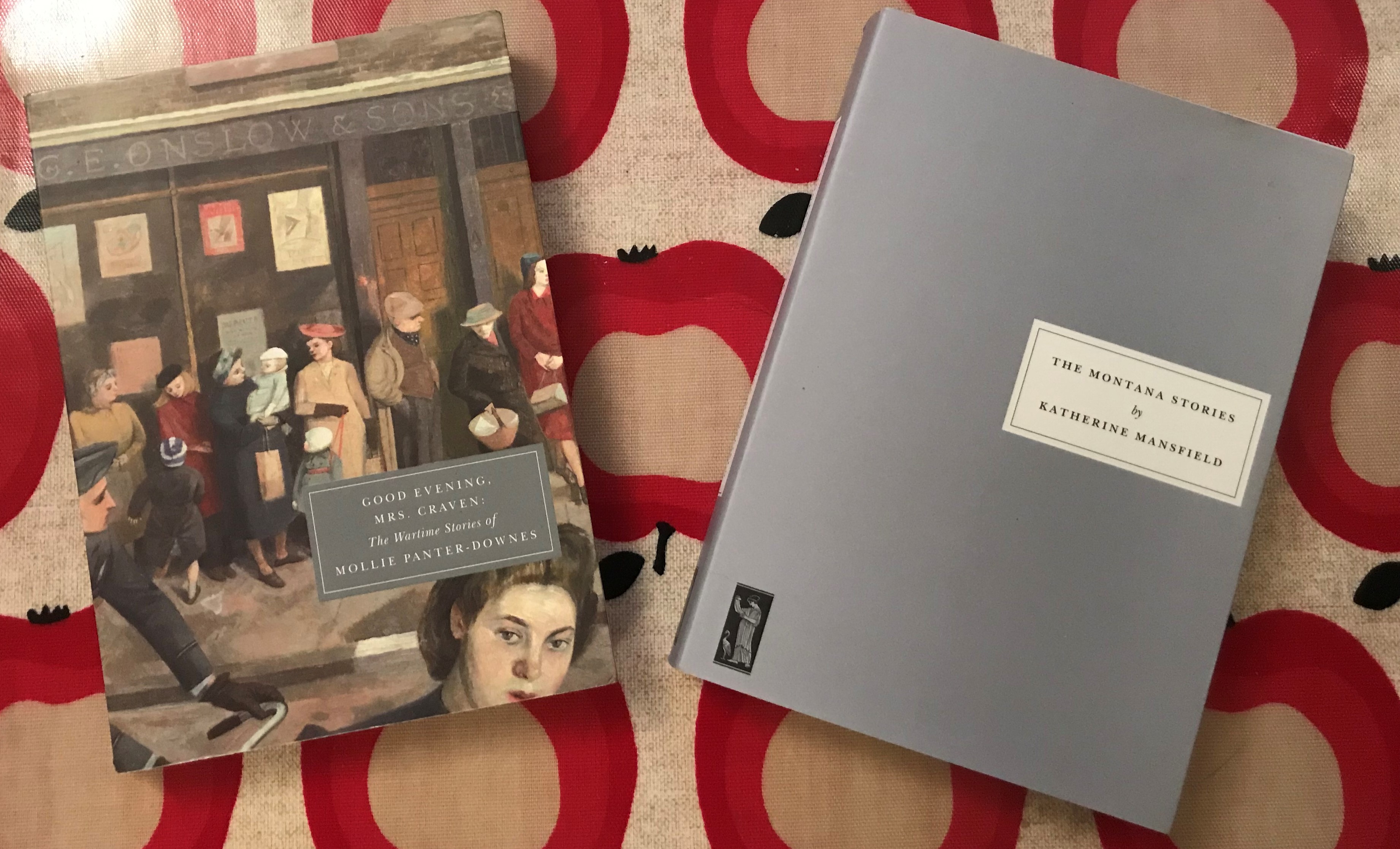
Firstly, Good Evening, Mrs Craven: The Wartime Stories of Mollie Panter-Downes by (unsurprisingly) Mollie Panter-Downes which is Persephone No.8. It features 21 stories which Panter-Downes wrote for The New Yorker between 1939 and 1944.
I wish I had picked up this collection when I had my reading slump, it would have been perfect. The pithy, concise portraits are a quick read, highly entertaining and insightful. Panter-Downes shows how human foibles don’t just disappear at the onset of war. The stories are amusing but never seek to trivialise the conflict. Rather they show how domestic life is driven by huge national change and small personality traits.
Meeting at the Pringles captures the organisation of women who find their raison d’etre during wars, and find themselves “happier, as a matter of fact, than they had been for the last twenty-one years” as they arrange a bandage-knitting party for the Red Cross. Similarly, an elderly Major in It’s the Real Thing This Time is overjoyed at the thought of conflict “[looking] up for the falling body of a German soldier like a lover watching for a sign from a stubbornly closed window”
Family life continues, but is subject to greater pressures than ever. Mrs Ramsay’s War sees a young mother taking in evacuees and being shocked by the realities of motherhood for the first time:
“On the afternoon the nurse went out, the harsher facts of infant life were concealed from her by the nursery maid, who let her have fun pretending to fool around with two little dears who were always perfectly dry, perfectly sweet-smelling, and done up in pretty organdie tied with ribbons.”
Her naivety is subject to the onslaught of the Clark family, and she can’t close her eyes to other, less agreeable, lives any longer:
“there didn’t seem to be a disinfectant invented that could drown the Clark smell of grinding, abject poverty, very different from the decent, cottagey variety with a red geranium on the window sill, which had been the worst Mrs Fletcher had encountered up to now.”
In As the Fruitful Vine another young mother, this one expectant, rues the fact that she has fallen pregnant during a time of international conflict: “In her mother’s day a pregnant woman spent a good deal of time on a sofa, thinking beautiful thoughts and resolutely avoiding unpleasant ones; people took care not to speak of anything shocking or violent in front of her”
All these small events will lead to irrevocable societal changes. This is perhaps most apparent in Cut Down the Trees where an elderly retainer is deeply disturbed by the changes being wrought on a country house: “the conspiracy against Dossie’s way of life, which they called a war and which had taken first the manservants and then the girls one by one, which had stopped the central heating, made a jungle of the borders and a pasture of the lawns, marooned the two old women in a gradually decaying house with forty Canadians, and made Mrs Walsingham stop dressing for dinner.”
Good Evening Mrs Craven is a wonderful collection of highly entertaining stories, showing what went on at home – what women, the very young and the very old got up to – while the soldiers were away. It’s a brilliant work, and if you think you don’t like short stories but want to give them another chance, I would say this is a perfect place to start.
Secondly, The Montana Stories by Katherine Mansfield, which is Persephone No.25. This remarkable collection contains everything Mansfield wrote between July 1921 and her death in January 1923, while she was being treated at the Chalet des Sapins in Montana, Switzerland, for the tuberculosis which would ultimately kill her.
The stories in this collection are of various length, some unfinished but still an enjoyable read. Unusually, they are collected chronologically, which is highly effective here, giving a sense of Mansfield’s preoccupations and creative focus in her final years. I’m just going to pick two which really stood out for me, though the whole collection is a strong one.
In Marriage a la Mode, a young couple find themselves in bewildering conflict, as Isabel is influenced by modern-thinking friends and William can’t work out how on earth to reach her. He’s unsure what toys to buy his children:
“ ‘It’s so important,’ the new Isabel explained, ‘that they should like the right things from the very beginning. It saves so much time later on. Really, if the poor pets have to spend their infant years staring at these horrors, one can imagine them growing up and asking to be taken to the Royal Academy.’
And she spoke as though a visit to the Royal Academy was certain immediate death to anyone…
‘Well, I don’t know,’ said William slowly. ‘When I was their age I used to go to bed hugging an old towel with a knot in it.’
The new Isabel looked at him, her eyes narrowed, her lips apart.
‘Dear William! I’m sure you did!’ She laughed in the new way.”
The story ends with Isabel doing something incredibly cruel. Yet I felt sorry for her and for William. Isabel isn’t happy but is looking for fulfilment amongst vacuous people and missing what is truly important. William is baffled and desperate. A sad story, all the more so for portraying its tragedy as so small and everyday, yet devastating.
In The Garden Party, the Sheridans are a well-off family planning the titular event when they learn a working-class neighbour has been killed. Their daughter Laura wants to cancel the party while the rest of her family find this ridiculous.
“They were mean little dwellings painted a chocolate brown. In the garden patches there was nothing but cabbage stalks, sick hens and tomato cans. The very smoke coming out of their chimneys was poverty-stricken. Little rags and shreds of smoke, so unlike the great silvery plumes that uncurled from the Sheridans’ chimneys […]
‘And just think what the band would sound like to that poor woman,’ said Laura.
‘Oh, Laura!’ Jose began to be seriously annoyed. ‘If you’re going to stop a band playing every time someone has an accident, you’ll lead a very strenuous life.’”
The story is about beginning to forge your own way beyond all that is familiar; it is also about deciding what is truly important. Mansfield writes with wisdom and insight, and a deceptively light touch. She’s masterful at the short story form and her stories absolutely stay with you.
To end, some highly impressive mascara-wearing and a song which tells a short story:


















 madame bibi lophile recommends

