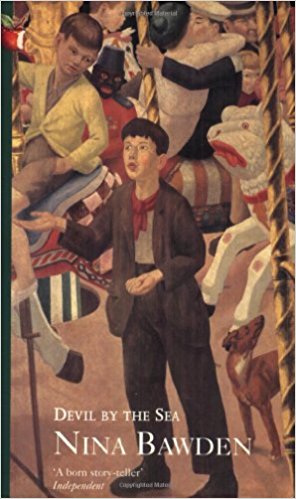
When I was a child I loved Nina Bawden’s books, particularly The Peppermint Pig and Carrie’s War, which a read and re-read. For some reason though, I never picked up her novels for adults. Ali has been championing her writing over on her blog Heavenali, and this prompted me to dig Devil by the Sea out of the Virago TBR (yes, the TBR is so humungous now there are TBR sub-piles) and give it a read.
I’m happy to say that Bawden is just as wonderful writing for adults as she is for children. This creepy, tightly plotted tale is a compulsive read with plenty to say about human relationships – particularly those between adults and children – and the nature of feeling Other. It begins:
“The first time the children saw the Devil, he was sitting next to them in the second row of deckchairs in the bandstand. He was biting his nails.”
The children are Hilary and Peregrine. They are not happy, carefree children; Bawden would never be that patronising in her portrayal of young people. Instead, Hilary is jealous and angry, and can be petty. Peregrine is religious and anxious. They live in a seaside town all year round and it is holiday season. Their half-sister is having an affair with a vain married man who does not love her. Their father and step-mother are under-involved in the children’s lives. Their Auntie beachcombs and keeps the rotting fish she finds. Into all this comes a man they believe is the devil.
“The man turned and looked at them. A shadow crossed his face: like an animal, he seemed to shrink and cringe before the mockery Hilary had made of him […] He continued to watch her with a steady, careful stare. She fumbled in the pocket of her cotton dress. Her voice croaked with embarrassment.
‘Would you like a toffee?’
The man looked beyond her to Peregrine. Briefly, their eyes met. Peregrine could not look away, he was transfixed. The man’s eyes were dark and dull, dead eyes without any shine in them. They reflected nothing.”
A child with the unfortunate moniker of Poppet goes missing, and Hilary saw the man lead her away.
“Poppet’s picture was in the middle of the front page and Hilary looked at it with interest….She read the first few lines beneath the picture and a dark veil came down over her eyes. Her heart beat wildly in her throat. Something cold and evil menaced her from the shadowed corners and for a while she crouched quite still, as if afraid to wake a sleeping beast.”
The fact that this evidence is not easily voiced for the situation resolved is due to the misunderstanding and myth-making of children; the obliviousness and myopia of adults; the fear of everyone.
Despite being a gothic tale in many ways, Devil by the Sea is wholly believable. This is not least because Bawden is not interested in making her characters likable, but rather real, complex, flawed and fascinating. It is creepy and captivating and deeply unsettling. On the strength of this, I will definitely be reading more of Bawden’s adult fiction, not least because I was lucky enough to win The Birds on the Trees in Ali’s giveaway last year 🙂
For a while now I’ve been enamoured of the novella. I enjoy sparse writing styles (not so good at this myself 😉) and at its best a novella gives us a narrative distilled to its essence for maximum impact. To spread novella love I’ve decided to post about a novella each day for the whole month. There’s no fixed definition of a novella so for my purposes I’ve decided its longer than 70 pages and shorter than 200. This will definitely work! It won’t peter out and die in a heap by 5 May at all! Onwards…
The Game of Cards – Adolf Schroder (trans. Andrew Brown, 2008) 143 pages
The Game of Cards is not ostensibly gothic or a thriller, and yet it is both these things. The story of how student Markus Hauser is employed by Selma Bruhns for a week to put several trunks worth of letters into chronological order is truly creepy and suspense-filled.
Selma is a terse, uncommunicative employer, who lives in an old house with a vast number of cats at varying stages of disease. Markus is constantly at the point of leaving, unable to stomach the “stench” of the house, the feral occupants, his awkward employer and the seemingly pointless nature of his repetitive task:
“He squatted down between the piles of letters lying on the floor, but when her resumed his work…looking for the pile in which he was putting the letters from 1943, laying the pages of the letter on it and reaching out for the next one, he paused, as if he’d only just realised that he had absolutely no idea what he was doing”
Gradually however, Markus is drawn into the letters, all written to a woman named Almut. Very little is given away, but Markus finds himself compelled to continue, without really understanding why.
“Words from the letters that he had read came alive. He found himself in streets where he had never been, heard the shrieking and whistling of creatures that he could not see but whose presence he surmised, felt on his skin the burning sun whose strength he had never yet felt, saw a woman coming up to him who spoke in a language that he did not understand.”
This chronology is interspersed with the investigation being conducted by Superintendent Berger, who suspects Markus of having strangled Selma with her own scarf on his last day of work. Thus we are drawn into not only the mystery of who Almut is and why Selma is obsessively writing to her, but also who killed Selma and why. Schroder jumps between the two timelines without preamble and so the reader is drawn into the disorienting, imperfectly understood situation of the all the characters.
“With a sudden move that took Markus by surprise, she threw the animal towards him, it crashed into his chest, and only because Markus reacted quickly and caught the animal could he prevent I from falling onto the ground.
‘You are working slowly and without much concentration,’ said Selma Bruhns, turning round and stepping into the house.”
There is also the question of what happened – and what the stake was – in the titular match between Markus and Selma…
The Game of Cards is a deeply disturbing read, and a powerful portrait of enduring psychological trauma. It will stay with me for a long time.
This week’s theme stems from a very boring reason. But I try to pick themes that relate to my life or what’s happening in the world in some way, and my life is very boring. In fact, the most remarkable thing about it is just how dull it is. So brace yourself reader, and try & stay awake while I tell you that I am a leasehold flat owner.
I’ve always hated this because my managing agents are inept slimebags truly reprehensible human beings, but I spent an evening last week consoling a friend who is a share-of-freeholder and is engaged in a long dispute with her one of her neighbours/fellow freehold sharers, which has now turned vaguely medieval and who she refers to by a most unsavoury nickname.
If you’re still with me, you deserve a little treat. Here’s a trailer for one of my favourite ever films which is rather apt:
So as I spent a long time thinking about flats recently, the theme is novels set in apartment blocks. Firstly, Paradises by Iosi Havilio (2012, trans. Beth Fowler 2013). Apparently this is a sequel to the author’s previous novel Open Door, which I haven’t read, but it didn’t seem to restrict my understanding of Paradises, which I found compelling. Following the death of her partner, an unnamed woman leaves her country home with her small child, Simon, and moves to Buenos Aires. She gets a job at the local zoo:
“Something about the gloomy light, the small of the enclosure, the watchfulness of the snakes in captivity produces a hole in my stomach, an anguish that forces me to increase my pace. I skirt the large tank of water turtles, ignore the lizards walk past the door saying nursery and go outside.”
The janitor, Canetti, takes a shine to her. He used to be a bank treasurer before losing his job through fraud and is filled with bitterness. He shows the woman the el Buti squat, presided over by the obese, immobile, morphine-addicted Tosca. She moves in:
“And yet despite the filth, the heat, those intestinal noises, and the smell of shit that rises in waves, at some point in the early hours Canetti’s words from the first time he brought me here come to mind: We’re safe here. I even babble them to myself to confirm it. And so I relax and rest a bit, although still without sleeping. On the third day I cover the windows with black bin bags to prolong the night.”
The voice of the young woman is matter-of-fact and she presents her extreme circumstances almost indifferently (Paradises has been compared to L’Etranger). This, combined with the present-tense, captured the numbness of grief and the sense of just getting through each moment. Yet according to the introduction by Alex Clark, the narrator’s passivity and weird equanimity was present in Open Door too, so maybe it’s just her character. Either way, I found her voice distinct and engaging. We follow her through her life as she juggles motherhood, work, relationships with idiodyncratic but wholly believable characters: seemingly spiky Iris who cares for Simon; the unpredictable Eloisa who seems to have no boundaries at all and drags the narrator along with her; the various residents of el Buti.
“each of us has to devise our truth in relation to the other”
The squat is surrounded by paradise trees, whose berries are poisonous and whose bark holds the cure. This duality is repeated throughout the novel: alienation sits alongside connection, love and grief are side by side. Paradises is an unsettling novel but at no point did I feel alienated from the unusual, detached woman telling the story. A remarkable achievement.
Let’s take a Vincent Cassel break (that’s definitely a thing, isn’t it?)
Secondly, A Far Cry from Kensington by Muriel Spark (1988) is set at “14 Church End Villas, South Kensington, that rooming house, shabby but clean, that today is a smart and expensive set of flats, gutted and restructured, far beyond the means of medical students, nurses, and the likes of us as we were.”
Narrated by the young widow Mrs Hawkins, she describes her time at the rooming house in the 1950s. She moves between jobs in publishing with little respect for her employers:
“Sir Alec was thin and grey and his voice matched his looks. It sounded like a wisp of smoke wafting from some burning leaves hidden by a clump of lavender.”
“I had a sense he was offering things abominable to me, like decaffeinated coffee or coitus interruptus”
Spark’s satire of publishing and writers is a joy, but A Far Cry From Kensington is also about capturing a moment in time when society is on the cusp of change. Relationships between the sexes are changing, and Mrs Hawkins pushes against societal expectations of women in the mid-20th century. She is resentful of being characterised as a capable widow (she feels this is partly due to her size and begins determinedly losing weight).
Meanwhile, there is tension in the house as someone is sending threatening anonymous letters to Wanda, a European seamstress who rooms there. The different residents begin to suspect each other while landlady Milly is certain it’s an outsider:
“Milly was upset at the suggestion that it was someone in the house, to the point of being almost mesmerized by the idea. She also feared further letters. ‘These things happen in threes’ said Milly in her way of uttering bits of folk-wisdom; she was spooning tea into the heated teapot. She always mixed tea with maxims.”
Mrs Hawkins is a great narrator: matter-of-fact, funny, uncompromising.
“I enjoy a puritanical and moralistic nature; it is my happy element to judge between right and wrong, regardless of what I might actually do.”
The plot around the victimisation of Wanda is frankly a bit bonkers and easily the weakest point in the novel, but despite a weak plot A Far Cry From Kensington is full of Spark’s wit and razor-sharp observation. Not a word in this short novel is wasted.
To end, a video putting the brutalist architecture of the Thamesmead flats to good use:
I live on a tiny grey island. This year Spring has been even greyer than usual and it felt like winter had gone on for eleventy million years. Now the weather is overcompensating by being unseasonably warm for a few days (just in time for the London marathon – kudos to those hardy runners), and so I’ve decided to celebrate by looking at two novels set on warm islands. They are two more stops on my Around the World in 80 Books Reading challenge, hosted by Hard Book Habit, and I’m sure by the time I’ve posted this my home will be back to service-as-usual grey and we’ll all know where we stand.
Firstly, Salt by Earl Lovelace (1996), set in Trinidad where Lovelace was born and still lives. I read The Dragon Can’t Dance years ago and really liked it, but for some reason I hadn’t picked up a Lovelace since. Salt is primarily the story of Alford George, but it is also a story about Trinidad.
“Maybe that madness seized Columbus and the first set of conquerors when they land here and wanted the Carib people to believe that they was gods; but, afterwards. After they settle in the island and decide that, yes, is here we are going to live now, they begin to discover how hard it was to be gods.
The heat, the diseases, the weight of the armour they had to carry in the hot sun, the imperial poses they had to strike, the powdered wigs to wear, the churches to build, the heathen to baptise, the illiterates to educate, the animals to tame, the numerous species of plants to name, history to write, flags to plant, parades to make, the militia to assemble, letters to write home. And all around them, this rousing greenness bursting in the wet season and another quieter shade perspiring in the dry.”
Alford dreams of leaving the island and decides the way to do this is to speak ‘English’. Lovelace shows the legacy of colonialism and how the language of the colonisers is still associated with power and accomplishment.
“His thinking was in another language and he had to translate. He began to speak more and more slowly to make sure that his verbs agreed with his subjects, to cull out words of unsure origin and replace them with ones more familiarly English. Caribbean words like jook, mamaguy and obzocky all had to be substituted. He felt his meanings slipping away as he surrendered his vocabulary.”
However, as time goes on, Alford stays on the island, becomes a teacher, fights for his students rights and becomes embroiled in politics. His identity becomes more bound with contemporary Trinidad, and it’s then that he realises that emancipation has been a false promise:
“manoeuvre them into accepting not freedom but the promise of being set at liberty, with no more attention given to their years if degradation and captivity and abuse than if they had been dogs”
There is a plethora of other characters in Salt and I can barely scratch the surface here. They are drawn vividly and with affection, a cacophony of voices that pick up Lovelace’s themes of identity, home and meaning. They exist within a beautifully evoked Trinidad whereby Lovelace is able to explore his weighty themes without becoming overly didactic.
This post is ridiculously long and I don’t have time to explore Salt properly, but I did just want to mention this beautiful portrait of the elderly Miss May:
“And with the laborious delicacy choreographed by her pains eased herself down unto the step where the sun was brightest and rested there, her eyes shut, her breath inhaled, the metronome of her mind keeping time to the rhythm of her distress, trying to find within the music of her pain a space in which to breathe.”
I think that’s a stunning piece of writing. Lovelace writes with clarity and a unique voice, and he has important things to say:
“The tragedy of our time is to have lost the ability to feel loss, the inability of power to rise to its responsibility for human decency.”
Secondly, By Night the Mountain Burns by Juan Tomas Avila Laurel (2008, trans. Jethro Soutar 2014) who is from Equatorial Guinea, and whose parents are from Annobon Island. The island in the novel is unnamed but shares a location and a history of Spanish colonialism with Annobon.
“We were on our own out in the middle of the Atlantic Ocean. People had given up hope of the boat ever coming back – the boat from the place where our fathers were.”
The narrator recounts his experience of childhood on the island. He lives with his silent, remote grandfather.
“I can’t say for sure whether my grandfather was or wasn’t mad. I saw him through a child’s eyes and through such eyes it’s impossible to tell whether an adult man, who lives in your house and who you’ve been told is your grandfather, is mad or not.”
“The house was close to the beach. And not any old beach either but the big village beach. Yet despite being so close to the shore, grandfather had built the house with its back to the sea…everything faced the mountain.”
Women on the island own the land, while the men undertake the fishing. Things are not easy on the island – there is poverty at times, white people arrive and trade sex with women for cigarettes and kerosene – but things deteriorate significantly during the period the narrator is recalling. There is a bush fire, then cholera wipes out a huge proportion of the population, and there is a horribly violent instance of scapegoating.
“Today, looking back, I see, or understand, that the incident and the cholera were part of the same sickness. And the cure for that sickness was beyond the reach of our adults for it was a sickness that was greater than them, and so it was able to dominate them. And on that island out in the middle of the Atlantic Ocean, nasty episodes unfortunately had to be explained somehow; something to satisfy people’s need for a cause.”
The island may be out in the middle of the Atlantic Ocean, and the faith of the people may be a mix of their traditional beliefs and Catholicism, but I felt what the narrator is speaking about was far from remote from me as a UK-based reader:
“For I know now that all people are not treated equally when it comes to apportioning blame for bad things that happen in communities. I know that, in this world of ours, how facts are judged depends on who’s doing the judging.”
I’m making this novel sound depressing, and it isn’t. The point of view of a child enables the story to be told but with a degree of distance that enables the reader to keep reading. This is not to suggest that Laurel obfuscates or pulls his punches. The brutal scapegoating is repeatedly returned to and described in detail. It is horrific. The repetitions of the story enable it to effectively capture the sense of reminiscences, and also how defining moments are those we return to time and again, informing our understanding of the past and who we are.
Towards the end we learn how this story is embedded within colonialism, and how what we are reading exists within this history. The narrator learned Spanish at school, a language that existed detached from meaning for him:
“We learned everything by heart, and I think that’s why we did it singing. In fact, although we sometimes saw books with the letters and pictures, I didn’t know that amapola, burro, cochino and dado were Spanish words for poppy, donkey, hog and dice, or that poppy, donkey, hog and dice were things we were supposed to have heard of. I didn’t know what any of them were, so I didn’t know the words were supposed to represent the letters and I didn’t associate the letters with the pictures in the books.”
As a result of this, he is able to tell his story to Spanish-speaking researchers who have come to the island:
“If this story becomes known, it will be because of some white people.”
Laurel writes with unrelenting power in beautiful prose about huge issues: society, colonialism, legacy, blame, belief. His writing is stunning and his anger palpable without overwhelming the narrative. Another great edition from And Other Stories, who are rapidly becoming one of my favourite publishers.
Firstly, Penelope Fitzgerald’s first novel, The Golden Child, which she published aged 60 (it’s never too late, budding writers!) This is a typically slim Fitzgerald novel, just 189 pages, and while I didn’t love it as much as the others by her which I’ve read (The Bookshop; At Freddies) there’s still a lot to enjoy.
The title refers to an exhibit that is on loan to a London museum. It is hugely popular with people queueing for hours on end to see the tiny dead Garamatian king covered in gold, and his ball of gold twine. The story concentrates on behind the scenes: the relationships and internal politics of the museum.
“At the sight of his tiresomely energetic subordinate, Hawthorne-Mannering felt his thin blood rise, like faint green sap, with distaste. He closed his eyes, so as not to see Waring Smith.”
It is from the energetic Waring Smith’s viewpoint that the story unfolds. He realises that certain deals have been done, certain backs have been scratched, in order for the museum to gain the exhibit.
“He had a glimpse for the first time of the murky origins of the great golden attraction: hostilities in the Middle East, North African politics, the ill-coordinated activities of the Hopeforth-Best tobacco company. Perhaps similar forces and similar shoddy undertakings controlled every area of his life. Was it his duty to think about the report more deeply and, in that case, do something about it?”
Things take a sinister turn when someone tries to strangle him with the golden twine, and two of his colleagues end up dead in highly suspicious circumstances. Waring Smith is sent on a farcical trip to the USSR (as it then was) to consult with an expert regarding the exhibit. On his return, he becomes embroiled with Special Branch, and has to decipher a code on a clay tablet which might hold a clue as to what on earth is going on.
“The Museum, slumberous by day, sleepless by night, began to seem to him a place of dread. Apart from the two recent deaths, how many violent ways there were in the myriad of rooms of getting rid of a human being! The dizzy stairs, the plaster-grinders in the cast room, the poisons of conservation, the vast incinerators underground!”
There’s a great deal to enjoy in The Golden Child but it doesn’t quite work as a mystery – some of the solving takes place ‘off-screen’ and Waring Smith is then told about it, so it doesn’t quite match what it sets itself up to be. Its strengths are Fitzgerald’s wit and her satire of politics big (The Cold War) and small (workplace); it’s a quick, fun read.
Disclaimer, and a note for those of you who, like me, were born around the time of this Club: I’m aware that part of my enjoyment of this novel came about because of a very specific reason, which may have coloured my view somewhat. As a child one of my favourite TV programmes was The Baker Street Boys, which showed what the Baker Street Irregulars got up to when they weren’t helping out a certain world-famous detective. My favourite episode was The Adventure of the Winged Scarab, involving mystery, museums and mummies. Anyone else who remembers this series fondly can indulge in a nostalgia-fest because I’ve just discovered some kind soul has uploaded the whole lot to YouTube.
Secondly, Injury Time by Beryl Bainbridge, which is set over the course of one evening. Edward has agreed that his mistress Binny can give a dinner party and he will invite his colleague Simpson and Simpson’s wife Muriel along.
“He gave her so little, he denied her the simple pleasures a wife took for granted – that business of cooking his meals, remembering his sister’s birthday, putting intricate little bundles of socks into his drawer.”
I loved that line which comes early in the novel and so I settled into what I fully expected to be full of the joys of Bainbridge: acerbic wit, idiosyncratic characters, acute social observation. For much of the novel, this is exactly what Injury Time provided. None of the characters seem to know exactly what they want and the changes taking place in 1970s Britain leave them all slightly baffled.
“It was astonishing how fashionable it was to be unfaithful. He often wondered if it had anything to do with going without a hat. No sooner had the homburgs and the bowlers disappeared from the City than everyone grew their hair longer, and after that nothing was sacred.”
The dinner party never really takes place. Binny is an appalling housekeeper and her home is filthy (Bainbridge based Binny on herself and Edward on a lawyer she had an affair with). Before anyone arrives she’s thrown the hoover into the backyard and stuffed the pudding behind the fridge.
“Though most of her life she had rushed headlong into danger and excitement, she had travelled first-class, so to speak, with a carriage attendant within call. The world was less predictable now…in her day dreams, usually accompanied by a panic-stricken Edward, she was always being blown up in aeroplanes or going down in ships.”
The less predictable world erupts violently into the evening of Binny, Edward, Simpson, Muriel and Binny’s inebriated friend Alma. It’s here that I have a bit of trouble with Injury Time. A character is raped. For me, this jarred uncomfortably in what until that point had been a funny, sharp novel puncturing 1970s social mores and pretensions. The rape itself is dealt with oddly: it’s part of a section that verges on surreal and is filled with non-sequiturs; the character it happens to is weirdly detached, which may be shock but this is never made clear. Looking at reviews online, I was really surprised that so few reviewers even mentioned this event. For many Injury Time remains an unproblematic comic novel. So I wouldn’t want to put anyone off reading it; I adore Bainbridge and still do, but for me how the rape was portrayed and contextualised was a problem.
I don’t want to end on a downer when so much of Injury Time is funny, so I’ll end with this quote which is pure Bainbridge. I wonder how far Binny was based on her and whether she actually did this?
“There had been too that incident when he couldn’t see Binny because he wanted to prune his roses, and she’d threatened to come round in the night and set fire to his garden, Later, a small corner of the lawn had been found mysteriously singed, but nothing had been proved.”
To end, the UK number one from this week in 1977. AHA!
When I was searching for quotes about libraries I really liked this quote by Libba Bray but it was too long to use for a title:
“The library card is a passport to wonders and miracles, glimpses into other lives, religions, experiences, the hopes and dreams and strivings of ALL human beings, and it is this passport that opens our eyes and hearts to the world beyond our front doors, that is one of our best hopes against tyranny, xenophobia, hopelessness, despair, anarchy, and ignorance.”
This week’s theme is libraries, because one of the unforeseen benefits of my 2018 book buying ban is that I have rediscovered the joy of the library. You may well be wondering what kind of moron I am not to foresee this, but I really didn’t. The purpose of the book-buying ban is to get through the piles of unread books I own. It’s working, but not quite as well as I hoped because I’ve realised my library has novels. Up until this point I’d mainly used it for non-fiction books. It’s taken the ban for me to realise I can get in the library queue for new releases and get hold of rare books I’ll never be able to afford. Libraries are amazing!
Firstly, I finally reached the top of the queue for Reservoir 13 by Jon McGregor, which was published before my book buying ban last year, but I hadn’t got a copy. McGregor is one of my favourite authors and I didn’t want to wait another year before reading this, so I got on a long waiting list at the library.
Disclaimer: McGregor is never going to get anything but gushing reviews from me. I’ve loved his writing since his first novel If Nobody Speaks of Remarkable Things and as far as I’m concerned he can do no wrong. I understand this novel has divided people and I think its because the premise sets up certain expectations. A 13 year old girl, Becky Shaw, disappears from a village where she and her parents are holidaying for new year. However, this isn’t a thriller. It isn’t about the search for the girl, or what happened to her, or who may have taken her. What it is about is a community, the people in it, how their stories touch on one another. If like me, you’re a fan of McGregor, this won’t greatly surprise you. Although the rural setting is unusual for him, the themes are not. But if you come to it expecting a missing person puzzle to be solved, you’ll be sorely disappointed.
There are many recurring phrases and details in the book. Becky is 13, the village has 13 reservoirs, the story is set over 13 years and divided into 13 chapters. The chapters begin “At midnight when the year turned…” At intervals we are reminded “The missing girl’s name was Rebecca, or Becky, or Bex”. The effect is to show how things move on within the familiar; village lives continue but they also change. Meanwhile, Rebecca/Becky/Bex is held in a stasis, forever 13, the questions around what happened to her left hanging.
I associate McGregor with urban settings, but he writes beautifully of rural life. Old traditions are dying out: only one of the residents bothers collecting nettles for tea or elderflowers for cordial. The butchers – like so many local shops – closes due to lack of demand. Yet the seasons in their distinct beauty are there:
“On Bonfire Night there was a heavy fog, thick with woodsmoke, the fireworks seen briefly like camera flashes overhead. In the beech wood the foxes prepared their dens. The vixens dug down into old earths and reclaimed them, lining them out with grasses and leaves. In the eaves of the church the bats settled plumply into hibernation. By the river the willows shook off the last of their leaves. At night the freight trains came more often a single white leading and the wagons shadowing heavily behind. The widower asked Clive for advice over pruning his fruit trees and Clive was surprised to see the state things were in.”
McGregor does this throughout the novel, going straight from describing the natural world into a detail about the lives of one of the villagers without a paragraph break. In doing so he weaves the lives into the world that surrounds them and shows how one cannot be understood without the other.
I thought Reservoir 13 was absolutely stunning. It reminded me of Virginia Woolf in the use of repeated phrases and the focus small but significant details. In his usual unshowy style, McGregor captures the beauty and fragility of everyday life.
After I finished Reservoir 13 I went straight to the library to see if they had a copy of Reservoir Tapes, the sequel of sorts, and I didn’t even have to put my name in the queue for it. Reservoir Tapes is a series of short stories connected to Reservoir 13, originally broadcast on the radio. You can listen to them here.
Secondly, I found my library had a copy of Rhododendron Pie, Margery Sharp’s first novel from 1930, which is practically impossible to find and which you pay hundreds of pounds for online. There was a copy just sitting there – I couldn’t believe I hadn’t checked before.
Rhododendron Pie tells the story of Ann Laventie, whose natural leanings towards conservatism mark her out as different from the rest of her family. Her sister Elizabeth begins the birthday tradition of inedible floral birthday pies of the title, while little Ann would prefer an apple pie.
“It had once been said of Mr Laventie that he was a traditionalist in wine and a revolutionary in morals; and indeed, this capacity for making the best of both worlds was an outstanding characteristic of the family. They combined the extremes of old-world elegance and modern freedom, tempering a belief in free verse and free love with an equal feeling for societal decorum.”
As the children grow up, Elizabeth becomes an intellectual forever having essays published in journals while her brother Dick becomes a sculptor. Ann is at a bit of a loss. She is good at admiring what the others do and she is well-liked, but she flounders in working out what she wants and where she fits in. Sharp captures how society is changing for the interwar generation; one of Ann’s friends is perfectly open about the men she lives with on occasion. While there is discussion around this which seems remarkably forward-thinking and would sit well with readers today, Ann does not want a bohemian lifestyle.
“ ‘What I want,’ continued Ann recklessly, ‘is a nice wedding in the village church, with a white frock and orange blossom and lots of flowers and ‘The Voice that Breathed’ and two bridesmaids in cyclamen pink and rose petals afterwards and a reception in the drawing-room with a string quartet playing selections from Gilbert and Sullivan. In June. And a honeymoon in the Italian Lakes.
‘Where does Gilbert come in?’
‘He doesn’t. And I want to live in a house, not a flat, even if it’s only a little one in a suburb where there’s no-one amusing, with a back garden to dig in. And have bird pattern chintzes in the drawing-room and cold supper on Sundays because the maid’s out. I shall probably,’ finished Ann defiantly, ‘take a stall at the church bazaar.’”
Ann doesn’t come across as remotely priggish or boring though. She is authentic and truthful, and struggles with her knowing, arch, ironic family
“ ‘One of your family methods. Every now and then you do something deliberately ordinary, but in inverted commas so to speak, just to see what it feels like.”
What Rhododendron Pie is about is working out who you are and what you want from the world, and how tricky this can be when you seem to be at odds with your family and the section of society you live within. Without any didacticism, Sharp captures how this is especially hard for women. New freedoms are opening up, but women are still judged more harshly by society and have their actions further circumscribed by law.
“These were the things they understood, patient hope and quiet brave endurance: these were the woman’s part.”
Rhododendron Pie is remarkably accomplished for a first novel. Sharp would hone her skills further in future novels – particularly characterisation, which is a bit weak here – but her wit is here, her warmth, and her wisdom.
“‘That’s what you clever people never understand. You talk about life as though it were something rare and surprising that one had to be careful of. It’s nothing of the sort. It’s ordinary. And it’s only when you’ve accepted it as ordinary that you begin to see the wonder of it. That a swallow or a green field should be beautiful is nothing, but that they should be common as dirt is a miracle. I am continually amazed…at the casual beauty of things.’”
To end, a woman whose name helpfully rhymes with her profession, and an annoying man who won’t shut up and let people read in peace:
This is my final contribution to Reading Ireland Month 2018, hosted by Cathy at 746 Books and Raging Fluff. Do check out the posts from the month, it’s been great 😊
I had 2 Molly Keane novels in my substantial TBR, so this seemed a perfect opportunity to get to know an author so many seem to enjoy. I began with her first novel, the wonderfully titled The Knight of Cheerful Countenance (1926). Unbelievably, she wrote this at the age of 17 to supplement her dress allowance (!) and chose the pseudonym MJ Farrell to hide what she was doing from her friends, who were all huntin’ shootin’ fishin’ types. Molly Keane wrote the introduction to my Virago edition and it’s well worth a read, to hear tales of friends with uncles called Major Hyacinth Devereaux and the butler shrouding the parrot before morning prayers. I’d love to know if she ever met the Mitfords.
The plot of The Knight of Cheerful Countenance is slight: Allan comes to visit his Irish cousins, falls in love with one who loves another, while his other cousin falls in love with him. It’s full of horses and slightly less full of bloodsports, thankfully. There were about 2 passages I skipped because I just really don’t want to read about such things. And yet despite these unpromising qualities, I thoroughly enjoyed the novel.
In her introduction Keane fully acknowledges that the incredibly privileged, oblivious existence of her childhood and young adulthood is gone forever. The novel makes passing reference to the political situation of the time, but Allan and his cousins Ann and Sybil are walled up on an estate away from it all:
“Deeds of unbelievable foulness and treachery were still – judging by the newspapers – of almost daily occurrence in the land, but they seemed to leave untouched the district of Bungarvin. Yet wrecked police barracks and courthouses, country houses standing empty, and the charred walls of what had once been country houses, all went to show how little of a myth was the state of civil war in Ireland.”
As the title suggests, the novel is a romance and there is most certainly an escapist quality to it (the first publishers were Mills & Boon, although I think they published a wider range then than they do now).
“Dennys St Lawrence presented as good a picture of young manhood as one could wish to see on any glorious summer morning. With his bare dark head and his grey eyes, his handsome horse, and his easy seat in the saddle, he belonged to this Irish morning with complete entirety.”
This isn’t straight romance though. Keane views the events and the people with a fond, humorous eye:
“Silence, however, never reigned for long when Allan was anywhere about.
‘Jolly little successful what-not, what?’ he observed affably, by way of starting the conversation.”
The Knight of Cheerful Countenance is a short novel (272 pages) and so it doesn’t flag, and I would never have guessed it was written by a 17 year old. It’s not the most accomplished piece, but it’s not juvenilia either. I don’t really feel I’ve done it justice here. It’s very readable and good fun, and it certainly made me want to read more by Molly Keane.
Which is exactly what I did. Loving Without Tears (1951) was Keane’s tenth novel and she was also a successful dramatist by this time, so it is a much more sophisticated novel than her first. It is much darker than The Knight of Cheerful Countenance, centring around a wholly manipulative matriarch, the inappropriately monikered Angel, who bends her children, niece and faithful retainers to her will.
“Each worshipped her and each lamp should have its due portion of oil to feed that flame of worship, and from each she would obtain the maximum of that slave labour which is the expression of such a love.”
She is an absolute tyrant, all the more despicable because her tyranny is couched in expressions of maternal love and concern. But things are about to change. Her son Julian has returned from the war with a fiancée who is (shock!) American, and a woman of the world. She sees through Angel and will not be manipulated, unlike Angel’s daughter Slaney, who is oblivious to her mother trying to split her up from the man she loves:
“As a gardener tends nectarines, so did Angel minister anxiously to skin and hair and health of body. As well, she disciplined the beautiful body towards an excellence in the sports best calculated for its exhibition – a garlanded, shampooed young heifer, her looks a miracle, her thoughts unknown, Angel led her daughter by a ribbon towards the supreme sacrifice and glory of the right marriage.”
There’s also a niece, Tiddley, who Angel abuses despicably, bribing her to help with her plans to disrupt her children’s lives. The nanny Birdie, sees things as they are:
“the love she’s pinching out from each of us, same as I’d disbud a rose”
Yet the brilliance of Keane’s writing means that while I desperately wanted everyone to wake-up to what Angel was up to, and for her to get her comeuppance, I didn’t want her punished too badly. Loving Without Tears is an astute psychological study of a woman who behaves appallingly, but it is done without heavy judgement and you are left to fill in some gaps as to why Angel behaves as she does. To some extent it is a comedy of manners; if only everyone can cast aside convention and have an honest conversation, everything will work out. So it is funny, but with a cynical undertone running through it which stops it being fluffy. I enjoyed watching it all play out pretty much as I expected (not a criticism, I enjoy Austen for the same reason) and the ending was entirely satisfying.
This is my second contribution to Reading Ireland Month 2018, hosted by Cathy at 746 Books and Raging Fluff. Do join in!
As with my previous Reading Ireland 2018 post, I picked two books at random from the TBR, but they turned out to be thematically linked. They are both about the impact of alcohol dependency on families, and both achieve the difficult balance of not being depressing yet not shying away from the damage alcohol can cause. Orange juices all round everyone – or maybe a cup of tea?
Firstly, Paula Spencer by Roddy Doyle (2006), a sequel to his 1996 novel, The Woman Who Walked Into Doors. I thought TWWWID was brilliantly written, and I was looking forward to catching up with Paula again and finding out what she’d made of her life beyond her abusive husband. At the start of the novel Paula is 4 months sober.
“She’s tired at night and that’s the way it should be. A hard day’s work and that. She likes being tired. Tired and sober – it’s different. The sleep is different – it’s sleep. Although she doesn’t always sleep. But it’s grand; it’s fine. She’s not complaining.
Who’d listen?
She brushes her teeth. The important ones are there. The ones at the front. The missing ones aren’t seen, unless she smiles too wide. Then the gaps appear.”
We don’t learn what prompted Paula to commit to sobriety this time but she’s sticking with it. She’s worried about her kids: Nicola has grown up too quickly, caring for Paula and her siblings; John Paul has given up drugs but is in a relationship with a woman Paula’s not keen on; Jack is fine, but Leanne seems to be following in her mother’s footsteps:
“What does an alcoholic mother say to her alcoholic daughter? It’s shocking. It’s terrible. But Paula’s not falling down on the ground. She’s not running away or pretending it’s not there, or screaming and making it worse, All the things she’s done before and will probably do again.
I am an alcoholic.
She’s facing it.
She drinks her tea standing up. She needs the energy that standing up gives her, the alertness.”
Paula facing it was what I really liked about the characterisation in this novel. She feels guilty about the past, but she doesn’t beat herself up over it – if anyone’s had enough beatings it’s Paula. She allows that she’s human, and she never pities herself. She’s a remarkable woman, a strong woman, although she doesn’t see it.
“Maybe it’s the way the brain works to protect itself. It invents a new woman who can look back and wonder, instead of look back and howl. Maybe it happens to everyone. But it’s definitely the drink, or life without it. It’s a different world. She’s not sure she likes it that much. But she’s a new-old woman, learning how to live.”
This is the problem for addicts: often by the time they’re ready to be sober, there’s very little to be sober for. But Paula takes the life she has, her problematic relationship with her kids, her low-paid, hard-graft job and she gets on with it. This isn’t bleak or depressing, it’s actually a believable and life-affirming story of human endurance and resilience.
“She sits back and it sits beside her. The need, the thirst – it’s there, here.”
As with TWWWID, I was absolutely rooting for Paula. It’s her story and as it was in TWWWID her voice is crystal clear and so real. But it’s also a story of modern Ireland: the Celtic Tiger, being part of the EU – Paula is the only Irish cleaner at her work – and contemporary music that Paula takes joy in, learning what came after Thin Lizzy. It’s about redemption, personal and national (the IRA disarm towards the end), but a redemption that carries the past with it:
“All of Paula’s past is in her back. It’s there, ready, breathing. One last kick from a man who died twelve years ago.”
Secondly, Tatty by Christine Dwyer Hickey (2004). In Paula Spencer, the question is posed: “Alcoholics can stop drinking but what is there for the children of alcoholics? Is it always too late? Probably. She doesn’t know.” and this is what Tatty is concerned with. It follows Tatty over 10 years as the child of at least one alcoholic, possibly two. Hickey manages a remarkable feat in capturing both a child’s point of view and writing in the second person in a way that isn’t annoying:
“And you can feel your face wobbling like jelly when the car goes out of town and over the cobblestones, and you can see all the dark houses on all the dark roads; then you can lie down and look at the orange street lights, pulling you home on a long orange string.”
Tatty is an observant, confused, conflicted child. She lives in a world where men and women live clearly delineated lives, separate from one another. Tatty adores her roguish father and this adds to her isolation from her mother:
“They stay in the kitchen; they sit at the table and smoke cigarettes and drink tea and give out stink about men and that’s a bit mean because the men never give out about them. The men never say anything about them at all.”
Tatty is a bright child and she finds solace and companionship in books:
“They’re nearly as good as real friends anyway, because she can go places with them and talk to them and they talk back and include her in. Sometimes they’re even better than real friends, because you just don’t just know what they look like and where they live; you know as well what they’re thinking and how they feel about things. A real friend mightn’t tell you something like that.”
Hickey brilliantly captures the pain of childhood even when it is barely acknowledged by the child. Tatty and her siblings have markers of difference that are picked up on by the other children. Her sister ditches her milk on the way to school because it’s in a whiskey bottle. The fact that the family have little money and the children are neglected is perfectly obvious to the other children at school:
“Sometimes you can match the girls to their lunches. The best lunches belong to the same sort of girls. Girls with lace socks and black patent shoes. Girls like Geraldine Draper. She gets a Club Milk and a bottle of Coca-Cola that she opens with her own proper opener, She gets triangle sandwiches packed into her lunch box and King crisps her Dad buys in a shop near his work…She has bouncy ringlets squirting all over her head and a different ribbon for every day of the year…She has lovely plastic covers on her schoolbooks; her pencil case is always packed.”
Tatty is offered an escape when she goes away to boarding school. We don’t know why she is going because Tatty doesn’t know, but it may be because she is her father’s favourite and the brightest. She finds the separation from family not remotely traumatic:
“Tatty tries to think what homesick means and why it makes you cry. When Mam goes mental she might start shouting, I’m sick of this bloody house! I’m sick of it! Sick of it!
But she knows that can’t be the same thing.”
Tatty is a subtle novel. We can see the damage being caused by the parents but it is never hammered home, because Tatty herself is not aware of it. It stops the novel from being unrelenting bleak, but it doesn’t obscure the damage that is being done to a family by the alcohol dependency. The final image in the novel is truly heart-breaking and it left me reeling.
To end, another clip from Father Ted, and a reminder that reading Roddy Doyle can have side effects:
We’ve arrived at the equinox where day and night are of equal length. In the northern hemisphere it’s the Spring Equinox and I’d love to say that winter finally seems far behind us but it’s still bloomin’ freezing.
Still, I’m hopeful that the weather will soon rectify my plummeting levels of vitamin D, and to celebrate I’ve chosen one novel set over a single day, and one set over a single night.
Firstly, daytime with The Pigeon by Patrick Suskind (1987, trans. John E Woods), which is a novella of just 77 pages in my edition, and yet feels entirely complete. It tells of a day in the life of Jonathan Noel, a bank security guard whose ordered, circumscribed life suits him perfectly. He lives in one room, goes to work, comes home and follows a routine whereby he tries to draw as little attention to himself as possible. Then one morning he opens his front door to find a pigeon sat there. The pigeon has also fouled the communal hallway.
“no human being can go on living in the same house with a pigeon, a pigeon is the epitome of chaos and anarchy, a pigeon that whizzes around unpredictably, that sets its claws in you, picks at your eyes, a pigeon that never stops soiling and spreading the filth and havoc of bacteria and meningitis virus, that doesn’t just stay alone, one pigeon lures other pigeons…”
As a Londoner that passage definitely spoke to me.
Jonathan manages to leave his room and get himself to work, but the presence of the pigeon has entirely destabilised him.
“But today everything was different. Today Jonathan was having no success whatever at achieving his sphinx-like calm. After only a few minutes he could feel the burden of his body as a painful pressure”
As we follow Jonathan through his day, a day beset by small catastrophes, Suskind shows “how quickly the solidly laid foundation of one’s existence could crumble.” Why Jonathan is so utterly discombobulated by the pigeon is never fully explained, but the tale is entirely believable. Jonathan is lonely and frustrated and the pigeon exposes the fissures in his careful façade.
“He had a mighty urge to pull out his pistol and let loose in every direction […] into the hot sky, into the horrible, oppressive, vaporous, pigeon blue-grey sky, bursting it, sending the leaden lid crashing with one shot, smashing down and pulverising everything and burying it all”
The Pigeon was Suskind’s follow-up to the massively successful Perfume. This is a very different tale but an equally memorable piece of writing. Determinedly grounded in banal everyday detail, The Pigeon highlights the extraordinary inner lives that could be taking place beneath the most ordinary of outer lives.
Secondly, into night with After Dark by Haruki Murakami (2004, trans. Jay Rubin) which follows a group of characters from just before midnight to just before dawn in Tokyo. A young girl, Mari, is reading in a nearly empty diner, when she encounters Takahasi, a musician who knows her and her beautiful model sister Eri. He’s chatty and seemingly unperturbed by Eri’s self-contained reticence. The difficulty of communication between people is a recurring theme:
“ ‘Finally, no matter what I say, it doesn’t reach her. This layer, like some kind of transparent sponge kind of thing, stands there between Eri Asai and me, and the words that come out of my mouth have to pass through it, and when that happens, The sponge sucks almost all the nutrients right out of them.’ ”
This idea of permeable surfaces also recurs, bring a surreal element to the story. Eri is asleep, watched by a masked man through an unplugged television set. At one point, Eri is dragged into the scene within the television. Meanwhile, Mari walks away from a mirror she has been gazing into:
“A closer look reveals that Mari’s image is still reflected in the mirror over the sink. The Mari in the mirror is looking from her side into this side. Her sombre gaze seems to be expecting some kind of occurrence. But there is no one on this side. Only her image is left in the Skylark’s restroom mirror.”
This surreal quality mixes with the viscerally real – a Chinese prostitute is beaten up and Mari is asked by the ex-wrestler manager of a love hotel to come and translate for her; characters search for and consume food; Shirakawa, the attacker, works late in his office and does sit-ups. The matter-of-fact narration is highly effective in grounding the story in a recognisable reality but also emphasising the unsettling, eerie quality of the tale. It is precisely because Tokyo and its inhabitants are so recognisable that the unpredictable, nocturnal elements are so unnerving. From this background, there is the possibility that Mari and Takahasi may begin a tentative romance:
“ ‘Wanna walk a little?’ Mari says.
‘Sure, let’s walk. Walking is good for you. Walk slowly, drink lots of water.’
‘What’s that supposed to mean?’
‘It’s my motto for life. ‘Walk slowly; drink lots of water.’
Mari looks at him. Weird motto. She does not comment on it however, or ask him about it. She gets out of the swing and starts walking. He follows her.”
I read After Dark in a wonderfully apt setting: a weirdly empty night bus (at only 201 pages I was able to finish it on the journey). I felt Murakami perfectly captured a sense of night, of the unknown, and of possibility. He uses the night to heighten his portrayal of transgressed boundaries and of what is hidden, both knowingly and unknowingly, from others and from ourselves.
“ ‘It’s not as if our lives are divided simply into light and dark. There’s a shadowy middle ground. Recognising and understanding the shadows is what a healthy intelligence does.’”
It’s Mother’s Day today here in the UK and in Ireland, Nigeria, Jersey, Guernsey & the Isle of Man. The shops have never been so awash with pastel bouquets; trying to find a non-twee arrangement for a woman who would think I had lost my mind if I presented her with such has proved an epic quest.
Sometimes I worry my mother and I have a weird relationship (we definitely do). The run up to today has also been a cause of tension, as its my birthday, and we both think the other person should be the focus of the celebration* (I mean, 41 years old, who cares?) There’s nothing like reading about dysfunctional relationships to make you feel comparatively better about your own, so here are 2 short novels that expertly portray difficult, strange but loving mother/daughter relationships.
Firstly, Hot Milk by Deborah Levy (2016). Sofia and her mother Rose are in the south of Spain, desperately hoping (at least, Sofia is) that the unconventional approach of Dr Gomez will cure Rose of her various and variable health problems. The two of them have a claustrophobically co-dependent relationship, and while Sofia admits “I want a bigger life.” she is unable to tear herself away from her mother, physically and emotionally:
“I dared not move to a less painful position because I knew that she was scared and that I had to pretend not to be. She had no God to plead to for mercy or luck. It would be true to say she depended instead on human kindness and painkillers.”
Dr Gomez’s approach is psychological as well as physical, and he orders Sofia to spend time away from her mother. As the sun beats down, Sofia has time to think. Back in London, she works in a coffee shop and sleeps in what basically amounts to a cupboard on the premises. She has given up her PhD in social anthropology, but still thinks like a social anthropologist, such as when considering a woman she is interested in:
“Who is Ingrid Bauer? What are her beliefs and sacred ceremonies? Does she have economic autonomy? What are her rituals with menstrual blood? How does she react to the winter season? What is her attitude to beggars? Does she believe she has a soul? If she does, is it embodied by anything else? A bird or a tiger? Does she have an app for Uber on her smartphone? Her lips are so soft.”
We are entirely inside Sofia’s head and it is a suffocating, fascinating place to be. She is a mixture of insight and naivety, self-knowledge and self-delusion, but she starts to peel back a few layers of her life.
“Anything covered is always interesting. There is never nothing beneath something that is covered.”
The relationship between Sofia and Rose is as suffocating as the heat that surrounds them, but Levy builds this up in small, telling details.
“Sometimes, I find myself limping. It’s as if my body remembers the way I walk with my mother. Memory is not always reliable. It is not the whole truth. Even I know that.”
This idea of subjective truth permeates the novel. If Rose is a hypochondriac, or if she is deliberately manipulating or daughter, or if she is truly unwell, the result is the same. The truth of Rose, of Sofia, of their individual identities and relationship together will shift and change constantly. There is understanding but they don’t necessarily know one another, or themselves.
“I have more of an ear for the language of symptoms and side effects, because that is my mother’s language. Perhaps it is my mother tongue.”
Levy is not interested in making Sofia or Rose likeable, yet both are sympathetic. They are both floundering, and this is described in beautiful precise prose.
“She had catalogued over a billion words but she could not find words for how her own wishes for herself had been dispersed in the winds and storms of a world not arranged to her advantage.”
Hot Milk has stayed with me long after I finished it. It is not a novel that ties things up neatly, because Levy would never be so trite, but that does not mean it is not satisfying. It’s a brilliant, disturbing story that creates an oppressive atmosphere and believable characters. A fully realised story in a small space: my favourite kind of writing.
Secondly, My Name is Lucy Barton by Elizabeth Strout (2016). I haven’t read Olive Kitteridge, which won Strout the Pulitzer Prize, but I definitely will now because the writing in Lucy Barton was perfection. Like Hot Milk, it’s a short tale (thanks to terrible London traffic I read the whole thing on an arduous journey to work one morning) but fully realised.
Lucy is looking back on when she was hospitalised with appendicitis. In a time before mobile phones and other digital communication (sometime in the 1980s) she feels isolated and so her husband asks her mother to visit her. Her mother has never been on a plane but she is a determined character and gets herself from the fields of Illinois to the concrete jungle of New York, to ask her daughter questions like:
“‘Wizzle, how can you live with no sky?’”
They haven’t seen each other in many years yet Lucy is happy to see her. The estrangement has emerged rather than been absolutely decided upon, but estrangement it most certainly is. Lucy’s childhood was not a happy one and we gradually learn this through her recollections – most certainly not through any open discussion with her mother.
“There are times now, and my life has changed so completely, that I think back on the early years and I find myself thinking: It was not that bad. Perhaps it was not. But there are times too – unexpected – when walking down a sunny sidewalk, or watching the top of a tree bend in the wind, or seeing a November sky close down over the East River, I am suddenly filled with the knowledge of darkness so deep that a sound might escape my mouth, and I will step into the nearest clothing store to talk with a stranger about the shape of sweaters newly arrived.”
Lucy’s family was also incredibly poor, and yet it is this that has made her a college graduate and a writer, escaping her home town, something her brother and sister have not managed.
“There are elements that determine paths taken, and we can seldom find them or point to them accurately, but I have sometimes thought how I would stay late at school, where it was warm, just to be warm.”
Her mother regales her with anecdotes about families in their home town, but they never address the issues in their own family. It is never fully articulated exactly what went on, but it seems Lucy’s father had PTSD following the war, and was given to violent fits of temper.
“I took Vicky away in the fields until it was dark and we became more afraid of the dark than our own home, I still am not sure it’s a true memory, except I do know it, I think. I mean: It is true. Ask anyone who knew us.”
Not explicitly explaining what happened is a master stroke by Strout. The idea of unreliable memory is a recurring one and she effectively captures how family history is a mix of shared differing memories, understanding, bafflement, conflict and love. We rarely sit down and objectively explain our families and who we are to ourselves at length; it’s too close to see and insights come in flashes rather than long interior monologues. Lucy understands as best she can, and she accepts what she can.
“ ‘Lucy comes from nothing.’ I took no offense, and really, I take none now. But I think: No one in this world comes from nothing.”
Strout is a wonderful writer. She is interested in people and in presenting them in their unfinished state – there is a feeling her characters can surprise you, as we surprise each other and ourselves, because no-one is wholly consistent or coherent all of the time. She writes simply but beautifully.
“Lonely was the first flavour I had tasted in my life, and it was always there, hidden in the crevices of my mouth, reminding me.”
To end, my mother combines her mothering of me with that of my brother, who was a big Mr T fan when we were wee. But that’s really no justification for what follows:

















 madame bibi lophile recommends