Today is National Poetry Day in the UK and the theme is Messages. I fully endorse this choice, primarily because I didn’t have to think twice about which retro pop video I could shoehorn into this post:
Arguably any poem is a message, but I’m lazy don’t believe in shying away from the obvious so I’ve chosen two poems that are titled as messages. Nothing kills a poem like analysing it to death, hence not one of my typically waffling posts this week 🙂
Firstly, back to the 8th century and prolific poet Wang Wei (I’m not sure who translated the poem, but I took the version from here). I chose it because it also references autumn, which is apt right now for those of us in the northern hemisphere.
Message to P’ai Ti
Cold and blue now are the mountains From autumn-rain that beat all day. By my thatch door, leaning on my staff, I listen to cicadas in the evening wind. Sunset lingers at the ferry, Cooking-smoke floats up from the houses… Oh, when shall I pledge Cheih-yu [the great hermit] again And sing a wild poem at Five Willows?
I love the simplicity of the poem, and how evocative it is of a slightly melancholic moment taken to reflect at the end of the day.
Secondly I chose Message by Dorothy Richardson, because it echoes Wang Wei as it also picks up on autumn, and ends with a question, this time to a silent interlocutor rather than the self. I also chose it because I’m really enjoying reading about Jane and Sarah’s experiences reading her Pilgrimage series, but I haven’t yet got round to these novels…
Seeing in flight along the lifting wind, Like sudden birds peopling an empty sky, Those last crisped leaves so long you had passed by – Where dark they hung that had been fire behind The pasture whose scant blossoms kept in mind Our summer now grown gold for memory – Did you remember as you saw them pass, Flutter and sink, sully the silvered grass, That each forsaken stem bears, fast asleep, An eager bud to tell the tale of spring? Will you forget, hearing darkness weep, How each hour moves toward their awakening?
I liked how this poem concentrates on one action, a leaf in the air, and yet weaves a wide experience around it, structured in quite a complex way. The iambic pentameter (more or less, Richardson plays with rhythm a bit) echoes Shakespeare’s sonnets, which I just adore. The message of this poem is one I need to remember – I find the dark days of winter hard-going, so I will remind myself how each forsaken stem contains an eager spring bud in those seemingly never-ending grey days of January and February…
To counteract my comparative reticence in this post, some indulgence to finish. A second – yes, second! – 1979 pop video. Happy Thursday 🙂
It was the autumn equinox last week here in the UK, which means summer for us is officially over and everyone’s back at work. For this reason I thought I’d look at the theme of London as it’s where I live and work, alongside eleventy-million others. Those heady summer days are rapidly becoming a distant memory under the realities of train strikes (salt rubbed into the wound of a service so bad it often seems like Southern rail are running a surrealist immersive art installation they’ve forgotten to tell anyone about) and falling temperatures. For this reason, and after the tribulations of The Notebook last week, I’ve chosen 2 comic novels for a bit of light relief.
Firstly, NW by Zadie Smith (2012) or, how I learned to stop worrying and love Zadie Smith, if you will. This is Smith’s fourth novel (she recently published her fifth, Swing Time) and it’s the first of her much-lauded fiction that I’ve truly enjoyed. Until this point I always preferred her journalism and essays, but NW is the point at which her fiction really grabbed me.
Set in the part of London whose postcode gives the book its title, NW experiments with various forms, hopping between stream-of-consciousness, text-speak, first and third person, diagrams… It is a successful approach, creating the multiple voices and sensory overload that London offers, without descending into a chaotic mess. Edgware Road:
“Sweet stink of the hookah, couscous, kebab, exhaust fumes of a bus deadlock. 98, 16, 32, standing room only – quicker to walk! Escapees from St Mary’s Paddington: expectant father smoking, old lady wheeling herself in a wheelchair smoking, die-hard holding urine sack, blood sack, smoking. Everybody loves fags. Everybody. Polish paper, Turkish paper, Arabic, Irish, French, Russian, Spanish, News of the World. Unlock your (stolen) phone, buy a battery pack, a lighter pack, a perfume pack, sunglasses, three for a fiver, a life size porcelain tiger, gold taps.”
Leah, Natalie (who used to be called Keisha), Felix and Nathan grew up on the same Caldwell estate and went to the same school. As adults, their lives have diverged, but they all still live in the area (Willesden) and their stories overlap and layer one another, broadening each of their individual tales. Leah and Natalie are each other’s oldest friend. Both are married – more or less happily – and employed, building their lives. But whereas Natalie spent the 90s knuckling down to work and is now a successful barrister, Leah spent it enjoying rave culture and now has a socially responsible but low-paid job, which creates a tension in their relationship:
“Leah watches Natalie stride over to her beautiful kitchen with her beautiful child. Everything behind those French doors is full and meaningful. The gestures, the glances, the conversation that can’t be heard. How did you get to be so full? And why so full of only meaningful things? Everything else Nat has somehow managed to cast off. She is an adult.”
Of course, when we get to Natalie’s version of the story Leah has alluded to, we realise all is not as it seems. Natalie is not entirely happy; she has not shrugged off Caldwell, nor does she entirely want to. There are areas of her life where she still refers to herself as Keisha, and when she gives birth to the first of her beautiful children it is her childhood friends and family that give most comfort:
“People came with advice. Caldwell people felt everything would be fine as long as you didn’t actually throw the child down the stairs. Non-Caldwell people felt nothing would be fine unless everything was done perfectly and even then there was no guarantee. She had never been so happy to see Caldwell people.”
Another section of the novel follows recovering addict Felix around the borough. He is emerging from a destructive life into something more positive. As he moves around the area, between the people of his old life and new, his story simultaneously captures the transformation which his home town is undergoing:
“He steadied himself with a hand on the Tavern’s back door: fancy coloured glass now and a new brass doorknob. Wood floors where carpets used to be, real food instead of crisps and scratchings. About six quid for a glass of wine! Jackie wouldn’t recognise it. Maybe by now she’d be one of those exiles on the steps of the betting shops, clutching a can of Special Brew, driven from the pub by the refits.”
Nathan meanwhile, beautiful and talented at school, now a physical wreck, has not managed to pull himself out of the sort of life Felix had been living. NW is funny and sad, effectively capturing born –and-bred Londoners at a specific time in an ever-changing city. As a born-and-bred Londoner myself, around the same age as Zadie Smith and therefore her protagonists, I thought it was highly effective in capturing place, time and voice(s). I still think Zadie Smith’s editor needs to be heavier-handed, and one of the characters makes a leap at the end that I thought didn’t quite hold up, but NW means I’m now really looking forward to reading Swing Time.
Not the only member of her family to engage with ideas around language, here is Zadie’s brother Ben aka comedian/rapper/actor Doc Brown, proving that apparently the whole family are good-looking, talented and witty, damn them (little bit rude and mild swears):
Secondly, Capital by John Lanchester (2012). In 2010 former journalist Lanchester wrote a non-fiction book, Whoops!: Why Everyone Owes Everyone and No-one Can Pay (2010) about the credit crunch. This is a fictional look at the same time, through the residents of Pepys Road in south-west London. Pepys Road, like much of London, has seen the value of the property rise exponentially:
“For most of its history, the street was lived in by more or less the kind of people it was built for: the aspiring not-too-well-off. They were happy to live there, and living there was part of a busy and determined attempt to do better, to make a good life for themselves and their families. But the houses were the backdrop of their lives: they were an important part of life but they were a set where events took place, rather than the principal characters. Now, however, the houses had become so valuable to people who already lived in them, and so expensive for people who had recently moved into them, that they had already become central actors in their own right.”
Hence Capital is about the capital city, and also about the financial capital which the city propagates and runs on.
“She wasn’t sure how to make money, exactly, but anyone with eyes could see that it was everywhere in London, in the cars, the clothes, the shops, the talk, the very air. People got it and spent it and thought about it and talked about it all the time. It was brash and horrible and vulgar, but also exciting and energetic and shameless and new”
In Mr Phillips, Lanchester wrote a slim novel detailing one man’s life over one day. By contrast, this is a 577 page (in my edition) novel takes in the lives of many: Petunia, an elderly lady who has lived in Pepys Road most of her life and her grandson, a Banksy-style artist; Roger and Arabella, a city worker and his materialist wife, their Hungarian nanny and Polish builder; the British Muslim family who run the corner shop; the Senegalese footballer whose club owns one of the houses; the Zimbabwean refugee who works illegally as a traffic warden, ticketing the Aston Martins and Jeeps in the road.
Unsurprisingly, it is Roger and Arabella who are most affected by the financial collapse. At the start of the novel Roger is anticipating his million-pound bonus:
“His basic pay of £150,000 was nice as what Arabella called ‘frock money’, but it did not pay even for his two mortgages. The house in Pepys Road was double-fronted and had cost £2,500,000, which at the time had felt like the top of the market, even though prices had risen a great deal since then. They had converted the loft, dug out the basement, redone all the wiring and plumbing because there was no point in not doing it, knocked through the downstairs, added…”
The chapter continues in the vein, listing all their running costs and conspicuous consumption before concluding “it did mean that if he didn’t get his million-pound bonus this year he was at genuine risk of going broke.”
Good grief. Arabella’s whole existence revolves around spending money – she doesn’t work, a nanny takes the kids out all day, (“Matya had no theories about children, she took them as she found them, but it seemed to her that many of the children she had looked after were both spoilt and neglected.”) she has no hobbies or interests and seems to define herself through what she owns, so Roger and Arabella’s entire lives pretty much rest on his bonus.
Meanwhile, someone is sending postcards to the residents of the street, which only say “We Want What You Have”. The campaign escalates and the various residents start to feel uneasy:
“the thought of other people wishing they had your level of material affluence was an idea you could sit in front of, like a hearth fire. But this wasn’t like that. This was more like having someone keeping an eye on you and secretly wishing you ill.”
Detective Inspector Mill is called in to investigate:
“His hair wasn’t in fact long enough to get into his eyes, but this gesture was like an atavistic survival of a period during which he had a long, floppy fringe. So for a moment everyone in the room glimpsed him with that languid public school hair.”
Underestimate this unlikely copper at your peril, though. Mill’s investigation forms the background mystery to the novel, but really this is a story about the variety of overlapping lives that take place in a typical London street: their hopes, triumphs, tragedies and the banal stuff in between. It’s a clever novel and extremely well-written, the pace doesn’t flag and I cared about all the characters (even a tiny bit about Arabella, who is clearly deeply unhappy and has no idea why). Unlike NW, there is one consistent authorial voice, but similarly to NW, Capital succeeds in capturing some of the complexity of a huge city and its many residents.
Capital was adapted into a 3-part BBC drama last year, starring the brilliant Toby Jones as Roger and a great turn by Rachel Stirling as the terrible Arabella:
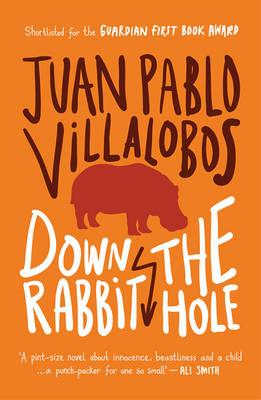
Firstly, Down the Rabbit Hole by Juan Pablo Villalobos (tr.Rosalind Harvey, 2011), which I picked up after reading Shoshi’s excellent review. It is published by And Other Stories, a not-for-private-profit company which concentrates mainly on translated fiction. That sentence makes me feel better about the world 🙂
Back to the novel: Tochtli (rabbit in Nahuatl, an indigenous language of Mexico), tells us about his love of samurai films, hats, learning new words, and his life as the young son of a drug baron, Yolcaut (rattlesnake).
“I think we have a very good gang. I have proof. Gangs are all about solidarity. So solidarity means that because I like hats, Yolcaut buys me hats, lots of hats, so many that I have a collection from all over the world and all periods of the world. Although now more than new hats what I want is Liberian pygmy hippopotamus. I’ve already written it down on the list of things I want and given it to Miztli. That’s how we always do it, because I don’t go out much, so Miztli buys me all the things I want on orders from Yolcaut.”
The isolation is a necessary part of his father’s business, whose paranoia is an occupational hazard that is no doubt keeping them all alive. The tragic effect that this is having on young Tochtli becomes increasingly apparent as the story progresses. Tochtli accepts his life, knowing no different, but to the adult reader he displays worrying signs of severe anxiety: wanting his head shaved because he doesn’t want ‘dead’ hair on him, compulsively wearing hats, constant severe stomach pains, and later, after he sees something his father tried to keep hidden, selective mutism. He also takes violence pretty much in his stride:
“One of the things I’ve learnt from Yolcaut is that sometimes people don’t turn into corpses with just one bullet. Sometimes they need three or even fourteen bullets. It all depends where you aim them. If you put two bullets in their brains they’ll die for sure. But you can put up to 1,000 bullets in their hair and nothing will happen, though it might be fun to watch.”
Although dealing with extremely serious subject matter, there is humour is the novel, such as Tochtli’s description of the preparation for a drug run to Liberia which he also goes on in order to get one of his beloved pygmy hippos:
“By the way, Franklin Gomez started being Franklin Gomez yesterday in the airport. That’s what his passport from the country of Honduras says: Franklin Gomez. There were problems because Franklin Gomez didn’t want to be Franklin Gomez. Until Winston Lopez convinced him.”
In such a short tale (70 pages in my edition)Villalobos effectively widens the narrative of drug trade away from the usual barons/dealers/ users paradigm to show how the fallout from the industry can reach far and wide, including devastating those too young to have a choice about their own involvement. It is a truly moving story, not about drugs (you can read an article by the author where he refutes the term narcoliteraturahere), but about children trying to cope with the messy, corrupt world adults create around them: sadly, pretty much a universal theme.
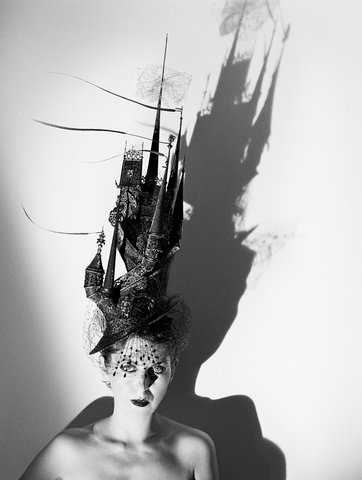
Fellow hat enthusiast, the late Isabella Blow, wearing Philip Treacy’s Castle hat
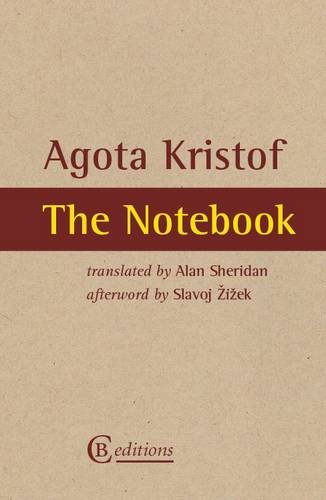
Secondly, The Notebook by Agota Kristof (1986, tr. Alan Sheridan, 1989) published by CB editions, a publishing house which focuses on short fiction, poetry and translations. Kristof was Hungarian but was exiled to French-speaking Switzerland in 1956, and wrote this, her first novel, in French.
Like Down the Rabbit Hole, The Notebook is told from a child’s point of view, in this instance twin boys – we never know their individual names and they always use the first-person plural – who are evacuated to live with their maternal grandmother in the countryside of an unnamed nation, but which is generally thought to be Hungary.
“We call her Grandmother. People call her the Witch. She calls us ‘sons of a bitch’…Grandmother never washes. She wipes her mouth with the corner of her shawl when she has finished eating and drinking. She doesn’t wear knickers. When she wants to urinate, she just stops wherever she happens to be, spreads her legs and pisses on the ground under her skirt.”
This woman shows them no love or affection (although as the novel progresses we learn to recognise the small signs that she does care for them) and life is tough. They work on her smallholding and undertake various psychological ‘exercises’ to try and adjust to their straightened circumstances.
“ ‘My darlings! My loves! My joy! My adorable little babies!’ When we remember these words, our eyes fill with tears. We must forget these words because, now, nobody says such words to us and because our memory of them is too heavy a burden to bear. So we begin our exercise again in a different way…By repeating them we make these words gradually lose their meaning and the pain that they carry in them is reduced.”
The tone of the narration is astonishing. As the boys become more and more detached in an effort to preserve themselves from the horrors they witness, the reader is faced with filling in the gaps regarding what is happening. The delivery is so matter-of-fact that more the once I found myself stopping, thinking ‘Wait a minute, what the…’, going back and finding that something devastating had been described and I’d nearly missed it.
“Words that define feelings are very vague; it is better to avoid using them and to stick to description of objects, human beings and oneself; that is to say, to the faithful description of facts.”
The Notebook is a shattering work, and a challenging read. Human relationships are warped under the pressures of war. More than once, these pretty, golden twins get drawn into adult sex games. A young girl who is named after her birth anomaly – Harelip is apparently her given name – engages in some truly upsetting sexual acts. A neighbour behaves with horrific cruelty toward a group of starving people (presumably Jewish prisoners) and the boys wreak a terrible revenge (which they never admit in the text but you know what has happened and why). It is a difficult read but a powerful one, which does not shy away from the damage done when the acts of nations cause individuals to lose sight of their humanity. It is a political book, but not a polemical one: the twins’ equanimity leaves the reader to draw their own conclusions.
“Later, we have our own army and government again, but our army and government are controlled by our Liberators. Their flag flies over all the public buildings. The photograph of their leader is displayed everywhere. They teach us their songs and their dances; they show us their films in our cinemas. In the schools, the language of our liberators is compulsory; other foreign languages are forbidden.”
Highly recommended, but go in prepared – brilliantly written and completely brutal.
The Notebook was adapted into a film in 2013, which completely passed me by. From this trailer it looks excellent, and thankfully laws protecting children and animals means certain scenes are guaranteed to have not been filmed, surely?
This is a further (mini) contribution (not my usual two-work blog post) to Jean Rhys Reading Week, hosted by Jacqui at JacquiWine’s Journal and Eric at Lonesome Reader. Do check out their blogs and join in!
This time I’m looking at Sleep It Off Lady (1976) which is Rhys’ final collection of stories, published 3 years before she died. The stories are presented in a chronological order of the age of the protagonist, so it almost feels like a dipping into and out of someone’s life at various points; from the two young sisters living in Dominica in the first story Pioneers, Oh Pioneers to the young woman in Paris in Night Out 1925, to the elderly woman living alone in the titular penultimate story.
This approach is not dissimilar to her longer fiction, such as Good Morning Midnight, which used stream of consciousness to build up a picture of a life from fractured parts. All the things I enjoy in Rhys’ longer fiction are evident in her short stories. For example…
Her humour used to highlight a serious issue – such as mental illness encountered by repressed Edwardian Brits in the colonies:
“‘If,’ said Mr Eliot ‘the man had apologized to my wife, if he’d shown the slightest consciousness of the fact that he was stark naked, I would have overlooked the whole thing. God knows one learns to be tolerant in this wretched place. But not a bit of it. He stared hard at her and came out with: ‘What an uncomfortable dress – and how ugly!’ My wife got very red. Then she said: ‘Mr Ramage, the kettle is just boiling. Will you have some tea?’” (Pioneers Oh Pioneers)
Her unblinking look at sexual politics which degrade women and empower men. This takes an even darker turn when she documents the sexual assault of a twelve year old (this is written very sensitively and not at all gratuitously, but neither does it let the reader off the hook – we can’t ignore what has happened):
“He talked of usual things in a usual voice and she made up her mind that she would tell nobody of what had happened. Nobody. It was not a thing you could possibly talk about. Also, no one would be believe exactly how it had happened, and whether they believed her or not she would be blamed.” (Good-bye Marcus, Good-bye Rose)
And her startling observations that disconcert yet articulate something fundamental:
“But it was always the most ordinary things that suddenly turned round and showed you another face, a terrifying face. That was the hidden horror, the horror everyone pretended did not exist, the horror that was responsible for all the other horrors.” (The Insect World)
I’m so glad I took part in Jean Rhys Reading week as it encouraged me to explore this writer much sooner than I otherwise might have done. I’ve no idea why, having rated Wide Sargasso Sea so highly when I first read it in my teens, I allowed Rhys to slip off my radar. Her writing seems drawn directly from her life yet she is able to explore themes that you don’t need to be an ex-colonial, chorus girl, artist’s model, thrice-married Parisian who is friends with Ford Madox Ford to find meaning in (at least I assume so, since that’s basically my life in a nutshell).
“Very widespread now – heart condition.” (Sleep It Off Lady)
I’m really looking forward to reading the rest of her work, I only wish there was more of it.
Somehow I’ve contrived to remain blissfully unaware that today would have been Roald Dahl’s 100th birthday and celebrations abound. I only realised this morning when the BBC News informed me of such, and then at work one of my colleagues mentioned she’d sent her daughter to school dressed as a spider. I assume this is a reference to James and the Giant Peach, and not her convoluted way of telling me she’s taking 6 months sick leave because she’s lost her mind.
As a result I’ve prepared zero for this blog, but I was reminded of one of the best viewing experiences of my childhood a few weeks ago, when my sister-in-law mentioned she was reading George’s Marvellous Medicine with my niece. My brother has no memory of this televisual treat – sometimes I wonder if we shared a childhood at all. Luckily for my brother & anyone else who missed the programme as a child, some kind person has uploaded it in 5 parts on YouTube and its brilliance is not dimmed by adulthood – enjoy!
This is my contribution to Jean Rhys Reading Week, hosted by Jacqui at JacquiWine’s Journal and Eric at Lonesome Reader. Do check out their blogs and join in!
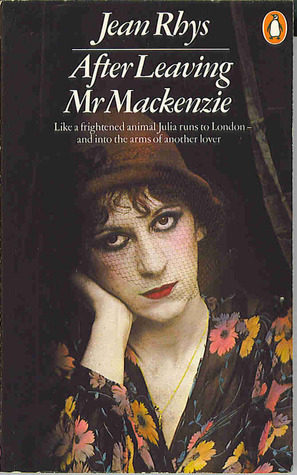
Firstly, After Leaving Mr Mackenzie (1930).
My edition is this 1970s Penguin – the subtitle manages to be both cheesy and misleading – bad Penguin!
I feel I should have found this novel much more depressing I did. Julia is a woman whose looks are fading, an impending disaster for her, as she has no money and lives off the handouts of lovers who will find her easier to discard the older she gets. At the moment she has an ambiguous quality:
“Her career of ups and downs had rubbed most of the hallmarks off her, so that it was not easy to guess at her age, her nationality, or the social background to which she properly belonged.”
People tend to judge her harshly rather than kindly, particularly because she is a woman and at a time of more rigid social rules, they can read her lifestyle in her clothes, hair and makeup. The men who use her escape more lightly, such as the titular lover with whom her relationship is breaking down:
“He was of the type which proprietors of restaurants and waiters respect. He had enough nose to look important, enough stomach to look benevolent. His tips were not always in proportion with the benevolence of his stomach, but this mattered less than one might think.”
After her cheques from Mr Mackenzie stop, Julia returns to England from France. Not quite estranged from her family but not on fond terms with them either, she lives in seedy Bloomsbury boarding houses:
“But really she hated the picture. It shared, with the colour of the plush sofa, a certain depressing quality. The picture and the sofa were linked in her mind. The picture was the more alarming in its perversion and the sofa the more dismal. The picture stood for the idea, the spirit, and the sofa stood for the act.”
I find that an astonishing piece of writing. To take a description of a dilapidated room and show how that reflects the mood of the person in it is one thing, but to extend it in such a way, so original and startling, really demonstrates why Rhys deserves to be lauded.
Julia ricochets around London, trying to find a man to take care of her. Rhys does not judge her protagonist which must have been quite shocking for 1930. Julia is sexually active, unmarried, childless, and is not punished by Rhys for such deviation from the feminine ideal. While she is a sad figure, even tragic, Rhys shows how we share a commonality with Julia rather than marking her out as Other.
“She was crying now because she remembered that her life had been a long succession of humiliations and mistakes and pains and ridiculous efforts. Everybody’s life was like that. At the same time, in a miraculous manner, some essence of her was shooting upwards like a flame. She was great. She was a defiant flame shooting upwards not to plead but to threaten. Then the flame sank down again, useless, having reached nothing.”
After Leaving Mr Mackenzie is a sad novel, but what keeps it from being depressing, for me, are the gentle touches of Rhys’ humour, such as in the description of Mr Mackenzie, and the fact that Julia holds on to her resilience. She is not a victim, despite being treated appallingly, but rather a realist, who knows that her options as a woman in her circumstances are limited. Rhys has a great deal to say but does so in a non-didactic way, leaving the reader to reach their own conclusions.
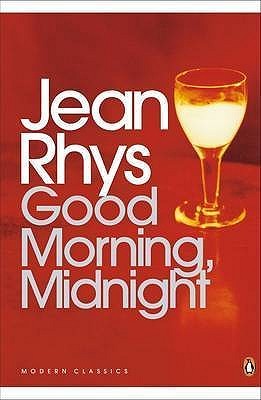
Secondly, Good Morning Midnight (1939). Superficially, this sounds very similar to After Leaving Mr Mackenzie: Sasha Jansen returns to Paris alone and broke. She is losing her looks and feels lonely and desperate… but it is quite different.
A more recent Penguin edition – blessedly free of a cheesy subtitle
Sasha does not flail around trying to extract money from everyone. Rather, Rhys writes this novel in the first person, using a degree of stream of consciousness to explore how a single woman at this point in history comes to terms with her life and the future that awaits her. Sasha is fragile:
“On the contrary, it’s when I am quite sane like this, when I have had a couple of extra drinks and am quite sane, that I realise how lucky I am. Saved, rescued, fished-up, half-drowned, out of the deep, dark river, dry clothes, hair shampooed and set. Nobody would know I had ever been in it. Except, of course, that there always remains something. Yes, there always remains something…”
She is self-destructive and lonely:
“I’ve had enough of these streets that sweat a cold, yellow slime, of hostile people, of crying myself to sleep every night. I’ve had enough of thinking, enough of remembering. Now whisky, rum, gin, sherry, vermouth, wine with the bottles labelled ‘Dum vivimus, vimamus….’ Drink, drink drink…As soon as I sober up I start again. I have to force it down sometimes…Nothing. I must be solid as an oak.”
And yet, amidst the sadness, there is resilience. We learn of Sasha’s past in Paris as she walks the streets, meets new people and is drawn back into her memories. The stream of consciousness and flitting between past and present is a highly effective. Rather than feeling like a contrived literary style, Rhys is able to create a real sense of being inside Sasha’s head and how someone would think: not in straight lines but (to steal an analogy from Jeanette Winterson) in spirals, back and forth.
Based on these two novels, I would say Rhys is brilliant at creating flawed, vulnerable women who are somehow survivors – they have a strength which is not immediately obvious, that perhaps they don’t even recognise themselves.
“I am trying so hard to be like you. I know I don’t succeed, but look how hard I try. Three hours to choose a hat; every morning an hour and a half trying to make myself look like everybody else. Every word I say has chains around its ankles”
A single woman with a sexual history who is no longer young does not have the most rosy prospects in interwar society and Rhys does not shy away from this. However, there is a sense that Sasha (and Julia) is not alone in her struggles. The search for meaning in a society that can degrade through disregard affects many and there is fellowship and sympathy to be found.
“I look thin – too thin – and dirty and haggard, with that expression that you get in your eyes when you are very tired and everything is like a dream and you are starting to know what things are like underneath what people say they are.”
Wiki tells me that when first published, (male?) critics found this novel well written but too depressing. I thought it was beautifully written and sad, but not depressing. I think for me depressing comes with a certain bleakness, and I didn’t find either novel bleak: neither Julia or Sasha ever quite lose hope.
To end, if anyone can capture the vicissitudes of a life well-lived in Paris:
So I thought I would look at novels about teachers. Firstly, Notes on a Scandal by Zoe Heller (2003). Narrated by Barbara, an older, unmarried teacher heading towards retirement, it tells the tale of another teacher, Sheba Hart’s, affair with a pupil. Sort of. Barbara purports to be doing so, but we don’t know what happened, because Barbara does not really know. Instead, what we have is an intense character study of Barbara, and her relentless campaign to work her way in Sheba’s life.
“I simply went on with my life – reading my books, preparing my meals, changing my sheets – quietly certain all the while that, sooner or later, she would wake up to my importance in her life.”
Sheba is open and naïve to Barbara’s machinations, making it easy for Barbara to engineer a friendship. Sheba’s horrible, destructive secret is the perfect leverage Barbara needs to wheedle her way into Sheba’s life further:
“For most people, honesty is such a unusual departure from their standard modus operandi – such an aberration in their workaday mendacity – that they feel obliged to alert you a moment of sincerity is coming on. ‘To be completely honest,’ they say, or ‘To tell you the truth,’ or ‘Can I be straight?’ Often they want to extract vows of discretion from you before going any further. ‘This is strictly between us, right?…You must promise not to tell anyone…’ Sheba does none of that. She tosses out intimate and unflattering truths about herself, all the time, without a second thought.”
Notes on a Scandal is a brilliant character study. Heller feels no need to make her protagonist likeable, but Barbara is so very believable in all her contradictions and complexity. She veers between sharply observant and utterly deluded, a compelling mix for a narrator.
“Any sexual arrangement existing outside the narrow channels of family newspaper convention is relegated to a great, sinister parenthesis of kinky ‘antics’.”
“As Sheba’s unofficial guardian, I have certain obligations that I cannot shirk”
She is a horrible snob who views almost everyone with utter disdain at best; a cynical cruelty at worst:
“St George’s is the holding pen for Archway’s pubescent proles – the children of the council estates who must fidget and scrap here for a minimum of five years until they can embrace their fates as plumbers and shop assistants.”
Yet, as Zoe Heller explains here, she has a sympathy for Barbara, for her loneliness and the desperation that evokes. She behaves despicably, but is motivated by a great sadness, and unarticulated sexual longing, which means it is hard to condemn her without reservation.
“I have sat on park benches and tubes and schoolroom chairs, feeling the great store of unused, objectless love sitting in my belly like a stone until I was sure I would cry out and fall, flailing, to the ground. About all of this, Sheba and her like have no clue.”
Notes on a Scandal was made into a film in 2006, starring Cate Blanchett as Sheba and Judi Dench as Barbara, directed by Richard Eyre. Playwright Patrick Marber wrote the screenplay and changed the ending, but it stayed true to the tone of the book and I thought it was an effective adaptation:
Secondly, Wonder Boys by Michael Chabon (1995) which was recommended to me by David Bowie. It follows a weekend in the life of Professor Grady Tripp: adulterous, permanently stoned and struggling to find an ending to a 2000 page novel he’s writing called Wonder Boys. As a young man he’d wanted to be a writer and has even been moderately successful:
“I’d read Kerouac the year before and had conceived the usual picture of myself as an outlaw-poet-pathfinder, a kind of Zen-masterly John C Fremont on amphetamines with a marbled dime-store pad of lined paper in the back pocket of my denim pants. I still see myself that way, I suppose, and I’m probably none the better for it.”
Understandable in an adolescent, this self-image easily becomes pathetic in middle-age, of which Grady is all too aware:
“Here I was, forty-one years old, having left behind dozens of houses, spent a lot of money on vanished possessions and momentary entertainments, fallen desperately in and abruptly out of love with at least seventeen women, lost my mother in infancy and my father to suicide, and everything about to change once more”
The change is due to Grady’s wife having left him and his mistress, Sara – the wife of his boss – being pregnant.
“For me the act of marriage has proven, like most other disastrous acts of my life, little more than a hedge against any future lack of good material.”
Things are about to change, but first Grady has to get through a weekend with a suicidal student James Leer, who wears a coat which “emitted an odour of bus stations so desolate that just standing next to him you could feel your luck changing for the worse” and his old friend and editor Crabtree, who is determined to sleep with James and wants to read Wonder Boys, which Grady has assured him is finished. What follows is a farce involving dead dogs, squashed snakes, stolen vintage jackets once worn by Marilyn Monroe, and car theft. It is a comic novel but I didn’t find it laugh out loud funny, more wryly amusing despite the broader elements. Grady has no illusions about himself but neither is he self-pitying, and as he blunders around trying to piece his life back together I did find myself rooting for him.
“Terry Crabtree gazed at me with such an air of cool and unconcerned appraisal he was no longer generally seeing me, his oldest friend, in whom all the outlandish promises of life and every chance for glory intimately and anciently adhered. He was seeing only the pot-addled author of a bloated, boneless, half-imaginary, two-thousand page kraken of a novel”
Chabon has a pithy turn of phrase which I greatly enjoyed:
“It wore an oddly crooked grin – almost as if a muscle in its cheek were paralysed – and a little black eye patch over its left eye. I liked that. I wondered if I had it in me to produce a baby with a piratical air.”
“She was a natural blonde, with delicate hands and feet, and in her youthful photographs one saw a girl with mocking eyes and a tragic smile, the course of whose life would conspire in time to transpose that pair of adjectives.”
But he doesn’t allow these to overwhelm the narrative in order to prove how clever and witty he is. All in all, an entertaining, well-observed read.
Wonder Boys was also adapted into a film, in 2000, starring Michael Douglas as Grady Tripp and the incomparable Frances McDormand as Sara. I saw it when it came out & to be honest it has much faded in my memory, but from this trailer it looks like a faithful adaptation:
So if we’ve learnt anything kids, I think it’s to stay well away from teachers. Happy studies!
A little while ago I wrote about Sarah Water’s The Paying Guests, her novel set in the 1920s, which I took refuge in as I was trying to grow my hair into a bob (well, it made sense at the time). Rest easy reader, I know you must have been worrying about it, but a friend proclaimed this weekend that my hair looks most definitely bob-like so I’m walking around like a fabulous flapper:
Maybe not. But regardless, to celebrate I’m looking at two novels from the 1920s, as recommended by Sarah Waters at the end of The Paying Guests. Choosing from the list of ten was a serious business, involving shortlists, consulting with various bookish types, taking votes…. OK, I just picked the two I had on my TBR mountain 🙂
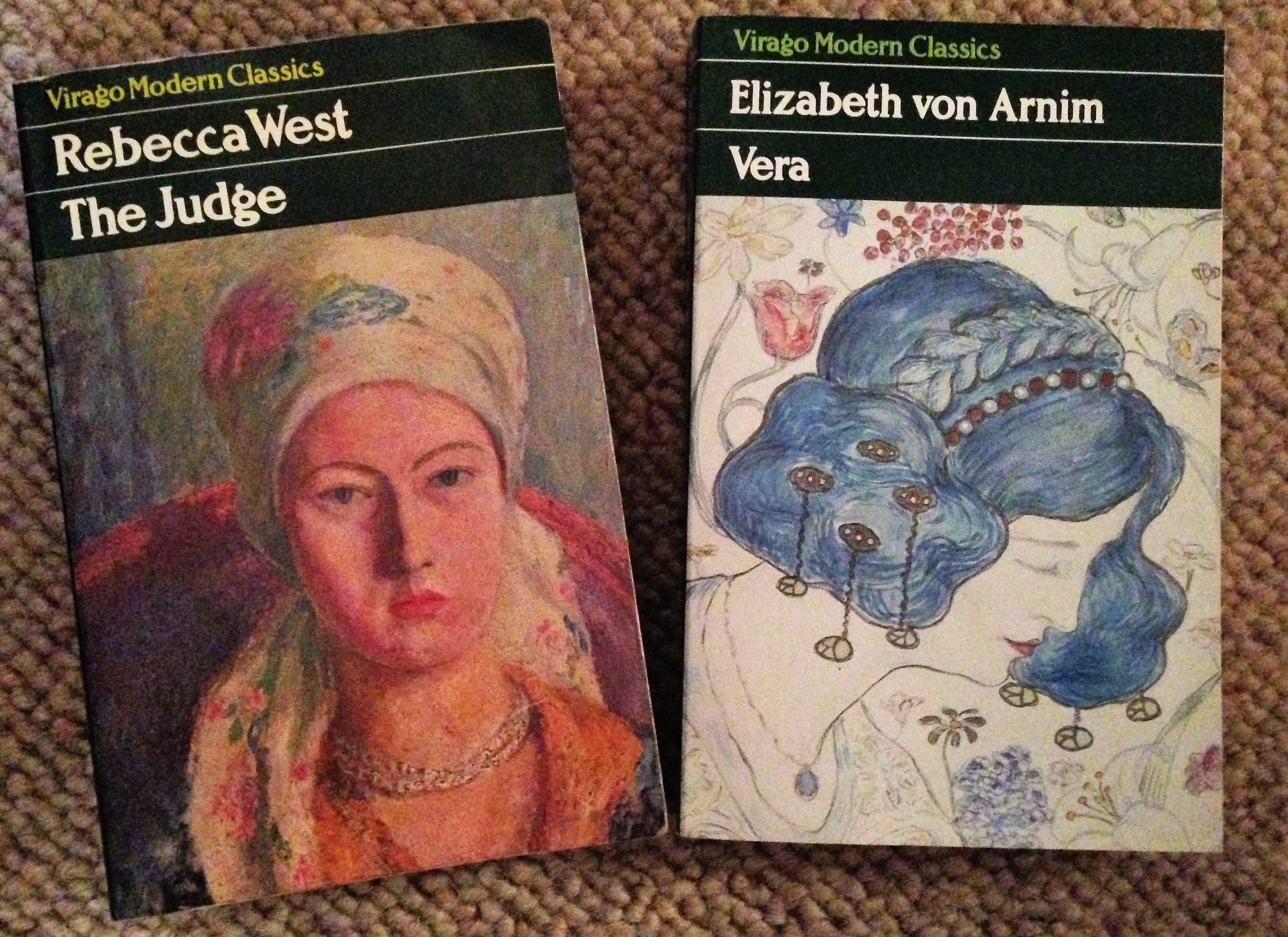
Firstly, The Judge by Rebecca West (1922) which Sarah Waters describes thusly: “Suffragism, illegitimacy, motherhood, melodrama: like lots of West’s fiction, this is sprawling, brilliant, funny – and a little bit crazy.” The story begins in Edinburgh, where Ellen, nineteen years old, beautiful and a suffragette, meets Richard Yaverland:
“For sufficient reasons he was very sensitive to the tragedies of women, and he knew it was a tragedy that such a face should surmount such a body. For her body would imprison her in soft places: she would be allowed no adventures other than love, no achievements other than births.”
Later in the story it will emerge what those sufficient reasons are, but against her better judgement Ellen falls in love with worldly, handsome Richard.
“She was not sure that she approved of love. The position of women being what it was. Men were tyrants, and they seemed to be able to make their wives ignoble. Married women were often anti-Suffragists; they were often fat; they never seemed to go out on long walks in the hills or write poetry.”
Alongside this humour and Ellen’s naivety “I will have nothing to do with any man until I am great. Then I suppose I will have to use them as pawns in my political and financial intrigues” West does have something serious to say about relationships between the sexes at that moment in time. The Judge presents detailed character studies of Ellen, Richard and his mother Marion, and how society has influenced the nature and capacity of their love. This is not a rose-tinted view of young marriage by any means.
“Perhaps something like fear would have come upon her if she had known how immense he felt with victory; how he contemplated her willingness to love him in a passion of timeless wonder, watching her journey from heaven, stepping from star to star, all the way down the dark whirling earth of his heart; and how even while he felt a solemn agony at his unworthiness he was busily contriving their immediate marriage. For there was a steely quality about his love that would have been more appropriate to some vindictive purpose.”
The second half of the novel sees Ellen leave Edinburgh to live with Richard and his mother in the Home Counties. More emerges about the circumstances of Richard’s illegitimacy and subsequently complex family dynamics. It is at this point that the melodrama mentioned by Sarah Waters really starts to ramp up. I think it’s here that the novel may start to lose readers, but although it begins to spiral somewhat, I still thought the novel had a lot to say about women’s position and the ramifications of moral absolutes. Marion and Richard have a relationship Freud would have found great mileage in, teetering on the edge of impropriety. Ellen is understandably somewhat befuddled by this brittle woman and her weird family, but she decides they suit her:
“The rapidity with which she had changed from the brooding thing she generally was, with her heavy eyes and her twitching hands perpetually testifying that the chords of her life had not been resolved and she was on edge to hear their final music, and the perfection with which she had assumed this bland and glossy personality at a moment’s notice, struck Ellen with wonder and admiration. She liked the way this family turned and doubled under the attack of fate. She felt glad that she was going to become one of them, just as a boy might feel proud on joining a pirate crew.”
The Judge is somewhat overblown, but I enjoyed it for that reason – sometimes it’s nice to indulge in a bit of mad melodramatics alongside the serious issues.
Secondly, Vera by Elizabeth von Arnim (1921) which Sarah Waters describes as “a brilliant depiction of a sinister, suffocating marriage, this novel also features one of the most likeable spinster aunts in British fiction.” Sinister is right: this is a very different tale to the delightful The Enchanted April. Definitely not escapist, Vera is rather one of those novels where you want to reach into the book, yank out one of the characters and shake them until they listen to you, the older, wiser reader. Maybe I get over-involved in my reading…
Lucy Entwhistle, young and naïve, finds herself almost alone in the world after her beloved father dies. Blundering into her grief moments after the death is the older, good-looking Wemyss, also grieving a loss, as his wife has recently died in possibly murky circumstances:
“‘How good you are!’ she said to Wemyss, her red eyes filling. ‘What would I have done without you?’
‘But what would I have done without you?’ he answered; and they stared at each other, astonished at the nature of the bond between them, at its closeness, at the way it seemed almost miraculously to have been arranged that they should meet on the crest of despair and save each other.”
Vera is extremely clever, as at first we don’t like Wemyss, but like Lucy’s beloved spinster Aunt Dorothy, it’s not totally clear why: “whatever she felt about his legs she welcomed him with the utmost cordiality”. The more time he spends with Lucy, the more unpleasant he reveals himself to be – a wholly self-centred, arrogant, ignorant bully. Aunt Dorothy is wise enough to realise that if she registers her objections, it will only push Wemyss and Lucy closer together, and so she keeps quiet, though distressed, as she watches the tragedy unfold.
“His way of courting wouldn’t be – she searched about in her uneasy mind for a word, and found vegetarian. Yes; that word sufficiently indicated what she meant: it wouldn’t be vegetarian.”
Von Arnim’s lovely humour stops the tale being bleak, but it is a tense tale, increasingly so after Wemyss and Lucy marry less than a year from the death of the titular wife. The scales begin to fall from Lucy’s eyes:
“One learns a lot on a honeymoon, Lucy reflected, and one of the things she had learned was that Wemyss’s mind was always made up.”
But Lucy doesn’t realise the extent of what is going on in her marriage. We are living at a time of fourth-wave feminism, and in a post-Freudian world, so I would say Lucy is in a psychologically abusive marriage with a narcissistic, megalomaniac sadist who seeks to destroy her. But she cannot see it.
“the mood of tender, half-asleep acquiescence in which, as she lay in his arms, he most loved her; then indeed she was his baby…You couldn’t passionately protect Vera. She was always in another room.”
Wise Vera. There is a glimmer of hope, and that hope is the wonderful Aunt Dorothy. Never underestimate the clear-sighted spinster Wemyss, you have no idea who you’re dealing with.
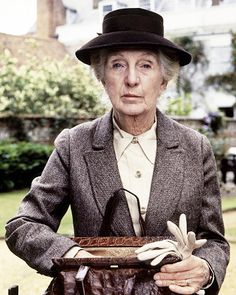
Joan Hickson, the greatest Miss Marple – 5 points if you can spot the wardrobe malfunction in this picture
Vera is a brilliantly written psychological study of the dangers for women in a society that seeks to position them as economically and socially dependent on men, particularly when this dependency is wrapped up in romantic notions. It made me furious and it made me sad. It also made me glad that although we have some way to go, I live where my rights as a woman are enshrined in law.
To end, what Lucy needs is a Lesley Gore classic cranked up to 11, sung by the perennially awesome feminist icon Joan Jett:
The 2016 Olympics have come to an end (boo!) but we still have the Paralympics to come (hooray!) There have been astonishing achievements by those who seem to have been made from very different stuff to us mere mortals. When they seem doused in more than their fair share of charisma as well, you can’t even make yourself feel better by thinking that they’re probably horrible people, because they’re just so funny and charming about it all. Who could I be thinking of….?
Human being 2.0
To celebrate the Olympics, I thought I’d take up triathlon sit on my backside reading, of course. It’s Women In Translation Month (head over to Meytal’s blog to read all about WITmonth) so I’m looking at two novellas by Brazilian women writers. This will also be one more stop on my Around the World in 80 Books Reading Challenge, hosted by Hard Book Habit.
Firstly, Agua Viva by Clarice Lispector (1973, tr. Stefan Tobler 2012). Although I’ve called this a novella, I’m not sure that’s really what it is. It’s a series of impressions and observations, plotless but definitely not artless.
“This is life seen by life. I may not have meaning but it is the same lack of meaning that the pulsing vein has.”
I say it’s not artless, because although Agua Viva can give the impression of randomness, it’s carefully constructed to carry you through, the different passages building on and echoing one another.
“So writing is the method of using the word as bait: the word fishing for whatever is not word. When this non-word – between the lines – takes the bait, something has been written…so what saves you is writing absentmindedly.
I don’t want to have the terrible limitation of those who live merely from what can make sense. Not I: I want an invented truth.”
“I notice that I’m writing as if I were between sleep and wakefulness.”
Agua Viva quite a difficult work to talk about, because it resists being pinned down. I could attach various labels to it: impressionistic, modernist, stream-of-consciousness, but none of these are quite right. On this reading – for I suspect it changes every time you read it – I felt it was about trying to capture the immediate present, to pin down moments knowing that they are gone forever just as you recognise them. The style lends itself to this theme, as it jumps and disorientates, on occasions tipping over into surrealism:
“I am feeling the martyrdom of an untimely sensuality. In the early hours I awake full of fruit. Who will come to gather the fruit of my life? If not you and I myself? Why is it that things an instant before they happen already seem to have happened? It’s because of the simultaneity of time. And so I ask you questions and these will be many. Because I am a question.”
I read Agua Viva cover to cover, and I do wonder if this was the wrong approach. While the kaleidoscopic style and images build towards an overall impression, Agua Viva would equally lend itself to being dipped into, reading a single passage and ruminating on it. Apparently the Brazilian singer Cazuza read Agua Viva 111 times. I suspect it’s that sort of book: either you hurl it against the wall within minutes of opening it, or it becomes a mercurial companion for life.
I can’t sum myself up because you can’t add a chair and two apples. I am a chair and two apples. And I cannot be added up.”
Secondly, With My Dog-Eyes by Hilda Hilst (1986 tr. Adam Morris 2014). This is also a disorienting , unsettling work, non-linear and impressionistic. Hilst uses this style to create a highly effective portrait of Professor Amos Keres, who is having some sort of breakdown or psychotic episode. The fractured story-telling serves to take the reader inside the mind of someone who is extremely unwell.
“Poetry and mathematics. The black stone structure breaks and you see yourself in a saturation of lights, a clear-cut unhoped-for. A clear-cut unhoped-for was what he felt and understood at the top of that small hill. But he didn’t see shapes or lines, didn’t see contours or lights, he was invaded by colours, life, flashless, dazzling, dense, comely, a sunburst that was not fire. He was invaded by incommensurable meaning. He could only say that. Invaded by incommensurable meaning.”
The narrative shifts from third to first person as Keres copes with his boss suggesting he take a break, and then spends the day thinking over his life since boyhood, his career and his marriage. This makes it sound more linear and contained than it is, and does With My Dog-Eyes a great disservice. Its power comes from its layering of ideas and images with such rapidity as to almost assault the reader – never incoherent but an effective immersion in an unravelling mind.
“And everything begins anew, the patience of these animals infinitely digging a hole, until one day (I hoped, why not?) transparence inundates body and heart, body and heart of mine, Amos, animal infinitely digging a hole. In mathematics, the old world of catastrophes and syllables, of imprecision and pain was cracking up. I no longer saw hard faces twisting into questions, in tears so many times, I didn’t see the gaze of the other on mine, what a thing it can be to have eyes on your eyes, eyes on your mouth. Waiting for what kind of word? Such formidable cruelties occurring every day, humans meeting and in the good-mornings and good-afternoons such secrets, such crimes, such chalice of lies…”
It’s a good job this was a novella (59 pages in my edition) as I don’t think I could have taken much more of it (that’s a recommendation, not a criticism). With My Dog-Eyes is a short, sharp, shock: a plunge into madness.
To end, I was very excited that Caetano Veloso was performing at the Olympic opening ceremony, but I don’t think the acoustics did him any favours in capturing his wonderfully sensitive voice. Here he is as part of the Pedro Almodovar film Hable Con Ella (Talk to Her):
A couple of weeks ago the news reported it was the busiest day for holiday getaways. And just in case there was any doubt that this was a British news story, it was delivered by a reporter standing next to a motorway, framed within a narrative context of extreme traffic jams, while the traffic behind her was disappointingly free-flowing. Brilliant. It’s the first bit of news that raised a smile from me after Brexit.
Sadly, my finances are as dire as ever so I will have to leave the joys of non-existent traffic jams to more solvent souls. Instead I looked to my TBR for some suitably summery titles and came up with two that by coincidence are both short story collections. So not quite the traditional holiday doorstop reading matter, but highly recommended nonetheless.
Firstly, Sunstroke by Tessa Hadley (2007), whose stories explore desire in various guises, showing how it is both extraordinary and everyday. The titular story looks at old friends Rachel and Janie, married with kids, committed to their lives yet willing to risk it all for a moment’s sexual excitement:
“Neither is exactly unhappy, but what has built up in them instead is a sense of surplus, of life unlived. Somewhere else, while they are absorbed in pushchairs and fish fingers and wiping bottoms, there must be another world of intense experiences for grown-ups.”
Hadley is very good at placing dramatic tension within these ordinary domestic details. Her settings and characters are wholly recogniseable, and it is this that makes her writing challenging: you can’t step away from it as something outside your experience. So even if you’ve never had an affair with your lecturer, tracked down the older woman who got away, or recreated the sexual betrayals of your parents within your own love life, as the protagonists of Hadley’s short stories have, it is difficult to claim that these experiences are entirely alien. Is it out of character behaviour, or is it that someone’s character is sublimated beneath the ordinary? Hadley questions how secure anything is, how sure we can be of the foundations of our lives, when in a moment, something can happen to change the narrative we’ve constructed:
“Even if we were good, if we were perfectly and completely chaste, we can’t control what happen in our imagination. So being good might only be another kind of lie.”
Hadley is a highly skilled writer. Often I found myself on finishing the stories thinking “Oh, that’s clever.” The collection works as a whole and the individual stories are exactly what the genre should be: powerful, contained, strengthened rather than weakened by their limited words. She’s also great at effective turns of phrase:
“For a moment he was sure she could smell something on him, see something of the dazzle that was clinging to him, dripping off him, flashing round in his veins. But he saw her deliberately tidy that intimation away, out of consciousness. This was her husband, the man she knew. He was a physics teacher and competition-standard chess player, wasn’t he?”
Duran Duran taking a formal approach to their barging holiday along Birmingham’s canal system
Secondly, The Shell Collector by Anthony Doerr (2002), written 12 years before the Pulitzer prize-winning All the Light We Cannot See. Having read this collection, I don’t think it’s too much to say the Pulitzer potential was already evident – this is a brilliantly written collection of stories, spanning several countries: Kenya, Liberia, the US, Finland, Tanzania. In the titular story, a young boy loses his sight and discovers the love of his life:
“‘That’s a mouse cowry,’ the doctor said. ‘A lovely find. It has brown spots, and darker stripes at its base, like tiger stripes. You can’t see it, can you?’
But he could. He’d never seen anything so clearly in his life. His fingers caressed the shell, flipped and rotated it. He had never felt anything so smooth – had never imagined something could possess such deep polish. He asked, nearly whispering: ‘Who made this?’ The shell was still in his hand, a week later, when his father pried it out, complaining of the stink.”
As an adult, his quiet life collecting on the coast is disturbed by people wanting him to sting them with cone shells, convinced it will cure their various ills. It is a melancholy tale, about a search for meaning in the world, about loneliness and grief. Ultimately though, it is about resilience and love.
“He took the cone shell and flung it, as far as he could, back into he lagoon. He would not poison them. It felt wonderful to make a decision like this. He wished he had more shells to hurl back into the sea, more poisons to rid himself of.”
All eight stories in this collection are beautifully written; wise and moving. Even in such company, one of the stories which stood out for me was The Caretaker, about a Liberian refugee. Joseph Saleeby is not a particularly likable man when we first meet him: selfish, spoilt and making a living illegally. Then war breaks out, and he suffers horribly. He arrives in the US to claim refuge, deeply traumatised. When the bodies of six whales are washed ashore, he takes their hearts and buries them on the estate where he is caretaker:
“He fills the hole, and as he leaves it, a mound of earth and muscle, stark amid a thicket of salmonberry with the trunks of spruce falling back all around it… he feels removed from himself, as though his body were a clumsy tool needed only a little longer. He parks in the yard and falls into bed, gore-soaked and unwashed, the door to the apartment open, the hearts of all six whales wrapped in the earth, slowly cooling. He thinks: I have never been so tired. He thinks: at least I have buried something.”
He starts growing fruit and vegetables on the plot of land and befriends the unhappy daughter of the owners. Things do not go well for Joseph as people don’t realise how mentally fragile he is, but his friendship with Belle endures:
“The girl saws a wedge from one of the halves. The flesh is wet and shining and Joseph cannot believe the colour – it is as if the melon carried light within it. They each lift a chunk of it to their lips and eat. It seems to him that he can taste the forest, the trees, the storms of the winter and the size of the whales, the stars and the wind. A tiny gob of melon slides down Belle’s chin.”
Doerr writes with delicacy but without sentimentality. His view is penetrating and unblinking, but compassionate. Just devastating.
To end, summer = Pimms, and this advert = another chance to acknowledge the enduring genius of Adam Ant:









 madame bibi lophile recommends