This is my (incredibly long – apologies!) contribution to the 1930 Club, hosted by Karen at Kaggsy’s Bookish Ramblings and Simon at Stuck in a Book. It’s running all week so do join in if you have a chance!

The two novels I’ve chosen are lovely Virago Modern Classics both concerned with the role of women in society, specifically the work that they do, but beyond that they could not be more different. I’ll begin with a scathing indictment of war, before moving on to some light relief via a comic presentation of upper middle-class privilege…
Helen Zenna Smith’s Not So Quiet was written as a response to Remarque’s All Quiet on the Western Front, from a female perspective. It is a work of fiction but Smith aims to narrow the gap between fiction and reality by calling the narrator Helen Smith and writing from a first person perspective.
Helen has gone to France to volunteer as an ambulance driver, leaving behind her comfortable middle-class existence, much to the delight of her jingoistic mother. Helen and the other young women she works with share no such illusions, as her friend Tosh points out:
“No Smithy, you’re one of England’s Splendid Daughters, proud to do their bit for the dear old flag, and one of England’s Splendid Daughters you’ll stay, until you crock up or find some other decent excuse to go home covered in glory. It takes nerve to carry on here, but it takes twice as much to go home to flag-crazy mothers and fathers…”
In this short novel Smith documents the experience of war for those not engaged in trench warfare but shockingly, dangerously close to it. Her gaze is unflinching:
“We hate and dread the days following on the guns when they boom without interval. Trainloads of broken human beings: half-mad men pleading to be put out of their misery; torn and bleeding and crazed men pitifully obeying orders like a herd of senseless cattle, dumbly, pitifully straggling in the wrong direction, as senseless as a flock of senseless sheep obeying a senseless leader, herded back into line by the orderly, the kind sheep-dog with a ‘Now then, boys, this way. That’s the ticket, boys’, instead of a bark; men with faces bleeding through their hasty bandages; men with vacant eyes and mouths hanging foolishly apart dropping saliva and slime; men with minds mercifully gone; men only too sane, eyes horror-filled with blood and pain…”
Not So Quiet is not a plot driven novel as such. Instead it documents one woman’s experience, and how she is utterly destroyed by it. In addition to the horror of the men used as machine gun fodder, she sees England’s Splendid Daughters live infested with fleas, eating slop, needing illegal abortions and desperately trying to find some reprieve. For a whole generation the war wreaked absolute devastation of land, industry, mind, body and soul.
“We young ones doomed to live on without belief in anything human or divine again are the ones to be pitied.”
Not So Quiet is not a subtle novel. By that, I don’t mean it is badly written, its extremely well written. Smith is furious, and not interested in presenting a considered, moderate view. Some things do not warrant a moderate response, and the horrors of war are one of those. The world she depicts is unrelenting and nightmarish.
“I become savage at the futility. A war to end war, my mother writes. Never. In twenty years it will repeat itself. And twenty years after that. Again and again, as long as we breed women like my mother and Mrs. Evans-Mawnington. […]
Oh, come with me, Mother and Mrs. Evans-Mawnington. Let me show you the exhibits straight from the battlefield. This will be something original to tell in your committees, while they knit their endless miles of khaki scarves,…. something to spout from the platform at your recruiting meetings. Come with me. Stand just there.”
Reading Not So Quiet recently meant I was reading within a context of our Prime Minister pandering to the fascist fringe using inflammatory language around Brexit. This offensive rhetoric encourages people to forget that the EU was set up to promote peace and co-operation in Europe, after two twentieth century wars tore it apart. I wish more people would read things like Not So Quiet to remind themselves of experiences they’ve been lucky enough not to have to live through.
”What is to happen to women like me when this war ends … if it ever ends. I am twenty-one years of age and I know nothing of life but death, fear, blood, and the sentimentality that glorifies these things in the name of patriotism”
Deep breath… enough politics from me. But I hope I’ve shown how No So Quiet is still a relevant novel and an urgent one.
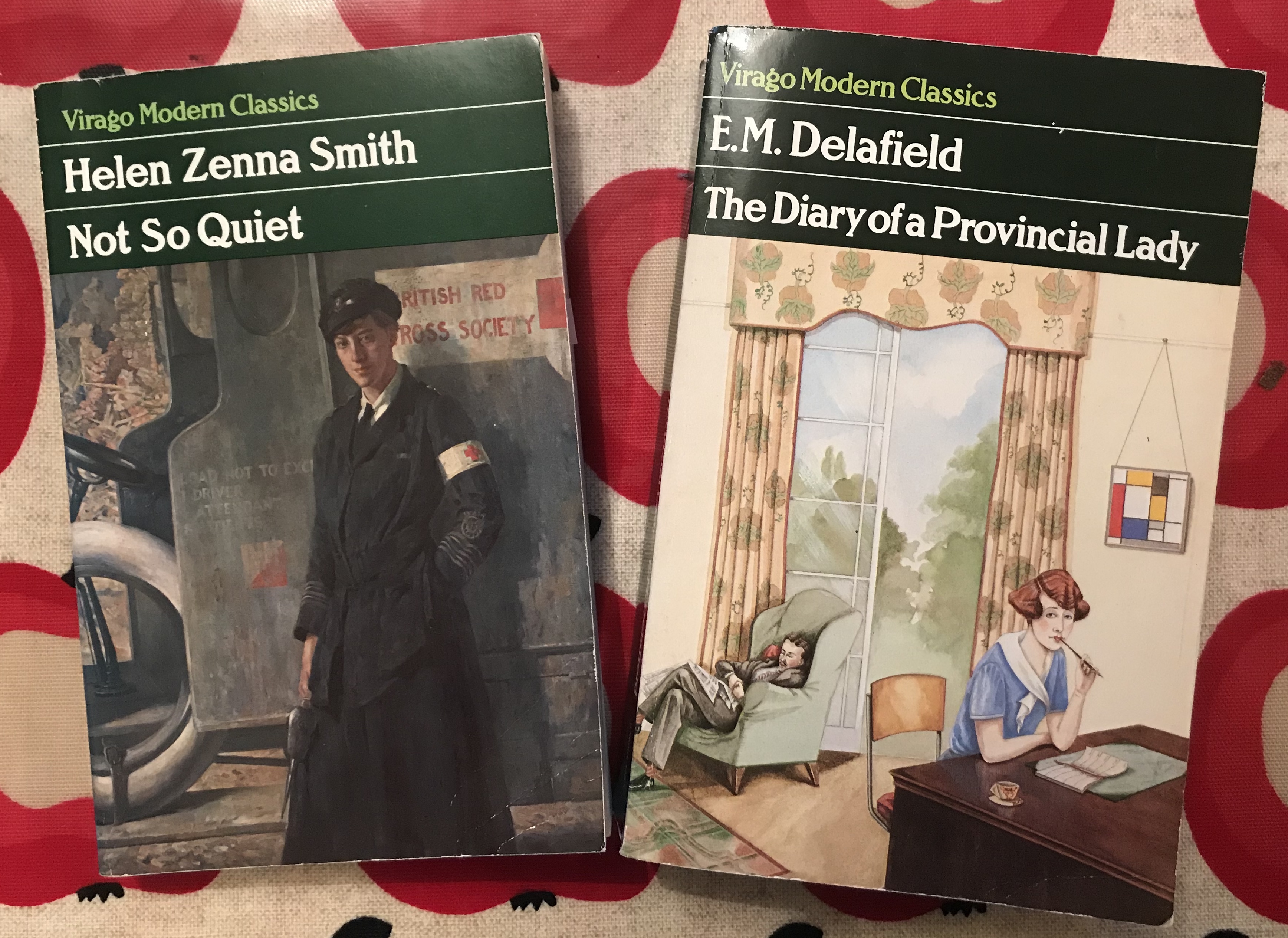
Secondly, a chance to recover with a light, fun novel about no greater tribulation than how to plant indoor bulbs. The Diary of a Provincial Lady by EM Delafield is not fluffy though – it is witty and incisive about social mores and the knots people, especially genteel British people, tie themselves in to avoid appearing rude. Again, it’s not a hugely plot driven novel, having been written as a weekly serial for Time and Tide magazine. It documents the titular lady’s experience of genteel middle-class life, with her disinterested husband Robert falling asleep behind The Times, son Robin away at boarding school, and daughter Vicky in the charge of Mademoiselle, the French governess.
“Robert takes the boys back after dinner, and I sit in hotel lounge with several other mothers and we all talk about our boys in tones of disparagement, and about one another’s boys with great enthusiasm.
Am asked what I think of Harriet Hume but am unable to say, as I have not read it. Have a depressed feeling that this is going to be another case of Orlando about which was perfectly able to talk most intelligently until I read it, and found myself unfortunately unable to understand any of it.”
One ongoing source of tension in the Provincial Lady’s life is her aristocratic neighbour, Lady Boxe, who is self-dramatizing and unable to conceive of any situation other than her own:
“Why not just pop into the train, enquires Lady B., pop across France, and pop out into Blue Sky, Blue Sea, and Summer Sun? Could make perfectly comprehensive reply to this, but do not do so, question of expense having evidently not crossed Lady B.’s horizon. (Mem.: Interesting subject for debate at Women’s Institute, perhaps: That Imagination is incompatible with Inherited Wealth. On second thoughts, though, fear this has a socialistic trend.)
The Lady’s days seemed to be filled with social events she finds tedious, writing innumerable letters, negotiating with servants and managing debt in a most peculiar way:
“Robert startles me at breakfast by asking if my cold—which he has hitherto ignored—is better. I reply that it has gone. Then why, he asks, do I look like that? Refrain from asking like what, as I know only too well. Feel that life is wholly unendurable, and decide madly to get a new hat.
Customary painful situation between Bank and myself necessitates expedient, also customary, of pawning great-aunt’s diamond ring, which I do, under usual conditions, and am greeted as old friend by Plymouth pawnbroker, who says facetiously, And what name will it be this time?
Visit four linen-drapers and try on several dozen hats. Look worse and worse in each one, as hair gets wilder and wilder, and expression paler and more harassed. Decide to get myself shampooed and waved before doing any more, in hopes of improving the position.”
The Diary of a Provincial Lady could so easily be tedious but its so well written that instead it is an utter delight. I would generally have very short patience with well-to-do ladies with very little to fill their days, but the Provincial Lady knows that a lot of what she expected to concern herself with is completely frivolous, and she’s taking an askance view of it all, while not really putting anyone down (not even Lady B).
“Lady B. amiably observes that I, at least, have nothing to complain of, as she always thinks Robert such a safe, respectable husband for any woman. Give her briefly to understand that Robert is in reality a compound of Don Juan, the Marquis de Sade, and Dr. Crippen, but that we do not care to let it be known locally.”
The Diary of a Provincial Lady is a quick read, and one that can be dipped into, given its episodic, diary structure. It’s a welcome bit of escapism in these troubled times!
“Lady Frobisher, who would be so delighted if Robert and I would come over for tea whilst there is still something to be seen in the garden. (Do not like to write back and say that I would far rather come when there is nothing to be seen in the garden, and we might enjoy excellent tea in peace—so, as usual, sacrifice truth to demands of civilisation.)”
Jacqui has also reviewed The Diary of a Provincial Lady for the 1930 Club and you can read her excellent post here.
To end, I was tempted to choose a clip from Anna Christie as it was released in 1930 and I love Greta Garbo. But instead I’ve gone for this anthem about female working life from the only person who can convincingly rhyme ‘kitchen’ with ‘ambition’:

 madame bibi lophile recommends