“The Riviera isn’t just a sunny place for shady people” (W. Somerset Maugham)

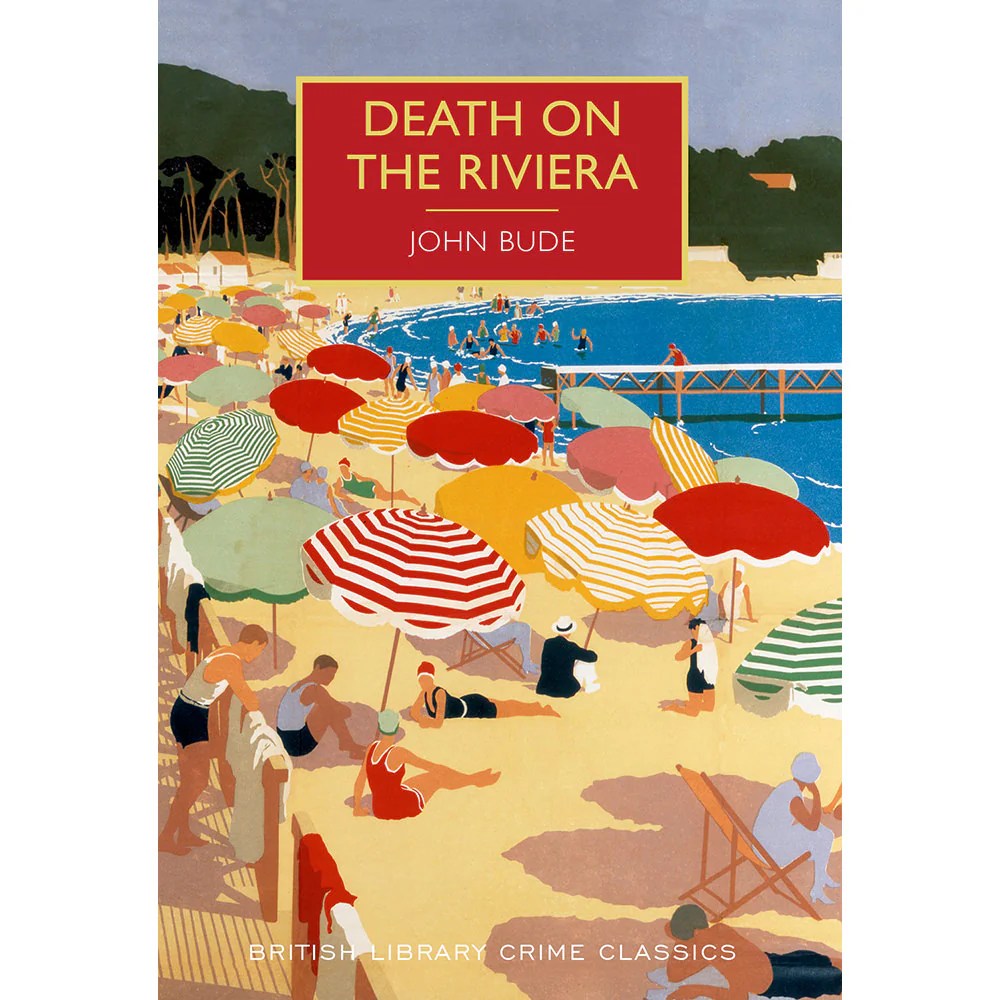
This is my final contribution to Kaggsy and Simon’s1952 Club which has been running all week. So far I’ve read two golden age mysteries for the club and I’m finishing with one too: Death on the Riviera by John Bude, in a pleasing British Library Crime Classics edition.

I read The Cheltenham Square Murder for the 1937 Club last year, and while I had enjoyed it, I didn’t think it was the strongest of Bude’s novels or a particularly perplexing mystery. This, I’m happy to report, was much stronger.

The story centres around the rich and privileged Nesta Hedderwick and her various assorted guests at her villa in the south of France.

“But for the nagging accusations of her weighing-machine life might have been perfect. She’d money; one of the loveliest villas in Menton; A large … collection of friends; splendid health; a sense of humour; and a virile capacity for enjoyment. Her husband, a successful but dyspeptic stockbroker, had died between the wars of ptomaine poisoning.”

Staying with Nesta are her niece Dilys; “smooth-faced bounder” Tony Shenton; Nesta’s companion Miss Pilligrew; beautiful Kitty; and a decidedly shifty artist:

“When Nesta had an artist living in the house she expected him to behave like one. Paul Latour certainly did his best to live up to the fin de siècle Bohemianism on which Nesta had directed her romantic ideas of the genre.”

Bude clearly has a lot of fun with Paul’s artistic swizz:

“A cod’s head capping the naked torso of a woman, balanced onto cactus leaves and garnished with the motif of lemons and spaghetti… Paul shrugged hopelessly.”

Although Dilys’ attitude to where she has found herself suggests Paul isn’t alone in his pretence:

“Just paste and cardboard and tinsel, like most of my aunt’s insufferable friends. Actually I find it rather boring. It gets that way after a time.”

So it seems the French Riviera is the perfect place for a counterfeiting operation, which is what brings DI Meredith and Acting-Sergeant Freddy Strang across La Manche, searching for Tony ‘Chalky’ Cobbett.

They work closely with Inspector Blampignon and refreshingly, the local police are shown to be entirely competent and pleasant to work with.

As the British and French police investigate the local forgers, Freddy runs into Dilys and they begin a very sweet romance, which brings the two threads smoothly together. When an acquaintance of the villa coterie goes missing, the police investigation widens.

One of my complaints with The Cheltenham Square Murder was that something completely and utterly obvious takes forever to be recognised by Meredith and I thought the same had happened here. Fortunately it turned out I’d fallen into exactly the assumption Bude had set up for the reader: at one point he has Meredith explain that when such an occurrence happens in mystery novels it always means the following…. a nice little meta joke with the reader which I appreciated 😊

Oddly, given the novel’s title, no-one is murdered until around page 160 of a 223 page novel. For my tastes, too long was spent on the counterfeiting and too little on people getting bumped off, but the investigation worked well and it was a steady police procedural without being plodding:

“He was visited by one of those revealing flashes of deduction that spring, not from any inspirational source, but from a clearly realised and logical appreciation of the facts.”

Death on the Riviera is well-paced and enjoyable, with enough characters for plenty of suspects without being completely baffling. The humour is gentle and light, and the setting beautifully evoked:

“It wouldn’t be easy, he realised, to take leave of this sunlit, sparkling coast with its terraced vineyards and olive groves, it palms and oleanders, it’s fantastic cacti, it’s mimosa-scented streets and impossibly blue seas. He thought of the Old Kent Road on a wet February night and shuddered.”
“Good authors don’t seem to do much good these days. Books have got so psychological.” (Laura Talbot, The Gentlewomen)

This is a contribution to Kaggsy and Simon’s1952 Club, running all week. One of the many great things about the Club weeks is that they encourage me to raid the TBR and get to books which could have languished there forever. Today’s book is a perfect example: an author and a novel I knew nothing about but which I greatly enjoyed.

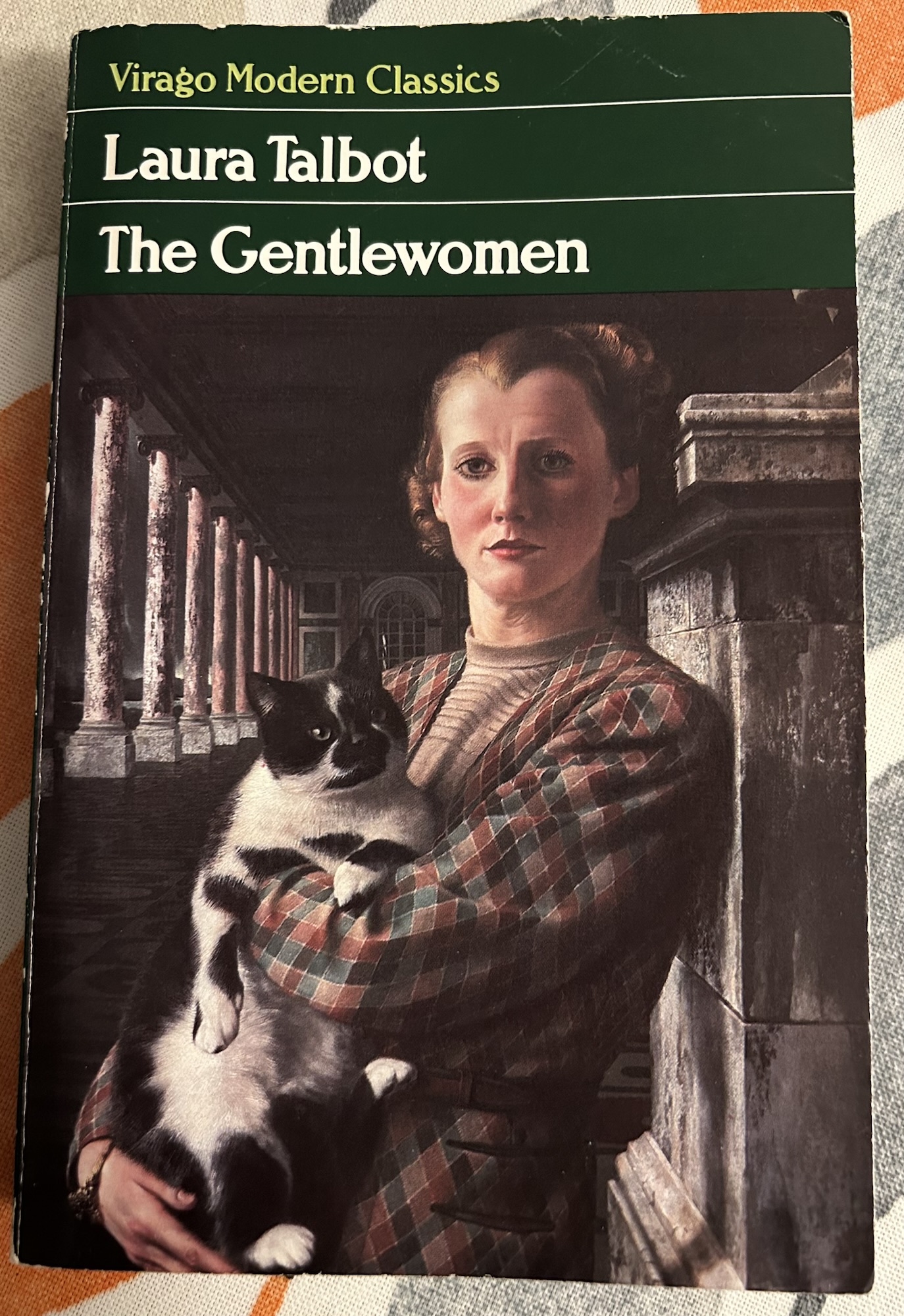
Laura Talbot was the pen-name of Lady Ursula Chetwynd-Talbot, and her knowledge of the land-owning classes informs The Gentlewomen throughout. It tells the story of Miss Roona Bolby, a single woman growing older who has to earn her living as a governess. She clings desperately to her family’s genteel background and colonialism while around her the world changes irrevocably.

“When she had been sent back to England she had been seven. She had been told so much since that memories which had been sharp had become blurred by that which she had been told. It was difficult now to sort her own from Sita’s and Mavis’s. India had not faded with the journey home; from then on it had grown, it had become as much a part of her own life as of her Mother’s and Sita’s and Mavis’s.”

Thus she will tell anyone – repeatedly and incessantly – that she was born in India, as she wears gold Indian bangles and uses an Indian silver brush set. She remains oblivious to the fact that her background is a matter of utter indifference to everybody.

At the beginning of the novel she leaves her shabby boarding house Hillstone in Birmingham, (filled with characters which could have made a great novel in itself!) and heads to the country seat of the Rushford family.

The Second World War is ongoing, and so the house is not as it once was. Lord Rushford is overseas, there are two Italian POWs and Land Girls have working on the estate, and my favourite character, straight-talking Reenie, has never been a kitchen maid before.

Miss Bolby has been employed to tutor to the various children from both parents’ first marriages, while Nanny Becca cares for the younger toddler Bella. Jessy, Barby, Louisa and Ruth dislike their tutor, and why wouldn’t they? She is completely devoid of any warmth towards them, won’t call them by the names they use, and seems a pretty dull teacher.

In Miss Bolby, Laura Talbot has not created a likable protagonist. She is so bound up in outdated societal structures, she entirely fails to respond to people as people. Her snobbery infects all her thoughts and actions:

“I always think it helpful to know from what milieu people come, especially in these days when one so frequently find the unexpected.”

The Introduction to my edition suggests that the portrait of Miss Bolby is without compassion, but I disagree. While she is petty, silly and resentful, we see how thwarted she is through her memories. Her mother used phrases like “rather deuxième” about those she deemed socially inferior, failing to recognise the crassness of such a phrase – one which Miss Bolby echoes later in the novel. She also wished to be a singer, which her mother prevented.

And so while she declined suitors in her youth as never good enough, it is really only she who suffered, and continues to do so. She was beautiful, but rejected the chances that this gave her, and now when roles and opportunities for women are still so circumscribed, she is losing her looks too. Her world is getting smaller and smaller, and she exacerbates this.

“Drawing-rooms and dining-rooms were as passages, her presence in them transitory: she had been forced to grope as a moth gropes before flying out into the night.”

When Miss Pickford arrives at Rushford, the reader is shown another way for someone in similar circumstances to live. The other gentlewoman of the title, Miss Pickford has little advantages in her favour, but she enjoys people and is interested in them, is entirely without Miss Bolby’s pettiness and relentless judgements, and has genuine skill in her work as secretary. The children warm to her and call her Picksie, and no-one seems to consider her an “old bag” – an epithet frequently associated with Miss Bolby.

As this disparate group rub along together, there is a threat to Miss Bolby’s fragile sense of worth, grounded as it is on meaningless external attributes rather than who she is as a person. Her sister Sita made a marriage to Arthur Atherton-Broadleigh and lives abroad, so Miss Bolby puts great store by the connection (and by constantly referring to it) despite little knowledge of the actual realities of the relationship. Unfortunately for her, there is someone who knows Arthur’s past very well…

At the same time her Indian bracelets go missing, and this additional pressure on her psyche means she starts to behave quite viciously. While there is never quite the psychological disintegration that occurs in William’s Wife or Wish Her Safe at Home, The Gentlewomen did remind me of these novels, with the portrayal of societal pressure and delusion for women who wanted so much more from life.

The war is far away physically, but the drudge of various privations and the frequent noise of aeroplanes bearing down to the local airbase add an atmosphere of bleak strain, which becomes almost Gothic as it turns out Rushford has been burned out from fire in many places, and sits in overgrown, unmanageable grounds.

“War was a lonely battle for the lonely, for those not urgently connected with it, and in her case a lonely battle for what?”

In case this sounds very heavy, I should say I disagree with the Introduction in another way, when it says Talbot had no humour.  I think she is easy to underestimate because she is not interested in drawing attention to her writing at all; there is no strong authorial voice. Her style is to present the characters, and leave judgement to the reader. Often Miss Bolby’s pretentious assertions go ignored by her interlocutors which speaks volumes.

And so I found there were various moments of humour, from the wonderful Reenie, to the neighbour Lady Archie who consistently baffles her devoted husband by acquiring modern slang from the Squadron-Leader at the RAF base. Needless to say, this doesn’t fit in Miss Bolby’s schema at all:

“She had wondered all evening about Lady Archie, and who Lady Archie was and why she used such phrases as ‘It seems to ring a bell’ and ‘Same here’, which one expected from a Mr Billings, but not from a woman such as Lady Archie.”

“ ‘Wizard!’ said Lady Archie. ‘But I’ll have to consult Hughie about the car.’”

The tension builds in The Gentlewoman towards a somewhat melodramatic climax, but while I felt this came close to clumsy, it was also a real page-turner. On the strength of this novel, I would definitely be interested in reading more by Laura Talbot. (And although I’m not usually bothered by writer’s biographies particularly, I’m also intrigued by her third marriage, which took place two years after she published this novel, to Patrick Hamilton. How on earth did that come about?!)

Sadly, ultimately Miss Bolby’s harshest judgements are in the fleeting ones she puts upon herself:

“A failure, who had not lived fully in any sphere – who had always lived up on the fringe.”

“Nothing puts things in perspective as quickly as a mountain.” (Josephine Tey)

Today for the 1952 Club hosted by Kaggsy and Simon I’m looking at another golden age mystery. The Singing Sands by Josephine Tey features her regular detective, Inspector Alan Grant. It was found in her papers after she died and published posthumously, which usually makes my heart sink, but the novel seems pretty complete so I hope it was as she planned.

You can come across all sorts prejudices and snobberies in golden age crime and The Singing Sands has a strong one running throughout, which admittedly I’ve not encountered before in the genre: Tey is a total snob about Scotland. As far as I can work out her rules are:

  1. Be Scottish
  2. But speak with an English accent (by which I assume she means RP – I doubt my south London tones would cut the mustard)
  3. Don’t be from the city
  4. Especially don’t be from Glasgow
  5. Be from the Highlands
  6. Don’t be a nationalist
  7. Really don’t be from Glasgow

I take great exception to her attitude to Glasgow – it’s a beautiful city full of friendly people. Every time I go I’m knocked out and I’m still giving serious consideration to moving there. In the end when I came across these attitudes I just rolled my eyes and skipped on, and it didn’t affect my enjoyment of the novel. But as a counterbalance I urge everyone to (re)visit wonderful Glasgow!

On with the novel! It opens with Grant struggling with his mental health and deciding to visit his cousin Laura (Lalla) and her family in the Highlands to recuperate. The background of what led to Grant reaching this point is never quite specified but he seems to be experiencing burnout/PTSD.

As he disembarks the train, the grumpy attendant is trying to rouse the passenger in berth B Seven. Grant realises he is dead, and his interest in faces (detailed extensively in The Daughter of Time which is where the title quote comes from but would have worked very well in this novel too) is piqued:

“What would bring a dark, thin young man with reckless eyebrows and a passion for alcohol to the Highlands at the beginning of March?”

He also picks up B Seven’s newspaper, which has some cryptic verse scribbled on it. Much as Grant tries to focus on his family and the fishing expeditions he had planned, his mind keeps being drawn back to B Seven. The verse leads him to visit some of the islands to identify the landmarks mentioned:

“There was nothing else in all the world but the green torn sea and the sands. He stood there looking at it, and remembering that the nearest land was America. Not since he had stood in the North African desert had he known that uncanny feeling that is born of unlimited space. That feeling of human diminution.”

Although his colleagues in London have identified the body and ruled accidental death, Grant thinks both these conclusions are questionable. Despite trying to recover from his work, he can’t let it go. He is aware that keeping his mind occupied can be useful, but it is a fine balance:

“Grant was very conscious that his obsession with B Seven was an unreasonable thing; abnormal; that it was part of his illness. That in his sober mind he would not have thought a second time about B Seven. He resented his obsession and clung to it. It was at once his bane and his refuge.”

We follow Grant as he heals, with the help of his beautiful environment, the understanding of his family, and his pursuit of the truth.

“But for B Seven he would not be sitting above this sodden world feeling like a king. New born and self-owning. He was something more than B Seven’s champion now: he was his debtor. His servant.”

The Singing Sands is not heavily plot-driven and the mystery is slight, but it is still an enjoyable read, if a slightly unusual approach to the genre. Grant’s dogged pursuit of the truth of a death which others seem quick to disregard makes him endearing, and there are lovely descriptions of the Highlands. It’s a quick read that doesn’t outstay its welcome, and it is compassionate in its portrayal of mental health.

“In matters where A was at spot X at 5:30pm on the umpteenth inst, Grant’s mind worked with the tidiness of a calculating machine. But in an affair where motive was all, he sat back and let his mind loose on the problem. Presently, if he left it alone, it would throw up the pattern that he needed.”

“London is too full of fogs and serious people.” (Oscar Wilde)

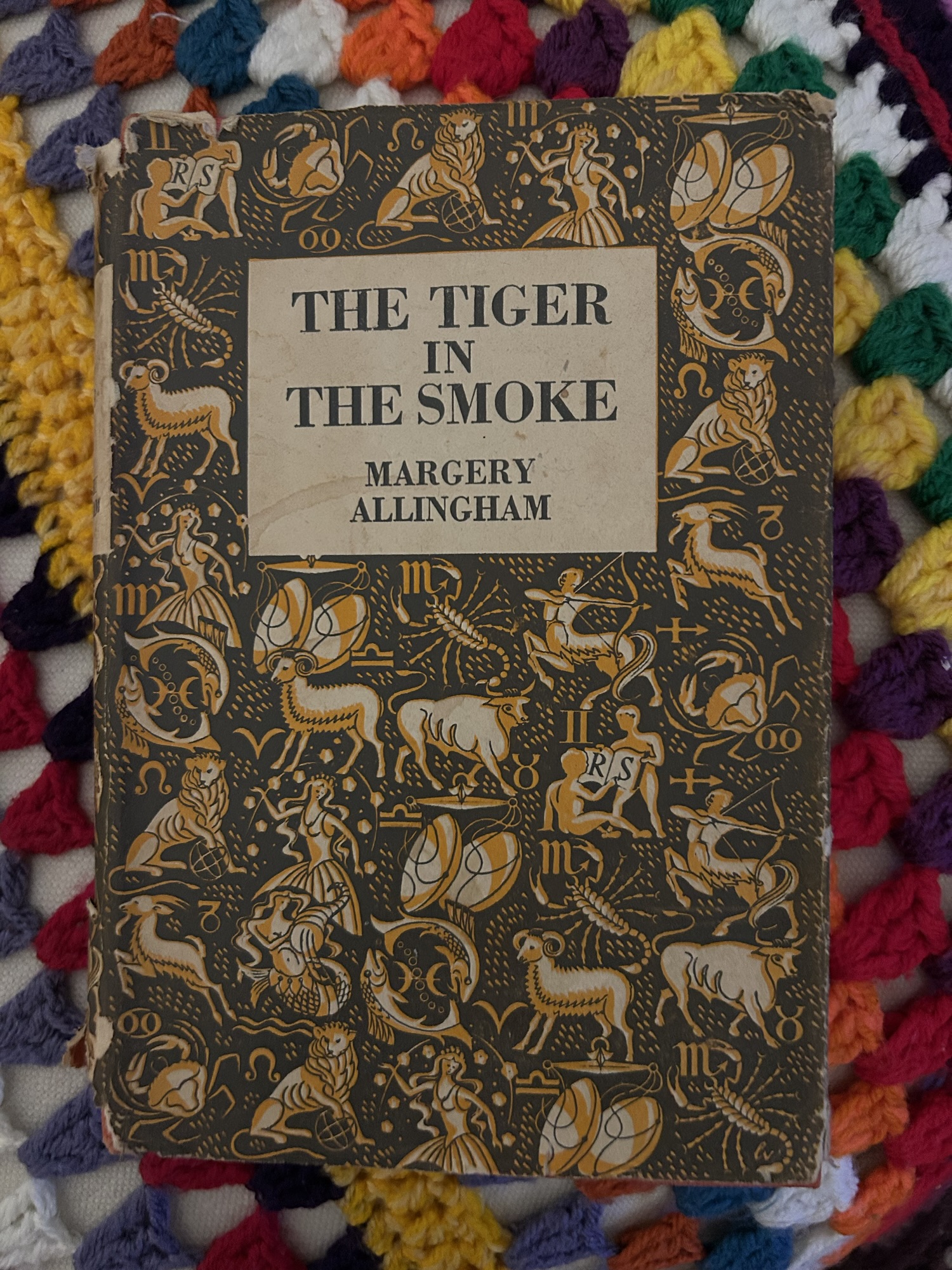
This is a contribution to Kaggsy and Simon’s 1952 Club, running all week. I found a few contenders in the TBR including several golden age mysteries, so I’m starting today with a pretty famous one, Tiger in the Smoke by Margery Allingham.

The titular smoke is a London pea-souper, a thick smog that chokes the airways and severely limits visibility – perfect for dastardly crimes to be committed!

“The fog was like a saffron blanket soaked in ice-water. It had hung over London all day and at last was beginning to descend. The sky was yellow as a duster and the rest was a granular black, overprinted in grey and lightened by occasional slivers of bright fish colour as a policeman turned in his wet cape.”

The story opens with Geoffrey Levett and Meg Elginbrodde crawling through the fog-bound traffic in a taxi. They are one of those wonderful postwar stiff-upper-lipped couples whose romantic chit-chat takes place along the following lines:

“Look, we’ll get out of this somehow and we’ll go through with the whole programme. We’ll have everything we planned, the kids and the house and the happiness, even the damned great wedding. It’ll be alright, I swear it, Meg.”

Love it!

The blight on their nuptials is that someone has been sending blurry photos to Meg of someone who could be her first husband Martin, presumed dead in the war. So she meets friend of the family  – and Allingham’s regular detective  – Albert Campion, along with Inspector Charlie Luke, at a train station.

It quickly emerges that the man is not her husband but a criminal named Duds Morrison. As the group begin to unravel what is going on and why, there is less mystery and more of a character study of a truly sinister criminal named Havoc. Inspector Luke is unnerved:

“Just then he had a presentiment, a warning from some experienced-born six sense, that he was about to encounter something rare and dangerous. The whiff of tiger crept to him through the fog.”

A gang of criminals appear and my heart sank a bit, as they all had various physical differences and I was braced for ableism. But while that is certainly present, the real menace in the book lies with Havoc, and Allingham labours over how physically perfect he is:

“His beauty, and he possessed a great deal […]

His face was remarkable, in feature it was excellent, conventionally handsome […]

Jail pallor, which of all complexions is the most hideous, could not destroy the firmness of his skin […]

He was a man who must have been a pretty boy, yet his face could never have been pleasant to look at. Its ruin lay in something quite peculiar, not in expression only but in something integral to the very structure. The man looked like a design for tragedy. Grief and torture and the furies were all there naked, and the eye was repelled even while it was violently attracted. He looked exactly what he was, unsafe.”

In other words, as beautiful and deadly as a tiger.

In comparison there is my favourite character, Canon Avril, Meg’s father:

“he asked so little of life that its frugal bounty amazed and delighted him. The older he grew and the poorer he became, the calmer and more contented appeared his fine gentle face.”

In fact, Tiger in the Smoke had an increasing amount of religious references and imagery as it went along (though it isn’t didactic at all) and I found myself reminded of Muriel Spark. I ended up googling Margery Allingham to see if she had a strong faith like Spark but couldn’t find it referenced. Tiger in the Smoke isn’t like Spark tonally, but it is certainly concerned with notions of good and evil in a similar way to her novels.

Although this is a Campion mystery, he barely features. Apparently the 1956 film cut him out entirely, and this wouldn’t be difficult at all. His sarcastic retainer Lugg also appears, and his wife Amanda along with Oates from Scotland Yard “a drooping figure in a disgraceful old mackintosh” but this could just as easily be a standalone novel.

While there isn’t a mystery as such, the plot is satisfyingly complex and the novel is expertly paced. The foggy atmosphere is used to full effect and Allingham creates a real page-turner. I was whizzing through Tiger in the Smoke to find out what happened.

It leads to a tense denouement, underpinned by a real sadness. A hugely satisfying start to my 1952 Club reading!

“Havoc was ‘police work’. There was no mystery surrounding his guilt. He was something to be trapped and killed, and Campion was no great man for blood sports.”