“A woman happily in love, she burns the soufflé.” (Baron St. Fontanel, Sabrina 1954)

Trigger warning: mentions suicide

This is my second contribution to this week’s 1954 Club, hosted by Simon and Kaggsy, and a chance to revisit Barbara Comyns, having really enjoyed Our Spoons Came From Woolworths.

The opening line of Who Was Changed and Who Was Dead may have usurped The Crow Road* to become my favourite beginning to a novel ever:

“The ducks swam through the drawing-room windows.”

Thus the scene is set for an unsettling domestic tale where nothing can be taken for granted.

The Willoweed family live in an English village where the river has just flooded in June. Then follows pages of dead animals, which I was prepared for, having read Jacqui’s wonderful review but I was exceedingly relieved when it ended (unfortunately there was also a horrible cat death later). Much as I could have done without the litany of death, it sets the tone for the darkness that follows.

In 1911 Emma, Dennis and Hattie live with their father Ebin and their grandmother who rules with a rod of iron. She is permanently furious, which Ebin attributes as follows:   

“It’s all this cleaning, I suppose; but she can’t expect me to help; my hands are my best feature, and they would be ruined.”

Ebin does very little apart from make vague overtures towards his children’s schooling and sleep with the baker’s wife.

“‘Father makes me hate men,’ thought Emma as she pumped water into a bucket.”

This is not an idyllic pre-war rose-tinted existence. Money is tight, relationships are tense, there is sexual deceit, violent undercurrents that threaten to overwhelm, and macabre power games. Grandmother Willoweed treats the servants horribly, but Old Ives the handyman is a match for her:

 “They always exchanged birthday gifts, and each was determined to outlive the other.”

Their lives are disrupted by a mysterious illness that sweeps through the village. People kill themselves following horrific delusions. By the time the cause of the illness has been identified, tragedy has touched the family and violence has ensued. As the title tells us, lives will have changed irrevocably one way or another.

I don’t want to say much more as the joy of reading Barbara Comyns is being so unsettled as to have no idea which way she is going to take you. There’s no-one like her; her view is so singular, so disturbing and yet so compelling. I found Who Was Changed and Who Was Dead brutal and horrifying, and also funny and enchanting. I couldn’t look away.

Secondly, I wrote last week about the middle two novels in Antonia White’s quartet, detailing the early life of Clara Batchelor, and now the final instalment, Beyond the Glass.

The novel picks up precisely where The Sugar House left off, with Clara and Archie having decided to separate. Clara moves back to her parents’ house to live with them and her grandmother in West Kensington. As she packs up her old life, she feels disassociated:

“She had the odd impression that it was not she who was stripping hangers and throwing armfuls of clothes into suitcases but some callous, efficient stranger. She herself was lying on the unmade bed, staring blankly at the cracks in the sugar-pink ceiling.”

This sense of disassociation deepens and broadens throughout the novel. When Clara announces to her mother “It’s a great relief not to have any feelings. I’m certainly not going to risk getting involved with anyone again.”

The reader of course knows what will happen. She attends a party with her friend Clive Heron (an intriguing character, my personal theory is he works for MI5) and falls instantly in love with the dashing soldier Richard Crayshaw.

What follows is such a clever exploration of someone slowly – then suddenly – unravelling. Clara stops eating and sleeping, she has a “strange sense of heightened perception” ever since she danced with Richard. She believes they communicate telepathically, a belief supported by others, but then she thinks the photographs of dead soldiers in her father’s study are speaking to her. She has gone from no feeling:

“Null and void. Null and void. She sat staring at the roses on her bedroom wall-paper, saying the words over and over again until she was half hypnotised.”

To too much feeling. At first her mania is disguised by being in love – plenty of people feel heightened and have reduced appetite and problems sleeping in the excitement of new romance. Certainly that is what Clara’s mother Isabel believes.

But gradually the reader begins to realise that Clara is really quite unwell. As Beyond the Glass is told from Clara’s perspective this takes some time, but it dawns us through others’ responses to her. In this way it is reminiscent of Wish Her Safe at Home, another excellent novel about severe mental illness.

Eventually she is ‘certified’ – made an in-patient at a public mental health hospital. The descriptions of the environment and the practices make me wonder how on earth anyone would have a hope of ever becoming well again. Thankfully mental health services, though chronically underfunded, are very different now.

I was so impressed with how White conveyed Clara’s disorientation and confusion, without making the narrative confusing and disorienting at all:

“Time behaved in the most extraordinary way. Sometimes it went at tremendous pace, as when she saw the leaves of the creeper unfurl before her eyes like a slow motion film, or the nurses, instead of walking along the passage, sped by as fast as cars. Yet often, it seemed to take her several hours to lift a spoon from her plate to her mouth.”

During her deep distress there are also echoes of events that occurred earlier in the narrative, particularly in The Sugar House, showing with the lightest of touches that her severe ill health has been building for a while:

“Since her marriage she had had an increasing sense of unreality, as if her existence had been broken off like the reel of a film.”

The recurring images of mirrors and glass as barriers reminded me of Plath’s The Bell Jar. Like The Bell Jar, this novel is based on the personal experiences of the author.

“She had an instantaneous vision of herself as someone forever outside, forever looking through glass at the bright human world which had no place for her and where the mere sight of her produced terror.”

Beyond the Glass ends on a note of hope, and faith, drawing on the Catholic thread that runs through all four novels. At times Clara’s Catholicism is more strongly felt in the story than at others, reflecting the character’s experience of her faith. I’m not religious but I felt the focus on this theme ended the novel and the series perfectly.

It’s so impressive that all the novels in the quartet are distinct and stand individually, while also developing across the sequence a fully realised portrait of Clara, and her family.

I’ve really enjoyed immersing myself in Clara’s life and I’m going to miss her (and her much-maligned mother, a great piece of characterisation). I wish Antonia White had continued writing her story.

“Something told her that, when they saw her again, they would know as well as she did that she no longer belonged to the world beyond the glass.”

To end, I finished my previous 1954 Club post with a filmed musical, so here’s another. The film of The Pajama Game is from 1957 but the Broadway show first appeared in 1954:

* “It was the day my grandmother exploded.”
“I coulda had class. I coulda been a contender.” (Marlon Brando, On The Waterfront, 1954)

The 1954 Club is running all this week, hosted by Simon and Kaggsy. Do take a look at the posts and join in if you can, the Club weeks are always great events 😊

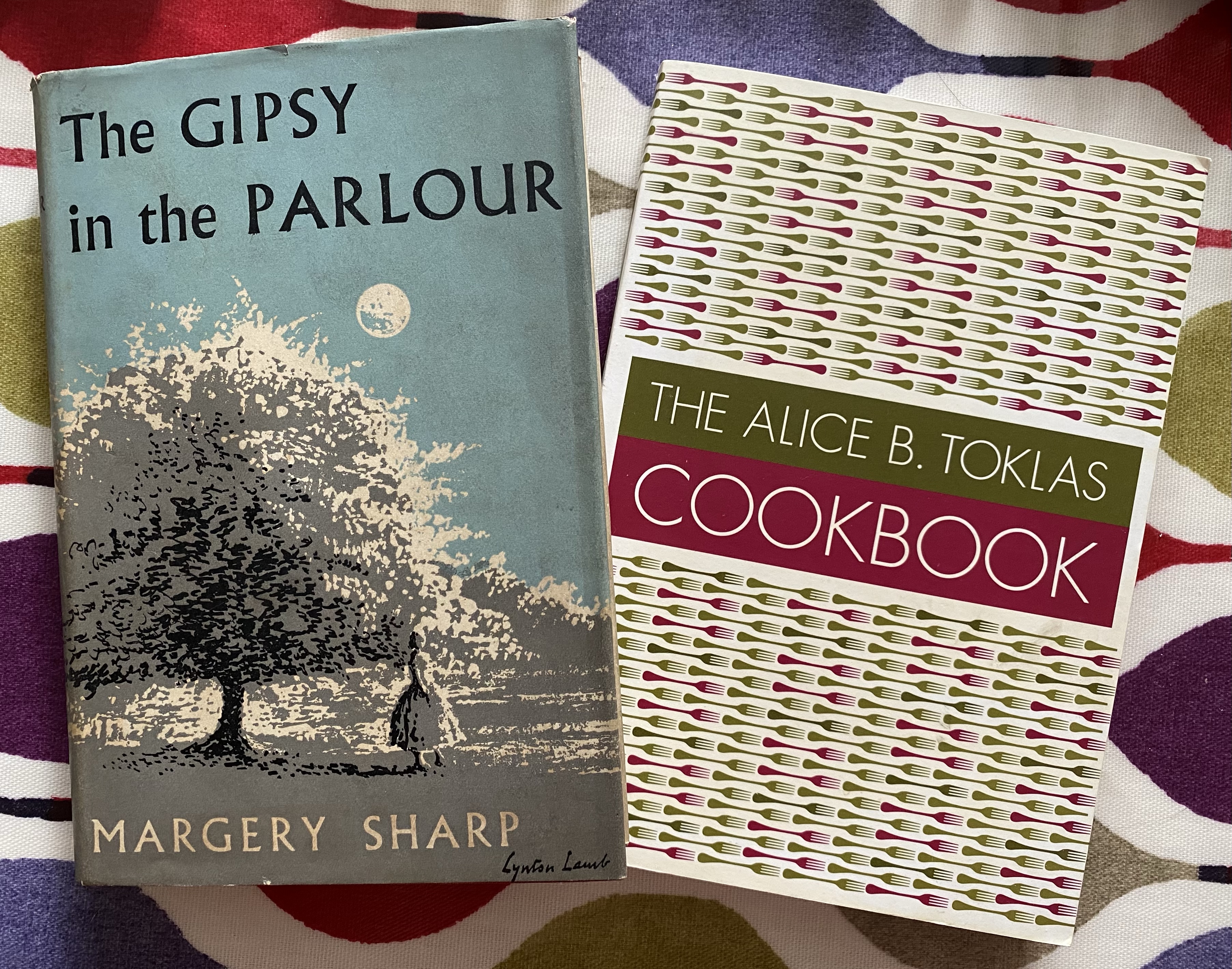
For this contribution, I thought I’d look at two books on a domestic theme. Firstly, The Gipsy in the Parlour by Margery Sharp. Despite the concerning title I can confirm while there is definitely dated language, it’s not prevalent throughout the novel.

The story is set in the 1870s and told from the point of view of an unnamed cousin of the family, looking back on her childhood as an adult now in the 1920s. This means Sharp manages a 11 year-old’s point of view without getting too caught by it, and it works well.

The child loves visiting her family in Devon, leaving behind the fog and grime of London for a West Country summer. She also leaves behind her cold, distant parents for her beloved aunts, Charlotte, Grace and Rachel. They have all married into the Sylvester family and form a capable team who run the domestic affairs of the farm with good-natured hard work.

“Nature had so cheerfully designed them that even wash-day left them fair-tempered: before the high festivity of a marriage their spirits rose, expanded and bloomed to a solar pitch of jollification.”

At the start of the novel they await the arrival of a fourth sister-in-law, who is going to marry Stephen Sylvester, the kindest of the male members of the family (who feature very little in the child’s world, due to their “effortlessly preserved complete inscrutability”). However, when Fanny Davis arrives, she is very different to the rest of the family – thin and pale rather than hale and hearty.

“She seemed to have nothing to say. She had neither opinions nor tastes. She hadn’t even an appetite. The amount she left on her plate would have fed a plough-boy – I believe often did feed a plough-boy”

The family know very little about Fanny “the most that could be discovered was a sort of shadow-novelette” but they welcome her in. However, it isn’t long before trouble strikes. Although Fanny attends a dance with family, whirling around quite happily, it isn’t long before she enters a Decline, and has to spend her days laying in the parlour.

The 11 year-old enlightens us:

“I knew a good deal about declines. A friend of my mother’s had a daughter who had been in one for years. Declines also occurred frequently in cook’s novelettes

And

“No common person ever went into one. Common persons couldn’t afford to. Also, there needed to be a sofa. No sofa, no decline.”

As the narrator boldly plans to cure Fanny, in the manner of an Angel-Child in a novelette, the reader knows more is going on than the characters realise. Quite what Fanny is up to only gradually emerges, and in the meantime Sharp shows how destructive one person can be for previously happy family. Fanny may be persistently reclined but she is never passive, and she causes a great deal of stress and heartache for the Sylvesters.

Meanwhile, the narrator back in London is making a great friend of Clara Blow, the sort-of landlady to her handsome cousin Charlie. Despite Fanny’s frequent assurances to the young girl that they are “special friends”, it is loyalty to Clara that causes conflict for the narrator and makes her question what is actually happening back in Devon.

Will Fanny’s machinations come to light? Will the Sylvester family find a way back to happiness? Will everything work out in the end? Despite this being not as broadly comic as other Sharp novels I’ve read, I was never in any doubt that all would come right. Which it did 😊

Secondly, a slight departure, as I’m going to review a cookery book. Except it’s not really a review of the recipes in The Alice B Toklas Cookbook. There are plenty of recipes, but the book is a memoir too, which is what makes it all the more interesting. Alice B Toklas was the life-partner of Gertrude Stein, and as she reminisces about growing and eating food, she records their life together and meals taken with the many well-known artists who crossed their path, such as decorating a bass fish to entertain Picasso (we’ve all been there, desperately trying to create piscine entertainment for a Cubist in a Rose Period).

Image from wikimedia commons

She also recalls living through France during the war: “In the beginning, like camels, we lived on our past.”  They live through rationing: trading cigarettes with soldiers, and Gertrude Stein acquiring food on the black market through force of personality.

“When in 1916 Gertrude Stein commenced driving Aunt Pauline for the American Fund for the French Wounded, she was a responsible if not an experienced driver. She knew how to do everything but go in reverse.”

Aunt Pauline is their Model T Ford, succeeded by Godiva:

“Even though Godiva was what a friend ironically called a gentleman’s car, she took us into the woods and fields as Auntie had. We gathered the early wildflowers, violets at Versailles, daffodils at Fontainebleau, hyacinths (the bluebells of Scotland) in the forest of Saint Germain. For these excursions there were two picnic lunches I used to prepare.”

But just in case this excursion sounds too idyllic…

“Back in Godiva on the road again it was obvious that somewhere we had made a wrong turning. Was Godiva or Gertrude Stein at fault? In the discussion that followed we came to no conclusion.”

One of my favourite stories was of Alice making raspberry flummery for a friend in the resistance who has a sweet tooth. It leads to a conversation about gelatine, the friend borrowing several sheets. Alice later finds out this is because it is essential for making false papers.

This is not the book to read if you want some easy, quick recipes to cook after work (and of course Alice and Gertrude had domestic staff to help them, several described in the book). There is more than one recipe that calls for 100 frogs legs, but as Maureen Duffy points out in her introduction, is that the legs of 100 frogs, or 100 legs in total? There’s also the detailing of how to prepare a leg of mutton by injecting it with orange juice and brandy for a week.

In case it’s not already apparent, this is also not the book to support a plant-based diet. Toklas acknowledges this, naming Chapter 4Murder in the Kitchen.  A vast quantity of eggs seem necessary to many recipes. When I came across a recipe for frangipane tart I thought I’d finally found something I’d enjoy, but it was like no frangipane I’d ever encountered. However, Chapter 5 Beautiful Soup, was quite tempting with its descriptions of various ways to make gazpacho.

I didn’t know this before I read the book, but the interwebs tell me that the recipe for haschich fudge is the most famous. Apparently the first publisher didn’t realise what it was and so allowed it to be printed, perhaps misled by Alice’s mischievous suggestion that “it might provide an entertaining refreshment for Ladies Bridge Club or a chapter of the DAR”.

My favourite chapter was 13, “The Vegetable Gardens at Bilignin”. Alice’s passion for the garden shone through:

“For fourteen successive years the gardens at Bilignin were my joy, working in them during the summers and planning and dreaming of them during the winters”

Her descriptions of the gardens and produce were absolutely lovely:

“The day the huge baskets were packed was my proudest in all the year. The cold sun would shine on the orange-coloured carrots, the green, the yellow and white pumpkins and squash, the purple eggplants and a few last red tomatoes. They made for me a more poignant colour than any post-Impressionist picture.”

Again, the love of Alice’s life undercuts the romanticism:

“Gertrude Stein took a more practical attitude. She came out into the denuded wet cold garden and, looking at the number of baskets and crates, asked if they were all being sent to Paris, that if they were the expressage would ruin us.”

There are a million quotable and notable passages in this cookbook. If you’ve any interest in Stein and Toklas, in interwar France, or in generation perdu, I’d urge you to get this. You can just dip into it and there’s always something to entertain, but probably not much to cook…

“From Madame Bourgeois I learned much of what great French cooking was and had been but because she was a genius in her way, I did not learn from her any one single dish. The inspiration of genius is neither learned nor taught.”

To end, Dorothy Dandridge in an Oscar-nominated performance in 1954’s Carmen Jones: