“Compared to memory, every possession can only ever seem disappointing” (Giorgio Bassani)

This is my final post for the 1962 Club, hosted by Simon and Kaggsy, which has been running all week. It’s been a great event as always, and I’m really pleased it prompted me to pick the three I’ve read off the TBR pile at long last!

(Please note, despite the subject matter I’ve made a deliberate choice not to draw contemporary parallels. I think Lisa explained this decision really well in her blog post here.)
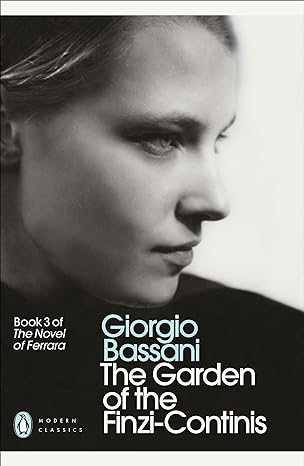
I adored Giorgio Bassani’s The Gold-Rimmed Spectacles (1958) when I read it last year, so I had high expectations when I approached The Garden of the Finzi-Continis (transl. Jamie McKendrick, 2007), the third book in his Romanzo di Ferrara cycle. It fully lived up to those expectations.
The unnamed narrator tells us in the Prologue that he is looking back from 1957 to a time before World War II. However the tone is more elegiac than nostalgic, as he also tells us that those he recalls perished in concentration camps.

Before the war the Finzi-Continis were a prosperous family, but the conflict destroyed them and all they owned. The large house is now squatted in, and the titular space:

“All the broad-canopied trees, limes, elms, beeches, poplars, plane trees, horse chestnuts, pines, firs, larches, cedars of Lebanon, cypresses, oaks, holm oaks, and even the palm trees and eucalyptuses planted in their hundreds by Josette Artom during the last two years of the first world war, were cut down for firewood, and for some time the land had returned to the state it was in when Moisè Finzi-Contini acquired it”

So it is with this knowledge that we then meet the younger, somewhat callow narrator, and follow his developing friendship with the younger Finzi-Contini’s, Alberto and Micòl, son and daughter of Professor Ermanno and Signor Olga.

Racial laws are coming into effect in Italy in the late 1930s, and this sees the narrator invited into the walled estate, as Jewish people are banned from places such as the local tennis club.

“They entirely left aside the existence of a far greater intimacy, a secret one, to be valued only by those who shared it, which derived from the fact that our two families, not by choice, but by virtue of a tradition more ancient than any possible memory, belonged to the same religious observance, or more accurately to the same ’School’”

Despite the growing pressures of the outside world, within the Finzi-Continis walls the narrator remembers a time where:

“The weather remained perfect, held in that state of magical suspension, of glassy, luminous, soft immobility which is the special gift of some of our autumns. In the garden it was hot, just slightly less than if it was summer.”

In this enchanted space the narrator falls for Micòl, but their relationship never develops, characterised by misunderstandings and ambiguity that they are too young to resolve. Being too young for what life throws at you is also shown through the political conversations with Giampi Malnate, an older Christian friend of Alberto, as well as an experience of terminal illness.

What I thought was so subtle and clever from Bassani is that nothing overly dramatic happens. Rather, things fade out. The huge events that we know are looming take place outside of the novel, and instead we are shown how we can take for granted the moments that seemingly have no wider ramifications. Except of course, they do. This is a formative time for the narrator.  

The Garden of the Finzi-Continis is not a plot-driven novel. It is a beautifully written evocation of a time before unimagined horrors. It is reflective and elegiac in tone without ever letting sentimentality lessen the portrait of a family obliterated by the Holocaust. It’s a truly devastating read.

The novel was adapted into a film in 1970, which won the Best Foreign Language Oscar that year. Has anyone seen it? It looks pretty faithful to the book so I’m interested to watch it:

“Writing’s not always a pleasure to me, but if I’m not writing every other pleasure loses its savour.” (John Braine)

This is my second contribution to the 1962 Club, hosted by Simon and Kaggsy, which is running all week. Do check out all the wonderful posts!

I picked up Life at the Top by John Braine because it is the sequel to Room at the Top (1957) which I really rated, with its depiction of the postwar north of England and Joe Lampton’s determination to leave his working -class life behind, whilst juggling complex sexual relationships. Life at the Top I didn’t find as compelling, but there was still a lot to enjoy.

Set ten years after Room at the Top, the novel follows Joe as he lives the life he thought he always wanted. Even if you’ve not read the first novel, take a guess as to how that’s working out for him 😀

“The truth was that I actually wanted a drink now, I wanted something to blur things slightly, to put a haze between me and the pink wallpaper and the pink cupboards and the white refrigerator and the electric oven and the mixing machine and the pink wall table and the pink covered stool; it was too bright and shiny and hygienic at eight o’clock on a March morning with Harling Crescent quiet under the weight of Sunday, it reminded me rather too coldly that I was thirty-five and a father of two children and at least ten pounds overweight.”

Joe adores his young daughter Barbara but feels alienated from his son Harry, who has been sent away to a school of his grandfather’s choosing. He and his wife Susan still sexually desire one another, but there seems to be little intimacy. Working at the family firm (Susan’s family), Joe is frustrated:

“I had stopped wanting things. I wanted power, power to put through my own ideas; I wanted to be taken seriously, I wanted to be something more than the boss’s son-in-law.”

He is going to become a local councillor, but that doesn’t suggest fulfilment to him (nor should it, bloomin’ Tory! 😀 )

“The prosperous middle-aged grumblers, the solid sensible citizens; I would sit here or in the committee room listening to them; taking great care not to offend them, and without my realising it, I would become exactly like them. Waiting my turn to grumble, waiting my turn for thrombosis, waiting my turn for death.”

So what does Joe do? Talk honestly with his nearest and dearest? Seek out a life of authenticity? Reflect honestly on the deep-rooted cause of his dissatisfaction and what he can do to make his life more fulfilling? No, of course not. He starts an affair with an attractive young journalist named Norah Hauxley and runs away to London.  The shadow of his former lover (from Room at the Top) still looms large, and I felt Alice was really the only woman Joe had loved:

“She was grown up. I hadn’t met a grown up woman in ten years, and for ten years I hadn’t felt the need to be with one. And Alice, even Alice, had been broken somewhere, she had lost the habit of happiness.”

Joe is not likable. He takes decisions that hurt others. He behaves selfishly. He’s a bit of a misogynist.But still I found myself staying alongside him as narrator, because he’s so honest. He doesn’t ask the reader to like him, because he doesn’t much like himself. I thought Braine did a brilliant job of presenting a man so of his time, and so completely believable.

Life at the Top doesn’t have a huge amount of plot, but I found it a compelling read in its honesty, particularly around flawed human relationships.

“I looked at her in surprise; I had not felt so close to her since we were first married. But I made no move to comfort her.”

Life at the Top is a short read, and I may not have stuck with it had it been longer. But as it was it was well-judged, and there are some developments in Joe’s familial relationships toward the end that I found truly moving. I’m glad the 1962 Club prompted me to finally pick this one up after it had been languishing in the TBR for many a year.

Life at the Top was adapted into a film in 1965, with the magnetic Laurence Harvey, who also starred in Room at the Top. Unfortunately the director changed from the first excellent film, and although I tried to watch the sequel, I found it so heavy-handed and unsubtle compared to the book that I gave up. But it did make me appreciate the book more!

So rather than a trailer for the film, here’s a 1962 song about rain, which the West Yorkshire town of Warley would be no stranger to:

“I regret profoundly that I was not an American and not born in Greenwich Village.” (John Lennon)

The 1962 Club, hosted by Simon and Kaggsy, starts today and is running all week which I am very excited about 😊 The Club weeks are always great and I’m really looking forward to seeing the posts. This is the first of  what I hope will be three contributions, but as I never blog as much as I mean to, failure is almost inevitable!

The Golden Spur was Dawn Powell’s last novel, and it’s a humorous look at the bohemian arts scene of late 1950s New York, specifically Greenwich Village. This was a world Powell was very much a part of and my edition features an effusive introduction from Gore Vidal who was one of her close friends.

We are introduced to the artists and writers – both up and coming, and those very much faded and failing – their hangers-on and their varied associates through the outsider view of Jonathan Jaimison. He is in his late twenties and recently discovered that his father isn’t the domineering tyrant he grew up with, but someone from this scene, back when his mother was hanging out with Prohibition-era flappers.

So Jonathan leaves his Ohio home and soon makes his way to the titular bar, at the start of his quest to find his biological father:

“Through a gap in the plum velvet cafe curtains he could see the bar … He breathed deep of the heady New York air, that delirious narcotic of ancient sewer dust, gasoline fumes, roasting coffee beans, and the harsh smell of the sea that intoxicates inland nostrils. Then he pushed open the door.”

He’s quickly adopted by Lize and Darcy, two frenemies who sleep with the same male artists, although it’s not entirely clear why, as they seem to have no great fondness for men or for art:

“The girls never asked questions about a man’s private interests or listened when he tried to tell them. For them it was enough that he was a man and that he was there. Who needs a talking man?”

“That his newest canvas was gone should have told her something, but she wasn’t sure which was the new one because all his pictures looked alike to Lize. Great lozenges of red and white (‘I love blood,’ he always said), black and grey squares (‘I love chess,’ he’d say), long green spikes (‘I love asparagus’). All Lize had learned about art from her life with painters was that the big pictures were for museums and the little ones for art.”

As Jonathan makes his way in New York, he moves between two generations: the young artists and the fading interwar generation. There is a nostalgia for the Prohibition period and what New York was then which is beautifully evoked, alongside a recognition that New York is a city that continually makes itself and its inhabitants anew:

“Jonathan recognised New York as home. His whole appearance changed overnight, shoulders broadened, apologetic skulk became swagger; he looked strangers in the eye and found friendship wherever he turned. With the blight of Jaimison heritage removed, his future became marvellously incalculable, the city seemed born fresh for his delight. He took for granted that his mother’s little world, into which he had dropped, was the city’s very heart.”

Although The Golden Spur is described as a comic novel, I didn’t find it laugh-out-loud funny. Rather I’d describe it as affectionately satirical. It ribs the 1950s arts scene and the vacuous people drawn to it, but it never has a bitter or nasty tone:

“Anybody with a tube of paint and a board was an artist. But writers were not writers unless decently unpublished or forever muffled by a Foundation placebo.”

“‘I just want to be overestimated,’ Earl shouted, ‘like everybody else, goddammit.’”

Despite the overarching plot being Jonathan’s search, this really isn’t a plot-driven novel. Rather, the question of his paternity is a device to introduce the various characters and their world. It’s a novel to read for the evocation of the city, of a particular society found within it, and for the characterisation and the wit. In the way that Tales of the City was serialised in the San Franciso Chronicle, I felt The Golden Spur could have worked similarly in The Village Voice. It’s almost a series of sketches, albeit well realised ones.

I can’t say I loved this quite as much as Gore Vidal clearly did, but then he probably recognised a lot of the characters and situations within the novel. I still found a great deal to enjoy, and Powell certainly has a way with words:

“She was making more and more passes at the wrong men, then trying to recoup with stately cultural pronouncements in her refined Carolina accent, which she kept polished up like her grandfather’s shotgun, ready to bring recalcitrant suitors into line.”

To end, I was going to go with the song Little Lize because that’s the only other time I’ve come across the name. I thought it would be easy to get a good quality version as the massively successful Fisherman’s Friends have recorded it. But I couldn’t find a decent one so here they are instead singing about never leaving home. New York isn’t for everyone…