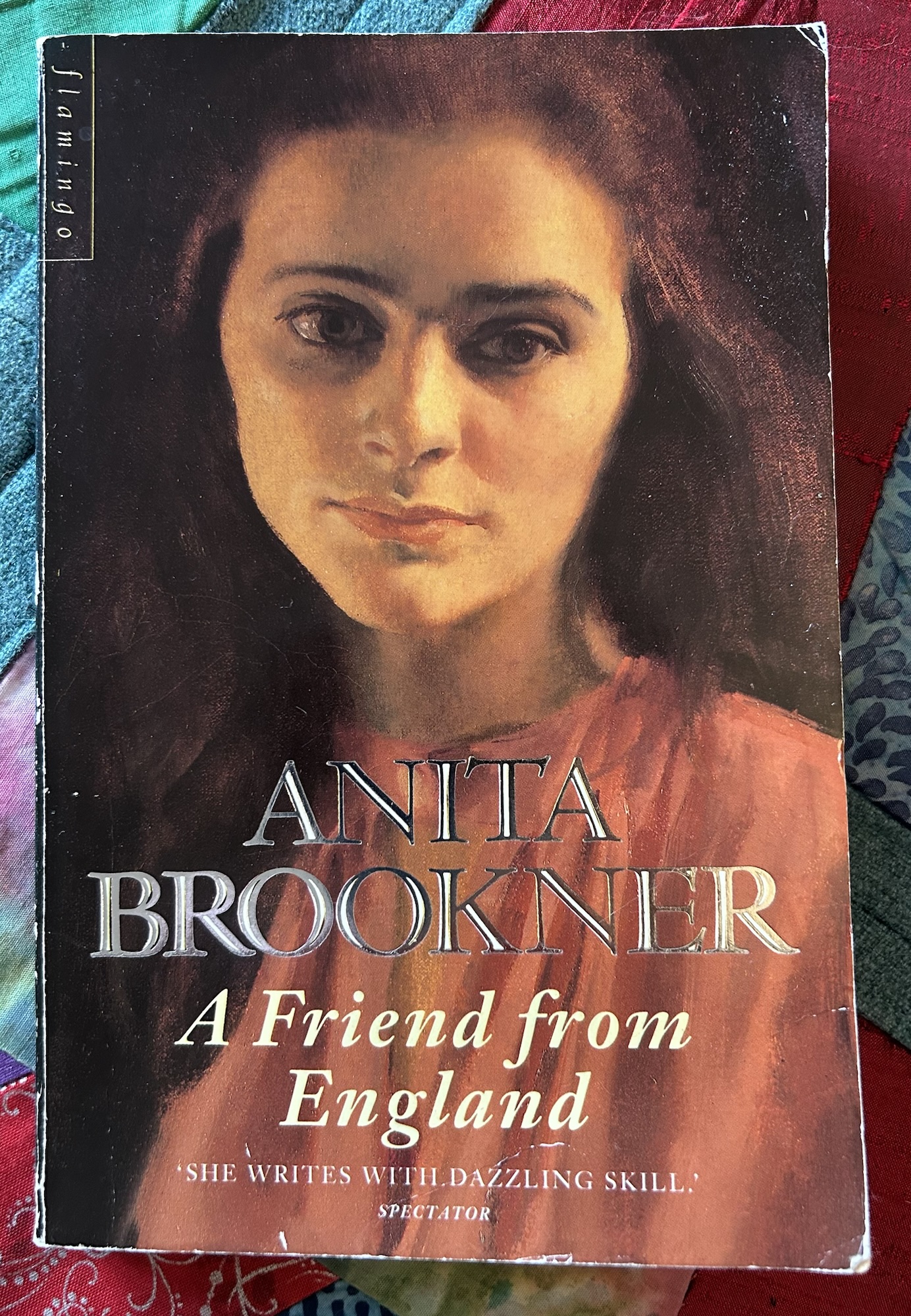
A Friend from England – Anita Brookner (1987) 172 pages
Anita Brookner is one of those authors I keep meaning to get back to. I was too young when I read Hotel du Lac; when I read Family and Friends for this project back in 2019 I knew the time was right. Despite this, I keep failing to pick her up! Hopefully A Friend from England signals the start of my more consistent reading of this striking and clear-sighted author.
The novella is essentially a character study of Rachel, a typical Brookner heroine.She is solitary and somewhat spiky, with the reader sensing more loneliness that she admits to.
She inherits her financial advisor Oscar from her deceased parents. When Oscar retires after winning a lot of money on the pools, Rachel visits him at home rather than his office.
“All the rooms seemed to repel both light and weather; they were designed to keep one’s thoughts indoors, resigned and melancholy.
[…]
I found it all very cosy. Although their life seemed to depress Oscar and his wife, both of whom had a vaguely disappointed air, I could see myself transformed into just such a virtuous member of just such a successful but melancholy family.”
Rachel starts attending Oscar and his wife Dorrie’s home regularly for dinner, and meets their daughter Heather, who it is clear the family are keen to see married and settled. (There was something oddly old-fashioned about A Friend from England, so much so that I went back to the beginning to double-check I hadn’t missed something about it being set in the early 1960s.)
No-one does a bitchy character summation like Brookner, and here is Rachel’s assessment of Heather:
“I could feel the force of her passive temperament, and I say temperament rather than personality, for there was little personality in evidence.”
Ouch!
Oscar and Dorrie seem keen for the two women to become friends, and Heather regularly drives Rachel home, but remains unknowable. This doesn’t particularly bother Rachel:
“I felt a genuine love for Heather’s parents, while feeling rather little for Heather herself. When I say rather little, I mean that I felt a full complement of boredom, irritation, tolerance, and reluctant affection for her.”
However, then Heather does what everyone expects, and gets engaged. Rachel is unsure of her choice:
“My first impression of Michael Sandberg was that he was blessed with, or consumed by, radiant high spirits. My second impression was that a man of such obvious and exemplary charm must be a liar.
[…]
Michael had a sort of sunniness about him which seemed to preclude any baffling depths of character: I thought that was probably just as well, for Heather, despite her shrewdness, seemed to have very little curiosity and might not have much patience with a difficult or troublesome man.”
The “shrewdness” which Rachel frequently attributes to Heather is a masterstroke by Brookner. As readers we never see any evidence of such a trait. No-one else observes Heather as being shrewd. We are more aware than Rachel that she has proclaimed this motivation to Heather’s behaviour because it makes sense to her. This misjudgement has a significant fallout later.
“I felt a spasm of distaste for her and for all those women like her, women who work for fun and marry for status, and still demand compensation. The only excuse for such women is incurable frivolity. And Heather was not even frivolous.”
[Slight spoilers ahead]
Heather’s marriage does fall apart (again, for a reason I found somewhat out of keeping with its late 1980s setting, unless the reason we’re shown is supposed to be a signifier of a deeper incompatibility.) But it is Rachel who begins to unravel. She has been insistent all along that her solitary life suits her, but this seems grounded in pain and avoidance rather than a life choice which makes her happy and fulfilled.
“The process of thinking does not become me. I feel my face growing longer, my eyes sinking deeper. Thinking, for me, is accompanied by a wave of sadness. Therefore I try to avoid introspection. I long ago decided to live my life on the surface, avoiding entanglements, confrontations, situations that cannot be quickly resolved, friendships that lead to passion.”
When Heather’s subsequent decisions do not fit with Rachel’s judgements of who she is or what she should do, we witness Rachel behaving more and more extremely, despite her distaste for drama. This observant, clever, discerning woman has completely failed to recognise that others could have considered and reached different values and different aspirations from her. The destabilisation which occurs suggests that Rachel wasn’t as secure in her life choices as she liked to believe.
A Friend from England is such a cleverly paced novel. The acerbic, domestic everyday gradually becomes something much darker and more devastating, with all the fault lines set up to fracture from the very beginning.
 madame bibi lophile recommends