“My roommate got a pet elephant. Then it got lost. It’s in the apartment somewhere.” (Steven Wright)

This week’s theme stems from a very boring reason. But I try to pick themes that relate to my life or what’s happening in the world in some way, and my life is very boring. In fact, the most remarkable thing about it is just how dull it is. So brace yourself reader, and try & stay awake while I tell you that I am a leasehold flat owner.

I’ve always hated this because my managing agents are inept slimebags truly reprehensible human beings, but I spent an evening last week consoling a friend who is a share-of-freeholder and is engaged in a long dispute with her one of her neighbours/fellow freehold sharers, which has now turned vaguely medieval and who she refers to by a most unsavoury nickname.

If you’re still with me, you deserve a little treat. Here’s a trailer for one of my favourite ever films which is rather apt:

So as I spent a long time thinking about flats recently, the theme is novels set in apartment blocks. Firstly, Paradises by Iosi Havilio (2012, trans. Beth Fowler 2013). Apparently this is a sequel to the author’s previous novel Open Door, which I haven’t read, but it didn’t seem to restrict my understanding of Paradises, which I found compelling. Following the death of her partner, an unnamed woman leaves her country home with her small child, Simon, and moves to Buenos Aires. She gets a job at the local zoo:

“Something about the gloomy light, the small of the enclosure, the watchfulness of the snakes in captivity produces a hole in my stomach, an anguish that forces me to increase my pace. I skirt the large tank of water turtles, ignore the lizards walk past the door saying nursery and go outside.”

The janitor, Canetti, takes a shine to her. He used to be a bank treasurer before losing his job through fraud and is filled with bitterness. He shows the woman the el Buti squat, presided over by the obese, immobile, morphine-addicted Tosca.  She moves in:

“And yet despite the filth, the heat, those intestinal noises, and the smell of shit that rises in waves, at some point in the early hours Canetti’s words from the first time he brought me here come to mind: We’re safe here. I even babble them to myself to confirm it. And so I relax and rest a bit, although still without sleeping. On the third day I cover the windows with black bin bags to prolong the night.”

The voice of the young woman is matter-of-fact and she presents her extreme circumstances almost indifferently (Paradises has been compared to L’Etranger). This, combined with the present-tense, captured the numbness of grief and the sense of just getting through each moment. Yet according to the introduction by Alex Clark, the narrator’s passivity and weird equanimity was present in Open Door too, so maybe it’s just her character. Either way, I found her voice distinct and engaging. We follow her through her life as she juggles motherhood, work, relationships with idiodyncratic but wholly believable characters: seemingly spiky Iris who cares for Simon; the unpredictable Eloisa who seems to have no boundaries at all and drags the narrator along with her; the various residents of el Buti.

“each of us has to devise our truth in relation to the other”

The squat is surrounded by paradise trees, whose berries are poisonous and whose bark holds the cure. This duality is repeated throughout the novel: alienation sits alongside connection, love and grief are side by side. Paradises is an unsettling novel but at no point did I feel alienated from the unusual, detached woman telling the story. A remarkable achievement.

Let’s take a Vincent Cassel break (that’s definitely a thing, isn’t it?)

Secondly, A Far Cry from Kensington by Muriel Spark (1988) is set at “14 Church End Villas, South Kensington, that rooming house, shabby but clean, that today is a smart and expensive set of flats, gutted and restructured, far beyond the means of medical students, nurses, and the likes of us as we were.”

Narrated by the young widow Mrs Hawkins, she describes her time at the rooming house in the 1950s.  She moves between jobs in publishing with little respect for her employers:

“Sir Alec was thin and grey and his voice matched his looks. It sounded like a wisp of smoke wafting from some burning leaves hidden by a clump of lavender.”

“I had a sense he was offering things abominable to me, like decaffeinated coffee or coitus interruptus

Spark’s satire of publishing and writers is a joy, but A Far Cry From Kensington is also about capturing a moment in time when society is on the cusp of change. Relationships between the sexes are changing, and Mrs Hawkins pushes against societal expectations of women in the mid-20th century. She is resentful of being characterised as a capable widow (she feels this is partly due to her size and begins determinedly losing weight).

Meanwhile, there is tension in the house as someone is sending threatening anonymous letters to Wanda, a European seamstress who rooms there. The different residents begin to suspect each other while landlady Milly is certain it’s an outsider:

“Milly was upset at the suggestion that it was someone in the house, to the point of being almost mesmerized by the idea. She also feared further letters. ‘These things happen in threes’ said Milly in her way of uttering bits of folk-wisdom; she was spooning tea into the heated teapot. She always mixed tea with maxims.”

Mrs Hawkins is a great narrator: matter-of-fact, funny, uncompromising.

“I enjoy a puritanical and moralistic nature; it is my happy element to judge between right and wrong, regardless of what I might actually do.”

The plot around the victimisation of Wanda is frankly a bit bonkers and easily the weakest point in the novel, but despite a weak plot A Far Cry From Kensington is full of Spark’s wit and razor-sharp observation. Not a word in this short novel is wasted.

To end, a video putting the brutalist architecture of the Thamesmead flats to good use:
“It’s just a job. Grass grows, birds fly, waves pound the sand. I beat people up.” (Muhammad Ali)

Every six months or so the friends I made when I was training for my profession meet up, which we did yesterday.  They were remarkably good natured as the question “how are you?”, when directed towards me, was met with a wail of despair and a twenty minute garbled monologue about how difficult I was finding things. Safe to say I’ve never really mastered the British stoic reticence thing.

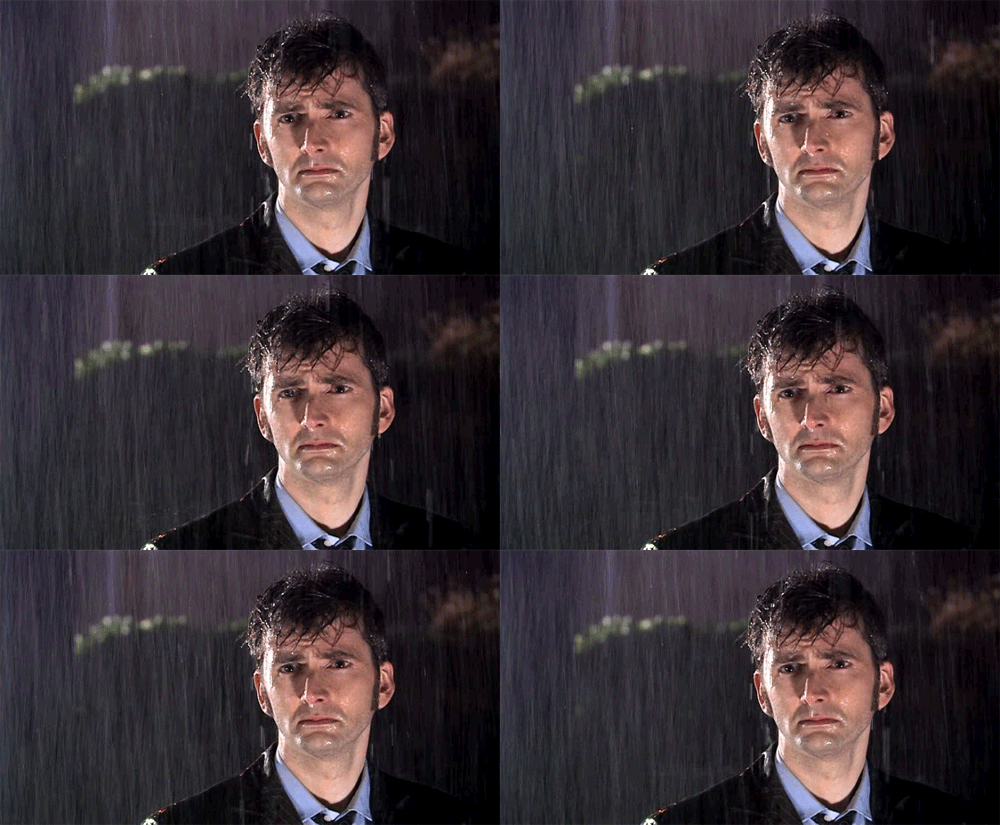
Dr.-Who

My ongoing crisis aside, time spent with my lovely, indulgent friends prompted me to look this week at novels that focus on a profession. Firstly, The Electric Michelangelo by Sarah Hall (2004, Faber & Faber), which is about a tattoo artist. Undoubtedly this is a growth industry, certainly in the UK which is the most tattooed nation in Europe: one-fifth of adults have a tattoo, rising to almost one-third of those under 45. That’s a lot of ink.

Maud_Stevens_Wagner

 I recently wrote about Hall’s first novel Haweswater, which I loved.  I didn’t feel The Electric Michelangelo, her second novel, was as accomplished as her first, but it was still strong.  It follows tattooist Cy Parks from an adolescent apprenticeship with the alcoholic Eliot Riley in his hometown of Morecambe Bay to a career in carnivalesque Coney Island and back again. Growing up in early twentieth-century Morecombe, Cy’s formidable mother Reeda runs a hotel for consumptives:

“They sucked it down in between their fits and held it inside their lungs like opium smokers in a den…Morecombe’s air was renowned, if not nationwide then reliably in the north, for its restorative properties, its tonic qualities. That was how everyone described it…”

Cy is fairly directionless until his artistic skills catch the eye of Eliot Riley, a man who “lived as if trying to siphon out that darker portion [of life], with alcohol, with banter, with bad habits, bad politics, bad language, obloquy, anguish and despair.” Riley offers Cy an apprenticeship, and for reasons he doesn’t entirely understand, Cy accepts. “Tattooing was like being called by a siren song, or the music of the spheres, impossible to resist, impossible to explain.”

We are drawn into the world of tattooing alongside Cy “a dreamscape type of world, where strange occurrences and dark-wrought ideas, if not normal, were almost commonplace.” Hall is clearly respectful of this ancient trade and its rituals and rites: what the tattooists enact and what the customers endure.

“Riley paused for whisky. After ten more minutes the customer stood wearing art. The snake and dagger flexed on his back, weeping a little as he bent for his shirt. The man had added to his body in a way that was brave and timeless and beyond adornment.”

After his apprenticeship ends, Cy moves across the Atlantic to Coney island, where he falls in love with circus performer Grace, who employs him to tattoo her entire body with eyes.

“the eye was in a league of its own. It had meaning upon meaning, there were currents writhing under currents where that symbol was concerned, like the sea. He had the distinct impression that Grace possessed a fast-flowing undertow also, a restlessness behind her own dark eyes.”

Eye tattoo by Niki Norberg

Eye tattoo by Niki Norberg

Image from here

Like the other relationships in Cy’s life, his romance with Grace is characterised by the unknown and the unsaid. The man who works in images finds spoken language inadequate and lacking, unable to express pain, desire and love in the way his needle can. Sarah Hall certainly doesn’t suffer from a lack of eloquence, but despite this, I came away feeling The Electric Michelangelo didn’t quite add up to an entirely satisfying whole. However, she is such a hugely talented writer that this barely matters. The Electric Michelangelo is a beautifully written character study of Cy and of a profession.

Secondly, The Tango Singer by Tomas Eloy Martinez(tr. Anne McLean, Bloomsbury  2006), and one more stop on my Around the World in 80 Books Reading Challenge, hosted by Hard Book Habit. It was Sarah from Hard Book Habit who made me aware of this novel so a big thank you to Sarah 🙂

The Tango Singer is narrated by Bruno Cadogan, a student who is writing his thesis on Borges and the origins of tango.  He travels to Buenos Aires to track down Julio Martel, the titular legend whose voice has never been recorded but is unforgettable to those lucky enough to catch one of his impromptu performances around the city:

“I was floating in mid-air, and when the voice fell silent, I didn’t know how to detach myself from it, how to get back to earth…the Martel experience is like another dimension, almost supernatural.”

Cadogan’s search for Martel becomes entwined with the city and its history, ultimately indivisible: “the grass that grows over this field of music and lyrics is the wild, rugged, invincible grass of Buenos Aires, the scent of weeds and alfalfa.” Buenos Aires is a city in a constant state of flux: politically, linguistically, architecturally, geographically:

“Every time I looked up I discovered baroque palaces and cupolas in the shape of parasols and melons, with purely ornamental turrets. I was surprised that Buenos Aires was so majestic from the second or third storey upwards and so dilapidated at street level, as if the splendour of the past had remained suspended in the heights and refused to descend or disappear.”

“the language of Buenos Aires shifted so quickly that the words appeared first and then reality arrived, and the words carried on when reality had already left.”

This layering is a theme throughout the novel. Martinez is interested in how reality is formed of the past as well as the present, the unknown as well as the known. It is a beautifully evocative portrait of a city and explores big themes around politics, memory, loss, time and truth in an extraordinarily short novel (243 pages in my edition) which cannot be read quickly. It is also a highly literary novel, peppered with allusions and quotes. Bruno becomes convinced the city houses Borge’s aleph, all of the universe held at a single point. If the aleph is anywhere, probably it is Buenos Aires, which in this novel is a place where reality constantly reforms itself.

The Tango Singer is a sad novel, but not depressing; it is elegiac, and yet suggests that nothing is ever truly lost:

“I would have liked to explain that it wasn’t her who attracted me but the lights that Martel had left on her face that I could half make out, the reverberations of the dying voice that were inscribed on her body.”

To end – what else? – an Argentine tango being performed on the street in Buenos Aires:

https://www.youtube.com/watch?v=Gcs4LY_ljQk