Novella a Day in May 2025: No.8

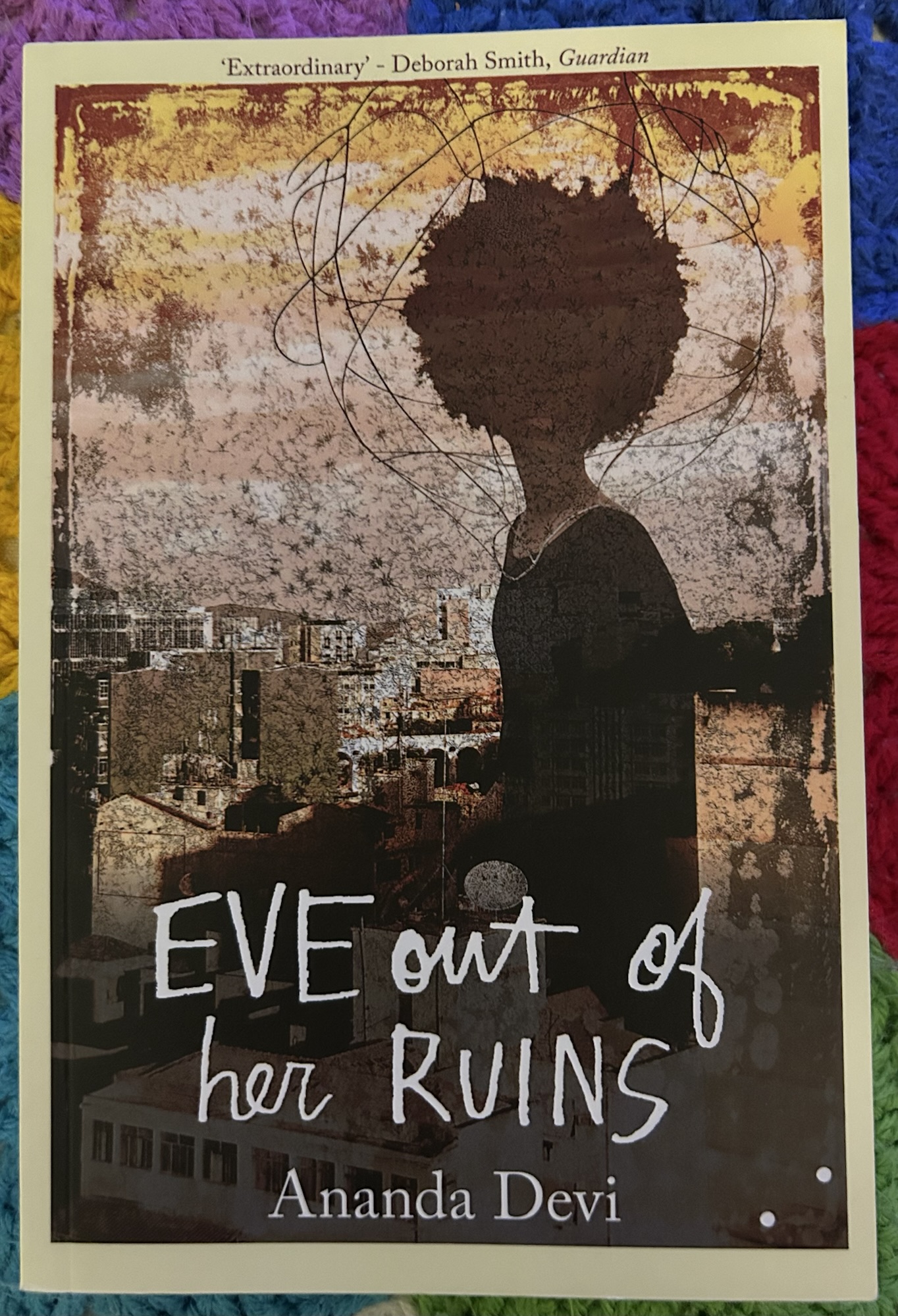
Eve Out of Her Ruins – Ananda Devi (2006, transl. Jeffrey Zuckerman, 2016) 164 pages

I picked up Eve Out of Her Ruins as I hadn’t read any Mauritian literature before and I’m enjoying seeking out new-to-me authors as part of my Around the World in 80 Books reading challenge.

The story is told from the point of view of four young people: Eve, Saad, Savita and Clélio who live in Troumaron, a cité geographically close to and societally far away from the capital Port-Louis. As Saad observes:

“Our cité is our kingdom. Our city in the city, our town in the town. Port Louis has changed shape; it has grown long teeth and buildings taller than its mountains. But our neighbourhood hasn’t changed. It’s the last bastion.”

Saad runs with the gangs to not draw attention to himself, but he loves poetry ever since he discovered Rimbaud, and he dreams of being a writer and escaping the ghetto.

“Just as the island unfurled it’s blues and oranges, so the words unfurled still more vividly purple rages in my head.”

He is in love with Eve, who learnt early on that although she had nothing, she still had something to sell. She has been trading her body to boys and then men, for school supplies and other things she needs, since she was a child. At 17, she is still a child, but a worn-out one.

“Saying no is an insult, because you would be taking away what they’ve already laid claim to.”

“I think I look like lots of things — organic, or mineral, or strange and sloughed off, but I don’t look like a woman. Only a reflection of a woman. Only an echo of a woman. Only the deformed idea of a woman.”

Eve’s sex work is portrayed carefully. It’s not explicit but nor is it obfuscated. I thought this was responsible without being overly harrowing or voyeuristic.

Clélio likes to sing from the rooftops, but is bewildered at how to escape the cité when he is already known to the police. He pins his hopes on his elder brother who has escaped to France, while simultaneously recognising that his brother’s life may not be going well, and he is unlikely to return to collect Clélio as he promised.

“I am Clélio. Dirt poor bastard, swallower of everyone else is rusty nails. What can you do? Nobody changes just like that.”

Eve and her friend Savita are in love, and it is Savita who recognises that Eve is getting more and more closed off as she tries to protect herself from the impact of her sex work and the domestic violence her father metes out at home. It is also Savita who recognises that as they get older, the boys’ anger is growing and the girls are increasingly vulnerable.

Saad sees this too, but knows Eve won’t listen to him however desperately he tries to reach her. There is real tension in the narrative as the sense of imminent violent explosion grows.

Eve Out of Her Ruins is a tough read and a million miles away from the paradisical tourist resorts of Mauritius. It is not poverty porn though, or voyeuristic. The voices of the young people ring true and lack any self-pity. The reader is not asked to pity them, but recognise their resilience and feel the desperation of seeking a way out when the odds are against you.

“They tell me I’ll succeed. But success does not mean the same thing for everyone. It’s a slippery word. In my case, it simply means that locked doors could open just a bit and I could, if I sucked in my stomach, slip through and escape Troumaron.”

In the Author’s Preface, Devi explains “I loved them and wanted to find a way out for them. I couldn’t, not for everyone. So I have left a trail of crumbs for some of them to follow.” Hence, there is hope in Eve Out of Her Ruins, it is not relentlessly bleak. But neither is it unrealistic or sentimental. It definitely doesn’t promise a happy-ever-after for the youngsters of Troumaron.

“I read in secret, all the time. I read in the toilets, I read in the middle of the night, I read as if books could loosen the noose tightening around my throat. I read to understand that there is somewhere else. A dimension where possibilities shimmer.”
“The palest ink will endure beyond the memories of man.” (Tan Twan Eng)

Continuing my plan to try and take my Around the World in 80 Books reading challenge by the scruff of the neck, today I’m off to Malaysia. The Garden of Evening Mists by Tan Twan Eng (2012) has been hugely lauded and it had completely passed me by. I rectified this situation by taking it with me on a long weekend in the New Forest recently, and it definitely suits those moments when you have a decent amount of time to commit to it.

Back at the end of May when Kim at Reading Matters very kindly invited me to take part in her Triple Choice Tuesday, I chose The Secret Garden as a book that changed my world due to its themes of gardens and healing. So The Garden of Evening Mists was always going to be a winner for me as it explores these themes.   

The story opens in the 1980s, Yun Ling is a high court judge, just about to retire. This means she is leaving the bustle of Kuala Lumpur to return to her home in the Cameron Highlands.

“Most people in Kuala Lumpur couldn’t bear the stench, especially when the river was running low between monsoon seasons, but I had never minded that, in the heart of the city, I could smell the mountains over a hundred miles away.”

She hasn’t been back for years, and her return encourages her to reflect on her past:

“The garden’s name in English: Evening Mists. I felt I was about to enter a place that existed only in the overlapping of air and water, light and time.”

The main focus of her reflections is the time she spent as apprentice to a gardener who had been employed by the Emperor of Japan. Nakamura Aritomo is a mysterious figure, best known to his South African neighbour Magnus Pretorious, who still doesn’t know him hugely well, or why he seems to be in self-imposed exile in this remote part of Malaysia.

The past narrative begins in 1951 and Teoh Yun Ling is the sole survivor of a Japanese POW camp, where her sister died. She wants to build a Japanese garden in memory of her sister:

“Yun Hong kept our spirits up by talking about the gardens we had visited in Kyoto, describing even the smallest details to me. ‘This is how we’ll survive,’ she told me, ‘this is how will walk out of this camp.’”

In order to build her garden, Yun Ling is going to need the help of Aritomo, and for that to happen she needs to learn to trust a Japanese man despite associating him with her torturers.

“The imminent rain in the air smelt crisp and metallic, as though it has been seared by the lightning buried in the clouds. The scent reminded me of my time in the camp, when my mind had latched onto the smallest, most inconsequential thing to distract myself: a butterfly wafting from a patch of scrub, a spider web tethered to twigs by strands of silk, sieving the wind for insects.”

The relationship between Yun Ling and Aritomo is undoubtedly the centre of the story, but this is an ambitious novel and covers a great many themes, including the aftermath of World War Two and pre-independence Malaysia. (There are a few info-dump moments but not many.) It shows how power is achieved through violence, during British colonialism and beyond.

Within a carefully evoked historical context, Tan Twan Eng explores how we heal from trauma; how we reconcile to ourselves and to others; how we find redemption, and how we can forgive. It’s an immensely powerful story, and Yun Ling has to navigate her survivors guilt and overwhelming anger, to try and work out how on earth she is going to continue with her life.

“Walking in the garden I had heard about almost half a lifetime ago, I wished Yun Hong were here with me. She would have enjoyed it more than me. I wondered what I was doing here, living the life that should have been my sister’s.”

From goodreads I know some readers found Yun Ling too detached and remote a voice within her own story. Although some of the characterisation in the novel felt thin at times, I didn’t have a problem with Yun Ling’s voice. I thought it worked well in conveying her detachment through trauma, and it also balanced the style of storytelling. The descriptions are so richly detailed (sometimes a bit too much for my austere tastes) that to have a highly emotive voice amongst it all would have been too much.

Birdsong song sparkles the air; mists topple over the mountains and slide down their flanks, slow and soundless as an avalanche witnessed from miles away. Instinctively I turn to look behind me, expecting Aritomo to chide me with a look or a scathing word. I see only my own footprints on the dusty floorboards as the bamboo blinds creak softly in the wind.”

Amongst this beauty are some gruesome scenes too, both in the 1950s setting and in Yun Ling’s memories of the camp. I didn’t find this gratuitous at all and thought they were responsibly handled, but wanted to warn any readers late to The Garden of Evening Mists like me that it is certainly not an unrelentingly pretty read.

Underpinning all periods is the theme of memory, effectively evoked through the shifting back and forth between timelines. Tan Twan Eng demonstrates how we cling to memory, how important it can be despite its unreliability. He shows how this can limit our knowledge of ourselves, others and circumstances, yet it remains vitally important.

The Garden of Evening Mists presents complex people and situations and demonstrates how, even when we don’t know everything and can’t rely on what we do know, all are worthy of compassion.

“Are all of us the same, I wonder, navigating our lives by interpreting the silences between words spoken, analysing the returning echoes of our memory in order to chart the terrain, in order to make sense of the world around us?”

To end, has anyone seen the adaptation from 2019? From this trailer I can’t decide if I want to watch it…

“The life of every man is a diary in which he means to write one story, and writes another.” (JM Barrie)

Continuing my endeavour to try and get some momentum back in my Around the World in 80 Books reading challenge, today I’m off to Uruguay, with Mario Benedetti’s The Truce: The Diary of Martín Santomé (1960, transl. Harry Morales 2015) which I was alerted to by Fiction Fan’s glowing review at the start of the year.

As the title suggests, the novella is in diary form, as Martín records his days in the run-up to his retirement, reflecting on how to live out his days. He is a quiet man in an administrative job; things are predictable.

“Today was a happy day; just routine.”

He is a widow of twenty years, and although he still has an eye for women (particularly their legs) he hasn’t had another relationship:

“The entire machinery of my emotions came to a halt twenty years ago when Isabel died. First there was pain, then indifference, then, much later, freedom, and then, finally, tedium. Long, lonely, constant tedium.”

His children Esteban, Jaime and Blanca are essentially unknown to him:

“At least Blanca and I have something in common: she, too, is a sad person with a calling for happiness.”

But although Martín is recording a lot of sadness, it’s not overly depressing. He has an acceptance of his life, and he makes quietly humorous observations, such as an old acquaintance learning of Isabel’s death:

“There is a sort of automatic reflex which makes one talk about death and then immediately look at one’s watch.”

Or his grief when his mother died:

“Only a fervent hatred of God, relatives and fellow man sustained me during that period.”

But things are about to change for Martín in ways he didn’t expect, when he falls in love with Laura Avellaneda, a work colleague half his age. While this would naturally raise questions about power dynamics and appropriateness, I felt it worked in The Truce, as Martín has been established as a gentle man, uninterested in wielding any sort of power or manipulation, and he is very respectful of Laura:

“I’m not going to demand anything. If you, now or tomorrow or whenever, tell me to stop, we won’t discuss the matter anymore and we’ll remain friends.”

In this short novel Benedetti perfectly evokes the gentle, slowly evolving love of Martín and Laura, and of Martín’s grief and acceptance of all he has lost in life alongside all that he still has. It suggests hope is still a realistic thing to hold onto, at any time.

The Truce isn’t sentimental, and although it depicts a romance it’s not rose-tinted. There is one point in particular where Martín behaves badly. He is not a perfect human-being and he causes hurt as well as joy to people.

But it is an empathetic tale, warmly clear-sighted towards ordinary people and all the foibles, weaknesses and strengths that we all carry.

The Truce is realistic, in a way that suggests even the most painful experiences can still be worthwhile. It explores how to not let pain overwhelm, and the importance of compassion for others and for the self:

They suffer from the most horrible variant of solitude: the solitude of someone who doesn’t even have himself.

This was my first experience of Benedetti and I’d be interested to read more by him. Apparently he wrote over ninety books so there’s plenty for me to choose from!

“It takes a village to raise a child.” (Proverb)

Well, as I predicted a significant part of my May was grim, but at least it was short-lived. So while I couldn’t commit to my novella a day in May project this year, I have managed to read a few novellas which I’m hoping to blog on before the end of the month. Here’s hoping June is a massive improvement!

When I undertook the Around the World in 80 Books reading challenge, I wanted each book to be by an author from that country, not only set there. So the challenge has slowed as I try and locate appropriate translated fiction. Bright by Duanwad Pimwana (2002 transl. Mui Poopoksakul 2019) was apparently the first novel by a Thai woman to be translated into English. A volume of her short stories has also been translated, under the title Arid Dreams.

Bright almost reads like a series of short stories, except that the characters and setting are carried across the vignettes. It begins with a five-year-old boy, Kampol, being abandoned by his father who is taking his little brother Jon to live with his grandmother after their mother has left. But Bright isn’t unremittingly grim or a trip into poverty porn. The community of Mrs Tongan’s tenements rally round Kampol with varying degrees of willingness to ensure the boy is cared for.

“Kampol watched his father walk off until he disappeared. The flavour of the palo stew had grown distant, and the scent of detergent faint. He opened his hand: the blue action figure glinted in the dim light.”

We meet the various residents through Kampol’s eyes and we follow the events of the community alongside him. He plays with his best friend Oan, and is often cared for often by Oan’s hardworking mother Mon. But Pimwana never lets us forget that Kampol is carrying a lot of pain, just below the surface.

“He had found the best hiding place: you’d have to travel back in time to discover it. He skipped away joyfully. But then his melancholy caught up to him and his steps grew slow and measured – he didn’t know where to go.”

My heart sank when mobile caterer Dang offers Kampol a way to earn money if he keeps it quiet – but Dang only wants Kampol to walk on his back to relieve his aching muscles. Kampol also earns money running errands for soft-hearted Chong, the shopkeeper who finds it hard to refuse people credit. Bookish Chong was my favourite character, a man trying to convince the local kids of the joy of the printed word, without much success apart from Kampol.

“Chong was mournful as he watched the tree-cutting operation. The workers sawed off one section at a time, starting from the crown and working their way down. The pines disappeared, one top at a time, one tree at a time. Kampol stood next to Chong staring upward until the sky was empty. The notion of his mother, too, grew empty in his mind.”

The simple writing style worked really well in keeping the reader alongside Kampol while not claiming to be completely a child’s point of view. I found it direct and compelling in portraying a life with both hardships and joys in it.

Pimwana portrays a Thailand away from the tourist hotspots or glamourous settings. In doing so, she never patronises her characters or preaches of a life of either degrading poverty or sentimental saintly striving. The personalities in her pages are entirely believable, human and humane. It’s a fine balance that she achieves with the lightest touch. A hugely impressive and highly readable novella.

“He had felt lonesome before, many times in fact. But in those moments, even if he didn’t have anyone in the world, he had his familiar neighbourhood, with its familiar crevices and corners that he knew so well, which provided comfort. There was the wall outside Chong’s shop, where the jasmine bush stood, marked with dirt from where he leaned against it when he visited. Or there was the wedged fork of the poinciana. Or behind Mrs Tongjan’s house, his hideout beneath the shrub whose leafy branches bowed down and kissed the ground. When desolation struck, Kampol had these familiar nooks to embrace him.”

“I must love a loathed enemy.” (Romeo and Juliet, Act 1 Scene V)

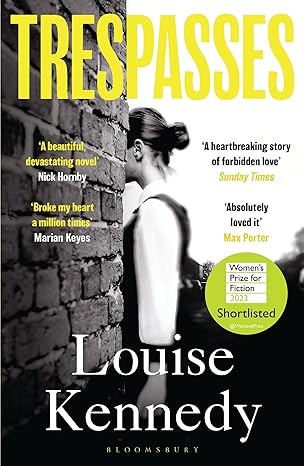
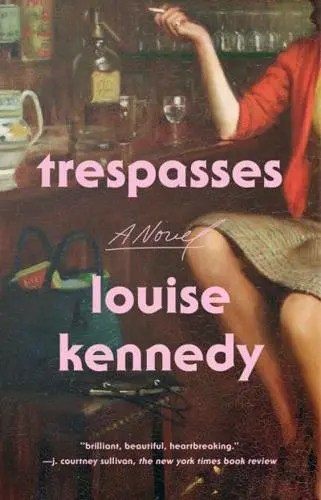
I’m not sure there’s much I can add to the cacophony of praise that Trespasses by Louise Kennedy (2022) has garnered. In fact I did consider not writing a post at all. But in the end because it moved me so much I thought I’d jot a few thoughts down as part of Reading Ireland 2024 aka the Begorrathon, hosted by Cathy at 746 Books. It’s also a stop on my Around the World in 80 Books reading challenge.

A summary of the plot doesn’t do this finely-crafted tale justice.

Cushla Lavery is a Catholic teacher, twenty-four years old and working at a school in a garrison town in 1970s Northern Ireland. She also helps out at her family’s pub, which is where she meets Michael Agnew – around twice her age, Protestant, and married. The attraction is instant and mutual.

“Countless times she had replayed the evening in her head, searching for the word or gesture or pronunciation that had repelled him, that had shown she was too young, too unsophisticated, too Catholic. It seemed piteous now that she had opened her college Irish books at Penny’s messy, elegant table, desperate to impress him. Perhaps she had been too obviously besotted with him.”

They know they have to keep their relationship secret. At the height of the Troubles, they are different religions and Michael already attracts attention through his work as a barrister defending those accused of killing members of the Royal Ulster Constabulary (RUC).

This is a time when politics and violence are woven through the daily lives of people in an immediate way. Cushla has to tread carefully around British soldiers in the pub, the threat of their brutality insidious and palpable. On the way to a party with her colleague and friend Gerry, they are stopped at an army checkpoint. At the flat where Cushla and Michael meet, she tells him not to sit with the lights on and curtains open, and her trepidation is not only due to their forbidden relationship…

Meanwhile, other aspects of life don’t stop. Her grieving mother Gina is self-medicating with gin. A boy in Cushla’s class, Davy McGeown, is bullied because he is from a mixed-marriage family and he ‘smells’ – his mother can’t hang the washing out because the neighbours throw dog dirt at it. His vulnerability is noticed by the priest Father Slattery, who everyone knows shouldn’t be left alone with children.

“Michael said there were all kinds of families. Cushla’s was an unhappy one. What was his like?”

The strain of daily life, living under the misuse of power both political and religious, is brilliantly realised. The narrative is incredibly tense, and the 1970s details are vivid.

The contrast of these tensions with the tender love between Cushla and Michael is subtly portrayed and never jars. Their relationship is believable, and while Michael is known to be “Fond of the women, by all accounts. Sure he’d charm the knickers off you.” he never seems creepy. Cushla is young but not naïve. They know what they have is unlikely to end well and yet they cling to it, the human need for love asserting itself over all that would seek to subdue it.

“She was overcome with a feeling of utter defeat. She wanted to lie on her bed and sleep, but had been unable to say no to him. It wasn’t because he had been kind to her. It was because each time she saw him she was afraid it would be the last time.”

It was the resilience Kennedy portrays which ultimately I found so moving. Not only with Cushla and Michael but in those that surround them, and particularly with Davy McGeown, a bright child caught up in a situation he barely comprehends.

“Booby trap. Incendiary device. Gelignite. Nitroglycerine. Petrol bomb. Rubber bullets. Saracen. Internment. The Special Powers Act. Vanguard. The vocabulary of a seven-year-old child now.”

Kennedy is not remotely sentimental but she is compassionate. She doesn’t judge people or the situation. Through creating recognisable, fully realised characters struggling to live the best way they can, Trespasses is a stunning exploration of the endurance of human spirit.

“For the umpteenth time Cushla wished her parents had called her Anne or Margaret or Rose – not Mary, with its connotations of Marian shrines and rosaries – any name that didn’t mark her out as so obviously a Catholic. She felt guilty for the thought which, she realised, also marked her as a Catholic.”

Novella a Day in May 2022 No.27

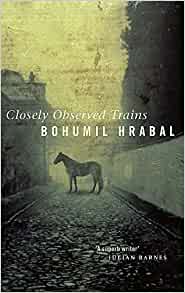
Closely Observed Trains – Bohumil Hrabal (1965, trans. Edith Pargeter 1968) 91 pages

I’m flagging a bit with my Novella a Day challenge, but I’m telling myself there’s only a few more days to go. I’m still really enjoying it, but my post-covid brain is struggling. This meant when I sat down to read Closely Observed Trains, I thought for ages that it wasn’t working for me due to my rubbish concentration levels. Then suddenly it clicked, and as a result it broke my heart.

The story is narrated by Miloš Hrma, young apprentice on the railways during 1945 in Bohemia (one more stop on my Around the World in 80 Books reading challenge.)

“The dive-bombers were disrupting communications to such an extent that the morning trains ran at noon, the noon trains in the evening, and the evening trains during the night, so that now and then it might happen that an afternoon train came in punctual to the minute, according to the timetable, but only because it was the morning passenger train running four hours late.”

This slightly surreal comedic tone continues throughout the novel as we learn about Miloš’ colleagues: lascivious dispatcher Hubička and pigeon-loving station master Lánksý. There is a lot of silliness – Hubička is caught up in a daft sex scandal, Lánksý can be pompous and ridiculous.

But there is a serious side too. Miloš is returning to work after cutting his wrists. There is a lot of animal suffering and at first I was baffled as to why, before realising it was a way of introducing violence and victimhood to a novel about war which doesn’t include warfare.

As Miloš and his colleagues continue their ordinary lives, the troop trains trundle past to the Eastern front.

“This year the Germans had lost control of the airspace over our little town. When I rode along the footpath to the fuselage of the aircraft the snow was glittering on the level fields, and in every crystal of snow there seemed to be an infinitely tiny second hand ticking, the snow crackled so in the brilliant sunlight, shimmering in many colours.”

Closely Observed Trains presents a narrator with a distinct young voice: vulnerable, inexperienced, sceptical and funny. It finely balances unreality and humour alongside humanity and pathos. It’s deeply serious but written lightly, showing how bravery and heroism can exist in the unlikeliest places.

It could be my aforementioned foggy covid brain, but as I was writing this post I started to feel a bit teary by the end. This really was the most affecting novella.

“I am always late on principle.” (Oscar Wilde)

After getting off to a pretty good start with my Women in Translation Month reading, I stalled badly with my final post. Although I read these two novels during August, writing about them in time for WIT Month 2021 (hosted by Meytal at Biblio) proved an insurmountable task. I still hope one day to get my blogging back on track but clearly August 2021 was not where this miracle was going to occur!

So here we are in September and I’m revisting two authors I’ve enjoyed in the past. When I decided to write on them initially I didn’t consider any connected themes, but there are some: ideas of home, otherness, what it means to live among a community, unlikely friendships, coming to terms with aging.

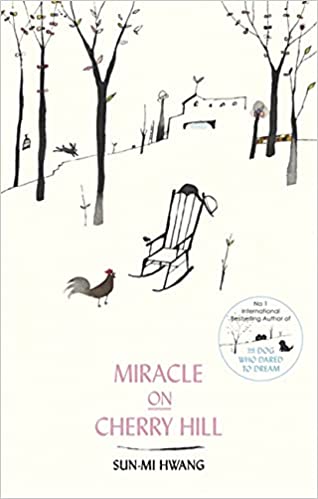
Firstly, Miracle on Cherry Hill by Sun-Mi Hwang (2019, trans. Chi-Young Kim 2019).  I enjoyed the simplicity of The Hen Who Dreamed She Could Fly and found it very moving, so I was looking forward to this. I also thought – rightly – that it shouldn’t be too traumatic, given I’m a delicate flower at the moment.  Like The Hen… this is a quick read with no great surprises, but that’s not a criticism, as it still offers a rich story with fully realised characters.

Miracle on Cherry Hill sees successful business leader Kang Dae-su move back to his childhood home town having been diagnosed with a brain tumour (named Sir Lump). He plans to hole up in a huge, fenced-off house, away from any company to see out his days.

“Cherry Hill was an outdated name. New apartment buildings had uprooted nearly every last cherry tree around it, like insects gnawing through greenery. Only one old original house remained in this neighbourhood, near the bus stop, because the woods surrounded it and the owner was stubborn. He also owned all the land surrounding the house, At least, that’s what they said – nobody had ever laid eyes on the owner.”

Things don’t go quite according to Kang’s plan. For a start, the townspeople have used his property while he has been absent. The children play hide-and-seek in the grounds, an elderly woman with dementia grows vegetables, her granddaughter Yuri exercises her puppy and collects hens eggs.

“How dare Sir Lump pity him? He heard something coasting along with the wind, something like humming. Kang remained on his back. If he concerned himself with every singing animal or person who was evidently trespassing on his property the tumour would swell and burst from sheer irritation.”

Despite Kang’s irritation, a series of comic events demonstrate it’s better to share his garden for continued use by the town. What’s more, he even invites people in, recognising troubled youngster Sanghun would benefit from being employed to mow his lawns.

As Kang begrudgingly becomes involved in the life of the town and the people who live there, he becomes reconciled to his past, and the pain from childhood he has been holding onto begins to heal.

“Each of these new discoveries left him with a refreshing sensation, as if a cold drop of water was falling into the depths of his heart. These feelings had to be carefully swallowed down.”

Miracle on Cherry Hill is a sweet tale, but not sentimental as it tackles some difficult issues. It’s fabulistic but also recognisably real. It’s poignant and playful, and as someone who loves a redemption story I found it charming.

Secondly, Drive Your Plow Over the Bones of the Dead by Olga Tokarczuk (2009 trans. Antonia Lloyd-Jones 2018) which was a highly anticipated read for me, having loved Flights. For some reason I didn’t count that read on my Around the World in 80 Books Reading Challenge, so Drive Your Plow… has formed my Poland visit.

This is a very different reading experience to Flights, which was fragmentary and mixed different genres. In contrast, Drive Your Plow… is more linear and plot-driven. However, it is still a complex novel that resists easy categorisation. I really loved it.

Janina Duszejko is a middle-aged woman with mysterious ailments, who hates her name and lives alone in a remote part of Poland:

“All you can see on the map is a road and a few houses. It’s always windy here, as waves of air come pouring across the mountains from west to east from the Czech Republic. In winter the wind becomes violent and shrill, howling in the chimneys. In summer it scatters amongst the leaves and rustles – it’s never quiet here.”

This harsh and isolated landscape suits Janina, as she is viewed as eccentric and regards people warily. When she engages in company, it is in her own way:

“What a lack of imagination it is to have official first names and surnames. No one ever remembers them, they’re so divorced from the Person, and so banal they don’t remind us of them at all…That’s why I try my best never to use first names or surnames, but prefer epithets that come to mind of their own accord the first time I see the Person.”

Janina is a fan of Blake and this is reflected not only in the title of he novel and the epigraphs, but also her Fondness for Capitalising for Emphasis, which I thought a nice touch and added to the sense of her unique voice.

At the start of the novel, Janina is disturbed by her neighbour Oddball, who asks her to come with him to check on another neighbour, Big Foot. He is dead, having choked on a bone. Janina doesn’t grieve for him as he was part of the local hunting club, and she much prefers animals to humans. Sadly her “Little Girls” – her two dogs – have disappeared.

As other members of the hunting club die – all local powerful men, all seemingly pretty unpleasant – Janina shares her theory with the police that animals are taking their revenge for the cruelties enacted upon them. This theory is supported by her astrological studies, and is completely ignored by the authorities:

“Once we have reached a certain age, it’s hard to be reconciled to the fact that people are always going to be impatient with us.”

The mystery of the deaths of the men isn’t the heart of the novel though. Although the blurb on mine describes it as ‘an existential thriller’ I wouldn’t even go that far.  For me the driving force of the story is the character of Janina and how she exposes attitudes to women, to aging; the power of the patriarchy, of money; and the disregard of anyone who is inconvenient to conventional society. She does this simply by existing and narrating how people respond to her.

I should warn readers here that the novel does describe cruelty to animals. Because Janina is appalled by it, the scenes are never dwelt on, but they are important to the story. This can make it a tough read but that is precisely the point – to question the horrors of how animals are treated. Drive Your Plow… was adapted into a film called Spoor in 2017 and I was going to end with the trailer, but even then there are some pretty grim scenes so I opted not to.

Drive Your Plow… raises important, complex themes through the voice of a truly memorable narrator. There is a dry humour running through the novel, but it also doesn’t pull its punches. The landscape is beautifully evoked and the characterisation compassionate. It will stay with me for a long time.

“As I gazed at the black and white landscape of the Plateau, I realised that sorrow is an important word for defining the world. It lies at the foundations of everything, it is the fifth element, the quintessence.”

To end, a song about a town community:

“Killing Me Softly” (Roberta Flack)

Hello bookish blogosphere! I’ve been away for what feels like a long time. June and July were a big pile of pants and I needed a step back from things. I want to say thank you to the lovely bloggers who contacted me to ask if I was OK, when I really wasn’t. Your kindness genuinely meant a lot.

I’ve only just started reading again after about six long weeks of being unable to digest a single written word. Some very strange things have happened to my reading; I couldn’t deal with fiction for a while so I finally got round to reading some of the biographies that have languished in my TBR for aeons. Then having got back to fiction I’ve started with a subject about as far from my usual fare as its possible to be: serial killers. Except neither novel is really about serial killers…

Firstly, My Sister the Serial Killer by Oyinkan Braithwaite (2017). This made quite a splash when it came out and I remember large, eye-catching posters on the tube, back when commuting was a thing. It’s a quick read and it was that reason that made me pick up this debut, thinking it was a good way to try and get back into reading.

My logic worked well, and I whizzed through this tale of a murderous sibling, narrated by Korede, a young successful nurse whose talent for cleaning comes in handy when helping her sister Ayoola cover up her deeds.

The novel starts in media res as Ayoola contacts Korede to ask for help having killed her third boyfriend in self-defence. Ayoola is completely oblivious to the seriousness of her crimes and seems to feel no remorse. Although Korede loyally helps her, she is beginning to have doubts as to the nature of Ayoola’s self-defence.

“ ‘Do you not realise the gravity of what you have done? Are you enjoying this?’ I grab a tissue and hand it to her, then take some for myself.

Her eyes go dark and she begins to twirl her dreadlocks.

‘These days you look at me like I’m a monster.’ Her voice is so low, I can barely hear her.

‘I don’t think you’re – ‘

‘This is victim shaming you know.’”

The novel isn’t graphic and the details of the killings are not dwelt on – thankfully, if you’re as squeamish as me. Instead what Braithwaite explores is a complex relationship between sisters and the impact of patriarchal systems on young women. It’s set in Nigeria but the themes certainly resonated with me as a UK reader.

Korede and Ayoola grew up with a violent father and it his weapon that Ayoola uses:

“ ‘The knife is important to me Korede. It is all I have left of him.’

Perhaps if it were someone else at the receiving end of this show of sentimentality, her words would hold some weight. But she cannot fool me.”

No-one questions Ayoola because she is beautiful, no-one pays attention to Korede because she is average looking. Both women suffer under a society that commodifies women, even though Korede is successful in her career as a nurse and Ayoola is a talented clothes designer.

A doctor where Korede works, Tade, seems to be decent but even he follows the predictable path of not noticing what Korede can offer and falling for Ayoola’s looks, projecting his fantasies onto her.

“ ‘She is beautiful and perfect. I never wanted to be with someone this much.’

I rub my forehead with my fingers. He fails to point out the fact that she laughs at the silliest things and never holds a grudge. He doesn’t mention how quick she is to cheat at games or that she can hemstitch a skirt without looking at her fingers. He doesn’t know her best features or her…darkest secrets. And he doesn’t seem to care.”

Ayoola dating Tade adds tension to the narrative – will she try to kill him? Will Korede try to save the man she has feelings for? Who will succeed?

Sometimes satire can leave a bitter taste, but MSTSK avoids this with it’s dry humour and lack of preachiness. It doesn’t attempt crass psychology as to why both women are as they are, it simply presents their lives and upbringing and leaves the reader to draw their own conclusions. This light touch means it raises serious issues about contemporary society without losing sight of characters or plot. An impressive debut.

Secondly, Sword by Bogdan Teodorescu (2008, trans. Marina Sofia 2020) which was sent to me by the lovely Marina Sofia who blogs over at Finding Time to Write. She has translated this novel under Corylus Books, the publishing house which she has founded with three others.

MSTSK used a serial killer to satirise patriarchal systems, and Sword uses it in a similar way to satirise political systems. Set in Romania, it forms another stop on my Around the World in 80 Books Reading Challenge, hosted by Hard Book Habit who sadly don’t seem to be blogging any more.

Someone is killing Roma people in Bucharest using the titular weapon. There is no apparent motive – except presumably a racist one – and the murders have a competence to them which means the police investigation has very little to go on. This isn’t a police procedural though, and very little of the story is given over to the murders themselves (again, thankfully…) aside from the first. Instead Teodorescu uses the murders to explore the power systems in place in Romania and how this exposes the weaknesses and motivations of those within.

If that sounds dry, it really isn’t. The story whips along and the portrayals of power players feel authentic (Teodorescu is a political analyst). Early on, the petty concerns of Istrate, Head of Comms and Press Relations at the Presidential Office, demonstrate the disregard that the deaths receive. He only likes the social side and travel associated with his job, and the President hates him and so has set up another press office.

“He was briefly tempted to write a report complaining about the lack of professionalism in his team. Instead of getting reports about major problems, the international situation, global crises that could destabilise the Balkan region, an in-depth political analysis, he had to put up with silly homicide stories! He gave up reading the press summary, but resolved to complain about it the next time he met the President.”

The government is concerned, but only in trying to balance appealing to those who might welcome vigilante justice represented by Sword (as the press have nicknamed the killer) because he only kills criminals, and how it will look internationally that they haven’t caught him. The advice given to the Minister of the Interior suggests how to manage the situation in a pre-election year:

“A few heads rolling at all levels in the police force should demonstrate the government is taking things seriously. Admittedly, it also demonstrates how incompetent the police are, but no-one worries about that too much.”

Despite such machinations, the murders continue to rack up and tensions in the country between various groups escalate. The context of Romania finding its place in international capitalist systems after the fall of communism is evoked well but it doesn’t take much imagination – if any – to see parallels across different political systems. I felt this could just as easily be Westminster. There’s something depressingly universal about someone with integrity being forced aside for political expediency:

“ ‘It’s not anger. It’s profound sadness. Because you’ve proven to me yet again that it’s not good enough to be qualified, professional, well-intentioned and to work your socks off… it still won’t get you the respect you deserve.’”

Sword is incisive and uncompromising in its portrayal of corruption and the powerless victims of such systems, but its not depressing. Instead I found it a compelling read and I’d definitely be interested to read more by this author.

Writing this post was difficult as I’m so out of practice, but to end it’s business as usual with an obvious late twentieth century pop choice 😀

Novella a Day in May 2020 #28

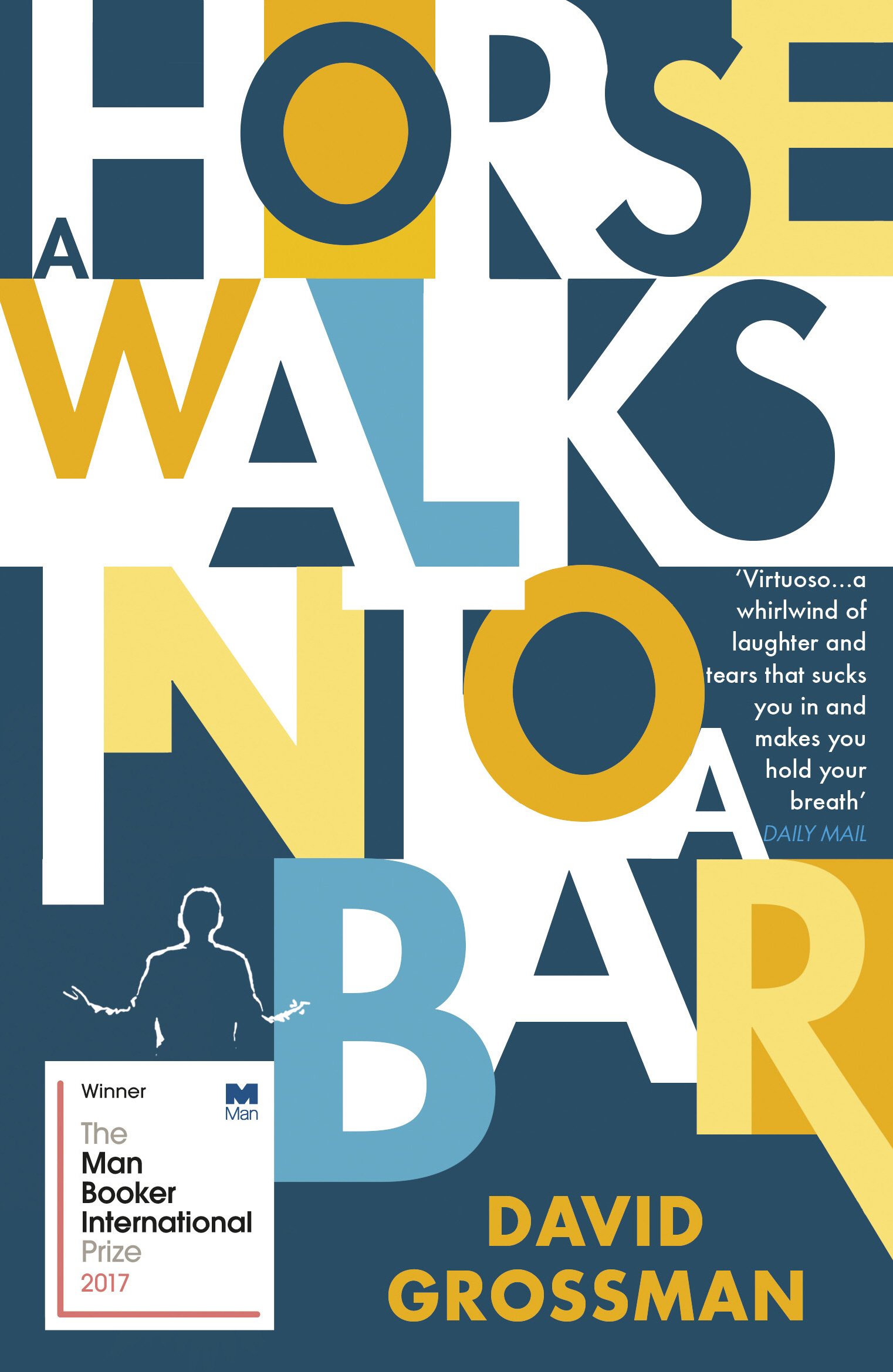
A Horse Walks into a Bar – David Grossman (2014, trans. Jessica Cohen 2016) 198 pages

A Horse Walks Into a Bar is a novel about a comedian, but the fact that it won the 2017 Man Booker International Prize (there’s an interesting interview with translator Jessica Cohen on the Asymptote blog) is an indication that it has serious things to say. Its takes place in Israel and so it also forms my last stop this novella month on my Around the World in 80 Books reading challenge, hosted by Hard Book Habit. 

Dovaleh Greenstein is a stand-up comic known as Dovaleh G, and the novel follows his set in a Netanya comedy club over two hours, from the point of view of his childhood friend Avishai Lazar, now a retired district court judge in his late 50s who barely remembers Dovaleh.

“From the minute he got on stage he’s been seeking my eyes. But I can’t look straight at him. I dislike the air in here. I dislike the air he breathes.”

Dovaleh G is not a pleasant man. He berates the audience, he insults their town, he has the style of stand-up that mixes old-fashioned jokes with barely concealed aggression.

“I swear to God, standing before you tonight is the first man in history to get post-partum depression. Five times! Actually four, ‘cause two of them were twins. Actually five, if you count the bout of depression after my birth.”

He’s offensive and at various points audience members walk out. They complain he is not giving them what they paid for – a night of laughs. Instead, Dovaleh recounts his childhood memories: living with his mother who was traumatised from the camps, and his father who beat him. He walked on his hands to escape neighbourhood bullies.

Onstage, he verges on being a bully himself. Someone else is in the audience who remembers him as a child: Azulai, a small woman and spirit medium, to whom he is absolutely brutal. Yet his most vehement aggression is reserved for himself:

“Somehow, on the phone, there was something attractive about his offer, and I can’t deny that he does have his moments on stage, too. When he hit himself, there was something there, I’m not sure what, some sort of alluring abyss that opened up. And the guy is no idiot. He never was”

Grossman captures brilliantly that tension that can exist in stand-up where the audience don’t feel entirely safe, and don’t exactly know where their laughter is coming from. He also exploits fully that a lot of comedy is born out of pain. Dovaleh G is not likable, but throughout the course of the novella he does become understandable, and it is possible to feel compassion for him.

The audience (and readers) become witnesses for Dovaleh G; to his life, his trauma and his anger. What humour there is, is very, very dark. There was a riff on Dr Mengele that actually made me wince – I’m not sure I’ve winced at a book before.

A Horse Walks into a Bar is a devastating read but not a destructive one. At the end I felt there was some hope, which given Grossman is a highly political writer has wider significance than the life of Dovaleh G and Avishai Lazar. I’ve not discussed the politics of the novella because I felt I didn’t know enough about Israel and Palestine to do it justice, but if you know about this in more depth then I’m sure A Horse Walks Into a Bar will have an extra resonance for you.

“How, in such a short time, did he manage to turn the audience, even me to some extent, into household members of his soul?

Novella a Day in May 2020 #21

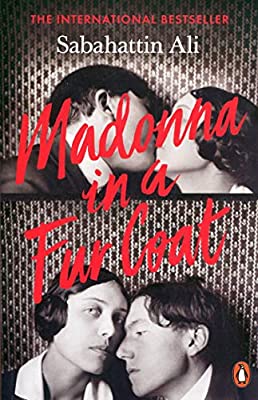
Madonna in a Fur Coat – Sabahattin Ali (1943, trans. Maureen Freely and Alexander Dawe 2016) 168 pages

Madonna in a Fur Coat is set mainly in Berlin, but is bookended by scenes in Ankara, so I’m counting it as another stop on my Around the World in 80 Books reading challenge, hosted by Hard Book Habit (who unfortunately don’t seem to be blogging any more). It feels a bit of a cheat to count it as Turkey but I’m so behind on the challenge that I’m taking a few liberties!

Continuing yesterday’s theme of an elegy for a young love affair, Madonna in a Fur Coat tells the romance of a Turkish man with a visual artist in 1920s Berlin. The novel begins in 1930s Ankara, where the narrator visits his unremarkable colleague at home, and is struck by the disregard his family show him.  

“It seemed impossible that a man like Raif Efendi – what sort of man that might be, I had no idea, but I was sure he was not as he seemed – that a man like this would shrink away from those closest to him.”

He feels there must be more to his quiet colleague, who is fluent in German, than meets the eye.

“Why, when we are reluctant even to describe a wedge of cheese we are seeing for the first time, do we draw our final conclusions from our first encounters with people, and happily dismiss them?”

Raif knows he may die and so he asks the narrator to destroy a notebook, which of course the narrator reads. It was written ten years after the events it documents and describes how, as a young man, Raif stayed in Berlin to learn soap manufacturing, a career he is far from committed to. One day, visiting a gallery, he becomes mesmerised by a portrait of a woman in the titular garment:

“All I can say is that she wore a strange, formidable, haughty and almost wild expression, one that I had never seen before on a woman. But while that face was utterly new to me, I couldn’t help but feel I had seen her many times before.”

He visits daily to stare at the picture, and eventually meets Maria Puder, the woman who painted the self-portrait. They begin an intense, but largely platonic relationship. Raif is inexperienced and shy:

“If I ever met a woman I found attractive, my first thought was to run away.”

While Maria is determined and self-reliant:

“This all ends the moment you want something from me.”

My tolerance for young, earnest love affairs is pretty minimal, being old and sceptical myself 😀 Yet I was able to follow the relationship between Raif and Maria with interest because I wanted to see how it was that Raif ended up ill, poor and disregarded back in Ankara; and because Maria is a well-drawn woman rather than bland love object:

“I was only too aware that I still knew next to nothing about her. My judgements were formed of my own dreams and illusions. At the same time, I was absolutely sure they would not deceive me.”

Madonna in a Fur Coat is a sad tale of lives half-lived, of ill-advised restraint and missed opportunities. I didn’t find it depressing, but it’s certainly a melancholic and mournful read.

Kim from Reading Matters reviewed this novella back in January, you can read her excellent review here.