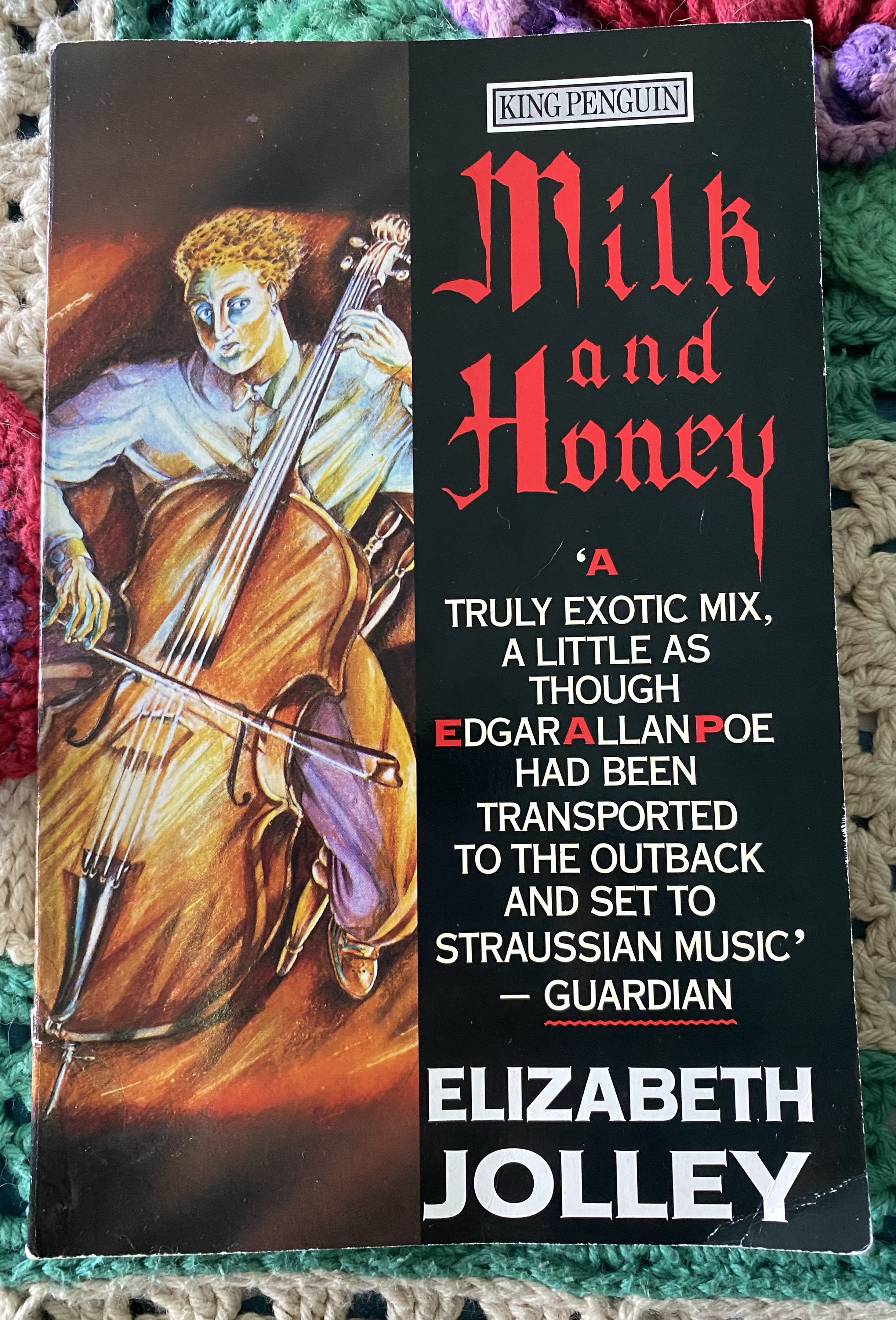
Milk and Honey (1984) has quite a Gothic feel to it, so it’s worked out well with Hallowe’en too…
The story is narrated by Jacob, who at the beginning of the novella is an unhappy, unfulfilled door-to-door salesman with an injured hand.
“Sometimes, after my cup of real coffee in the Beach Hotel, I sat outside on the small, sandy cliffs, looking down onto the sea as it came up in long, slow waves to the rocks and sunk sighing back down the beach, and I felt the profound melancholy that all my life has come over me from time to time. It was the melancholy of dark trees standing alone and the quiet sadness of the colours of the land, dark greens and browns and the sand subdued. As I sat, the colours deepened, tawny, dun coloured blending beneath the low grey sky. And from somewhere hidden, the sun lit up the sea.”
We then go back in time to when Jacob was a teenager and sent by his father to live with the Heimbachs so he can be tutored in the cello by Leopold. The widowed tutor adores Jacob, calling him ‘Prince’, but his sisters Tante Rosa and Aunt Heloise may be more ambivalent. Certainly Jacob’s lauded genius may not be as evident as Leopold proclaims. But Jacob does play with feeling:
“When I played the cello and the cello hesitated, poised on a single note so pure and restrained and lovely, I closed my eyes with an exquisite love of the cello. I was in love with the cello.”
Also in the house are Leopold’s children. His daughter Louise is a romantic interest for Jacob, and there is his son Waldemar who has unspecified disabilities. The household is insular and claustrophobic, but Jacob willingly relinquishes external experiences:
“I had no wish to be free. I preferred not to go to school, and, though the house and garden were open to the street, I never went out into the street. I read and studied and lived in the household which seemed to contain all in the way of books and musical instruments and teachers I could ever need.”
For the reader though, the household is deeply unsettling. We never really know what anyone’s motivations, views or plans are. Jacob is self-focussed and so as a narrator he doesn’t tell us. We piece together certain aspects of the wider life of the household – I guessed an unpleasant twist towards the end – but so much is left unspecified.
Conspiracies abound in this small household. A major decision is taken early in the novel that is traumatising for Jacob but we’re not completely sure why such action is taken. Jacob is having an affair but it seems entirely likely that everyone knows about it. A wedding ceremony is sprung on him, and yet everyone seems to think this is completely acceptable:
“But even after the surprise celebration of our engagement, on the day of my inheritance, the idea of marriage had seemed remote, something vague, talked about in laughter while eating apples and trying on rings made from human hair, something looked forward to from childhood but, like a disease experienced by adults, never reached.”
Milk and Honey is an odd novel and at times I wasn’t sure it was for me. There was so much that was unexplained that it could be entirely discombobulating, and Jacob was so oblivious and callow I wasn’t sure he could carry me through. I’m glad I persevered though, and I would definitely be interested to read more by Jolley. From this, I would say she writes about nature beautifully and is expert in creating an unsettling, memorable atmosphere.
You can read Lisa’s excellent review of Milk and Honeyhere.
To end, a bit of a departure from my usual 80s cheese – I always find Elgar’s cello concerto in E minor so moving (and this is with the City of Birmingham symphony orchestra, which was Elizabeth Jolley’s place of birth before she emigrated to Australia – see what I did there? 😀 ):
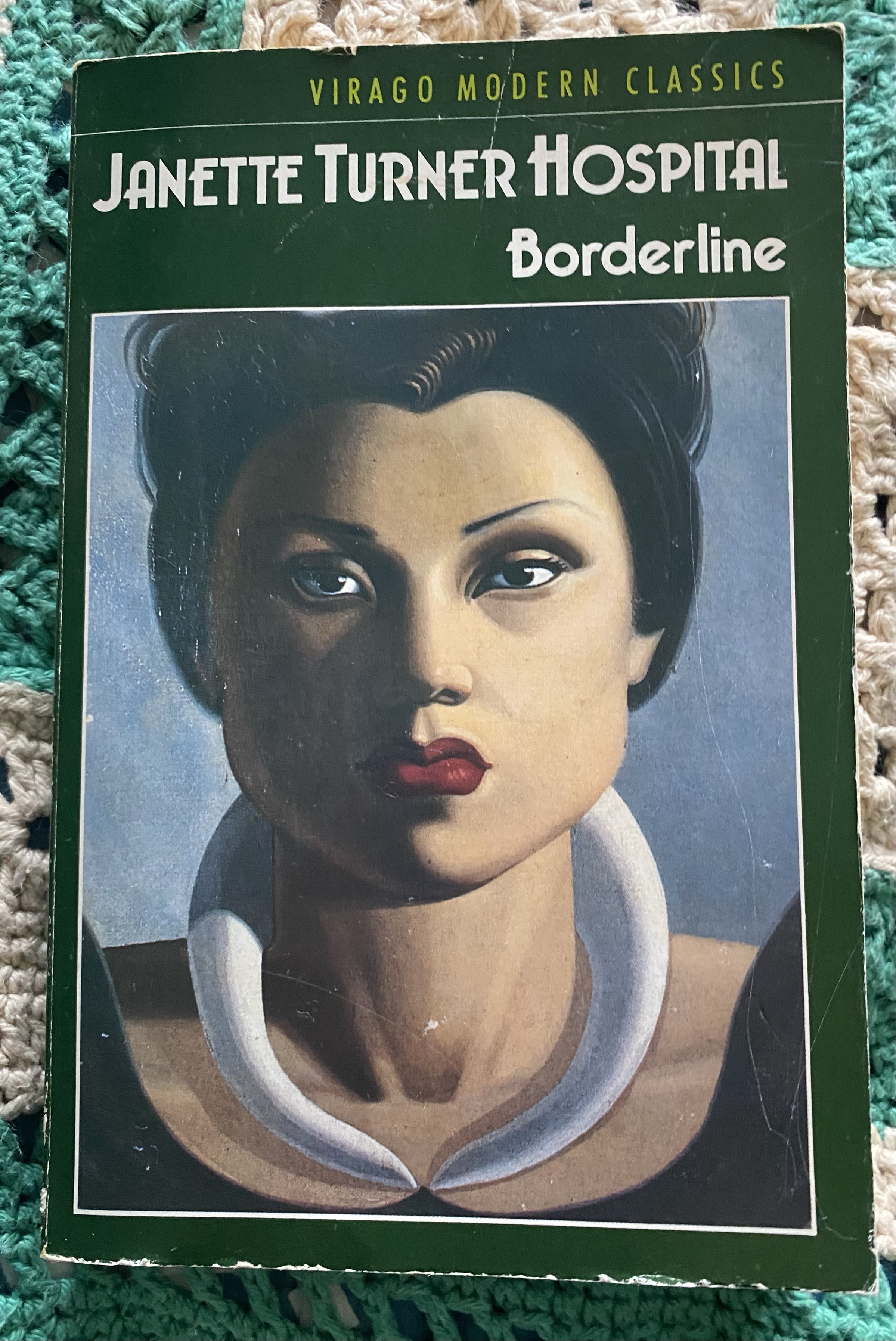
Somehow I’ve accumulated several Janette Turner Hospital books in the TBR, without ever managing to get round to reading any of them. So thank goodness for AusReading Month 2023 hosted by Brona at This Reading Life which finally got me to pick one up!
Borderline is JTH’s third novel, published in 1985. The blurb on the back describes it as a metaphysical thriller, but I don’t think that’s a helpful description. There are thriller elements but what JTH is more concerned with is the unreliable narratives we tell ourselves and others; how we can love those who remain so unknown to us; and the unpredictability of all our lives that can change in an instant. These themes don’t lend themselves to definite resolutions, so those seeking a thriller will be disappointed.
However, if you’re happy to go along with an exploration of these ideas that ends without any neat answers, there’s a lot to enjoy in Borderline.
The narrator is Jean-Marc, a man who has always had a slightly Oedipal relationship with his father’s girlfriend, Felicity. Seymour aka Old Volcano, was an artist much older than Felicity, who was nearer in age to her stepson.
“When I was five, my father was already famous and my mother was mostly distraught. Later she escaped. She made a quantum leap into banality. Which is the true secret of happiness – a second marriage, a very ordinary life, other children. Naturally she does not care to see me, a revenant from that earlier bad time, and I do not blame her at all.”
Felicity and Seymour’s relationship inevitably ends, and Felicity becomes a successful art dealer. She is returning from a trip when, at a border crossing between the United States and Canada, she makes the impulsive decision to smuggle Dolores Marquez, a refugee from El Salvador, with the help of a man called Gus.
Gus’ full name is Augustine, he’s a salesman who is routinely unfaithful to his wife. Felicity calls Dolores La Magdalena after a painting. People in this novel have different names, different roles, splintered lives. They disappear and no-one knows where to begin looking for them.
Gus’ daughter Kathleen turns up at Jean-Marc’s house, and their relationship seems to almost transgress boundaries, but not quite. As they try and locate their loved ones, Jean-Marc acknowledges that he is filling in a lot of gaps with very little to go on:
“Her stories bombard me, they seem to have become my own memories, they writhe and change and regroup in the way true memories do. They are like photographs in her grandfather’s dresser, a deluge of the ever-present past.”
The plot of Borderline is enough to pull the reader along, but this is not the novel to read if you want a plot-driven story. Jean-Marc tracks Felicity as best he can, but she remains out of reach. The stories in Borderline are unclear in origin: what Jean-Marc has experienced, what he has been told, what he is making up.
“Her days are baroque, they curl into each other like acanthus leaves, she lives somewhere between now and then. She moves in and out of her life.”
“Still, I have to admit, there has always been a quality of absence about her; which is why her disappearance itself seems insubstantial, merely a figure of speech, or a trick of the light, a momentary thing.”
I would completely understand if someone experienced this novel as a frustrating and disappointing read. However, I felt Borderline was an effective exploration of how human beings try and make sense of themselves, each other and the world when so much remains unknown and chaotic. It has some truly breathtaking passages and JTH is absolutely a writer I’d like to explore further.
To end, let it never be said that I shy away from the obvious in my 80s song choices 😀
This is my third read for AusReading Month 2023 hosted by Brona at This Reading Life and so far I’ve been very lucky with my choices from the TBR, they’ve all been striking and compelling reads. I’m grateful this month-long event has finally prompted me to get to them.
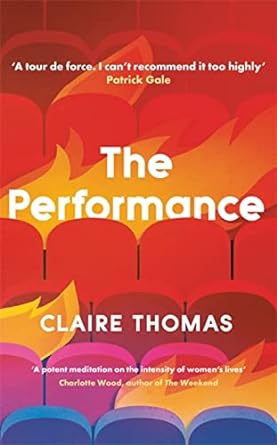
I was immediately taken with the premise of Claire Thomas’ The Performance when it was published in 2021, as it is set in one of my favourite places to be: the theatre. Also I’m shallow and I really liked the cover too, with flames licking through the seats.
Set during a performance of Samuel Beckett’s Happy Days in a Melbourne theatre, the novel follows the thoughts of three women in the audience.
Margot is a professor nearing unwanted retirement:
“Margot refuses to be patronised by sudoku puzzles or the cryptic crossword – lifting a pen towards one of those activities announces you as a gullible geriatric – and she has instead embarked on this careful consideration of her past.”
Ivy is a rich patron of the theatre, who has recently had a child many years after the death of her first, and has been a huge Beckett fan since her student days:
“Ivy pulled down her SB picture after a further year of tertiary education bloated with critical theory, once the idea of idolising a dead white man had become too embarrassing to have on public display.”
And Summer is a young usher who doesn’t know key facts about her past and is trying to manage her anxiety about the future:
“Summer wishes that she were more even-tempered. She wishes she noticed less and worried less and cared less. She knows there are better ways to live a functional life. Well, she hopes that there might be better ways to live a functional life and she just hasn’t worked them out yet.”
Like Winnie on the stage, trapped in earth up to her waist (then up to her neck in the second half), the three women are rendered immobile by the conventions of theatre-going. As they sit in the auditorium, there are bushfires edging ever closer…
“Everyone seems engrossed. The performance is working on them. Perhaps they are immune to what is going on outside this cold bubble of culture. Maybe they already felt safe in their city or their suburbs, buffered from the threat of the distant, unpredictable flames.”
Thomas balances all the elements of the story so well. The three women are all fully realised and believable individuals and the performance they are watching intrudes enough to give a sense of the play without being jarring or gimmicky.
Speaking of which… the interval is written in playscript style which is clearly marked in the book with grey-edged pages, so I knew it was coming and wasn’t convinced. But on reading it in context I thought it was well-justified. It gave a sense of the change of environment and pace for the characters in a clever way, without losing sight of what had gone before or would come after. I can be a bit grumpy about such techniques but really can’t complain here 😀
I thought the themes regarding the roles of women and environmental crisis were so deftly handled too. Happy Days lends itself to these really well and provided a constant background reverberation, alongside the threat of encroaching fires.
Meanwhile, the three women are trying to work out which parts of their many roles feel performative and which feel authentic:
“Summer is not effortlessly cool. She is not effortlessly anything. Performing in the right way each day is exhausting her.”
“Ivy suspects that feeling confused about whether one is being ironic is a key indicator of approaching middle age.”
“So [Margot] imagined being someone without a professorial chair. Someone who had not written several books. Someone who had not won many prestigious awards and grants for her work […] and those erasures were only momentarily tolerable before she felt panicked and bereft.”
As the quote about Ivy shows, there is a dry humour running through The Performance that keeps it engaging. Like Beckett, Thomas uses humour to keep explorations of existential crisis becoming utterly overwhelming for the reader/audience.
This is the first work I’ve read by Melbourne-based Claire Thomas and I’ll definitely seek out more. Apparently she’s currently working on her third novel and I’d be interested to read her first, Fugitive Blue.
“This is what’s so special about theatre, Ivy thinks. This forced intimacy between strangers. This shared experience of watching or not watching other people performing right now in this delicate moment. Anything could happen beside me or in front of me, but here I am, sitting here, just doing this play.”
To end, a brief interview with Judith Lucy who played Winnie in the Melbourne Theatre Company’s production of Happy Days earlier this year:
Trigger warning: mentions physical and psychogical violence; domestic violence and gaslighting.
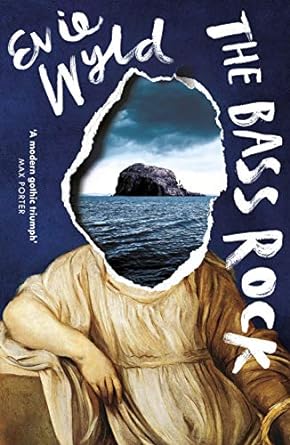
I absolutely loved Evie Wyld’s first two novels, After the Fire, A Still Small Voice (which was set in Queensland) and All the Birds, Singing (which was set in Scotland and Australia and won the Miles Franklin Award). Despite this I was slow to pick up her third novel The Bass Rock (2020) which won the Stella Prize in 2021, so I’m really glad this reading event finally prompted me to get to it. Evie Wyld was born in London and lives there now, after growing up on her grandparents’ farm in New South Wales; her wiki entry describes her as an Anglo-Australian author.
The Bass Rock is mainly set in North Berwick in Scotland, the titular rock being in Firth of Forth (there’s a great picture of the Bass Rock accompanying this Guardian review here), and across three different timelines. My heart always sinks at multiple timeline novels – usually one of the strands is far more compelling than the rest and I find myself whizzing through sections to get back to the one I’m enjoying most. But Wyld balanced all her elements expertly: formally through structure, and informally as they echoed one another while maintaining coherent yet distinct voices.
The contemporary strand is told in the first person by Viv. She is feeling entirely adrift after the death of her father and has had to spend some time as an inpatient being treated for her mental health. Now she is occupied trying to catalogue the possessions of her grandmother and great-aunt, with limited success.
“If I eat the cruciferous vegetables and cream the disgusting leg I would feel better and I would look better and I would be better. I scratch my leg through my tights until I feel the satisfactory glow of broken skin.”
In the second strand, we meet Ruth who, in the aftermath of the Second World War, has married Patrick. He is a widower with two young sons, Michael and Christopher, and has moved Ruth .to North Berwick. She is trying to find her place there, somewhat hindered by the fact that Patrick is barely ever at home. Instead, Ruth’s mainstay is her housekeeper Betty.
Finally, there is a strand told in the first person from the point of view of an eighteenth-century young man, about a woman called Sarah fleeing towards North Berwick after she is accused of witchcraft. This I thought was the least compelling narrative, but I think that was a deliberate choice. The Bass Rock is not about what men think. It is about what they do, and how too often that can involve violence towards women.
The Bass Rock really got under my skin. Its themes are domestic violence, societal violence, gaslighting and abuse. Through the different stories of these women across the ages, Wyld demonstrates how society both implicitly and explicitly condones and perpetrates this.
As Betty summarises to Ruth: “‘Men do these things and then they take on with their lives as though it’s all part and parcel.’ She placed the knife back on the table, laced her small fingers together and caged them over her knee.”
Or as Ruth’s sister Alice pragmatically observes: “’And in order to be able to enjoy your life there are certain things that one has to accept. It’s not being deluded, I won’t have that – it’s seeing things for what they really are, and buggering on until eventually the penny drops and you find yourself living a very fruitful life partly with them but partly with yourself. And the great thing is, they almost always die first.’”
Undoubtedly this novel is a tough read. I think what Wyld did brilliantly was show the insidious, everyday nature of so much abuse and how it is sustained. There is a particularly terrifying scene – ordinary, familial – demonstrating how ‘reasonable’ abusive men collude together to protect their own interests as part of the power structures that serve them so well, and fail women and children.
Wyld makes a great case for trusting your gut: Viv and her sister are on a train, pursued by a violent ex, they know they need to do something – move, pull the cord – but somehow remain frozen. Ruth knows Patrick is gaslighting her but somehow is persuaded to ignore what she fundamentally feels, both about her own situation and that of her step-sons.
But there is humour here too, mainly through Viv:
“I’m a little embarrassed by the assortment of snacks I bought during the day – honeyed almonds and wasabi peas. They are in bowls and I think it looks like I’m throwing some do, rather than persuading a homeless sex worker to stay with me because there might be a ghost.”
Yes, there is a supernatural element to The Bass Rock but it is a constant background murmur, rather than direct plot point, so don’t let that put you off if you are not keen on ghost stories. Looking on goodreads, those who came to The Bass Rock for a gothic tale were disappointed, and I do think it’s poor marketing to label it as such. There are gothic elements, and a tv adaptation could definitely choose to shoot it in such a way, but I would argue it’s not a thoroughly gothic novel. The ghost – if there is one – forms part of the wider theme of going with what you know rather than with what others try to persuade you to believe.
The Bass Rock is incredibly accomplished and I didn’t feel its themes ever overwhelmed story or characterisation. Recently I read a short story by one of my favourite writers on a similar subject, and was disappointed. In that instance I felt the characters were only there to enact the wider argument – both they and the plot felt flimsy. But here I found the characters and the plot compelling, with the wider themes making it an immensely powerful read.
There’s a five minute interview with Evie Wyld talking about The Bass Rock and visiting the location here
“As they crossed the June and reached the peak, the bay became visible, with the Bass Rock looming behind it. On clear days with the low tide it appeared so close that it might have beached itself on the sand, as if it were unmoored and went where it pleased.”
To end, an 80s song as usual, and I thought I’d choose rock with a heavy bass, because I have no shame when it comes to silly puns 😀 Classic song though…
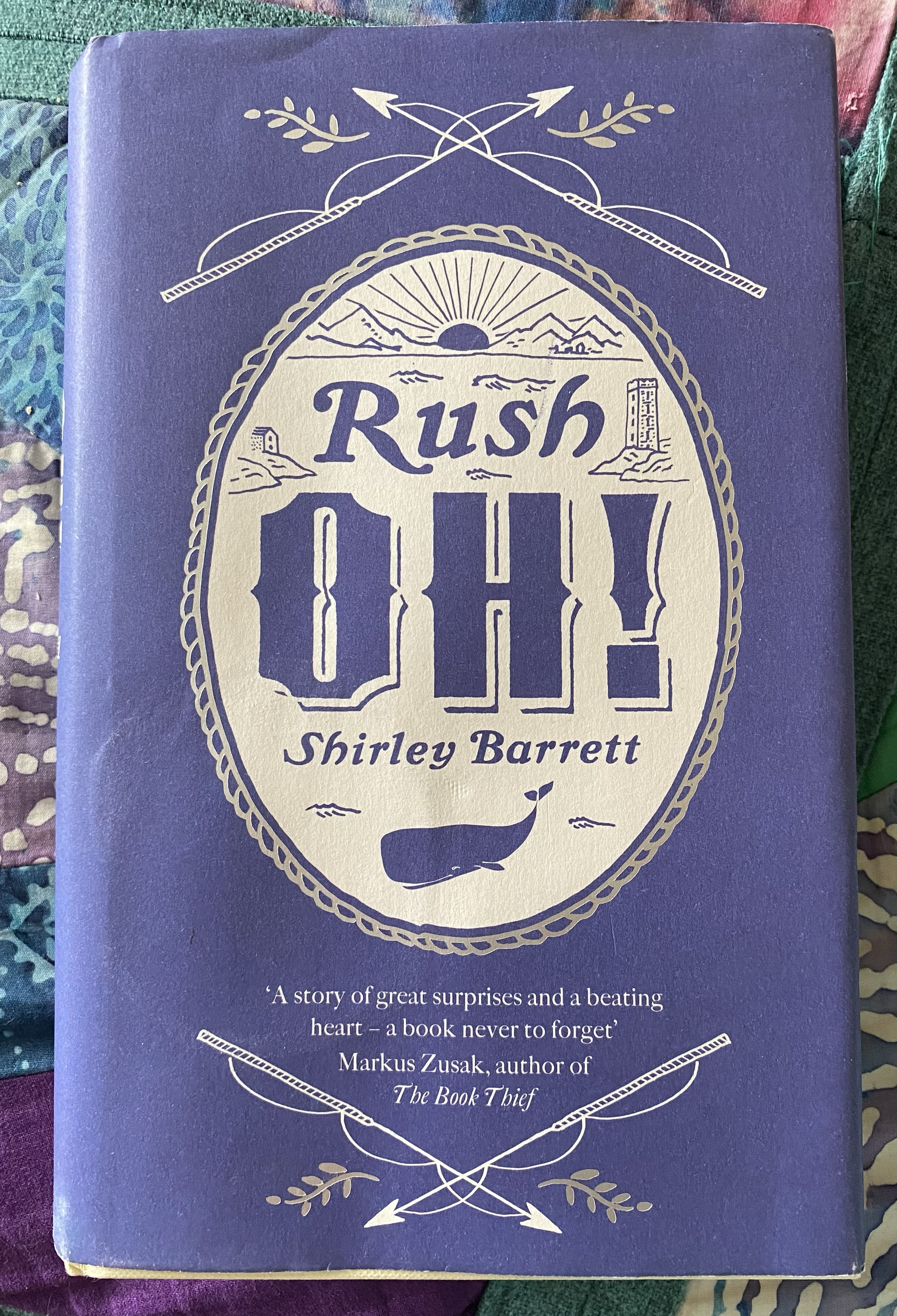
Now, I am definitely not in the market for a novel about whaling, but I remember Rush Oh! by Shirley Barrett getting a lot of love in the blogosphere when it came out in 2015, so I was persuaded to give it a try. Barrett was born in Melbourne and lived in Sydney, she was a filmmaker as well as an author and Rush Oh! was her first novel.
Rush Oh! is loosely based on a famous New South Wales whaling family, but Barrett explains in an Author’s Note at the end that she made a lot of changes and it is a work of fiction. There were a few passages I had to skip and one particular scene, but generally I found not too traumatic a read. It’s told from the point of view of nineteen-year-old Mary Davidson, the eldest daughter of a famous whaler, George ‘Fearless’ Davidson.
As Mary isn’t a whaler, and the season of 1908 is a particularly bad one, there isn’t much whale slaughter. When it does occur, Mary and her sister Louisa are horrified at “the ghastly brutality” they witness, Louisa refusing to speak to her father. Many years later, when George harpoons a whale without the need to bring it in for earning money, Mary finds this entirely unconscionable as killing for its own sake. Rush Oh! remains well-balanced and I didn’t feel Barrett was putting modern sensibilities into a historical figure.
The Davidson’s live in Eden and George sails from Twofold Bay with his crew which includes five Aboriginal men. They are helped in their work by a “gentlemen’s agreement” with a pod of Orcas, who herd Humpback and Sperm whales into the bay, knowing they will get a share of the spoils.
“I awoke suddenly to hear a distant but determined smack! It was a Killer whale flop-tailing, surely? Smack! There it was again, and no doubt about it this time. I jumped out of bed and hurried out to the veranda – my father was running stiff-legged down to the sleeping huts, shouting, ‘Rush oh! Get up, boys! Rush oh!’”
The Orcas are well-known to the family, who give them names: Hooky, Humpy, Typee, Jackson, led by Tom:
“In spite of his distinguished years, his demeanour was ever that of a cheeky schoolboy, the sort that might steal your apples or throw rocks at you from across the street, but nonetheless a good boy in his heart and loved by all who knew him. As well as his duties as Chief Scallywag and Rouseabout, it was Tom who would generally take it upon himself to alert my father and his men whenever he and his companions had herded a whale into the bay.”
For the Aboriginal crew members, the Orcas are recognised as ancestors.
Into this world arrives handsome John Beck, an ex-Methodist-minister. Mary falls hard for him, but as her mother has died and she has a fractious relationship with her sister, she turns to novels and etiquette articles for advice on how to talk to men:
“I had often notice to certain archness deployed by the heroines when addressing members of the opposite sex and I strived to emulate this tone whenever the opportunity arose, which was infrequently. […] In desperation, I had even attempted to engage my uncle Aleck in repartee, but it was difficult to sparkle when constantly having to repeat things in a louder voice.”
Poor Mary. She is awkward and surrounded by older fisherman and her relatives, trying to eke out paltry food supplies to feed them all. She is looking back on this time from 30 years hence, and there is no bitterness in her tone. Rather there is a gentle humour and acceptance of who she was then and who she is now.
Her youth and naivete are also demonstrated in the style of the tale, with little sketches throughout (Matt Canning was the illustrator) and sometimes tying herself in knots with her syntax:
“I fear it will only invite comparisons with Mr Melville that will not be flattering. (I mean, they will not be flattering to me; they will be perfectly flattering to Mr Melville).”
But she is intelligent and funny and she cares for her family; I found her believable and charmingly honest. The humour could be gently mocking at times:
“The age at which Uncle Aleck started whaling was a variable thing, but it was consistent in the fact that it was always younger than anybody else’s.”
But really it was fond more than anything, such as the fishermen’s reaction to John Beck’s sermonising:
“‘Father, since you asked, I have not been buffeted by temptation in a long time,’ said Uncle Aleck.
‘Me neither,’ admitted Arthur Ashby.
‘I would very much like to be buffeted by temptation, but sadly no one is buffeting me,’ said Salty.
‘I wonder if we could get onto the business of praying for a whale,’ said my father.”
Rush Oh! doesn’t fall into the info-dump trap of some historical fiction and wears its research lightly, evoking the setting beautifully and not losing sight of the story at all. My only reservation was that the point of view varies without stating so: Mary describes scenes she wasn’t present for. Although she states at one point this is because she heard about it from John Beck, it didn’t quite work for me.
But this is a minor quibble about an original and engaging tale with a clear-voiced narrator. The ending was left somewhat open on a couple of storylines and while I know that could irritate some readers I thought it worked really well in terms of allowing Mary a life beyond the story without everything tied off neatly.
Shirley Barrett wrote one other novel before she died in 2022. I understand The Bus on Thursday is very different to Rush Oh! but the strength of this novel has made me keen to read it.
To end, I do try and shoehorn in an 80s pop video where I can, and this one seemed apt:
Well, we’ve reached the end of November and contrary to my plans but entirely in keeping with my expectations, I’ve barely managed to blog at all despite all the wonderful reading events that take place. Still, I’m delighted that I am at least managing to join in with AusReading Month 2022 hosted by Brona at This Reading Life. (Even if it is at the eleventh hour and I’m conveniently ignoring the fact it’s already 1 December in Australia right now – I really must do better.)
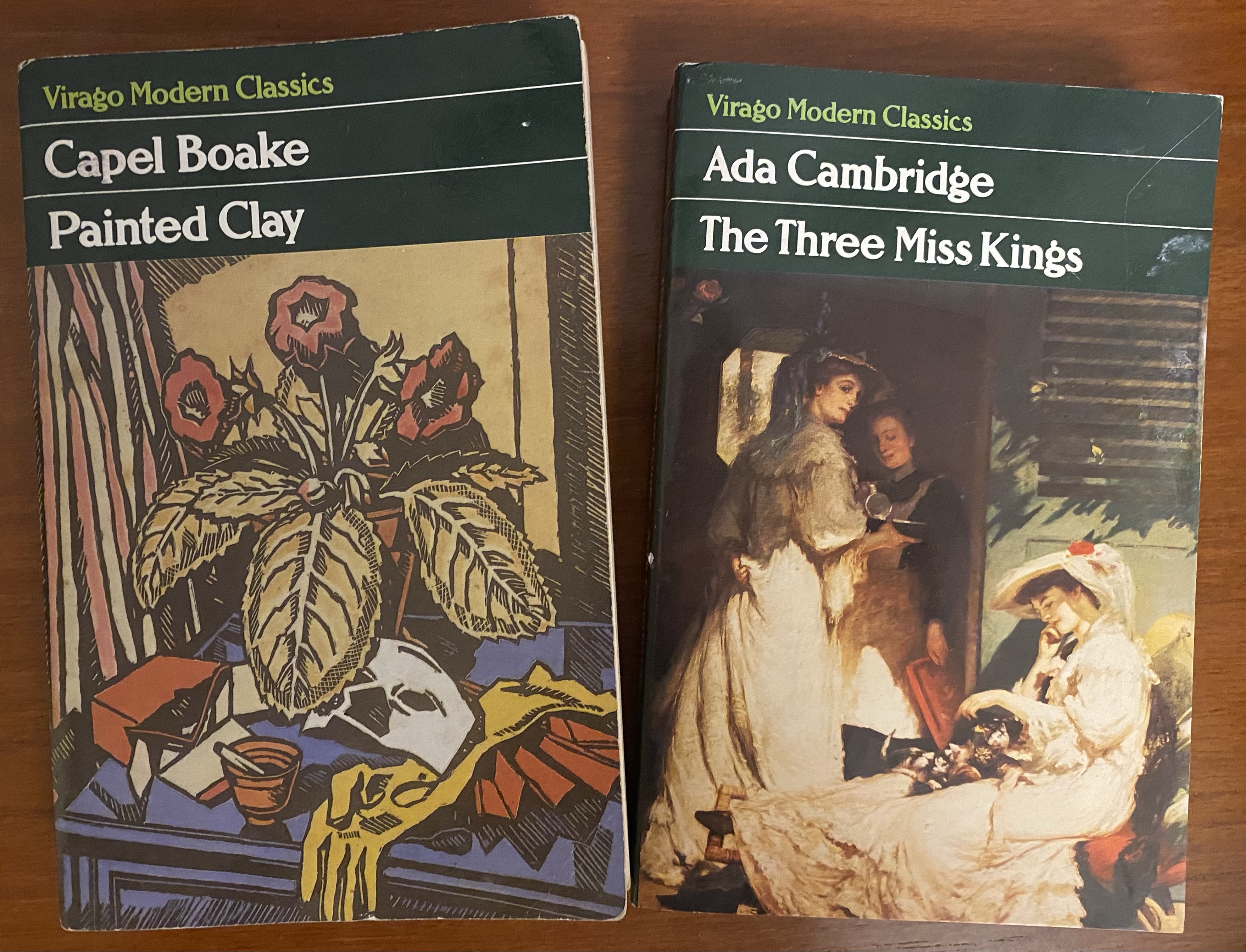
I chose two novels out of the humungous VMC pile and they both turned out to be entertaining considerations of the roles of women in late nineteenth and early twentieth century Melbourne.
In reverse chronological order, Painted Clay by Capel Boake (1917). Set in 1913-14, this coming-of-age story follows Helen Somerset as she tries to forge her own way in a society that places considerable strictures on women.
At the start of the novel, lonely and isolated Helen is only a few years older than the century, as she living in a suburb with her distant father:
“Several women had watched carefully and had made sure their curtains had not been down for months. They always took their curtains down, washed them, and put them up again, every four weeks. The end house did not do this. Therefore there must be something very wrong with the occupants of the end house.”
Determined for change, she makes overtures to the young women who live next door, and finds herself invited in. She is shy and awkward, but the family is warm and welcoming.
“She knew that if she were alone she could have carried on the most brilliant conversation with everybody, but now she seemed to have nothing to say.”
Belle is engaged to sleazy Bert, while her sister Irene moons over the picture of a matinee idol. They are full of life and show Helen another way to live. She joins Irene in working in a shop, suffering under the deliberately unpleasant work given to her by the jealous supervisor. We follow Helen from shop to office work, as she learns to wrestle with the bullying of women and the unwanted attentions of men, struggling to work out what she wants when it seems to be so different from other women her age:
“She fled from the thought of sex; it horrified her – but it came back and back. She tried to close her mind against it, but it came insistent and whispering, distorting her view of life full in despair she went to her books again.”
Helen is not a wet blanket though, or a naïve and priggish beauty which can sometimes make heroines of this era hard to warm to. She’s quite determined to live her own life, away from the life paths everyone seems to expect of her.
“Helen had a soft, but unyielding obstinacy against which all argument beat in vain.”
Things begin to change for her when she is taken into a bohemian artistic set. She falls in lust with Alick Russell, and one thing leads predictably to another … what is less predictable is Helen’s reaction to sleeping with a man outside marriage:
“She wondered why she did not grieve over it, why she was not overcome with sorrow and repentance. She puzzled over it with frowning brows, but could reach no satisfactory conclusion.”
[…]
“I can’t see the difference between being married and not. It doesn’t seem to me to matter very much, and yet it does. I wish I were either a very bad woman or a very good one. If I were a bad woman nothing would bother me, and if I were a very good woman I wouldn’t think about it. I would just be married, and that would be the end of it.”
Painted Clay is a carefully non-didactic exploration of women’s roles and choices at this moment in time. Female characters are not judged for choosing unsatisfactory marriages, when the alternative may be worse for them. Older unmarried women are not shown as leading happy lives due to how limited their choices are, yet Helen is consistent in her belief that marriage is not for her.
Although not explicit, female desire is dealt with frankly, as is the fallout from its expression – fallout which lands disproportionately on women rather than men, despite their equal involvement.
What struck me most though, was not the attitude towards female sexuality or marriage, but towards sex work. It is referred to more than once in the novel and Boake is determinedly non-judgemental of those who undertake it. There is this interview Helen undergoes with a recruiting Madam:
“Helen shook her head, ‘No’ she said. ‘I can’t.’ Her tone was final, and the woman recognised it, though she made a last effort to persuade her. ‘Why not?’ she asked.
‘I don’t know why not,’ answered Helen. ‘It’s not my way, that’s all.’”
Then later in the novel she takes a woman from the street for a hot meal:
“Helen looked round with a frown. She found that everyone in the room was staring at them. She looked at them with bitter scorn. She hated them for their smug complacency. She felt neither love, liking, or even pity for the girl she was with, but she preferred her to the smug suburban women with their intolerable air of conscious virtue.”
I expected a much more judgemental attitude for the time, and it was refreshing to have this assumption undermined. (Also on the subject of the streets – the urban setting and changing seasons are wonderfully evoked. Sadly I don’t know Melbourne but I’m sure those who do would find much to enjoy in this evocation of it in the early decades of the last century).
Painted Clay was Capel Boake’s first novel and on the strength of this I would definitely be interested in reading more. It’s not the most sophisticated novel but it’s concise, well-paced and very readable. Boake died in her 40s having published three novels (one further was published posthumously) and some poetry.
Secondly, The Three Miss Kings by Ada Cambridge (1891) which I was encouraged to take off the shelf by Emma’s escapism list. Although depicting a far more conventional life of middle-class mores and marriage than Painted Clay, The Three Miss Kings still manages to cast an askance, humorous view at late Victorian life.
At the beginning of the novel the titular heroines – Elizabeth, Patty and Eleanor – find themselves all alone in the world after their father dies.
“It was a curious position altogether. As far as they knew, they had no relations, and they had never had a friend. Not one of them had left their home for a night since Eleanor was born, and not one invited guest had slept there during the whole of that period. They had never been to school, or had any governess but their mother, or any experience of life and the ways of the world save what they gained in their association with her, and from the books that she and their father selected for them.”
Cambridge is at pains to stress the young women’s refinement and ‘breeding’ to an extremely tedious degree. However, later in the novel she stops banging on about this quite so much, which was certainly a relief, and gets on with telling an oft-told tale in a very readable way (excepting a couple of clunky passages with characters voicing long opinions on topical issues such as the role of the church).
The women travel from their rural home to Melbourne to be shocked and then embraced by city life, under the guiding light of their self-appointed guardian Mrs Duff-Scott:
“The only drawback to her enjoyment in them was the consciousness that, though they were nobody else’s, they were not altogether hers. She would have given half her fortune to be able to buy them, as she would buy three bits of precious crockery, for her absolute possession, body and soul—to dress, to manage, to marry as she liked.”
Three comely young ladies, refined of manner and naïve of just about everything – what will possibly happen? Mrs Duff-Scott has an idea, and lines up potential suitors for all of them with alarming ineptitude. I particularly enjoyed her assessment of Mr Westmoreland:
“He was the richest of them all, and the most stupid, and therefore he seemed to be cut out for Patty, who, being so intellectual and so enterprising, would not only make a good use of his money, but would make the best that was to be made of him.”
Cambridge does undermine some of the conventions she is focussing on, or at least mocks them lightly. For example, how to describe her heroines:
“like a tall lily, I feel I ought (and for a moment was tempted) to add, only that I know no girl ever did look like a lily since the world was made, nor ever will, no matter what the processes of evolution may come to.”
She’s also very pragmatic alongside the romance, such as the consideration of marrying for money:
“If these motives seem poor and inadequate, in comparison with the great motive of all (as no doubt they are), we must remember that they are at the bottom of a considerable proportion of the marriages of real life, and not perhaps the least successful ones. It goes against me to admit so much, but one must take things as one finds them.”
She even allows some feminist commentary regarding commanding male heroes:
“’Who would marry a chicken-hearted milksop if she could get a splendid tyrant like that?’ exclaimed Patty, fervently, for the moment forgetting there were such things as woman’s rights in the world.”
So although a romance in many ways, The Three Miss Kings is not unwaveringly romantic. I’ve never read Ada Cambridge before and I really enjoyed this first encounter. She brought a different voice, humour and interesting characterisation to make a familiar story include some surprises.
The story is firmly rooted in 1880 and in Melbourne, with descriptions of the International Exhibition. Melbourne Cup, public gardens, streets and crowds which were very evocative. If I’ve not said much about the plot it’s because I don’t think it’s really needed – you get the idea!
“I don’t think it is that things are going wrong, dear. It is only that we have to manage them, and to steer our way, and to take care of ourselves, and that is so trying and perplexing.”
To end, forward a century for service as usual with a 1980s pop video, from a Melbourne band:
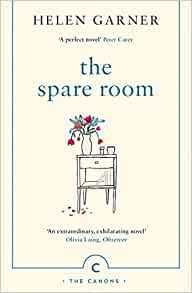
The Spare Room was on my radar for a long time before I read it, as the themes are ones that mean a lot to me. I’ve spent nearly all my working life in cancer care and palliative care in one form or another, and so a novella about a friend caring for a dying person was always going to be of interest.
It also means I’m hard to please – anything vaguely sentimental or factually inaccurate is going to annoy me. I thought Helen Garner got everything spot-on.
The novel opens with Helen preparing her spare room for a friend to stay:
“I made it up nicely with a fresh fitted sheet, the pale pink one, since she had a famous feel for colour, and pink is flattering even to skin that has turned yellowish.”
She is still shocked by Nicola’s frail appearance when she picks her up. She knows her friend has terminal cancer and is with her in Melbourne to attend an alternative clinic. However, it quickly becomes clear that Helen will provide a more involved caring role than she anticipated.
An unspoken tension between the friends is that Helen is highly sceptical of the treatments Nicola is putting her faith in:
“ ‘Don’t worry,’ she said. ‘It’s the treatments causing the pain – that’s how I know they’re working. It’s just the toxins coming out.’
[…]
I held my peace. The ozone smelt delicious, very subtle and refreshing, like watermelon, or an ocean breeze. I sat on a chair in the corner and pulled the lid off my coffee.”
Garner brilliantly captures all the negotiations that take place, the bargaining between Helen and Nicola about what is acceptable and what will not change.Helen doesn’t try to talk her friend out of the treatments that she thinks are a total swizz, but she does try and get her to accept pain relief. Nicola flatly refuses to see the palliative care team – who would support Helen in such a physically and emotionally stressful situation – because she associates them with giving up.
“What was all this anger? I needed to be kinder to her. Dying was frightening. But it was easier to imagine being tender when I had a packet of slow-release morphine capsules in my bag.”
Nicola doesn’t recognise the immense pressure she puts on Helen, and on other friends, by expecting them to care for her as she refuses statutory care services. The story is compassionate to all involved, showing the immense love the women have for one another, and how this can sit alongside selfish actions. Neither Helen or Nicola are self-sacrificing angels, quietly enduring the unendurable. Instead they are kind, funny, angry, confused and scared – recognisably human.
“I longed to slip her shoes off, to draw a cotton blanket over her. But was scared to touch her. I was afraid of her weakness, afraid of her will. So I stepped out of the room and closed the door behind me.”
It’s such an impressive achievement by Garner to capture a complex emotional story without minimising it or retreating into cliché and sentiment. The Spare Room is a truly affecting exploration of death and dying. It shows how grief begins before the person dies, and the pain and joy that can exist alongside each other in such moments.
“Oh, I loved her for the way she made me laugh. She was the least self-important person I knew, the kindest, the least bitchy. I couldn’t imagine the world without her.”
I’ve not done too badly with contributing to November’s plethora of reading events, despite my snail-like reading speed. Unfortunately I’m not going to manage a #MARM post, but I did find a short novel by an Australian author to squeeze in, so here on the final day of the month is my hastily written contribution to AusReadingMonth hosted by Brona at This Reading Life. At 204 pages it is just a teeny bit too long to count for #NovNov though…
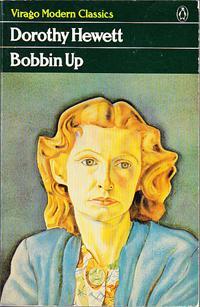
I went into Bobbin Up by Dorothy Hewett (1958) with quite low expectations, set by the author herself 😀 In her introduction to my 1985 VMC edition, she explains “looking back on the 36-year-old Communist who wrote Bobbin Up, I am embarrassed by at her proselytising, stubborn blindness, this Antipodean Alice in Wonderland who had a protracted love affair with an idealised working class.”
However, she also acknowledges: “Sometimes sentimental, sometimes didactic, sometimes clumsy and overwritten Bobbin Up was the work of a still young writer struggling to find her own style and voice. Its form, which was criticised at the time as too episodic, seems to me to suit the subject perfectly”
As a middle-class woman who chose to work in a factory and then write about it, I was put in mind of Nell Dunn. While both authors are open to accusations of class tourism and exploitation, I think they wrote with the best of intentions, attempting to shine a light on ignored and marginalised female workers. The novels are sixty or so years old, and these days we understand allyship differently.
These disclaimers out the way, I really enjoyed Bobbin Up. I thought it was stronger than Hewett suggested and was a compassionate portrait of the lives of women on low incomes in 1950s Sydney. Although she sets in the fictional Jumbuck Woollen Mills, the frequent references to songs playing on the radio and the sputnik gliding overhead root it firmly in a specific time.
Hewett captures the work environment in broad strokes before focussing in on particular workers:
“Women came in from everywhere, laughing and chiacking down the long, slippery aisles between the rovers, spinners, and winders. Relief healed their aching backs, relief loosened their tongues, they ran and pushed and scurried, jamming into the washroom, five minutes to change and scrub up and catch the bus to Redfern, Marrickville, Paddo, Woollahra and all points north, south, east and west.”
Their lives are hard and the women’s bodies are broken by tough, unrelenting work.
“Violet McHendry, forty-five, sharped tongued, hard as nails, was always fighting a losing battle with life in the grey, warped, weatherboard semi in Maddox Lane. But she still kept, until the day she died over her washtubs, ten years later, that peculiar girlishness, that grace of face and voice, that has nothing to do with time.”
The best time they can hope for is when they are young, still fit and might have some energy to enjoy the times when they’re not at work.
“[Beth] passed proudly and yet compassionately, conscious of her youth and motherhood. The old men stared after her, jealous of the radiance they could never share again, loafing on borrowed time, unwanted, under the dapple of poplar trees.”
There is domestic violence, self-medicating with alcohol, sixteen-year-olds being told they’ll be raped if they ‘lead men on’. But also some tender relationships, resilience and hope.
“Upstairs Lil had a view. Across the crooked slate and corrugated iron roofs of Waterloo and Redfern the Housing Commission flats stood out like a dream of luxury amidst green lawns. The sunlight slanted golden against their solid brick walls, a rainbow of mist from their water sprinklers circled them with enchantment.”
For Nell, the committed communist (presumably based on Hewitt, and she does seem to make her the most self-critical character), the hope is for a better society:
“Everything fell into place like the pieces in a jigsaw puzzle, and the best part of it was she knew she had always been right. There was something more than the narrow, bitter, cranky world she’d been reared in. There was another world to be built, here on earth, based on the kind of brotherhood and selflessness and energy she’d seen displayed long ago in the strike in the textile mills.”
I do agree with Hewett that Bobbin Up is somewhat overwritten and clunky in places, but it wasn’t particularly torturous. Amidst the bleak subject matter, it balanced the story somewhat, without obscuring the difficulties the women face.
“You could never be lonely in Waterloo, always conscious of the myriad lives woven and interwoven with your own, breathing, battling, loving, fighting, suffering in the stifling summer dusk.”
To end, a song about the charms of women who work in factories:
I’m not a big follower of book prizes although I like the Bailey’s Prize and usually try & read the Booker winner. However, the annual Stella Prize, which started in 2013 and awards outstanding Australian women’s writing, has lists which always look fascinating and wide-ranging. Currently the 2018 long list has been announced and the shortlist will be revealed on International Women’s Day, 8 March. I hadn’t read any of the winners and obviously this enormous oversight needed correcting. Also, Kate at Booksaremyfavouriteandbest’s wonderful reviews of the last two winners convinced me I needed to rectify this sooner rather than later.
The 2017 winner was The Museum of Modern Love by Heather Rose. You can read Kate’s review here. It is an extraordinary novel, centred around the real-life event of The Artist is Present by Marina Abramovic, a 2010 performance art installation at MoMA in New York, which you can read about here.
Arky Levin is a film score composer, estranged from his wife and devoted to the city:
“When he moved to New York… and found the stars in their gaping darkness were nowhere to be seen, eclipsed by SoHo apartments and Midtown high-rises, Chinatown neons and flashy Fifth Avenue commercial buildings…he felt he had won. That humanity had won. New York was brighter than the universe bearing down on them. For this alone he had decided that he could live here forever and entirely expected to.”
Arky attends the installation for each of the 75 days it is in situ, and during this time he witnesses the profound effect the installation has on people. Marina sits one side of a table, and the public volunteers sit opposite her one at a time, gazing into her eyes. They can stay for as little or as long as they want, but they must make eye contact.
“Here in New York, where time was everyone’s currency, and to gaze deeply into the face of another was possibly a sign of madness, people were flocking to sit with Marina Abramovic. She wasn’t so much stealing hearts, he thought, as awakening them. The light that came into their eyes. Their intelligence, their sadness, all of it tumbled out as people sat.”
Such a simple but incredibly powerful idea, and the installation was a smash hit. Similarly, Rose uses a simple writing style to explore massive themes: love in many guises, loss, art, the desperate need for meaning in life and how we locate it. Arky learns about other and himself simply by sitting and watching the installation.
“Art will wake you up. Art will break your heart. There will be glorious days. If you want eternity, you must be fearless.”
The Museum of Modern Love, as the title suggests, is a love story, but not in the traditional sense. It is not a romance between two people. Instead it is a love story about people and all they can give to one another, as lovers, friends, relatives, artist and spectator. It is life-affirming without being sentimental. Rose acknowledges there is pain for people, but suggests that we have to get out there anyway, engage in acts of love in a myriad of ways, find connection and transcend.
“She was watching Marina Abramovic in her white dress on this final day of her enduring love. For hadn’t it been that for Abramovic? An act of love that said, This is all I have been, this is what I have become in travelling the places of my soul and my nation, my family and my ancestral blood. This is what I have learned. It is all about connection. If we do it with the merest amount of intention and candour and fearlessness, this is the biggest love we can feel. It’s more than love but we don’t have a bigger word.”
And here she is, on the last day, in the white dress:
In 2016 the winner was The Natural Way of Things by Charlotte Wood. You can read Kate’s review here. I wish I’d read The Museum of Modern Love after this, as it would have been a good aid to recovery. The Natural Way of Things is brutal, shocking, urgent and without doubt one of the most powerful books I’ve read in recent years. It has absolutely stayed with me.
A group of young women are kidnapped and held hostage in a large, bleak piece of land in the outback, surrounded by an electric fence. There is no escape, and gradually they realise no-one is coming for them.
“Nobody knows. They have been here almost a week. Nobody has come, nothing has happened but waiting and labour and dog kennels and DIGNITY & RESPECT and beatings and fear and a piece of concrete guttering, and now perhaps infection is coming too.”
Gradually it emerges that all the women have a sex scandal in their past. These are never fully explained but enough information is given for the reader to realise that in each case, the power lay with the men involved, and in each case, the women are the vilified parties. Possibly they have been taken by a moral fanatic, who we never see. Their heads are shaved, their clothes taken and replaced with basic garments, including Handmaid’s Tale style bonnets, which come to represent both a coping mechanism and gradual institutionalisation for some of the captives:
“they depend on them for the snug containment of their heads, covering their ears, the obscured vision. Verla can understand it, though only from a distance. She used to hold them in contempt for keeping the bonnets; not anymore. But still, for her herself, that limp, stinking thing felt more like a prison than this whole place.”
As food supplies dwindle and illness threatens, the women fight for survival in their various ways. Their jailers are pathetic and inept, but also men and they hold the power.
“He frowns down and Verla knows he is thinking ugh at the two filthy girls, that he is freshly fearful of the lice eggs in their matted hair, of Verla stretched white with illness, of Yolanda and her rusted weaponry. He fears their thin feral bodies, their animal disease and power.”
The Natural Way of Things is about how society figures men and women, where power lies, how that is wielded and how predator and prey lies barely concealed in human relationships. It is beautifully written, perfectly paced, and absolutely terrifying.



 madame bibi lophile recommends