“Words burst forth, recognised at last, while underneath other silences start to form.” (Annie Ernaux, The Years)

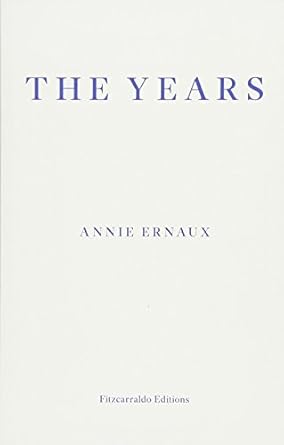
#ReadIndies is running all month hosted by Kaggsy and Lizzy and it has meant I’ve finally got to a book that I’ve been meaning to read for ages: The Years by Annie Ernaux (2008, transl. Alison L. Strayer 2018) published by Fitzcarraldo Editions.
A further incentive was that I really want to see the theatre adaptation which is currently running, and now I’ve read the book I have bought my ticket 😊

The Years is a book which deliberately avoids categorisation. Told in chronological order from 1941 to 2006 but in a fragmentary style, it is a memoir/autobiography/autofiction where Ernaux never uses the first person. She refers to ‘she’ for the more personal memories triggered by photographic images, and ‘we’ for considerations of the society and cultural influences experienced by ‘she’ at the time.

Growing up, she is aware of the poverty of her family, and dreams of escape. Ernaux captures so well the confusion of trying to find an authentic escape, trying to determine what she truly wants, alongside what advertising tells her she wants:

“Meanwhile, as we waited to be old enough to wear Rouge Baiser lipstick and perfume by Bourjois with a j as in joy, we collected plastic animals hidden in bags of coffee, and from Menier chocolate wrappers, Fables of La Fontaine stamps that we swapped with friends at break time.”

“It seems to her that education is more than just a way to escape poverty. It is a weapon of choice against stagnation in a kind of feminine condition that arouses her pity, the tendency to lose oneself in a man.”

There are strong feminist themes running throughout The Years, as she grows up on the brink of societal change. At the start:

“Nothing, not intelligence, education, or beauty mattered as much as a girl’s sexual reputation, that is, her value on the marriage market, which mothers scrupulously monitored as their mothers had done before them.”

Yet the 1960s are on their way… Ernaux pulls no punches in detailing the tyranny of menstrual cycles, and of “kitchen table abortions” before the contraceptive pill arrives and pregnancy terminations are legalised.

“Between the freedom of Bardot, the taunting of boys who claimed that virginity was bad for the health, and the dictates of Church and parents, we were left with no choices at all.”

The Years is lightened by humour too, such as this wry observation regarding her young feminist:

“Two future goals coexist inside her: (1) to be thin and blonde, (2) to be free, autonomous, and useful to the world. She dreams of herself as Mylène Demongeot and Simone de Beauvoir.”

The Years is a powerful evocation of a woman’s life at a specific time. Ernaux demonstrates so clearly how lives are bound up with the culture and the wider political forces in which they take place. It is impossible to consider the life in The Years without considering France in the same period. Yet this is an observation which occurs as she looks back, not at the time:

“Between what happens in the world and what happens to her, there is no point of convergence. They are two parallel series: one abstract, all information no sooner received them forgotten, the other all static shots.”

But as she grows older:

“What is most changed in her is the perception of time and her own location within it.”

And yet,plus ca change plus c’est la même chose, as Ernaux notes consumerism and its false promises endure:

“More than a sense of possession it was this feeling people sought on the shelves of Zara and H&M, instantly granted upon acquiring things, a supplement of being.”

The fragmentary style in The Years is perfect example of an experimental style being grounded by the story it wishes to tell, rather than being employed just for the sake of being different or to demonstrate the author’s cleverness. It conveys the experience of memory as well as the memories themselves. As a reader you are drawn into the layering of images, feelings and experiences in such a direct and immersive way, with all the intimacy of a first-person narrative despite the fact that Ernaux never articulates ‘I’.

“Everything will be erased in a second. The dictionary of words amassed between cradle and death bed, eliminated. All there will be is silence and no words to say it. Nothing will come out of the open mouth, neither I nor me. Language will continue to put the world into words. In conversation around a holiday table, we will be nothing but a first name, increasingly faceless, until we vanish into the vast anonymity of a distant generation.”

“The house allows one to dream in peace.” (Gaston Bachelard)

November is full of wonderful reading events and I’ve been through the TBR pulling out possibilities for Novellas in November, German Lit Month, Margaret Atwood Reading Month and AusReading Month. Given my current reading and blogging pace it’s highly unlikely that I’ll manage them all, but I’m starting today with a post for Nonfiction November hosted by Doing Dewey.

In many ways this is the least likely of all the events for me to take part in, as I read practically no nonfiction. However, last year I read the first two in Deborah Levy’s ‘living autobiography’ trilogy and absolutely loved them.  The bibliophile’s crack-den that is the charity bookshop across the road from my flat never lets me down, and when saw the third instalment in there recently of course I swooped.

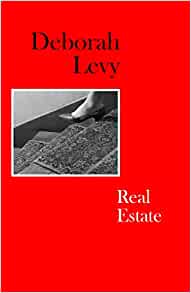
Real Estate (2021) sees Levy still living in the flat she moved to when her marriage ended, but as her children leave for university and beyond, she is trying to work out what makes a home, and whether she wants one.

“I was also searching for a house in which I could live and work and make a world at my own pace, but even in my imagination this home was blurred, undefined, not real, or not realistic, or lacked realism. I yearned for a grand old house (I had now added an oval fireplace to its architecture) and a pomegranate tree in the garden. It had fountains and wells, remarkable circular stairways, mosaic floors, traces of the rituals of all who had left there before me. That is to say the house was lively, it had enjoyed a life. It was a loving house.

[…] The odd thing was that every time I tried to see myself inside this grand old house, I felt sad.”

The themes from The Cost of Living and Things I Don’t Want to Know continue, as Levy considers how to live in a way that supports her work and enables her to authentically create her own space in middle-age, in a society that undervalues ageing and especially ageing women.

In Real Estate Levy is looking at the spaces she creates both internally and externally, and the challenge to have both reflecting and supporting the other.

“An extended family of friends and their children, an expanded family rather than a nuclear family, which in this phase of my life seemed a happier way to live. If I wanted a spare room for every friend, my flat could not support this idea. If I wanted a fireplace in every room, there were no fireplaces in my flat. So what was I going to do with all this wanting?”

She takes a fellowship in Paris for a while, living in an apartment she barely furnishes, knowing it will be transitory and focussing on her work. She visits Berlin and Mumbai and holidays in Greece. The various changes of scene don’t enable Levy to reach any conclusions about where to live, or how to reconcile her desires and needs with the practicalities entailed in bricks and mortar. But that’s not the point of these exploratory, reflective living autobiographies. Perhaps the point is that there is no answer – as we evolve and change, so do our needs, and perhaps so does the best place for us to be.

With this volume as with the previous two, Levy is a witty and challenging writer, so much fun while not shying away from serious issues and a strong feminist sensibility:

“Are women real estate owned by patriarchy?… Who owns the deeds to the land in that transaction?”

I particularly enjoyed this encounter at a literary party which she gatecrashes in London:

“A male writer of some note, but not in my own hierarchy of note, had knocked back a few too many gin cocktails. This liberated his desire to find a female writer in the room to undermine […] The truth was that he viewed every female writer as a sitting tenant on his land.”

Real Estate has been marketed as the final volume of Levy’s living autobiography and I really hope that’s not the case. She’s wonderful company.

To end, my own perennial real estate quandary is: do I leave my little London flat for somewhere cheaper so I can have a garden? I’ve been debating this for years and I will leave in the end, but here’s a warning about the perils of leaving London for a trip to the Home Counties (a bit sweary so do avoid if you’re not keen, but the lyric ‘Could you be my big spoon or are you just a bigot in Wetherspoons?’ meant I really wanted to share 😀 )

“A tree’s wood is also its memoir.” (Hope Jahren)

This week I’m joining in with Nonfiction November hosted by What’s Nonfiction. Despite not being a big non-fiction reader, I’ve been inspired by the month long event and also by Novellas in November, hosted by Cathy at 746 Books and BookishBeck. So I’m reading some short nonfiction to take part in both at once 😊

I’ve really enjoyed the novels by Deborah Levy that I’ve read: Swimming Home and Hot Milk. The first two volumes of her ‘living autobiography’ have been languishing in the TBR, so I’m grateful these two reading events prompted me to pick them up.

The first volume, Things I Don’t Want to Know (2013, 163 pages) is a response to George Orwell’s essay Why I Write, using the same headings (political purpose/historical impulse/sheer egoism/aesthetic enthusiasm). However, I think it’s also very much in conversation with Virginia Woolf’s A Room of One’s Own, as Levy considers what it means to be a professional writer for women in the twenty-first century.

“A female writer cannot afford to feel her life too clearly. If she does, she will write in a rage when she should write calmly.”

Yet the ‘living autobiography’ is written in the midst of events, without the distance of hindsight. This means the writing has an immediacy and is highly engaging, but there is also the discipline and consideration that comes from Levy being such a highly skilled writer.

The two sections that bookend the essay see Levy in Majorca at a time when she is deeply unhappy, finding herself crying on escalators. She escapes to Palma to think about her life, and also her art and the influence of other female artists. With Zofia Kalinska she observes:

“Content should be bigger than form – yes, but that was a subversive note to a writer like myself, who had always experimented with form, but it is the wrong note for a writer who has never experimented with form.”

While Things I Don’t Want to Know doesn’t follow a usual form for essay or memoir – it’s non-linear, never sets out a clearly-stated argument and hops between memories and broader observations – the content does remain bigger than form, because Levy’s observations are so sharp and her memories clear-sighted and unsentimental.

If I’m making this sound very heavy then I’m doing Levy a disservice, because she is humorous and has a wonderfully light touch. For example, she repeatedly returns to Duras in her artistic considerations, but wonders:

“Was Marguerite Duras suggesting that women are not so much a dark continent as a well-lit suburb?”

There is a strong feminist sensibility that runs throughout Things I Don’t Want to Know. In responding to Orwell, Levy highlights the very different experience of trying to work alongside the particular expectations and responsibilities faced by many women.

“We were to be Strong Modern Women while be subjected to all kinds of humiliations, both economic and domestic. If we felt guilty about everything most of the time, we were not sure what it was we had actually done wrong.”

In the Historical Impulse section, Levy reflects on her childhood in South Africa, where her father was imprisoned for being part of the African National Congress. As a child much of what is happening goes over her head though she also picks up on plenty; I found her portrait of her godmother’s daughter (who has to hide her relationship with her Indian boyfriend) very affecting:

“Melissa was the first person in my life who had encouraged me to speak up. With her blue painted-on eyes and blonde beehive that was nearly as tall as I was, she was spirited and brave and making the best of her lot. I couldn’t hear her but I knew her words were to do with saying things out loud, owning up to the things I wished for, being in the world and not being defeated by it.”

In the Sheer Egoism section, Levy moves to England with her family, and starts scribbling on paper napkins in cafes, not sure what she is doing but certain she has to write.

“Writing made me feel wiser than I actually was. Wise and sad. That was what I thought writers should be. I was sad anyway, much sadder than the sentences I wrote. I was a sad girl impersonating a sad girl.”

The Cost of Living sees Levy leaving her marriage and moving into a flat with her daughters. We learn very little about her husband or her marriage – which I was quite happy about – and instead Levy takes us with her as she considers what she wants from life and how she wants to live.

“Chaos is supposed to be what we most fear but I have come to believe it might be what we most want.”

The flat is not glamorous – visitors are creeped out by the communal areas Levy nicknames The Corridors of Love. She buys some plants, fixes her own plumbing, and works to her own hours.

“After all the heavy lifting, it was shock to be figuring out how to land the cadence of one single sentence”

Levy does not give the impression of being happy – she is grieving the breakdown of her marriage and she is very aware that she has not taken the easy choice – but she is living authentically. It is more sustainable and rewarding than fleeting happiness.

“To become the person someone else had imagined for us is not freedom – it is to mortgage our life to someone else’s fear.”

The strong themes of feminism, womanhood and the life of a writer established in Things I Don’t Want to Know continue through this volume. Levy has left behind the roles of Wife and Homemaker. She remains a mother but her children are older and don’t need her quite as they did.

“It was possible that femininity, as I had been taught it, had come to an end. Femininity, as a cultural personality, was no longer expressive for me. It was obvious that femininity, as written by men and performed by women, was the exhausted phantom that still haunted the early twenty-first century.”

Levy is a daughter and the section about her mother dying is very moving. She is also a friend and therefore not alone: her friend Celia helps her by providing the writing shed where her late husband (the poet Adrian Mitchell) used to work. Levy writes there trying to stay warm and listening to apples thud onto the roof.

At no point is The Cost of Living didactic. Levy doesn’t suggest for one moment that anyone should make the same choices she has. The title is literal and metaphorical: she has to work to earn money as this is a very real concern, but simultaneously to feel she is truly living there has been the cost of her marriage. All choices bring associated costs.

But with the right choices those costs are price worth paying. Levy is living her truth, has friends and fun, and she finds great meaning in her work:

“It is always the struggle to find language that tells me it is alive, vital, of great importance.”

I really loved both these volumes. Levy is so wise, funny and readable. She is never boring or pedestrian. The interesting choices she has made in life are reflected in the engaging choices she makes with her writing. I’m looking forward to reading the third volume of these memoirs, Real Estate, which was published this year.

To end, a song about a woman assessing her life choices:

“Mancestre….is the fairest, best buildied, quikkest and most populus Tounne of al Lancastreshire” (John Leland, 1538)

The final part of my cities trilogy of posts sees me in Manchester, a place that has made worldwide news in recent times for the most tragic of reasons. I saw the floral tributes when I was there and it was deeply moving. Manchester is a great city with a rich history & I still think that even though it bucketed with rain the whole time I was there and I spent every moment on a spectrum of sogginess, never entirely dry. If any of you go to this fine place before 28 August I highly recommend Shirley Baker’s photographs at the Manchester Art Gallery; her images of Mancunians in the late 1960s-early 70s are absolutely wonderful.

Image from here

From the TBR mountain I’ve chosen two autobiographies, one from a writer born in Manchester, and one who has now made Manchester their home. Firstly, the classic Confessions of an English Opium Eater by Thomas de Quincey (1821). De Quincey was born in Manchester to a family of cloth merchants when Manchester was a major industrial centre for the cotton industry.

“On passing through Manchester, I was informed by several cotton manufacturers that their workpeople were rapidly getting into the practice of opium-eating; so much so, that on a Saturday afternoon the counters of druggists were strewed with pills…in preparation for the known demand of the evening. The immediate occasion of this practice was the lowness of wages, which at that time would not allow them to indulge in ale or spirits, and wages rising, it may be thought this practice would cease; but …I do not readily believe that any man having once tasted the divine luxuries of opium will afterwards descend into the gross and mortal enjoyments of alcohol.”

Yes, opium (laudanum) was legal and widely used at this time. DeQuincey suffers with excruciating stomach pains due to childhood poverty and starvation, and a well-meaning friend suggests he try opium to ease his what ails him:

“I took it – and in an hour – oh, heavens! What a revulsion! What an upheaving, from its lowest depths, of inner spirit! What an apocalypse of the world within me! That my pains had vanished was now a trifle in my eyes: this negative effect was swallowed up in the immensity of those positive effects which had opened before me – in the abyss of divine enjoyment thus suddenly revealed.” *

The record of positive experiences with opium meant Confessions was controversial on its release. But DeQuicey does not glamourise the drug nor his experience with it. After all, people wouldn’t get addicted to something which made them feel horrible, and DeQuincey is seeking to make people understand. He doesn’t shy away from all the effects of the drug, and his hallucinations under its influence are grim:

“I was kissed, with cancerous kisses, by crocodiles; and laid, confounded with all unutterable slimy things, amongst reeds and Nilotic mud.”

Overall, the feeling I was left with from this short biography was one of sadness. DeQuincey is ruled by something far more powerful than he is, and the sense is of a life half-lived, a life DeQuincey wishes had been different. He has a fatal flaw:

“I hanker too much after a state of happiness, both for myself and others; I cannot face misery, whether my own or not, with an eye of sufficient firmness”

And opium convinces him that this state is achievable. In so desperately wanting to believe this lie, DeQuincey is never able to shake free of his addiction. At the beginning of the novel he proclaims:

 “I have at length accomplished what I never yet heard attributed to any other man – have untwisted, almost to its final links, the accursed chain which fettered me.”

But modern readers will know he never did accomplish this, and remained addicted his entire life. Confessions is very readable, much more so than other essays and similar of the period, and remains a thought-provoking insight into the nature of addiction.

Secondly, Red Dust Road by Jackie Kay (2010), a Scottish writer who has settled in Manchester and is the current Scots Makar.  If Confessions left me feeling sad, Red Dust Road left me feeling warmed and moved, although it is not a comfort read. It is the story of Jackie Kay’s search for her birth parents, and like her other writing – poetry, fiction, short stories, children’s books – it is funny and affectionate and real and sad.

“the search is often disappointing because it is a false search. You cannot find yourself in two strangers who happen to share your genes. You are made already although you don’t properly know it, you are made from a mixture of myth and gene, you are part fable, part porridge. Finding a strange, nervous, Mormon mother and finding a crazed, ranting Born-Again father does not explain me. At least I hope not!”

That passage occurs near the start of the book, and so it is not a spoiler.  We know Jackie finds her birth parents. What she does, expertly, is cut back and forth in time to show what has made her what she is. Raised in Glasgow by a white couple, Jackie and her (non-biological) brother are mixed race. Growing up in the 70s and 80s they encounter racism (there is a particularly chilling experience for teenage Jackie at Angel tube station).  They also encounter a wonderful, unconditional love from their parents who are communists with a strong sense of right and wrong and a strong sense of fun. (Seriously, Helen and John Kay sound awesome.) While her brother has no interest in finding his biological parents, Jackie finds that falling pregnant with her own son spurs her on to trace her relatives. She discovers that her father was a Nigerian student who met her mother in Aberdeen when she was a nurse. Along the way, she has to pick apart the fairytales she has told herself about them since childhood, and the reality of who they are:

“they are ghosts one minute haunting the city of stone, and ordinary people the next. It is impossible to sustain them, or maintain them. I take another swig of gin. It is time to let them fend for themselves. It is time to let them go. They need to grow up, those young parents. They need to grow up because they are already old, and so am I.”

Red Dust Road is a hugely engaging memoir, full of warmth for all her family and written with humour without shying away from sadness. Ultimately it is a book about what makes us who we are, and how some of it is easy to pinpoint, some of it impossible to fully fathom. It is also about finding home, and how that can be in several places. Jackie Kay has a strong Scottish identity, lives in Manchester, and then visits Nigeria for the first time:

“The earth is so copper warm and beautiful and the green of the long elephant grasses so lushly green they make me want to weep. I feel such a strong sense of affinity with the colours and the landscape, a strong sense of recognition. There’s a feeling of liberation, and exhilaration, that at last, at last, at last I’m here.”

I highly recommend Red Dust Road. Jackie Kay has brought her poetic sensibility to write a glorious memoir about how ourselves, our families and our homes are always an unpredictable work in progress.

To end, a classic song by a classic Manchester band:

*Just say no, kids

“All women become like their mothers. That is their tragedy. No man does. That’s his.” (Oscar Wilde)

I inherited all the great loves of my life from my mother: literature, the theatre, film, Islay single malt whisky, and cheese that will blow out your nasal passages from 50 metres. We don’t agree on everything: Kris Kristofferson remains an enduring source of contention (me: total  1970s love god, have you seen A Star is Born? She: eyes are too small. Neither of us is willing to back down.) These enormous differences aside, we get on pretty well, and so Mother’s Day is a source of celebration in my family.  In the UK Mother’s Day is 10 March (for once I’ve managed to post on time, in fact a day early as tomorrow will be spent cooking up a feast for the family), so to any of you who aren’t from the UK, Ireland or Nigeria (ie where Mother’s Day is the 4th Sunday in Lent), I apologise and ask that you view this as a postponed/pre-emptive post depending on when Mother’s Day occurs for you. I’ve chosen one book written about a mother from the point of view of a child, and one written from a mother to her child.  Both merge fiction with biography and contain significant sadness, but both are about the triumph of the human spirit. Well, mother-child relationships can be among the most complex…

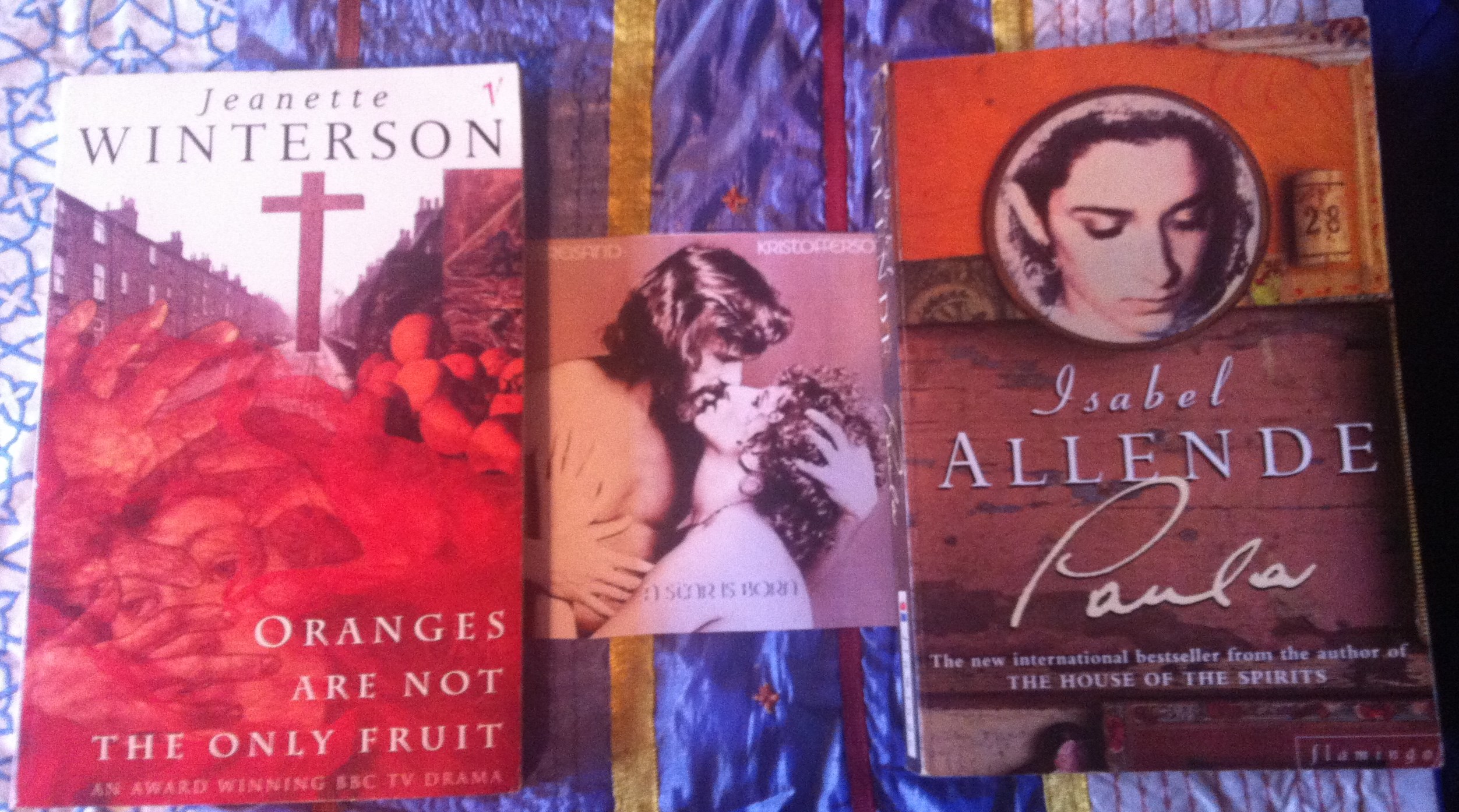
Firstly, a novel that my English teacher at school thought was very nearly perfectly written: Oranges Are Not the Only Fruit by Jeanette Winterson (1985, my copy Vintage, 1991).  Oranges tells the story of Jeanette, who grows up in an evangelical household in the north of England.  Her mother is a strong, dominant and domineering woman who initially believes Jeanette will help her in her idiosyncratic crusade against sin.  As Jeanette gets older, she realises she is attracted to women, and acts on this.  Her refusal to subdue who she is to the will of her mother leads to a failed religious intervention (almost exorcism) and eventually a breakdown in their relationship.  If this sounds utterly heavy and depressing, let me assure you it’s not.  Humour runs throughout the whole of Oranges, a gentle prodding at the absurdity of life:

““You can always tell a good woman by her sandwiches,” declared Pastor Finch.

My mother blushed.

Then he turned to me and said, “How old are you, little girl?”

“Seven.” I replied.

“Ah, seven,” he muttered. “How blessed, the seven days of creation, the seven branched candlestick, the seven seals.”

(Seven seals? I had not yet reached the Revelation in my directed reading, and I thought he meant some Old Testament amphibians I had overlooked….)

…”Yes,” he went on, “how blessed,” then his brow clouded. “But how cursed.” At this word his fist hit the table and catapulted a cheese sandwich into the collection bag;”

The narrative is interspersed with a fairytale that echoes the main narrative. This serves to broaden the perspective away from its immediate setting, and emphasise that while it is a unique story that is being told, it is also something familiar to us all, a fable.  We may not all be northern English, evangelical Christian and gay, but, in the words of the author:

“Everyone, at some time in their life, must choose whether to stay with a ready-made world that may be safe but is also limiting, or to push forward, often past the frontiers of commonsense, into a personal place, unknown and untried.”

Oranges is fantastically well written (when the author was just 24) and succeeds in being challenging and complex, but also easy to read and reassuring.  The language is poetic and exacting but never overblown:

“We lived in a town stolen from the valleys, a huddled place full of chimneys and little shops and back-to-back houses with no gardens. The hills surrounded us, and our own swept out into the Pennines, broken now and again with a farm or a relic from the war. There used to be a lot of old tanks but the council took them away.”

Oranges is one of my favourite books by one of my favourite authors and so of course, I highly recommend it.  The author was asked if it was autobiographical.  Her answer: “No not at all and yes of course.”  For those of you who enjoy it, I also recommend Why Be Happy when you Could Be Normal?,  Jeanette Winterson’s autobiography, (the title taken from a question her mother asked her when she came out) which shows the story behind Oranges, and also beyond it.

Secondly, Paula by Isabel Allende (1994, my copy Flamingo, 1995 trans. Margaret Sayers Peden). Tragically, in 1991, Isabel Allende’s 28 year old daughter Paula fell into a coma caused by porphyria, and died in 1992 having never recovered. Paula is the story Allende writes for her daughter as she waits for her in the hospital, bringing her novelist’s sensibilities to the story of her family’s life:

“Listen, Paula. I am going to tell you a story, so that when you wake up you will not feel so lost. The legend of our family begins at the end of the last century, when a robust Basque sailor disembarked on the coast of Chile with his mother’s reliquary strung around his neck and his head swimming with plans for greatness.”

Those of you who enjoy Allende’s fiction will find the same style here, and some very recognisable characters from The House of the Spirits. Allende writes vividly and with love of and for her family past and present.

“[Your grandmother] was drinking cheap pisco, and hiding the bottles in strategic places.  You Paula, who loved her with infinite compassion, discovered the hiding places one by one and without a word carried off the empty bottles and buried them amongst the dahlias in the garden.”

“Celia and Nicolas have asked me to come home to California for the arrival of their baby in May. They want me to take part in the birth of my granddaughter; they say after so many months of being exposed to death, pain, farewells, and tears, it will be a celebration to welcome this infant as her head thrusts into life. If the visions I had in dreams come true, as they have in other times, she will be a dark-haired, likeable little girl , with a will of her own. You must get better soon, Paula, so you can go home with me and be Andrea’s godmother.”

Time is not linear or earthbound in Paula, as the family’s past, present and spirits all exist in a mother’s story, evoked in a hospital room. The final third of the book sees Allende stop talking to Paula and instead speak to the reader, as she loses hope that her daughter will recover.   However, the death of her daughter is not an irretrievable loss for Allende who has an acute awareness of the afterlife and sees her family around her whether they are alive or dead.

“She died in my arms, surrounded by her family, the thoughts of those absent, and the spirits of her ancestors who had come to her aid. She died with the same perfect grace that characterised all the acts of her life.”

Paula is a hugely affecting narrative of one of the hardest experiences a mother can live through, but ultimately the enormity of the familial love that surrounds Paula is the strongest force, and this makes it a great Mother’s Day read.

Here are the books alongside the gorgeous Kris.  To my mother I say, Happy Mother’s Day, Maman, and I hope titling this post with a quote from your beloved Oscar compensates for my insistence on presence of Mr Kristofferson.  And yes, I am planning a substantial cheese plate for the meal tomorrow, don’t worry….

Image