“Women are most fascinating between the ages of 35 and 40 … Since few women ever pass 40, maximum fascination can continue indefinitely.” (Christian Dior)

On Saturday I had a BIG birthday.

Why thank you, Mr DiCaprio. Yes, ‘twas the big 4-0 for me so this week I’m looking at one book written in 1977 and one book set in 1977. What they’ve taught me about the year of my birth is that much as nostalgia-fest programmes will try and convince me I was born into a glittery glam-rock utopia:

In fact I was born into a post-colonial nightmare of racism and corruption. 1977 was rubbish.

1977: a year so bad even Christoph Waltz looked like this

Firstly, the novel written in 1977, Petals of Blood by Ngugi wa Thiong’o, a damning indictment of the legacy of colonialism and political corruption. Set in Kenya not long after independence from the British in 1964, it is one more stop on my Around the World in 80 Books Reading Challenge, hosted by Hard Book Habit. It tells the story of Munira, a teacher; his friend Abdulla, a shopkeeper; Wanja, a barmaid and object of Munira’s affection; and Karega, a young man who wants to know about Munira’s history of school strikes and acts as the voice of communist ideals in the novel. All have moved to the remote village of Ilmorog to try and come to terms with the fallout from the Mau Mau war and build a life for themselves in the new republic.  The title image recurs throughout the story. At its earliest point it is voiced by a child in Munira’s class:

“ ‘Look. A flower with petals of blood.’

It was a solitary red beanflower in a field dominated by white, blue and violet flowers. No matter how you looked at it, it gave you the impression of a flow of blood. Munira bent over it and with a trembling hand plucked it. It had probably been the light playing upon it, for now it was just a red flower.

‘There is no colour called blood. What you mean is that it is red.’ “

What emerges throughout the novel is that of course, there are literally petals of blood. Kenyans have fought and died on their land and their blood is in the earth. Stories of Munira’s school strikes show how indoctrination under empire was a mix of politics, religion and outright racism:

“We saluted the British flag every morning and every evening to the martial sound from the bugles and drums of our school band. Then we would all march in orderly military lines to the chapel to raise choral voices to the Maker: Wash me Redeemer, and I shall be whiter than snow. We would then pray for the continuation of the Empire that had defeated the satanic evil which had erupted in Europe to try the children of God.”

Following severe drought, the residents of Ilmorog travel to Nairobi to speak with their MP. They encounter indifference at best and outright hypocrisy and corruption at worst from businessmen, their MP, a reverend, which allows wa Thiong’o to explore what and who a new society is built on.

“And suddenly it was not her that he was looking at, seeing, but countless other faces in many other places all over the republic. You eat or you are eaten. You fatten on another, or you are fattened upon.”

If this sounds unremittingly bleak, the residents do also encounter a principled lawyer who helps them. If it sounds polemical and more of a treatise than a novel, it isn’t. wa Thiong’o is furious at the injustice and corruption he portrays, but the power of Petals of Blood is that it is never at the expense of believable characters. Munira, Abdulla, Wanja and Karega bring home the human cost of political decision-making and large-scale corruption.

“She had carried dreams in a broken vessel.”

Petals of Blood is an incredible novel. Angry and urgent, ultimately optimistic and with a belief that human beings can make better lives for themselves and for one another, but with a clear-sighted view of the damage we can wreak.

“It was really very beautiful. But at the end of the evening Karega felt very sad. It was like beholding a relic of beauty that had suddenly surfaced, or like listening to a solitary beautiful tune straying, for a time, from a dying world.”

Looking for the name of the translator of this novel, I was surprised to discover that wa Thiong’o wrote in the language of his country’s colonisers. Apparently Petals of Blood was the last time he did so, and he has since written in Gikuyu and Swahili.  He has led a fascinating life, including time as a prisoner of conscience, which you can get a taste of on Wiki.

Ngugi wa Thiong’o

Image from here

Secondly, Jubilee by Shelley Harris (2011), set on the day of a street party to celebrate the Queen’s Silver Jubilee, and also in 2007, where a 30 year reunion of the people captured in a famous photo of that day is planned. The photo featured Satish, the son of Ugandan refugees fleeing Idi Amin, sat amidst his white neighbours:

“Here he was after all, an Asian boy happy in his white-majority Buckinghamshire village, and posing only a minimal threat to house prices.”

For reasons of his own, Satish has no desire to recreate that day. In 2007 he is married to a woman he loves, has two children and a successful career as a paediatric cardiologist. He also has an escalating addiction to diazepam.  We know something awful happened to him on the day of the Jubilee, and by moving back and forth in time, Harris is able to show how the celebration built to crisis, and the fallout thirty years later. This is handled deftly, and didn’t get tiresome. Similarly, the period details are in abundance but not too heavily rammed home, possibly because the author is drawing on her lived experience as the daughter of 1970s immigrants to Britain, fleeing apartheid in South Africa.

“mushy peas; scampi; egg-and-bacon sandwiches; chips and mash and roasties – every iteration of the glorious potato; faggots; fry-ups; fish and chips; jelly and rice pudding; apple pie and Artic roll….He wondered what might happen if these were the only things he ate. Would it build up Britishness in him, all this English food? Would it drain his colour, sharpen his soccer skills, send him rushing into church?”

Satish encounters both casual ignorance and outright racist prejudice from his neighbours, and this is not shied away from but also not dwelt on, as young Satish does not dwell on these things. As adult readers, we know where the hatred can lead and its enduring effect on Satish, which lends the novel an underlying sense of menace.

 “What were they exactly? Indian? Ugandan? He had never been clear. But this was neither their country nor their culture, and no matter how many Union Jacks they raised, they would always be waving someone else’s flag.”

Depressingly, these attitudes do  not make the novel a period piece. There is a still need anti-racism marches, with Stand Up to Racism taking place this Saturday, on UN Anti-Racism Day.

Jubilee builds carefully towards its denouement, and shows the long-term damage that blind prejudice can inflict. It also shows how an act of hatred does not define either the perpetrator or the victim, and the power of forgiveness and reconciliation towards the events of our lives and the choices we make. I don’t know what it was about Jubilee that stopped me totally loving it, but it is a good read and effective evocation of a moment in time.

They look this happy because they’re yet to taste the Coronation chicken

Image from here

To end, the cheesy earworm that was number one the week I was born. I’ve always thought my enduring love of sax solos came from Careless Whisper, but maybe this made an impact at a very impressionable age. All together now: ya-da-da-da-da….


“Bureaucracy is the art of making the possible impossible” (Javier Pascual Salcedo)

Last week I looked at politics with a big P; this week I thought I’d look at politics with a small p, the civil servants and bureaucrats that keep the machine turning. Hence one novel about a postman and one about a clerk, and two more stops on my Around the World in 80 Books Reading challenge, hosted by Hard Book Habit.

Firstly, The Peculiar Life of a Lonely Postman by Denis Theriault (2005, trans. Liedewy Hawke, 2008) which I first heard about over at Naomi’s blog Consumed by Ink – do check out her review! This novella (108 pages) is a wee gem. It tells the story of Bilodo, the titular mail deliverer, who loves his job.

“He wouldn’t have wanted to swap places with anyone in the world, Except perhaps with another postman.”

He spends his days delivering mail and practising calligraphy, and his nights steaming open the (increasingly rare) personal letters which he subsequently delivers the next day. He is a loner who enjoys the drama of life at a step removed:

“Love in every grammatical form and every possible tone, dished up in every imaginable shape: passionate letters or courteous ones, sometimes suggestive and sometimes chaste, either calm or dramatic, occasionally violent, often lyrical, and especially moving when the feelings were expressed in simple terms, and never quite as touching as  when the emotions hid between the lines, burning away almost invisibly behind a screen of innocuous words.”

Eventually though, he comes to obsess about one correspondence only, that between Segolene, a teacher in Guadalupe, and Gaston, a Canadian poet, which takes place through an exchange of haikus. Gradually Bilodo’s life becomes narrower and narrower as he is convinced he is in love with Segolene:

“Bilodo dreamt, and wished for nothing else; he wanted only to continue on like this, to keep savouring the dazzling dreams and ecstatic visions Segolene’s words conjured up for him. His only desire was that the pleasant status quo might endure, that nothing would disturb his quiet bliss.”

Needless to say, the status quo does not endure. Rather Bilodo’s life starts to rapidly unravel and reconstruct in a way that challenges who he is and his sense of self. I can’t say too much more for fear of spoilers in such a short book, but it is a beautifully written tale that has stayed with me.  Miraculously, Bilodo seems sad and misguided rather than creepy and disturbing.  The haikus are a great touch and a surprising source of comedy as Bilodo tries his hand and fails miserably. It’s most certainly a peculiar tale, melancholy yet playful, and with a truly surprising ending.

Secondly, All the Names by Nobel Prize- winning author Jose Saramago (1997, trans. Margaret Jull Costa, 1999). Superficially at least, this has many similarities with The Peculiar Life of a Lonely Postman. A male loner becomes obsessed with a woman he has never met, and his life is increasingly consumed in the quest for knowledge of her, whilst remaining removed from the woman herself. But All the Names has a very different feel to it, almost fabulist and bordering on the surreal.

Senhor Jose works in the Central Registry for Births, Marriages and Deaths. He thinks of himself as elderly although he’s only in his 50s, and is a reliable, unobstrusive worker.

“the Registry contains a record of everything and everyone, thanks to the persistent efforts of an unbroken line of great registrars, all that is most sublime and most trivial about public office has been brought together, the qualities that make the civil servant a creature apart, both usufructuary and dependent on the physical and mental space defined by the reach of his pen nib.”

However, Senhor Jose secretly flouts the Registry’s rules, by compiling records of celebrities, tracking the events in their lives and using the Registry’s documents to do so. In such a regimented place where everyone follows numerous rules, customs and protocols, the increased use of file documents is noted. At this point though, Senhor Jose accidently takes the file card of a perfectly ordinary woman, and subsequently becomes obsessed with piecing together her life without arousing the suspicions of his monolith employer.

“One of the many mysteries in life in the Central Registry, which really would be worth investigating if the matter of Senhor Jose and the unknown woman had not absorbed all our attention, was how the staff, despite the traffic jams affecting the city, always managed to arrive at work in the same order, first the clerks, regardless of length of service, then the deputy who opened the door, then the senior clerks, in order of precedence, then the oldest deputy, and finally, the Registrar, who arrives when he has to arrive and does not have to answer to anyone. Anyway, the fact stands recorded.”

As Senhor Jose pieces together the woman’s history, Saramago is able to explore enormous themes around life, death, purpose, memorial, memory, the state and individual free will. He does so with such wit and humanity that it is never a heavy going, but rather a careful balance of compassion and absurdity which makes for an unsettling, though-provoking read.

“There was almost an absolute silence, you could scarcely hear the noise made by the few cars still out and about in the city. What you could hear most clearly was a muffled sound that rose and fell, like a distant bellows, but Senhor Jose was used to that, it was the Central Registry breathing.”

To end, I know Pete Burns is singing about vinyl not paper, but there are surprisingly few pop songs about administrative record-keeping:

“Let it snow!” (Dean Martin)

Or, you know, don’t.  A friend of mine from the east coast of America asked me last week why all the weather reports in the UK were focussing on snowmageddon when really, very little happened. A German colleague is baffled every year by our total inability to deal with anything above a flurry. I have no answers for them. What I do have, in honour of the snow that barely made an appearance last week, is novels where there is serious snow. Snow that means business. Snow you have to dig yourself out of. If only because then I get to include this gif:

199676-penguin-in-the-snow

Firstly Snowblind by Ragnar Jonasson (2010, tr.2015 Quentin Bates 2015). I’m not a huge reader of crime fiction set any time after the middle of the last century, but I was convinced by the enthusiastic reviews of FictionFan and Sarah from Hard Book Habit, and the promise that this was like a golden age crime novel but with a contemporary, Icelandic setting (the author translated Agatha Christie into Icelandic when he was 17).

Rookie copper Ari Thor Arason leaves Reykjavik and his girlfriend behind to take a posting in the remote town of Siglufjordur, in the far north of Iceland. A place so small you don’t need to drive to get around, and only accessible via a mountain pass.

“On the right were the snow white mountains, magnificent and formidable, while on the other side was a terrifying, sheer drop onto the expanse of Skagafjordur. One mistake on a patch of ice and there would be no tomorrow…he relaxed as the tunnel entrance finally approached. They had made it all the way in one piece. But his relief was short-lived. He expected a broad, well-lit modern tunnel, but what lay in front of him looked forbidding. It was a narrow single track. Ari Thor later learned it had been carved through the mountainside more than forty years ago when there were only a few tunnels in Iceland. It didn’t help that water dripped here and there from the unseen rock ceiling above. Ari Thor suddenly felt himself struck by a feeling he had never experienced before – an overwhelming claustrophobia.”

As Ari Thor settles into life in place where everyone knows everyone and no-one locks their doors, a local celebrity falls down some stairs whilst drunk and dies (or did he? or was he?) When a woman is found close to death, bleeding out in the snow in her garden, the police start to suspect that the two may be linked. As “every winter is a heavy winter in Siglufjordur”, the mountain pass is soon made unpassable through an avalanche, and so essentially what  Jonasson has done is use the snow to create a claustrophobic, tense, locked-room murder mystery (please commend me on my enormous restraint in avoiding snow-based puns like ‘chilling’ or ‘unsettling’, despite the fact it is both those things).

Snowblind is a short novel (252 pages in my edition) and so I can’t say much more without spoilers. What I will say is that it feels resolutely contemporary with references to the financial crash which devastated Iceland at the time (although for the once-busy port of Siglufjordur, “if there’s a recession here, it comes from the sea”) whilst at the same time being part of a tradition of non-gory, page-turning whodunits. Siglufjordur itself is wonderfully evoked, with a real sense of place created, whilst at the same time becoming a fictional other, and somewhat eerie.

Siglufjordur

Siglufjordur

Image from here

“This peaceful little town was being compressed by the snow, no longer a familiar winter embrace but a threat like never before. The white was no longer pure, but tinged blood red.”

Secondly, Miss Smilla’s Feeling for Snow by Peter Hoeg (1992, tr. F David 1993) and one more stop on my Around the World in 80 Books Reading Challenge, hosted by Hard Book Habit (new year’s resolution from now on – stop being so euro-centric with this challenge). I distinctly remember all the hype around this novel when it first came out. Not that I’m slow on the uptake, but 24 years later, I’ve finally read it. These days we are awash with antisocial-genius detectives but back in the day Smilla Jaspersen may have been more of a novelty:

“I feel the same way about solitude as some people feel about the blessing of the church. It’s the light of grace for me.”

Smilla does need people, even if she doesn’t like to admit it, and when her neighbour, six year old  Isiah, falls to his death from a roof, she is galvanised to act:

“Isiah’s death is an irregularity, an eruption that produced a fissure. That fissure has set me free. For a brief time, and I can’t explain how, I have been set in motion, I have become a foreign body skating on top of the ice.”

Smilla, half-Greenlandic, can read the snow and she knows Isiah’s last footprints tell a different story to the one the authorities are spinning. This is a theme throughout the novel, which is as much a commentary on post-colonial power structures as it a detective story. Smilla has a history of far left political activism and is not easily cowed by those trying to silence her. I found her a believable, idiosyncratic heroine and really enjoyed her matter-of-fact voice:

 “The knives I keep in my apartment are just sharp enough to open envelopes with… I don’t need anything sharper. Otherwise, on bad days, it might easily occur to me that I could always go and stand in the bathroom and slit my throat. Against such a contingency it’s nice to have the added security of needing to go downstairs and borrow a decent knife from a neighbour.”

My quibble would be that I thought the story lost momentum a bit when Smilla left Denmark and journeyed towards Greenland; I think the return to the land of her childhood was inevitable so maybe it needed a heavier edit earlier in the novel. But overall, an intriguing premise for an intelligent mystery with a strong political message.

“Reading snow is like listening to music. To describe what you’ve read is to try and explain music in writing.”

To end, the unintentionally hilarious trailer for the film adaptation. So very earnest, so very heavy-handed 😀  (and yet still following the Hollywood tradition of whitewashing, unless Julia Ormond is part-indigenous Greenlander?)

“At a dinner party one should eat wisely but not too well, and talk well but not too wisely.” (W. Somerset Maugham)

‘Tis the season of the works Christmas do, and this week I’ll be stuffing my face at not one but two dinners, as I’m going to both my old job and new job’s yuletide outing. I hate works outings, so I’d be tempted to proclaim that there is no God, but that’s not really in keeping with the season. So I’ll just say I’m not happy about the week’s forthcoming events.

robin-llorando

This week I’m looking at two stories that will help me stop being so ungrateful, as they feature horrific dinners with despicable people. Buon Natale!

Firstly, The Dinner by Herman Koch (2009, tr. 2012 Sam Garrett) and one more stop on my Around the World in 80 Books Reading Challenge, hosted by Hard Book Habit. Paul and his wife Claire are meeting his brother Serge and his wife Babette at a swish Amsterdam restaurant. Fairly quickly, it is apparent that Paul harbours a great deal of resentment towards his brother:

“Through and through, Serge remained a yokel, a boorish lout: the same boorish lout who used to get sent from the table for farting”

The dinner begins to unravel from the beginning. Babette arrives visibly upset:

 “Yet there was something else, something different about her this time, like a room where someone has thrown out all the flowers while you were gone: a change in the interior you don’t even notice at first, not until you see the stems sticking out of the garbage.”

As they work their way through the dinner (the different sections of the book are split into the consecutive sections of a menu), Paul reflects on why they are actually all meeting – to discuss a horrific crime which has taken place – and recent events in his life. The further we get into the novel, the more of Paul’s personality begins to emerge, from a slightly controversial take on memorial stones…

 “The injustice is found more in the fact that the assholes are also put on the list of innocent victims. That their names are also chiselled onto the war memorials.”

…escalating to an increasingly apparent violent nature and fascistic attitude to people.  A worrying combination:

“The little hairs on the back of my neck and my tingling fingers had not betrayed me: when the lower intelligences are about to lose an argument, they grasp at other straws in order to justify themselves.”

I won’t say too much more for fear spoilers, but The Dinner is a quick read, its light touch belying its serious concerns: should personal interest ever outweigh societal responsibility and what are the ramifications if it does?

Safe to say you’ll finish the novel mightily relieved that you never have to sit down to a meal with a single character portrayed within. And this is Koch’s master stroke. I desperately wanted the whole family to implode, for justice to be done. In doing so, I realised I wasn’t so very different to these repugnant people and their feeling of moral superiority towards others. It was not a comfortable place to be. The Dinner leaves a bad taste in the mouth, exactly as its creator intended.

Secondly, Festen (2004), the stage play by David Eldridge of the 1998 film by Thomas Vinterberg (trigger warning: mentions incest). I was a huge fan of the Dogme 95 films and I saw the play in 2004 where it translated well to the stage. It’s a simple plot but powerful: Christian’s twin sister Linda has killed herself and as the family meet to celebrate their father’s 60th birthday, Christian makes a speech about why Linda would do such thing – the sexual abuse she and Christian endured as children at the hands of their father.

“Christian: I apologise for interrupting again.

A slight pause.

I’m sorry, but I’ve forgotten the most important thing. We’re here today because it is my father’s birthday. We’re not here for any other reason.

A slight pause.

I’m sorry if I led you all up the garden path before. I am sorry. I’d like to make it all up to you all now by asking you to charge your glasses. To my father.

Helmut: Well done Christian.

Poul: Yes, well done.

Christian: If you would all like to stand with me. And raise your glasses.

Everyone stands.

To the man who killed my sister. To a murderer.”

Unsurprisingly, all hell breaks loose. Unlike The Dinner, there are people to care about and root for. Despite the horrific subject matter, there are moments of levity and the play is warm towards the majority of the characters.  Reading plays can be an odd business, because it’s not the primary form for the story. I found the playtext of Festen very readable and affecting, but if you don’t fancy it, do give the film a go, as the story is a moving one and brilliantly directed (contains swearing):

What a depressing post this has turned into! ‘Tis the season of being grumpy about enforced joviality 😉 I promise I’ve a much lighter-hearted Crimbo post planned for next week. For this week, I wish you all a lovely load of Christmas parties, may they be as adorable as this dinner:

tumblr_mgy6596y1n1rjmdrro1_500

“All great novels are great fairytales.” (Vladimir Nabokov)

Last week the news included a feature with Jeanette Winterson talking to children about fairytales and ways in which these narratives might be rewritten.

I think Jeanette would approve of my upbringing. I have a clear memory of a bedtime story told to me by my mother when I was aged about four: a girl with the same name as me was offered the opportunity to swop places with a princess. She did so, and didn’t like it because all she did was shake hands with people for the whole day and she had to keep her clothes clean rather than running about with her friends getting as mucky as she liked. This was around the same time as Charles and Diana getting married, and while the world went princess mad, my mother told me “He doesn’t love her, you know.” Safe to say by that tender age I thought being a princess vastly overrated.

Pretty as a princess: bored, bored, booorrrred......

Pretty as a princess: bored, bored, booorrrred……

So in honour of Jeanette and my mother, this week I’m looking at novels that rework a fairytale narrative to some extent.  Firstly, a young girl living in a castle with her sister, brother, father and step-mother. Except her sister is beautiful & they love each other, and the stepmother is batty and awesome and holds the whole family together, in I Capture the Castle by Dodie Smith (1949).

“I have just remarked to Rose that our situation is really rather romantic – two girls in this strange and lonely house. She replied that she saw nothing romantic about being shut up in a crumbling ruin surrounded by a sea of mud.”

So says Cassandra Mortmain, 17-year-old narrator of her family’s trials and tribulations as they live in a castle in the 1930s with no money, as her writer father isn’t doing any writing. Her stepmother Topaz is an unusual mix of naked-communer-with-nature and grounded housewife:

“She has a very deep voice- that is, she puts one on; it is part of an arty pose, which includes painting and lute playing. But her kindness is perfectly genuine and so is her cooking.”

Two American men arrive to disrupt this picturesque but borderline-starving idyll, and what follows is a coming of age novel, as Rose plans to marry one of them and Cassandra comes to terms with her feelings about her sister, family, life, love and money.

 “Never have I felt so separate from her. And I regret to say that there were moments when my deep and loving pity for her merged into a desire to kick her very hard.”

And I really don’t think I have the words to convey how I feel about this novel. I could layer superlative upon superlative and not get close. It is a wonder.

I wish I’d read it as a teenager, because then I could have read it another ten times (minimum) by now. I wish I’d met Cassandra Mortmain years ago but at least I have her in my life now. She is witty, insightful, wise and funny.

“Noble deeds and hot baths are the best cure for depression.”

Her family are flawed and eminently loveable. The story is eccentric but not self-consciously so; it is heart-warming but not sentimental. I absolutely adored it.

“It’s going to be happy ever after, just like in fairy tales.  – And I still wouldn’t like it. oh, I’d love the clothes and the wedding. I am not so sure I should like the facts of life, but I have got over the bitter disappointment I felt when I first heard about them, and one obviously has to try them sooner or later. What I’d really hate would be the settled feeling, with nothing but happiness to look forward to.”

I Capture the Castle was adapted into a film in 2003. It can’t possibly be as good as the book but Bill Nighy means I’ll probably like Father more in the film:

Secondly, The Snow Child by Eowyn Ivey (2012), based on various fables of snow children, particularly Arthur Ransome’s Little Daughter of the Snow. In 1920s Alaska (one more stop on my Around the World in 80 Books Reading Challenge, hosted by Hard Book Habit), Jack and Mabel are homesteaders with a huge grief in their marriage: they lost a child and are unable to conceive any more. The drama in the landscape of their new home reflects their grief:

“It was beautiful, Mabel knew, but it was beauty that ripped you open and scoured you clean so that you were left helpless and exposed, if you lived at all.”

One night, the two of them carve a snow child, and shortly after they are visited by its embodiment:

“There was the child herself, her face a mirror of the one Jack had sculpted in the snow, her eyes like ice itself. It was fantastical and impossible, but Mabel knew it was true – she and Jack had formed her of snow and birch boughs and frosty wild grass.”

 “Jack would have spoken to her, but her eyes – the broken blue of river ice, glacial crevasses, moonlight – held him. She blinked, her blond lashes glittering with frost, and darted away.”

The child, Faina, visits them each year when it snows, and a delicate, fragile bond is formed. Mabel and Jack are respectful of her need for freedom and are careful not to swamp her with the force of their immense love:

 “like a rainbow trout in a stream, the girl sometimes flashed her true self to him. A wild thing glittering in dark water.”

Ivey writes beautifully regarding both landscape and people. She explores grief and love in its various forms with great sensitivity and never offers trite answers. The fabulism brings an unnerving quality to the story, where you are never sure what might happen. The Snow Child is always completely believable in its emotion and characterisation, alongside startling images that disconcert:

“She told no-one of the otter. Garrett would want to trap it; Faina would ask her to draw it. She refused to confine it by any means because, in some strange way, she knew it was her heart. Living, twisting muscle beneath bristly damp fur.”

To end, a fairytale that survived my childhood scepticism, and my adult cynicism too 🙂

“The problem with the world is that everyone is a few drinks behind.” (Humphrey Bogart)

This post is my contribution to the 1947 Club, hosted by Karen at Kaggsy’s Bookish Ramblings and Simon at Stuck in a Book, do check out their blogs and join in!

1947-club-pink

Firstly, In a Lonely Place by Dorothy B Hughes, which I was inspired to pick up after reading Jacqui’s excellent review. Dix Steele is a war veteran who has recently moved to LA. He runs into one of his army buddies, Brub, who updates Dix on his career choice since the army:

“He came sharply into focus. The word had been a cold spear deliberately thrust into his brain. He heard his voice speak the cold, hard word. ‘Policeman?’ But they didn’t notice anything. They thought him surprised, as he was, more than surprised, startled and shocked.”

Why the problem with Brub being a policeman? Brub is investigating a strangler who is terrorising the young women of the city. Dix is intrigued by this and carefully questions his friend on the investigation, gleaning as much information as he dare. The third-person narration is from Dix’s point of view and we are privy to his disturbing thoughts, including his attitude to the strangler’s latest victim:

“The only exciting thing that had ever happened to her was to be raped and murdered. Even then she’d only been subbing for someone else.”

It emerges then, that Dix is a deeply disturbed human being.  He is filled with anger, and feels alienated from the rich society of LA (although he is staying in a stylish apartment loaned from a friend, whose car, clothes and accounts he has also appropriated) and from the marital happiness he sees between Brub and his wife, although he is dating a beautiful actress, Laurel Gray:

“To hell with happiness. More important was excitement and power and the hot stir of lust. Those made you forget. They made happiness a pink marshmallow.”

In a Lonely Place works well as thriller, it is tightly written and the narrative tension is maintained. However, like Highsmith’s Ripley novels, it also works extremely well as a character study of a complex human being. Dix is not likeable, but at the same time he is damaged and lonely, unable to see a way out of his desperation.

“He was there for a long time. Lost in a world of swirling fog and crashing wave, a world empty of all but these things and his grief and the keening of the fog horn at sea. Lost in a lonely place. And the red knots tightened in his brain.”

I thought I knew the story as I had studied the 1950 film at university, but in fact the film is very different. It is a wonderful film noir, and because of the significant plot changes, it doesn’t matter which you experience first. I recommend both the book and the film of In a Lonely Place:

Secondly The Plague (La Peste) by Albert Camus, which I read in the English translation by Stuart Gilbert (1948). Set in the Algerian coastal city of Oran, it is one more stop on my Around the World in 80 Books Reading Challenge, hosted by Hard Book Habit. The story begins with the rats of the city gruesomely dying in abundance.

“It was as if the earth on which our houses stood were being purged of its secreted humours – thrusting up to the surface the abscesses and pus-clots that had been forming in its entrails. You must picture the consternation of our little town, hitherto so tranquil, and now, out of the blue, shaken to its core”

Yuck,yuck,yuck. Told by a narrator who doesn’t identify himself (there are no women in this tale) until the end, The Plague recounts the experience of Dr Rieux who works treating the victims; Grand, who works on his novel but never gets beyond constantly re-writing the first line; Cottard, who is suicidal before the plague but reinvigorated by the outbreak; Rambert who was only visiting Oran for work but now finds himself trapped, and a handful of other citizens. The Plague is told in a deceptively simple style, and captures the oppressive atmosphere of a town trapped in quarantine, where you might die at any moment:

“Thus, in a middle course between these heights and depths, they drifted through life rather than lived, the prey of aimless days and sterile memories, like wandering shadows that could have acquired substance only by consenting to root themselves in the solid earth of their distress.”

Amongst this desperation there is also surprising humour (Camus was associated with absurdism):

“One of the cafes had the brilliant idea of putting up a slogan: ‘The best protection against infection is a bottle of good wine’, which confirmed an already prevalent opinion that alcohol is a safeguard against infectious disease.”

And with regard to the officials of the town:

“That, in fact, was what struck one most – the excellence of their intentions. But as regards plague their competence was practically nil.”

Yet of course this was written by one of the foremost philosophers of the twentieth century, and so there is more to this tale than the plague in Oran. It has been read as an allegory for French resistance to Nazism but it is wider than any one reading.

“What’s true of all the evils in the world is true of plague as well. It helps men rise above themselves. All the same, when you see the misery it brings, you’d need to be a madman, or a coward, or stone blind, to give in tamely to the plague.”

While they don’t give in, the reactions to the plague by the characters are various but also oddly subdued – there is very little panic or revolt. The desperation is quiet but Camus shows the tragedy of this as life goes on under the shadow of an indiscriminate threat: “the habit of despair is worse than despair itself”.

The Plague is a remarkable novel, straightforward yet complex, that would lend itself to repeated re-readings, and which is both bleak yet hopeful. Thus when Camus writes:

 “each of us has the plague within him; no one, no one on earth, is free from it”

He is pointing out the common humanity which unites as well as the plague of existence.

I don’t want to end a blog post with the phrase ‘plague of existence’ so instead I’ll end it with the phrase chuckles of stardust.

… and a song written in 1947 (this performance from 1962) which suggests it’s all OK really:

“Great things are done by a series of small things brought together.” (Vincent van Gogh)

This is my contribution to Small Press September, hosted by Bibliosa. Do head over to her blog to read all about it and join in! The novels are also two more stops on my Around the World in 80 Books Reading Challenge, hosted by Hard Book Habit.

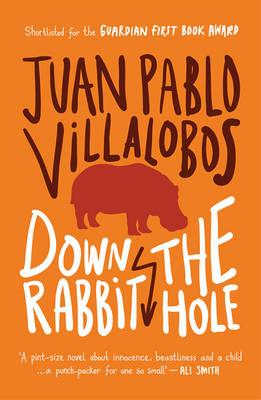
Firstly, Down the Rabbit Hole by Juan Pablo Villalobos (tr.Rosalind Harvey, 2011), which I picked up after reading Shoshi’s excellent review.  It is published by And Other Stories, a not-for-private-profit company which concentrates mainly on translated fiction. That sentence makes me feel better about the world 🙂

9781908276285

Back to the novel: Tochtli (rabbit in Nahuatl, an indigenous language of Mexico), tells us about his love of samurai films, hats, learning new words, and his life as the young son of a drug baron, Yolcaut (rattlesnake).

“I think we have a very good gang. I have proof. Gangs are all about solidarity. So solidarity means that because I like hats, Yolcaut buys me hats, lots of hats, so many that I have a collection from all over the world and all periods of the world. Although now more than new hats what I want is Liberian pygmy hippopotamus. I’ve already written it down on the list of things I want and given it to Miztli. That’s how we always do it, because I don’t go out much, so Miztli buys me all the things I want on orders from Yolcaut.”

The isolation is a necessary part of his father’s business, whose paranoia is an occupational hazard that is no doubt keeping them all alive. The tragic effect that this is having on young Tochtli becomes increasingly apparent as the story progresses. Tochtli accepts his life, knowing no different, but to the adult reader he displays worrying signs of severe anxiety: wanting his head shaved because he doesn’t want ‘dead’ hair on him, compulsively wearing hats, constant severe stomach pains, and later, after he sees something his father tried to keep hidden, selective mutism. He also takes violence pretty much in his stride:

“One of the things I’ve learnt from Yolcaut is that sometimes people don’t turn into corpses with just one bullet. Sometimes they need three or even fourteen bullets. It all depends where you aim them. If you put two bullets in their brains they’ll die for sure. But you can put up to 1,000 bullets in their hair and nothing will happen, though it might be fun to watch.”

Although dealing with extremely serious subject matter, there is humour is the novel, such as Tochtli’s description of the preparation for a drug run to Liberia which he also goes on in order to get one of his beloved pygmy hippos:

“By the way, Franklin Gomez started being Franklin Gomez yesterday in the airport. That’s what his passport from the country of Honduras says: Franklin Gomez. There were problems because Franklin Gomez didn’t want to be Franklin Gomez. Until Winston Lopez convinced him.”

In such a short tale (70 pages in my edition)Villalobos effectively widens the narrative of drug trade away from the usual barons/dealers/ users paradigm to show how the fallout from the industry can reach far and wide, including devastating those too young to have a choice about their own involvement. It is a truly moving story, not about drugs (you can read an article by the author where he refutes the term narcoliteratura here), but about children trying to cope with the messy, corrupt world adults create around them: sadly, pretty much a universal theme.

Fellow hat enthusiast, the late Isabella Blow, wearing Philip Treacy's Castle hat

Fellow hat enthusiast, the late Isabella Blow, wearing Philip Treacy’s Castle hat

Image from here

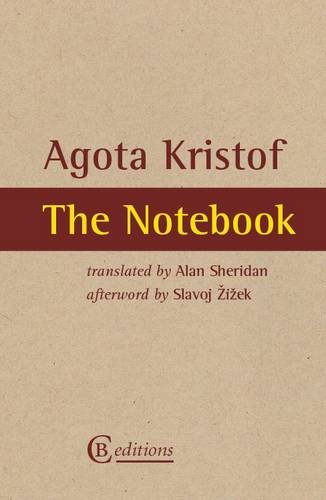
Secondly, The Notebook by Agota Kristof (1986, tr. Alan Sheridan, 1989) published by CB editions,  a publishing house which focuses on short fiction, poetry and translations. Kristof was Hungarian but was exiled to French-speaking Switzerland in 1956, and wrote this, her first novel, in French.

notebook

Like Down the Rabbit Hole, The Notebook is told from a child’s point of view, in this instance twin boys – we never know their individual names and they always use the first-person plural – who are evacuated to live with their maternal grandmother in the countryside of an unnamed nation, but which is generally thought to be Hungary.

“We call her Grandmother. People call her the Witch. She calls us ‘sons of a bitch’…Grandmother never washes. She wipes her mouth with the corner of her shawl when she has finished eating and drinking. She doesn’t wear knickers. When she wants to urinate, she just stops wherever she happens to be, spreads her legs and pisses on the ground under her skirt.”

This woman shows them no love or affection (although as the novel progresses we learn to recognise the small signs that she does care for them) and life is tough. They work on her smallholding and undertake various psychological ‘exercises’ to try and adjust to their straightened circumstances.

“ ‘My darlings! My loves! My joy! My adorable little babies!’ When we remember these words, our eyes fill with tears. We must forget these words because, now, nobody says such words to us and because our memory of them is too heavy a burden to bear. So we begin our exercise again in a different way…By repeating them we make these words gradually lose their meaning and the pain that they carry in them is reduced.”

The tone of the narration is astonishing. As the boys become more and more detached in an effort to preserve themselves from the horrors they witness, the reader is faced with filling in the gaps regarding what is happening. The delivery is so matter-of-fact that more the once I found myself stopping, thinking ‘Wait a minute, what the…’, going back and finding that something devastating had been described and I’d nearly missed it.

“Words that define feelings are very vague; it is better to avoid using them and to stick to description of objects, human beings and oneself; that is to say, to the faithful description of facts.”

The Notebook is a shattering work, and a challenging read. Human relationships are warped under the pressures of war. More than once, these pretty, golden twins get drawn into adult sex games. A young girl who is named after her birth anomaly – Harelip is apparently her given name – engages in some truly upsetting sexual acts. A neighbour behaves with horrific cruelty toward a group of starving people (presumably Jewish prisoners) and the boys wreak a terrible revenge (which they never admit in the text but you know what has happened and why). It is a difficult read but a powerful one, which does not shy away from the damage done when the acts of nations cause individuals to lose sight of their humanity. It is a political book, but not a polemical one: the twins’ equanimity leaves the reader to draw their own conclusions.

“Later, we have our own army and government again, but our army and government are controlled by our Liberators. Their flag flies over all the public buildings. The photograph of their leader is displayed everywhere. They teach us their songs and their dances; they show us their films in our cinemas. In the schools, the language of our liberators is compulsory; other foreign languages are forbidden.”

Highly recommended, but go in prepared – brilliantly written and completely brutal.

The Notebook was adapted into a film in 2013, which completely passed me by. From this trailer it looks excellent, and thankfully laws protecting children and animals means certain scenes are guaranteed to have not been filmed, surely?

“Oh Rio, Rio hear them shout across the land/From mountains in the north down to the Rio Grande” (Duran Duran)

The 2016 Olympics have come to an end (boo!) but we still have the Paralympics to come (hooray!) There have been astonishing achievements by those who seem to have been made from very different stuff to us mere mortals. When they seem doused in more than their fair share of charisma as well, you can’t even make yourself feel better by thinking that they’re probably horrible people, because they’re just so funny and charming about it all. Who could I be thinking of….?

Usain_Bolt_after_4_×_100_m_Rio_2016

Human being 2.0

To celebrate the Olympics, I thought I’d take up triathlon sit on my backside reading, of course. It’s Women In Translation Month (head over to Meytal’s blog to read all about WITmonth) so I’m looking at two novellas by Brazilian women writers. This will also be one more stop on my Around the World in 80 Books Reading Challenge, hosted by Hard Book Habit.

Brazil_topo

Firstly, Agua Viva by Clarice Lispector (1973, tr. Stefan Tobler 2012). Although I’ve called this a novella, I’m not sure that’s really what it is. It’s a series of impressions and observations, plotless but definitely not artless.

“This is life seen by life. I may not have meaning but it is the same lack of meaning that the pulsing vein has.”

I say it’s not artless, because although Agua Viva can give the impression of randomness, it’s carefully constructed to carry you through, the different passages building on and echoing one another.

“So writing is the method of using the word as bait: the word fishing for whatever is not word. When this non-word – between the lines – takes the bait, something has been written…so what saves you is writing absentmindedly.

I don’t want to have the terrible limitation of those who live merely from what can make sense. Not I: I want an invented truth.”

“I notice that I’m writing as if I were between sleep and wakefulness.”

Agua Viva quite a difficult work to talk about, because it resists being pinned down.  I could attach various labels to it: impressionistic, modernist, stream-of-consciousness, but none of these are quite right. On this reading – for I suspect it changes every time you read it – I felt it was about trying to capture the immediate present, to pin down moments knowing that they are gone forever just as you recognise them.  The style lends itself to this theme, as it jumps and disorientates, on occasions tipping over into surrealism:

“I am feeling the martyrdom of an untimely sensuality. In the early hours I awake full of fruit. Who will come to gather the fruit of my life? If not you and I myself? Why is it that things an instant before they happen already seem to have happened? It’s because of the simultaneity of time. And so I ask you questions and these will be many. Because I am a question.”

I read Agua Viva cover to cover, and I do wonder if this was the wrong approach. While the kaleidoscopic style and images build towards an overall impression, Agua Viva would equally lend itself to being dipped into, reading a single passage and ruminating on it. Apparently the Brazilian singer Cazuza read Agua Viva 111 times. I suspect it’s that sort of book: either you hurl it against the wall within minutes of opening it, or it becomes a mercurial companion for life.

I can’t sum myself up because you can’t add a chair and two apples. I am a chair and two apples. And I cannot be added up.”

82873390_Two_Apples_On_A_Chair_By_The_Window

Secondly, With My Dog-Eyes by Hilda Hilst (1986 tr. Adam Morris 2014). This is also a disorienting , unsettling work, non-linear and impressionistic. Hilst uses this style to create a highly effective portrait of Professor Amos Keres, who is having some sort of breakdown or psychotic episode. The fractured story-telling serves to take the reader inside the mind of someone who is extremely unwell.

“Poetry and mathematics. The black stone structure breaks and you see yourself in a saturation of lights, a clear-cut unhoped-for. A clear-cut unhoped-for was what he felt and understood at the top of that small hill. But he didn’t see shapes or lines, didn’t see contours or lights, he was invaded by colours, life, flashless, dazzling, dense, comely, a sunburst that was not fire. He was invaded by incommensurable meaning. He could only say that. Invaded by incommensurable meaning.”

The narrative shifts from third to first person as Keres copes with his boss suggesting he take a break, and then spends the day thinking over his life since boyhood, his career and his marriage. This makes it sound more linear and contained than it is, and does With My Dog-Eyes a great disservice. Its power comes from its layering of ideas and images with such rapidity as to almost assault the reader – never incoherent but an effective immersion in an unravelling mind.

“And everything begins anew, the patience of these animals infinitely digging a hole, until one day (I hoped, why not?) transparence inundates body and heart, body and heart of mine, Amos, animal infinitely digging a hole. In mathematics, the old world of catastrophes and syllables, of imprecision and pain was cracking up. I no longer saw hard faces twisting into questions, in tears so many times, I didn’t see the gaze of the other on mine, what a thing it can be to have eyes on your eyes, eyes on your mouth. Waiting for what kind of word? Such formidable cruelties occurring every day, humans meeting and in the good-mornings and good-afternoons such secrets, such crimes, such chalice of lies…”

It’s a good job this was a novella (59 pages in my edition) as I don’t think I could have taken much more of it (that’s a recommendation, not a criticism). With My Dog-Eyes is a short, sharp, shock: a plunge into madness.

To end, I was very excited that Caetano Veloso was performing at the Olympic opening ceremony, but I don’t think the acoustics did him any favours in capturing his wonderfully sensitive voice.  Here he is as part of the Pedro Almodovar film Hable Con Ella (Talk to Her):

https://www.youtube.com/watch?v=1emgUdD3_pE

“Without translation, we would be living in provinces bordering on silence.” (George Steiner)

Last week I looked at a Nordic mystery as part of Women in Translation month, and this week I thought I’d make it the central theme – head over to Meytal’s blog to read all about WITmonth. The need for Women in Translation month was brought home to me when I went to my TBR shelves thinking “No problem! I have loads of translated literature waiting to be read.” Well, yes, I do, but looking at the titles I suddenly realised it was very much dominated by male writers.

tumblr_inline_mozjjfa9bR1qz4rgp

I’m glad you asked, Mads. Firstly, The Vegetarian by Korean writer Han Kang (2007, tr. Deborah Smith 2015) and one more stop on my Around the World in 80 Books Reading Challenge, hosted by Hard Book Habit. You probably don’t need me to tell you how good The Vegetarian is; it was the glowing reviews and enthusiasm from bloggers that led me to pick up this novel in the first place. The hype was well deserved – The Vegetarian is an unsettling, brutal and beautifully written tale which has stayed with me long after I finished it.

It is the story of Yeong-hye, the titular herbivore, told from three points of view: her husband, her brother-in-law and her sister, over the course of a few years, from the point she starts refusing to eat meat. Her husband can’t believe that his wife – whose main appeal was that she impinges on his life in no way whatsoever – would do something so antisocial.

“As far as I was concerned, the only reasonable grounds for altering one’s eating habits were the desire to lose weight, an attempt to alleviate certain physical ailments, being possessed by an evil spirit or having your sleep disturbed by indigestion. In any other case, it was nothing but sheer obstinacy for a wife to go against her husband’s wishes as mine had done.”

Yeong-hye’s behaviour is not rooted in any of these ‘reasonable grounds’ but in a deep disturbance at thought of eating meat, something which is not easy to cope with or explain:

“Something is lodged in my solar plexus. I don’t know what it might be. It’s lodged there permanently these days. Even though I stopped wearing a bra, I can feel this lump all the time. No matter how deeply I inhale, it doesn’t go away. Yells and howls, threaded together layer upon layer, are enmeshed to form that lump. Because of meat. I ate too much meat. The lives of all the animals I ate are lodged there. Blood and flesh, all those butchered bodies are scattered in every nook and cranny, and though the physical remnants were excreted, their lives stick stubbornly to my insides.”

Yeong-hye’s behaviour exposes the fractures in her family: the tensions, hidden desires, and loyalties which on one occasion spills over into physical violence. She can’t be what her husband wants her to be. Subject to her brother-in-law’s sexual fetishes, she cannot answer all of his needs either. Nor can she start eating to please her sister who sees her wasting away. Her deterioration – mental and physical – is painful but her determination is relentless.

“Her voice had no weight to it, like feathers. It was neither gloomy nor absent minded, as might be expected of someone who was ill. But it wasn’t bright or light-hearted either. It was the quiet tone of a person who didn’t belong anywhere, someone who had passed into a border area between states of being.”

The Vegetarian is a short novel, 183 pages in my edition, but it punches far above its weight. Kang’s voice is strong and unique, her writing all the more dramatic for its concise understatement, and she refuses to offer any easy answers. Disturbing and brilliant.

Images from here and here

Secondly, a classic of Spanish literature, Nada by Carmen Laforet (1945 tr. Edith Grossman 2007). Andrea, a young student, leaves her rural home to attend university and moves in her with grandmother, aunt, two uncles, her uncle’s wife, a green-toothed maid and a dog. Although filled with youthful hope for opportunities and change, the atmosphere is unsettling from the start:

“We rode down Calle Aribau, where my relatives lived, its plane trees full of dense green that October, and its silence vivid with the respiration of a thousand souls behind darkened balconies.”

Once inside the house, things worsen. The house is cluttered, dirty, filled with layers of past glories.

“That bathroom seemed like a witches house, the stained walls had traces of hook-shaped hands, of screams of despair. Everywhere the scaling walls opened their toothless mouths oozing dampness. Over the mirror, because it didn’t fit anywhere else, they’d hung a macabre still-life of pale bream and onions against a black background. Madness smiled from the bent taps.”

The Spanish Civil War – over six years previously – is mentioned in passing but never dwelt upon, though there is the sense that this is a family and a city, possibly a nation, dealing with the aftershocks of trauma. The family are entirely dysfunctional, locked in abusive, sado-masochistic, manipulative relationships to a greater or lesser extent. Andrea’s uncle Juan savagely beats his wife Gloria; her aunt Angustias tries to control Andrea through a  mix of overbearing affection and oppressive boundary-setting; her uncle Roman plays  cat-and-mouse with just about everyone he encounters. Andrea’s friend Ena offers a possibility of escape:

“Ena never resembled on weekdays the rash girl, almost childish in her high spirits, that she turned into on Sundays. As for me – and I came from the countryside – she made me see a new meaning in nature that I’d never thought of before. She made me understand the pulsing of damp mud heavy with vital juices, the mysterious emotion of buds that were still closed, the melancholy charm of algae listless on the sand, the potency, the ardour, the splendid appeal of the sea.”

Nada is a gothic tale without a doubt, but never quite spills over into the camp that gothic often skirts along. The novel had to pass through Franco’s censors, and while its not overtly a political tale, I think the Gothicism helps disguise the fact that it is a tale of a society in shock; of resistance to oppression; of survival and escape.

“The memory of nights on Calle de Aribau comes to me now. Those nights that ran like a black river beneath the bridges of the days, nights when stagnant odours gave off the breath of ghosts.”

To end, an example of gothic that doesn’t skirt around camp but rather dives straight in – quite the maddest film I’ve ever seen:

“But what first, Debbie, attracted you to the millionaire Paul Daniels?” (Mrs Merton/Caroline Aherne)

Caroline Aherne, actor and writer, creator of the comedic brilliance that was The Royle Family, died on Saturday.  And so 2016 continues as forerunner for the most rubbish year in recent memory. If the political situation and the death of a yet another great person this year is getting you down, I would prescribe YouTubing  Caroline’s career for some solace.

If you enjoy someone’s work, there is a consolation that they leave this behind when they are no longer around, so I thought I would look at two novelists last works which were published in their lifetimes.

Firstly, The Old Man and the Sea by Ernest Hemingway (1952), fulfilling the sea-based tale requirement of the Around the World in 80 Books reading challenge hosted by Hard Book Habit. And so my inexplicable love affair with Hemingway continues. I’ve written before about how much I want to dislike Hemingway, but I just adore his writing. Like all great love affairs, we are wholly incompatible, and yet I find myself drawn back time and time again, whilst knowing I cannot change him. The Old Man and the Sea did not succeed in breaking the spell.

Hemingway, rocking a chunky knit to give his best salty old sea dog impression

Hemingway, rocking a chunky knit to give his best salty old sea dog impression

The titular old man is Santiago, a Cuban fisherman who sails in the Gulf Stream and has gone 84 days without catching a fish.

“Everything about him was old except his eyes and they were the same colour as the sea and were cheerful and undefeated.”

Manolin, a young boy, has known the fisherman his whole life and loves him, and it is through his eyes that we first see Santiago:

“His shirt had been patched so many times that it was like the sail and the patches were faded to many different shades by the sun. The old man’s head was very old though and with his eyes closed there was no life in his face. The newspaper lay across his knees and the weight of his arm held it there in the evening breeze. He was barefooted.

The boy left him there and when he came back the old man was still asleep.

“Wake up old man,” the boy said and put his hand on one of the old man’s knees.

The old man opened his eyes and for a moment he was coming back from a long way away. Then he smiled.”

They head out to fish separately – Manolin is banned from accompanying Santiago due to his salao bad luck – and what follows is the story of Santiago’s lone sea journey. The descriptions have Hemingway’s trademark pinpoint accuracy but this exists alongside metaphorical beauty, which absolutely captures the water and the isolation of the sailor.

“The old man knew he was going far out and he left the smell of the land behind and rowed out into the clean early morning smell of the ocean. He saw the phosphorescence of the Gulf weed in the water as he rowed over the part of the ocean that the fishermen called the great well because there was a sudden deep of seven hundred fathoms where all sorts of fish congregated because of the swirl the current made against the steep walls of the floor of the ocean.”

“The sea was very dark and the light made prisms in the water. The myriad flecks of the plankton were annulled now by the high sun and it was only the great deep prisms in the blue water that the old man saw now with his lines going straight down into the water that was a mile deep.”

The fisherman succeeds in hooking a “great fish” but is unable to bring it aboard, and so is towed by the marlin farther and farther out to sea, as he waits for the fish to die. I can’t say much more as it is only novella length (you can read the full text here) so I’ll just say that The Old Man and the Sea is extraordinary: fable, allegory, elegy, a meditative page-turner which I found truly moving.

“He looked across the sea and knew how alone he was now. But he could see the prisms in the deep dark water and the line stretching ahead and the strange undulation of the calm. The clouds were building up now for the trade wind and he looked ahead and saw a flight of wild ducks etching themselves against the sky over the water, then blurring, then etching again and he knew no man was ever alone on the sea.”

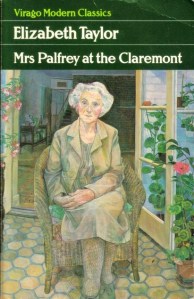
Secondly, Mrs Palfrey at the Claremont by Elizabeth Taylor.

Image from here

Following the death of her beloved husband, Mrs Palfrey moves to the Claremont Hotel on the Cromwell Road “The porch pillars had been recently painted; there were spotted laurels in the window boxes; clean curtains – a front of emphatic respectability.” to see out her days.

“She was a tall woman with big bones and a noble face, dark eyebrows and a neatly folded jowl. She would have made a distinguished-looking man and, sometimes, wearing evening dress, looked like some famous general in drag.”

Mrs Palfrey and her fellow permanent residents at the hotel are desperately trying to avoid a nursing home and rub along together in a mix of boredom, gossip and barely suppressed disdain. Although Taylor is interested in aging and how to find meaning in a world that considers you finished, this isn’t a depressing novel , but rather a gentle comedy with a melancholic tinge.

“Soon, there was a soft, slapping sound as Mr Osmond shuffled a pack of cards for a game of patience: against this, the knitting sounds, and sighs, and stomach gurglings (quickly coughed over).

‘Well, another Sunday nearly gone,’ Mrs Post said quickly, to cover a little fart. She had presence of mind.”

Mrs Palfrey is a resolute soul, who refuses to feel sorry for herself. Part of the generation who lived through both World Wars, she gets on with things.

 “She felt a determination about the lilac trees. They were to be a part of her rules, her code of behaviour. Be independent; never give way to melancholy; never touch capital. And she had abided by the rules.”

On a walk around London, she has a fall and is rescued by a young man, Ludo. He is shaggy-haired, scruffily dressed, good-looking and a wannabe writer. They end up forming an unlikely friendship and the nuances, contradictions, tensions and tenderness between the two are beautifully observed. Taylor is a wonderful writer: sharp, observant, funny and real. She put me in mind of Barbara Pym, and the blurb on the back of my copy of this novel compares her to Jane Austen.  Certainly if you like those, you’ll find a lot to love here.

 “She could glimpse bed-sitting rooms – like Ludo’s some of them – where once cooks had attended ranges, rattling dampers, hooking off hot-plates, skimming stock pots, while listening to housemaids’ gossip bought from above stairs. Mrs Palfrey went slowly by, imagining those days, which were almost clearer to her than this present structure of honeycomb housing and the isolation of each cell, because they were the days that belonged to her being young, and so were the clearest of all to her.”

To end, if you think Ernest Hemingway and Elizabeth Taylor are an unlikely pairing, here’s a heavy metal band and an orchestra performing a song named after a Hemingway novel: