This post is my second contribution to #DiverseDecember, which was brought about due to there being no books by BAME authors on the World Book Night list. Please head over to Naomi’s blog for an excellent, thorough discussion about this.
This week I thought I’d look at a classic novel by a Black American writer and a highly acclaimed first novel by a Malaysian writer now living in Britain, linked by portrayals of marriage. Sadly neither feature an Impressive Clergyman:
Firstly, Their Eyes Were Watching God by Zora Neale Hurston (1937), a much loved classic – my copy comes complete with effusive cover quotes from Zadie Smith, Toni Morrison, Alice Walker and Oprah Winfrey. I recommend this Virago edition: it has an interesting introduction by Zadie Smith, from which I took the title quote for this post, and an afterword by Sherley Anne Williams.
Beautiful Janie lives with her grandmother in the early part of the twentieth century:
“You know, honey, us colored folks is branches without roots and that makes things come round in queer ways. You in particular. Ah was born back due in slavery so it wasn’t for me to fulfil my dreams of whut a woman oughta be and to do. Dat’s one of de hold-backs of slavery. But nothin’ can’t stop you from wishin’. You can’t beat nobody down so low till you can rob ‘em of they will.”
When Janie is caught kissing a local bad boy, her grandmother arranges a marriage with a much older man who has land. It is an empty, lonely relationship and Janie runs off with her second husband, Jody. He is glamorous and exciting, but wants a trophy wife and is given to violence towards her:
“Janie stood where he left her for unmeasured time and thought. She stood there until something fell off the shelf inside her. Then she went inside there to see where it was. It was her image of Jody tumbled down and shattered. But looking at it she saw that it never was the flesh and blood figure of her dreams. Just something she had grabbed up to drape her dreams over.”
This is really what TEWWG is about: a woman’s search for self-fulfilment. Although the narrative drive comes from her three marriages, Janie is searching for a situation that will allow her to express who she is. She finds it with her third husband, Tea Cake:
“He drifted off into sleep and Janie looked down on him and felt a self-crushing love. So her soul crawled out from its hiding place.”
Janie is a compelling character, a spirited woman who strives for her voice to be heard and respected at a time when being a black woman meant there were few opportunities available. Hurston is undoubtedly a politically engaged writer, and her style is direct but not didactic. Rather, she has an unflinching gaze and a dry humour:
“Mrs Turner, like all other believers, had built an altar to the unobtainable – Caucasian characteristics for all….Behind her crude words was a belief that somehow she and others through worship could attain her paradise – a heaven of straight-haired, thin-lipped, high-nose boned white seraphs.”

Their Eyes Were Watching God is sad and hopeful; it is wise and affecting.
“Love is lak de sea. It’s uh movin’ thing, but still and all, it takes its shape from de shore it meets, and it’s different with every shore.”
Secondly, The Harmony Silk Factory by Tash Aw (2005), which was longlisted for the Man Booker, the Guardian First Book Prize and the Impac, winning the Whitbread First Novel award and the Commonwealth Writers Prize. It tells the story of the marriage of Snow to Johnny, a merchant/mechanic/mercenary, during the Second World War.
The tale begins with their son Jasper, attending his father’s funeral. Jasper’s feelings towards his father are complex to say the least:
“As we drove away I knew that I had been mistaken. That tender moment had been a mere aberration; it changed nothing. My father was born with an illness, something that had eaten to the core of him; it had infected him forever, erasing all that was good inside him.”
Snow’s diary from the early days of her marriage to Johnny makes up the second part of the novel and gives a different picture of Johnny as a quiet, conflicted man, perpetually displaced from his surroundings “I saw Johnny gathering himself to reply. He had an expression I had come to recognise, his broad face set in nearly cross-eyed determination.” Jasper sees his father as a thug, and while Snow doesn’t necessarily understand Johnny any better, she complicates the portrait drawn by her son.
Johnny and Snow honeymoon with an enigmatic Japanese professor for whom Snow feels a deep attraction; a displaced Englishman, Peter Wormwood; and the misnamed Honey, a mine-owner. This part of the novel sees relationships shift and change, reflected within an unpredictable tropical climate, during a strange suspension of reality prior to the Japanese invasion of Malaya:
“They ran through the towns and villages, barely pausing to plant flags of the Rising Sun before moving on. The red dust kicked up by the soldiers’ boots hung in the air, turning it crimson before settling on the leaves of the trees; all along the roads the trees turned red, and in some parts of the valley it was said that the streams ran deep scarlet.”
The third and final part of novel is narrated by an elderly Peter, looking back on that time while planning the new garden for the care home he lives in. As the answers to mysteries within the story emerge, we are left with contradictory accounts and loose ends. It is not so much unreliable narration, as a demonstration of how we are all unreliable narrators; we all have our own truth.
The personal story is bound up in issues of imperialism and displacement, expressed in Peter’s determination that his garden will be resolutely English, despite being planted in Malaysia:
“Not just lily-of –the valley, but ox-eye daisy, foxglove, cranesbill, snake’s head fritillary: I will plant them all in this hot earth… no longer will I have to wait for summer to enjoy its scent, for here it is summer all year long”
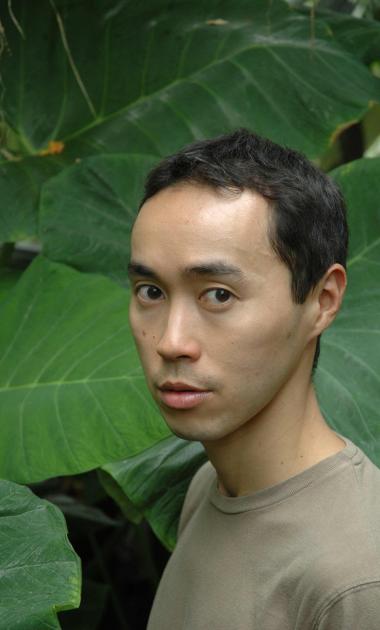
Tash Aw, who grows Malaysian plants in his London garden
(Image from https://www.goodreads.com/author/show/140377.Tash_Aw )
The overall impression I have on finishing The Harmony Silk Factory is captured by a comment the professor makes to Snow:
“Life is a palimpsest.”
Layers upon layers, each leaving their trace on people, places and memories. The Harmony Silk Factory manages the impressive feat of demonstrating how people remain unknown, stories unfinished, and yet still providing a satisfying resolution in itself.
Unfortunately I can’t think of a satisfying resolution to this post, so when in doubt, end on a song. Take it away, Freda:
 madame bibi lophile recommends