Judge for yourselves, ladies and gents:

I would say 1920s myself, although I bet he gives good late-18th century too (dedicated to my friend M, who has never quite recovered from the fact that both Benedict Cumberbatch and Jamie Parker insist on being married to women who aren’t her).
This week I received my dissertation results. It was much sooner than I expected, as frankly, I’m still in recovery from the whole thing. I’d love to claim I’ve learnt loads about ritualistic bloodshed on the late Jacobean stage, but in reality what I’ve learnt is that you should never, ever, never under any circumstances attempt to undertake a full-time MA while also working full-time (even if your results are good 😉 ).
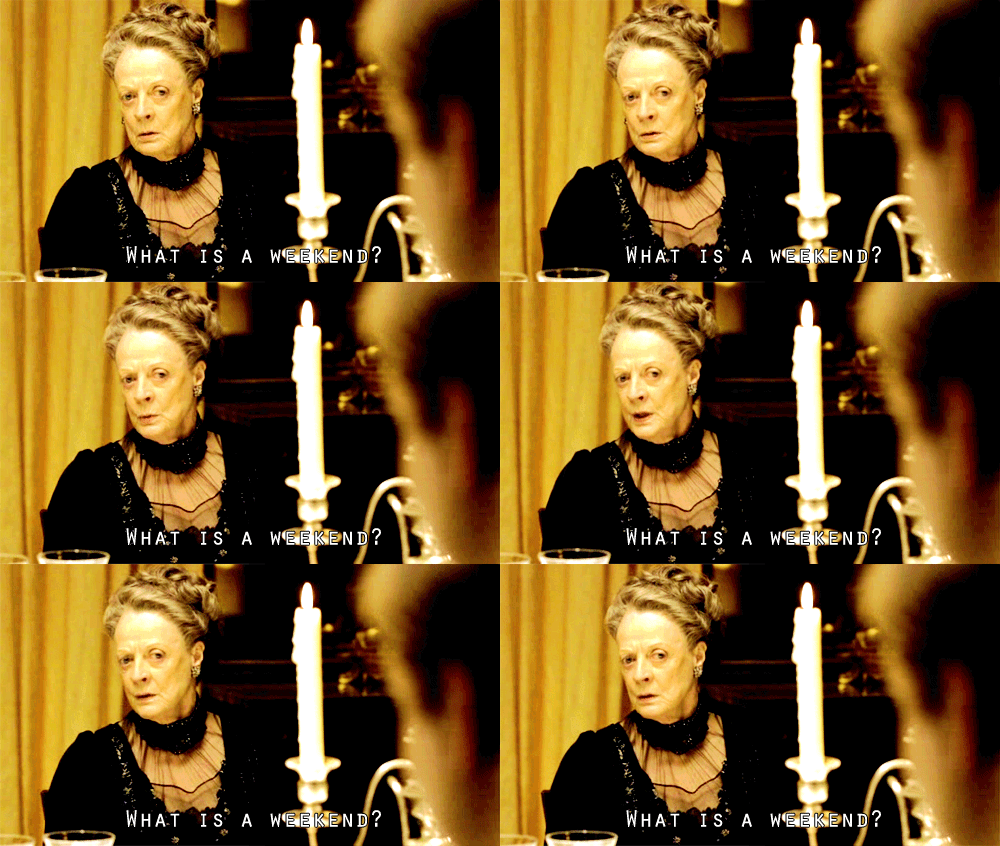
Now that I have some spare time the main thing I’ve been doing is… nothing at all. Bliss. I am vegging out to my bursting-at-the-seams digibox and of course, reading for pleasure. Hence this week I thought I’d look at books that have been adapted for the small screen (sadly neither feature Tom Hiddleston). I should say from the off that I won’t be looking at the behemoth of literary adaptations which currently dominates popular culture in almost all its forms:

Sorry ‘bout that.
The BBC normally saves its big literary adaptations for the autumn season, but there were two broadcast over the summer to whet the appetite of us bookish types, which I had to delay watching. Now I have handed in my millstone I’ve finally been able to watch them both (but as this is a book blog I’ll be concentrating on the paper versions).

Firstly, Jonathan Strange and Mr Norrell, by Susanna Clarke. This was adapted into an impressive (and pretty expensive-looking) seven-part series, featuring two fine actors who I’ll watch in anything, Eddie Marsan and Bertie Carvel:
It’s fair to say I am not the target audience for this novel. Magicians, meh. However, the fact that I made it through this close to 800 page tome is a ringing endorsement. Clarke has written a very readable alternative history of England during the Napoleonic wars, whereby Wellington employs magician Jonathan Strange to help him beat Napoleon:
“In the early summer of 1813 Strange again performed a sort of magic the like of which had not had not been done since the days of the Raven King: he moved a river. It happened like this. The war that summer was going well and everything Lord Wellington did was crowned with success. However it so happened that one particular morning in June the French found themselves in a more advantageous position than had been the case for some time. …His lordship was in really excellent spirits that summer and he greeted Strange almost affectionately. ‘Ah Merlin! There you are! Here is our problem! We are on one side of the river and the French are on the other side and it would suit me much better if the positions were reversed.”
Strange of course obliges. Back home, his scholarly mentor Mr Norrell disapproves, thinking English magic belongs in books, to be rarely practiced by himself first and foremost, and secondly by Strange “yet within Mr Norrell’s dry little heart there was [a] lively ambition to bring magic back to England”.
The two men are entirely different – dashing, ironic, friend-of-Byron Strange, and small, anti-social Norrell “the dullest man in Yorkshire”. Of course, they are entirely similar too, and of course they quarrel horribly. While there is war abroad, there are tensions at home, and not all of them between England’s foremost magicians. An evil faery, with the entirely excellent appellation of The Gentleman With Thistle-Down Hair is going round enchanting people to his evil ends:
“’Yet we ought to kill someone,’ said the gentleman, immediately reverting to his former subject. “I have been quite put out of temper this morning and someone ought to die for it. What do you say to the old magician? –Oh, but wait! That would oblige the younger one, which I do not want to do! What about Lady Pole’s husband? He is tall and arrogant and treats you like a servant!’
‘But I am a servant, sir.’
‘Or the King of England! Yes, that is an excellent plan! Let you and I go immediately to the King of England.’”
Will the Gentleman with Thistle-Down Hair be stopped? Will Strange and Norrell reconcile? Will the Raven King return to claim his place as Lord of English Magic? The only spoiler you’ll get from me is… England wins the Napoleonic Wars.
I’ve mentioned before that I love Marc Warren as a baddie, and so special mention must be made to his performance in the BBC adaptation as the Gentleman with Thistle-Down Hair – another great performance, another great outfit:
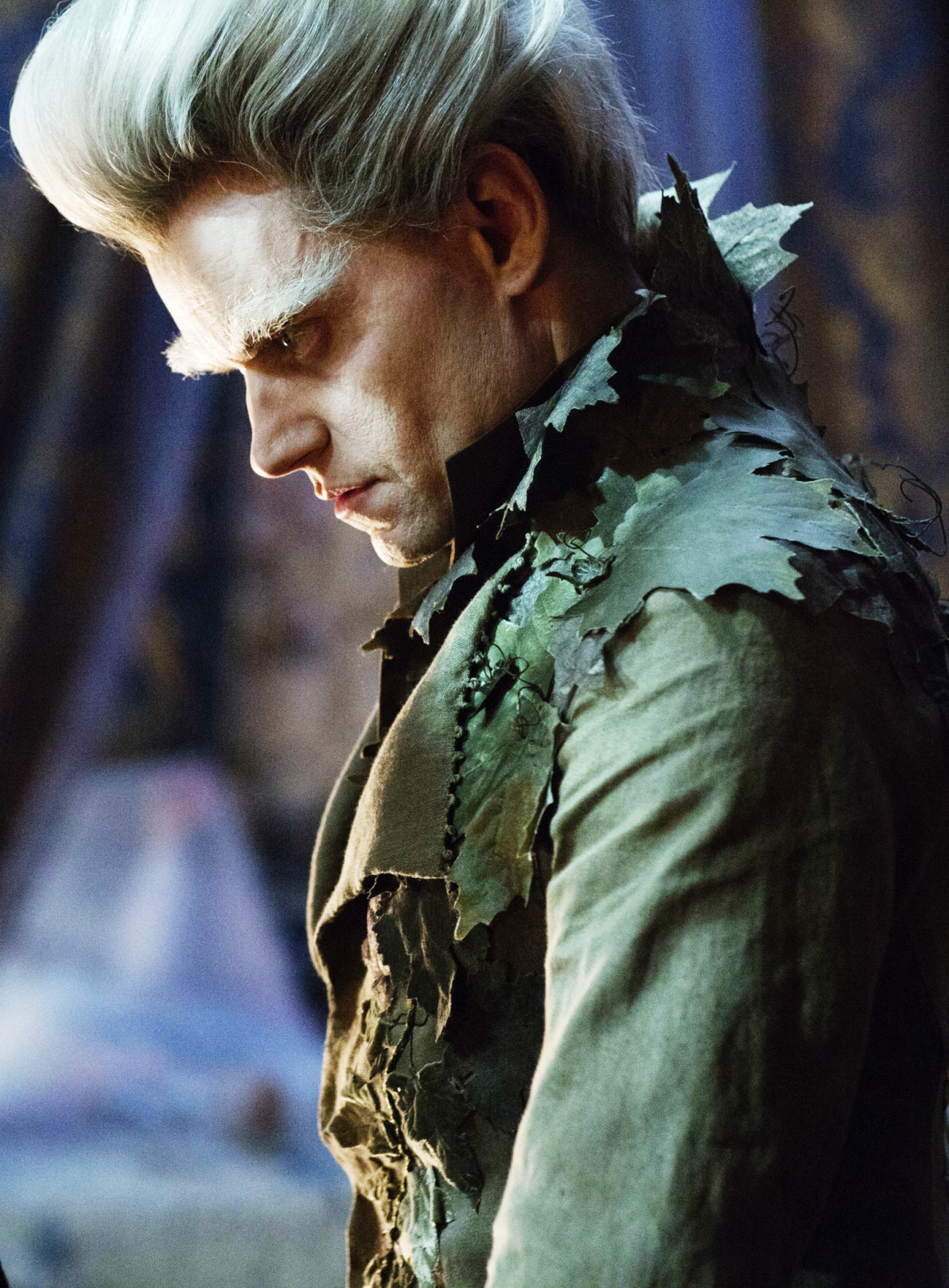
Image from here
Secondly, The Outcast by Sadie Jones, which was adapted into a two-part drama:
Damn, this was hard-going. Not because of Jones’ writing, I hasten to add, but because the injustice of the treatment towards a nine year-old boy who loses his mother is infuriating, and the hypocrisy that surrounds him is absolutely sickening. Lewis Aldridge grows up in 1950s Surrey, in a village built on things unsaid. When his sparkling, vivacious, alcoholic mother drowns with Lewis the only witness, he and his father spiral into separate pits of despair, unable to reach out to one another:
“he saw the moment between the not knowing and the knowing, as he woke, and he recognised it, because it was how he felt on waking too. He wanted to obliterate it. He wanted to take his son’s head in his hands and crush the feeling from it. He wanted to hold him hard and kiss him and make Lizzie come back to them through loving him badly enough. He wanted to hide his face and never think of it again.”
Jones is very good at this, capturing the messy, conflicting, contradictory emotions housed within one person, behind a still façade. Lewis becomes an expert at this outer calm, learning to bury all that he lacks the words to express:
“He didn’t feel sad anymore, it just went away and he felt hard as anything, hard as a diamond…
‘Lewis? Do come back in. Please.’
What could he do? He went.”
Lewis’ unnatural calm disturbs people; they find him uncomfortable and so they isolate him. He is unable to join in with the social niceties layered upon the secrets and lies of post-war British society and so this innocent, damaged boy is excluded, while a wife-and-child-beating sadist is welcomed as the powerhouse of village society. The Outcast is a novel that had me outraged at the injustice of it all, and at the cruelty of the refusal to acknowledge another’s pain “the world had exploded, but Sunday lunch would go ahead as usual.”
Lewis’ behaviour becomes violent as his desperation emerges in uncontrolled outbursts. The locals refuse to see their own complicity in what happens to him, and only Kit Carmichael, a fellow outsider, sees the village and Lewis for what they are. She loves him, but are they both too damaged to find their way to each other?
The Outsider is psychologically acute, well-paced, and unflinching in its portrayal of the damage human beings can do each other:
“It was an odd feeling, a looking-glass feeling, that he had, that all his life he had been on one side of the glass with everybody else on the other and now the glass had broken and the thick, broken pieces were at all of their feet.”
When I was cemented to my chair for 14 hours a day giving myself RSI through poor typing technique in a desperate attempt to meet the dissertation deadline, I would time my short breaks to the length of a Tim Minchin video. They broke the monotony, made me laugh, and stopped a short break spiralling into half a day. Here he is singing about not being cool which, now my MA is in, is the obvious topic choice for my doctorate as I have a lifetime of research behind me (contains strong language):

 madame bibi lophile recommends