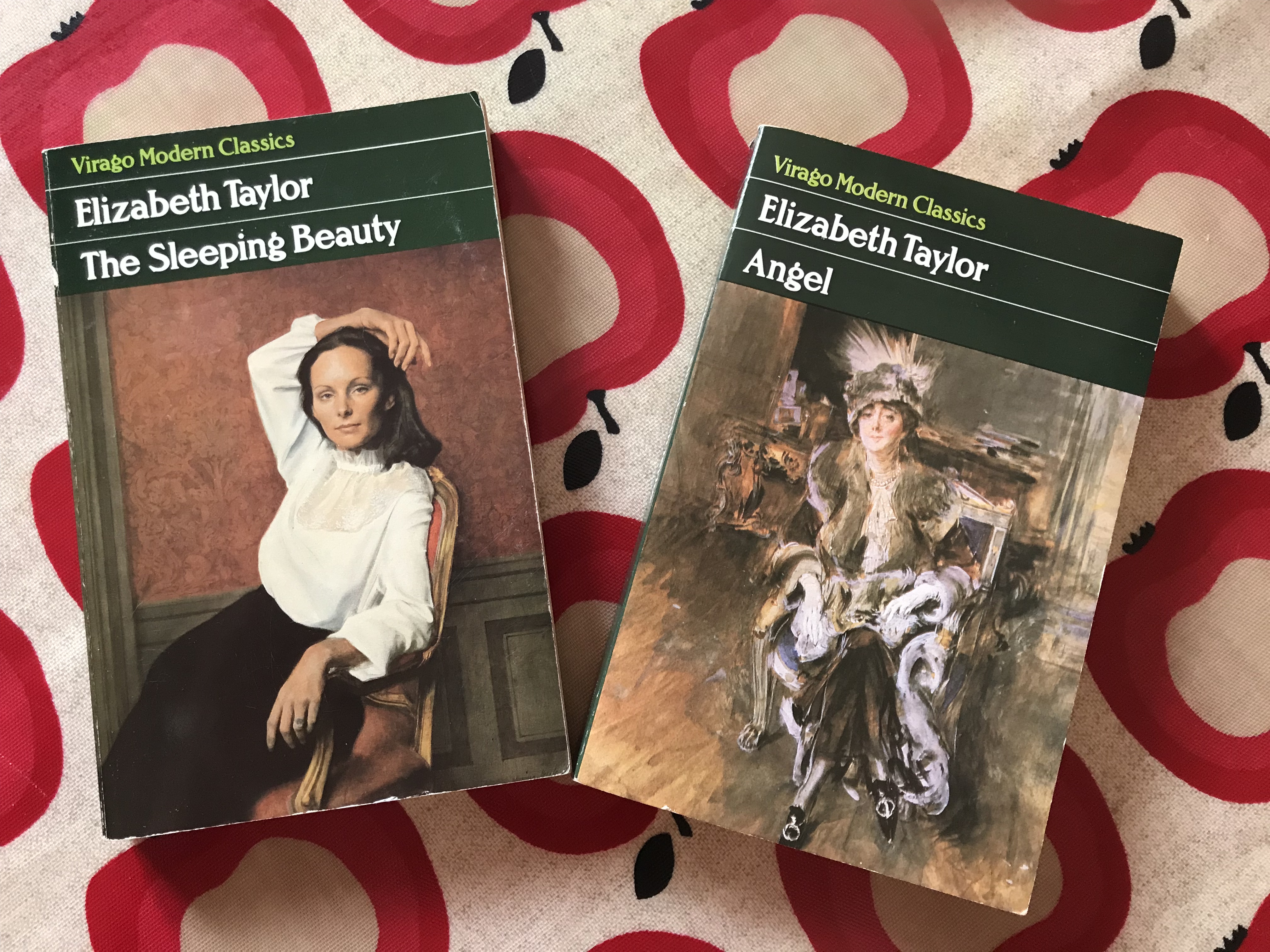
“People call me a feminist whenever I express sentiments that differentiate me from a doormat.” (Rebecca West)

A definite theme of the blog this year has been me being late for reading events. This will probably be my final post of 2018 so it’s apt to end on yet another belated entry, this time for Rebecca West Day in Jane at Beyond Eden Rock’s Birthday Book of Underappreciated Lady Authors, which was 21 December.
I’d hoped to do a post on two books, but the second half of this year has also seen me sluggish in both reading and blogging, so it’s just the one novel, The Fountain Overflows (1956), the first in the trilogy about the Aubrey family.

The story starts in 1900 and is narrated by Rose, one of four children of Piers and Clare. Piers is a gambling addict, and so although he and his wife are from genteel backgrounds, they survive on the brink of absolute destitution. The children grow up moving from place to place.

“We were experts in disillusion, we had learned to be cynical about fresh starts even before we ourselves made our first start”

Despite this, the children are not timid or anxious, but rather self-reliant and independent. Their mother is devoted to their father, as they all are, and the children clear-sightedly see their struggles.

“But I did not trust her. I loved her. Still I could see that she had been tripped by the snare of being grown up, she lay bound and struggling and helpless […] we children could always deceive her. Had it not been so we could not have provided for her happiness half as well as we did.”

West achieves a delicate balance in the portrayal of the Aubrey adults. It would be very easy to create to caricatures of a selfish, wastrel father and downtrodden female victim:

“ ‘Oh I am getting old and ugly, but it is not that. I cannot compete with debt and disgrace, which is what he really loves.’ “

Yet Clare never seemed especially weak to me. Her focus is music, and this takes priority over everything else. Rose and her sister Mary are gifted and practice incessantly, their brother Richard Quin is also talented but more interested in juggling and sports; their poor sister Cordelia has no talent and refuses to acknowledge it, egged on by a music teacher who is in love with her and so blind to her faults.

The Aubrey household is an intellectual one, with priorities very different to those around them in the south London suburb where they live.

“’You are allowed to read the newspapers now. I hope you will not attach too much importance to them. They give you a picture of a common-place world that does not exist. You must always believe that life is as extraordinary as music says it is.’”

West can be a colourful writer and there are elements of that here, with supernatural events and poltergeists related as matter-of-factly as trips to the House of Commons and music concerts. There isn’t a strong over-arching plot but enough to pull the reader along. The story has sadness in it, as any family with an addict in it will know, but it is not depressing because Rose’s voice is strong, unapologetic and funny in it’s unblinking assessment of those who surround her:

 “Her colouring recalled a doll left out in the rain, she had the dislocated profile of a camel”

However, as a reader I found it very hard to indulge Piers as much as his wife and children did. To me he was utterly selfish and self-focussed even without his gambling, without the slightest scruple as to the risk he placed his family in.

“I had a glorious father, I had no father at all.”

The Aubrey’s practical cousin Rosamund and Aunt Constance frequently live them as they are also subject to a husband who refuses to provide, although in a very different way to Piers. There is plenty here about what led to first-wave feminism in the UK without being didactic. The men are fairly appalling but not judged harshly (except by me). Rather, West’s focus is the constraints which prevent women being able to sort things for themselves. There’s also a recurring focus on women’s clothes and how the start of the twentieth century saw female oppression made explicit through the fashions:

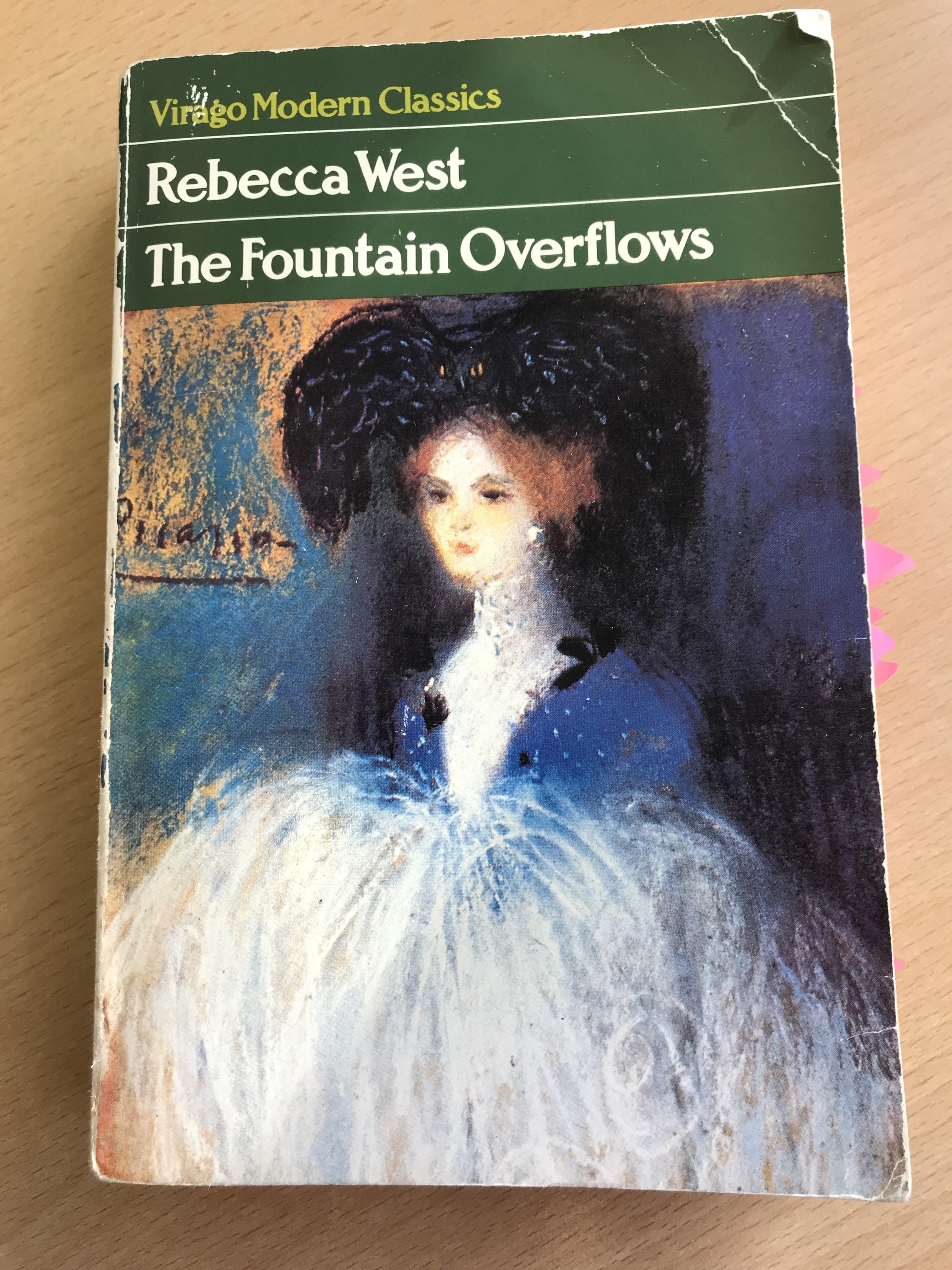
 “ ‘Any tragic scene in those days necessarily appeared grotesque, because of the clothes worn by the women […] Today she would have the right to look like that, plain and distraught and like a hen, but she was compelled by the mode of the day to make herself as absurd as a clown by wearing a hat the size of a tea-tray, which dipped and jerked and swayed as often as she did, which was perpetually.”

Hence the Virago cover:
All in all I greatly enjoyed meeting the idiosyncratic, independent-minded Aubrey family. The characters were wholly believable, the evocation of a lost time done without nostalgia, and West had plenty to say about wider Edwardian society. I’ll look forward to spending more time with the Aubreys through the two sequels.

“We had very often been sharply warned against sentimentality, and though we might have been able to define it only vaguely as the way one should not play Bach, we recognised it.”

And so it just remains for me to wish you all the festivities of your choosing and leave you with a non-Christmassy song (because you may well be sick of them by now) from a great Christmas film which I watched yesterday, Scrooged:

“I loved Mr. Darcy far more than any of my own husbands.” (Rumer Godden)

Today is Rumer Godden Day in Jane at Beyond Eden Rock’s Birthday Book of Underappreciated Lady Authors. I’m so grateful that this prompted me to read the two by Godden I had in the TBR, as she’s quickly become a new favourite.  Godden is such an accomplished writer; her books are so readable and her use of language is stunning.

Image from here

Firstly, Kingfishers Catch Fire (1953), which I started reading with some trepidation. I expected a novel about a 1950s English woman living in India to be filled with white entitlement and comic/exoticised portraits of the locals. Thankfully, Godden is far too sophisticated an author to do anything so crass, and the comic portrait is resolutely reserved for the clueless but well-meaning white foreigner, Sophie.

“To the Pundit, Sophie was precisely like any other European or American, only more friendly; the friendliness alarmed him. ‘These people are poor and simple…’ he began, but Sophie interrupted him.

‘We shall be poor and simple too,’ she said with shining eyes.

[…]

Sophie would not listen. Like many people there were some words about which she was sentimental; one of these was ‘peasant’. ‘Peasants are simple and honest and kindly and quiet,’ she said. ‘They don’t want what they don’t possess. They have the wisdom to stay simple. They don’t want to change.’”

This idealistic young woman crashes into Kashmir with her two children, estranged from her husband and determined to establish a life for herself. Yet the portrait of Sophie is a subtle one: she is oblivious to the needs of her children and to the cultural differences between her and her neighbours, but somehow not arrogant, just hopelessly naïve.

“Teresa could not count how many times they had moved, but each time the small ballast of hopes and plans they had collected was thrown overboard and everyone they had known was left behind.

Moo did not care. Like a little seed that is blown and can grow anywhere, on a rocky ledge, in a crack of earth, he lived a contained contented small life of his own no matter where he went. To Moo it did not matter but Teresa had roots, they were tender, soft and trailing…”

Poor Teresa. She is sensible and understands so much more than her adult parent. She also cares for Moo, who is probably on the autistic spectrum and in his own world.

In describing how Sophie and her children live in Kashmir, Godden adopts an interesting approach by having the story interjected with later reflections from Sophie and her family. So the narrative will be interrupted with comments like “‘But you were not qualified to teach Urdu,’ said Toby afterwards.” It’s not a technique I’ve seen before and it doesn’t jar as much as I would expect. The effect is to temper Sophie’s idealism and blind actions. It works to offset what sceptical readers (ie me) might be thinking: ‘but that’s just ridiculous, she’ll never make that work…’ etc. It keeps the story grounded even when the main protagonist ricochets from one ill-conceived action to the next.

Godden wrote Kingfishers Catch Fire based on her own experiences of India and her love of the land is obvious:

“There were no ceilings, only cross beams stuffed with dried furze as in most Kashmiri peasant houses. There was no glass in the windows, only hanging window shutters, no water system of course, no lighting, but it was a rarely beautiful little house. In summer it was hung with vines and honeysuckle and white-scented roses, and all around it were flowering trees….Above it all the mountain reared its head while below, lay the lake and its reflections and, far, the horizon of snow peaks.”

The plot is a deceptive one. I was enjoying what I thought was comic novel about the escapades of a fairly clueless woman; then suddenly things took a very dark turn and I found myself racing towards the end, desperate to know what happened and for things to work out well.

I loved the ending. This pithy comment on stealthy imperialism summed it up for me:

“The missionaries worked for the people but did not respect them. For all their love and zeal the wanted to bend them, bend them out of their own truth”

The message I took from Kingfishers Catch Fire was one of resolutely sticking to your own truth, whilst acknowledging and respecting other people’s. I just loved it.

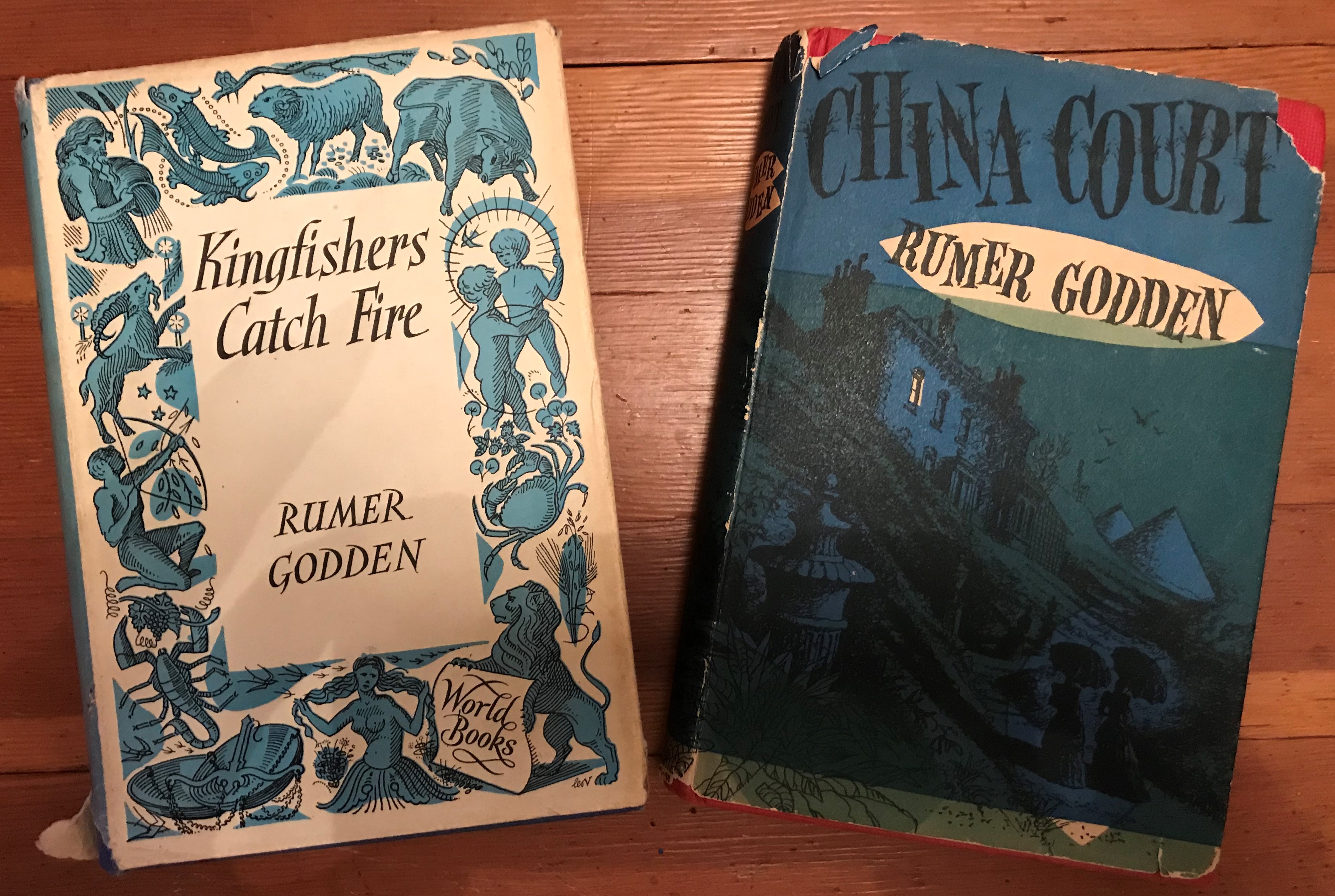
Behold my slightly battered, kitschy-covered editions:

Secondly, China Court (1961). This is another story of a dilapidated house and the woman who loves it, but otherwise very different to Kingfishers Catch Fire. The titular pile is the Victorian home of five generations of the Quin family set in the Cornish moors and built on the proceeds of china clay works.

“When one of the…rose bowls or vases is rung it gives off a sound, clear, like a chime, the ring of true porcelain, so China Court gives off the ring of a house, a true home.”

The story begins with the death of Mrs Quin, the matriarch who has resolutely stayed in China Court against all her family’s wishes (except her granddaughter) and looks at what happens after her death as her family besiege the house for the reading of the will.

The story moves back and forth across the generations. There is no indication when this will happen; scenes cut between the various family members, all in present tense. Again, this stylistic experiment doesn’t jar nearly as much as I would expect. Instead it captures a sense of the house holding all the members of the family at any one time, the echoes of their steps and their voices all layered upon one another.

“Homes must know a certain loneliness because all humans are lonely, shut away from one another, even in the act of talking, of loving. Adza cannot follow Eustace in his business deals and preoccupations as she cannot follow Mcleod the Second or Anne or Jared – no one can follow Eliza. Mr King Lee, kissing Damaris, has no inkling of the desolation he has brought her, just as Groundsel only half guesses Minna’s; Jared hides himself from Lady Patrick, and John Henry and Ripsie, in their long years together are always separated by Borowis

[…]

Loneliness can be good. Mrs Quin learns that in the long companionship of the years after Tracy goes, when she and Cecily are alone in the house; companionship of rooms and stairs, of windows and colours; in the gentle ticking away of the hours, the swinging pendulum of the grandfather clock. ‘I was happy,’ Mrs Quin could have said. Contented loneliness is rich because it takes the imprint of each thing it sees and hears and tastes”

This for me was the central theme of China Court: the value of everyday domesticity. The characters who recognise it are fulfilled and live rich lives that outwardly appear narrow but in reality connect with something fundamental that enables a wider kinship with others.

The portraits of the individuals run seamlessly and as the novel progresses they weave together for a complex depiction of family, and how histories are cyclical, building on what has gone before.

Mrs Quin is an avid gardener, and as in Kingfishers…there are beautiful descriptions of the natural world, but also of food and the various meals the family have taken together over the years.

“Now Cecily brought in saffron cake, buttered scones hot in a silver dish, brown bread and butter thin as wafers, quince jelly and strawberry jam from China Court quinces and strawberries; she had made shortbread, fruitcake and because Tracy likes them as a child, thin rolled ginger-snaps filled with cream.”

Gradually the family histories build towards a brilliant denouement in the present day of the novel. It’s dramatic but believable and once again I found myself racing towards the end. And the end is where I encountered my first reservation about Godden’s writing. To discuss it I’ll have to include a SPOILER so skip to the end of this paragraph if you don’t want to know. Here it is: an act of domestic violence takes place, an act which is quickly forgiven and leads to sex. I think it’s a dramatic device to shock a couple who aren’t communicating well (a recurring theme in the novel) towards honesty and resolution, but reading this almost 60 years after it was written was just horrible. I know from films of the time that slaps and spankings were freely given, but I’d be very surprised if this worked for modern readers.

This one incident aside, China Court is a wonderful portrait of a house and a family, beautifully evoked and fully realised with fondness but without sentimentality.

“ ‘We were truly kin,’ says Mrs Quin, and it is true that Tracy is like her grandmother in many ways; for instance, both, from the moment they first see it, are enslaved by China Court.”

To end, regular readers will know there are no depths to which I won’t sink in order to shoehorn in an 80s pop video. So please pardon the pun that has enabled my childhood hair icons to be this week’s choice:

“It is not possible to have perfection in life but it is possible to have perfection in a novel.” (Elizabeth Taylor)

Today is Elizabeth Taylor Day in Jane at Beyond Eden Rock’s Birthday Book of Underappreciated Lady Authors, which gave me a chance to read the last two novels I had of hers remaining in the TBR (thankfully I’ve not yet read all her work – roll on the end of the book-buying ban…).

Firstly, The Sleeping Beauty (1953), which tells the story of Vinny, a man who is a reliable shoulder to cry on for all his female friends.

“It was his business to be loved – a mission created afresh with everyone he met – and he was always conscious of another’s coldness.”

When Isabella’s husband dies, he is down to visit her at her coastal home like a shot.

“ ‘You are welcome to follow me to the ends of the earth’ Vinny seemed to be assuring people when he was introduced.”

Vinny should be seen as a model of compassion, but instead Taylor’s sharp eye shows him as vain and very much driven by his own needs. Isabella’s son Laurence, courting a young nursemaid staying at a local B&B, doesn’t take to him as he thinks he has plans to marry Isabella. The thought crosses Isabella’s mind too, and she finds comfort in planning how she will turn him down. What neither of them know is that firstly, Vinny is already married (though separated) from his wife Rita “[who] had, in fact, a great distaste for the truth and was forever tidying it up or turning her back on it.” and secondly, that Vinny has fallen in love at first sight with Emily, who he saw on the beach.

“When they had gone from view, he turned back to the room, and found it dark now, and very small.”

Emily is a blank canvas in many ways, perfect for Vinny’s romantic sensibility.

 “Nearing fifty, Vinny felt more than ever the sweet disappointments only a romantic knows….the imperfectly remembered and the half-anticipated. Past and future to him were the realities; the present dull, meaningless.”

Emily has been in a car accident and her heart was broken when her lover subsequently dumped her, unable to cope with her changed appearance. She is still beautiful, but in a strange way, as Vinny’s mother observes:

“anything passive she abhorred, and Emily’s dead-white skin, her lack of expression, about which Vinny had found no words to forewarn her, no heart to explain or discuss, annoyed and repelled her. She could sense Emily’s life drifting by in an incurious desuetude.”

The Sleeping Beauty has a determinedly unromantic male lead, and a beauty whose awakening is for his benefit not hers. Taylor shows how we attempt to construct our lives around our desires and how that can cause pain rather than delight for ourselves and those we love. She is very funny (such as Isabella and her friend Evalie being avid racing gamblers, hiding this from her son, who is also betting and hiding it from his mother) but overall the tale is unsettling. If the romance will result in happily-ever-after for any of those concerned is left for the reader to decide.

“ ‘Oh, I am nothing without you,’ she said. ‘I should not know what to be. I feel as if you had invented me. I watch you inventing me, week after week.’”

Secondly, Angel (1957) a hilarious portrait of a writer supposedly based on the romantic novelist Marie Corelli. Angelica Deverell decides before she’s even left school that she’s going to be a romantic novelist. This is despite not liking love, or novels:

“Until now she had thought of love with bleak distaste. She wanted to dominate the world, not one person.”

“She had never cared much for books, because they did not seem to be about her”

Angel is one of the most rampant egotists ever committed to paper. She is a terrible writer without life experience, knowledge or taste to draw on, and yet she is hugely popular – her readers don’t care about her error-ridden purple prose. Her fame insulates her from the world and so she is able to continue her entirely ego-driven existence, never bothering to look beyond herself for anything. She is physically astigmatic but psychologically myopic to the point of blindness.

Maybe I’m lacking compassion but I didn’t find Angel remotely sympathetic. She is appalling. The pathos comes through her mother: baffled by her daughter, and yanked from her home by Angel’s material wealth. I found this passage heart-rending:

“At a time of her life when she needed the security of familiar things, these were put beyond her reach. It seemed to her she had wasted her years acquiring a skill which in the end was to be of no use to her: her weather-eye for a good drying day; her careful ear for judging the gentle singing sound of meat roasting in the oven; her touch for the freshness of bacon; and how, by smelling a cake, she could tell if it were baked: arts, which had taken so long to perfect, now fell into disuse. She would never again, she grieved, gather up a great fragrant line of washing in her arms to carry indoors.”

Amazingly, Angel does have people who care about her, repugnant as she is. Theo, her publisher, takes a paternalistic attitude and worries she will never get what she wants:

“Love, which calls for compliance, resilience, lavishness, would be a shock to her spirit, and upset to the rhythm of her days. She would never achieve it, he was sure. For all the love in her books, it would be beyond her in life.”

Nora is a devoted friend and lives with Angel for the majority of their lives, even during Angel’s marriage to Nora’s feckless brother Esme:

“ ‘I read one of your books.’ he said, sounding as if it were rather a surprising thing to do.

She blinked, jolted by what he had said. She always supposed that everyone had read all of her books and had them nearly by heart, that they thought about them endlessly and waited impatiently for the next one to appear.”

Her marriage is held together through Esme’s lies and Angel’s unrelenting capacity for self-delusion, despite the fact she doesn’t enjoy the honeymoon:

“Greece was especially disappointing. It was nothing like her novels.”

 Angel is an astonishing character study and the story of one writer’s life. What is most astounding is that the grotesque Angel is apparently not too far from real life; apart from the fact that she was probably gay and more interested in the esoteric, Marie Corelli seems to have been very much like Angel. Certainly like Corelli, Angel refuses to acknowledge her waning star following the First World War when people don’t want overwritten romances anymore.

Angel never has an epiphany, she remains resolutely vain, deluded and solipsistic until the end. The novel is a comi-tragedy, carefully balancing absurd excess with sharp-eyed psychological insight.

“She went to the Royal Garden Party in violet satin and ostrich feathers with purple-dyed chinchilla on her shoulders; amethysts encrusted her corsage and mauve orchids were sewn all over her skirt where they quickly wilted. Glances of astonishment she interpreted as admiration.”

 “Arrogant and absurd she had been and remained; she had warded off friendship and stayed lonely and made such fortifications within her own mind that truth could not pierce it”

Ultimately, Taylor treats Angel kindly:

“I am frightened, she suddenly thought. But there was nothing to be frightened of; not even poverty now. I have come such a long way, she told herself, and done all that I wanted and there is nothing to fear.”

In life and in fiction, I like people who walk to the beat of their own drum. Angel certainly does this. I think the reason I couldn’t stand her is because she is so utterly self-focussed. She has zero interest in other people or in the world. Taylor is such a skilled writer that her horrible main character does not detract from the joy of this novel. The comedy is gentle; although we laugh at Angel it is in disbelief rather than cruelty. There is also enough reality and pathos through the characters that surround her to ground the novel away from Angel’s delusions.

Elizabeth Taylor is such a wonderful writer. Any novel of hers is an absolute masterclass in astute, humane, witty style. The fact that she is an Underappreciated Lady Author is an absolute travesty.

To end, I saw a documentary recently about female singers and Annie Lennox was part of it, looking bloomin’ amazing in every shot. Here she is singing about an angel:

“Writing is a cop-out.” (Monica Dickens)

Today is Monica Dickens Day in Jane at Beyond Eden Rock’s Birthday Book of Underappreciated Lady Authors. I’d planned for May to be only novellas over here, but I couldn’t resist the chance to dig out 2 Persephone editions from the TBR and join in with Jane’s celebration. I’m glad I did, because I really enjoyed my first encounter with Monica Dickens.

Image from here

Firstly Mariana (1940) which is part of the Persephone Classics range. On the Persephone website they say:

 “We chose this book because we wanted to publish a novel like Dusty AnswerI Capture the Castle or The Pursuit of Love, about a girl encountering life and love, which is also funny, readable and perceptive; it is a ‘hot-water bottle’ novel, one to curl up with on the sofa on a wet Sunday afternoon. But it is more than this.”

That just about sums it up. On the one hand Mariana is a very simple novel, about a young girl called Mary growing up and reaching adulthood just as World War II breaks out. She has various infatuations and gets her heart bruised, if not quite broken, before she meets the love of her life. What raises it above this very ordinary premise is the fond characterisation and Dickens’ wit.

Mary herself is a determinedly independent soul:

“People were kind and friendly and amusing, but they thought that companionship and conversation were synonymous and some of them had voices that jarred in your head. There was a lot to be said for dogs.”

She has been this way her whole life, as her school report testifies:

“Mary is a dear little girl…but we find a tendency in her to resent authority to the point of resistance. Although she is popular with her fellow pupils, I am afraid she is a bad mixer, being at the same time intolerant and unconfident of others and disinclined to enter into the heart of the community.”

She lives with her mother who works in a dress shop, as her father died in the previous war. There is also her reprehensible, indulgent Uncle Geoffrey who leaves her aged 8 to catch the Tube home by herself. He subsequently goes off to Hollywood to make his name in the movies. What stops this being entirely whimsical is the first chapter: we know the adult Mary is waiting for news of her husband whose ship has been sunk in the conflict. So alongside the fun characters and the wit is the background of potential tragedy; things do not seem to bode well for Mary, given the titular reference to Tennyson’s poem.

But in the meantime there is gentle fun to be poked at the trials and tribulations of young love:

“She told herself that she had been through a searing experience which had left her as a woman set apart from love – a tragic figure. This sustaining vision had tided her over the misery of the end of last summer, until the excitement and newness of Dramatic College had given her something else to think about.”

Dickens is a wise writer though, and so while she presents her characters with a slightly askance view, she shows how their feelings make them who they are, and who they will be:

“She had thought that [he]was the answer to everything, and when she had found out that he wasn’t she had been left alone with no one on whom to pin her burden of romantic devotion.”

I really enjoyed Mariana, which I wouldn’t have assumed would be the case given the subject matter. Dickens is very readable and I whizzed through the novel. I enjoyed spending time with all the characters (apart from an awful arrogant Bullingdon club type who seemed to have future-Prime-Minister written all over him) and I enjoyed Dickens unpretentious, thoughtful style.

“A corner of the jigsaw of Mary’s life had been made into the right pattern, by unknown means. It seemed that one had little control over one’s own destiny. All one could do was to get on with the one job nobody else could do, the job of being oneself.”


Secondly, The Winds of Heaven (1955), which had far fewer likeable characters and was almost bleak at times, but just saved from being so by the gentle endurance of the main character, Louise, who is widowed and destitute.

“She reached for the ashtray, for she wanted to tap off the ash frequently, as she had seen highly-strung, busy people do. Louise was neither highly-strung, nor busy, but when she was in London, among people who all seemed to be doing something important in a hurry, she liked to try and keep pace.”

The reason Louise is destitute is because her husband, Dudley, who seems to have had absolutely no redeeming qualities, died and left her with all his worldly debts.

“Everyone said Louise was ‘wonderful’ about Dudley’s death, but she could not be anything else, because, shocking though it was to her, she hardly cared.”

“there was nothing for it but that Louise should stay with her daughters in turn to pass the summer months. It was all arranged at an embarrassing family conclave, where no-one could say what they were thinking, and each tried to outdo the other in unselfishness.”

And so The Winds of Heaven follows Louise as she moves from one daughter to another. Miriam lives in a suburb in the Home Counties and is an absolute snob; Anne is the laziest person on earth who has somehow managed to marry a lovely man who runs a smallholding and genuinely cares for Louise; Eva is an actor in London and having an affair with a married man. They clearly all take after their father as they are selfish and self-absorbed.  They are also, in different ways, all quite unhappy, and Louise has no idea how to help.

“she had wanted the futile thing she had made of her marriage with Dudley to be justified at least by the emergence of three happy lives.”

The novel is episodic in nature and through it we learn about Louise and her daughters. It’s a very mid-20th century English family, full of unspoken truths, supressed conflicts, and love. The somewhat depressing state of Louise’s familial relations is lightened by two beacons of light in her life: a friend, and her granddaughter. Gordon Disher is a bed salesman and pulp-fiction author who becomes: “The oddest, but most comforting friend she had ever made”. Ellen is Miriam’s daughter who like Louise, is a misfit in the family (a good thing, seeing as how appalling they all are) and who provides genuine kinship.

“how delightful to be a grandmother with a responsive grandchild, who opened her heart to you without embarrassment, because she had no-one to talk to at home”

The Winds of Heaven captures a particular moment in time, where women had only just begun to stop being exclusively homemakers and enter the workplace. Louise feels she can’t support herself, because she doesn’t believe she has any skills. This leaves her in genteel middle-class poverty, dependent on her daughters. She is part of a vanished world, and is not treated kindly by those who are finding their way in a new one. Dickens handles this social commentary with an incredibly light touch though, and so The Winds of Heaven often reads more like a series of acerbic character studies than a commentary on mid-twentieth century gender roles. It’s always highly readable, quietly building to a dramatic, tragic denouement, where hope survives.

To end, Monica had a rather famous great-grandfather. To tell you all about him, here are the incomparable Horrible Histories, channelling The Smiths: