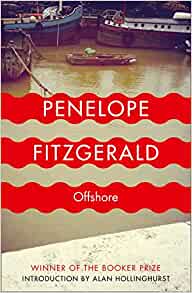
Offshore – Penelope Fitzgerald (1979) 141 pages
Penelope Fitzgerald won the Booker prize for this novella, in which she draws on her experience of living on a houseboat on the Thames at Battersea (which sank twice). She set it eighteen years earlier in 1961, at which point Battersea was not nearly as salubrious as it is now (cf: Up the Junction by Nell Dunn).
The houseboat inhabitants are all struggling in a way that gives rise to water-based imagery:
“The barge dwellers, creatures neither of firm land nor water, would have liked to be more respectable than they were. They aspired towards the Chelsea shore, where, in the early 1960s, many thousands lived with sensible occupations and adequate amounts of money. But a certain failure, distressing to themselves, to be like other people, caused them to sink back, with so much else that drifted or was washed up, into the mud moorings of the great tideway.”
Fitzgerald evokes the setting and the characters so well without wasting a word. Opening at a meeting of the barge dwellers we meet them all, including upright Richard, and savvy, kind Maurice:
“Richard was quite correct, as technically speaking they were all in harbour, in addressing them by the names of their craft. Maurice, an amiable young man, had realised as soon as he came to the Reach that Richard was always going to do this and that he himself would accordingly be known as Dondeschiepolschuygen IV, which was inscribed in gilt lettering on his bows.
He therefore renamed his boat Maurice.”
The portrait of Maurice surprised me in being more progressive than I would expect for the time. He is a sex worker and brings customers back to his barge, where he also allows a decidedly shifty friend called Harry to store stolen goods. Maurice is never judged harshly and in fact is probably the most sympathetic of all the characters, providing real friendship to the others.
Nenna is living on Grace, seemingly having half-left her husband, who is in north London. Her daughters have adapted to their new life well, mud-larking and flogging their finds.
“You know very well that we’re two of the same kind, Nenna. It’s right for us to live where we do, between land and water. You, my dear, you’re half in love with your husband, then there’s Martha who’s half a child and half a girl, Richard who can’t give up being half in the Navy, Willis who’s half an artist and half a longshoreman, a cat who’s half alive and half dead …’”
Offshore isn’t plot-heavy, although events do build towards a surprising denouement. Rather it is a snapshot in time of people trying to find a place for themselves beyond conventional safety. For each of them, there is a sense of desperation but it lives alongside resilience, hope, and friendship.
“There isn’t one kind of happiness, there’s all kinds.”
 madame bibi lophile recommends