“The story of our lives still isn’t finished, and it never will be.” (Beatriz Bracher, Antonio)

Trigger warning: mentions mental illness and infant death.

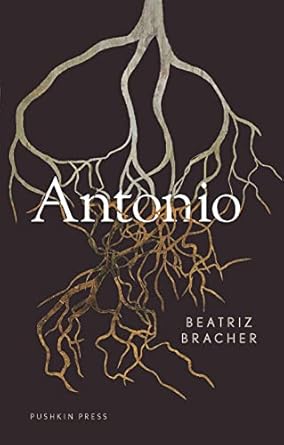
Stu over at WinstonsDad’s blog is hosting Spanish Portuguese Lit Month for the whole of July and so this was the perfect opportunity to get to a novella by Brazilian author Beatriz Bracher which had been languishing in the TBR: Antonio (2007, transl. Adam Morris 2021) published by the wonderful Pushkin Press.

I want to start with the disclaimer that I don’t think I’ve really got to grips with Antonio, so this post is just some initial impressions. Although only 187 pages long it is incredibly densely written and it took me a week to read. Admittedly work has been really demanding lately, but usually it still wouldn’t take me that long to read a book of that length.

Also looking online, there are many effusive reviews praising the socio-political commentary of Antonio, which I’m sure I didn’t fully comprehend. I did pick up some, but I’m certain I need to re-read Antonio at some point.

The novella is told through the alternating viewpoints of three people: Raul, Isabel and Haroldo. Their silent interlocutor is Benjamim, who is awaiting the birth of his first child, the titular Antonio. The imminent arrival of his son has prompted Benjamim to probe into his family history in more depth.

“I’d like to think your mother was also a free person, and maybe you can hold onto that thought, instead of clinging to fear and rage.”

Benjamim knows that his father was Teodoro and that his mother was  Elenir.  Elenir had a son with Benjamim’s grandfather Xavier first, who they also called Benjamim and who died very young. The second Benjamim was raised by his father after his mother died in childbirth.  

Raul is his father’s friend, Isabel is his paternal grandmother, and Haroldo was Benjamim’s grandfather’s friend. They all provide histories of Benjamim’s family that echo and contradict each other, and none seem any more reliable or authoritative than any other. Each has their own truth.

The family is well-off and privileged in São Paulo, but their history is a troubled one. Both Xavier and Teodoro had periods of intense mental illness.

For Xavier, this occurred after the death of Benjamim. As Haroldo recalls:

“[Elenir] looked like a bent piece of wood. She didn’t cry. She received each condolence with correct politeness. Xavier was the total opposite: he was in pieces […] I managed to gain entry to that hell three times. The last time, I brought a team of nurses, to drag my friend out of there and take him to a sanatorium.”

Later, Xavier meets and marries Isabel and they raise a family. They are the generation that came of age in the 1950s and 1960s, idealistic and, in Isabel’s case, driven:

“In a family we’re always a me or and I who’s scattered and complex. It’s only at work, especially work that has to do with ideas, but it’s possible to feel ourselves out and let the contours assume the shape.”

Their youngest son Teo rejects the urban privilege he is born into and goes to live in rural Minas. He throws himself into village life but ultimately becomes rudderless and unwell. Isabel reminds Benjamim of his early childhood:

“You’re from this family, so you are this family. Your father wanted to be rid of all that, and shed himself along with it. The history that he crafted for himself in Minas was a non-history. He went too deep. By the time I brought him back, there was nothing left to hold onto, no handle I could use to hoist him back out: only damaged pieces.”

This is one of central themes of Antonio: how to live an authentic and conscious life, but not be overwhelmed by the search for meaning. How to truly find who you are, alongside the demands of daily life. Isabel believes the answer is hard work, but only Big Work. Haroldo points out:

“She raised a bunch of irresponsible ingrates who are incapable of the most basic displays of solidarity, like visiting their dying mother. Isabel cultivated a true horror of responsibility in them, and at the same time overloaded them with the responsibility to be nothing but the best.”

Isabel recognises that privilege brings responsibility, but she also remains an elitist. When she observes: “I never understood any language that wasn’t well spoken Portuguese.” she is being both literal and metaphorical. The family’s wealth isn’t what it once was and she is unhappy at her children’s middle-class existence.

To me Isabel was the strongest of the three narrators and I got a real sense of her. But Raul, living an ordinary life and baffled by what happened to his childhood friend, and the somewhat reprehensible, colourful Haroldo were also distinct characters if not entirely differing voices, and Bracher balances the three viewpoints well.

I’ve focused on some of the ideas rather than the events of Antonio and that is partly because the novella has some graphic scenes in it – of extensive mental breakdown, one of pig-killing and one of caring for a dead body by someone who doesn’t know what they are doing. None of these are gratuitous but they mean Antonio can be very difficult to read in places.

Bracher avoids conclusions about the causes of Xavier and Teo’s ill health and whether there is a genetic component or whether it is the demands of society on the individual. She vividly, sometimes viscerally, evokes the pressures of family and the search for self in late twentieth-century Brazil.

“To live long and stay well, stay away from your relatives.”
“Insanity – a perfectly rational adjustment to an insane world.” (R. D. Laing)

Some friends of mine recently got married in a beautiful venue, which used to be a mental health hospital. A lovely time was had by all. People were struck at how nice it was, and it got me wondering: why? Were they expecting the institution to be grim in itself, or was it the thought that somehow all that pain remains and would be felt? It seemed to be a bit of both. Clearly the idea of a place where mental health is treated is a powerful one. It’s no surprise then, that it’s proved a tempting choice for writers, so it’s led me to this week’s theme of novels set in mental health units. Rest assured Reader: although powerful, neither of my choices are depressing. At this time of year it can feel like everyone’s mental health is under siege and we just don’t need it. In fact, here’s a little pick-me-up for us all:

On with books! Firstly, All Dogs Are Blue by Rodrigo de Souza Leao (2008, trans.Zoe Perry and Stefan Tobler 2013). This novella is only 107 pages long but it is one of the most affecting and powerful pieces I have ever read. Rodrigo de Souza Leao died in a psychiatric clinic in Rio de Janeiro in 2009, shortly after this was published. All Dogs Are Blue takes the reader into life inside such an institution, and does so with an unblinking gaze, humour, warmth and blistering truth.

The narrator is 36-year-old man who has swallowed ‘a chip’ which alters his behaviour. This has led to his incarceration. There isn’t a plot, it wouldn’t make sense if there was. Instead, the narrator takes us through his daily experiences and reminiscences about his past.

“The Christian says hallelujah. She takes my hand. I take out my dick and can’t play snooker. I go back to my nine-by-twelve cubicle, where they put me to smile bayoneting my veins. Grab the flesh, stretch the flesh, shove another injection in.”

The narrator never tries to convince us of his sanity. Rather, we are given his world view, one which is sometimes shocking in its clarity amongst flights from reality:

“If it could bark and eat, what would a blue dog eat? Blue food? And if it got ill. Would it take blue medicine? A lot of medicines are blue, including Haldol. I take Haldol to be under no illusions that I’ll die mad one day, somewhere dirty, without any food.”

Despite detailing an individual in dire circumstances, All Dogs Are Blue is not a depressing book. This is because the narrator is resilient and self-aware, even as he experiences psychotic delusions. There is humour found in his hallucinatory companions, nineteenth century French writers:

“Rimbaud wasn’t used to modern stuff, He was a guy from another time. He had to learn everything. He’d never written another poem. But he was a good companion for wasting away the hours and for poker.”

Whereas Baudelaire can be a bit more moody.

De Souza Leao also writes with great beauty and poetry:

“Everything went green like the colour of my brother Bruno’s eyes and the colour of the sea. Rimbaud was happy and decided not to kill himself.

Everything went Van Gogh. The light of things changed.”

But the humour and the poetry do not detract from the pain. Rather, they capture it in the most effective way to draw you in to begin to understand an extreme experience that thankfully, most of us will not endure.

“I break everything because I’m made of shards and when the shards invite me to, I wreak havoc.”

Through an individual experience, the wider issue of how we treat the mentally ill is addressed. De Souza Leao doesn’t offer answers but he poses uncomfortable questions about institutionalised mental healthcare:

“Mostly, they only wanted you to keep your mouth shut all the time, like no-one deserved to hear you say anything noble or important.”

All Dogs Are Blue is a stunning, heartbreaking novella. It is also yet another example of the brilliant work being done by not-for-profit publishers And Other Stories bringing translated fiction to a wider audience.

Secondly, a novel which examines the impact on family when a member has enduring mental ill health, The Gravity of Love by Sara Stridsberg (2014, trans. Deborah Bragan-Turner 2016). I was inspired to pick this up after reading Kate’s wonderful review. It’s also another stop on my Around the World in 80 Books Reading challenge, hosted by Hard Book Habit. Narrated by Jackie, it tells of her relationship with her alcoholic father Jim, who is an inpatient at Beckomberga Hospital in Stockholm. This was one of the largest mental health hospitals in Europe, but was closed in 1995 as the focus on care shifted to the community.

Image from here

Jackie finds herself drawn to her father and to the hospital, visiting repeatedly throughout her young life, despite the pain it causes.

“The light that has always been in his eyes is there no longer. The beautiful, terrifying desolate light that spilled over, illuminating the night around him and betraying a special kind of intensity and recklessness, something unstoppable, a raging fire, the sheerest drop.”

Stridsberg is excellent at capturing the complexities of loving someone who is hell-bent on self-destruction; the contradictory state whereby the person and what they seem to promise constantly shifts and hope of a better future never quite dies.

“All at once he sounds like the Jim I find so hard to remember, the way he was before the alcohol, before the devastation; if there really is such a thing as before.”

Jim is treated with compassion but the selfishness of his behaviour is not shied away from. He is the alcoholic but the disease that affects far more than just him:

“Every morning, a great despondency in his chest that stretches out like a wasteland. A blazing sun within him, his blood screaming for the warmed brandy running through his veins.”

Jackie makes highly questionable decisions herself and while this is clearly due to Jim’s impact on her life, Stridsberg is wise enough to present these decisions as they stand and not pull them apart in trite pseudo-psychological interpretations. We never entirely understand what draws Jackie relentlessly back to Beckomberga, because she doesn’t entirely understand it herself.

“Each time I walk through the hospital gates the rest of the world slides away, like the tide that recedes to lay bare another shoreline”

The Gravity of Love is about families, about how they make us who we are and how we make us who we are. Stridsberg explores a variety of familial relationships with great subtlety, but it is also a story of individuals’ relationships with institutions. Jackie’s relationship with Beckomberga is complex, and similarly, the inpatients’ relationship with the hospital is shown to be ambivalent, both supportive and restrictive:

“People say that former patients keep returning to Clock-House Park at Beckomberga, that they stand under the trees with their hands pressed on the sun-bleached walls, as if the institution’s heart were still beating within – a weak human pulse against my hand when I touch the faint blood-red colour of the façade.”

The fate of the last patient of the hospital, Olaf, is a sad one and this description of his experience just absolutely floored me:

 “He has always walked alone with the stamp of illness imprinted under his skin, visible to all apart from himself. Whenever he has approached a girl she has shied away. Every time he has offered his hand to someone it has been construed as hostile and he has been banished back to the hospital.”

Although very different from All Dogs Are Blue, Stridsberg is similarly challenging in her questions around how we treat mental illness: institutionally, societally, politically and individually. A beautifully written, poetic novel that never lets the style detract from the substance.

To end, I promised a return to 80s pop videos this week, and so I thought I’d pick an artist who has been very open about his experience with bipolar disorder. The fact that I’ve been in love with him for 37 years did not influence my choice in the slightest 😉

“Oh Rio, Rio hear them shout across the land/From mountains in the north down to the Rio Grande” (Duran Duran)

The 2016 Olympics have come to an end (boo!) but we still have the Paralympics to come (hooray!) There have been astonishing achievements by those who seem to have been made from very different stuff to us mere mortals. When they seem doused in more than their fair share of charisma as well, you can’t even make yourself feel better by thinking that they’re probably horrible people, because they’re just so funny and charming about it all. Who could I be thinking of….?

Usain_Bolt_after_4_×_100_m_Rio_2016

Human being 2.0

To celebrate the Olympics, I thought I’d take up triathlon sit on my backside reading, of course. It’s Women In Translation Month (head over to Meytal’s blog to read all about WITmonth) so I’m looking at two novellas by Brazilian women writers. This will also be one more stop on my Around the World in 80 Books Reading Challenge, hosted by Hard Book Habit.

Brazil_topo

Firstly, Agua Viva by Clarice Lispector (1973, tr. Stefan Tobler 2012). Although I’ve called this a novella, I’m not sure that’s really what it is. It’s a series of impressions and observations, plotless but definitely not artless.

“This is life seen by life. I may not have meaning but it is the same lack of meaning that the pulsing vein has.”

I say it’s not artless, because although Agua Viva can give the impression of randomness, it’s carefully constructed to carry you through, the different passages building on and echoing one another.

“So writing is the method of using the word as bait: the word fishing for whatever is not word. When this non-word – between the lines – takes the bait, something has been written…so what saves you is writing absentmindedly.

I don’t want to have the terrible limitation of those who live merely from what can make sense. Not I: I want an invented truth.”

“I notice that I’m writing as if I were between sleep and wakefulness.”

Agua Viva quite a difficult work to talk about, because it resists being pinned down.  I could attach various labels to it: impressionistic, modernist, stream-of-consciousness, but none of these are quite right. On this reading – for I suspect it changes every time you read it – I felt it was about trying to capture the immediate present, to pin down moments knowing that they are gone forever just as you recognise them.  The style lends itself to this theme, as it jumps and disorientates, on occasions tipping over into surrealism:

“I am feeling the martyrdom of an untimely sensuality. In the early hours I awake full of fruit. Who will come to gather the fruit of my life? If not you and I myself? Why is it that things an instant before they happen already seem to have happened? It’s because of the simultaneity of time. And so I ask you questions and these will be many. Because I am a question.”

I read Agua Viva cover to cover, and I do wonder if this was the wrong approach. While the kaleidoscopic style and images build towards an overall impression, Agua Viva would equally lend itself to being dipped into, reading a single passage and ruminating on it. Apparently the Brazilian singer Cazuza read Agua Viva 111 times. I suspect it’s that sort of book: either you hurl it against the wall within minutes of opening it, or it becomes a mercurial companion for life.

I can’t sum myself up because you can’t add a chair and two apples. I am a chair and two apples. And I cannot be added up.”

82873390_Two_Apples_On_A_Chair_By_The_Window

Secondly, With My Dog-Eyes by Hilda Hilst (1986 tr. Adam Morris 2014). This is also a disorienting , unsettling work, non-linear and impressionistic. Hilst uses this style to create a highly effective portrait of Professor Amos Keres, who is having some sort of breakdown or psychotic episode. The fractured story-telling serves to take the reader inside the mind of someone who is extremely unwell.

“Poetry and mathematics. The black stone structure breaks and you see yourself in a saturation of lights, a clear-cut unhoped-for. A clear-cut unhoped-for was what he felt and understood at the top of that small hill. But he didn’t see shapes or lines, didn’t see contours or lights, he was invaded by colours, life, flashless, dazzling, dense, comely, a sunburst that was not fire. He was invaded by incommensurable meaning. He could only say that. Invaded by incommensurable meaning.”

The narrative shifts from third to first person as Keres copes with his boss suggesting he take a break, and then spends the day thinking over his life since boyhood, his career and his marriage. This makes it sound more linear and contained than it is, and does With My Dog-Eyes a great disservice. Its power comes from its layering of ideas and images with such rapidity as to almost assault the reader – never incoherent but an effective immersion in an unravelling mind.

“And everything begins anew, the patience of these animals infinitely digging a hole, until one day (I hoped, why not?) transparence inundates body and heart, body and heart of mine, Amos, animal infinitely digging a hole. In mathematics, the old world of catastrophes and syllables, of imprecision and pain was cracking up. I no longer saw hard faces twisting into questions, in tears so many times, I didn’t see the gaze of the other on mine, what a thing it can be to have eyes on your eyes, eyes on your mouth. Waiting for what kind of word? Such formidable cruelties occurring every day, humans meeting and in the good-mornings and good-afternoons such secrets, such crimes, such chalice of lies…”

It’s a good job this was a novella (59 pages in my edition) as I don’t think I could have taken much more of it (that’s a recommendation, not a criticism). With My Dog-Eyes is a short, sharp, shock: a plunge into madness.

To end, I was very excited that Caetano Veloso was performing at the Olympic opening ceremony, but I don’t think the acoustics did him any favours in capturing his wonderfully sensitive voice.  Here he is as part of the Pedro Almodovar film Hable Con Ella (Talk to Her):

https://www.youtube.com/watch?v=1emgUdD3_pE