“I hate the idea of sequels. I think you should be able to do it in one book.” (Jane Gardam)

This week I’m looking at two novels by Antonia White, prompted by the pending arrival of next week’s 1954 Club, hosted by Simon and Kaggsy. When I looked at the TBR for 1954 novels, one that I had was Beyond the Glass. However, it’s the final novel in a quartet, and I hadn’t read the middle two…

It’s been six years since I read Frost in May and I’m not sure why it’s taken me so long to pick up Antonia White again, because I really enjoyed that first instalment. Frost in May was written in 1933, and White didn’t continue the story again until 1950, going on to write the last two in the quartet in 1952 and 1954.

The Lost Traveller (1950) sees Nanda from Frost in May renamed Clara and returning to her childhood home in West Kensington to attend the funeral of her paternal grandfather. Her father is bereft, but in 1914 emotions were to be controlled absolutely:

“Suddenly he was touched by an old fear of which he had never spoken to anyone, the fear that one day he might lose all control of his mind. Against that there was only one weapon; his obstinate will.”

Mr Batchelor is a teacher who harbours academic ambitions for Clara. His feckless wife Isabel wants Clara to be beautiful. She is both of these things, but not to the extent that either of her parents would like. The complex family relationships are brilliantly portrayed by White: the mismatched parents, the passive aggressive power struggles between Isabel and her mother-in-law (“Mrs Batchelor’s face … assumed a look of patient malice.”) and in the middle of it all, adolescent Clara.

“At home, to be silent was taken for a sign one was sulking.”

After her mother is ill with the mysterious women’s problems that were always so common and yet so unspoken, Clara’s father can no longer pay her school fees (the NHS was over 30 years away) and so she has to leave Catholic boarding school to attend a local Protestant school. She’s actually quite happy there, and makes two friends, although neither of them are Catholic, to the concern of her convert parents.

“Isabel, who would never have come to such a decision on her own, was willing to follow him. Catholicism seemed to her a poetical and aristocratic religion.”

Clara’s religion plays a large part in The Lost Traveller, as she tries to establish what it means for her as a young adult, away from the structures of her convent school.

Of course, with the year being 1914, readers know what the family is about to live through. However, when war breaks out, the only person it really affects is Mr Batchelor, as he sees the population of his old boys steadily wiped out.

“If only he could have gone to the front with them, he would have been completely happy.”

Although Clara prides herself on not being as vacuous as her mother, in some ways she is just as self-focussed and oblivious:

“Since she had nobody at the front in love with her and was too young to be a nurse or W.A.A.C, Clara refused to take any interest in the progress of the war.”

So while the war takes place somewhere else, Clara struggles with her sense of self, trying to work out who she is and how to manage the tumultuous feelings of teenage life in a family where so much goes unspoken. Her father is devout, strict, and given to tempers. Clara adores him and yet there is distance between them:

“Why couldn’t he understand without being told that there was nothing she would not do, cut her hair off, hold her hand to the fire, if it would bring any comfort? Why couldn’t he realise that the one impossible thing was to speak?”

Meanwhile her mother is struggling with her life choices – or lack thereof – and is drawn to one of her husband’s colleagues, Reynaud Callaghan, who encourages her romantic fancies.

“‘But I love Versailles,’ she went on dreamily. ‘I had an ancestress at the court of Louis XVI. I should have adored that life. Those exquisite clothes and the balls by candlelight and the masquerades by moonlight.’”

Isabel is great creation: vain, shallow, a snob, and yet in many ways she sees more clearly than anyone else. She tries to talk to Clara about childbirth and sex, but Clara stops her. Clara’s naivete about both is astonishing yet believable.

An opportunity comes up for Clara to be a governess for six months to an aristocratic Catholic family,  which her family are keen she take up. I found her charge thoroughly unpleasant – an over-privileged, spoilt, entitled little brat. The type that grows up to run the country 😉

It’s there that Clara meets Archie Hughes-Follett, injured in the line of duty. He will come to play a much larger role in her life in The Sugar House.

“When she considered her vanity and duplicity and how little her beliefs influenced her behaviour, she began to wonder whether she might not be insensibly growing into a hypocrite.”
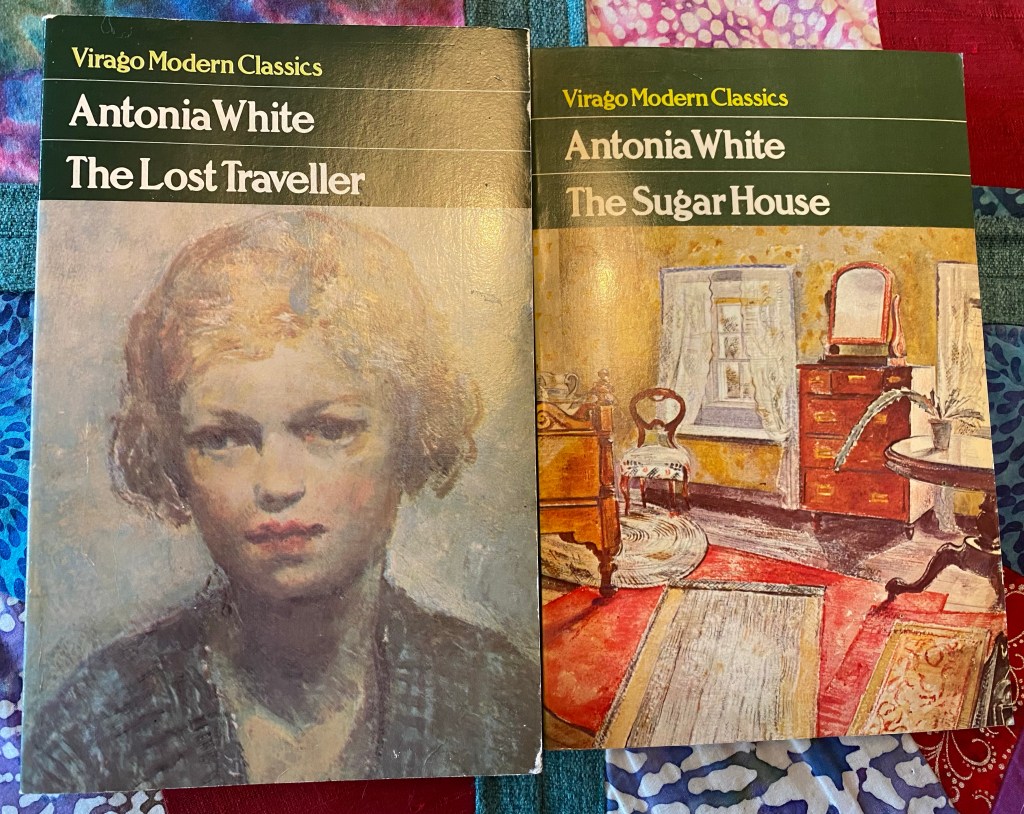
The Sugar House (1952) picks up Clara’s story six years later in 1920. She is an actress, having paid for her drama tuition herself with money made from working in a government office. She doesn’t seem wholly committed to her profession, but she is to her older lover Stephen Tye.

Needless to say, the reader may not be quite so enamoured of a man given to pronouncements such as: “‘No female novelist is worth reading,’ said Stephen. ‘Women can’t write novels any more than they can write poems.’” He then wheels out the tired old misogynist cliché that Branwell wrote Wuthering Heights. Sigh…

Thankfully we don’t have to endure this awful man for too long, as he ends up on a different tour to Clara. I thought the touring life was wonderfully evoked by White:

“Though towns changed, landlady’s sitting-rooms remained the same. There were always round tables with red or green serge cloths, aspidistras, photographs of seaside towns in plush frames and, in lucky weeks, a tinny, yellow-keyed piano.”

Clara often finds herself sharing rooms with fellow actor Maidie, who is at once much more devout and much more worldly than Clara. Religion is not such a strong theme throughout The Sugar House as it was in The Lost Traveller, but it is there as a constant.

When things fall apart with Stephen – as the reader knows they inevitably will – Clara returns to the security of what she knows: home, and Archie. He loves her, and unlike Stephen he respects her writing:

“I didn’t think even you could write anything which got me so much.”

However, he is conflicted and confused. He has the same childlike quality he had in The Lost Traveller, but his self-medicating with alcohol has worsened:

“Often he had sulked like a schoolboy but never had she seen him in this mood of aggressive bitterness.”

Clara doesn’t love him, but she marries him. Although Maidie has helped Clara to become less naïve, she is still hopelessly ignorant and to a modern reader the whole thing is doomed to failure. Probably to 1950s readers too, as this is Clara on her wedding day:

“She wondered if he had really expected her to run away. Her will was too paralysed even to formulate the wish.”

The titular house is their first married home, as Clara is desperate to leave the stifling atmosphere of her parents’ house. She finds a place in Chelsea, the portrayal of which is amusing for twenty-first century readers. Now it is one of the most expensive parts of London, but apparently in the 1920s it was bohemian and considerably less salubrious. This does not go down well with her upright father:

“ ‘No doubt you fill the place with short-haired women and long-haired men. Archie has all my sympathy if he prefers the public house.”

The horror!

Interestingly, what draws Clara to this atmosphere is the evidence of people working. Artists wander the streets with the tools of their trade tucked under the arms, and Clara realises she is desperate to write:

“Oh, God, don’t let me be just a messy amateur.”

However, her increasingly stressful married life where Archie fritters away money and drinks heavily means that she finds it hard to focus on work. The house, with its distempered walls that look like sugar icing, cramped rooms and two untidy people living it, begins to oppress her almost as much as her parents’ house.

“Once this sense of non-existence was so acute that she ran from the basement to the sitting room full of mirrors almost expecting to find nothing reflected in them.”

Eventually things reach a breaking point, at once dramatic and understated, entirely believable and very sad. I wouldn’t normally read books by the same author so close together, but I’m glad I did here. I’ve felt very much submerged into Clara’s world and completely involved in her story.

“Yet here, as there, she found herself both accepted and a little apart. She was beginning to wonder if there were any place where she did perfectly fit in”

All being well, Beyond the Glass next week!

(I should mention there is antisemitism expressed in both novels, particularly The Lost Traveller. However, the characters stating such views are never portrayed as admirable. I think writing in the 1950s, White was reminding a contemporary readership who would have had the holocaust in recent living memory, of the pervasiveness of racism in society).

To end, a song that sums up Clara and Archie’s situation pretty well:

“Rough winds do shake the darling buds of May” (William Shakespeare)

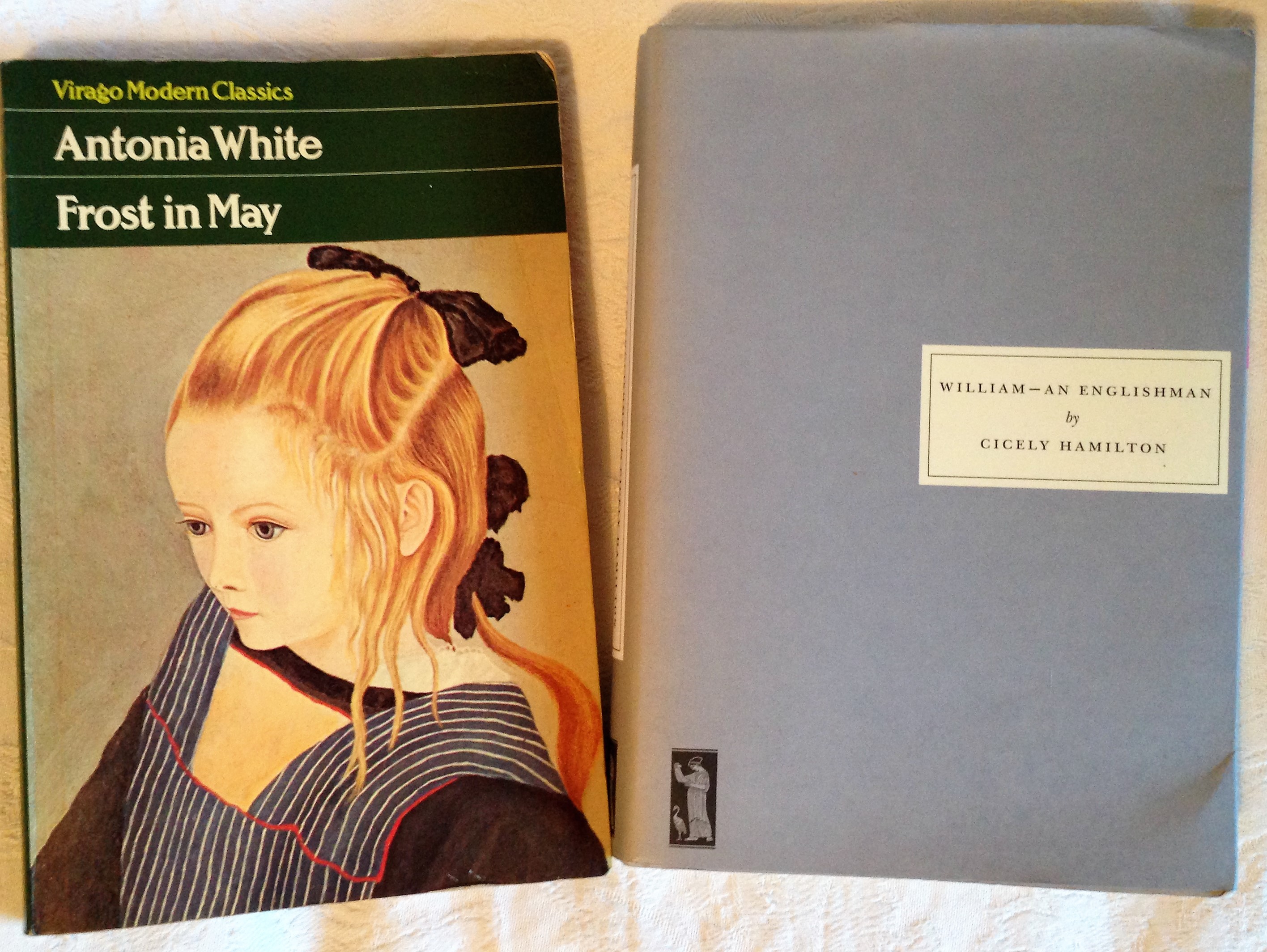
Last week I looked at The Enchanted April, so this week for May Day I thought I’d look at another Virago that helpfully has the current month in the title, Frost in May by Antonia White (1933). Virago was founded in 1973, with the Modern Classics imprint starting in 1978 “dedicated to the rediscovery and celebration of women writers, challenging the narrow definition of Classic”. Frost in May was the first Modern Classic title, so for this post I’ve paired it with the first Persephone title, as Persephone, founded in 1998, have a similar remit to publish lost or out of print books which are mainly written by women.

200 (2)

Frost in May is Antonia White’s autobiographical first novel, telling the story of Nanda Gray and her schooling at the Convent of the Five Wounds from the ages of 9 to 14. Nanda begins school as a devout child, finding her way in Catholicism:

“St Aloysius Gonzaga had fainted when he heard an impure word. What could the word have been? Perhaps it was ‘belly’, a word so dreadful that she only whispered it in her very worst, most defiant moments. She blushed and passionately begged Our Lady’s pardon for even having thought of such a word in her presence.”

White charts Nanda’s development throughout her school career.  She is from an ordinary middle-class family, her father a recent convert, and the other girls from aristocratic European Catholic families are glamorous and much more worldly:

“Leonie and Rosario were seasoned retreatants. They went into this solitary confinement with as little fuss as old soldiers going into camp. Rosario supplied herself with a great deal of delicate needlework if a vaguely devotional nature, while Leonie announced frankly that she was going to use her notebook to compose a blank verse tragedy on the death of Socrates.”

As Nanda becomes older, she begins to struggle with her faith, although there is never a sense that she will abandon it all together. Rather it is the story of a young person trying to find a true sense of meaning within her faith, rather than without it.

“She had often been rewarded by a real sense of pleasure in the spiritual company of Our Lord and Our Lady and the saints. But over and over again she encountered those arid patches where the whole of religious life seemed a monstrous and meaningless complication.”

If this sounds like it has no place in today’s secular world, I’ve not done Frost in May justice. The novel is about a young person’s growing realisation of self, explored with sensitivity. As a heathen book lover, I related to Nanda’s discovery of poetry:

“She read on and on, enraptured. She could not understand half, but it excited her oddly, like words in a foreign language sung to a beautiful air. She followed the poem vaguely as she followed the Latin in her missal, guessing, inventing meanings for herself, intoxicated by the mere rush of words. And yet she felt she did understand, not with her eyes or her brain, but with some faculty she did not even know she possessed.”

Frost in May is a short novel and a quick read, and I can see both why it was marginalised and why Virago chose it to launch its Modern Classics imprint. It is easy to overlook: a school story in which little happens, five years in a young girl’s life and no intrusive authorial voice to proclaim any wider profundity beyond the immediate story. Yet it has plenty to say about what is profound for the individual, the influences and experiences that shape us and leave an indelible mark. White’s light touch should not be mistaken for a lack of something to say.

“Do you know that no character is any good in this world unless that will has been broken completely? Broken and reset in God’s own way. I don’t think your will has quite been broken, my dear child, do you?”

IMG_0699

Secondly, William – An Englishman by Cicely Hamilton (1919) who was a suffragette and wrote this novel during the last year of World War I. The eponymous Mr Tully is a young man who prior to the war is a socialist, fired less by idealism and more by the need for something with which to occupy himself.

“The gentlest of creatures by nature and in private life, he grew to delight in denunciation, and under its ceaseless influence the world divided itself into two well-marked camps; the good and enlightened who agreed with him, and the fool and miscreants who did not…in short, he became a politician.”

William meets and marries a similarly dim suffragette, Griselda, and Hamilton’s satire of their unthinking politicking is relentless.  They are shown as well-meaning but avoiding any challenge to their ideals and any opportunity for genuine original thought. When a certain archduke is assassinated in Sarajevo, they pay it little mind as it does directly affect their parochial politics, and they head off on honeymoon to Ardennes. When they emerge from the Forest of Arden three weeks later, they are captured by soldiers and face a traumatic awakening as to the state of the world:

“So they trotted down the valley, humiliated, dishevelled, indignant, but still incredulous – while their world crumbled about them and Europe thundered and bled.”

Hamilton does not baulk from the realities of war – of which she had first-hand experience – and it is shown as bloody and brutal. The satire falls away as William becomes the everyman caught up in circumstances far beyond his control.

“It had not seemed to him possible that a man could disagree with him honestly and out of the core of his heart; it had not seemed to him possible that the righteous could be righteous and yet err. He knew now, as by lightening flash, that he, Faraday, a thousand others, throwing scorn from a thousand platforms on the idea of a European War, had been madly, wildly, ridiculously wrong – and the knowledge stunned and blinded him.”

Hamilton’s master stroke is that the things she satirised – William and Griselda’s lack of understanding, ignorance and youthful certainties – become the very things that drive home the human tragedy of the war. They are ordinary people who just wanted to live the life they imagined for themselves, and their powerlessness and profound losses are what makes this so very sad. The devastation of World War I is left in no doubt.

After all this talk of devastation, let’s pick ourselves up with some love poetry: the wonderful Harriet Walter reading the sonnet from which this post takes its title:

“Remember, remember the 5th of November: Gunpowder, Treason and Plot!” (Traditional, British)

OK, so I’m a day late, but that’s practically on time compared to how late some of my other posts have been.  I’ve met my own low standards. 5 November is Guy Fawke’s Night in Britain, where we commemorate the foiling of an attempt to blow up the House of Lords and kill the king in 1605 by, er, setting fires and letting off fireworks. We used to burn effigy of the plotter Guy Fawkes (who was discovered with all the gunpowder) but that and kids asking you for “a penny for the guy” doesn’t seem to happen anymore – which is fine with me, it was a bit gruesome for my delicate sensibilities.

Gunpowder_Plot_conspirators

Anyway, the plotters were Catholic and wanted to kill the Protestant James I to put a Catholic monarch on the throne, so I thought this week I’d commemorate the plot through books rather than pyromania and look at work by Catholic writers.

Firstly, Ben Jonson, frenemy of Shakespeare, who actually had dinner with the plotters but somehow managed to duck suspicion and went on to become a writer for the court of James I. Jonson converted to Catholicism in 1598, while imprisoned for killing fellow playwright Gabriel Spencer in a duel (he’d previously been imprisoned for suspected sedition – he had quite the life). Jonson converted back to Anglicism in 1610, but the poem I’m going to look at sees him wrestling with his faith while still a Catholic.  Much of Jonson’s writing doesn’t carry well across the ages – he was heavily satirical and our knowledge of early seventeenth century politics and theatre-life has waned somewhat. However, this poem, written when his first son Benjamin died of plague aged just seven, captures such grief and pain as to be recogniseable today:

On My First Son (1603)

Farewell, thou child of my right hand, and joy;

My sin was too much hope of thee, lov’d boy.

Seven years tho’ wert lent to me, and I thee pay,

Exacted by thy fate, on the just day.

O, could I lose all father now! For why

Will man lament the state he should envy?

To have so soon ‘scap’d world’s and flesh’s rage,

And if no other misery, yet age?

Rest in soft peace, and, ask’d, say, “Here doth lie

Ben Jonson his best piece of poetry.”

For whose sake henceforth all his vows be such,

As what he loves may never like too much.

There’s a theory sometimes advanced that parents in this period were so used to losing their children that they met their deaths with equanimity.  Jonson’s poem shows how totally misguided this is.  He writes in heroic couplets, showing how deeply felt this is for him; the poem is epic in style, if not in length (the short length thereby reflecting his son’s short life).  Jonson finds himself tormented in faith rather than soothed by it; he knows he should be glad his son has “scap’d world’s and flesh’s rage” but can’t help feeling he has to pay for the sin of loving his son too much, and grieving the loss; he is left with the questions that form the middle of the poem, rather than answers.  The answer Jonson finds for himself means this is a poem that captures two tragedies – the death of the seven year old, and a father so consumed by pain that he wishes he had never known parenthood: “O, could I lose all father now!” determining to close off his feelings in future: “As what he loves may never like too much.” Jonson was egomaniacal about his work, so when he says “Rest in soft peace, and, ask’d, say, “Here doth lie/Ben Jonson his best piece of poetry.”” There is no higher acclaim he can give the seven year old. Truly heart-breaking.

Secondly, The Girls of Slender Means by Muriel Sparks (1963, Penguin, my edition 2013).  Like the titular girls, this novel is one of slender means, only 142 pages in my edition.  But although it is a short novel and very funny, it is not fluffy or disposable.  It tells the story of a group of women living in the boarding house the May of Teck Club, when “long ago in 1945 all the nice people in England were poor”.  Thus, the slender means, but they also have other slender means; the girls are obsessed with calories and being thin enough to attract a husband.  I would normally find this sort of behaviour intensely irritating, but it is testament to Spark’s writing that I didn’t – it’s 1945, options are limited for women, and they are using the means at their disposal to improve their lot.  They are pragmatic rather than vain and foolish.

“And they realized themselves in varying degrees, few people alive at the time were more delightful, more ingenious, more movingly lovely, and, as it might happen, more savage, than the girls of slender means.”

Selena is beautiful and promiscuous, trying to decide which of her lovers to marry; Joanna has abandoned romantic love for reciting poetry and giving elocution lessons, Jane is overweight (which she hates) and intellectual, and writes to famous authors in an attempt to get autographs for her strange employer.  I was quite fond of Dorothy:

“Dorothy could emit, at any hour of the day or night, a waterfall of debutante chatter, which rightly gave the impression that on any occasion between talking, eating and sleeping, she did not think, except in terms of those phrase-ripples of hers: ‘Filthy lunch.’ ‘The most gorgeous wedding.’ ‘He actually raped her, she was amazed.’ ‘Ghastly film.’ ‘I’m desperately well, thanks, how are you?’[…] It was some months before she was to put her head round Jane’s door and announce ‘Filthy luck. I’m preggers.  Come to the wedding.’”

As this passage shows, Sparks humour is acute, incisive, and packs a punch.  She captures dark circumstances and behaviour with such a light touch that is ultimately a lot more shocking than from within an unrelentingly bleak novel. We know that Nicholas Farringdon, drawn into the May of Teck circle, became a missionary and subsequently died in Haiti, but we don’t know what prompted the conversion.  As The Girls of Slender Means builds towards its denouement, Sparks doesn’t spell out the totality of the impact of the events in 1945.  The novel is more powerful for this; the women and Nicholas remain partly unknown: to themselves, to each other, and to the reader.

giphy