I’m not a fan of Dickens. I don’t like his caricatured villains, I don’t like his insipid virgin heroines, I don’t like his sentimentality. This may explain why it’s taken me thirty years to open the copy of Bleak House given to me as a teenager by my mother, as it’s one of her favourite novels. It begins:
“London. Michaelmas term lately over, and the Lord Chancellor sitting in Lincoln’s Inn Hall. Implacable November weather. As much mud in the streets as if the waters had but newly retired from the face of the earth, and it would not be wonderful to meet a Megalosaurus, forty feet long or so, waddling like an elephantine lizard up Holborn Hill. Smoke lowering down from chimney-pots, making a soft black drizzle, with flakes of soot in it as big as full-grown snowflakes—gone into mourning, one might imagine, for the death of the sun. Dogs, undistinguishable in mire. Horses, scarcely better; splashed to their very blinkers. Foot passengers, jostling one another’s umbrellas in a general infection of ill temper, and losing their foot-hold at street-corners, where tens of thousands of other foot passengers have been slipping and sliding since the day broke (if this day ever broke), adding new deposits to the crust upon crust of mud, sticking at those points tenaciously to the pavement, and accumulating at compound interest.”
And that’s how long it took me to absolutely love Bleak House. Which just goes to show that as always, my mother knows best 😀 (as do the bloggers who recommended I choose this as my tome reading after a month of novellas – many thanks!)
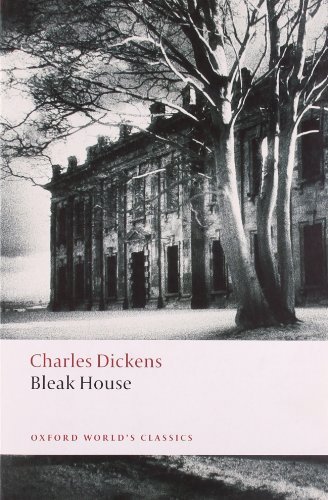
Bleak House follows the fortunes of three young people caught up in a long-running legal wrangle:
“Jarndyce and Jarndyce drones on. This scarecrow of a suit has, in course of time, become so complicated that no man alive knows what it means. The parties to it understand it least, but it has been observed that no two Chancery lawyers can talk about it for five minutes without coming to a total disagreement as to all the premises. Innumerable children have been born into the cause; innumerable young people have married into it; innumerable old people have died out of it.”
Esther Summerson, Ada Clare and Richard Carstone find themselves under the guardianship of John Jarndyce, a benevolent older distant relation of the latter two. Ada and Richard fall in love, but it is Esther rather than the young lovers who is the focus, her first-person narration alternating with that of an omniscient narrator.
She is from a mysterious background, not knowing who her parents are and raised by an abusive godmother. “Your mother, Esther, is your disgrace, and you were hers”. Esther is a Victorian heroine though, so rather than becoming defensive or angry, she decides she will:
“strive as I grew up to be industrious, contented, and kind-hearted and to do some good to some one, and win some love to myself if I could. I hope it is not self-indulgent to shed these tears as I think of it. I am very thankful, I am very cheerful, but I cannot quite help their coming to my eyes.”
Although tediously self-deprecating at times, generally I found Esther really likable. Her narrative is can be witty and some of her portraits of others almost sharp, so I did wonder if the reader wasn’t supposed to take her modest protestations entirely at face value, at least not consistently.
The omniscient narrator widens the tale to explain the various legal dealings of Chancery Lane and all its hangers-on, alongside the situation of the Dedlock family:
“there is no end to the Dedlocks, whose family greatness seems to consist in their never having done anything to distinguish themselves for seven hundred years.”
The current incumbent Sir Leicester Dedlock does little to change this history of his family as he “is generally in a complacent state, and rarely bored. When he has nothing else to do, he can always contemplate his own greatness. It is a considerable advantage to a man to have so inexhaustible a subject. After reading his letters, he leans back in his corner of the carriage and generally reviews his importance to society.”
He is devoted to his beautiful, fashionable, remote wife Honoria, who the reader quickly realises has A Big Secret in Her Past. Hmm, based on what we know of the other characters so far, what on earth could it be…?
It’s not hard to guess what it is as the clues are laid on pretty thickly, and I thought the imagery when Esther first sees Lady Dedlock was so striking:
“It was easy to know that the ceremonious, gouty, grey-haired gentleman, the only other occupant of the great pew, was Sir Leicester Dedlock, and that the lady was Lady Dedlock. But why her face should be, in a confused way, like a broken glass to me, in which I saw scraps of old remembrances, and why I should be so fluttered and troubled (for I was still) by having casually met her eyes, I could not think.”
Dickens weaves together the various strands of the story, the main plots and all the subplots with brilliant dexterity. Sometimes with these big Victorian baggy monsters (to steal a phrase from Henry James) the stories can flag a bit, as the authors are trying to keep them going for a number of episodes in the serial. I really didn’t feel this with Bleak House. The story kept driving forward and all the various plots came together so cleverly, contriving to make a well-paced page-turner.
What really struck me about Bleak House though, is that it is a story of great compassion. Of course I knew Dickens had a strong social conscience and his work has a social message to it. But Bleak House demonstrated a degree of understanding and sympathy that I wasn’t expecting. Unmarried mothers, those struggling with addictions, human weakness and vulnerability – none are judged. Those who are judged are the ones who seek to profit from such.
Which brings me on to Mr Tulkinghorn… I said at the beginning I’m not usually keen on Dickens’ villains, finding them too caricatured. The lawyer Tulkinghorn was medacious, conniving, cold as ice, completely believable and completely terrifying. Truly villainous.
Although there are romantic elements to Bleak House, it is not an overly romantic tale. It is a novel much more concerned with the fall-out on the vulnerable members of society from immovable and self-serving institutions. Perhaps the main way in which the novel has dated is an engagement that seemed highly questionable to me, but as it remains chaste and ultimately everyone comes to their senses, it didn’t overly offend my modern sensibilities 😀
If I’ve made Bleak House sound a heavy read though, I’ve done it a disservice. I found it very often funny, whether satirically critiquing the legal system or broader nonsense like Mrs Guppy trying to throw John Jarndyce out of his own home and resisting all attempts to explain the illogicality of such a move. It has its sad moments too, and is genuinely moving in places.
And just in case a Victorian novel may seem to have no relevance to our modern world, I leave you with this exchange between Esther and Miss Flite:
“I said it was not the custom in England to confer titles on men distinguished by peaceful services, however good and great, unless occasionally when they consisted of the accumulation of some very large amount of money.
“Why, good gracious,” said Miss Flite, “how can you say that? Surely you know, my dear, that all the greatest ornaments of England in knowledge, imagination, active humanity, and improvement of every sort are added to its nobility! Look round you, my dear, and consider. YOU must be rambling a little now, I think, if you don’t know that this is the great reason why titles will always last in the land!”
I am afraid she believed what she said, for there were moments when she was very mad indeed.”
This is an excessively long post and I’ve barely scratched the surface of Bleak House. But in summary: funny, sad, socially engaged, well-paced, emotionally affecting, entertaining, original. An absolute masterpiece.
To end, I remember watching the BBC adaptation of Bleak House when it came out and thinking it very well done. Now I’ve read the book I might go for a rewatch, as I don’t remember it that well and it does look entertaining (especially Charles Dance as Tulkinghorn):

 madame bibi lophile recommends